Call CA Tally HelpDesk
+91 9205471661,
7428779101
Why Furniture Businesses Need Smarter Financial Management in 2026
The furniture industry is evolving rapidly. From traditional furniture showrooms and wooden furniture manufacturers to modular kitchen suppliers, office furniture dealers and interior furnishing businesses, companies must manage increasing operational complexity while maintaining profitability.
A furniture business involves much more than purchasing products and selling them to customers. Business owners must monitor raw material costs, production expenses, warehouse inventory, customer advances, supplier payments, GST invoices and financial performance.
Even a small accounting mistake can affect profitability.
For example, a furniture manufacturer may receive a large order for customized office workstations but underestimate the cost of plywood, hardware, labour, transportation and installation.
Although the order generates substantial revenue, the actual profit may be considerably lower than expected.
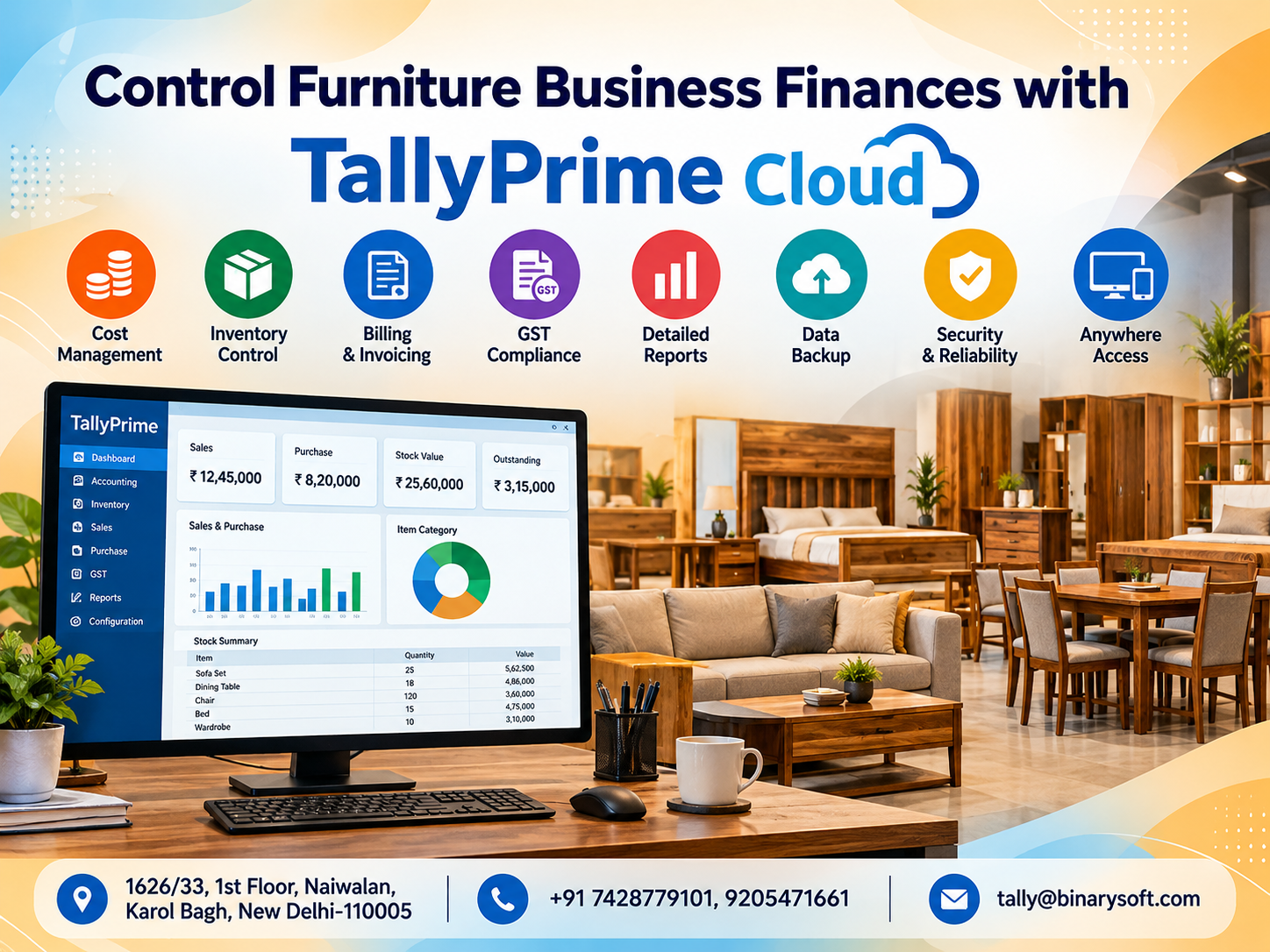
TallyPrime Cloud helps furniture businesses manage accounting, inventory, billing, financial reporting and remote access through a centralized accounting environment.
By combining TallyPrime's accounting capabilities with suitable cloud hosting, furniture businesses can improve financial visibility, reduce repetitive administrative work and support informed decisions.
Whether you operate a small furniture showroom or manage a manufacturing and distribution business, digital accounting can provide a stronger foundation for sustainable growth.
A Furniture Business Owner's Story: When Growing Sales Failed to Deliver Peace of Mind
For more than fifteen years, Amit operated a furniture manufacturing business in Delhi.
He started with a small workshop, three carpenters and a dream of building a successful furniture brand.
Over time, his business expanded.
He began supplying office desks, wooden wardrobes, modular furniture and customized interiors to residential and commercial customers.
His workshop became busier, orders increased and additional employees joined the company.
From the outside, everything appeared successful.
However, Amit faced a problem that customers could not see.
Despite increasing sales, his bank balance remained unpredictable.
Raw material purchases were recorded in notebooks, customer advances were tracked through spreadsheets and production expenses were calculated manually.
One month, Amit completed a large corporate furniture order.
He expected a substantial profit.
But when his accountant calculated the final expenses, the result was disappointing.
Additional hardware purchases, transportation charges, labour overtime and installation expenses had consumed most of the expected margin.
Amit felt helpless.
He remembered the years he had spent building the business and wondered why growing sales were not translating into financial security.
His wife noticed that he was spending evenings checking bills instead of spending time with their children.
That moment convinced Amit that his business needed a more organized financial system.
He introduced TallyPrime with cloud hosting.
His team began recording purchases, sales, inventory movements, customer payments and expenses in a structured accounting environment.
Over time, Amit gained better visibility into outstanding payments, stock balances and operating costs.
He could review business reports while visiting customers or traveling, subject to secure remote access.
The biggest improvement was not simply faster accounting.
It was the confidence that came from understanding his business finances.
Amit discovered that financial control is not about how much a business sells. It is about knowing what the business earns, spends, owns and owes.
This story is illustrative and represents common financial challenges experienced by furniture businesses.
1. Understanding the Financial Challenges of Furniture Businesses
Furniture businesses face several financial and operational challenges that differ from those of ordinary retail establishments.
Fluctuating Raw Material Costs
Prices of plywood, timber, laminates, glass, metal fittings, adhesives and upholstery materials can change frequently.
These fluctuations directly affect production costs.
Customized Manufacturing Orders
Furniture manufacturers often receive orders with different sizes, designs, materials and installation requirements.
Calculating profitability for each order can become difficult without proper cost tracking.
Inventory Complexity
Furniture businesses may maintain raw materials, semi-finished products, finished furniture and accessories.
Tracking these categories manually increases the risk of inventory discrepancies.
Customer Advances and Outstanding Payments
Customized furniture orders frequently involve advance payments, milestone payments and final settlements.
Businesses must monitor these transactions carefully.
Multiple Business Locations
Furniture companies may operate showrooms, manufacturing workshops and warehouses at different locations.
Coordinating accounting information across these locations can become challenging.
TallyPrime helps address these requirements through integrated accounting and inventory features, while cloud hosting can provide additional flexibility.
2. Furniture Cost Management with TallyPrime
Accurate cost management is essential for maintaining profitability in furniture manufacturing and trading.
A furniture business must understand the actual cost of producing or purchasing each product.
Raw Material Cost Tracking
Furniture manufacturers can create inventory records for materials such as:
-
Plywood and MDF boards
-
Solid wood and timber
-
Laminates and veneers
-
Hinges, handles and fittings
-
Glass and metal components
-
Foam, fabric and upholstery
-
Adhesives and finishing materials
Recording purchases against relevant stock items helps maintain inventory values and material consumption records.
Labour and Production Expenses
Furniture production involves cutting, polishing, assembling, finishing and installation.
Businesses can record relevant labour and production expenses under appropriate accounting ledgers.
Cost centres and suitable inventory configurations can support internal cost analysis.
Order-Wise Cost Monitoring
Businesses can use cost centres, job-related references and appropriate accounting procedures to organize expenses for individual projects.
For example, a customized modular kitchen project may involve:
Raw materials: ₹1,20,000
Labour: ₹45,000
Hardware and accessories: ₹30,000
Transportation and installation: ₹15,000
Total Project Cost: ₹2,10,000
If the selling price is ₹2,75,000 before applicable taxes, the estimated gross contribution is ₹65,000 before any additional overheads.
This type of analysis helps businesses evaluate pricing decisions.
TallyPrime supports recording and reviewing the underlying transactions, although detailed project costing may require careful configuration or supplementary processes.
3. Furniture Inventory Management: Control Raw Materials and Finished Goods
Inventory represents a significant investment for furniture businesses.
Excess inventory increases storage costs, while insufficient inventory can delay customer deliveries.
TallyPrime provides inventory management features that help businesses monitor recorded stock quantities and values.
Stock Group Management
Businesses can organize inventory into categories such as:
Raw Materials: Wood, plywood, laminates, hardware and upholstery materials.
Semi-Finished Goods: Partially assembled furniture components.
Finished Goods: Beds, wardrobes, dining tables, sofas and office furniture.
Accessories: Handles, hinges, fittings and decorative items.
Stock Item Creation
Each product can be maintained with relevant details, including units of measurement and stock classification.
Inventory Movement Tracking
Purchase, sales and appropriate stock vouchers update inventory records.
Multiple Godown Management
Furniture businesses operating workshops, showrooms and warehouses can configure location-wise stock records.
Stock Valuation
Inventory valuation reports help businesses understand the financial value of recorded stock.
Reorder Planning
Reorder levels can help identify materials requiring replenishment.
Important: Accurate inventory visibility depends on timely transaction entry, appropriate configuration and regular physical stock verification.
4. Simplify Furniture Billing and Customer Invoicing
Furniture businesses handle different billing situations, including retail sales, wholesale orders, customized furniture projects and installation services.
TallyPrime helps businesses create organized invoices and maintain corresponding accounting records.
Retail Furniture Billing
Showrooms can generate invoices for furniture products sold to individual customers.
Wholesale Furniture Billing
Furniture distributors can maintain customer-wise sales transactions and outstanding balances.
Customized Furniture Orders
Businesses can record customer orders and advances using suitable transaction workflows.
GST Invoice Preparation
Invoices can include applicable GST details based on the business's configuration and statutory requirements.
Customer Ledger Management
Customer-wise accounting records help businesses review payments, outstanding invoices and transaction histories.
Integrated billing reduces the need to maintain separate sales and accounting registers.
5. GST Management for Furniture Manufacturers and Dealers
GST compliance is an important responsibility for furniture businesses operating in India.
Furniture products, materials and related services may have different classifications and tax treatments.
TallyPrime supports GST accounting through configurable statutory features.
GST-Ready Invoicing
Businesses can create invoices containing GSTIN, taxable value, applicable tax rates and tax amounts.
Purchase GST Recording
Supplier invoices can be recorded with relevant GST details.
GST Reporting
Businesses can review GST-related transaction information for return preparation.
Input Tax Credit Review
Supported GST reconciliation features can help businesses review purchase information and relevant portal data.
GST Classification
Correct HSN or SAC classification is essential for applying appropriate tax treatment.
Furniture businesses should verify current tax rates, classifications and eligibility conditions rather than assuming one GST rate applies to every product or service.
6. Case Study One: Furniture Manufacturer Improves Production Cost Visibility
Business Background
A furniture manufacturer in Delhi produced modular wardrobes, office workstations and customized wooden furniture.
The business employed carpenters, polishers, machine operators and installation workers.
Challenges
The company struggled to calculate production costs accurately.
Raw material purchases were recorded separately from labour expenses.
Management frequently underestimated installation and transportation costs.
As a result, some large orders generated lower profits than expected.
TallyPrime Implementation
The company introduced TallyPrime with structured inventory and accounting records.
Raw materials were organized into stock groups.
Purchase transactions were recorded against relevant inventory items.
Production-related expenses were classified under appropriate ledgers and cost centres.
Management began reviewing monthly expense reports and project-related financial information.
Business Improvements
The company gained clearer visibility into material purchases and operating expenses.
Managers could review recorded costs before preparing quotations for similar projects.
Inventory monitoring also improved purchasing decisions.
Key Learning
Furniture manufacturers can improve pricing discipline when material consumption, production expenses and financial records are maintained systematically.
This is an illustrative case study, not an independently verified customer implementation.
7. Case Study Two: Furniture Retail Chain Gains Better Financial Control
Business Background
A furniture retailer operated three showrooms and a central warehouse.
The company sold sofas, beds, dining tables, wardrobes and office furniture.
Challenges
Each showroom maintained separate sales records.
Warehouse employees tracked stock manually.
The business experienced delays in reconciling showroom sales, customer payments and inventory transfers.
Management also found it difficult to review consolidated financial performance.
TallyPrime Cloud Implementation
The retailer adopted a centralized TallyPrime environment hosted on suitable cloud infrastructure.
Authorized employees accessed accounting information according to assigned permissions.
The company configured stock locations for its warehouse and showrooms.
Sales, purchases and inventory transfers were recorded through appropriate transactions.
Business Improvements
Management gained more organized visibility into sales and inventory information.
The company reduced dependence on separately maintained spreadsheets.
Financial reports became easier to review because transactions were recorded within a structured accounting environment.
Key Learning
Centralized accounting can help multi-location furniture businesses improve coordination and financial visibility.
This illustrative case study demonstrates a possible implementation approach.
8. Advanced Financial Reporting for Furniture Businesses
Financial reporting helps furniture business owners understand profitability, liquidity and operational performance.
TallyPrime provides reports that support regular financial reviews.
Profit and Loss Statement
Businesses can evaluate income, expenses and profitability over selected periods.
Balance Sheet
The Balance Sheet provides information about assets, liabilities and capital.
Cash Flow Statement
Cash flow reporting helps management understand cash movements and financial liquidity.
Outstanding Receivables
Furniture businesses can monitor unpaid customer invoices and overdue balances.
Outstanding Payables
Supplier outstanding reports help businesses plan payments for raw materials and other purchases.
Inventory Reports
Stock summaries help management review recorded inventory quantities and values.
Cost Centre Reports
Where configured, cost centre reports can support analysis of expenses associated with departments, projects or other business activities.
Regular financial reporting helps business owners identify problems before they become serious.
9. TallyPrime Cloud: Manage Your Furniture Business from Anywhere
Furniture business owners frequently travel between workshops, showrooms, warehouses and customer locations.
Traditional office-based accounting systems can restrict access to important information.
TallyPrime Cloud offers an alternative through cloud-hosted accounting environments.
Remote Accounting Access
Authorized users can access the hosted TallyPrime environment from supported locations with suitable connectivity.
Centralized Business Information
Businesses can maintain accounting information in a centrally managed environment.
Collaboration Between Teams
Accountants, managers and authorized employees can work according to licensing arrangements and user permissions.
Business Continuity
Suitable hosting, backup and recovery arrangements can help reduce dependence on a single office computer.
Operational Flexibility
Business owners can review financial information without always being physically present in the accounting office.
Cloud access should be configured carefully to protect business data and maintain system reliability.
10. Data Backup and Business Continuity
Furniture businesses maintain valuable financial records, including customer invoices, supplier transactions, stock information and accounting reports.
Data loss can disrupt operations and create significant financial difficulties.
A properly managed TallyPrime Cloud environment can support structured backup arrangements.
Scheduled Backups
Hosting providers may offer scheduled backups according to the selected service plan.
Data Recovery
Documented recovery procedures help businesses restore information when supported backup copies are available.
Reduced Local Hardware Dependence
Cloud hosting can reduce reliance on a single office computer for accessing accounting data.
Backup Verification
Businesses should periodically confirm that backups are being created successfully and can be restored.
Disaster Recovery Planning
A suitable recovery plan should define backup frequency, retention periods, recovery responsibilities and acceptable downtime.
Cloud hosting does not automatically guarantee complete protection against data loss. Businesses should verify backup policies and recovery commitments before choosing a hosting provider.
11. Security Features for Furniture Business Accounting
Financial information is among the most sensitive assets of any business.
Furniture companies must protect customer records, supplier information, pricing details and financial transactions.
TallyPrime supports user-level security controls, while hosting environments may provide additional infrastructure protections.
User Access Permissions
Businesses can assign appropriate permissions to employees based on their responsibilities.
Password Protection
Secure authentication helps restrict unauthorized access.
Controlled Financial Information
Sensitive accounting reports should be accessible only to authorized users.
Secure Remote Connectivity
Cloud hosting should use appropriate encrypted connections and access controls.
Regular Security Reviews
Businesses should review user permissions, backup arrangements and hosting security procedures periodically.
Security depends on the combined effectiveness of software configuration, hosting infrastructure and employee practices.
12. Managing Customer Advances and Outstanding Payments
Customized furniture orders frequently require advance payments.
For example, a customer may pay 40% when placing an order, 40% during production and the remaining 20% after delivery.
Businesses must record these payments accurately.
TallyPrime allows businesses to maintain customer ledgers and record receipts against appropriate references.
Outstanding reports help identify unpaid balances.
Proper accounting procedures also help distinguish customer advances from recognized sales revenue.
This is important because advance payments and completed sales may have different accounting and GST implications.
Businesses should configure transaction workflows according to applicable requirements and obtain professional advice where necessary.
13. Better Purchasing Decisions Through Inventory and Financial Reports
Furniture businesses purchase materials based on expected production requirements and customer demand.
Poor purchasing decisions can create unnecessary financial pressure.
Buying excessive plywood or upholstery materials may increase storage costs.
Purchasing insufficient materials may delay production.
TallyPrime inventory reports help businesses review available stock and recorded material movements.
Management can use this information alongside confirmed orders, supplier lead times and production schedules.
For example, if a furniture manufacturer identifies declining stock of a frequently used laminate, it can review upcoming requirements before placing another purchase order.
This supports more disciplined purchasing and reduces avoidable operational surprises.
14. Step-by-Step Guide to Using TallyPrime for Furniture Business Accounting
Step 1: Create Your Furniture Business Company
Enter company details, financial year information and relevant statutory registration details.
Step 2: Configure Accounting Ledgers
Create ledgers for customers, suppliers, banks, raw material purchases, sales, labour and operating expenses.
Step 3: Create Inventory Masters
Organize raw materials, semi-finished products and finished furniture into appropriate stock groups.
Step 4: Configure Warehouses
Create godowns for workshops, showrooms and storage facilities where required.
Step 5: Enable GST Features
Configure GST registration information and applicable tax classifications.
Step 6: Record Purchases
Enter purchases of plywood, timber, fittings, fabric and other materials.
Step 7: Record Manufacturing Transactions
Use suitable manufacturing or stock vouchers to record material consumption and finished goods production.
Step 8: Generate Sales Invoices
Create invoices for furniture products and applicable services.
Step 9: Monitor Customer Payments
Record advances, receipts and outstanding balances using appropriate accounting references.
Step 10: Review Financial Reports
Examine profitability, expenses, stock valuation and cash flow regularly.
Step 11: Configure Cloud Access
Choose a suitable hosting arrangement and establish secure access for authorized users.
Step 12: Maintain Backups and Controls
Verify backup procedures, review permissions and conduct periodic reconciliations.
15. Why TallyPrime Cloud Is Useful for Growing Furniture Businesses
As furniture companies expand, their accounting requirements become more complex.
A business operating one showroom may eventually establish multiple branches, manufacturing facilities and warehouses.
Managing financial information through disconnected systems can become increasingly difficult.
TallyPrime Cloud can support growth by providing a centralized accounting environment with remote accessibility.
Businesses can maintain organized transaction records, monitor inventory and review financial performance.
Management can also establish standardized accounting procedures across locations.
However, cloud deployment should be planned according to transaction volume, concurrent user requirements, licensing, internet connectivity and security needs.
A properly designed implementation can support business expansion without unnecessary accounting fragmentation.
16. Common Accounting Mistakes Furniture Businesses Should Avoid
Furniture businesses should avoid several common mistakes when implementing accounting software.
Incorrect Opening Stock: Inaccurate opening quantities can affect inventory valuation and subsequent reports.
Unrecorded Material Consumption: Failure to record production-related stock movements can create differences between physical and recorded inventory.
Mixing Customer Advances with Sales: Incorrect accounting treatment may distort financial reports.
Ignoring Installation Expenses: Transportation and installation costs can significantly affect project profitability.
Delayed Transaction Entry: Late accounting updates reduce the reliability of financial information.
Weak Backup Practices: Unverified backups can create serious recovery risks.
Excessive User Permissions: Unrestricted access increases the risk of unauthorized changes.
Regular reviews, employee training and appropriate internal controls help businesses avoid these problems.
17. The Future of Furniture Business Management in 2026 and Beyond
Furniture businesses are increasingly expected to deliver customized products, competitive prices and reliable delivery schedules.
Meeting these expectations requires better coordination between sales, purchasing, manufacturing, inventory and accounting.
Digital accounting provides an important foundation for this coordination.
TallyPrime helps businesses organize financial and inventory transactions, while cloud hosting can make accounting information more accessible to authorized teams.
Businesses can use financial reports to evaluate profitability, monitor expenses and improve working capital decisions.
Inventory records can support purchasing and production planning.
Customer outstanding reports can help improve payment follow-up.
The long-term objective is to establish reliable business processes that support sustainable growth.
A successful furniture business does not simply manufacture beautiful products. It also builds strong financial systems behind every product it delivers.
Conclusion: Take Better Control of Your Furniture Business with TallyPrime Cloud
Furniture businesses face unique financial challenges involving raw material purchases, manufacturing costs, inventory movements, customer advances, GST compliance and financial reporting.
Managing these activities through disconnected spreadsheets and manual records can increase operational complexity.
TallyPrime helps businesses maintain integrated accounting and inventory records, generate financial reports and improve financial visibility.
Cloud hosting can add the flexibility of remote access, centralized working environments and professionally managed infrastructure, depending on the selected service.
For furniture manufacturers, retailers, wholesalers and interior furnishing businesses, the combination can provide a practical foundation for stronger financial control.
Successful implementation requires accurate data, appropriate configuration, employee training, secure access and reliable backup procedures.
With TallyPrime Cloud, furniture business owners can spend less time searching for financial information and more time building products, serving customers and growing their businesses.
Powered by Binarysoft Technologies
Authorized Tally Partner
Binarysoft Technologies helps furniture manufacturers, retailers, wholesalers and other businesses implement TallyPrime for accounting, inventory management, GST-related processes, financial reporting and cloud-based access.
Our services include TallyPrime implementation, accounting configuration, inventory setup, employee training, technical support and assistance with Tally on Cloud solutions.
Location: 1626/33, 1st Floor, Naiwalan, Karol Bagh, New Delhi – 110005, INDIA
Contact Us: +91 7428779101, 9205471661
Email Us: tally@binarysoft.com
Business Hours: 10:00 AM – 6:00 PM, Monday to Friday
Frequently Asked Questions
What is TallyPrime Cloud for furniture businesses?
TallyPrime Cloud refers to using TallyPrime in a suitable cloud-hosted environment. It allows authorized users to access accounting and inventory information remotely, subject to licensing, connectivity and security configuration.
Can TallyPrime manage furniture manufacturing costs?
Yes. TallyPrime supports accounting and inventory features that can help businesses record raw material consumption, labour expenses and production-related costs. Detailed project costing may require appropriate configuration.
Is TallyPrime suitable for furniture showrooms?
Yes. Furniture showrooms can use TallyPrime for billing, sales accounting, stock records, GST transactions and customer outstanding management.
Can TallyPrime track furniture inventory across multiple warehouses?
Yes. Businesses can configure godowns or stock locations to maintain location-wise inventory records.
CA. Aaryan Kanodia focuses on GST reporting, bookkeeping systems, and financial process improvement. He works with businesses to simplify routine accounting activities and maintain records suitable for compliance and internal review.