Call CA Tally HelpDesk
+91 9205471661,
7428779101
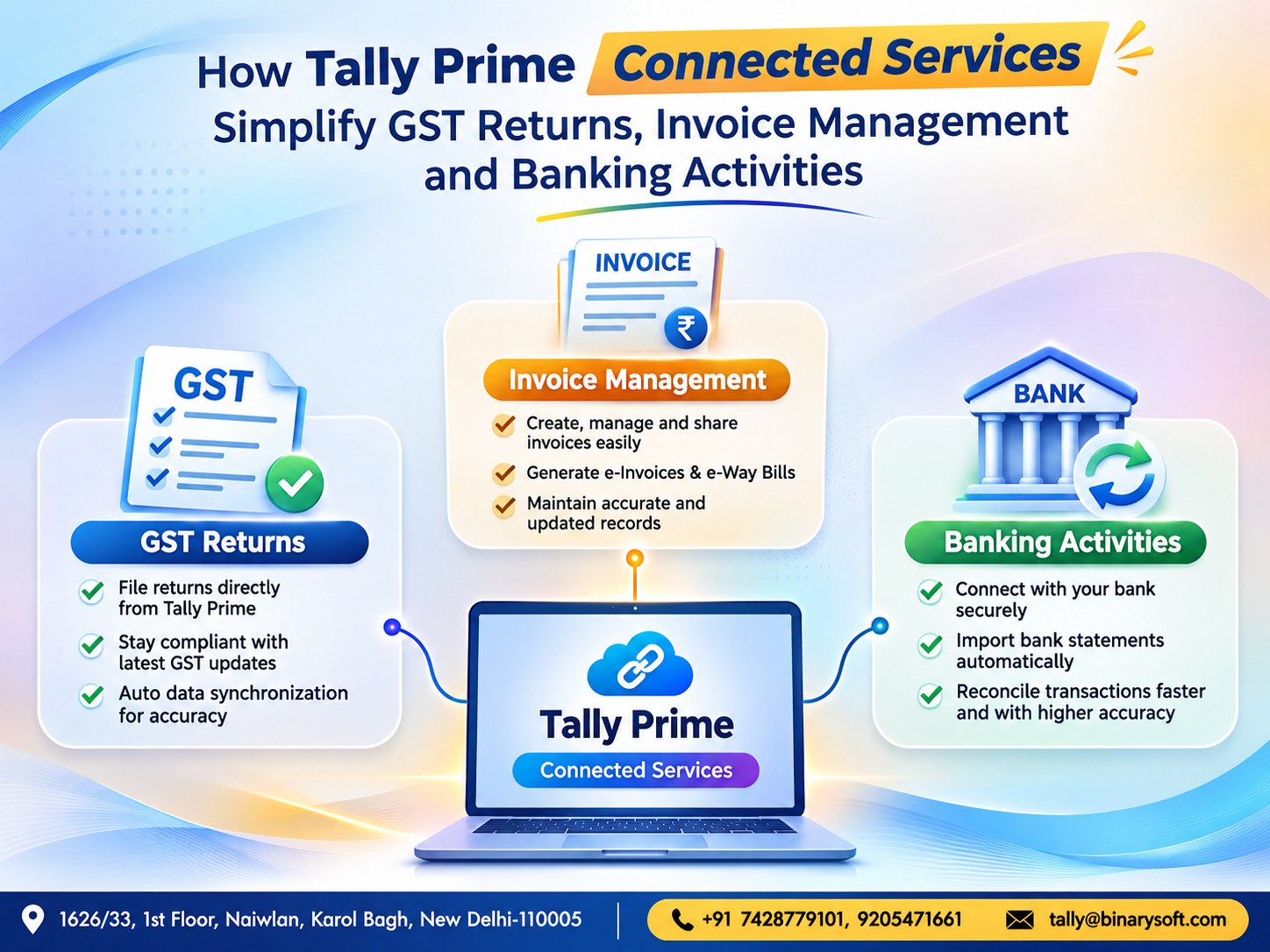
A Complete Guide to Smarter GST Compliance, Digital Invoicing, Bank Reconciliation and Connected Business Accounting
Managing GST returns, customer invoices, supplier payments and banking transactions has become increasingly complex for Indian businesses. Whether you operate a wholesale trading company, manufacturing unit, retail store, consultancy firm or service-based enterprise, maintaining accurate financial records while meeting compliance deadlines is essential.
Traditional accounting processes often involve switching between accounting software, GST portals, banking websites, spreadsheets and email communications. This creates unnecessary duplication, increases the possibility of errors and consumes valuable working hours.
Tally Prime Connected Services help businesses simplify these activities by connecting everyday accounting operations with digital compliance, invoice exchange and banking workflows.
Instead of treating GST filing, invoicing and banking as separate responsibilities, businesses can manage them through a more integrated accounting environment.
This article explains how Tally Prime Connected Services improve financial accuracy, simplify GST compliance, support digital invoice management and streamline banking activities. It also explores practical applications, implementation steps, real-world business scenarios and the benefits of adopting connected accounting.
1. What Are Tally Prime Connected Services?
Tally Prime Connected Services are digital capabilities that help businesses connect accounting information with external services and business processes.
These capabilities reduce repetitive manual work and make financial information easier to access, verify and manage.
Connected services can support several important activities:
-
GST return preparation and connected filing workflows.
-
GST reconciliation and transaction verification.
-
E-invoice generation for eligible businesses.
-
E-way bill generation and management.
-
Digital invoice sharing with customers.
-
Banking transaction import and reconciliation.
-
Payment tracking and outstanding management.
-
Remote access to authorized business reports.
The availability of individual features depends on the Tally Prime release, active subscriptions, service activation and applicable regulatory requirements.
Why Connected Accounting Matters
Consider a business processing 500 sales invoices, 300 purchase invoices and hundreds of banking transactions every month.
Without integrated workflows, employees may need to enter the same information repeatedly across different systems.
A connected accounting environment helps reduce this duplication.
For example, when a sales invoice is recorded correctly in Tally Prime, the same transaction information can support GST reporting, customer outstanding calculations, inventory updates and applicable digital compliance activities.
This creates a more reliable financial information system.
2. How Tally Prime Simplifies GST Return Management
GST compliance is one of the most important responsibilities for businesses operating in India.
Errors in GST returns can lead to reconciliation differences, delayed input tax credit, compliance notices and unnecessary financial pressure.
Tally Prime helps businesses maintain organized GST records and prepare return information using accounting transactions already recorded in the system.
Accurate GST Recording
Every taxable transaction must contain appropriate information, including:
-
GSTIN of the supplier or customer, where applicable.
-
Invoice number and date.
-
Taxable value.
-
Applicable GST rate.
-
CGST, SGST, IGST or cess details.
-
HSN or SAC classification.
-
Place of supply.
-
Applicable transaction category.
Tally Prime allows businesses to configure GST-related details in company settings, ledgers, stock items and transactions.
Correct configuration helps reduce tax calculation errors and improves return preparation.
GSTR-1 Preparation
GSTR-1 contains details of outward supplies made by registered taxpayers.
Tally Prime helps organize sales transactions and identify information required for GSTR-1 reporting.
Businesses can review taxable sales, credit notes, debit notes and other relevant transactions before preparing return data.
In supported connected workflows, businesses can upload or file applicable return information through the software after completing the required validations and authentication.
This reduces dependence on manually preparing large spreadsheets.
GSTR-3B Preparation
GSTR-3B is a summary return containing details of tax liability, eligible input tax credit and tax payments.
Tally Prime helps businesses review the accounting information needed to calculate these figures.
Businesses can examine outward tax liability, input tax credit records and relevant adjustments.
However, accounting calculations should always be reviewed against applicable GST rules and portal information before submission.
GST Reconciliation
One of the most useful connected accounting activities is reconciling purchase records with GST information available through the government system.
For example, a supplier may issue an invoice worth ₹1,00,000 plus GST, but the corresponding information may not appear in the recipient's GSTR-2B.
Without reconciliation, the business may incorrectly assume that the input tax credit is available.
Tally Prime's supported GST reconciliation features help identify differences between accounting records and GST information.
Businesses can investigate missing invoices, incorrect GSTINs, tax differences and duplicate entries.
Business benefit: Better reconciliation reduces avoidable compliance errors and supports more accurate input tax credit decisions.
3. Connected GST Services Reduce Manual Compliance Work
Traditional GST compliance frequently requires accountants to export reports, prepare spreadsheets, upload information and manually correct rejected transactions.
Connected GST workflows can simplify several stages of this process.
Step 1: Record Transactions
Enter sales, purchases, expenses, credit notes and debit notes in Tally Prime.
Step 2: Validate GST Information
Review missing GSTINs, incorrect classifications, tax calculation differences and other exceptions.
Step 3: Reconcile Purchase Records
Compare purchase information with available GST data and investigate discrepancies.
Step 4: Prepare Return Information
Generate relevant GST reports and verify taxable values, liabilities and eligible credits.
Step 5: Complete Filing
Use supported connected filing functionality or the prescribed GST portal process to submit applicable returns.
Step 6: Preserve Records
Maintain accounting reports, filing acknowledgements and supporting documents for future verification.
This structured approach improves compliance discipline while reducing unnecessary manual activity.
4. Simplifying Invoice Management with Tally Prime
Invoice management directly affects customer satisfaction, payment collection, GST compliance and business profitability.
An incorrect invoice can delay customer payments, create accounting differences and generate additional work for the finance team.
Tally Prime provides integrated sales invoicing capabilities that connect billing with accounting and inventory management.
Faster Invoice Creation
Businesses can create invoices using predefined customer ledgers, stock items, tax classifications and pricing information.
For example, a wholesale distributor selling 50 different products can select inventory items, quantities and applicable rates without repeatedly entering product descriptions.
The system calculates invoice values and configured taxes based on the transaction details.
Automatic Accounting Updates
When a sales invoice is recorded, the related accounting entries and inventory movements are reflected in the appropriate records.
This helps businesses maintain consistency between billing, customer balances and stock reports.
GST-Compliant Invoicing
Tally Prime supports GST invoice preparation with relevant tax details.
Businesses can configure invoice formats and maintain the information required for applicable tax documentation.
Digital Invoice Sharing
Businesses can generate invoice documents and share them electronically with customers through supported communication or document-sharing methods.
Digital invoice sharing reduces printing costs and helps customers receive billing information more quickly.
It also makes it easier to preserve invoice copies for future reference.
5. E-Invoicing and E-Way Bill Management
For businesses covered by applicable government requirements, e-invoicing and e-way bill compliance are essential parts of daily operations.
E-Invoice Generation
E-invoicing involves reporting specified invoice information to the authorized Invoice Registration Portal.
For eligible transactions, the portal generates an Invoice Reference Number and a digitally signed QR code.
Tally Prime supports e-invoice workflows that help eligible businesses prepare and report invoice information through supported connected services.
This can reduce the need to re-enter invoice details into a separate system.
Businesses should verify their e-invoicing applicability under current GST notifications.
E-Way Bill Generation
An e-way bill may be required for movement of goods when applicable legal conditions are met.
Tally Prime supports e-way bill-related workflows for eligible transactions.
Businesses can use invoice information to prepare relevant transportation details and generate e-way bills through supported facilities.
Benefits for Businesses
Integrated e-invoicing and e-way bill processes can help reduce:
-
Duplicate data entry.
-
Invoice reporting mistakes.
-
Delays in dispatch documentation.
-
Manual compliance preparation.
-
Differences between invoices and related accounting records.
These improvements are especially valuable for manufacturers, distributors, transport-linked businesses and wholesale traders handling frequent goods movements.
6. How Tally Prime Simplifies Banking Activities
Banking is another area where connected accounting can significantly improve operational efficiency.
Businesses regularly handle customer receipts, supplier payments, salary transfers, bank charges, interest and other financial transactions.
When bank records are not updated regularly, management may have an inaccurate understanding of available funds.
Tally Prime helps businesses maintain banking information and reconcile transactions against accounting records.
Bank Statement Import
Supported bank statement import features allow businesses to bring transaction information into Tally Prime.
This reduces the need to manually type every bank entry.
Depending on the bank, statement format and available features, imported transactions can be reviewed and matched with accounting records.
Bank Reconciliation
Bank reconciliation compares transactions recorded in company books with transactions appearing in the bank statement.
For example, a business may record a customer payment of ₹75,000, but the bank statement may show a different amount because of deductions or transaction differences.
Reconciliation helps identify such issues.
Tally Prime provides tools to review cleared and uncleared transactions and identify differences requiring attention.
Payment Management
Businesses can maintain supplier payment vouchers and relevant banking details.
Supported payment workflows may also provide facilities for preparing payment instructions or exchanging payment information with participating banks.
The precise functionality depends on the bank integration and software configuration.
Better Cash Flow Visibility
Regularly updated banking records help businesses understand:
-
Available bank balances.
-
Pending customer receipts.
-
Outstanding supplier payments.
-
Uncleared transactions.
-
Upcoming financial obligations.
-
Short-term cash requirements.
This information supports more informed financial decisions.
7. Connected Banking and Faster Customer Collections
One of the biggest challenges for small and medium businesses is collecting payments on time.
Delayed customer payments affect working capital, supplier relationships and business expansion plans.
Tally Prime helps businesses monitor outstanding invoices and improve payment collection.
Customer Outstanding Reports
Businesses can generate customer-wise outstanding reports showing unpaid invoices and pending amounts.
These reports help identify customers who have exceeded their payment terms.
Payment Links and UPI QR Codes
Supported digital payment features allow businesses to generate payment requests using payment links or UPI QR codes.
Customers can use these facilities to make payments through available payment methods.
This can simplify collections and reduce communication delays.
Integrated Banking
Supported connected banking facilities provide access to banking information, payment processing and transaction reconciliation.
For example, compatible integrations with participating banks can help businesses retrieve bank information and manage supported payment activities without repeatedly switching between separate applications.
Businesses should verify supported banks, authorization requirements and transaction limits before activating these facilities.
8. A Story of Transformation: When Accounting Pressure Became Peace of Mind
Every business owner dreams of growth, financial stability and a better future for their family.
But behind successful businesses are often stories of sleepless nights, financial pressure and difficult decisions.
Consider the fictional story of Rajesh, a wholesale electrical goods distributor operating in Delhi.
Rajesh started his business with a small shop and limited savings.
After fifteen years of hard work, his business had grown considerably. He employed twelve people, supplied products to retailers across Delhi-NCR and managed hundreds of invoices every month.
However, his accounting processes had not kept pace with the business.
His accountant maintained separate spreadsheets for GST reconciliation. Bank statements were downloaded manually, and customer payments were often updated several days after receipt.
During one particularly difficult month, Rajesh discovered that several supplier invoices had not been reconciled properly.
At the same time, customer payments were delayed, and his accountant was struggling to complete GST-related work.
One evening, his daughter asked why he had missed another family dinner.
Rajesh had no answer.
He realized that although his business was growing, the pressure of managing it was taking away the time he wanted to spend with his family.
The Decision to Change
Rajesh decided to improve his accounting processes using Tally Prime Connected Services.
His team began recording invoices consistently, reviewing GST reports regularly and reconciling bank transactions more frequently.
They also introduced digital invoice sharing and systematic customer outstanding reviews.
Over the following months, routine accounting activities became more organized.
Rajesh could review financial reports without waiting for multiple spreadsheets to be prepared.
His accountant spent less time searching for missing entries and more time checking transaction accuracy.
Most importantly, Rajesh felt more confident about his financial information.
One evening, he closed his office on time and returned home for dinner.
His daughter smiled and said, "Papa, today you came early."
For Rajesh, that moment represented something more valuable than a financial report.
Technology had not simply improved his accounting. It had helped him regain control over his time.
This fictional story reflects a common challenge faced by growing Indian businesses: operational success should not require constant personal sacrifice.
9. Case Study 1: Wholesale Trading Business in Delhi
Business: Electrical and hardware distribution company
Location: Delhi-NCR
Business Type: Wholesale trading
Monthly Sales Invoices: Approximately 800
Illustrative case study based on a typical wholesale accounting scenario.
Business Challenges
The company handled frequent sales transactions, supplier purchases and customer collections.
Its major problems included delayed GST reconciliation, manual bank statement checking, duplicate invoice information and difficulty identifying overdue customer payments.
The accounts department frequently worked additional hours near GST return deadlines.
Implementation of Tally Prime
The company introduced a structured accounting workflow using Tally Prime.
Sales and purchase transactions were recorded with appropriate GST classifications.
The accounting team used GST reports to review transaction exceptions and reconcile available purchase information.
Bank statements were imported regularly for reconciliation.
Customer outstanding reports were reviewed weekly, and digital invoices were shared promptly.
Illustrative Results
After establishing consistent procedures, the company estimated the following improvements:
| Business Activity | Before Improvement | After Improvement |
|---|
| Monthly bank reconciliation |
10 hours |
4 hours |
| GST preparation and review |
16 hours |
8 hours |
| Customer outstanding review |
5 hours |
2 hours |
| Invoice-related corrections |
Frequent |
Reduced |
| Financial reporting |
Delayed |
More timely |
These figures are illustrative and are not independently verified performance results.
Business Impact
The company gained better visibility into customer receivables, bank transactions and GST records.
Employees could focus more attention on resolving exceptions instead of repeatedly entering information.
Management also received financial reports more consistently.
Key learning: Connected accounting delivers the greatest benefit when supported by accurate data entry and regular reconciliation.
10. Case Study 2: Manufacturing Company Improves GST and Banking Control
Business: Industrial components manufacturer
Location: Faridabad, Haryana
Business Type: Manufacturing and B2B supply
Monthly Purchase Transactions: Approximately 450
Illustrative case study demonstrating a connected accounting implementation.
Business Challenges
The manufacturer purchased raw materials from multiple suppliers and sold finished goods to business customers.
Its finance department faced challenges involving purchase invoice verification, GST input tax credit reconciliation, e-invoice processing and supplier payments.
Different employees handled accounting, banking and compliance activities.
This sometimes created differences between financial records.
Tally Prime Implementation
The manufacturer configured GST information for relevant suppliers, customers and inventory items.
Its accounts team introduced a monthly GST reconciliation process.
Eligible invoices were processed using supported e-invoicing functionality.
Supplier payments were recorded systematically, and bank transactions were reconciled against accounting records.
Management also began reviewing cash flow and outstanding reports more frequently.
Illustrative Results
The company experienced a more organized month-end closing process.
Invoice-related discrepancies were identified earlier, supplier payment records became easier to verify, and the finance team gained improved visibility into outstanding obligations.
In an illustrative comparison, monthly reconciliation effort decreased from approximately 20 hours to 9 hours after process improvements.
Actual results will depend on transaction volumes, data quality, software configuration and employee training.
Business Impact
The company improved coordination between purchasing, accounts and finance teams.
Its management could make payment decisions using more current financial information.
Key learning: Combining GST compliance, invoicing and banking processes helps businesses improve financial control across departments.
11. How to Start Using Tally Prime Connected Services
Businesses planning to adopt connected accounting should follow a systematic implementation process.
Step 1: Review the Existing Accounting System
Identify activities that currently require manual work.
These may include GST reconciliation, invoice preparation, bank statement entry and customer payment tracking.
Step 2: Verify Software and Subscription Requirements
Ensure that the installed Tally Prime release supports the required connected services.
Check the applicable subscription, connectivity, authentication and service activation requirements.
Step 3: Configure GST Information
Update company GST registrations, customer and supplier details, tax classifications and relevant transaction settings.
Step 4: Organize Invoice Management
Create standardized invoice formats and establish consistent procedures for recording sales and purchases.
Step 5: Configure Banking
Create appropriate bank ledgers and activate supported statement import or connected banking features.
Step 6: Train Employees
Train accounting personnel to review GST exceptions, reconcile bank transactions, verify invoices and maintain accurate financial records.
Step 7: Introduce Regular Reviews
Establish daily, weekly and monthly accounting review procedures.
Automation works best when employees regularly monitor exceptions and verify financial information.
12. Important Security Practices for Connected Accounting
Connected accounting provides convenience, but businesses must also protect financial information.
Recommended security practices include using strong passwords, assigning appropriate user permissions and restricting access to sensitive accounting activities.
Businesses should also maintain secure backups, review transaction changes and protect authentication credentials.
Banking and GST portal credentials should only be used through authorized processes.
Employees should never share passwords or verification codes through unsecured communication channels.
Where available, use additional authentication controls and maintain appropriate approval procedures for financial transactions.
13. Why Tally Prime Connected Services Are Valuable for Indian Businesses
The advantages of connected accounting extend beyond reducing manual data entry.
Improved Financial Accuracy
Consistent accounting records reduce unnecessary duplication and make transaction verification easier.
Better GST Compliance
Structured GST reporting and reconciliation help businesses identify discrepancies before they create larger problems.
Faster Invoice Processing
Integrated invoicing reduces repeated work and helps businesses maintain accurate customer records.
Improved Banking Control
Regular bank reconciliation supports more reliable cash flow reporting.
Better Customer Relationships
Prompt invoice sharing and organized payment tracking improve financial communication.
Greater Management Visibility
Updated accounting information helps business owners understand sales, expenses, receivables and liabilities.
Business Scalability
As transaction volumes increase, connected workflows help businesses manage additional activity without relying entirely on manual processes.
14. How Binarysoft Technologies Can Help
Implementing connected accounting successfully requires more than installing software.
Businesses need proper configuration, accurate master data, suitable accounting procedures and employee training.
Binarysoft Technologies, an Authorized Tally Partner, helps businesses adopt Tally Prime for efficient accounting, GST management, invoicing, inventory control and banking workflows.
Businesses can seek assistance with software implementation, GST configuration, invoice management, accounting workflow improvements, reporting and user training.
The objective is to help organizations reduce repetitive work, improve financial visibility and establish dependable accounting practices.
Whether you operate a retail store, wholesale distribution company, manufacturing business or professional service organization, the right implementation can make everyday accounting more manageable.
Conclusion
Tally Prime Connected Services bring GST compliance, invoice management and banking activities into a more integrated business accounting environment.
By reducing repetitive data entry, improving reconciliation and simplifying financial reporting, connected accounting helps businesses operate with greater efficiency.
GST return preparation becomes more structured, invoice information becomes easier to manage, and banking records can be reconciled more consistently.
For growing Indian businesses, these improvements can support better financial decisions, stronger compliance procedures and improved working capital management.
However, technology alone cannot guarantee accurate accounting or regulatory compliance.
Successful implementation requires correct transaction recording, regular verification, secure access controls and knowledgeable employees.
With appropriate configuration and professional support, Tally Prime can become an important part of a modern business management system.
The future of accounting is not simply about recording transactions. It is about connecting financial information, reducing unnecessary work and giving business owners greater confidence in their decisions.
Get Professional Assistance with Tally Prime
Powered by Binarysoft Technologies
Authorized Tally Partner
Location:
1626/33, 1st Floor, Naiwalan, Karol Bagh, New Delhi – 110005, INDIA
Contact us:
+91 7428779101, 9205471661
Email:
tally@binarysoft.com
Business Hours:
10:00 AM – 6:00 PM, Monday to Friday
Frequently Asked Questions
What are Tally Prime Connected Services?
Tally Prime Connected Services are integrated digital capabilities that help businesses manage GST-related activities, electronic invoicing, banking, payment collection and remote business information access through supported workflows.
Can Tally Prime help with GST return filing?
Yes. Tally Prime supports GST return preparation and connected activities such as uploading GSTR-1 and GSTR-3B information and filing supported returns. Availability depends on the software release, authentication and applicable service requirements.
Can Tally Prime reconcile GSTR-2A and GSTR-2B?
Yes. Supported GST reconciliation features help businesses compare purchase accounting records with available GST information and identify missing invoices, mismatched values and other discrepancies.
CA. Priya Tanvi specializes in accounting compliance, GST advisory, and business reporting for small and growing enterprises. She works with business owners to improve record-keeping and financial clarity. Her articles focus on practical compliance solutions and operational discipline.