Call CA Tally HelpDesk
+91 9205471661,
7428779101
Introduction: Why Cash Flow Visibility Is Becoming Essential for Indian Businesses in 2026
In 2026, many Indian businesses are discovering that increasing sales does not always mean having enough money to run daily operations. Retailers, wholesalers, distributors and service providers frequently face delayed customer payments, rising operating expenses and unpredictable supplier commitments. Even profitable businesses can experience financial pressure when invoices remain unpaid or cash movements are not monitored properly. Without clear visibility into receivables, payables and available funds, owners may struggle to plan purchases, pay employees or respond to unexpected expenses.
Tally Prime helps businesses organize invoice tracking, customer outstanding balances, banking transactions and financial reports within a coordinated accounting environment. Its bill-wise tracking, receivables analysis and cash flow reporting features make it easier to understand where money is coming from and where it is being spent. With accurate accounting records and regular financial reviews, businesses can identify collection delays, improve payment planning and make more confident decisions about working capital.
1. Understanding Cash Flow Visibility in Business
Cash flow visibility refers to a business's ability to understand its current cash position, monitor money entering and leaving the organization, and anticipate upcoming financial requirements.
Cash inflows generally include customer collections, cash sales, loans and other receipts. Cash outflows include supplier payments, salaries, rent, taxes, transportation and operating expenses.
A business may generate ₹15 lakh in monthly sales but receive only ₹8 lakh during the same period because many customers purchase goods on credit.
Although the sales figures appear encouraging, the business may still struggle to meet immediate payment obligations.
This is why cash flow visibility is different from profitability.
Profitability measures income against expenses under the applicable accounting method, while cash flow focuses on actual cash movements.
Businesses need both perspectives to understand financial performance.
Why cash flow visibility matters
-
Helps identify delayed customer payments.
-
Supports timely supplier settlements.
-
Improves working capital planning.
-
Reduces dependence on emergency borrowing.
-
Helps management evaluate available funds.
-
Supports inventory purchasing decisions.
-
Identifies financial risks before they become serious.
Tally Prime provides accounting and reporting tools that help businesses review these activities using recorded transaction information.
2. How Tally Prime Improves Cash Flow Visibility
Tally Prime connects invoicing, accounting, receipts, payments and financial reporting within a common system.
When a sales invoice is recorded, the relevant customer balance is updated according to the accounting configuration.
When payment is received and correctly allocated, the outstanding amount is reduced.
Similarly, supplier invoices and payment vouchers help maintain records of business obligations.
This integrated approach reduces the need to maintain separate spreadsheets for customer collections and supplier payments.
Business owners can review accounting reports to understand outstanding invoices, bank balances and recorded cash movements.
However, accurate cash flow visibility depends on timely transaction recording, correct bill allocations and regular bank reconciliation.
3. Invoice Tracking for Better Payment Management
Invoice tracking is an important part of receivables management.
Businesses that sell goods or services on credit need to know which invoices have been paid, which remain partially unpaid and which are overdue.
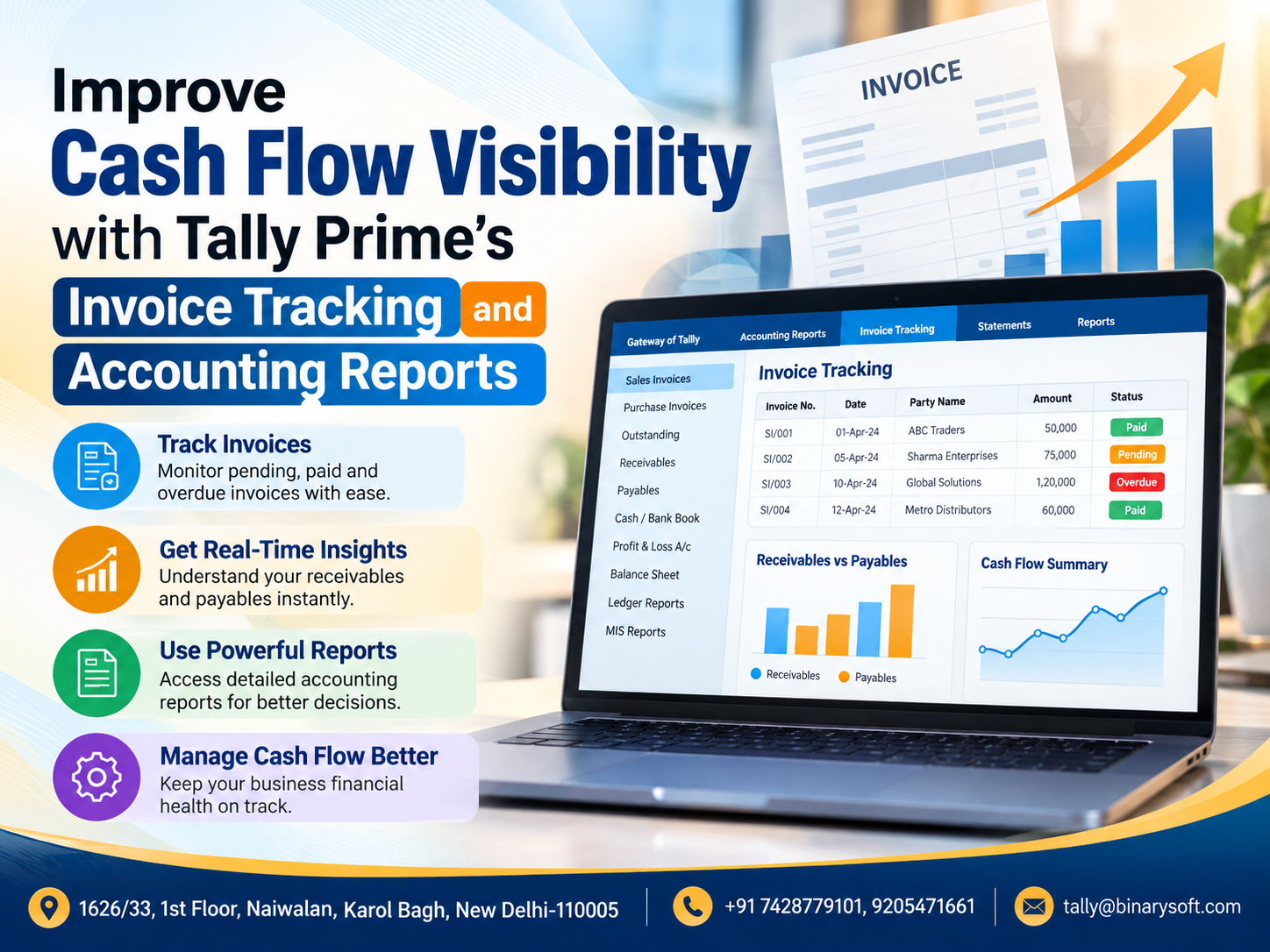
Tally Prime supports bill-wise accounting, allowing businesses to maintain individual invoice references and track outstanding balances.
Example of invoice tracking
|
Invoice
|
Customer
|
Invoice value
|
Received
|
Outstanding
|
|---|
|
INV-101
|
ABC Traders
|
₹1,20,000
|
₹80,000
|
₹40,000
|
|
INV-102
|
XYZ Enterprises
|
₹95,000
|
₹45,000
|
₹50,000
|
|
INV-103
|
Sunrise Distributors
|
₹1,75,000
|
₹1,00,000
|
₹75,000
|
|
Total
|
|
₹3,90,000
|
₹2,25,000
|
₹1,65,000
|
Illustrative invoice data for explaining customer outstanding management.
Instead of checking every invoice manually, the accounts department can review outstanding reports and identify pending collections.
This helps employees prepare customer statements and prioritize payment follow-ups.
4. Bill-Wise Accounting and Outstanding Receivables
Bill-wise accounting allows businesses to track transactions against individual invoice references.
For example, a wholesaler sells goods worth ₹2 lakh to a retailer on 30-day credit.
The invoice is recorded with a bill reference and relevant due date.
After fifteen days, the customer pays ₹75,000.
The accountant records the receipt and allocates it against the original invoice.
The remaining outstanding amount becomes ₹1.25 lakh.
This approach helps maintain a clear relationship between invoices and payments.
It is especially useful for wholesalers and distributors handling multiple invoices from the same customer.
Accurate bill-wise tracking also reduces confusion when customers make partial payments or settle several invoices together.
5. Customer Outstanding Reports and Ageing Analysis
Outstanding reports help businesses identify customers who owe money.
Ageing analysis adds another dimension by showing how long amounts have remained unpaid.
Illustrative receivables ageing report
|
Ageing period
|
Outstanding amount
|
Recommended review
|
|---|
|
0–30 days
|
₹4,50,000
|
Regular monitoring
|
|
31–60 days
|
₹2,25,000
|
Customer reminders
|
|
61–90 days
|
₹1,10,000
|
Priority follow-up
|
|
Above 90 days
|
₹75,000
|
Management review
|
|
Total
|
₹8,60,000
|
|
A business can use this information to prioritize collection efforts.
For example, invoices overdue by more than ninety days may require direct communication with the customer.
Ageing reports also help management identify customers whose payment behaviour has changed.
However, ageing analysis should be combined with customer discussions and internal credit policies before making decisions about future sales.
6. Credit Limits and Customer Payment Terms
Offering credit can help businesses maintain customer relationships, but excessive credit exposure may create financial risk.
Tally Prime allows businesses to configure customer credit limits and credit periods.
For example, a distributor may assign a customer a credit limit of ₹3 lakh with a 30-day payment period.
If the customer already owes ₹2.80 lakh, management should carefully evaluate an additional credit sale of ₹75,000.
The proposed transaction would increase the exposure beyond the established limit.
Configured credit controls and management approval procedures can help businesses review such situations.
Credit limits should be based on customer payment history, financial capacity and business requirements.
7. Cash Flow Reports in Tally Prime
Tally Prime provides cash flow reporting based on recorded accounting transactions.
Cash flow information helps management understand money received and paid during a selected period.
Illustrative monthly cash flow
|
Particulars
|
Amount
|
|---|
|
Opening cash and bank balance
|
₹3,50,000
|
|
Customer collections
|
₹9,00,000
|
|
Other receipts
|
₹50,000
|
|
Supplier payments
|
₹6,25,000
|
|
Salaries and operating expenses
|
₹2,00,000
|
|
Tax and other payments
|
₹75,000
|
|
Closing cash and bank balance
|
₹4,00,000
|
This example shows how a business can evaluate its cash position through receipts and payments.
A positive closing balance may appear reassuring, but management must also consider upcoming obligations.
For example, a business holding ₹4 lakh may still face financial pressure if ₹6 lakh in supplier payments becomes due within the next week.
Cash flow reports should therefore be reviewed alongside receivables and payables.
8. Supplier Payment Tracking and Accounts Payable
Managing supplier payments is equally important for maintaining liquidity.
Businesses often purchase inventory or services on credit and must settle invoices according to agreed terms.
Tally Prime supports purchase accounting and bill-wise supplier outstanding tracking.
For example, a distributor purchases inventory worth ₹4 lakh with a 45-day credit period.
The purchase is recorded against the supplier ledger.
When the payment becomes due, management can review the payable information and arrange funds.
This helps businesses avoid unnecessary delays and maintain dependable supplier relationships.
A practical payment schedule should consider available bank balances, expected customer collections and contractual obligations.
9. Bank Reconciliation for Accurate Cash Records
Bank reconciliation helps ensure that accounting records agree with actual bank transactions.
Differences may arise because of unrecorded bank charges, outstanding cheques, delayed deposits or incorrectly entered payments.
Tally Prime provides bank reconciliation facilities and supported statement-import capabilities in compatible releases.
For example, a business may record a customer payment of ₹1 lakh but later discover that the amount has not been correctly matched with the bank transaction.
Reconciliation helps identify and investigate such differences.
Regular bank reconciliation improves the reliability of cash balances and reduces the risk of financial reporting errors.
10. Financial Reports That Support Cash Flow Decisions
Tally Prime provides several reports that help management understand financial performance.
|
Report
|
Business benefit
|
|---|
|
Cash Flow
|
Reviews recorded cash movements
|
|
Balance Sheet
|
Shows assets, liabilities and financial position
|
|
Profit & Loss Account
|
Evaluates income and expenses
|
|
Bills Receivable
|
Identifies customer outstanding invoices
|
|
Bills Payable
|
Reviews supplier payment obligations
|
|
Trial Balance
|
Helps verify ledger balances
|
|
Sales Register
|
Reviews sales transactions
|
|
Purchase Register
|
Examines purchase activity
|
|
Day Book
|
Displays daily accounting transactions
|
These reports become more useful when examined together.
For example, increasing sales combined with rising receivables may indicate that collections are not keeping pace with business growth.
Management can use this information to strengthen collection procedures and review customer credit policies.
11. Cash Flow Forecasting and Working Capital Planning
Historical cash flow reports explain recorded cash movements, while forecasting estimates future financial requirements.
A practical forecast should include expected customer collections, supplier payments, payroll, rent, taxes and planned inventory purchases.
For example, a wholesaler expecting ₹12 lakh in collections may have ₹10 lakh in scheduled payments.
The apparent surplus is ₹2 lakh, but management must consider the possibility of delayed collections.
Businesses can use Tally Prime accounting reports as inputs for a separate weekly or monthly cash forecast.
Conservative assumptions help management avoid making commitments based on uncertain receipts.
12. An Emotional Story: When a Successful Business Almost Ran Out of Cash
The following is a fictional story illustrating a common business challenge.
For nearly twenty years, Manoj had operated a wholesale trading business in Delhi.
His father had started the company with a small shop and limited savings. Manoj gradually expanded the business, hired employees and developed relationships with retailers across the city.
Every month, sales continued to grow.
Customers placed large orders, and the warehouse remained busy.
Yet Manoj frequently struggled to arrange money for supplier payments.
One afternoon, his largest supplier called and informed him that the next delivery would be delayed until previous invoices were cleared.
At the same time, several customers requested additional goods on credit.
Manoj looked at his sales figures and felt confused.
How could a business generating strong revenue face such a serious shortage of cash?
That evening, he sat in his office reviewing old invoices and customer payment records.
He discovered that several customers had not cleared invoices issued months earlier.
The business had generated sales, but much of the money remained with customers.
Manoj remembered how his father used to carefully record every payment in a handwritten ledger.
He realized that the business had grown beyond the capacity of its old accounting process.
Determined to regain control, he reorganized customer ledgers and introduced bill-wise invoice tracking in Tally Prime.
His team began reviewing outstanding reports every week and following up on overdue payments.
Manoj also started checking expected collections before approving major purchases.
Gradually, the business developed a more disciplined financial routine.
For Manoj, improved cash flow visibility was not simply about accounting software.
It meant protecting employee salaries, maintaining supplier trust and preserving the business his family had spent decades building.
13. Case Study One: Electrical Goods Wholesaler in Delhi
Illustrative case study; figures and outcomes are hypothetical.
Business background
An electrical goods wholesaler supplied retailers and contractors across Delhi NCR.
The company generated substantial credit sales but maintained outstanding customer information through spreadsheets.
Challenges
-
Delayed customer collections.
-
Difficulty identifying overdue invoices.
-
Limited visibility into partial payments.
-
Manual preparation of customer statements.
-
Pressure on supplier payment schedules.
Proposed Tally Prime implementation
The company introduced bill-wise receivable tracking, customer credit periods and regular outstanding reviews.
Employees began allocating receipts against individual invoices.
Management established a weekly collection review process.
Illustrative improvement targets
|
Performance indicator
|
Before
|
Target
|
|---|
|
Average collection period
|
60 days
|
40 days
|
|
Outstanding review
|
Monthly
|
Weekly
|
|
Customer statements
|
Manual compilation
|
Accounting reports
|
|
Payment follow-ups
|
Reactive
|
Scheduled
|
|
Invoice verification
|
Multiple records
|
Bill-wise references
|
Expected business impact
The proposed system would help management identify overdue invoices earlier and organize customer follow-ups more effectively.
Reducing collection delays could release working capital for inventory purchases and daily operations.
Actual results would depend on customer payment behaviour and consistent implementation.
14. Case Study Two: FMCG Distributor Managing Cash Flow
Illustrative case study; figures are hypothetical.
Business background
An FMCG distributor supplied packaged consumer goods to supermarkets and retail stores.
The company purchased inventory from multiple suppliers and offered credit facilities to regular customers.
Challenges
The distributor frequently experienced mismatches between expected collections and scheduled supplier payments.
Management also found it difficult to prepare accurate weekly cash forecasts.
Proposed solution
The company configured customer and supplier bill-wise accounting in Tally Prime.
Outstanding reports were reviewed regularly, and bank reconciliation procedures were strengthened.
Management began using cash flow reports and payable statements to prepare weekly financial plans.
Expected improvements
The proposed workflow would improve visibility into overdue customer balances and upcoming supplier commitments.
It would also support more informed inventory purchasing decisions.
Key takeaway
Effective cash flow management requires coordination between sales collections, supplier payments and inventory planning.
15. Step-by-Step Guide to Invoice Tracking in Tally Prime
Businesses can establish a structured invoice tracking process through the following steps.
Step 1: Review company accounting settings. Confirm that the relevant accounting features are enabled.
Step 2: Enable bill-wise tracking. Configure bill-wise accounting for customer and supplier ledgers where required.
Step 3: Create customer ledgers. Enter appropriate customer details, credit periods and applicable credit limits.
Step 4: Record sales invoices. Create sales vouchers with relevant invoice references and payment terms.
Step 5: Record customer receipts. Use receipt vouchers and allocate payments against the correct outstanding bills.
Step 6: Review Bills Receivable. Examine unpaid invoices, due dates and outstanding balances.
Step 7: Analyze ageing. Identify invoices that have remained unpaid beyond the agreed credit period.
Step 8: Review Bills Payable. Monitor supplier obligations and upcoming payment requirements.
Step 9: Reconcile bank accounts. Verify that recorded receipts and payments agree with bank transactions.
Step 10: Examine cash flow reports. Review recorded cash movements and prepare a separate forward-looking cash forecast.
The exact menu paths and available options may vary according to the installed TallyPrime release and configuration.
16. Tally Prime on Cloud for Remote Cash Flow Monitoring
Business owners frequently need financial information while travelling or managing multiple branches.
A properly configured cloud-hosted Tally Prime environment can allow authorized users to access accounting records from approved locations.
For example, a distributor visiting suppliers may review customer receivables and available bank balances before approving a large purchase.
The accounts department can continue recording daily transactions in the centralized environment.
Cloud hosting can reduce dependence on a single office computer, but it requires appropriate licensing, internet connectivity, access controls and backup arrangements.
Businesses should evaluate these requirements before selecting a hosting solution.
17. Best Practices for Better Cash Flow Visibility
Improving cash flow visibility requires consistent accounting practices and regular management attention.
Businesses should record invoices promptly, allocate customer receipts accurately and reconcile bank accounts frequently.
Outstanding reports should be reviewed according to a defined schedule.
Credit limits should be evaluated when customers demonstrate changing payment behaviour.
Supplier payment commitments should be compared with realistic expected collections.
Management should also review inventory investment because excessive stock can create unnecessary working capital pressure.
Combining these practices with Tally Prime reporting can support more dependable financial planning.
18. How Binarysoft Technologies Can Help
Binarysoft Technologies, an Authorized Tally Partner based in Karol Bagh, New Delhi, can assist businesses in evaluating Tally Prime accounting and financial management requirements.
Retailers, wholesalers, distributors and service providers can discuss invoice tracking, customer outstanding management, bill-wise accounting, supplier payments and cash flow reporting.
Businesses seeking remote accounting access can also evaluate suitable TallyPrime cloud-hosting arrangements according to their operational requirements.
The objective is to establish an accounting workflow that supports reliable financial information, better collection planning and improved business continuity.
Conclusion
Cash flow visibility is essential for businesses that depend on customer collections, supplier credit and regular operating payments.
Tally Prime provides useful tools for invoice tracking, bill-wise accounting, outstanding analysis, bank reconciliation and financial reporting.
These features help businesses understand which customers owe money, which supplier payments are approaching and how recorded cash balances are changing.
However, effective cash flow management requires more than software.
Businesses must maintain accurate accounting records, follow consistent collection procedures and prepare realistic forecasts.
With proper implementation and disciplined financial review, Tally Prime can help retailers, wholesalers and distributors improve working capital visibility, reduce avoidable payment delays and make more confident business decisions.
Powered by Binarysoft Technologies
Authorized Tally Partner
Location: 1626/33, 1st Floor, Naiwalan, Karol Bagh, New Delhi – 110005, INDIA
Contact us: +91 7428779101, 9205471661
Email us: tally@binarysoft.com
Business Hours: 10:00 AM – 6:00 PM, Monday to Friday
Frequently Asked Questions
What is cash flow visibility in Tally Prime?
Cash flow visibility involves reviewing recorded receipts, payments, outstanding invoices and financial reports to understand the movement and availability of business funds.
Can Tally Prime track unpaid customer invoices?
Yes. Bill-wise accounting allows businesses to monitor individual outstanding invoices and pending payment amounts.
How does Tally Prime help with invoice tracking?
Tally Prime maintains invoice references, customer balances and payment allocations, helping businesses identify paid, partially paid and unpaid invoices.
Can Tally Prime generate customer outstanding reports?
Yes. Businesses can review Bills Receivable and other outstanding reports to identify customer dues.
CA. Rishubh Talrejaa specializes in GST, business accounting, and compliance advisory for growing enterprises. With experience in handling real-time transactional data and audits, he writes practical insights on inventory control, taxation, and digital transformation for Indian businesses operating in competitive markets.