Call CA Tally HelpDesk
+91 9205471661,
7428779101
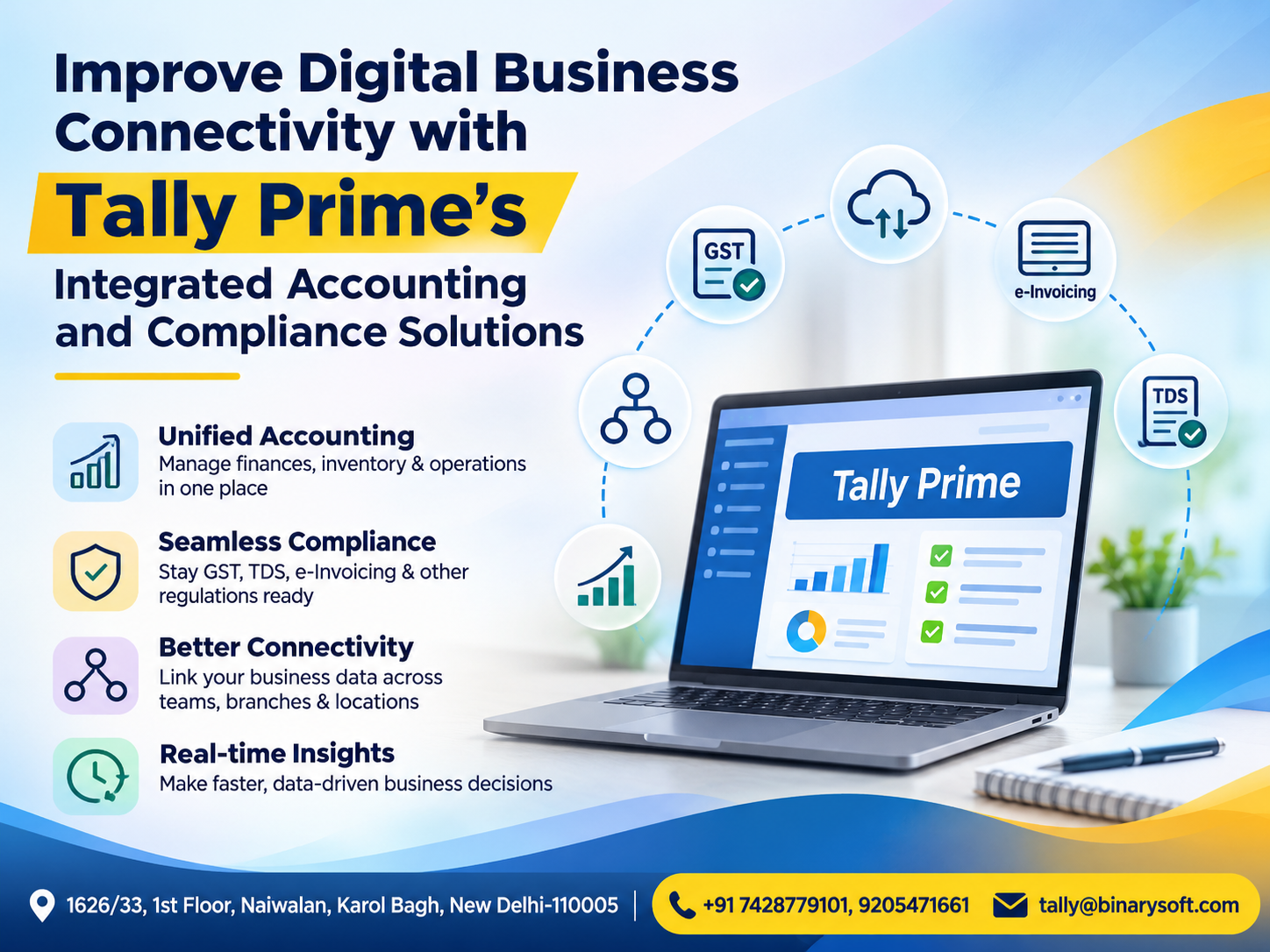
Introduction: Why Digital Business Connectivity Is Essential for Modern Businesses
Modern businesses operate in an environment where financial accuracy, operational efficiency and digital connectivity are essential for sustainable growth. Whether managing a small retail store, a manufacturing company, a wholesale distribution business or a growing service organization, maintaining accurate financial information across departments is increasingly important.
Traditionally, businesses maintained separate systems for accounting, inventory, invoicing, banking and statutory compliance. Although these systems performed individual functions, they often created communication gaps, duplicate data entry, reporting delays and unnecessary administrative expenses.
Today, business owners need more than accounting software. They need an integrated digital business management solution that connects financial transactions, inventory movements, customer relationships, banking activities and compliance processes.
Tally Prime helps businesses improve digital connectivity by bringing essential accounting and business management activities into a coordinated environment.
With its integrated accounting capabilities, GST-related features, banking support, inventory management and financial reporting tools, Tally Prime enables organizations to manage operations with greater visibility and control.
For Indian businesses, digital connectivity also supports more efficient GST compliance, invoice management, financial reconciliation and decision-making.
This article explores how Tally Prime can help businesses establish a more connected financial ecosystem, reduce manual work, strengthen compliance processes and prepare for future growth.
1. Understanding Digital Business Connectivity in Accounting
Digital business connectivity refers to the ability of different business activities, financial records and operational processes to exchange information efficiently.
For example, when a business generates a sales invoice, the transaction may affect several areas simultaneously:
-
Sales revenue and customer outstanding balances
-
Inventory quantities and stock valuation
-
GST calculations and tax records
-
Financial statements and profitability reports
-
Payment tracking and cash flow planning
When these activities are managed through disconnected applications, employees may need to enter the same information multiple times.
This increases the possibility of human error and creates inconsistencies between departments.
An integrated accounting environment helps eliminate unnecessary duplication by recording related financial and operational effects within the same system.
Why connectivity matters
A digitally connected business can monitor financial performance more effectively, respond to customer requirements faster and identify operational problems before they become serious.
For example, a wholesale distributor can examine stock availability while preparing an invoice, review customer outstanding amounts and assess whether additional purchases are necessary.
This coordination improves business productivity and supports informed management decisions.
2. How Tally Prime Creates an Integrated Business Management Environment
Tally Prime is designed to support multiple business processes within a unified accounting environment.
Instead of treating accounting, billing, inventory and compliance as completely separate activities, it allows businesses to manage related transactions through interconnected records.
Integrated financial accounting
Businesses can maintain ledgers, record transactions, manage receivables and payables, and prepare financial statements.
Sales, purchases, payments, receipts and journal entries contribute to the organization's accounting records.
Inventory and stock management
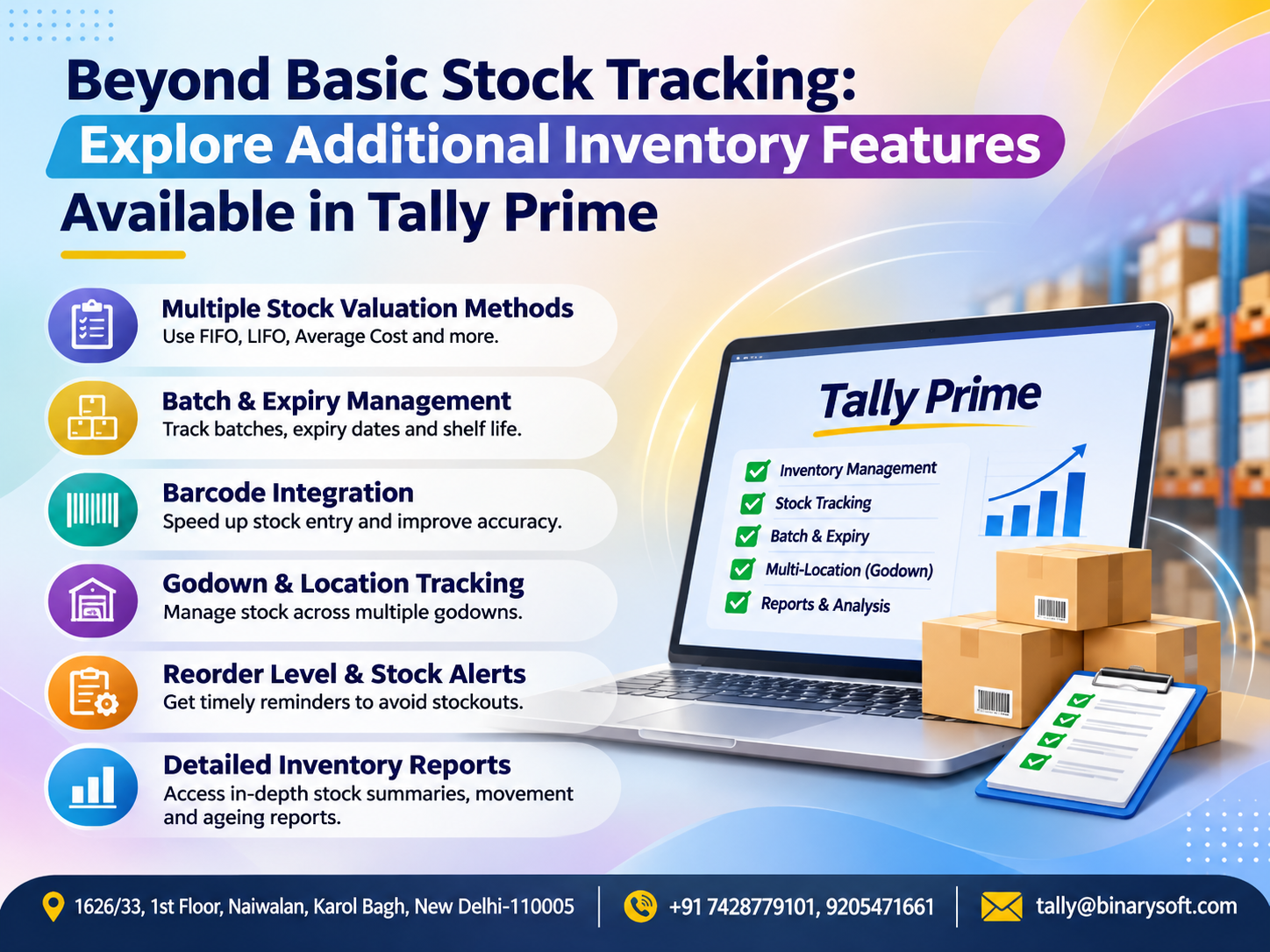
Businesses dealing with physical products can manage stock items, stock groups, units of measurement, godowns and inventory transactions.
This enables better coordination between purchasing, sales and inventory management.
GST and statutory compliance
Tally Prime supports GST-related accounting, tax calculations, return preparation workflows and reconciliation processes.
The availability of specific connected services depends on the software version, subscription eligibility, configuration and applicable regulatory requirements.
Banking and reconciliation
Banking features help businesses record payment transactions, manage bank-related information and reconcile accounting records against bank statements.
Financial reporting
Management can examine business performance using reports such as Balance Sheet, Profit & Loss Account, Cash Flow, Stock Summary and outstanding receivables.
Together, these capabilities establish a foundation for connected business operations.
3. Simplifying GST Compliance Through Connected Accounting
GST compliance is one of the most important financial responsibilities for businesses operating in India.
Organizations must maintain accurate transaction records, apply appropriate tax classifications and reconcile relevant information before filing returns.
Manual GST management can become challenging when businesses process large numbers of invoices.
Common difficulties include incorrect GSTIN details, mismatched invoice information, incorrect tax rates, missing purchase records and delays in reconciliation.
How Tally Prime helps
GST-compliant invoicing: Businesses can configure GST-related details and generate invoices with applicable tax calculations.
GST reports: Transaction records can be organized into relevant GST reports, helping accountants review taxable sales, purchases and tax liabilities.
Reconciliation: Supported features can assist businesses in comparing recorded transactions with GST-related information and identifying discrepancies.
E-invoicing support: Eligible businesses can use supported e-invoicing workflows to generate or exchange required invoice information, subject to applicable requirements.
E-way bill support: Relevant invoice and transport information can be used in supported e-way bill processes.
These capabilities reduce repetitive administrative work and improve the consistency of accounting information.
However, software automation does not eliminate the need for proper invoice verification, regulatory interpretation and timely return filing.
4. Improving Banking Connectivity and Financial Reconciliation
Bank reconciliation is an essential accounting activity because differences between company records and bank statements can affect financial accuracy.
A business may record a customer payment before it appears in the bank statement. Similarly, bank charges, interest, direct transfers and uncleared cheques may create temporary differences.
Without regular reconciliation, management may misunderstand the organization's available funds.
Tally Prime provides banking and reconciliation capabilities that help accountants compare recorded transactions with bank information.
Depending on the supported bank and enabled features, businesses may use bank statement imports, reconciliation assistance and connected banking services.
Business advantages
Regular reconciliation helps organizations identify missing entries, duplicate transactions, unexpected bank charges and outstanding payments.
It also supports more reliable cash flow planning.
For example, a company expecting ₹8 lakh from customers may discover that only ₹5 lakh has actually been received.
By reviewing receivables alongside reconciled bank information, management can make more realistic purchasing and payment decisions.
Digital banking connectivity therefore contributes directly to financial discipline.
5. Connecting Inventory Management with Financial Accounting
Inventory represents a significant investment for manufacturers, retailers, wholesalers and distributors.
Poor stock management can lead to excess inventory, stock shortages, delayed deliveries and unnecessary storage expenses.
When inventory records are disconnected from accounting, management may struggle to understand the relationship between stock movements and profitability.
Tally Prime helps businesses coordinate inventory and accounting transactions.
Important inventory capabilities
Stock item management allows businesses to maintain product-wise records.
Godown management supports stock tracking across configured storage locations.
Purchase and sales transactions help update inventory information.
Stock Summary reports provide visibility into available quantities and inventory values.
Batch-wise tracking, where applicable and configured, can assist businesses dealing with products that require batch identification.
Order processing features help organizations coordinate purchase orders, sales orders and subsequent transactions.
Example
Consider an electronics distributor selling 200 units of a product every month.
Without reliable inventory records, the distributor may reorder too late or purchase unnecessary quantities.
By examining sales trends and stock reports in Tally Prime, management can estimate future requirements more accurately.
The result is improved inventory planning, reduced working capital pressure and better customer service.
6. A Story of Business Transformation: From Financial Confusion to Confidence
Every business owner dreams of building a successful company, but growth often brings responsibilities that are difficult to manage.
Consider the fictional story of Rajesh, who operates a family-owned electrical goods distribution business in Delhi.
His father started the company with a small shop and a handful of customers. Over the years, Rajesh expanded the business to serve retailers across several markets.
Although sales increased, the accounting process remained largely manual.
Employees maintained stock records in spreadsheets, prepared invoices using separate software and shared payment information through messages.
At the end of each month, Rajesh struggled to determine how much money customers owed, which products were selling profitably and whether the company had enough funds to pay suppliers.
One evening, his daughter asked why he continued working after dinner.
Rajesh realized that despite years of effort, business growth had reduced the time he could spend with his family.
He decided to reorganize the company's accounting operations.
The business implemented Tally Prime, standardized product records, configured customer ledgers and established regular financial reporting procedures.
Employees began recording transactions through a coordinated workflow.
Over time, Rajesh could review outstanding receivables, stock positions and financial performance without waiting for several disconnected spreadsheets.
The transformation was not simply technological.
It helped him regain confidence in his decisions and create a more manageable working routine.
The lesson is that digital connectivity is not only about faster accounting. It is also about giving business owners greater clarity, control and peace of mind.
7. Case Study One: Wholesale Distribution Business Improves Operational Visibility
Illustrative case study based on common business challenges; figures are hypothetical.
Business background
A medium-sized wholesale distribution company in Delhi supplies electrical components to approximately 150 retail customers.
The company handles hundreds of monthly sales and purchase transactions.
Previously, the business maintained accounting records and inventory information in separate applications.
Challenges
The company frequently experienced differences between physical stock and spreadsheet records.
Customer outstanding amounts were difficult to verify quickly.
Preparing GST-related reports required additional manual checking.
Management also lacked a consolidated view of product profitability.
Tally Prime implementation
The company introduced Tally Prime and configured stock items, customer ledgers, supplier accounts and GST information.
Employees received training on invoice entry, purchase recording and reconciliation procedures.
Management began reviewing Stock Summary, receivables and profitability reports regularly.
Illustrative results
|
Performance indicator
|
Before
|
After
|
|---|
|
Monthly reconciliation effort
|
20 hours
|
9 hours
|
|
Inventory discrepancies identified monthly
|
18
|
6
|
|
Time to prepare management reports
|
3 days
|
1 day
|
|
Overdue receivables
|
₹12 lakh
|
₹8 lakh
|
These figures illustrate potential operational improvements rather than guaranteed software outcomes.
Key takeaway
By integrating accounting and inventory processes, the company gained more consistent records and improved its ability to identify problems early.
The greatest benefit came from combining software functionality with standardized accounting procedures.
8. Case Study Two: Manufacturing Company Strengthens Financial Control
Illustrative case study; business details and outcomes are hypothetical.
Business background
A small manufacturing company produces packaging materials for food processing businesses.
It purchases raw materials, processes production orders and supplies finished goods to multiple customers.
Business challenges
The company faced difficulties tracking material consumption, production costs and customer payments.
Separate records were maintained for purchases, production and accounting.
This made it difficult to calculate product-level profitability and identify excessive material consumption.
Implementation approach
The company configured inventory masters, raw material records, finished goods and relevant manufacturing workflows in Tally Prime.
Accounting staff established procedures for recording purchases, production-related transactions, sales and expenses.
Management also introduced monthly reviews of inventory valuation, outstanding payments and financial reports.
Illustrative improvements
After six months, the company estimated that improved monitoring and operating discipline helped reduce avoidable material waste by 8%.
Monthly reporting time decreased from approximately five working days to two.
Better receivables monitoring also improved payment follow-up.
These improvements depended on accurate data entry, staff training and management action rather than software installation alone.
Key takeaway
Integrated accounting and inventory records can help manufacturing businesses connect operational activity with financial performance.
This provides a stronger foundation for production planning, cost management and profitability analysis.
9. Remote Access and Cloud Connectivity for Modern Businesses
Modern businesses increasingly operate beyond a single office.
Owners travel to meet customers, accountants work from different locations and managers need financial information while visiting warehouses or manufacturing facilities.
Tally Prime offers remote connectivity and online reporting capabilities that help authorized users access relevant business information.
Depending on the deployment model, businesses can use remote access, browser-based reports or a suitable cloud-hosted environment.
Benefits of remote connectivity
Remote access can help authorized employees review transactions, examine outstanding balances and perform permitted accounting activities without being physically present at the main office.
Browser-based reporting allows business owners to review selected financial reports through supported devices.
For organizations operating multiple branches, synchronization features can help exchange accounting information between locations.
Businesses should understand that remote access and cloud hosting are different arrangements. The appropriate solution depends on licensing, security requirements, internet connectivity and operational needs.
10. Improving Customer and Supplier Communication
Effective communication is an important part of digital business connectivity.
Businesses regularly exchange invoices, payment reminders, purchase orders, delivery information and financial statements.
Delays in communication can create misunderstandings and affect customer relationships.
Tally Prime supports invoice sharing, outstanding management and relevant digital communication workflows.
Where supported and properly configured, WhatsApp-based communication can help businesses share invoices and reports more conveniently.
Accountants can also use outstanding reports to identify customers requiring payment follow-up.
For suppliers, accurate payable records support timely payment planning and better purchasing relationships.
By combining organized financial information with consistent communication, businesses can improve transparency and build stronger professional relationships.
11. Strengthening Data Security and Financial Control
Digital connectivity must be supported by appropriate information security.
Financial records contain sensitive information about customers, suppliers, transactions, payments and business profitability.
Unauthorized access or accidental data loss can create serious operational difficulties.
Tally Prime provides security-related capabilities such as user access controls, password protection, data encryption options and backup facilities.
Recommended security practices
Businesses should assign access permissions according to employee responsibilities.
Accounting users should receive only the permissions necessary for their work.
Regular backups should be maintained and restoration procedures should be tested periodically.
Organizations using remote access or cloud hosting should implement secure authentication, device protection and appropriate network security.
Financial data should also be reviewed regularly to identify unusual transactions or unauthorized modifications.
These measures help organizations maintain accountability while benefiting from digital connectivity.
12. How to Implement Integrated Accounting with Tally Prime
Successful implementation requires more than installing software.
Businesses should first evaluate their accounting procedures and identify areas where information is duplicated or delayed.
A practical implementation process includes the following stages.
Stage 1: Business assessment
Review existing accounting, invoicing, inventory, banking and compliance processes.
Stage 2: Company configuration
Configure company information, financial periods, taxation details and accounting preferences.
Stage 3: Master data preparation
Create or import appropriate customer, supplier, ledger and inventory records.
Stage 4: GST configuration
Set up applicable GST information and verify tax classifications.
Stage 5: Banking setup
Configure bank ledgers and enable suitable reconciliation or connected banking features.
Stage 6: Employee training
Train accounting and operational employees to record transactions consistently.
Stage 7: Reporting and monitoring
Establish daily, weekly and monthly financial review procedures.
Stage 8: Security and backup
Implement user permissions, backup schedules and recovery procedures.
Businesses should validate opening balances and migrated records before relying on the new system for financial reporting.
13. How Integrated Accounting Improves Business Decision-Making
Accurate financial information allows management to move from reactive decisions toward proactive planning.
A business owner can review outstanding receivables before extending additional credit.
A purchasing manager can examine stock reports before placing a large order.
An accountant can review tax-related reports before preparing compliance submissions.
Management can also examine expense patterns, gross profitability and cash flow trends.
For example, a company may report strong sales but still face liquidity difficulties because customers are paying late.
Integrated reporting helps reveal this difference between revenue and actual cash availability.
Similarly, inventory reports may identify products that remain unsold for extended periods.
By analyzing this information, businesses can improve pricing, purchasing, credit control and working capital management.
The true value of connected accounting lies in turning accurate transaction records into useful business intelligence.
14. Why Tally Prime Is Suitable for Growing Indian Businesses
Indian businesses operate across diverse industries, including trading, manufacturing, distribution, professional services and retail.
Each sector has different accounting requirements, but all benefit from accurate financial records and effective operational control.
Tally Prime provides configurable accounting and business management capabilities that can support organizations as their transaction volumes and reporting needs increase.
Small businesses can begin with essential invoicing and bookkeeping functions.
Growing organizations can introduce inventory controls, detailed reporting, departmental accounting and additional connected services.
Businesses with multiple locations can evaluate synchronization, remote access and cloud deployment options.
This flexibility makes Tally Prime relevant to organizations seeking a practical approach to digital financial management.
However, businesses should assess their actual requirements, software version, licensing and integration needs before selecting a deployment model.
Conclusion: Build a More Connected and Financially Confident Business
Digital business connectivity is becoming an essential part of modern financial management.
Organizations that depend on disconnected spreadsheets, manual reconciliation and fragmented reporting often experience unnecessary delays and operational uncertainty.
Tally Prime helps businesses create a more coordinated environment by connecting accounting, invoicing, inventory, GST-related processes, banking and financial reporting.
These capabilities can improve information accuracy, reduce repetitive work and strengthen financial visibility.
The two illustrative case studies demonstrate how structured accounting processes can support better inventory control, faster reporting and improved working capital management.
More importantly, the story of Rajesh highlights the human value of digital transformation.
For business owners, accurate financial information can mean fewer late evenings, greater confidence in important decisions and more time to focus on customers, employees and family.
The future of business accounting is not simply digital recordkeeping. It is connected, secure, efficient and decision-oriented financial management.
With appropriate implementation, employee training and professional support, Tally Prime can help businesses move toward that future.
Get Professional Tally Prime Support from Binarysoft Technologies
Businesses planning to improve accounting efficiency, GST compliance, banking reconciliation, inventory management or remote connectivity can benefit from professional implementation guidance.
Binarysoft Technologies assists businesses with Tally Prime licensing, configuration, implementation, training and technical support.
Whether you are starting a new business or modernizing an established organization, selecting the right accounting setup can make everyday operations easier and more reliable.
Powered by Binarysoft Technologies
Authorized Tally Partner
Location: 1626/33, 1st Floor, Naiwalan, Karol Bagh, New Delhi – 110005, INDIA
Contact Us: +91 7428779101, 9205471661
Email: tally@binarysoft.com
Business Hours: 10:00 AM – 6:00 PM, Monday to Friday
Frequently Asked Questions
What is digital business connectivity in Tally Prime?
Digital business connectivity refers to the coordination of accounting, invoicing, inventory, banking, compliance and financial reporting activities through integrated software and supported connected services.
How does Tally Prime improve accounting efficiency?
Tally Prime helps reduce duplicate recordkeeping by allowing related financial and inventory transactions to be managed within a coordinated accounting environment. It also provides reports that support faster financial reviews.
CA. Mayankh Singhaal is a Chartered Accountant experienced in accounting systems, statutory audits, and compliance advisory. He has worked with businesses across different sectors to improve reporting accuracy and inventory tracking. His writing focuses on structured growth and compliance-ready operations.