Call CA Tally HelpDesk
+91 9205471661,
7428779101

Introduction: A New Era of Digital Invoicing for UAE Manufacturers
The manufacturing industry in the United Arab Emirates is entering an important phase of digital transformation. From industrial equipment manufacturers in Dubai to food processing companies in Sharjah and packaging factories in Abu Dhabi, businesses increasingly need accurate financial records, transparent transactions and reliable digital invoicing systems.
The UAE's transition towards electronic invoicing represents more than a regulatory change. It creates an opportunity for manufacturing businesses to strengthen financial controls, reduce manual paperwork, improve VAT reporting and connect production operations with accounting.
For manufacturers already using Tally Prime, preparing for UAE e-invoicing does not necessarily mean replacing their existing accounting software or purchasing an entirely new accounting system.
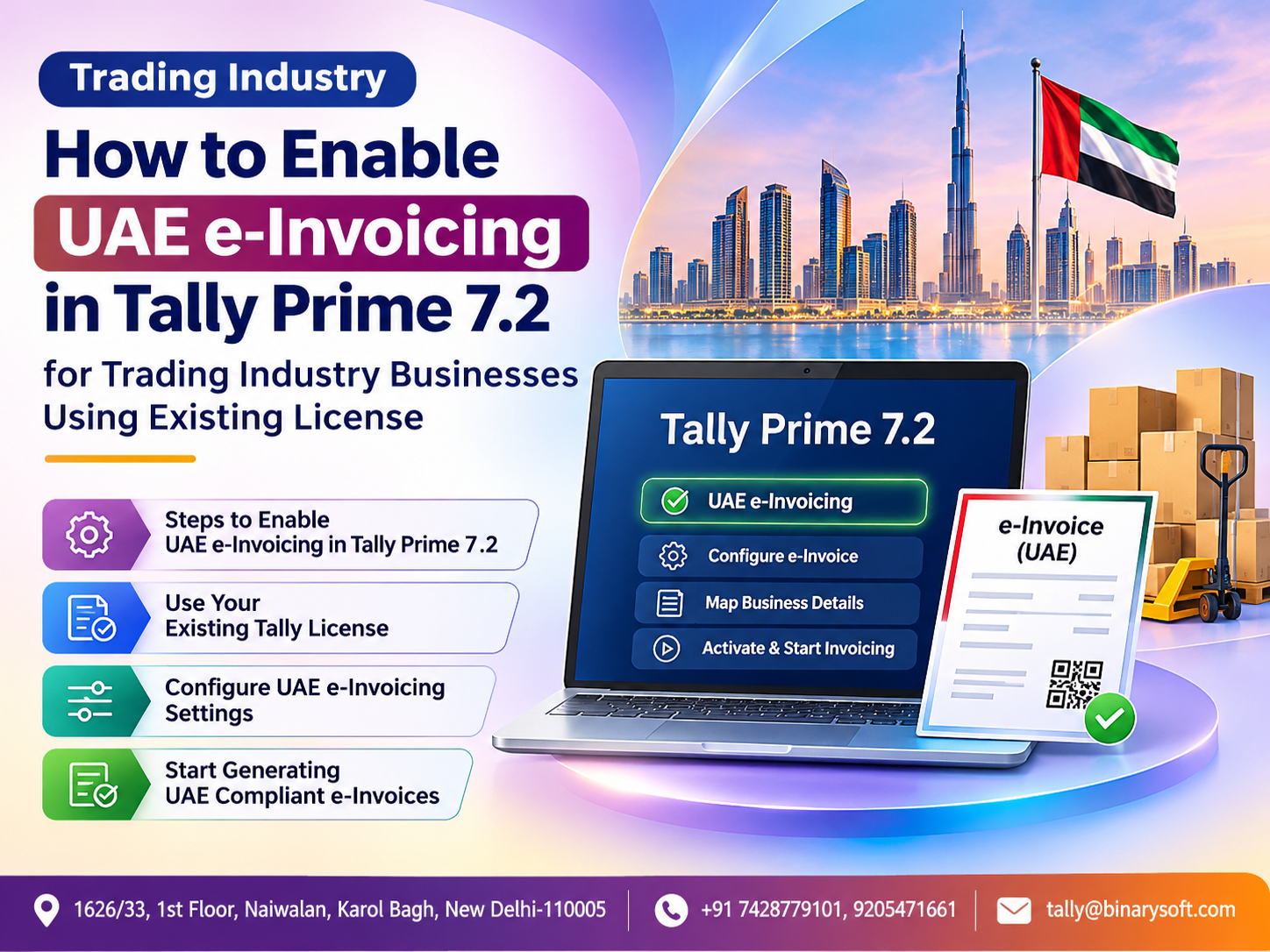
With Tally Prime 7.2, businesses can review their existing license, update their software where eligible, configure UAE VAT-related accounting information and prepare their invoicing processes for the country's electronic invoicing requirements.
However, it is important to understand that ordinary PDF invoices, emailed invoices and standard accounting entries are not automatically equivalent to UAE-compliant structured electronic invoices. Actual compliance depends on the supported integration, applicable regulatory requirements and the Accredited Service Provider (ASP) framework.
This guide explains how manufacturing businesses can prepare their existing Tally Prime environment, strengthen production accounting and move towards compliant digital invoicing without unnecessarily disrupting daily operations.
1. Understanding UAE e-Invoicing for Manufacturing Companies
Electronic invoicing is a structured digital process through which invoice information can be exchanged between businesses and relevant systems using prescribed technical standards.
Unlike traditional invoices printed on paper or shared as PDF attachments, compliant e-invoices contain structured information that authorized systems can process electronically.
For UAE manufacturers, this transformation is particularly important because manufacturing invoices frequently involve complex transactions.
These may include raw materials, finished products, packaging charges, transportation, customer discounts, credit notes, export supplies and multiple VAT treatments.
A manufacturing company might purchase raw materials from several suppliers, convert them into finished products and sell those products to distributors across the UAE.
Each stage generates accounting records that must be consistent with the final sales invoice.
A well-prepared e-invoicing environment helps establish a more reliable connection between these transactions.
Why manufacturers should prepare early
Manufacturing companies commonly manage hundreds or thousands of transactions each month. Even small invoicing mistakes can create significant reconciliation problems.
Common challenges include incorrect customer tax details, inconsistent item descriptions, missing invoice references, inaccurate VAT calculations and differences between dispatch records and accounting invoices.
Preparing early allows manufacturers to standardize customer information, validate tax settings, organize product records and test their digital invoicing workflows before mandatory requirements become applicable to their businesses.
2. UAE e-Invoicing Implementation: What Manufacturers Need to Know
The UAE is introducing electronic invoicing through a phased framework, with structured electronic invoice exchange and reporting supported by Accredited Service Providers.
The framework is designed to support digital transaction processing and improve the reliability of business invoice information.
Manufacturers should distinguish between three separate activities:
Accounting software preparation: Ensuring the business maintains accurate sales, purchase, inventory and VAT records.
Electronic invoice generation: Creating invoice information in the required structured format through a supported solution.
Electronic invoice exchange and reporting: Transmitting the information through the applicable ASP-based framework and completing the required reporting processes.
These activities may involve different systems or integration components.
Consequently, enabling VAT in Tally Prime or generating an ordinary sales invoice should not be treated as confirmation that the company has completed all UAE e-invoicing obligations.
Businesses should also verify their implementation phase, transaction coverage, applicable exceptions and technical readiness before going live.
For manufacturing businesses, the objective should be to build a reliable system that combines regulatory compliance with efficient production and financial management.
Implementation schedule for UAE businesses
Based on the updated October 2026 guidance, the main implementation milestones are:
|
Business category
|
ASP appointment deadline
|
Implementation date
|
|---|
|
Annual revenue of AED 50 million or more
|
31 October 2026
|
1 January 2027
|
|
Annual revenue below AED 50 million
|
31 March 2027
|
1 July 2027
|
|
Eligible voluntary participants
|
As applicable
|
From 1 July 2026
|
The applicable scope and subsequent amendments should be reviewed before implementation.
وزارة المالية - الإمارات العربية المتحدة+1
3. Can Manufacturing Companies Use Their Existing Tally Prime License?
One of the most important questions manufacturers ask is whether UAE e-invoicing requires purchasing a new Tally Prime license.
The answer depends on the company's existing license, software version, subscription entitlement and availability of a compatible e-invoicing integration.
Businesses may be able to retain their existing Tally Prime license and upgrade their installed software, subject to the applicable licensing and update conditions.
However, upgrading the accounting application does not automatically guarantee access to every electronic invoicing service.
Manufacturers should verify the following:
-
Whether the current Tally Prime license is genuine and active.
-
Whether the license is eligible for version 7.2.
-
Whether UAE company and VAT features are correctly configured.
-
Whether the installed version supports the required integration.
-
Whether an ASP connection or additional service subscription is necessary.
-
Whether existing company data can be safely migrated and tested.
A company using a single-user license should also review whether its daily invoicing volume and departmental workflow require additional users.
For larger factories, a multi-user arrangement may be more suitable because purchasing, production, warehouse and accounting teams frequently need coordinated access.
Important: An existing license can potentially remain part of the solution, but any ASP charges, integration costs or additional subscription requirements must be confirmed separately.
4. Step-by-Step Guide to Prepare Tally Prime 7.2 for UAE e-Invoicing
Manufacturing businesses should follow a structured implementation process rather than activating settings without checking their existing accounting environment.
Step 1: Verify your current Tally Prime license
Open Tally Prime and review the license and software version information.
Confirm the license status, serial number, current software version and update entitlement.
If the installed version is older than 7.2, verify upgrade eligibility before proceeding.
Keep the original license information available for support and activation purposes.
Step 2: Create a complete company data backup
Before updating software or modifying company settings, create a reliable backup of all accounting data.
The backup should include company ledgers, inventory masters, stock transactions, outstanding balances, purchase records, sales vouchers and manufacturing records.
Store a verified copy in a secure location separate from the working data.
This precaution is particularly important for manufacturers managing multiple financial years or complex stock records.
Step 3: Install or update Tally Prime 7.2
Use the appropriate authorized installation or update package.
Complete the installation according to the supported upgrade procedure, ensuring that the existing company data remains accessible.
After installation, open the company and verify major reports, including the Balance Sheet, Profit and Loss Account, Stock Summary, Sales Register and Purchase Register.
Do not assume that successful installation alone confirms e-invoicing readiness.
Step 4: Configure UAE company information
Open the company details and verify that the business information is accurate.
Review the legal company name, registered address, UAE location, contact details, financial year and other identification information.
For VAT-registered companies, verify the Tax Registration Number (TRN) and applicable tax configuration.
Manufacturers operating multiple branches should ensure that each establishment is represented correctly in the accounting and invoicing workflow.
Step 5: Review UAE VAT settings
Enable or review the applicable VAT functionality through the company's supported features and tax configuration.
Confirm that the business uses the correct VAT ledgers, tax classifications and transaction treatment.
The UAE's standard VAT rate is 5%, but not every transaction is necessarily subject to that rate.
Manufacturing companies may also encounter zero-rated transactions, exempt transactions, exports or other special treatments.
The correct VAT treatment should depend on the actual transaction and applicable UAE tax requirements.
Step 6: Standardize customer and supplier masters
Accurate master data is essential for electronic invoicing.
Review customer and supplier records for correct legal names, addresses, tax identifiers where applicable, contact information and other mandatory electronic invoice fields.
Manufacturers should avoid maintaining multiple inconsistent records for the same customer.
For example, a distributor appearing under three different names may create reconciliation problems when invoices are exchanged electronically.
Step 7: Configure inventory and manufacturing records
Manufacturing businesses should organize their stock items into meaningful categories.
Typical categories include raw materials, work-in-progress, finished goods, packaging materials and consumables.
Where supported and appropriate, configure units of measurement, stock groups, godowns, batch information and bills of materials.
Accurate item records improve invoice descriptions, inventory valuation and production reporting.
Step 8: Confirm the compatible ASP integration
This is the most important compliance-specific step.
The UAE e-invoicing framework requires applicable transactions to be exchanged and reported through the prescribed service-provider arrangement.
A manufacturing company must therefore confirm how its Tally Prime invoice data will reach its appointed Accredited Service Provider.
Depending on the available solution, this may involve an approved connector, integration service, supported data exchange workflow or another compatible mechanism.
The business should confirm that the solution supports required invoice fields, structured data generation, transmission, acknowledgements, error handling and electronic credit notes.
Do not rely on an unverified menu option or assume that Tally Prime 7.2 includes a built-in one-click UAE e-invoicing activation feature.
Step 9: Test the complete invoice workflow
Before using the system for live transactions, conduct end-to-end testing.
Create representative sales invoices for domestic B2B transactions, applicable export scenarios, discounts and credit notes.
Verify that invoice amounts, VAT calculations, customer identifiers and product descriptions remain accurate throughout the exchange process.
Confirm that the ASP integration returns appropriate delivery, validation or reporting status information.
Step 10: Train employees and begin controlled operations
Train the accounting, dispatch, sales and production teams on the revised process.
Assign responsibility for invoice creation, approval, submission, rejection handling and reconciliation.
Start with a controlled workflow and expand only after successful testing and confirmation of compliance readiness.
5. How Tally Prime Helps Manufacturing Companies Beyond e-Invoicing
For manufacturing businesses, the value of Tally Prime extends beyond creating sales invoices.
It can support the connection between purchasing, production, stock movement, customer billing and financial reporting.
Raw material inventory management
Manufacturers regularly purchase materials that must be monitored before production begins.
Tally Prime can help maintain stock records for materials such as steel, chemicals, plastic granules, packaging sheets and mechanical components.
Businesses can monitor stock quantities, purchase costs and material movement.
This helps purchasing managers identify shortages and reduce unnecessary purchases.
Bill of Materials and production accounting
A Bill of Materials (BOM) defines the components required to manufacture a finished product.
For example, a furniture manufacturer may need wooden panels, screws, adhesive, hinges and packaging material to produce one cabinet.
By configuring suitable BOM and manufacturing voucher workflows, the company can record consumption of components and receipt of finished goods.
This improves visibility into material requirements and production-related inventory movement.
Manufacturing cost monitoring
Production costs are not limited to raw materials.
Manufacturers also incur labour, electricity, machine maintenance, factory rent, packaging and transportation expenses.
Tally Prime's accounting, cost centre and reporting capabilities can help businesses organize relevant expenses and analyze profitability.
Where detailed job costing or specialized production costing is required, additional configuration or integration may be necessary.
Sales and purchase management
Manufacturers frequently handle bulk orders, purchase orders, delivery notes and invoices.
Tally Prime can help connect these records within the supported order-processing workflow.
This allows the accounting team to compare customer orders with deliveries and invoices while monitoring outstanding receivables.
VAT accounting and reporting
Correct VAT accounting is particularly important when manufacturers handle domestic sales, purchases and exports.
Tally Prime can support VAT-related accounting records and reports where the relevant country-specific features are available and configured.
These records can help accountants review taxable transactions, identify discrepancies and prepare supporting information for VAT compliance.
Electronic invoice reporting remains a separate requirement that must be fulfilled through the applicable compliant solution.
6. A Manufacturing Invoice Example
Consider a Dubai-based manufacturer producing industrial packaging containers.
The company receives an order for 1,000 containers at AED 80 each.
|
Particulars
|
Amount
|
|---|
|
Quantity
|
1,000 units
|
|
Unit selling price
|
AED 80
|
|
Taxable value
|
AED 80,000
|
|
VAT at 5%
|
AED 4,000
|
|
Total invoice
|
AED 84,000
|
The sales team records the transaction, while the warehouse team verifies the quantity dispatched.
The accounting team checks the customer details, VAT treatment and invoice value.
Tally Prime can be used to record the transaction and update the relevant financial and inventory records.
Through a separately verified compatible e-invoicing integration, the required invoice information can then be processed through the ASP framework.
This illustrates how accounting accuracy and electronic invoice compliance must work together.
7. An Emotional Story: When a Small Factory Faced a Big Digital Challenge
Illustrative story based on common manufacturing business challenges.
For more than fifteen years, Ahmed had operated a small packaging manufacturing business in Sharjah.
He started with two machines, five employees and a determination to provide a better future for his family.
Over time, the factory grew. His son joined the business, new customers arrived and production increased.
But behind the success was a growing problem.
Invoices were frequently checked manually. Customer information was scattered across spreadsheets, and the accounting team spent long evenings reconciling dispatch records with sales bills.
One evening, Ahmed found his son still sitting in the factory office after everyone else had left.
A customer had questioned an invoice, and the team was struggling to identify which dispatch record matched the billing entry.
Ahmed realized that the business had grown faster than its internal processes.
Instead of replacing every system, the family decided to improve its existing accounting workflow.
They reviewed their Tally Prime setup, cleaned customer records, organized stock items and prepared a structured digital invoicing process with specialist assistance.
The transition required training and careful testing, but it also changed how the team worked.
The staff could spend less time searching through paperwork and more time checking production schedules and customer requirements.
For Ahmed, the greatest achievement was not simply better accounting.
It was seeing his son leave the office on time and knowing that the family business was becoming stronger for the next generation.
The lesson for manufacturers is simple: digital transformation is not only about technology. It is about protecting the people, relationships and years of effort behind a business.
8. Case Study One: Packaging Manufacturer in Dubai
Illustrative case study; figures are hypothetical.
A medium-sized packaging manufacturer in Dubai produces cartons and protective packaging materials for industrial customers.
The company manages approximately 1,200 sales invoices each month.
Its accounting team previously depended on manual checks between sales orders, dispatch notes and invoice records.
The challenge
Customer details were occasionally entered inconsistently, while the warehouse and accounting departments maintained separate operational records.
This created delays during month-end reconciliation and increased the possibility of invoice corrections.
The proposed solution
The company adopted a structured improvement plan using its existing Tally Prime environment.
Customer masters were standardized, inventory groups were reorganized and sales invoice approval procedures were introduced.
The company also evaluated a compatible ASP integration for structured electronic invoice exchange.
Illustrative operational outcome
In a modeled scenario, average internal invoice preparation and checking time fell from six minutes to three minutes.
For 1,200 invoices, that would represent approximately 60 staff-hours saved each month.
The savings would depend on actual transaction complexity, employee training and integration performance.
Business lesson
Manufacturers can potentially achieve meaningful operational improvements by correcting their existing accounting processes before investing in a completely new business system.
9. Case Study Two: Industrial Components Manufacturer in Abu Dhabi
Illustrative case study; not a verified customer implementation.
An industrial components manufacturer in Abu Dhabi supplies precision parts to construction and engineering companies.
The business purchases raw materials, processes them through several production stages and dispatches finished components against customer orders.
The challenge
Management struggled to connect production consumption with final sales values.
Incorrect material classifications occasionally created differences between expected and actual inventory balances.
At the same time, the company needed to prepare for electronic invoicing.
The proposed solution
The business reviewed its bills of materials, stock item structure and manufacturing voucher procedures.
It introduced stronger controls for recording raw material consumption and finished goods production.
The accounting team also reviewed VAT classifications and customer data needed for future e-invoice processing.
Expected benefits
The improved workflow could help management monitor material usage, identify unusual production variances, improve stock reconciliation and prepare more accurate customer invoices.
A compatible ASP integration would be required to complete the applicable electronic invoice exchange and reporting process.
Business lesson
For manufacturers, electronic invoicing readiness begins with accurate production and accounting information.
A structured invoice cannot compensate for incorrect quantities, customer records or tax classifications.
10. Best Practices for Successful UAE e-Invoicing Implementation
Manufacturing businesses should treat e-invoicing as a coordinated operational project rather than a simple software update.
Maintain accurate master data: Review customer, supplier, inventory and tax information regularly. Incorrect master data can result in rejected invoices or unnecessary corrections.
Introduce invoice approval controls: Establish clear responsibilities for preparing, checking and approving invoices before electronic submission.
Connect dispatch and accounting records: Ensure the invoiced quantity agrees with the actual quantity delivered to the customer.
Monitor integration errors: Review failed transmissions, rejected documents and pending acknowledgements. Establish a documented correction process.
Protect accounting information: Maintain regular backups, appropriate user permissions and secure access to financial data.
Review VAT treatment: Verify domestic supplies, exports, credit notes and other transaction categories according to applicable UAE requirements.
Train employees: Provide practical training to accounting, sales, warehouse and production teams so that everyone understands their responsibilities.
Conduct periodic reconciliation: Compare Tally Prime accounting records with ASP transaction statuses and relevant tax records to identify missing or inconsistent transactions.
11. Why Choose Binarysoft Technologies for Tally Prime Assistance?
Manufacturing companies often need more than software installation. They need practical guidance that considers their existing accounting structure, inventory processes and daily business requirements.
Binarysoft Technologies, an Authorized Tally Partner, can assist businesses with Tally Prime licensing enquiries, software configuration, inventory management workflows, accounting process improvements and technical support.
Manufacturers can seek assistance with reviewing existing license eligibility, preparing company data, configuring relevant accounting features and evaluating integration requirements.
Any UAE e-invoicing implementation should include confirmation of the applicable ASP arrangement, technical compatibility and regulatory obligations.
The objective is to help manufacturing businesses make better use of their existing software investments while preparing for more efficient digital operations.
12. Conclusion
UAE e-invoicing represents an important development for manufacturing companies seeking stronger financial transparency, accurate tax records and efficient business operations.
For businesses already using Tally Prime, the transition offers an opportunity to improve existing processes without automatically replacing the entire accounting system.
Tally Prime 7.2 can form part of a manufacturing company's accounting and invoicing environment, subject to verified functionality, license eligibility and integration compatibility.
However, successful compliance requires more than a software update. Manufacturers must review their regulatory obligations, appoint an appropriate Accredited Service Provider, maintain accurate transaction data and test the complete electronic invoicing workflow.
By combining reliable accounting practices, inventory controls, production records and a compliant electronic invoice exchange solution, manufacturing companies can prepare for the UAE's digital future with greater confidence.
Powered by Binarysoft Technologies
Authorized Tally Partner
Location: 1626/33, 1st Floor, Naiwalan, Karol Bagh, New Delhi – 110005, INDIA
Contact Us: +91 7428779101, 9205471661
Email: tally@binarysoft.com
Business Hours: 10:00 AM – 6:00 PM, Monday to Friday
Frequently Asked Questions
Can manufacturing companies activate UAE e-invoicing using an existing Tally Prime license?
Manufacturing companies may be able to retain their existing Tally Prime license, depending on upgrade eligibility and software compatibility. However, compliant UAE e-invoicing may require an additional ASP integration or service subscription.
Does Tally Prime 7.2 automatically generate UAE-compliant electronic invoices?
This should not be assumed. Businesses must verify the availability of a supported UAE e-invoicing integration and confirm that the complete structured invoice exchange and reporting process meets applicable requirements.
CA. Lakshit Chordia works with MSMEs on accounting automation, tax compliance, and financial reporting. His approach focuses on practical solutions that improve accounting accuracy and provide business owners with clearer financial information.