Call CA Tally HelpDesk
+91 9205471661,
7428779101
Introduction: Why Connected Accounting Services Matter More in 2026
In 2026, Indian businesses are under increasing pressure to manage GST compliance, banking transactions, digital invoicing and financial reporting with greater speed and accuracy. Retailers, wholesalers, distributors and service providers often handle hundreds of invoices, supplier bills, customer payments and bank entries every month. When these activities depend on separate portals, spreadsheets and manual processes, employees spend valuable time transferring information and resolving mismatches. Even a small error in GST reporting or bank reconciliation can delay financial decisions and create unnecessary compliance work.
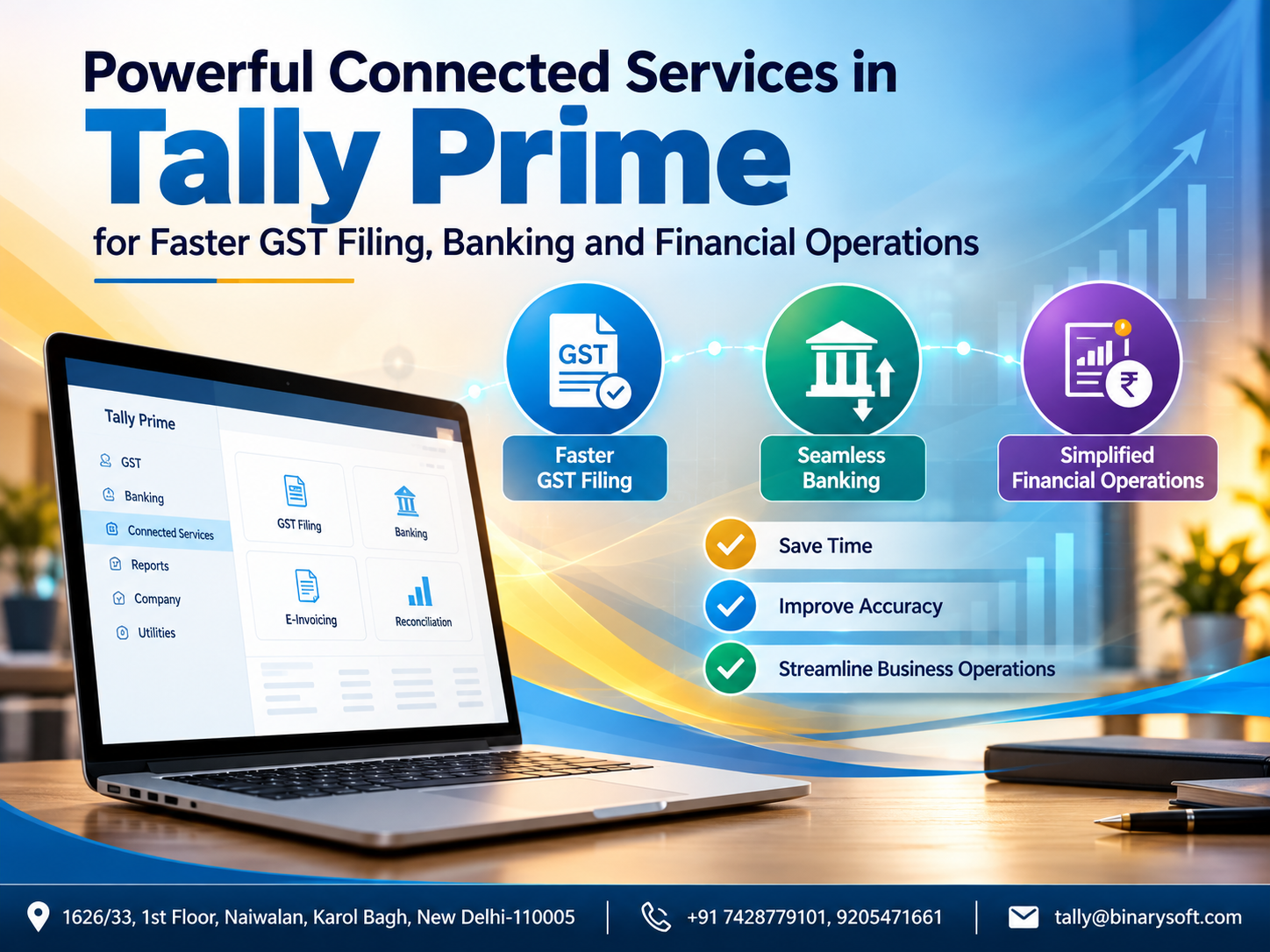
Tally Prime Connected Services help businesses bring selected online activities closer to their everyday accounting environment. Supported capabilities include GST-related data exchange, return preparation and filing workflows, e-invoicing, e-way bill services, bank statement processing and digital business communication. By combining accurate accounting records with appropriate connected features, businesses can reduce repetitive tasks, improve transaction visibility and coordinate financial operations more efficiently while maintaining necessary compliance checks and internal approvals.
1. What Are Connected Services in Tally Prime?
Connected Services are features that enable supported online activities to be performed from, or coordinated with, the Tally Prime accounting environment.
Traditional accounting workflows often require businesses to prepare transactions in one system and manually transfer information to another.
For example, an accountant may prepare GST information, open a government portal, enter credentials, upload files and compare the resulting information with accounting records.
Connected functionality can simplify parts of this process through supported online exchanges.
Depending on the software release, subscription, configuration and service availability, businesses may use connected capabilities for GST-related activities, e-invoicing, e-way bills and other supported services.
The objective is to reduce unnecessary duplication while maintaining control over business transactions.
Connected Services do not eliminate the need for accurate accounting records, authorized access or compliance verification.
2. How Connected GST Simplifies Tax Compliance
GST compliance involves maintaining correct sales and purchase records, applying appropriate tax classifications and preparing accurate return information.
Businesses must also review differences between their books and relevant GST portal data.
Tally Prime provides GST-related accounting, reporting and connected workflows that can support these activities.
Important Connected GST capabilities
-
Preparing GST-related transaction information.
-
Reviewing sales and purchase records.
-
Downloading supported GST portal information.
-
Comparing relevant portal data with accounting records.
-
Identifying differences requiring correction.
-
Supporting applicable GST return workflows.
-
Reviewing the status of supported online activities.
The availability of particular functions depends on the installed release and applicable connected-service arrangements.
For example, a wholesale distributor handling hundreds of monthly purchase invoices can use supported reconciliation facilities to identify differences between recorded purchases and supplier-reported information.
This helps the accounts department investigate discrepancies before completing relevant compliance activities.
3. Faster GSTR-1 Preparation and Filing
GSTR-1 contains details of outward supplies required to be reported by applicable registered taxpayers.
Preparing this information manually can be time-consuming for businesses handling large invoice volumes.
Tally Prime helps businesses organize sales transactions and prepare relevant GST reports.
In supported connected workflows, eligible users can perform applicable upload or filing activities through available services.
Before filing, businesses should verify customer GSTINs, invoice dates, taxable values, tax classifications, credit notes and other relevant details.
Example
A distributor issues 1,200 sales invoices during a month.
Instead of manually compiling information from multiple billing spreadsheets, the accounts team can review recorded transactions through GST reports.
Exceptions can be investigated and corrected before submission.
This approach can reduce duplicate data preparation, although final filing responsibilities remain with the taxpayer and authorized personnel.
4. GSTR-2B Reconciliation and Input Tax Credit Monitoring
Input Tax Credit is an important consideration for GST-registered businesses.
Differences between purchase records and supplier-reported information can create reconciliation difficulties.
Tally Prime supports GST reconciliation workflows that help businesses compare relevant purchase information with downloaded portal data.
Common reconciliation differences
Missing supplier invoices: A purchase recorded in the books may not appear in the relevant portal information.
Incorrect GSTIN: Supplier or recipient registration details may contain errors.
Invoice value mismatch: Taxable values or tax amounts may differ.
Duplicate records: The same invoice may have been entered more than once.
Timing differences: Transactions may appear in different reporting periods.
Businesses should investigate these differences before making input-tax decisions.
Eligibility for Input Tax Credit depends on applicable GST law and conditions, not merely whether a transaction appears in a software report.
5. E-Invoicing for Eligible Businesses
E-invoicing is an important compliance requirement for businesses covered by the applicable GST rules.
Tally Prime provides supported e-invoicing capabilities that help eligible businesses generate and manage electronic invoice information.
A properly configured workflow can assist with submitting relevant invoice details to the Invoice Registration Portal and obtaining the applicable Invoice Reference Number.
The resulting information may include an acknowledgement and QR code, depending on the transaction and service response.
Benefits for businesses
-
Reduced repeated entry of invoice information.
-
Better coordination between billing and e-invoicing.
-
Easier access to relevant invoice reference details.
-
More organized electronic invoice records.
-
Improved consistency between recorded transactions and submitted information.
Businesses must verify their e-invoicing applicability, transaction eligibility, deadlines and statutory requirements.
Software connectivity does not replace these compliance responsibilities.
6. E-Way Bill Management for Goods Movement
Businesses transporting goods may need to generate e-way bills under applicable GST rules.
Tally Prime supports relevant e-way bill workflows in compatible releases and configurations.
A wholesale distributor can record an invoice containing product, quantity, tax and transport-related information.
Supported connected functionality can assist with generating or managing the associated e-way bill details.
This can reduce repeated manual entry across different systems.
However, transport requirements vary according to transaction type, goods, distance, value and applicable exemptions.
Businesses should verify the current rules before dispatching goods.
7. Banking Features and Digital Financial Operations
Bank reconciliation is essential for maintaining reliable financial records.
Businesses receive and make payments through multiple banking channels, creating a need to match bank activity with accounting transactions.
Tally Prime provides banking features that help users record and reconcile relevant transactions.
Supported bank statement import and reconciliation capabilities can reduce manual matching work.
Depending on the release, bank, configuration and service availability, additional connected banking functionality may be available.
Practical example
A retailer records 150 bank-related transactions during a week.
Without structured reconciliation, employees may need to compare every transaction manually.
With supported statement processing and reconciliation tools, the accounts team can identify matching entries and investigate exceptions.
Unmatched transactions still require review to avoid incorrect accounting adjustments.
8. Bank Reconciliation and Transaction Accuracy
A bank reconciliation statement helps compare the company's recorded bank ledger with the corresponding bank statement.
Differences may arise because of uncleared cheques, bank charges, interest entries, omitted transactions or recording errors.
Tally Prime helps users review these differences.
Illustrative reconciliation
|
Particulars
|
Amount
|
|---|
|
Bank ledger balance
|
₹5,20,000
|
|
Add: Deposits not yet reflected by bank
|
₹40,000
|
|
Less: Issued cheques not yet cleared
|
₹25,000
|
|
Adjusted reconciliation balance
|
₹5,35,000
|
This simplified example illustrates the importance of timing differences. The actual reconciliation treatment depends on the starting balance, statement date and transaction status.
Regular reconciliation helps businesses maintain more dependable financial information and identify problems earlier.
9. Digital Invoice Sharing and Business Communication
Businesses frequently need to send invoices, payment information and financial documents to customers.
Tally Prime provides supported invoice printing, exporting, emailing and digital sharing options.
Depending on the installed release and applicable service arrangements, businesses may also use supported WhatsApp-related capabilities.
For example, a wholesaler can prepare a sales invoice and share the relevant document with a customer using an available communication method.
This can reduce delays associated with physical paperwork.
Digital communication should be supported by correct customer contact information, appropriate authorization and privacy-conscious handling of business documents.
10. Financial Reports for Better Management Decisions
Connected activities become more valuable when they are supported by accurate financial reporting.
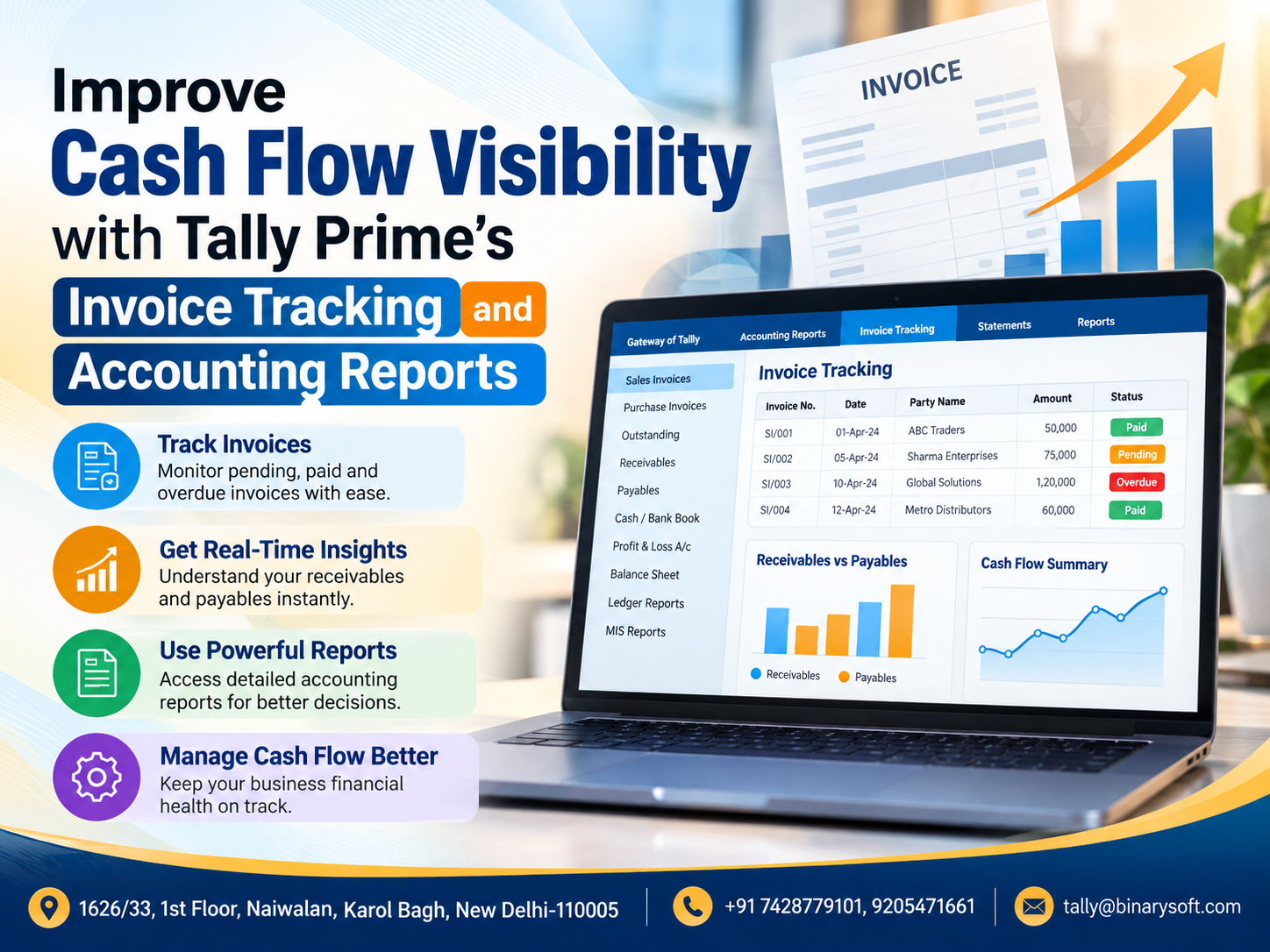
Tally Prime provides reports such as the Profit & Loss Account, Balance Sheet, Cash Flow, Trial Balance, Sales Register and outstanding statements.
|
Report
|
Business benefit
|
|---|
|
Profit & Loss Account
|
Evaluates income and profitability
|
|
Balance Sheet
|
Reviews assets and liabilities
|
|
Cash Flow
|
Examines recorded cash movements
|
|
Sales Register
|
Reviews sales transactions
|
|
Purchase Register
|
Examines purchasing activity
|
|
Bills Receivable
|
Tracks customer dues
|
|
Bills Payable
|
Monitors supplier obligations
|
|
GST Reports
|
Reviews tax-related transaction information
|
|
Bank Reconciliation
|
Identifies differences in banking records
|
Management can use these reports to understand financial performance and identify operational issues.
For example, increasing sales combined with growing customer outstanding balances may indicate that collections require attention.
11. An Emotional Story: When a GST Deadline Threatened a Family Business
The following story is fictional and illustrates a common business challenge.
For sixteen years, Arvind had operated a wholesale distribution business in Delhi.
His father had started the company with a small shop, and Arvind had gradually expanded its operations.
The business supplied goods to retailers across Delhi NCR and employed several people who depended on its success.
As transaction volumes increased, GST reporting became more complicated.
The accounts team maintained purchase information in spreadsheets and regularly compared records with downloaded portal information.
One evening, shortly before an important compliance deadline, Arvind discovered several mismatches in the company's purchase records.
His accountant was struggling to identify which invoices required correction.
Arvind became worried.
He was not only concerned about compliance. He feared that repeated accounting problems could affect the business's reputation and create financial pressure.
He remembered his father's belief that customers and suppliers should always be able to trust the company's records.
Arvind decided to strengthen the accounting process.
The business reorganized its GST masters, reviewed transaction classifications and began using supported reconciliation features in Tally Prime.
Employees were trained to verify supplier details and investigate exceptions regularly rather than waiting until filing deadlines approached.
Over time, the team developed a more organized compliance routine.
Arvind could review accounting information with greater confidence, and employees spent less time searching through disconnected records.
For him, modernization was not simply about adopting new software.
It was about protecting the business his father had built and creating a more dependable future for everyone associated with it.
12. Case Study One: Electrical Goods Wholesaler in Delhi
Illustrative case study; figures and outcomes are hypothetical.
Business background
An electrical goods wholesaler supplied retailers and contractors across Delhi NCR.
The company handled frequent GST invoices, supplier purchases and interstate sales.
Challenges
-
Time-consuming GST report preparation.
-
Purchase reconciliation differences.
-
Repeated manual data entry.
-
Delays in preparing e-invoicing information.
-
Difficulty tracking relevant online activity.
Proposed Tally Prime implementation
The business reviewed GST masters, configured relevant tax details and introduced supported Connected GST workflows.
Employees began reviewing GST exceptions regularly.
Eligible e-invoicing activities were incorporated into the billing process.
Illustrative improvement targets
|
Activity
|
Previous process
|
Target
|
|---|
|
GST data preparation
|
8 hours
|
3 hours
|
|
Purchase reconciliation
|
Manual spreadsheet review
|
Supported reconciliation workflow
|
|
Invoice verification
|
Periodic
|
Regular
|
|
E-invoice processing
|
Separate workflow
|
Integrated supported process
|
|
Exception monitoring
|
Deadline-driven
|
Scheduled review
|
Expected business impact
The proposed workflow would reduce repeated data preparation and improve visibility into reconciliation differences.
The main lesson is that connected services work best when supported by accurate accounting records and regular compliance review.
13. Case Study Two: FMCG Distributor Managing Banking and GST
Illustrative case study; figures are hypothetical.
Business background
An FMCG distributor supplied packaged consumer products to supermarkets and retail stores.
The business handled frequent customer receipts, supplier payments and GST-related transactions.
Challenges
The accounts team spent considerable time matching bank transactions and preparing GST-related reports.
Management also needed better visibility into outstanding customer balances.
Proposed solution
The company introduced structured bank reconciliation procedures and reviewed available connected banking features.
GST accounting configurations were checked, and employees received training in relevant reconciliation workflows.
Management began reviewing receivables, payables and financial reports more frequently.
Expected improvements
The proposed approach would reduce dependence on disconnected spreadsheets and help identify accounting exceptions earlier.
It would also support more consistent financial reporting.
Key takeaway
The greatest value of connected accounting comes from combining reliable transaction records, appropriate online services and disciplined internal review.
14. Step-by-Step Guide to Using Connected Services in Tally Prime
Businesses should adopt Connected Services through a structured implementation process.
Step 1: Review the installed release. Confirm the Tally Prime version, subscription status and available connected functionality.
Step 2: Verify company details. Check business information, GST registration details and relevant accounting configurations.
Step 3: Configure GST features. Enable applicable GST options and verify tax ledgers and classifications.
Step 4: Review user permissions. Ensure that only authorized personnel can perform sensitive accounting and online activities.
Step 5: Configure supported connectivity. Complete the applicable authentication and service setup.
Step 6: Review transaction records. Verify sales invoices, purchase invoices, GSTINs and tax information.
Step 7: Use available GST workflows. Download, reconcile, upload or file relevant information where supported and applicable.
Step 8: Configure banking functions. Set up relevant bank ledgers and supported statement processing.
Step 9: Review exceptions. Investigate unmatched transactions and GST differences.
Step 10: Monitor reports. Examine financial, GST and banking reports regularly.
Menu names and available functionality may vary by release, subscription and service provider.
15. Tally Prime on Cloud and Connected Business Operations
Businesses operating across multiple branches may benefit from a properly configured cloud-hosted Tally Prime environment.
Cloud hosting can allow authorized employees to access centralized accounting records from approved locations.
For example, a business owner travelling to meet suppliers may review outstanding balances and financial reports remotely.
The accounts department can continue recording transactions and performing supported connected activities within the hosted environment.
However, cloud hosting requires appropriate software licensing, connectivity, user permissions and security arrangements.
Businesses should also verify compatibility between the hosting environment and the connected services they intend to use.
16. Security and Compliance Considerations
Connected accounting involves financial information and potentially sensitive authentication processes.
Businesses should establish clear security procedures before enabling online services.
Important measures include strong passwords, restricted user permissions, secure devices and regular software updates.
Employees should never share sensitive authentication credentials unnecessarily.
Banking and GST activities should be performed only by authorized personnel.
Businesses should also maintain suitable backup arrangements and review connected activity statuses to identify failed or incomplete transactions.
Security and compliance remain shared operational responsibilities even when software supports online connectivity.
17. How Binarysoft Technologies Can Help
Binarysoft Technologies, an Authorized Tally Partner based in Karol Bagh, New Delhi, can assist businesses in evaluating Tally Prime accounting and connected-service requirements.
Retailers, wholesalers, distributors and service providers can discuss GST accounting, supported connected workflows, e-invoicing, e-way bills, bank reconciliation and financial reporting.
Businesses seeking remote access can also evaluate suitable cloud-hosting arrangements according to their operational requirements.
The objective is to establish a dependable accounting environment that supports efficient financial operations and informed business decisions.
Conclusion
Powerful Connected Services in Tally Prime can help Indian businesses simplify selected GST, banking, invoicing and financial workflows.
Supported Connected GST capabilities can reduce repeated data preparation and help identify reconciliation differences.
E-invoicing and e-way bill services can support eligible businesses in managing relevant compliance activities.
Bank reconciliation and digital communication features can improve the organization of everyday financial operations.
However, connected functionality does not eliminate the need for accurate records, statutory verification, authorized approvals and regular internal review.
With appropriate configuration, employee training and disciplined accounting practices, Tally Prime can help retailers, wholesalers, distributors and service providers build more efficient and reliable business processes.
Powered by Binarysoft Technologies
Authorized Tally Partner
Location: 1626/33, 1st Floor, Naiwalan, Karol Bagh, New Delhi – 110005, INDIA
Contact us: +91 7428779101, 9205471661
Email us: tally@binarysoft.com
Business Hours: 10:00 AM – 6:00 PM, Monday to Friday
Frequently Asked Questions
What are Connected Services in Tally Prime?
Connected Services are supported online capabilities that help businesses perform or coordinate selected GST, e-invoicing, e-way bill and other activities through their accounting environment.
Can Tally Prime help with GST return filing?
Yes. Supported GST features can assist with return preparation, reconciliation and applicable connected filing workflows, depending on the release and configuration.
Does Tally Prime support GSTR-2B reconciliation?
Yes. Compatible releases provide relevant reconciliation capabilities to compare purchase records with downloaded GST information.
Can businesses generate e-invoices through Tally Prime?
Eligible businesses can use supported e-invoicing functionality, subject to applicable statutory requirements and service availability.
CA. Lakshit Chordia works with MSMEs on accounting automation, tax compliance, and financial reporting. His approach focuses on practical solutions that improve accounting accuracy and provide business owners with clearer financial information.