Call CA Tally HelpDesk
+91 9205471661,
7428779101
In 2026, Indian businesses are under increasing pressure to maintain accurate financial records, reconcile GST transactions, manage invoices, and monitor cash flow without wasting valuable working hours. Traditional accounting processes involving repeated data entry, manual GST calculations, spreadsheet comparisons, and bank statement verification can create unnecessary delays and costly mistakes. As businesses handle growing transaction volumes and tighter compliance requirements, the demand for connected accounting software is becoming more important than ever.
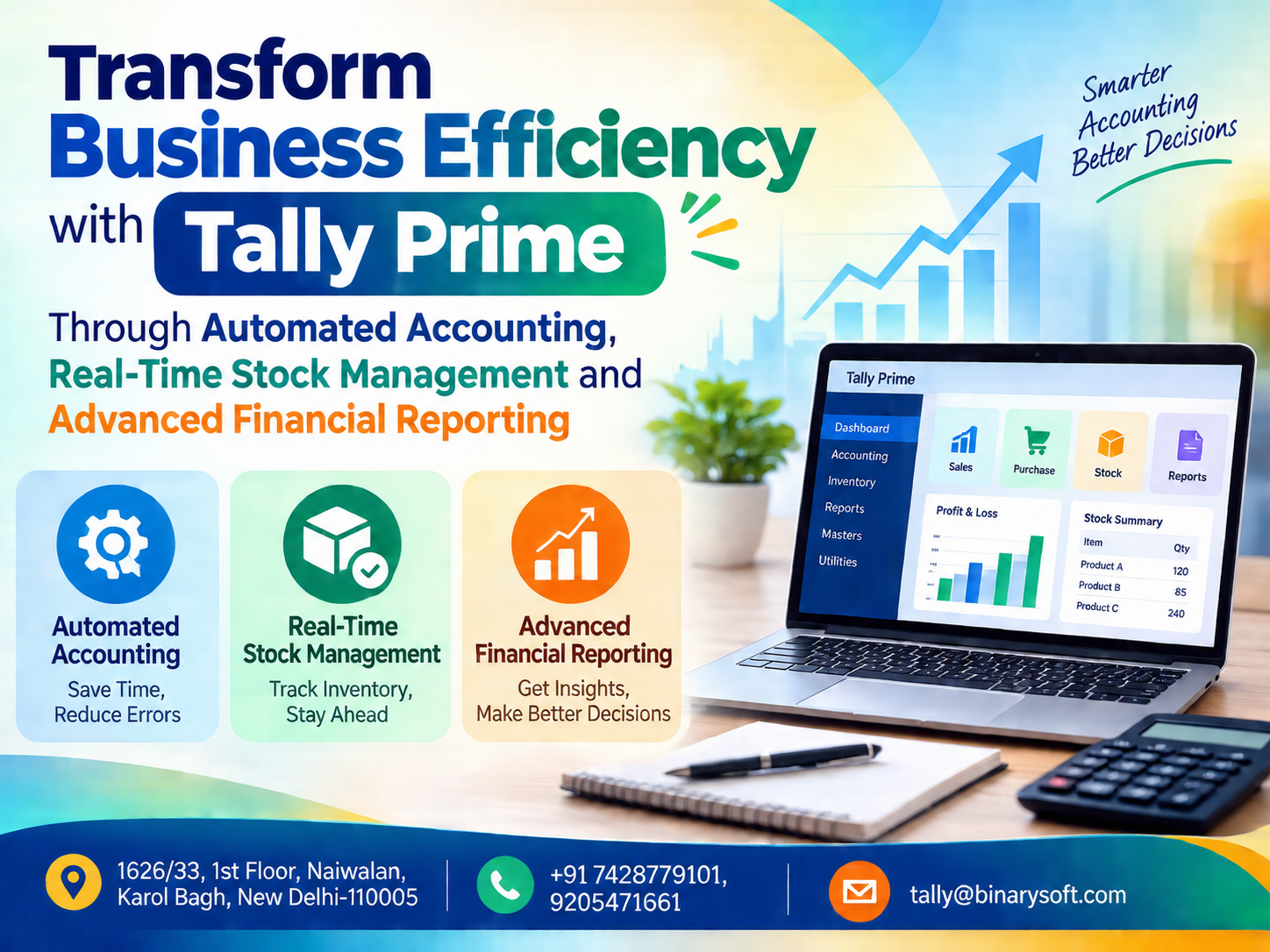
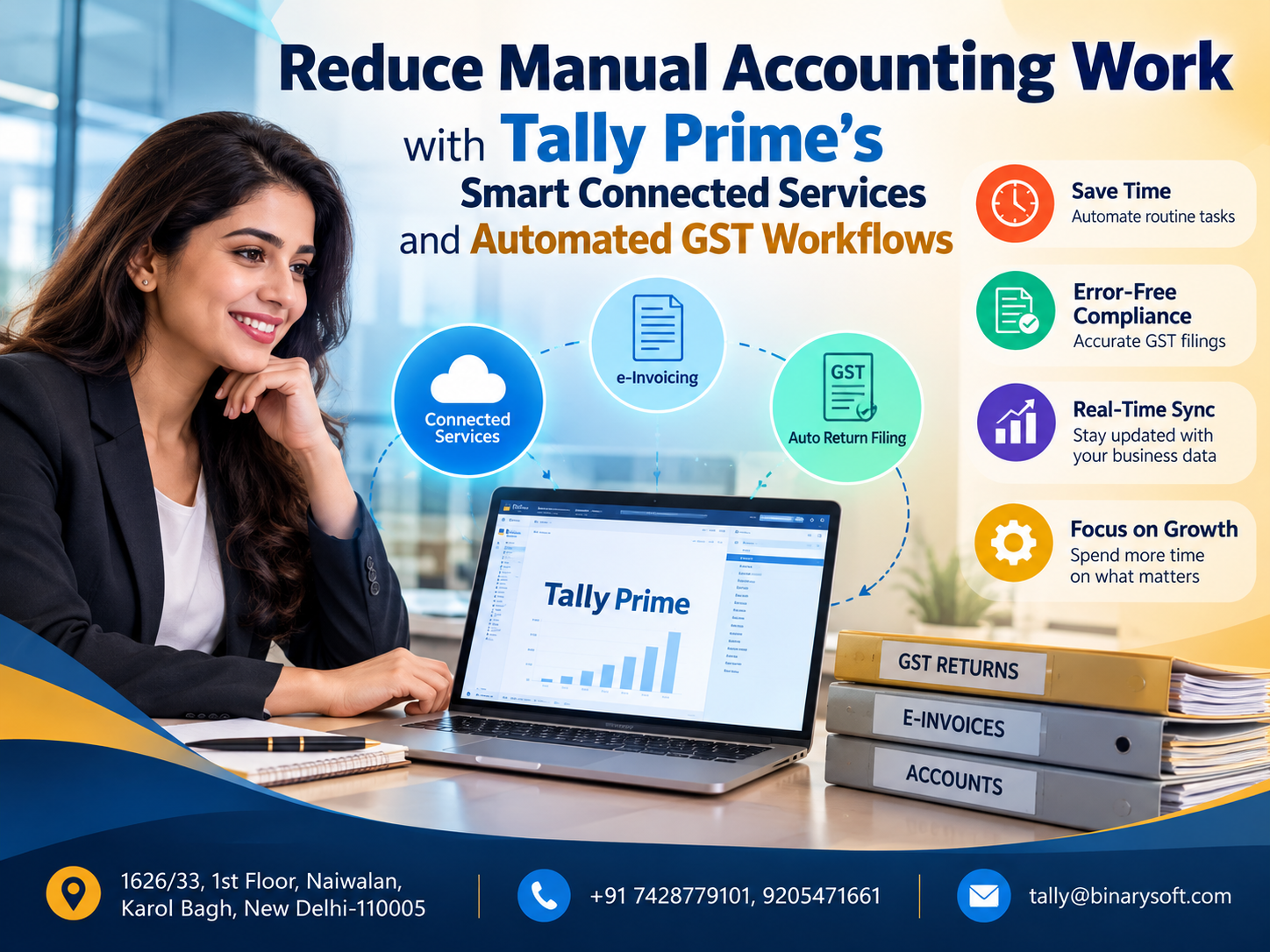
Tally Prime helps businesses address these challenges through smart connected services, automated GST workflows, digital invoicing, bank reconciliation, and real-time financial reporting. Instead of managing accounting and compliance as disconnected activities, businesses can bring important financial operations into a more organized system.
For retailers, wholesalers, manufacturers, distributors, and service providers, adopting Tally Prime's connected capabilities can reduce repetitive accounting tasks, improve financial visibility, and help teams focus on business growth rather than paperwork.
Why Manual Accounting Is Becoming a Major Challenge for Indian Businesses
Accounting is essential for every business, but traditional methods often consume considerable time and resources.
Many organizations continue to depend on spreadsheets, manual voucher entries, separate GST calculations, and repeated verification of financial transactions.
Although these methods may work for businesses with limited transactions, they become increasingly difficult to manage as operations expand.
Common challenges include:
-
Repeated entry of sales and purchase transactions.
-
Manual GST calculation and invoice verification.
-
Differences between accounting records and GST portal data.
-
Delays in bank reconciliation.
-
Incorrect customer and supplier ledger balances.
-
Difficulty tracking outstanding payments.
-
Time-consuming preparation of financial statements.
-
Limited visibility into daily business performance.
-
Errors caused by duplicate or missing transactions.
-
Increased workload during monthly and quarterly GST compliance.
When accounting teams spend most of their working hours correcting records, they have less time to analyze financial performance and support business decisions.
Tally Prime provides integrated accounting, inventory, taxation, and connected services that can simplify many of these activities.
A Business Owner's Story: From Late-Night GST Reconciliation to Better Financial Control
Consider the example of Rajesh, a fictional wholesale electronics distributor operating in Delhi.
His business had grown steadily over several years. What started as a small trading operation eventually developed into a distribution business handling hundreds of invoices every month.
However, business growth created an unexpected problem.
His accounting team was struggling to manage increasing transaction volumes.
Every month, employees spent several days comparing purchase invoices with GST records, checking customer payments, verifying bank statements, and preparing financial reports.
During one particularly busy month, Rajesh discovered that several purchase invoices had not been properly reconciled with the available GST information.
The accounting team had to review numerous transactions manually.
Some supplier invoices were missing from their records, while other entries contained incorrect GST details.
Rajesh became increasingly worried.
He was concerned about possible compliance problems, delayed reporting, and the financial impact of inaccurate records.
More importantly, he realized that his employees were spending valuable time correcting accounting mistakes instead of supporting customers and improving operations.
After reviewing his processes, Rajesh decided to organize his accounting activities using Tally Prime's connected GST and banking capabilities.
His team began maintaining structured sales and purchase records, using available GST reconciliation facilities, and importing supported bank statements for reconciliation.
Gradually, the accounting process became more manageable.
Instead of manually checking every transaction from the beginning, employees could focus on identifying and resolving exceptions.
Rajesh gained better visibility into receivables, payables, inventory, and financial reports.
The biggest change was not simply faster accounting.
It was the confidence that came from having a clearer understanding of his business finances.
This illustrative story reflects a challenge faced by many growing Indian businesses: accounting efficiency becomes increasingly important as transaction volumes rise.
1. What Are Smart Connected Services in Tally Prime?
Smart connected services are capabilities that allow supported accounting activities to interact with external digital systems and services.
Instead of treating accounting software as an isolated recordkeeping application, connected services help businesses access relevant information, exchange supported data, and complete certain compliance-related activities through integrated workflows.
Tally Prime provides connected capabilities for activities such as GST compliance, e-invoicing, e-Way Bills, banking, and business communication, depending on the software release, subscription, configuration, and applicable service availability.
Important connected accounting capabilities
Connected GST services
Businesses can use supported GST facilities to manage return-related activities, download available GST information, and compare accounting records with portal data.
E-invoicing integration
Eligible businesses can generate and manage e-invoices through supported connected workflows, subject to GST requirements.
E-Way Bill management
Businesses can manage applicable e-Way Bill activities using supported Tally Prime functionality.
Banking integration
Supported bank statement import and reconciliation features help businesses match financial transactions more efficiently.
Digital communication
Businesses can share invoices, statements, and reports through supported communication options.
Connected financial information
Accounting and business reporting features help authorized users access relevant financial information and make informed decisions.
These capabilities can reduce dependence on separate systems and repetitive data handling.
2. Automate GST Workflows and Reduce Repetitive Compliance Tasks
GST compliance remains one of the most important accounting responsibilities for Indian businesses.
Businesses must maintain accurate tax invoices, classify transactions correctly, verify GSTIN information, reconcile eligible input tax credit, and prepare returns within applicable deadlines.
Manual GST processes can become difficult when hundreds or thousands of transactions are involved.
Tally Prime helps simplify GST accounting by connecting transaction recording with compliance-oriented reporting and reconciliation.
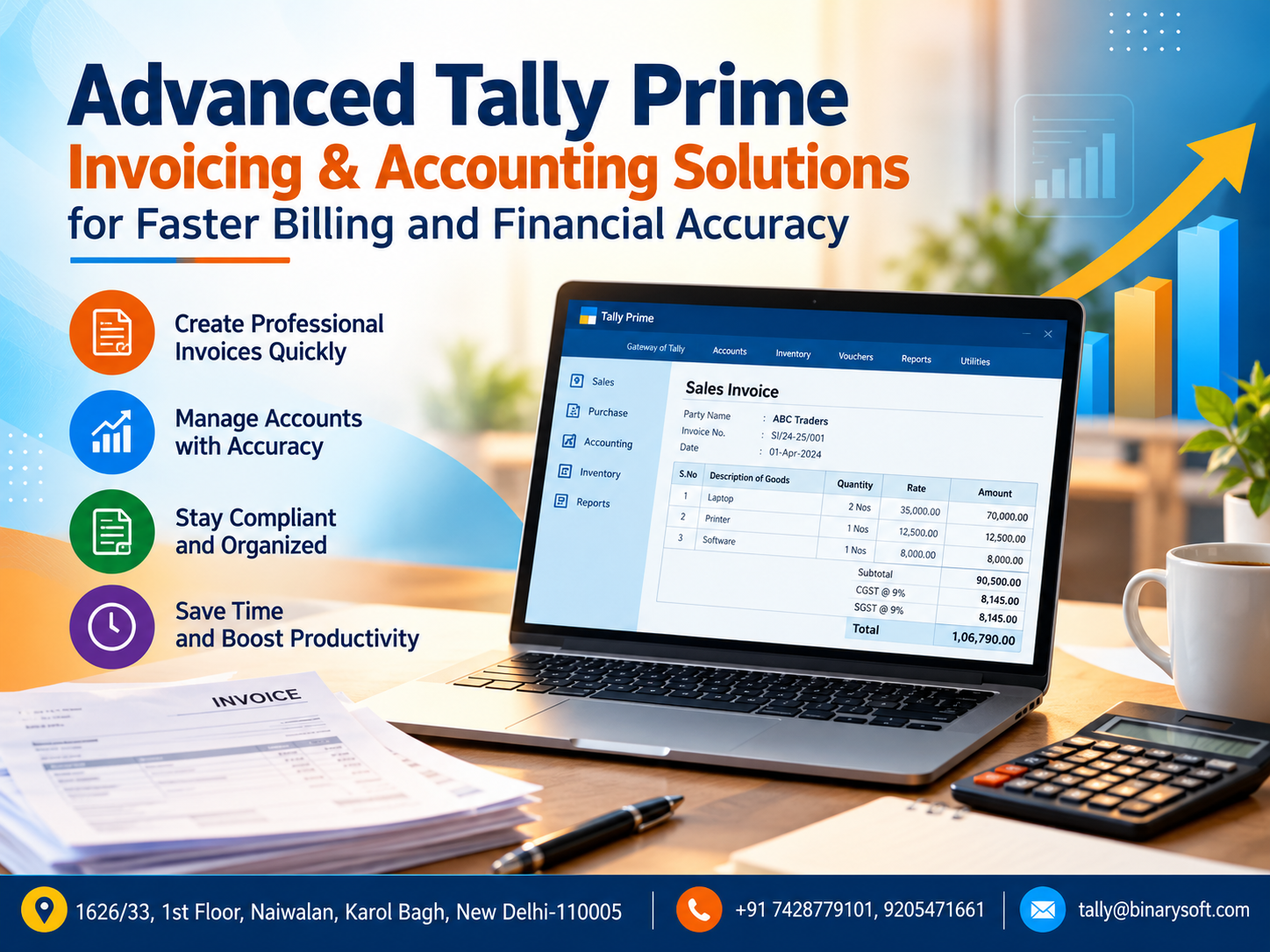
GST calculation during invoice creation
When GST masters, tax classifications, and transaction details are configured correctly, Tally Prime can calculate applicable GST amounts during voucher entry.
Depending on the transaction, the software can account for:
-
Central Goods and Services Tax (CGST).
-
State Goods and Services Tax (SGST).
-
Integrated Goods and Services Tax (IGST).
-
Applicable GST rates.
-
HSN and SAC information.
-
Taxable transaction values.
-
Relevant invoice and party details.
For example, consider a business selling taxable goods worth ₹50,000 at an illustrative GST rate of 18%.
|
Particulars
|
Amount
|
|---|
|
Taxable value
|
₹50,000
|
|
CGST at 9%
|
₹4,500
|
|
SGST at 9%
|
₹4,500
|
|
Total invoice value
|
₹59,000
|
For an eligible intra-state transaction, the correct tax configuration allows the accounting software to calculate and record the tax components.
The business must still verify the applicable GST rate, place of supply, and transaction classification.
Benefits of structured GST accounting
Businesses can improve consistency in invoice preparation, reduce repeated calculations, identify incomplete tax information, and maintain better records for return preparation.
This is particularly useful for wholesalers, manufacturers, distributors, and businesses handling large numbers of taxable transactions.
3. Connected GST Reconciliation for Better Input Tax Credit Management
Input Tax Credit (ITC) management is a critical responsibility for GST-registered businesses.
Differences between purchase records and available GST portal information can create challenges when reviewing eligible credit.
Common reasons for mismatches include incorrect GSTIN details, missing supplier invoices, different invoice dates, duplicate entries, and differences in taxable or tax amounts.
Tally Prime's supported GST reconciliation facilities help businesses compare accounting records with available GST information.
How the reconciliation workflow works
A typical process involves maintaining purchase transactions in Tally Prime, obtaining the relevant GST portal data through supported facilities, comparing invoice details, and reviewing discrepancies.
The accounting team can then investigate missing or mismatched transactions and coordinate with suppliers where necessary.
Example of an ITC reconciliation difference
A distributor records an eligible purchase invoice containing ₹18,000 in GST.
However, the corresponding invoice does not appear in the relevant GSTR-2B statement.
Without reconciliation, the business may overlook this difference.
A structured reconciliation process helps the accounting team identify the issue and contact the supplier for clarification.
Importantly, the availability of an invoice in accounting records does not by itself establish ITC eligibility. Businesses must follow the applicable GST law and conditions when claiming credit.
Why this matters
Regular reconciliation helps businesses detect discrepancies earlier, maintain stronger supporting records, and reduce last-minute pressure during GST return preparation.
4. Simplify GSTR-1 and GSTR-3B Preparation
Preparing GST returns requires accurate accounting information.
For businesses handling numerous invoices, manually consolidating transaction data can consume significant time.
Tally Prime provides GST reports and supported connected workflows that assist businesses in reviewing and preparing relevant return information.
GSTR-1 management
GSTR-1 generally contains outward supply information, including relevant B2B and B2C transactions, credit and debit notes, and other reportable details.
With properly recorded transactions, businesses can review return-related information and identify issues requiring correction.
Supported connected functionality may also help with uploading and tracking relevant return data.
GSTR-3B management
GSTR-3B is a summary return used to report applicable tax liabilities and input tax credit information.
Tally Prime helps organize relevant accounting data for review.
Businesses should reconcile their records with GST portal information and verify applicable adjustments before filing.
Benefits of connected return workflows
The primary advantage is reducing repeated data preparation.
Instead of preparing every return-related figure independently, accounting teams can work from maintained transaction records and review exceptions.
Actual filing steps and available connected functionality depend on the Tally Prime release and service configuration.
5. Automate E-Invoicing and Reduce Invoice Processing Delays
E-invoicing is an important compliance requirement for businesses covered by the applicable GST turnover and transaction rules.
For eligible transactions, the prescribed invoice details must be reported through the Invoice Registration Portal (IRP) to obtain an Invoice Reference Number (IRN).
Tally Prime supports connected e-invoicing workflows that can help businesses manage this process.
How connected e-invoicing helps
Businesses can prepare invoices in Tally Prime, validate relevant information, and use supported connected services to submit applicable invoice details.
Following successful IRP processing, the relevant IRN and other information can be associated with the invoice.
This can reduce the need to manually re-enter the same invoice information into another system.
Business advantages
-
Reduced duplication of invoice-related work.
-
More consistent invoice information.
-
Improved visibility into e-invoice processing.
-
Easier management of relevant invoice records.
-
Better coordination between billing and compliance teams.
E-invoicing requirements, thresholds, reporting timelines, and eligibility must be checked against current government notifications.
6. Manage E-Way Bills Through Connected Accounting Workflows
Businesses involved in the movement of goods may need to generate e-Way Bills when the applicable statutory conditions are met.
Preparing e-Way Bills separately can require additional data entry and verification.
Tally Prime's supported e-Way Bill functionality helps businesses manage relevant transport and invoice information within their accounting workflow.
Relevant details may include
-
Supplier and recipient information.
-
Invoice number and date.
-
Goods description.
-
HSN information.
-
Taxable and invoice values.
-
Transporter details.
-
Vehicle and transport information.
When properly configured, the connected workflow can reduce repeated entry of invoice-related details.
This is especially useful for manufacturers, distributors, wholesalers, and businesses handling frequent goods movement.
However, businesses remain responsible for verifying e-Way Bill applicability and the accuracy of transport information.
7. Reduce Manual Banking Work with Bank Statement Import and Reconciliation
Bank reconciliation is another accounting activity that can consume considerable time.
Businesses receive payments from customers, make supplier payments, pay salaries, and incur various operating expenses.
When bank transactions are not reconciled regularly, differences may remain unnoticed.
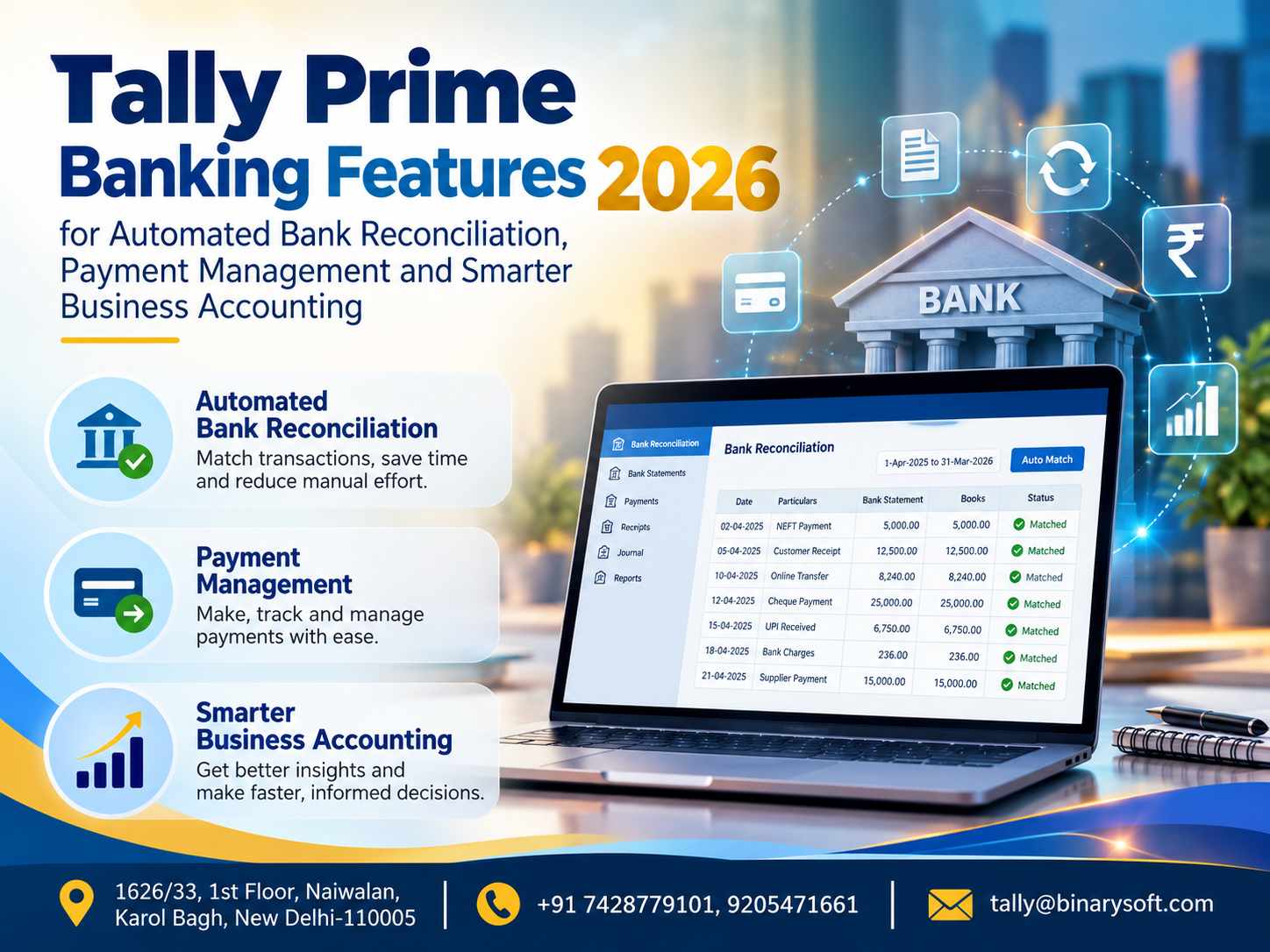
Tally Prime provides banking features that help businesses import supported bank statements and reconcile relevant transactions.
Traditional bank reconciliation challenges
Accounting teams may need to compare bank statements with recorded vouchers, identify unmatched transactions, and investigate payment differences.
This becomes more difficult when a business operates multiple bank accounts or handles high transaction volumes.
How Tally Prime improves the process
Supported bank statement import and reconciliation functionality can help accounting teams identify matching transactions and focus attention on exceptions.
For example, a business may record a customer receipt of ₹75,000.
When the corresponding bank transaction appears in an imported statement, the accounting team can reconcile it against the recorded receipt.
If the amounts or details do not match, the difference can be investigated.
Benefits
Bank reconciliation becomes more systematic, financial records can be updated more promptly, and businesses gain clearer visibility into available funds.
The extent of automation depends on the supported bank, statement format, software release, and configured banking facilities.
8. Improve Customer Payment Tracking and Receivables Management
Delayed customer payments can create serious cash flow problems.
Even profitable businesses may struggle to pay suppliers and meet operating expenses when customers do not settle invoices on time.
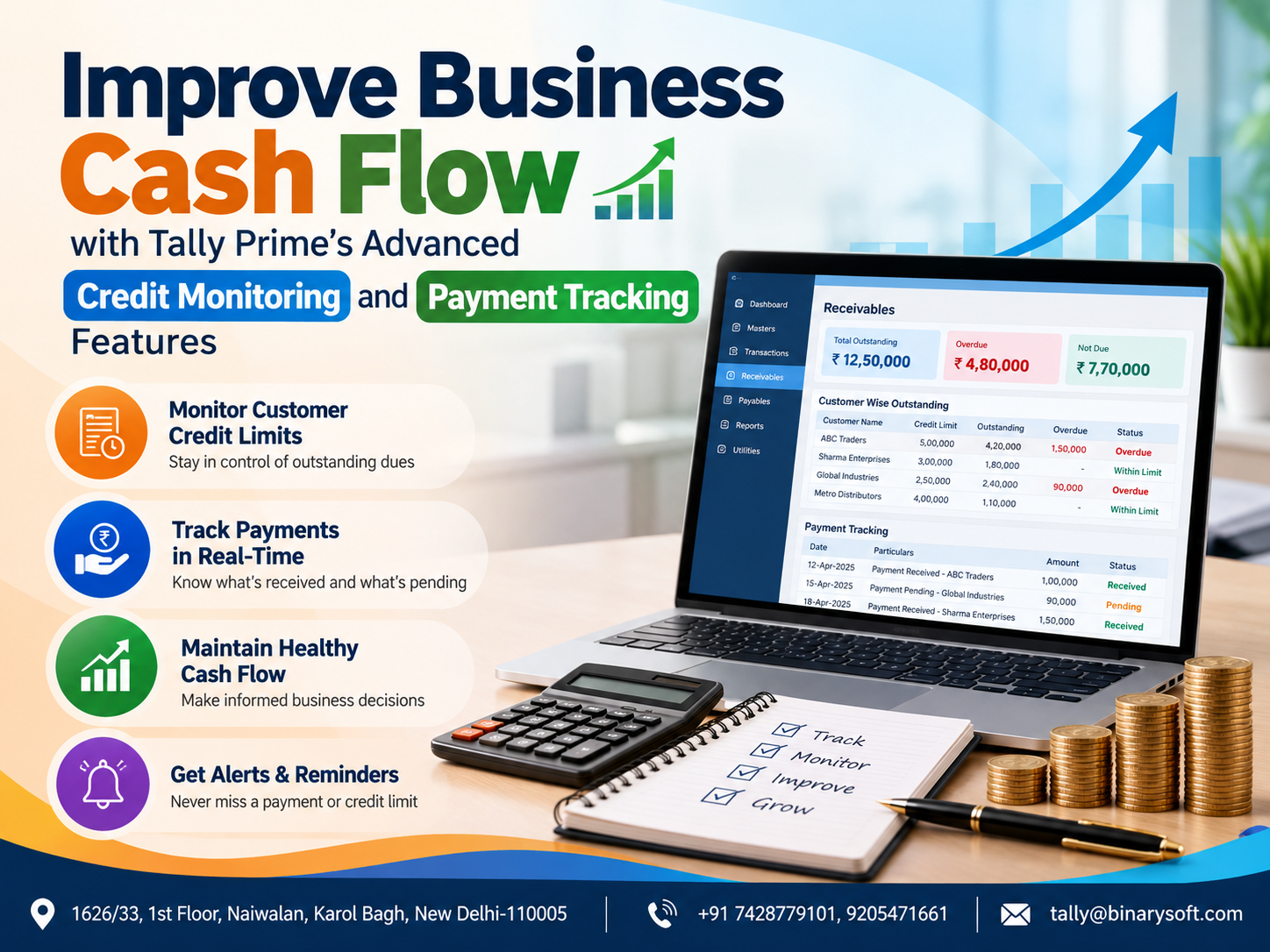
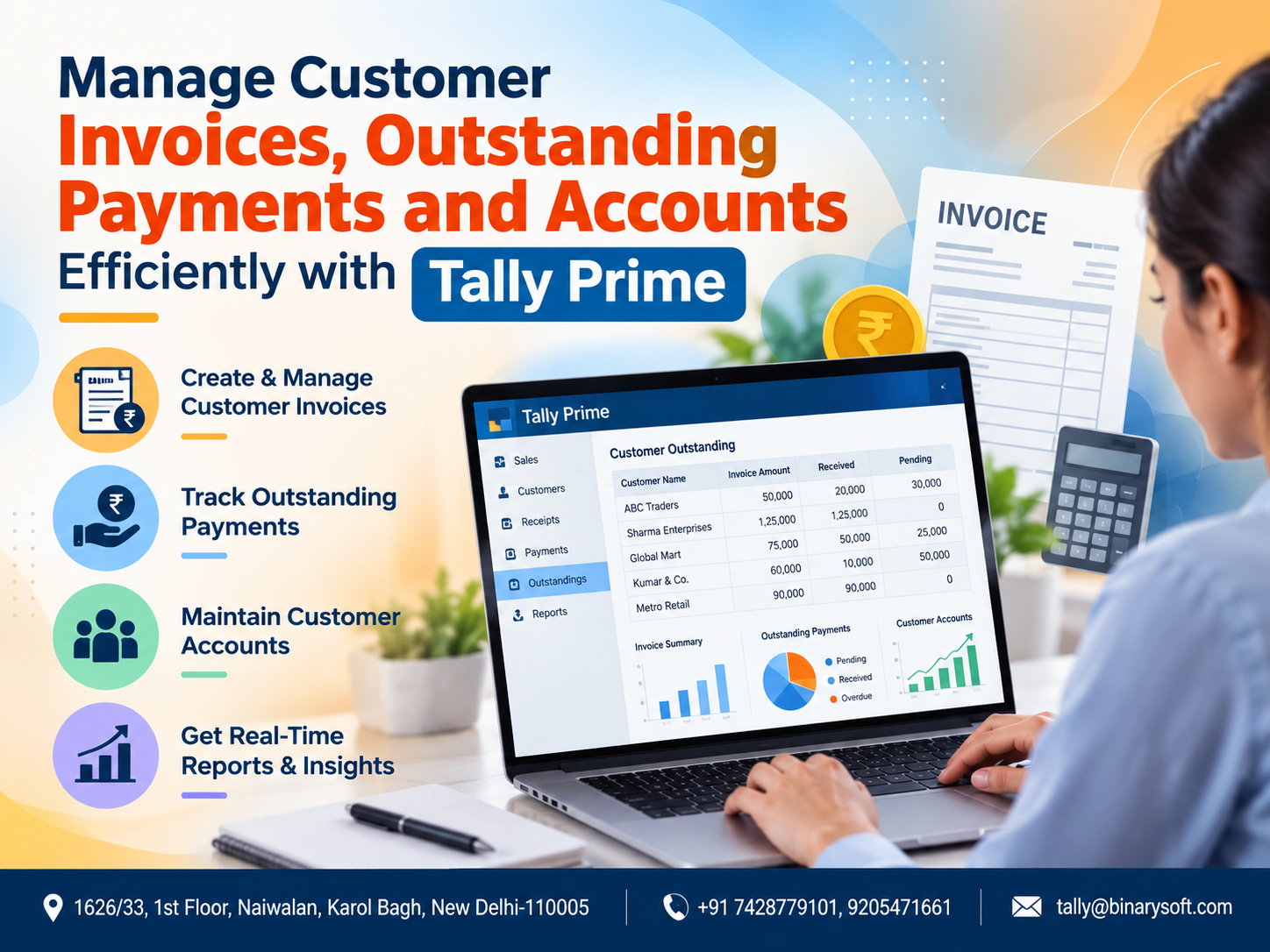
Tally Prime helps businesses maintain customer ledgers, track outstanding invoices, and review receivables.
Key receivables management activities
Businesses can review customer-wise outstanding balances, bill-wise receivables, overdue amounts, and relevant financial reports.
This information helps accounting teams prioritize follow-up activities.
Example
Suppose a distributor has the following outstanding invoices:
|
Customer
|
Outstanding amount
|
Overdue days
|
|---|
|
Customer A
|
₹85,000
|
12
|
|
Customer B
|
₹1,40,000
|
30
|
|
Customer C
|
₹62,000
|
45
|
|
Total
|
₹2,87,000
|
|
A structured receivables report helps management identify which customers require immediate attention.
Instead of searching through multiple spreadsheets, the team can review maintained ledger information.
Timely follow-up can support better cash flow and reduce uncertainty.
9. Simplify Supplier Payments and Accounts Payable Management
Supplier payment management is equally important.
Late payments may damage supplier relationships, while duplicate or incorrect payments can affect profitability.
Tally Prime helps businesses maintain supplier ledgers and review payable balances.
Important payable management features
Businesses can track outstanding supplier invoices, review payment obligations, and use financial reports to support payment planning.
When purchase transactions and payments are recorded accurately, accounting teams can identify outstanding amounts more easily.
Business impact
A company that understands its upcoming payment obligations can plan cash requirements more effectively.
This is especially useful for businesses purchasing goods on credit.
Better payable management also supports stronger supplier relationships and more disciplined working capital planning.
10. Connect Inventory Management with Accounting
One of the major advantages of integrated business software is the connection between inventory and accounting.
When stock records and financial records are maintained separately, differences may occur.
For example, a sales invoice may be recorded in accounting software while the stock quantity is updated manually in another system.
This can create inconsistencies.
Tally Prime supports integrated inventory and accounting functionality.
Inventory activities businesses can manage
-
Stock item creation and classification.
-
Purchase and sales transactions.
-
Stock quantity tracking.
-
Godown and location management.
-
Batch-related inventory records where configured.
-
Stock valuation.
-
Inventory movement reporting.
-
Reorder-related analysis.
-
Inventory and financial reporting.
Example
A wholesale trader purchases 500 units of a product.
During the month, the business sells 325 units.
Assuming there are no other stock movements, the remaining quantity is:
500 − 325 = 175 units.
With correctly configured inventory records and transactions, the business can review the available quantity without separately calculating every movement.
This reduces repetitive work and improves stock visibility.
11. Reduce Errors with Better Accounting Data Validation
Accounting automation is most effective when businesses maintain accurate data.
Incorrect ledger selection, incomplete GST details, duplicate invoices, and inconsistent master records can still create problems.
Tally Prime provides reporting, configuration, and validation-related facilities that can help accounting teams identify certain issues.
Areas requiring regular review
Ledger accuracy: Ensure customer, supplier, expense, income, and tax ledgers are correctly classified.
GST information: Verify GSTIN, registration type, tax classification, and relevant invoice details.
Voucher consistency: Maintain appropriate voucher types and transaction dates.
Duplicate transactions: Review suspicious or repeated entries before finalizing records.
Inventory masters: Maintain consistent item names, units, and relevant tax information.
Banking records: Reconcile imported transactions and investigate unmatched entries.
Automation reduces repetitive activity, but it does not eliminate the need for accounting controls.
12. Use Real-Time Financial Reports for Better Business Decisions
Accounting software should do more than record historical transactions.
Business owners need timely information about profitability, expenses, receivables, payables, and financial position.
Tally Prime provides financial reporting features that help management review important business information.
Profit and Loss Statement
The Profit and Loss Statement helps businesses understand revenue, expenses, and profitability for a selected period.
Balance Sheet
The Balance Sheet provides information about assets, liabilities, and capital.
Cash Flow Statement
Cash flow reporting helps businesses understand how money moves through operating, investing, and financing activities, as represented in their accounting records.
Outstanding reports
Receivables and payables reports help management monitor unpaid customer and supplier balances.
Inventory reports
Stock summaries and related reports help businesses review quantities, values, and movement.
These reports can support better financial decisions when transactions are recorded completely and accurately.
13. Improve Accounting Team Productivity Through Standardized Workflows
A major benefit of accounting automation is the opportunity to improve employee productivity.
Consider an accounting team that spends several hours each day checking invoices, comparing bank transactions, and preparing GST-related information.
By implementing structured accounting processes and supported connected features, the team may be able to reduce repetitive checking and focus on exceptions.
Illustrative time-saving example
|
Accounting activity
|
Manual process
|
Streamlined process
|
|---|
|
Bank reconciliation
|
5 hours
|
2 hours
|
|
GST data comparison
|
8 hours
|
3 hours
|
|
Invoice verification
|
4 hours
|
2 hours
|
|
Outstanding report preparation
|
3 hours
|
1 hour
|
|
Total
|
20 hours
|
8 hours
|
In this hypothetical example, the business saves 12 hours, representing a 60% reduction in the time spent on these activities.
These figures are illustrative, not measured Tally Prime performance results. Actual savings depend on transaction volumes, data quality, staff training, and available features.
The broader advantage is that accounting professionals can devote more attention to analysis, planning, and financial controls.
14. Strengthen Accounting Security and Data Management
Financial records contain sensitive business information.
Customer balances, supplier details, bank transactions, sales information, and financial statements must be protected against unauthorized access and accidental loss.
Tally Prime includes security and user-access facilities that businesses can configure according to their requirements.
Important security practices
Businesses should implement appropriate user permissions, restrict sensitive accounting functions, maintain regular backups, and protect access credentials.
Where relevant, organizations should also establish internal procedures for reviewing financial changes and safeguarding accounting data.
Connected services should be used with appropriate authorization and attention to data security.
A well-managed accounting system combines software controls with responsible operational practices.
15. Benefits for Different Types of Businesses
The value of connected accounting services varies according to business operations.
Retail businesses
Retailers can benefit from structured sales billing, inventory tracking, GST accounting, and daily financial reporting.
Wholesale distributors
Wholesalers often handle high transaction volumes, customer credit, supplier payments, and inventory movement.
Integrated accounting can help improve visibility across these activities.
Manufacturing businesses
Manufacturers may require inventory records, material tracking, purchase accounting, sales management, and financial analysis.
Tally Prime's relevant accounting and inventory features can support these requirements.
Service providers
Service businesses can maintain invoices, track customer payments, account for expenses, and manage applicable GST obligations.
Small and medium enterprises
SMEs can benefit from keeping financial information organized within one accounting environment instead of depending on disconnected spreadsheets.
Multi-location businesses
Businesses operating across locations may benefit from appropriate data-sharing, synchronization, remote-access, or hosted arrangements, depending on their setup and licensing.
16. How to Implement Smart Connected Accounting in Tally Prime
Successful accounting automation requires proper planning.
Installing software alone does not guarantee better results.
Businesses should first understand their existing accounting problems and identify the processes that need improvement.
Step 1: Review existing accounting activities
Identify repetitive tasks such as invoice entry, GST reconciliation, bank matching, and outstanding balance preparation.
Step 2: Check the Tally Prime release and eligibility
Confirm which connected services are available in the installed software release and whether the relevant subscription, registration, and access requirements are satisfied.
Step 3: Configure accounting masters
Review company information, ledgers, GST details, stock items, and relevant voucher configurations.
Step 4: Enable applicable connected services
Configure supported GST, e-invoicing, e-Way Bill, banking, and other connected facilities as required.
Step 5: Train accounting employees
Employees should understand how to record transactions, review exceptions, reconcile financial information, and correct errors.
Step 6: Establish reconciliation procedures
Schedule regular checks for GST information, bank balances, customer receivables, and supplier payables.
Step 7: Review accounting reports
Use financial reports to identify operational problems and monitor improvements.
Step 8: Maintain backups and security controls
Protect business information through appropriate backup procedures and user permissions.
17. Common Mistakes to Avoid When Automating Accounting
Businesses sometimes expect automation to correct every accounting problem automatically.
However, connected software depends on reliable input data and proper configuration.
Common mistakes include using incorrect GST classifications, maintaining duplicate ledgers, failing to reconcile supplier invoices, importing bank transactions without verification, and allowing unauthorized users to modify sensitive records.
Another mistake is assuming that automated reports are always correct.
Reports depend on the underlying transactions.
If sales, purchases, receipts, or payments are missing, the financial information may be incomplete.
Businesses should therefore combine automation with regular reviews and appropriate internal controls.
18. The Future of Connected Accounting and GST Automation in India
Indian businesses are increasingly adopting digital processes for invoicing, taxation, banking, and financial reporting.
As transaction volumes grow, the ability to maintain consistent information across accounting and compliance activities becomes more valuable.
Connected accounting systems are likely to remain important because they help reduce unnecessary duplication between business records and external digital services.
However, the future of accounting is not simply about eliminating manual work.
It is about improving the quality and usefulness of financial information.
Businesses need accounting systems that help employees identify discrepancies, understand financial performance, and make timely decisions.
Tally Prime's combination of accounting, inventory, GST, banking, and supported connected services provides a practical foundation for businesses seeking to modernize their financial processes.
The most effective approach is to adopt relevant features gradually, maintain accurate records, and review business requirements as software capabilities and regulations evolve.
19. Why Choose Binarysoft Technologies for Tally Prime Solutions?
Choosing accounting software is only one part of improving business efficiency.
Correct configuration, employee training, ongoing support, and an understanding of business requirements are equally important.
Binarysoft Technologies Pvt. Ltd., an Authorized Tally Partner, helps businesses explore suitable Tally Prime solutions for their accounting and operational needs.
Businesses can seek assistance with Tally Prime licensing, software implementation, accounting configuration, GST-related workflows, inventory management, and relevant connected services.
Organizations looking to reduce manual accounting work can discuss their existing challenges and identify suitable improvements.
Whether the business is a retailer, wholesaler, manufacturer, distributor, or service provider, a structured accounting implementation can help create a more reliable financial management process.
Conclusion: Build a More Efficient Business with Tally Prime's Connected Accounting Capabilities
Manual accounting processes can consume valuable time, increase the possibility of errors, and delay important financial decisions.
As businesses handle growing transaction volumes and changing compliance responsibilities, organized accounting workflows become increasingly important.
Tally Prime helps businesses streamline accounting through integrated financial records, GST-related functionality, supported connected services, inventory management, bank reconciliation, and business reporting.
By reducing repeated data handling and improving access to financial information, businesses can make accounting operations more manageable.
However, successful automation requires accurate records, appropriate configuration, employee training, and regular verification.
The real benefit of smart connected accounting is not simply doing the same work faster. It is creating a more reliable accounting process that gives business owners greater financial visibility and more time to focus on customers, operations, and sustainable growth.
For businesses planning to modernize their accounting operations, Tally Prime offers a practical platform for bringing important financial activities into a more connected environment.
Powered by Binarysoft Technologies Authorized Tally Partner
Location: 1626/33, 1st Floor, Naiwalan, Karol Bagh, New Delhi – 110005, INDIA
Contact us: +91 7428779101, 9205471661
Email us: tally@binarysoft.com
Business Hours: 10:00 AM – 6:00 PM, Monday to Friday
Frequently Asked Questions
How does Tally Prime reduce manual accounting work?
Tally Prime reduces repetitive accounting activities through integrated transaction recording, GST calculations, inventory accounting, financial reporting, and supported connected services. Features such as bank statement import and GST reconciliation can help accounting teams spend less time on manual comparisons.
What are smart connected services in Tally Prime?
Smart connected services are supported capabilities that allow Tally Prime to interact with relevant external digital services for activities such as GST compliance, e-invoicing, e-Way Bills, and banking. Availability depends on the software release, configuration, and applicable service requirements.
CA. Rishaan Lodha focuses on accounting controls, taxation, and financial reporting for trading and service organizations. He helps businesses improve transaction recording, reconciliations, and documentation for efficient financial management.