Call CA Tally HelpDesk
+91 9205471661,
7428779101
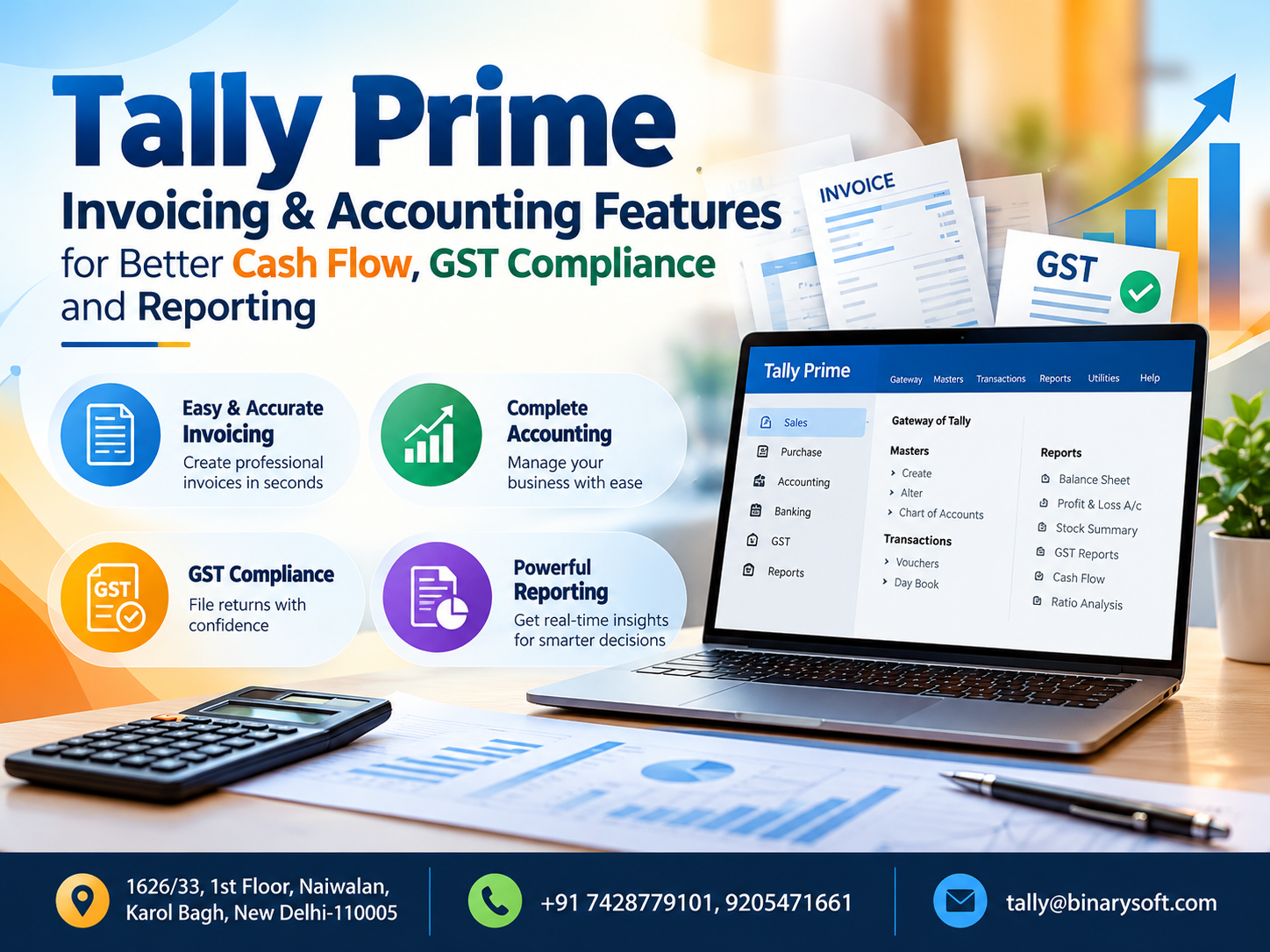
Introduction: Why Smarter Invoicing and Accounting Matter More for Indian Businesses in 2026
In 2026, Indian businesses are facing growing pressure to manage GST-compliant invoices, delayed customer payments, rising operating expenses, and increasingly complex financial records. For retailers, wholesalers, distributors, manufacturers, and service providers, generating an invoice is no longer enough. Every transaction must support accurate accounting, timely collections, inventory control, and reliable financial reporting. A small billing mistake or an overlooked outstanding payment can affect cash flow, customer relationships, and business profitability.
TallyPrime brings invoicing, accounting, GST management, banking, and financial reporting into an integrated business environment. Its capabilities help businesses record transactions, monitor receivables, manage supplier payments, review tax information, and understand financial performance. With proper configuration and disciplined data entry, businesses can reduce repetitive work and make better financial decisions.
This comprehensive guide explores essential Tally Prime invoicing and accounting features, their practical applications, and how they can help Indian businesses strengthen cash flow, improve GST compliance, and achieve more efficient financial management.
1. Understanding Invoicing and Accounting in TallyPrime
Invoicing and accounting are closely connected business activities.
Invoicing involves preparing and recording bills for goods sold or services provided. Accounting involves recording, classifying, summarizing, and analyzing financial transactions.
For a business to operate efficiently, these activities should work together.
When a sales invoice is recorded correctly, the transaction may affect several accounting records, including:
TallyPrime integrates these processes within a common accounting environment.
Instead of maintaining separate records for sales, customer balances, stock, and taxes, businesses can configure TallyPrime to record relevant information through appropriate vouchers.
Why Integration Matters
Consider a wholesale distributor selling goods worth ₹50,000 before GST on credit.
A correctly configured sales invoice can record the taxable sale, applicable GST, customer receivable, and inventory movement.
The business owner can subsequently review the transaction through the Sales Register, outstanding receivables, relevant GST reports, and financial statements.
This reduces the need to manually reproduce the same transaction across disconnected systems.
2. A Business Story: How Better Accounting Visibility Helped a Small Business Owner
Consider the illustrative story of Sunil, who operates a wholesale electrical goods business in Delhi.
For nearly ten years, Sunil worked hard to establish relationships with retailers, contractors, and commercial customers.
His business supplied electrical cables, switches, lighting products, and industrial accessories.
Sales were increasing, and the warehouse was frequently busy.
Yet Sunil faced a problem that many growing business owners recognize.
Despite generating substantial sales, he regularly struggled to maintain sufficient cash for supplier payments.
Customers were purchasing goods on credit, but collections were not being monitored consistently.
His employees prepared invoices and recorded payments, while outstanding balances were reviewed only when a supplier payment became urgent.
One afternoon, a major supplier requested payment for an overdue purchase invoice.
Sunil checked the business bank account and realized there was insufficient cash available.
He was surprised because his sales team had reported strong revenue during the previous month.
After reviewing customer accounts, he discovered that several large invoices remained unpaid.
Some customers had exceeded their agreed credit periods, while others had made partial payments that had not been properly allocated against invoices.
Sunil felt frustrated.
He had invested years building his business, but the lack of timely financial information was affecting his confidence and ability to plan.
He decided to improve his accounting processes using TallyPrime.
His team began recording invoices consistently, maintaining bill-wise details, allocating receipts correctly, and reviewing outstanding receivables every week.
They also started examining cash and bank balances before committing to major purchases.
Over time, Sunil gained a clearer understanding of the difference between sales revenue and available cash.
His business did not become successful simply because software was installed. The improvement came from combining suitable accounting features with regular reviews and better payment follow-up.
The lesson is important: accurate invoicing records sales, but effective accounting helps businesses understand when those sales will turn into cash.
3. Professional Sales Invoicing in TallyPrime
Sales invoicing is one of the most frequently used features in TallyPrime.
Businesses can create sales vouchers for different types of transactions, depending on their accounting requirements and configuration.
Common Sales Invoice Scenarios
Cash sales: Transactions where payment is received immediately.
Credit sales: Transactions where the customer pays at a later date.
Goods sales: Invoices involving stock items and inventory quantities.
Service invoices: Invoices for professional or business services.
GST invoices: Transactions containing applicable GST details.
Inter-state sales: Transactions where IGST may apply according to the place-of-supply rules.
Intra-state sales: Transactions where CGST and SGST or UTGST may apply.
Benefits of Structured Sales Invoicing
-
Consistent transaction records
-
Faster invoice preparation
-
Reduced manual calculations
-
Integration with customer ledgers
-
Relevant GST calculations
-
Better sales reporting
-
Improved tracking of credit transactions
-
More organized financial records
A standardized invoicing process can help businesses reduce billing errors and maintain professional documentation.
4. GST-Compliant Invoice Creation
GST compliance is an important part of invoicing for registered Indian businesses.
TallyPrime supports GST-related configurations and transaction recording.
Businesses can maintain relevant information such as:
-
Supplier GSTIN
-
Customer GSTIN
-
Invoice number
-
Invoice date
-
Place of supply
-
Taxable value
-
Applicable GST rate
-
HSN or SAC classification
-
CGST, SGST, UTGST, or IGST
-
Invoice total
The exact invoice requirements depend on the nature of the transaction and applicable GST rules.
Practical Example
A distributor sells 100 electronic accessories at ₹500 each.
Taxable value:
100 × ₹500 = ₹50,000
Assuming an applicable GST rate of 18% for an eligible intra-state transaction:
CGST at 9% = ₹4,500
SGST at 9% = ₹4,500
Total GST = ₹9,000
Invoice total = ₹59,000
TallyPrime can calculate relevant tax amounts when the transaction and tax configuration are correct.
However, businesses remain responsible for applying the correct tax rate, classification, place of supply, and statutory treatment.
5. Invoice Customization for Business Requirements
Different businesses have different invoicing needs.
A retail shop may require a compact invoice, while a wholesale distributor may need detailed product information and customer references.
TallyPrime provides invoice printing and configuration options, with further customization possible depending on the requirement.
Common Invoice Details
-
Business name and address
-
Customer information
-
GST registration details
-
Invoice number and date
-
Product or service description
-
Quantity and rate
-
Discount
-
Taxable amount
-
Applicable GST
-
Total invoice value
-
Payment terms
-
Bank details
-
Other relevant references
Why Invoice Presentation Matters
A clear invoice helps customers verify products, quantities, prices, taxes, and payment obligations.
It can also reduce disputes caused by missing information.
For businesses with specialized layouts, advanced branding requirements, or industry-specific fields, additional customization may be required.
6. Credit Sales and Customer Outstanding Management
Credit sales are common among wholesalers, distributors, manufacturers, and service providers.
However, sales recorded on credit do not immediately increase available cash.
Businesses must therefore monitor outstanding receivables carefully.
TallyPrime supports bill-wise accounting and outstanding reports that can help track amounts due from customers.
Practical Example
A distributor has the following outstanding invoices:
| Customer | Invoice Amount | Payment Due |
|---|
| Customer A |
₹85,000 |
15 days |
| Customer B |
₹1,20,000 |
30 days |
| Customer C |
₹65,000 |
20 days |
| Customer D |
₹1,50,000 |
45 days |
Total outstanding receivables: ₹4,20,000
The business can review customer-wise balances and due dates based on recorded bill-wise information.
Benefits of Outstanding Management
Better collection planning: Identify invoices requiring follow-up.
Reduced payment delays: Contact customers before overdue balances become excessive.
Improved cash visibility: Understand the amount of money tied up in receivables.
Credit control: Review customers with significant outstanding balances.
Financial planning: Estimate expected collections based on agreed payment terms.
These features support collection management, but businesses must still follow up with customers and verify actual receipts.
7. Bill-Wise Accounting for Accurate Receivable Tracking
Bill-wise accounting allows businesses to track outstanding amounts against individual invoices.
This is particularly useful when customers make partial payments or settle several invoices through one payment.
Example
A customer receives an invoice worth ₹1,00,000.
The customer later pays ₹40,000.
If the payment is allocated correctly, the remaining invoice balance becomes ₹60,000.
The business can continue tracking the unpaid amount against the original invoice.
Why Bill-Wise Accounting Is Important
Without proper allocation, businesses may know the total customer balance but struggle to identify which invoices remain unpaid.
Bill-wise accounting improves the clarity of customer accounts and supports more accurate collection follow-up.
8. Cash Flow Management in TallyPrime
Cash flow represents the movement of money into and out of a business.
A company can report accounting profit while still experiencing cash shortages.
This may happen when customers delay payments, inventory purchases increase, or major expenses become due.
TallyPrime provides cash and bank records, receivables and payables information, and financial reports that can help businesses understand their cash position.
Important Cash Flow Activities
-
Monitoring customer collections
-
Reviewing supplier payments
-
Checking cash and bank balances
-
Identifying overdue receivables
-
Planning upcoming expenses
-
Monitoring inventory investment
-
Reviewing business profitability
-
Evaluating working capital requirements
Example
A business records monthly sales of ₹12 lakh.
However, only ₹7 lakh is collected during the month.
The remaining ₹5 lakh may be outstanding, assuming there are no other adjustments.
If supplier payments, salaries, rent, and other cash expenses total ₹9 lakh, the business may experience cash pressure despite reporting substantial sales.
This demonstrates why revenue and cash availability should be monitored separately.
9. Purchase Accounting and Supplier Payment Management
Purchase accounting is equally important for maintaining financial control.
Businesses must record purchases accurately and monitor amounts payable to suppliers.
TallyPrime supports purchase vouchers, supplier ledgers, bill-wise accounting, and relevant outstanding reports.
Important Purchase Accounting Features
Purchase recording: Maintain supplier invoices and purchase values.
GST details: Record applicable input tax information.
Supplier ledgers: Track supplier-wise transactions.
Outstanding payables: Review amounts due to vendors.
Payment vouchers: Record supplier payments.
Purchase returns: Record applicable returns and adjustments.
Business Benefits
Accurate purchase accounting helps businesses understand purchasing costs, maintain supplier relationships, and plan payment obligations.
It also supports more reliable financial statements and GST-related records.
10. Banking Features for Better Financial Control
Bank transactions form an important part of daily business accounting.
Businesses receive customer payments, pay suppliers, transfer funds, and incur bank charges.
TallyPrime includes banking-related functionality that helps users record and review these transactions.
Depending on the installed release, configuration, and supported banking services, relevant features may include:
-
Bank ledger management
-
Receipt and payment recording
-
Contra entries
-
Bank reconciliation
-
Bank statement import
-
Banking transaction review
-
Cheque-related functionality
-
Supported connected banking services
Why Bank Reconciliation Matters
Bank reconciliation compares transactions recorded in accounting books with transactions reflected in the bank statement.
Differences may arise because of:
-
Unpresented cheques
-
Deposits not yet credited
-
Bank charges
-
Interest entries
-
Incorrect transaction amounts
-
Duplicate accounting entries
-
Unrecorded bank transactions
Regular reconciliation helps businesses identify discrepancies and maintain more accurate bank balances.
11. Bank Reconciliation in TallyPrime
Bank reconciliation is a valuable accounting control.
Practical Example
According to the business books, the bank balance is ₹2,50,000.
The bank statement shows ₹2,48,500.
Further review identifies bank charges of ₹1,500 that have not yet been recorded.
After recording the charges correctly, the book balance becomes ₹2,48,500.
The reconciliation process helps explain the difference.
Benefits
-
More accurate bank records
-
Faster identification of missing entries
-
Improved financial control
-
Better cash balance visibility
-
Reduced reconciliation errors
The availability of automated or connected reconciliation features depends on the TallyPrime release and supported banking arrangements.
12. Credit Notes and Debit Notes
Businesses sometimes need to adjust previously recorded transactions.
These adjustments may arise from product returns, pricing differences, discounts, or other valid commercial reasons.
TallyPrime supports credit note and debit note vouchers.
Credit Notes
A credit note may be used in applicable circumstances to reduce the value or tax liability associated with an earlier sale.
Debit Notes
A debit note may be used for relevant purchase-related adjustments or other appropriate accounting purposes.
Example
A wholesaler sells goods worth ₹50,000 before tax.
The customer later returns goods worth ₹5,000 before tax.
The business may need to record an appropriate sales return or credit note with the relevant GST treatment.
Correct documentation is important because GST adjustments are subject to applicable legal requirements.
13. Discount Management in Sales Invoices
Discounts are common in retail and wholesale transactions.
Businesses may offer discounts to encourage larger purchases, reward customers, or respond to market competition.
TallyPrime can support relevant discount recording through suitable invoice and ledger configurations.
Common Discount Types
Trade discount: A discount offered as part of the agreed selling price.
Item-level discount: A discount applied to a particular product.
Invoice-level discount: A discount applied to the overall transaction, subject to appropriate configuration.
Promotional discount: A discount associated with a specific commercial offer.
Example
A distributor sells goods worth ₹20,000.
A discount of 5% is offered.
Discount amount = ₹1,000
Value after discount = ₹19,000
Applicable GST treatment must be determined according to the relevant rules and invoice circumstances.
Accurate discount recording helps businesses maintain clearer sales and profitability information.
14. Inventory-Linked Invoicing
Businesses dealing in physical goods need their invoicing and inventory records to remain consistent.
TallyPrime supports inventory-linked sales and purchase transactions.
When appropriately configured, recording a sales invoice can affect stock quantities and relevant accounting balances.
Example
Opening stock: 500 units
Sales quantity: 120 units
Closing stock: 380 units
This assumes no other stock movements occurred during the period.
Benefits
-
Better inventory visibility
-
Reduced duplicate data entry
-
Improved stock reporting
-
More accurate transaction records
-
Better coordination between billing and inventory teams
Inventory accuracy still depends on recording purchases, sales, transfers, returns, and adjustments correctly.
15. E-Invoicing Capabilities in TallyPrime
Electronic invoicing under GST is applicable to businesses meeting the relevant legal criteria.
TallyPrime supports e-invoicing functionality in eligible and supported configurations.
Important E-Invoicing Activities
-
Preparing eligible invoices
-
Validating relevant invoice information
-
Generating or obtaining invoice reference information through supported workflows
-
Recording IRN details
-
Maintaining applicable QR code information
-
Managing eligible cancellation or correction processes
Important Compliance Consideration
Not every GST-registered business is required to generate e-invoices.
Applicability depends on the current legal threshold, transaction type, taxpayer category, and other statutory conditions.
Businesses should verify the current rules before determining their e-invoicing obligations.
16. E-Way Bill Management
E-way bills are required for certain movements of goods under applicable GST rules.
TallyPrime provides e-way bill-related functionality for supported transactions.
Businesses may use relevant features to maintain and process the information required for eligible goods movements.
Common Business Scenarios
-
Inter-state goods movement
-
Intra-state movement where applicable
-
Warehouse dispatches
-
Supplier deliveries
-
Customer shipments
-
Stock transfers requiring documentation
E-way bill requirements depend on the transaction, consignment value, exemptions, and applicable state or central rules.
Businesses should ensure that their dispatch procedures follow the relevant statutory requirements.
17. GST Reports and Reconciliation
Accurate GST reporting depends on correct transaction classification and complete accounting records.
TallyPrime provides GST-related reports and reconciliation capabilities, depending on the release and configuration.
Important GST Review Activities
Sales transaction review: Check taxable sales and relevant tax information.
Purchase transaction review: Verify recorded purchases and input tax details.
HSN/SAC review: Examine classification information.
Exception identification: Review transactions requiring correction.
Return preparation: Prepare and review relevant GST return information.
Reconciliation: Compare applicable accounting and GST records.
Why Regular GST Review Matters
Businesses that postpone GST review until the filing deadline may face avoidable pressure.
Incorrect GSTIN details, unsuitable tax classifications, missing invoices, or incomplete transactions can create reporting differences.
Regular review helps identify issues earlier.
18. Financial Reporting Features in TallyPrime
Financial reporting converts accounting transactions into useful business information.
TallyPrime provides reports that help businesses examine financial performance and position.
Profit and Loss Account
The Profit and Loss Account summarizes income and expenses for a selected period.
It helps businesses evaluate profitability.
Balance Sheet
The Balance Sheet presents assets, liabilities, and capital or equity balances.
Trial Balance
The Trial Balance helps review ledger balances and supports accounting verification.
Cash Flow Statement
Cash flow information helps businesses understand relevant movements in cash and cash equivalents.
Sales Register
The Sales Register provides details of recorded sales transactions.
Purchase Register
The Purchase Register provides details of recorded purchase transactions.
Outstanding Reports
These reports help businesses review customer receivables and supplier payables.
Inventory Reports
Inventory reports help businesses understand stock quantities, movements, and values.
Together, these reports provide a foundation for financial analysis and business planning.
19. Using Profitability Reports to Improve Business Decisions
Sales growth does not always mean profit growth.
A business may generate higher revenue while experiencing increased purchasing costs, operating expenses, or discounts.
Regular profitability analysis helps identify these issues.
Practical Example
A wholesaler records:
Sales revenue: ₹15,00,000
Cost of goods sold: ₹11,00,000
Gross profit: ₹4,00,000
Operating expenses: ₹2,50,000
Illustrative operating profit: ₹1,50,000
The business can use relevant accounting reports to review profitability and identify areas requiring attention.
Questions Management Should Ask
-
Are sales increasing faster than costs?
-
Which expenses have increased?
-
Are discounts reducing margins?
-
Is inventory investment becoming excessive?
-
Are customer collections keeping pace with sales?
-
Are supplier payments being planned properly?
Financial reporting becomes valuable when businesses use the information to make practical decisions.
20. Cost Centre Accounting for Department-Wise Analysis
Businesses operating multiple departments, projects, or business units may require more detailed expense and income analysis.
TallyPrime supports cost centre accounting.
Example
A company operates three departments:
-
Retail Sales
-
Wholesale Distribution
-
Service Operations
Management may want to allocate relevant expenses to individual departments.
Cost centre accounting can help organize financial information according to suitable internal reporting requirements.
Benefits
-
Better departmental analysis
-
Improved expense allocation
-
More structured management reporting
-
Greater visibility into business activities
The usefulness of cost centres depends on consistent transaction allocation and an appropriate reporting structure.
21. Multi-Currency Accounting for International Transactions
Businesses involved in international trade may deal with foreign currencies.
TallyPrime supports multi-currency accounting functionality.
This can help businesses record relevant transactions involving foreign currencies and maintain associated accounting information.
Example
An importer purchases electronic components from an overseas supplier.
The supplier invoice may be denominated in US dollars, while the business maintains its primary accounts in Indian rupees.
A properly configured multi-currency accounting process can help record the transaction and relevant exchange-rate information.
Businesses should also follow applicable accounting standards, foreign exchange rules, and tax requirements.
22. TDS and TCS Accounting Features
Certain business transactions may require Tax Deducted at Source or Tax Collected at Source under applicable Indian tax laws.
TallyPrime provides TDS and TCS-related accounting functionality.
TDS Applications
Businesses may need to account for tax deduction on eligible payments such as professional fees, contractor payments, rent, or other covered transactions.
TCS Applications
Certain transactions may require tax collection at source under applicable provisions.
Important Consideration
Applicability, rates, thresholds, exemptions, and reporting requirements can change.
Businesses should verify the current provisions of the Income-tax Act and related rules before configuring or processing TDS or TCS transactions.
Correct software configuration supports accounting, but does not replace legal compliance review.
23. Payment Reminders and Collection Follow-Up
Delayed payments are a major cause of cash flow pressure.
Businesses should establish a systematic collection process.
TallyPrime's bill-wise records and outstanding reports can help identify invoices requiring follow-up.
Depending on the installed release, available communication features, and integrations, businesses may also be able to share relevant information with customers.
Suggested Collection Process
Before due date: Review upcoming receivables.
On due date: Confirm whether payment has been received.
After due date: Contact the customer and verify the expected payment date.
For long-overdue invoices: Escalate according to the business's credit policy.
After receiving payment: Record and allocate the receipt correctly.
This process helps businesses maintain more reliable receivables records and improve collection discipline.
24. Using TallyPrime for Better Working Capital Management
Working capital is closely connected to receivables, payables, inventory, and available cash.
Businesses need sufficient working capital to purchase goods, pay employees, meet supplier obligations, and maintain operations.
Important Working Capital Components
Accounts receivable: Money owed by customers.
Inventory: Funds invested in goods and materials.
Accounts payable: Amounts owed to suppliers.
Cash and bank balances: Funds available for immediate use.
TallyPrime reports can help management examine these components.
Practical Example
A distributor has:
Inventory: ₹12 lakh
Customer receivables: ₹8 lakh
Cash and bank balances: ₹3 lakh
Supplier payables: ₹10 lakh
These figures help management understand important working capital balances.
However, a complete working capital calculation should consider all relevant current assets and current liabilities.
Better visibility can help businesses plan purchases, collections, and payments more effectively.
25. Common Invoicing Mistakes Businesses Should Avoid
Even businesses using accounting software can experience errors when processes are poorly managed.
Incorrect Customer Details
Wrong customer information may create billing and compliance problems.
Incorrect GST Rates
Applying unsuitable tax rates can affect invoice accuracy.
Duplicate Invoice Entries
Recording the same transaction twice can overstate sales and receivables.
Missing Credit Notes
Unrecorded returns or adjustments may distort customer balances.
Incorrect Payment Allocation
Receipts applied against the wrong invoices can create misleading outstanding reports.
Delayed Purchase Recording
Late entries can affect inventory, supplier balances, and GST-related records.
Ignoring Bank Reconciliation
Unreconciled transactions may result in inaccurate bank balances.
Incomplete Ledger Classification
Incorrect ledger grouping can affect financial statements.
Businesses should establish review procedures to identify and correct these issues.
26. Best Practices for Invoicing and Accounting in 2026
Businesses can improve financial management by following consistent accounting practices.
Record Transactions Daily
Avoid unnecessary delays in recording sales, purchases, receipts, and payments.
Maintain Accurate Customer and Supplier Masters
Verify names, GSTIN details, addresses, and relevant payment terms.
Use Bill-Wise Accounting
Track individual invoices and allocate receipts and payments correctly.
Review Outstanding Balances Weekly
Identify overdue invoices and plan collection activities.
Reconcile Bank Accounts Regularly
Compare accounting records with bank statements.
Review GST Information Before Filing
Check relevant transactions, classifications, and exceptions.
Monitor Cash Flow
Evaluate upcoming collections and payment obligations.
Maintain Secure Backups
Back up company data regularly and test restoration procedures.
Restrict User Permissions
Provide employees access according to their responsibilities.
Review Financial Reports Monthly
Use accounting information to evaluate profitability and business performance.
27. TallyPrime Invoicing and Accounting Compared with Manual Processes
| Business Activity | Manual Accounting | TallyPrime |
|---|
| Invoice preparation |
Manual calculations or spreadsheets |
Structured sales vouchers |
| GST calculation |
Separate calculation |
Configurable GST calculations |
| Customer balances |
Manual registers |
Customer ledgers and outstanding reports |
| Supplier balances |
Separate records |
Supplier ledgers and payable reports |
| Bank reconciliation |
Manual comparison |
Banking and reconciliation functionality |
| Inventory-linked billing |
Separate stock adjustments |
Integrated inventory transactions |
| Profit and Loss |
Manual preparation |
Built-in financial report |
| Balance Sheet |
Manual consolidation |
Built-in financial report |
| Credit notes |
Separate documentation |
Credit note vouchers |
| Multi-currency records |
Manual conversions |
Multi-currency accounting functionality |
| Department analysis |
Separate worksheets |
Cost centre accounting |
| Financial reporting |
Manual compilation |
Reports based on recorded transactions |
TallyPrime can reduce repetitive accounting work, but its results depend on correct configuration, accurate entries, and appropriate review procedures.
28. How TallyPrime Can Support Different Business Sectors
Retail Businesses
Retailers can use TallyPrime for sales recording, GST billing, stock-linked transactions, and financial reporting.
Wholesale Businesses
Wholesalers can manage bulk transactions, customer receivables, supplier payables, and inventory-linked accounting.
Distribution Businesses
Distributors can use accounting and inventory reports to review stock, sales, outstanding balances, and business performance.
Manufacturing Businesses
Manufacturers can combine financial accounting with suitable inventory and manufacturing-related features.
Service Businesses
Service providers can maintain invoices, customer ledgers, expenses, GST records, and financial reports.
Professional Firms
Professional firms can use TallyPrime for service invoicing, accounting, receivables, expenses, and applicable tax-related records.
The appropriate configuration depends on each organization's transaction types and reporting requirements.
29. Choosing the Right TallyPrime Configuration for Your Business
Businesses should review their requirements before implementing accounting software.
Important questions include:
-
How many invoices are generated daily?
-
How many employees need access?
-
Does the business sell goods, services, or both?
-
Is inventory management required?
-
Are credit sales common?
-
Does the business operate multiple branches?
-
Are cost centres required?
-
Are foreign currency transactions involved?
-
What GST-related workflows are needed?
-
Are specialized invoice formats required?
-
Does the business require remote access?
-
What backup and security arrangements are necessary?
The objective should be to create a configuration that supports actual business processes.
Enabling unnecessary features can increase complexity, while omitting essential features can create additional manual work.
30. How Binarysoft Technologies Can Help with TallyPrime Invoicing and Accounting
Implementing TallyPrime successfully requires proper accounting configuration, suitable business processes, and employee training.
Binarysoft Technologies Pvt. Ltd., an Authorized Tally Partner located in Karol Bagh, New Delhi, can be contacted for TallyPrime-related assistance.
Areas of Assistance
TallyPrime licensing: Guidance on selecting a suitable software edition.
Accounting configuration: Setting up ledgers, voucher types, and relevant accounting features.
GST-related setup: Reviewing appropriate GST configuration requirements.
Invoicing workflows: Understanding sales and purchase voucher processes.
Inventory integration: Configuring relevant stock masters and inventory features.
Banking and reconciliation: Guidance on available banking functionality.
Financial reporting: Helping users understand important accounting reports.
Data migration: Evaluating requirements for moving existing accounting information.
User training: Supporting employees in understanding daily accounting processes.
Businesses should discuss their requirements and confirm the scope of any proposed services before implementation.
31. Practical Checklist for Better Invoicing, Cash Flow and Reporting
| Area | Recommended Action | Business Objective |
|---|
| Sales invoicing |
Record invoices accurately and promptly |
Reliable revenue records |
| GST details |
Verify tax classification and transaction information |
Better compliance |
| Customer outstanding |
Review overdue invoices |
Improved collections |
| Supplier payments |
Monitor due dates |
Better payment planning |
| Bank reconciliation |
Reconcile transactions regularly |
Accurate bank balances |
| Inventory |
Record relevant stock movements |
Reliable stock reports |
| Credit notes |
Record returns and adjustments |
Correct customer balances |
| Cash flow |
Review collections and upcoming payments |
Better liquidity planning |
| Financial statements |
Review Profit and Loss and Balance Sheet |
Performance visibility |
| Data backup |
Maintain verified backups |
Business continuity |
| User permissions |
Restrict sensitive access |
Better internal control |
| Employee training |
Standardize accounting procedures |
Fewer recording errors |
Conclusion: Improve Cash Flow, GST Compliance and Financial Reporting with TallyPrime
Efficient invoicing and accounting are essential for businesses that want to maintain financial stability and support sustainable growth.
In 2026, Indian businesses must manage GST-related transactions, customer collections, supplier payments, inventory, banking, and financial reporting with greater discipline.
TallyPrime provides integrated capabilities for sales invoicing, purchase accounting, bill-wise outstanding management, bank reconciliation, inventory-linked transactions, GST-related records, and financial reporting.
These features can help businesses reduce repetitive accounting work, improve transaction visibility, and make more informed financial decisions.
However, better cash flow does not result automatically from installing accounting software.
Businesses must record transactions accurately, follow up on outstanding invoices, reconcile accounts regularly, review financial reports, and maintain suitable internal controls.
For retailers, wholesalers, distributors, manufacturers, and service providers, a properly configured TallyPrime environment can provide a strong foundation for organized accounting and more reliable business information.
With suitable implementation, employee training, and regular financial reviews, businesses can strengthen invoicing processes, support GST compliance, and develop better control over cash flow and financial performance.
Powered by Binarysoft Technologies
Authorized Tally Partner
Location: 1626/33, 1st Floor, Naiwalan, Karol Bagh, New Delhi – 110005, INDIA
Contact Us: +91 7428779101, 9205471661
Email: tally@binarysoft.com
Business Hours: 10:00 AM – 6:00 PM, Monday to Friday
Frequently Asked Questions
What are the main invoicing features in TallyPrime?
TallyPrime supports sales invoicing, purchase recording, GST-related invoice configuration, credit notes, debit notes, discounts, customer ledgers, and inventory-linked transactions.
How does TallyPrime help improve cash flow?
TallyPrime provides receivables, payables, cash, bank, and financial reports that help businesses monitor outstanding payments and plan financial obligations. Actual cash flow improvement depends on effective collection and payment management.
Can TallyPrime generate GST-compliant invoices?
Yes. TallyPrime supports GST-related invoice configuration and recording. Businesses must ensure the correct tax rates, classifications, customer details, and statutory requirements are applied.
Does TallyPrime support credit sales?
Yes. Businesses can record credit sales and maintain customer outstanding balances through appropriate ledger and bill-wise accounting configurations.
CA. Ronav Maheshwari works with small and mid-sized businesses on accounting processes, GST compliance, and financial reporting. His focus is on simplifying routine accounting workflows and helping business owners maintain accurate and audit-ready records.