Call CA Tally HelpDesk
+91 9205471661,
7428779101
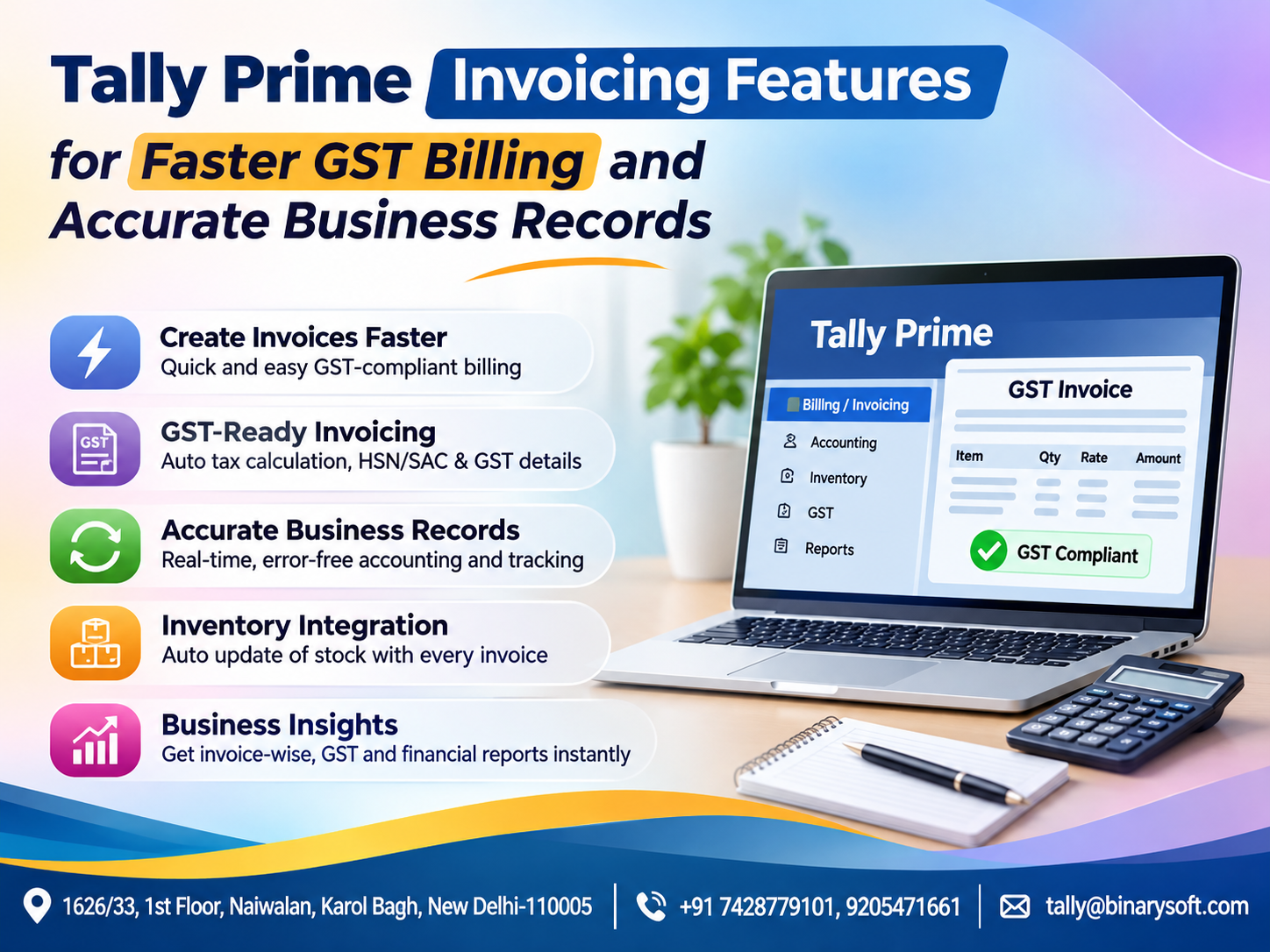
Why Faster and Accurate GST Billing Matters for Every Business
In today's competitive business environment, invoicing is more than generating a bill and collecting payment. Every invoice represents a financial transaction, a customer relationship and an important business record.
For Indian businesses, invoicing also involves GST compliance, tax calculations, inventory adjustments, customer outstanding balances and financial reporting.
A small billing error can create unexpected challenges. Incorrect GST rates, missing customer GSTIN details, duplicate invoice numbers or inaccurate taxable values may lead to reconciliation problems, customer disputes and additional compliance work.
Consider a wholesale distributor generating 150 invoices daily. If employees spend several minutes manually calculating taxes and entering accounting information for every transaction, the business loses valuable time.
Tally Prime helps businesses simplify these activities through integrated invoicing, GST accounting, inventory management and financial reporting features.
By connecting sales transactions with accounting records, businesses can reduce repetitive data entry, improve invoice accuracy and maintain better financial visibility.
The real advantage of efficient invoicing is not simply faster billing. It is the confidence that every transaction is properly recorded, financially traceable and ready for review.
1. Understanding GST Invoicing and Its Importance
A GST invoice is a document issued by a registered supplier for a taxable supply of goods or services, subject to the applicable invoicing requirements.
It generally contains information such as the supplier's GSTIN, invoice number, invoice date, customer details, product or service description, taxable value and applicable tax amounts.
Depending on the transaction, additional details may be required, including HSN or SAC codes, place of supply and other prescribed particulars.
Why accurate GST invoices are important
Accurate invoicing helps businesses:
-
Maintain reliable sales and tax records.
-
Support customers' input tax credit claims where eligible.
-
Reduce discrepancies during GST return preparation.
-
Track customer payments and outstanding invoices.
-
Maintain proper inventory and accounting information.
-
Improve transparency during financial reviews and audits.
Businesses should also distinguish between ordinary GST invoicing and statutory e-invoicing. E-invoicing requirements apply only to taxpayers and transactions covered by the relevant rules.
2. Common Invoicing Challenges Faced by Indian Businesses
Many small and medium-sized businesses continue to face billing difficulties because their invoicing and accounting processes are disconnected.
Manual tax calculation errors
Incorrect GST rates or tax classifications can create discrepancies between invoices and accounting records.
Duplicate or missing invoice numbers
Poor invoice numbering controls make transaction tracking and reconciliation difficult.
Delayed invoice generation
During busy sales periods, slow billing can affect customer service and dispatch operations.
Inconsistent customer information
Incorrect GSTIN, billing address or place-of-supply information may require invoice corrections.
Inventory mismatches
When billing and stock records are maintained separately, physical stock and recorded inventory may differ.
Difficult GST reconciliation
Businesses may spend considerable time comparing sales records with GST reports and identifying differences.
Tally Prime helps address these challenges by maintaining sales, taxation, inventory and accounting information within a connected system.
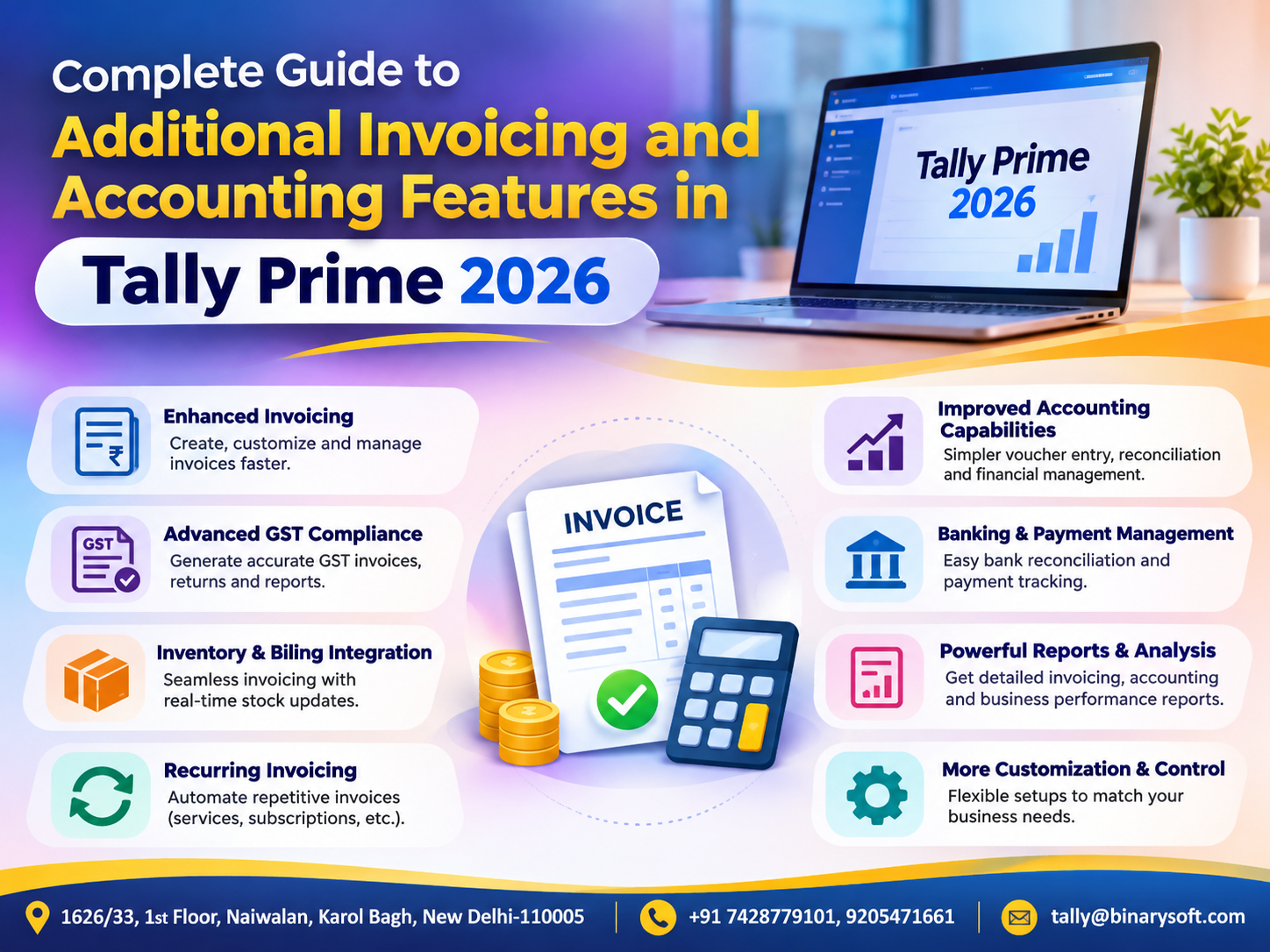
3. Key Tally Prime Invoicing Features That Improve Business Efficiency
Tally Prime offers several invoicing capabilities designed to support different business requirements.
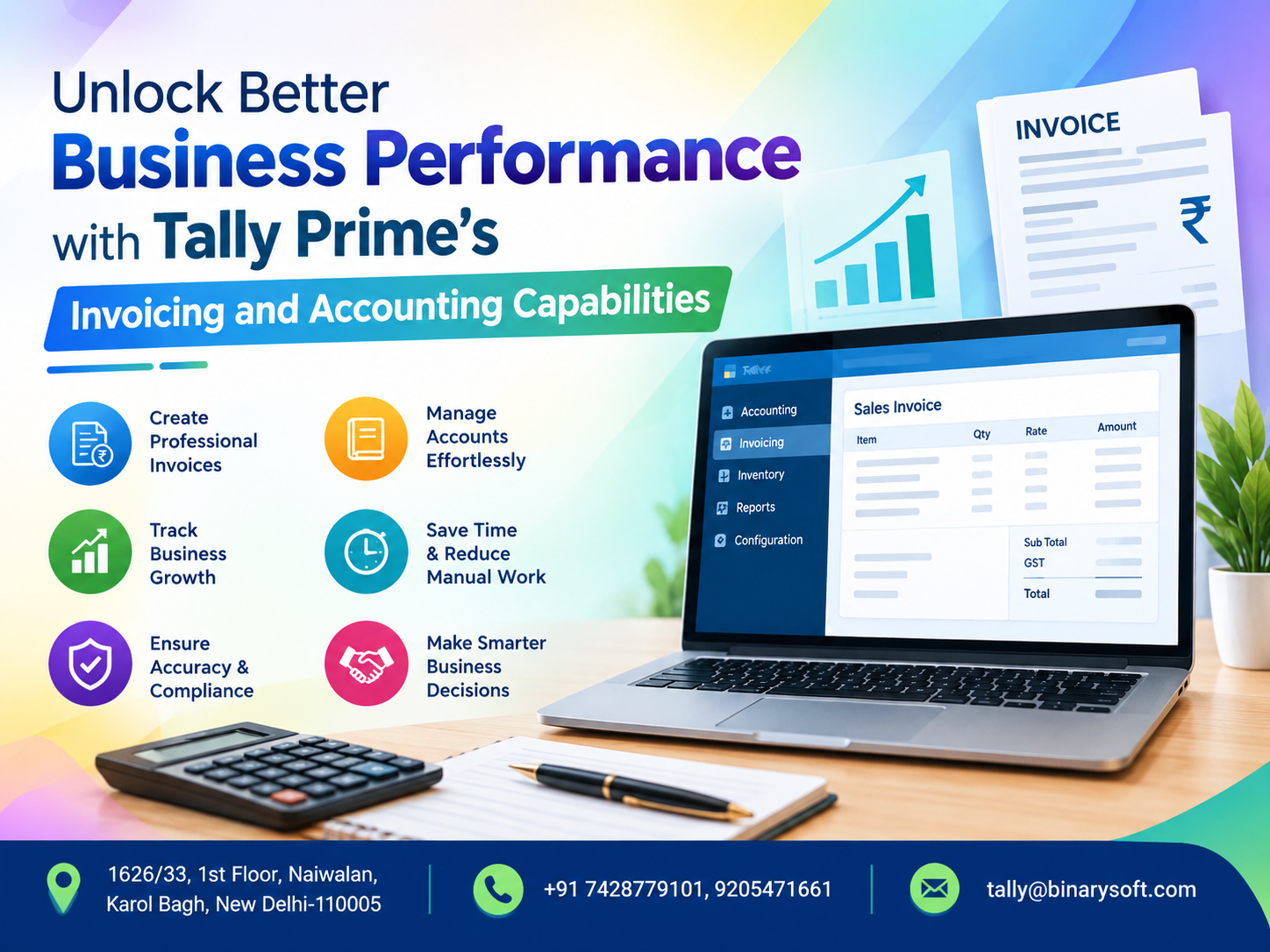
Professional invoice creation
Businesses can generate invoices containing relevant customer information, item descriptions, quantities, rates, discounts, taxes and transaction totals.
Invoice formats can be configured according to supported printing options and business requirements.
Automated GST calculation
When GST features, ledgers, tax classifications and item details are configured correctly, Tally Prime calculates applicable GST amounts during invoicing.
For example, consider a local taxable sale:
|
Particulars
|
Amount
|
|---|
|
Taxable value
|
₹50,000
|
|
CGST at 9%
|
₹4,500
|
|
SGST at 9%
|
₹4,500
|
|
Invoice total
|
₹59,000
|
This example assumes an intra-state supply taxable at 18%. The actual rate and tax treatment depend on the goods or services and transaction circumstances.
Multiple invoice types
Tally Prime supports invoicing workflows for goods and services, including accounting invoices and item-based invoices.
This makes it useful for traders, manufacturers, wholesalers, retailers and professional service providers.
Invoice numbering
Businesses can configure voucher numbering methods to maintain consistent invoice identification.
Appropriate numbering controls help reduce duplicate entries and improve transaction traceability.
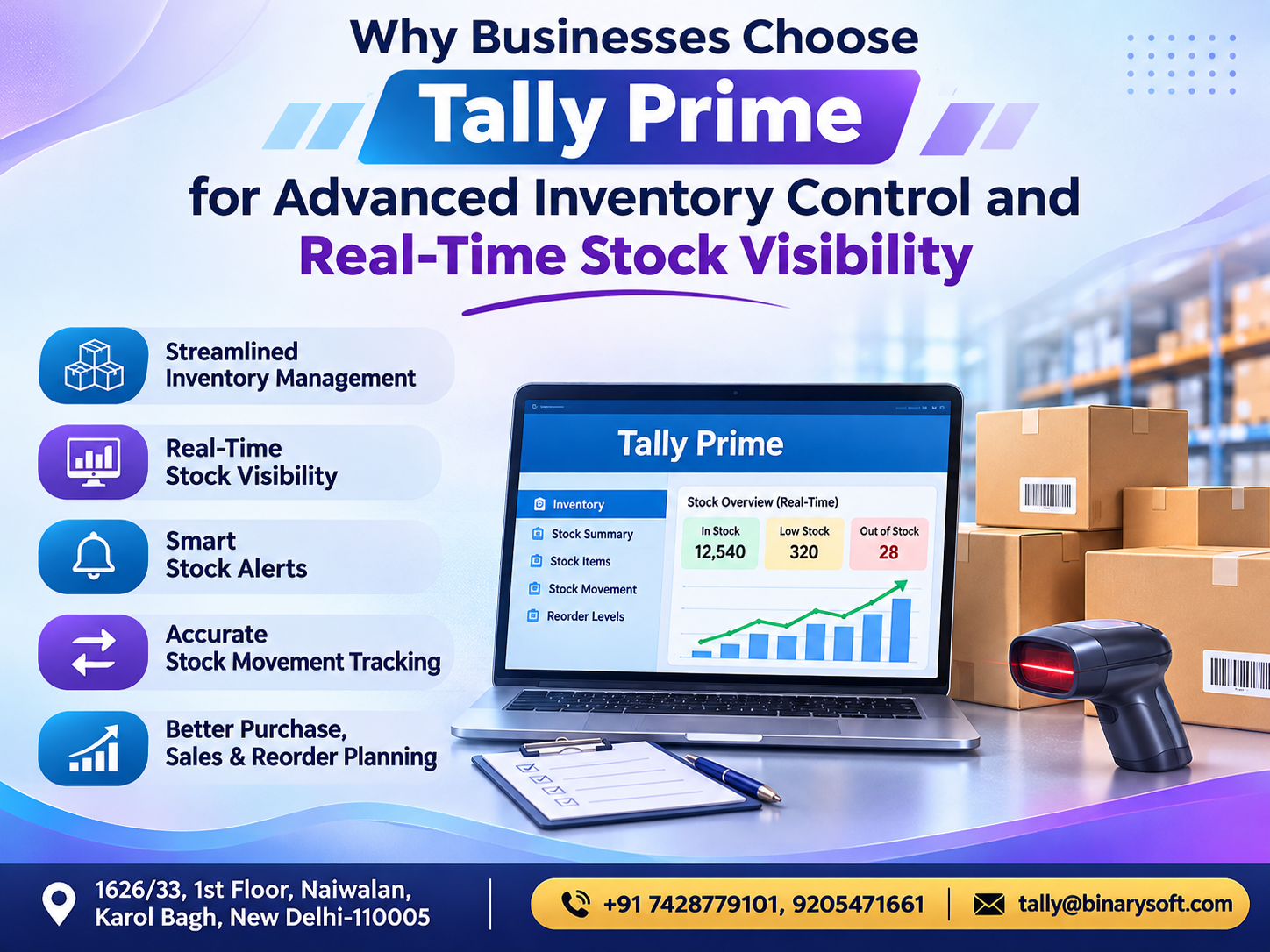
Inventory-linked invoicing
For inventory-based businesses, sales invoices can update stock records when configured and recorded correctly.
This reduces the need to enter the same transaction separately in accounting and inventory systems.
Customer outstanding tracking
Credit sales can be linked with customer ledgers and bill-wise references, making it easier to monitor unpaid invoices and payment collections.
4. Step-by-Step Guide to Creating GST Invoices in Tally Prime
Businesses can follow a structured setup process to maintain accurate billing records.
Step 1: Enable GST
Open the company in Tally Prime, press F11 and enable Goods and Services Tax (GST).
Enter the applicable GST registration information, including GSTIN and state details.
Step 2: Configure GST rates
Create or update stock items and sales ledgers with appropriate GST classifications, HSN or SAC codes and applicable tax rates.
Correct configuration is essential because automated calculations depend on the accuracy of these details.
Step 3: Create customer ledgers
Create customer ledgers under Sundry Debtors.
Enter relevant customer information, including GSTIN, registration type, address and place of supply.
Step 4: Generate a sales invoice
Navigate to Gateway of Tally > Vouchers and press F8 for Sales.
Select the customer, choose the appropriate invoice mode and enter the goods or services supplied.
Step 5: Verify GST calculations
Review taxable values, discounts, applicable CGST and SGST or IGST, and the final invoice amount.
Ensure that the correct tax treatment has been applied.
Step 6: Save and share
Save the invoice using Ctrl+A.
Print, export or share the invoice using the supported options available in the configured software.
The transaction will also contribute to relevant accounting and GST reports.
5. GST E-Invoicing and E-Way Bill Features
Businesses covered by mandatory GST e-invoicing requirements must follow the prescribed Invoice Registration Portal process.
Tally Prime supports e-invoice generation and management for applicable transactions.
E-invoicing capabilities
Eligible businesses can use supported functionality to generate Invoice Reference Numbers (IRNs), retrieve signed QR codes and monitor e-invoice status.
Depending on the configuration, businesses can generate e-invoices individually or in batches.
The software also supports identifying certain incomplete or inconsistent transaction details before submission.
E-way bill management
For goods movements requiring e-way bills, Tally Prime supports relevant e-way bill workflows.
Where applicable, e-way bill information can be submitted together with e-invoice information.
Businesses should verify statutory applicability, transaction details and current portal requirements before generating these documents.
6. An Emotional Story: A Small Business Owner Who Nearly Lost His Biggest Customer
The following story is fictional and illustrates a common billing challenge.
Amit operated a small auto-parts distribution business in Delhi.
His father had started the company with limited savings, and Amit wanted to expand it into a respected regional supplier.
Every morning, employees prepared orders while customers waited for invoices.
As sales increased, the billing process became more complicated.
One afternoon, Amit received an angry telephone call from his largest customer.
The customer had received an invoice containing incorrect GST information, and the accounts department had placed the payment on hold.
Amit immediately checked his records and discovered that several invoices required corrections.
The situation became serious when the customer threatened to move future orders to another supplier.
That evening, Amit sat alone in his office.
He remembered how his father had spent years building customer trust through reliable service.
The thought of losing that trust because of billing mistakes was painful.
Instead of blaming his employees, Amit decided to improve the process.
He reviewed customer masters, configured GST details, standardised invoice numbering and trained his team to use Tally Prime consistently.
Employees began checking customer information before generating invoices.
Stock records and accounting transactions were maintained through the same system.
Over time, invoice corrections became less frequent and the billing process became more organised.
Amit eventually regained his confidence.
He realised that technology could not replace honest business relationships, but it could help protect them.
For Amit, accurate invoicing was no longer just an accounting activity. It became a promise of reliability to every customer.
7. Case Study 1: Wholesale Distributor Improves GST Billing Efficiency
Illustrative case study using hypothetical business data.
Business background
A wholesale electrical distributor in Karol Bagh supplied products to retailers across Delhi and neighbouring states.
The company processed approximately 100 invoices daily.
Challenges
Its billing team manually checked GST rates and maintained separate inventory spreadsheets.
Invoice corrections consumed time, and customer payment reconciliation was often delayed.
Tally Prime implementation
The distributor configured GST rates, customer ledgers, stock items and invoice numbering.
It introduced inventory-linked invoicing and bill-wise customer accounting.
Employees also received training on invoice verification and reporting.
Illustrative results after three months
|
Performance indicator
|
Before
|
After
|
|---|
|
Average invoice preparation time
|
6 minutes
|
2 minutes
|
|
Monthly invoice corrections
|
45
|
12
|
|
Monthly billing effort
|
220 hours
|
120 hours
|
|
Inventory reconciliation
|
Weekly manual work
|
Regular system-based review
|
The figures illustrate potential operational improvements rather than guaranteed software outcomes.
Key learning
Standardised invoicing and accurate master data can reduce repetitive work and improve financial record quality.
8. Case Study 2: Manufacturing Company Strengthens Invoice Accuracy
Illustrative case study based on a typical small manufacturing operation.
Business background
A packaging manufacturer supplied cartons and printed materials to food-processing businesses.
The company handled customised orders, multiple product specifications and different customer pricing arrangements.
Challenges
Billing employees frequently entered product descriptions and rates manually.
Occasional errors created customer disputes, and invoice records did not always match inventory movement.
Tally Prime implementation
The company introduced properly configured stock items, customer masters and price information.
Sales invoices were recorded with appropriate product details and GST classifications.
Management also reviewed outstanding balances and financial reports regularly.
Illustrative results
Within four months, the company reduced its average invoice preparation time from eight minutes to three minutes.
Invoice-related customer complaints also decreased.
The accounts team spent less time correcting records and more time reviewing receivables.
Key learning
Accurate billing supports customer satisfaction, accounting reliability and better coordination between sales and inventory teams.
9. Advanced Invoicing Features for Growing Businesses
As businesses expand, their billing requirements become more complex.
Tally Prime provides additional capabilities that support different operational needs.
Multiple price levels
Wholesalers and distributors can maintain different pricing structures for different customer categories.
This reduces repetitive rate entry and supports consistent billing.
Discounts and adjustments
Businesses can record relevant invoice discounts and adjustments according to their accounting requirements.
Multiple GST registrations
Supported releases allow businesses to maintain multiple GST registrations within a company data environment.
Separate registration-specific reporting and invoice numbering can support businesses operating across states.
Debit and credit notes
Debit and credit notes help businesses record eligible transaction adjustments, including certain returns and price revisions.
The GST treatment of these documents must follow applicable legal requirements.
Multi-currency invoicing
Businesses dealing with international customers can record supported foreign-currency transactions.
Currency conversions and exchange differences require appropriate configuration and review.
10. How Accurate Invoicing Improves Business Records
Every sales invoice affects several aspects of financial management.
When transactions are recorded correctly, businesses can maintain more reliable sales ledgers, customer balances, tax records and inventory information.
For example, a credit sale may affect sales revenue, output GST, customer receivables and stock balances.
If these records are maintained in separate systems, employees may need to reconcile them manually.
Integrated accounting reduces duplication and helps maintain consistency.
Accurate invoicing also supports:
-
Better customer payment tracking.
-
Faster preparation of financial statements.
-
Improved GST return review.
-
More reliable sales analysis.
-
Easier identification of transaction discrepancies.
-
Better preparation for accounting reviews and audits.
However, businesses should regularly verify records because incorrect master data or transaction entry can still produce inaccurate reports.
11. GST Reporting and Reconciliation in Tally Prime
GST compliance involves more than issuing invoices.
Businesses must also review transaction classifications, reconcile relevant records and prepare returns according to applicable requirements.
Tally Prime provides GST-related reports that help users review sales and purchase transactions.
These include reports relevant to GSTR-1, GSTR-3B and supported reconciliation processes.
Businesses can identify transactions requiring correction, such as those containing missing GST information or inconsistent classifications.
Supported connected GST functionality can also assist with portal-related workflows, depending on the release and configuration.
Before filing returns, businesses should review taxable values, tax amounts, credit notes, debit notes and applicable reconciliation information.
Final filing responsibility remains with the taxpayer.
12. How Tally Prime Helps Improve Customer Payment Management
Efficient invoicing can improve the payment collection process.
When invoices contain accurate customer details, amounts and references, customers can verify their obligations more easily.
Tally Prime supports bill-wise outstanding tracking, allowing businesses to monitor individual unpaid invoices.
Accounts teams can review customer balances, payment due dates and overdue amounts.
Receipt vouchers can be allocated against relevant invoice references, including partial payments.
For example, if a customer has an invoice of ₹1,20,000 and pays ₹80,000, the remaining outstanding balance can be tracked as ₹40,000.
This provides better visibility into receivables and supports timely collection follow-ups.
13. Best Practices for Faster and More Accurate GST Billing
Businesses should follow consistent procedures to obtain the maximum benefit from invoicing software.
First, customer and product masters should be reviewed regularly.
GSTIN information, tax classifications, addresses and HSN or SAC codes should remain accurate.
Second, invoice numbering should be properly configured to support transaction traceability.
Third, employees should verify important invoice information before saving or issuing documents.
Fourth, user access should be controlled according to job responsibilities.
Fifth, businesses should maintain suitable data backup procedures and periodically test restoration.
Finally, management should review GST reports, sales registers and outstanding balances regularly.
These practices help establish accountability and reduce avoidable billing problems.
14. Why Tally Prime Is Suitable for Indian SMEs
Small and medium-sized businesses need invoicing software that can support daily operations without creating unnecessary complexity.
Tally Prime combines billing, accounting, inventory and taxation-related functionality within a common environment.
For retailers, it helps record frequent sales transactions.
For wholesalers, it supports customer-specific pricing, credit sales and stock management.
For manufacturers, it helps connect sales invoices with inventory and accounting records.
For service providers, it supports service billing and customer receivables.
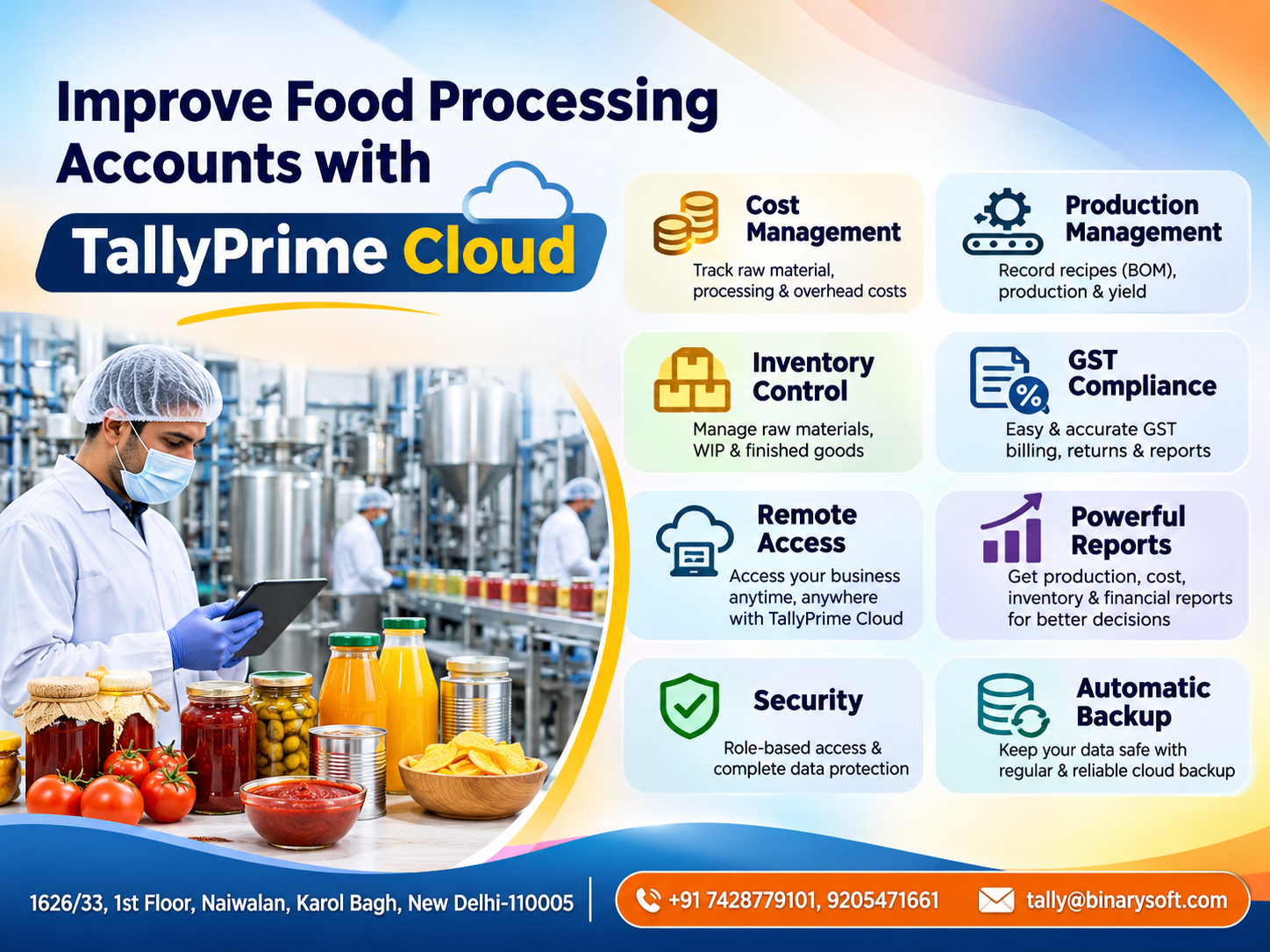
Businesses can also consider properly configured cloud-hosting arrangements when authorised employees require remote access to accounting information.
The actual benefits depend on transaction volume, business processes, software configuration and employee training.
15. How Binarysoft Technologies Supports Tally Prime Implementation
Binarysoft Technologies helps businesses implement practical Tally Prime accounting and invoicing workflows.
Businesses may require assistance with GST configuration, invoice formats, customer and stock masters, credit management, reporting and accounting processes.
Proper implementation can help employees maintain consistent records and reduce unnecessary manual work.
Businesses evaluating Tally Prime Cloud can also discuss suitable hosting, remote access, backup and security requirements.
The objective is to help organisations build a dependable billing and accounting process that supports daily operations and long-term growth.
Conclusion
Fast and accurate GST invoicing is essential for maintaining reliable business records, supporting customer relationships and improving operational efficiency.
Tally Prime provides integrated invoicing, GST calculation, inventory management, customer accounting and financial reporting capabilities.
These features can help businesses reduce repetitive data entry, improve transaction visibility and maintain organised accounting information.
However, successful implementation requires accurate configuration, employee training and regular verification of GST records.
For Indian retailers, wholesalers, manufacturers and service providers, a well-managed invoicing process can support faster operations, stronger financial control and better customer confidence.
The real value of Tally Prime invoicing lies in transforming everyday billing into a reliable foundation for business growth.
Powered by Binarysoft Technologies
Authorized Tally Partner
Location: 1626/33, 1st Floor, Naiwalan, Karol Bagh, New Delhi – 110005, INDIA
Contact us: +91 7428779101, 9205471661
Email us: tally@binarysoft.com
Business Hours: 10:00 AM – 6:00 PM, Monday–Friday
CA. Vedant Jhaveri works on GST compliance, accounting systems, and business reporting for growing enterprises. His approach combines accounting discipline with practical workflows suited to everyday business operations.