Call CA Tally HelpDesk
+91 9205471661,
7428779101
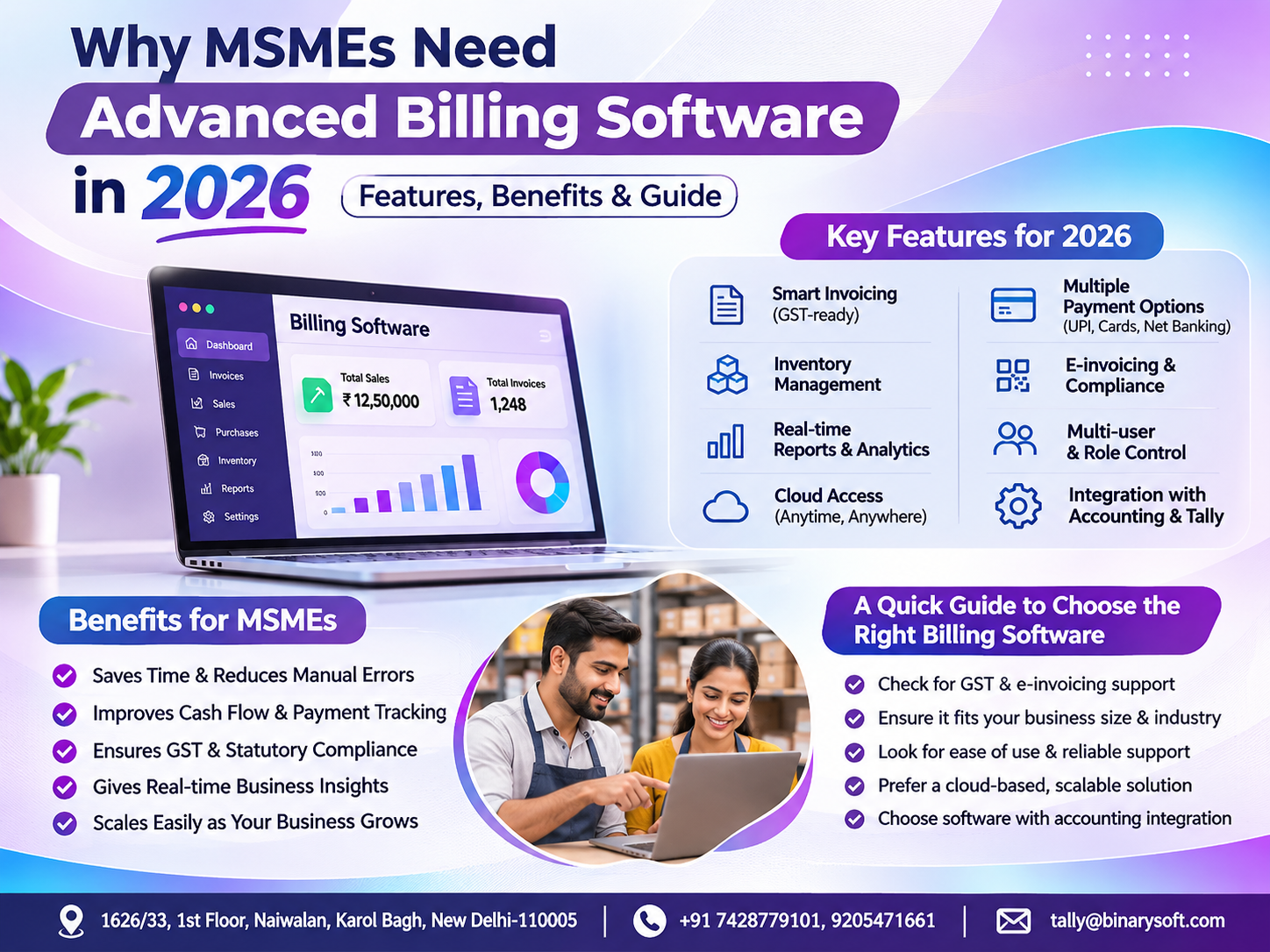
Why Advanced Billing Software Is Essential for MSMEs in 2026
Micro, Small and Medium Enterprises (MSMEs) are among the most important contributors to India's economic development. From neighbourhood retail shops and wholesale distributors to manufacturing units and service providers, millions of businesses depend on accurate billing, efficient accounting and timely payments to maintain financial stability.
However, managing business operations has become increasingly complex in 2026. Customers expect professional invoices, faster payment processing, digital transaction records and transparent billing. Businesses must also manage GST compliance, inventory movements, outstanding payments and financial reporting.
Traditional billing methods, including handwritten invoices, spreadsheets and disconnected accounting systems, are often insufficient for growing businesses.
This is where advanced billing software for MSMEs becomes an essential business investment.
Modern billing software does much more than generate invoices. It connects sales, purchases, inventory, taxation, accounting and financial reporting within a structured system.
Solutions such as Tally Prime help businesses reduce manual work, improve financial visibility and establish more reliable business processes.
For MSMEs planning sustainable growth, advanced billing software is no longer simply a convenience. It is becoming a foundation for efficient business management.
The Emotional Story: A Small Business Owner's Journey from Billing Stress to Financial Confidence
Every evening, after closing his electrical supplies shop in Delhi, Rajesh would spend nearly two hours checking invoices, calculating outstanding payments and updating stock records.
His business was growing, but so were his responsibilities.
Customers frequently requested duplicate invoices. Suppliers called regarding pending payments. Sometimes, products appeared available in his notebook even though they had already been sold.
One evening, his daughter asked him to attend her school performance.
Rajesh promised he would come.
Unfortunately, a billing discrepancy kept him at the shop until late evening. By the time he reached home, the event had ended.
That night, he realised something important.
He had started his business to provide a better life for his family, but inefficient business processes were taking away the time he wanted to spend with them.
After evaluating his requirements, Rajesh introduced integrated billing and accounting software.
Sales invoices, inventory records, customer balances and financial reports became easier to manage.
Within a few months, his daily administrative workload was noticeably reduced.
More importantly, he could leave his shop with greater confidence that essential financial information was organised.
The next time his daughter had a school event, Rajesh was sitting in the front row.
This illustrative story reflects a challenge faced by many MSME owners: business growth should create opportunities, not endless administrative pressure.
What Is Advanced Billing Software?
Advanced billing software is a business management application that automates invoice generation and connects billing activities with related financial operations.
Unlike basic invoice generators, advanced solutions provide integrated capabilities for managing transactions, taxation, customer accounts and inventory.
A comprehensive billing system can support:
-
Professional sales and purchase documentation.
-
GST-compliant invoicing and tax calculations.
-
Inventory tracking and stock valuation.
-
Customer and supplier account management.
-
Outstanding payment monitoring.
-
Financial statements and business reports.
-
Credit notes, debit notes and sales returns.
-
Multi-user access and controlled data permissions.
-
Business performance analysis.
When these functions operate within a connected environment, businesses can reduce duplicate entries and improve the accuracy of financial information.
Why MSMEs Need Advanced Billing Software in 2026
1. Increasing Business Transactions Require Faster Billing
As MSMEs expand, transaction volumes increase.
A business processing 20 invoices daily may initially manage billing through spreadsheets. However, when daily transactions grow to 100 or more, manual processes can become difficult to maintain.
Advanced billing software enables businesses to generate invoices using predefined customer details, product information, tax classifications and pricing structures.
This reduces repetitive data entry and supports faster customer service.
2. GST Compliance Requires Accurate Records
GST compliance is a significant responsibility for registered Indian businesses.
Invoices must contain applicable details, including GSTIN, invoice number, date, taxable value, tax rate and tax amount.
Advanced GST billing software helps maintain consistent transaction records and prepare information required for GST reporting.
Where applicable, businesses may also require e-invoicing and e-way bill functionality.
It is important to understand that e-invoicing obligations depend on the applicable turnover thresholds, transaction categories and government notifications.
Software can simplify compliance activities, but businesses remain responsible for reviewing the accuracy of their returns and tax obligations.
3. Manual Billing Errors Can Affect Profitability
Incorrect product rates, duplicate entries, missing invoices and inaccurate tax calculations can create financial losses.
Even relatively small errors can become significant when repeated across hundreds of transactions.
Integrated billing systems reduce these risks by using structured master records, predefined calculations and consistent accounting entries.
4. Better Cash Flow Management Is Essential
Many MSMEs experience financial pressure because customers delay payments.
A business may report strong sales while struggling to pay suppliers, employees or operating expenses.
Advanced billing software helps owners monitor outstanding invoices, customer balances, credit periods and overdue amounts.
With improved visibility, businesses can prioritise collections and make better working capital decisions.
5. Inventory and Billing Must Work Together
For retailers, wholesalers and manufacturers, inventory accuracy is directly connected to profitability.
When billing and stock records are maintained separately, discrepancies can arise.
Integrated software helps update stock quantities as transactions are recorded, reducing the need for repeated manual reconciliation.
Businesses can also monitor fast-moving products, slow-moving inventory and stock availability.
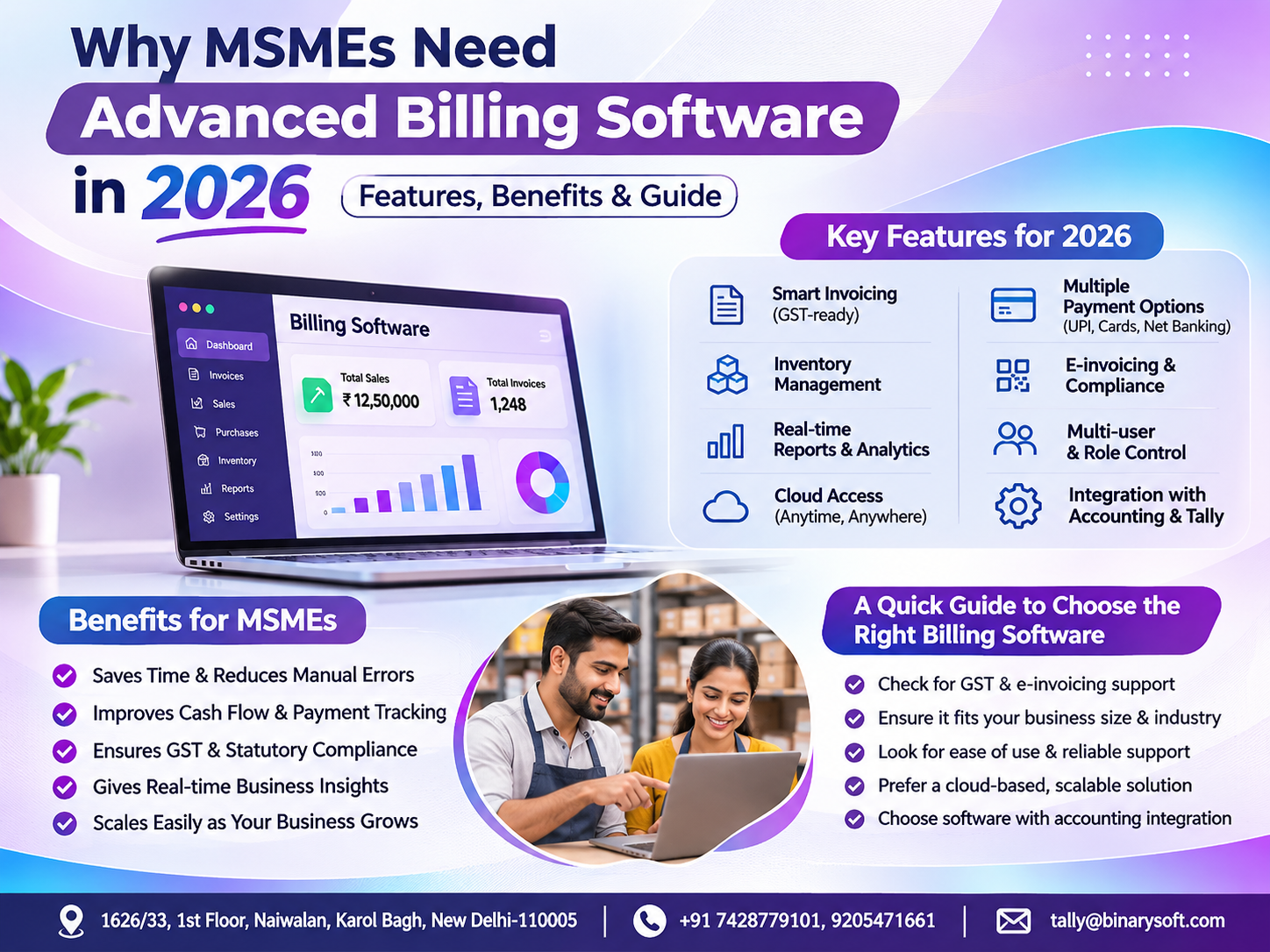
Essential Features of Advanced Billing Software for MSMEs
GST-Compliant Invoice Generation
Businesses should be able to generate professional invoices with appropriate tax calculations, product descriptions and customer details.
The system should support applicable GST requirements and allow invoice formats to be configured according to business needs.
Inventory Management
Integrated inventory capabilities help businesses monitor stock quantities, purchase transactions, sales movements and inventory valuation.
Features such as stock groups, godowns and batch tracking can be especially valuable for product-based businesses.
Customer and Supplier Management
A structured billing solution maintains customer and supplier ledgers, transaction histories, credit balances and outstanding amounts.
This makes account reconciliation and payment follow-up easier.
Financial Reporting
Business owners need timely information about sales, purchases, expenses, profitability and cash flow.
Reports such as Profit and Loss Account, Balance Sheet, cash and bank books, and outstanding statements support informed decisions.
Flexible Payment Recording
Businesses increasingly receive payments through cash, bank transfers, UPI and other digital channels.
Billing and accounting software should support accurate recording and reconciliation of these transactions.
User Access and Data Security
Growing businesses often have separate employees handling billing, accounts and inventory.
Role-based permissions help restrict access to sensitive financial information and reduce unauthorised changes.
Regular backups and secure access practices remain essential.
How Tally Prime Helps MSMEs Manage Advanced Billing
Tally Prime combines billing, accounting, taxation and inventory management in one business application. Its integrated approach helps MSMEs maintain organised records without repeatedly transferring information between separate systems.
1. Create Professional GST Invoices
Businesses can use Tally Prime to generate sales invoices for goods and services.
To create an invoice, users can:
-
Open Tally Prime and select the company.
-
Create customer and product masters with the required details.
-
Configure GST registration information and applicable tax rates.
-
Open the Sales Voucher using F8.
-
Select the customer, products, quantities and rates.
-
Verify tax calculations and save the invoice.
-
Print or share the invoice in the required format.
Depending on configuration and eligibility, Tally Prime also supports e-invoicing, Invoice Reference Number generation and e-way bill processes.
2. Manage Inventory Alongside Billing
Tally Prime enables businesses to maintain stock items, stock groups, units of measurement and godown information.
When inventory-linked sales and purchase transactions are recorded correctly, stock reports reflect the resulting movements.
This is particularly useful for wholesalers, distributors and retailers managing multiple product categories.
3. Track Customer Outstanding Payments
With bill-wise tracking enabled, Tally Prime helps businesses identify unpaid invoices, due dates and overdue customer balances.
Business owners can review receivables ageing, monitor credit periods and prioritise payment follow-ups.
This improves collection planning and reduces dependence on manually maintained outstanding registers.
4. Monitor Business Profitability
Tally Prime provides financial statements and operational reports that help owners understand their business performance.
The Profit and Loss Account shows income and expenses, while the Balance Sheet provides an overview of assets and liabilities.
Sales Registers, Stock Summaries and cash flow reports support everyday business decisions.
5. Improve Banking and Reconciliation
Businesses can record receipts, payments and bank transactions within their accounting records.
Supported banking and reconciliation features help identify differences between recorded transactions and bank statements.
The availability of connected banking functions depends on the software version, bank and relevant service configuration.
Case Study 1: How a Wholesale Distributor Improved Billing Efficiency
Illustrative case study based on common MSME operating challenges.
A Delhi-based electrical goods distributor managed approximately 150 invoices daily.
The business maintained separate spreadsheets for billing, inventory and customer outstanding amounts.
Employees frequently entered the same transaction information multiple times, increasing the possibility of mistakes.
The distributor introduced Tally Prime with structured product masters, GST configurations and integrated inventory accounting.
Improvements After Implementation
Sales invoices became easier to prepare, inventory records were updated through recorded transactions, and customer outstanding reports became available in one system.
The accounts team could review pending collections without manually combining multiple spreadsheets.
Management also gained better visibility into product movement and monthly profitability.
Key takeaway: Integrating billing and inventory can improve operational control and reduce repetitive administrative work.
Case Study 2: How a Small Manufacturing Business Strengthened Financial Control
Illustrative case study based on typical small-manufacturer requirements.
A small packaging manufacturer in Faridabad supplied products to retailers and industrial customers.
Its primary challenge was managing credit sales, raw material purchases and monthly expenses.
Although sales were increasing, delayed customer payments frequently affected working capital.
The business implemented Tally Prime for sales accounting, purchase records, inventory management and outstanding tracking.
Improvements After Implementation
Customer balances became easier to review, supplier payments could be planned against due dates, and management could monitor income and expenditure more consistently.
Inventory records also provided better visibility into materials and finished goods.
The owner began reviewing financial reports regularly instead of waiting until the end of each accounting period.
Key takeaway: Advanced billing software can support better cash flow decisions when transaction records are maintained accurately.
Advanced Billing Software vs Traditional Billing Methods
|
Business function
|
Traditional methods
|
Advanced billing software
|
|---|
|
Invoice generation
|
Manual preparation
|
Structured and faster
|
|
GST calculations
|
Often manually checked
|
Configurable calculations
|
|
Inventory records
|
Separate registers
|
Integrated stock tracking
|
|
Customer balances
|
Manual reconciliation
|
Outstanding reports
|
|
Financial statements
|
Prepared separately
|
Generated from records
|
|
Sales analysis
|
Time-consuming
|
Regular reporting
|
|
Data access
|
Paper or local files
|
Controlled digital access
|
|
Business expansion
|
Increasing manual effort
|
More scalable workflows
|
Advanced software does not eliminate the need for trained employees or proper financial controls. Instead, it provides tools that make those responsibilities easier to manage.
How to Choose the Best Billing Software for Your MSME
Choosing billing software should begin with understanding the business's operational requirements.
A retail shop may prioritise fast invoice generation and stock management, while a manufacturing business may require detailed inventory records, purchase tracking and cost analysis.
Before selecting software, evaluate GST functionality, reporting capabilities, data security, user permissions, support availability and future scalability.
Businesses should also consider the total cost of ownership, including licences, implementation, employee training, maintenance and upgrades.
An effective system should be easy enough for employees to use while providing the accounting controls required by management.
The Future of MSME Billing: Automation and Digital Integration
In 2026, billing software is increasingly becoming part of a broader digital business environment.
Businesses are seeking connected accounting processes, faster reconciliation, electronic documentation and improved financial visibility.
Cloud-hosted access can provide additional flexibility for authorised users working from different locations, provided suitable security and backup arrangements are maintained.
As MSMEs adopt digital workflows, the ability to connect billing with inventory, accounting and compliance processes will become increasingly valuable.
The objective is not simply to create invoices faster. It is to establish a dependable financial information system that supports long-term business growth.
Why Choose Binarysoft Technologies for Tally Prime?
Binarysoft Technologies, an Authorized Tally Partner, helps businesses evaluate and implement Tally Prime according to their accounting and operational requirements.
Businesses seeking to improve their billing processes can obtain assistance with software selection, initial configuration, GST billing, inventory setup, accounting workflows and user training.
A properly configured system, supported by trained users and regular data reviews, can help MSMEs improve transaction accuracy and financial management.
For growing businesses, selecting an experienced implementation partner can make the transition from manual processes to integrated accounting more manageable.
Conclusion
Advanced billing software has become an important business management tool for MSMEs in 2026.
As transaction volumes increase and financial responsibilities become more complex, businesses need reliable systems for invoicing, GST compliance, inventory management and outstanding payment tracking.
Tally Prime offers integrated capabilities that help businesses maintain structured accounting records, monitor stock movements, manage customer balances and analyse financial performance.
For MSME owners, the greatest benefit extends beyond automation. Better financial visibility can reduce administrative pressure, support confident decision-making and create more time to focus on customers, employees and business growth.
Investing in suitable billing software today can help build a more organised, competitive and resilient business for tomorrow.
Powered by Binarysoft Technologies
Authorized Tally Partner
Location: 1626/33, 1st Floor, Naiwalan, Karol Bagh, New Delhi – 110005, INDIA
Contact Us: +91 7428779101, 9205471661
Email: tally@binarysoft.com
Business Hours: 10:00 AM – 6:00 PM, Monday to Friday
Frequently Asked Questions
Why do MSMEs need advanced billing software in 2026?
MSMEs need advanced billing software to improve invoice accuracy, manage GST records, monitor inventory, track outstanding payments and reduce repetitive administrative work.
What is the best billing software for small businesses in India?
The best solution depends on business size, transaction volume and operational requirements. Tally Prime is an option for businesses seeking integrated billing, accounting, inventory and taxation features.
Can Tally Prime generate GST-compliant invoices?
Yes. Tally Prime supports GST invoice generation when company registration details, tax rates and transaction information are configured correctly.
Does Tally Prime support inventory management?
Yes. Businesses can maintain stock items, stock groups, godowns and inventory reports to monitor product quantities and movements.
CA. Tanishq Saraf works with traders and service businesses on GST compliance, ledger scrutiny, and accounting automation. His focus is on simplifying financial processes and improving the quality of business accounting records.