Call CA Tally HelpDesk
+91 9205471661,
7428779101
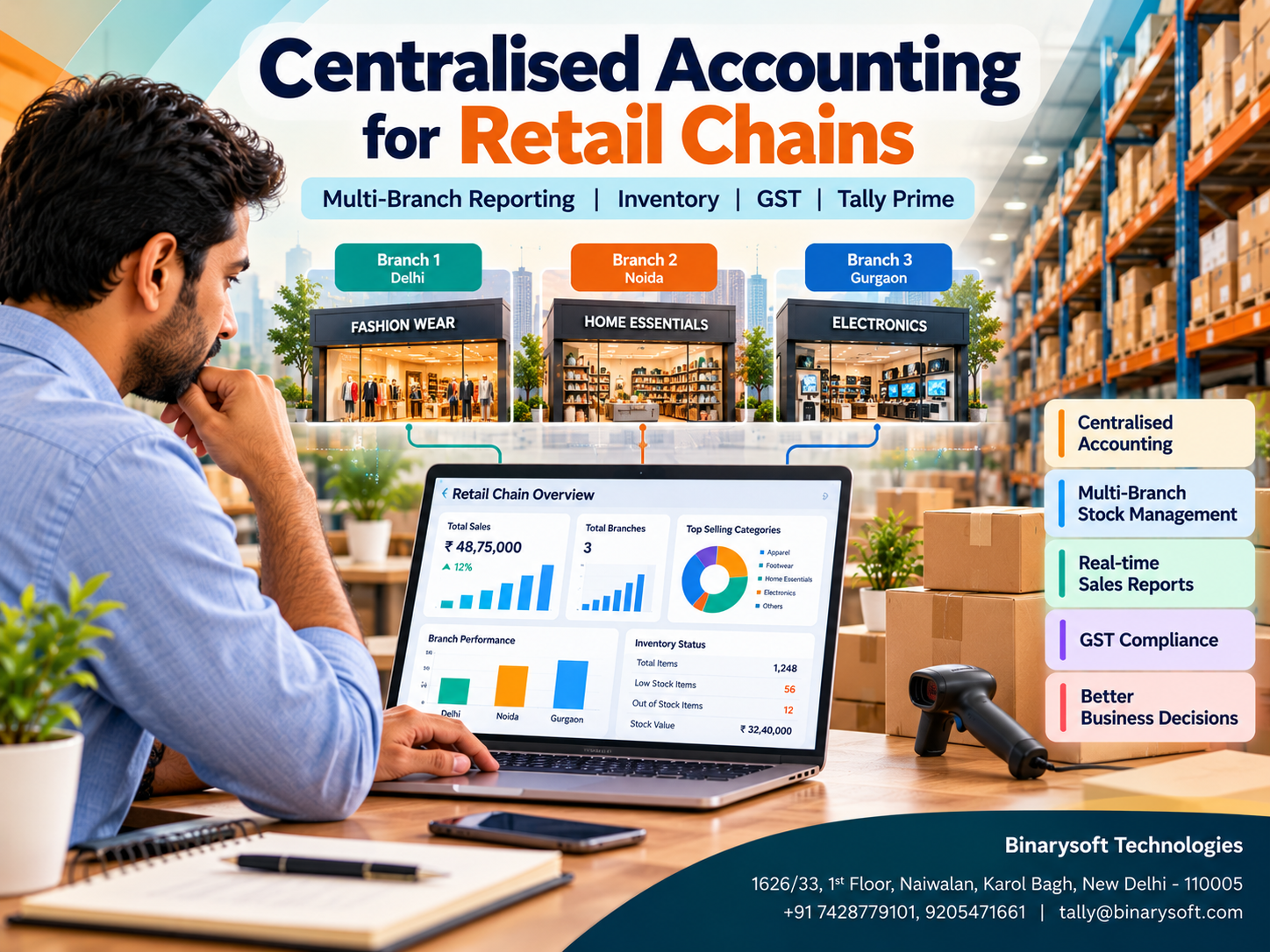
Introduction: Why Indian Retail Chains Need Centralised Accounting in 2026
Opening a second retail store is an exciting achievement. Opening five or ten stores can transform a small business into a growing retail chain.
However, expansion also introduces operational complexity.
Each branch generates sales, purchases, expenses, stock movements, customer transactions and banking records. When these activities are managed through separate spreadsheets or disconnected accounting systems, business owners may struggle to understand their actual financial position.
In 2026, Indian retail businesses increasingly need faster reporting, accurate GST records, coordinated inventory control and better visibility into branch performance.
A profitable store can sometimes hide losses at another location. Excess inventory at one branch may coexist with stock shortages elsewhere.
Centralised accounting helps address these challenges by creating a more consistent financial management process.
Modern retail businesses use accounting software, point-of-sale systems, inventory applications and enterprise management platforms to connect store operations with financial reporting.
For small and medium retail chains, Tally Prime can provide important accounting, inventory and reporting capabilities when configured according to the business's structure.
This guide explores how retail chains can select suitable software, monitor branch performance and build stronger financial control.
The Story of a Retailer Who Expanded Faster Than His Accounting System
Vikram started his first clothing store in Karol Bagh, Delhi, with a small collection of garments and a determination to create a successful family business.
His first store performed well. Customers appreciated the products, and sales increased steadily.
Encouraged by the results, Vikram opened another outlet in Rajouri Garden and later expanded into Rohini.
His family celebrated every new store opening.
But behind the excitement, financial problems were developing.
Each branch maintained separate sales spreadsheets. Inventory records were updated manually, and branch managers sent expense summaries through messaging applications.
One store frequently ran out of popular products, while another held unsold stock for months.
At the end of the financial year, Vikram discovered that although total sales had increased, profits were much lower than expected.
He felt devastated.
His father, who had helped him open the first shop, asked a simple question: "Do you know which store is actually making money?"
Vikram could not answer confidently.
That moment changed his approach to business management.
He introduced standardized accounting procedures, branch-wise expense tracking and regular inventory reviews.
Instead of relying on total sales alone, he began examining the financial performance of each location.
Gradually, he identified underperforming products, excessive expenses and unnecessary stock transfers.
The business became easier to manage because financial information was more organized.
This is a fictional illustrative story based on common challenges faced by expanding retail businesses.
The lesson is clear: opening more stores does not automatically create more profit. Sustainable retail growth requires financial visibility across every branch.
1. What Is Centralised Accounting for Retail Chains?
Centralised accounting is a system in which financial information from multiple retail locations is organized and managed under a coordinated accounting framework.
Individual branches may record daily sales, purchases, expenses and payments, while the head office reviews financial information across the organization.
The main objective is to provide consistent financial visibility without requiring manual consolidation of disconnected records.
For example, a retail chain operating five clothing stores can monitor overall sales while examining the performance of individual locations.
Centralised accounting also supports consistent ledger structures, reporting policies and internal controls.
2. What Types of Software Do Indian Retail Chains Use?
Retail chains commonly use several categories of business software.
|
Software category
|
Primary purpose
|
Suitable businesses
|
|---|
|
Accounting and inventory software
|
Financial records, GST, stock
|
Small and medium retail chains
|
|
POS-integrated accounting
|
Store billing and transaction transfer
|
High-volume retailers
|
|
Retail ERP
|
Purchasing, inventory, promotions, reporting
|
Growing multi-store chains
|
|
Enterprise ERP
|
Complex organizational processes
|
Large retail enterprises
|
|
Business intelligence tools
|
Dashboards and performance analysis
|
Data-driven retail chains
|
Popular software ecosystems include Tally Prime, Zoho's business applications, ERPNext, SAP Business One and Microsoft Dynamics 365.
These platforms differ considerably in capabilities, implementation complexity and cost.
Tally Prime is particularly relevant when accounting, GST compliance, inventory control and financial reporting are central requirements.
Businesses needing advanced loyalty programs, omnichannel order management or specialized POS functions should evaluate additional integrations or dedicated retail platforms.
3. Why Standalone Billing Software Becomes Difficult to Manage
Standalone billing software may work effectively for a single shop.
However, expanding retail chains often experience challenges when each outlet operates independently.
Common problems include inconsistent product codes, duplicate customer records, delayed sales reports and difficulties reconciling stock.
Head office accountants may spend several days combining reports from different branches.
This creates delays in financial decision-making.
An integrated accounting system can reduce repetitive entry and improve consistency.
However, businesses must establish clear data-sharing procedures and ensure that transactions are synchronized or consolidated correctly.
4. Essential Features of Multi-Branch Retail Software
A suitable retail management system should support both individual store operations and head office reporting.
Important capabilities include:
-
Centralised financial accounting
-
Branch-wise sales and expense tracking
-
Multi-location inventory management
-
Inter-branch stock transfers
-
GST accounting and reporting
-
Customer and supplier management
-
Bank reconciliation
-
Consolidated financial statements
-
User permissions and access controls
-
Integration with billing and POS systems
Businesses should also consider scalability, implementation support, backup procedures and data security.
5. How Centralised Accounting Improves Branch Performance Tracking
Branch performance tracking helps business owners identify which locations contribute positively to profitability.
Total revenue alone is not sufficient.
A branch generating high sales may also incur excessive rent, salaries, electricity and promotional expenses.
Consider this illustrative comparison:
|
Branch
|
Monthly sales
|
Allocated expenses and costs
|
Illustrative contribution
|
|---|
|
Karol Bagh
|
₹18,00,000
|
₹15,20,000
|
₹2,80,000
|
|
Rajouri Garden
|
₹14,00,000
|
₹12,80,000
|
₹1,20,000
|
|
Rohini
|
₹12,00,000
|
₹11,50,000
|
₹50,000
|
|
Total
|
₹44,00,000
|
₹39,50,000
|
₹4,50,000
|
The figures represent simplified branch contributions before any unallocated head office costs, financing costs or taxes.
This comparison helps management identify branches requiring operational improvement.
6. Branch-Wise Accounting Using Cost Centres in Tally Prime
Tally Prime provides Cost Centre functionality that businesses can use to allocate relevant income and expenses across departments, projects or branches.
For example, a retailer can establish separate cost centres for Karol Bagh, Rajouri Garden and Rohini.
Applicable transactions can then be allocated to the appropriate branch.
Management can review the Cost Centre Summary and monthly reports to compare allocated financial activity.
Practical setup
-
Open the required company in Tally Prime.
-
Enable Cost Centres where required.
-
Create separate cost centres for each branch.
-
Allocate relevant income and expense transactions to the correct location.
-
Review Cost Centre Summary and Cost Centre Monthly Summary.
-
Compare results and investigate unusual variations.
Cost centre reporting depends on accurate voucher allocations. It should not automatically be treated as a complete branch-wise statutory Profit & Loss Account without verifying inventory costs, shared expenses and other adjustments.
7. Multi-Godown Inventory Management
Inventory management becomes more challenging as retailers open additional stores.
One branch may have excess stock while another experiences shortages.
Tally Prime supports multiple Godowns or Locations for organizing inventory across shops and warehouses.
Businesses can create individual locations for each retail outlet and central warehouse.
For example, a clothing retailer might maintain:
|
Location
|
Inventory purpose
|
|---|
|
Central Warehouse
|
Bulk purchasing and distribution
|
|
Karol Bagh Store
|
Retail sales inventory
|
|
Rajouri Garden Store
|
Retail sales inventory
|
|
Rohini Store
|
Retail sales inventory
|
Stock movement records help management monitor quantities at different locations.
Godown reports can also support physical stock verification and inventory planning.
8. Managing Inter-Branch Stock Transfers
Retail chains regularly transfer products between stores.
For example, one outlet may have excess winter clothing while another requires additional stock.
Properly recorded transfers help maintain accurate inventory quantities.
Tally Prime supports stock transfer workflows through appropriate inventory vouchers, including Stock Journal transactions.
Businesses should establish approval procedures and maintain documentation for transfers.
Where transfers involve separate GST registrations or distinct legal entities, additional tax and accounting requirements may apply.
These transactions should not automatically be treated as ordinary internal stock movements.
9. Centralised GST Accounting for Retail Chains
GST compliance can become complicated when a retail business operates in multiple states.
A business may require separate GST registrations depending on its locations and statutory obligations.
Tally Prime supports GST-related accounting and multiple GST registrations within suitable company configurations.
Businesses should correctly identify the GST registration associated with each transaction.
Sales, purchases, credit notes, debit notes and stock transfers should be recorded according to applicable GST provisions.
Centralised accounting can improve visibility, but GST returns and liabilities must still be handled correctly for each applicable registration.
10. POS Integration and Retail Billing
Point-of-sale systems are important for retailers handling large numbers of customer transactions.
A POS application may provide barcode scanning, cashier workflows, discounts, payment processing and receipt generation.
When connected appropriately to accounting software, POS transactions can flow into financial records.
Tally Prime can support retail sales accounting and POS-related workflows, while external POS integrations may require compatible connectors or customization.
Businesses should verify whether the proposed integration supports returns, discounts, tax treatment, stock updates and error handling.
A reliable integration should also prevent duplicate sales entries.
11. Branch Performance Indicators Every Retailer Should Monitor
Retail managers should regularly review financial and operational indicators.
Important measures include sales growth, gross profit margin, inventory turnover, stock discrepancies, operating expenses and customer returns.
Another useful measure is sales per square foot, especially when comparing stores of different sizes.
However, performance comparisons should account for differences in location, store maturity and product mix.
A new branch may require time to establish a customer base.
Management should evaluate trends rather than making decisions from a single month's results.
12. Centralised Purchasing and Supplier Management
Retail chains can often improve purchasing efficiency by coordinating procurement.
Centralised purchasing may help businesses negotiate supplier rates, standardize product quality and reduce unnecessary duplicate orders.
However, branches may still require flexibility to respond to local customer demand.
Tally Prime supports purchase vouchers, supplier ledgers, purchase orders and inventory reporting.
These records can help management review supplier transactions and outstanding payments.
Businesses should establish clear authorization procedures for purchasing and vendor payments.
13. Case Study One: A Delhi Fashion Retail Chain Improves Branch Visibility
Illustrative case study — fictional business and figures
A clothing retailer operated four stores across Delhi.
Each branch maintained separate sales records, while the head office prepared consolidated reports manually.
The business frequently experienced stock shortages at popular outlets and excess inventory at slower-performing locations.
Management introduced standardized accounting procedures and configured Tally Prime for branch-wise expense allocation and multi-location stock tracking.
The business also established weekly reporting and stock transfer approval procedures.
Within six months, the team reported fewer inventory discrepancies and faster preparation of management reports.
Business benefits
The owner gained clearer information about store expenses, stock availability and branch contributions.
Underperforming locations could be reviewed more objectively.
Key lesson: Standardized accounting and inventory records can help retail chains improve financial visibility without relying on manual consolidation alone.
14. Case Study Two: An Electronics Chain Improves Stock Coordination
Illustrative case study — fictional business and figures
An electronics retailer operated five stores in Delhi NCR.
The business frequently purchased additional products despite having sufficient stock at other locations.
Branch managers could not easily identify available inventory across the chain.
The company introduced a structured inventory process using separate stock locations and centralized purchasing records.
Tally Prime supported stock reporting, purchase accounting and financial management.
The business also established a daily stock review procedure.
In this illustrative example, avoidable duplicate purchasing decreased, and management gained better control over inventory distribution.
Business benefits
The retailer improved stock visibility, reduced unnecessary purchasing and strengthened coordination between stores.
Key lesson: Accurate inventory information can help retail chains protect working capital and improve product availability.
15. How Tally Prime Supports Centralised Retail Chain Management
Tally Prime offers several capabilities relevant to growing retail businesses.
Financial accounting
Maintain sales, purchases, expenses, receipts and payments within structured accounting records.
Cost centre reporting
Allocate relevant income and expenses to branches and review performance using cost centre reports.
Multi-location inventory
Use Godowns or Locations to organize inventory across stores and warehouses.
Group company reporting
Where branches are maintained as separate company datasets, Group Company functionality can help present consolidated financial statements.
Data synchronisation
Tally Prime supports synchronization between appropriately configured locations.
Synchronization requires suitable rules, compatible company configurations and periodic verification. It should not be assumed to provide instantaneous updates in every deployment.
GST accounting
Maintain GST-related transaction records and reports according to the applicable registrations.
Receivables and payables
Monitor customer outstanding balances and supplier payment obligations.
Banking and reconciliation
Review bank transactions and reconcile accounting records.
User security
Configure user permissions to help restrict access according to staff responsibilities.
These capabilities can provide an important accounting foundation for multi-branch retail operations.
16. Tally on Cloud for Multi-Location Retail Businesses
Tally on Cloud can help authorized users access a centrally hosted Tally Prime environment from different business locations.
For example, a retail chain may have accountants at the head office and authorized employees at individual branches.
A suitable cloud deployment can provide shared access to accounting information, subject to licensing, user permissions and infrastructure capacity.
Important considerations include internet reliability, data backup, access controls, security monitoring and performance.
Cloud hosting does not automatically create a fully integrated retail ERP system.
Businesses may still require POS integration, branch-wise workflows or additional reporting customization.
17. How to Implement Centralised Accounting Successfully
A successful implementation should begin with a review of the existing business processes.
Management should identify how each branch records sales, purchases, inventory movements and expenses.
The next step is to standardize ledgers, product codes and reporting procedures.
Businesses should then determine whether to use a single company dataset, multiple company datasets, synchronization or a combination of approaches.
Before full implementation, test the system with a limited number of branches.
Verify opening balances, stock quantities, GST settings and user permissions.
Employees should receive training on accurate transaction entry and reporting.
After deployment, conduct regular reconciliations and review data quality.
18. Common Mistakes Retail Chains Should Avoid
A common mistake is assuming that software alone will solve operational problems.
Poor product coding, inconsistent transaction entry and unclear responsibilities can undermine even an advanced system.
Other mistakes include failing to reconcile inter-branch transfers, granting excessive user permissions and neglecting backups.
Businesses should also avoid comparing branch profitability without accounting for shared expenses and inventory costs.
Centralised accounting is most effective when supported by clear operating procedures and management oversight.
19. Choosing the Right Software for Future Retail Expansion
The best retail management software should support current operations while accommodating future growth.
Small retail chains may prioritize accounting, GST and inventory control.
Larger chains may require advanced POS integrations, loyalty programs, automated replenishment and enterprise reporting.
Before selecting a system, evaluate licensing, implementation costs, training, support and data migration requirements.
Businesses should also test real transaction scenarios, including sales returns, stock transfers and branch reporting.
Tally Prime can provide a strong accounting foundation, while specialized retail applications may complement it where more advanced operational capabilities are required.
Conclusion: Centralised Accounting Builds Stronger and More Profitable Retail Chains
Expanding a retail business requires more than opening additional stores.
Owners need reliable information about sales, expenses, inventory and profitability across every location.
Centralised accounting helps businesses standardize records, improve financial visibility and make more informed decisions.
Tally Prime supports important requirements through accounting, cost centres, multi-godown inventory, GST-related workflows, Group Company reporting and data synchronization.
With suitable implementation and integration, these capabilities can help Indian retail chains manage growing operational complexity.
The ultimate objective is not simply to collect more data. It is to turn accurate business information into better decisions, stronger financial control and sustainable retail growth.
Powered by Binarysoft Technologies
Authorized Tally Partner
Location: 1626/33, 1st Floor, Naiwalan, Karol Bagh, New Delhi – 110005, INDIA
Contact Us: +91 7428779101, 9205471661
Email: tally@binarysoft.com
Business Hours: 10:00 AM – 6:00 PM, Monday to Friday
Frequently Asked Questions
What is the best software for centralised accounting in Indian retail chains?
The best solution depends on business size and requirements. Tally Prime, retail ERP platforms and accounting-integrated POS systems are common options. Businesses should compare accounting, inventory, GST and branch reporting capabilities.
Can Tally Prime manage accounting for multiple retail branches?
Yes. Tally Prime supports branch-related accounting through features such as Cost Centres, multiple companies, Group Company reporting and data synchronization, depending on the selected configuration.
How can retailers compare profitability across branches?
Businesses can allocate relevant income and expenses to branches, review financial reports and account for inventory costs and shared overheads before comparing branch profitability.
Can Tally Prime track inventory at different store locations?
Yes. Its Godowns or Locations feature allows businesses to maintain and review inventory records for multiple stores and warehouses.
CA. Ankit Vardiya works closely with traders, wholesalers, and service businesses on accounting automation, GST reporting, and audit readiness. His professional exposure to day-to-day business operations allows him to translate complex accounting concepts into practical guidance for Indian business owners.