Call CA Tally HelpDesk
+91 9205471661,
7428779101
Introduction: The Hidden Cost of Running a Business Without Accounting Software
Every successful business depends on accurate financial information.
Whether a company operates a retail shop, wholesale distribution business, manufacturing unit or professional service organization, accounting plays an essential role in daily operations.
Business owners must monitor sales, purchases, customer payments, supplier balances, expenses, inventory and tax-related records.
However, many small businesses continue to depend on handwritten registers, spreadsheets and manual calculations.
These methods may appear inexpensive initially, but they can create serious operational and financial challenges as transaction volumes increase.
A missing invoice can affect customer balances. An incorrect stock entry can result in unnecessary purchases. Delayed bookkeeping can prevent business owners from understanding their actual financial position.
The disadvantages of not using accounting software extend beyond administrative inconvenience.
They may include financial inaccuracies, poor cash flow visibility, delayed reporting, inventory discrepancies and difficulties maintaining organized GST-related records.
Modern accounting software helps businesses establish more reliable financial processes.
For Indian MSMEs, Tally Prime provides accounting, invoicing, inventory management, outstanding tracking and financial reporting capabilities.
This guide explores the risks of operating without accounting software and explains how businesses can improve financial control through digital accounting.
A Business Owner's Story: The Missing Payment That Nearly Destroyed Years of Trust
For nearly eighteen years, Suresh had operated a wholesale hardware business in Sadar Bazar, Delhi.
His father had started the shop with a few shelves of tools, electrical fittings and construction accessories.
Over time, the business expanded.
Suresh developed relationships with suppliers, employed several workers and supplied products to retailers across Delhi NCR.
He believed that maintaining handwritten accounting registers was sufficient.
After all, his father had successfully managed the business using the same method.
However, as customer orders increased, bookkeeping became more complicated.
Some sales were recorded in notebooks, while others were maintained in spreadsheets.
Customer payments were sometimes updated several days after receiving them.
One morning, an important customer called Suresh.
The customer was upset because the business had demanded payment for an invoice that had already been settled.
Suresh searched through his registers.
After several hours, he discovered that the payment had been received but never entered into the customer account.
The mistake embarrassed him.
The customer questioned whether future transactions would be handled accurately.
Later that week, Suresh discovered another problem.
Several supplier payments were approaching their due dates, but his available cash was lower than expected.
He had no reliable report showing total customer outstanding balances.
That evening, Suresh sat in his office thinking about his father's years of hard work.
He feared that accounting mistakes could damage the relationships that had taken decades to build.
He realized that his business had grown beyond the capacity of its manual bookkeeping system.
After reviewing his requirements, Suresh introduced accounting software and organized his financial records.
His employees received training, customer balances were reconciled, and daily transactions were recorded more consistently.
Gradually, he gained greater confidence in the information available to him.
The experience taught him an important lesson:
A business can survive temporary sales difficulties, but unreliable financial information can quietly weaken customer trust, cash flow and long-term stability.
1. What Happens When a Business Does Not Use Accounting Software?
Businesses that do not use accounting software typically rely on manual bookkeeping methods.
These may include physical registers, spreadsheets, handwritten invoices and separate payment records.
Manual accounting is not automatically incorrect.
A small organization with limited transactions may maintain accurate books through disciplined procedures.
However, manual methods become more difficult to manage as business activities expand.
Employees may need to enter the same information repeatedly.
Preparing financial statements can require extensive calculations.
Customer outstanding balances may need to be reconciled manually.
Inventory and accounting information may remain disconnected.
Without consistent procedures, these activities increase the risk of errors and delays.
Accounting software can help organize financial information and reduce dependence on fragmented records.
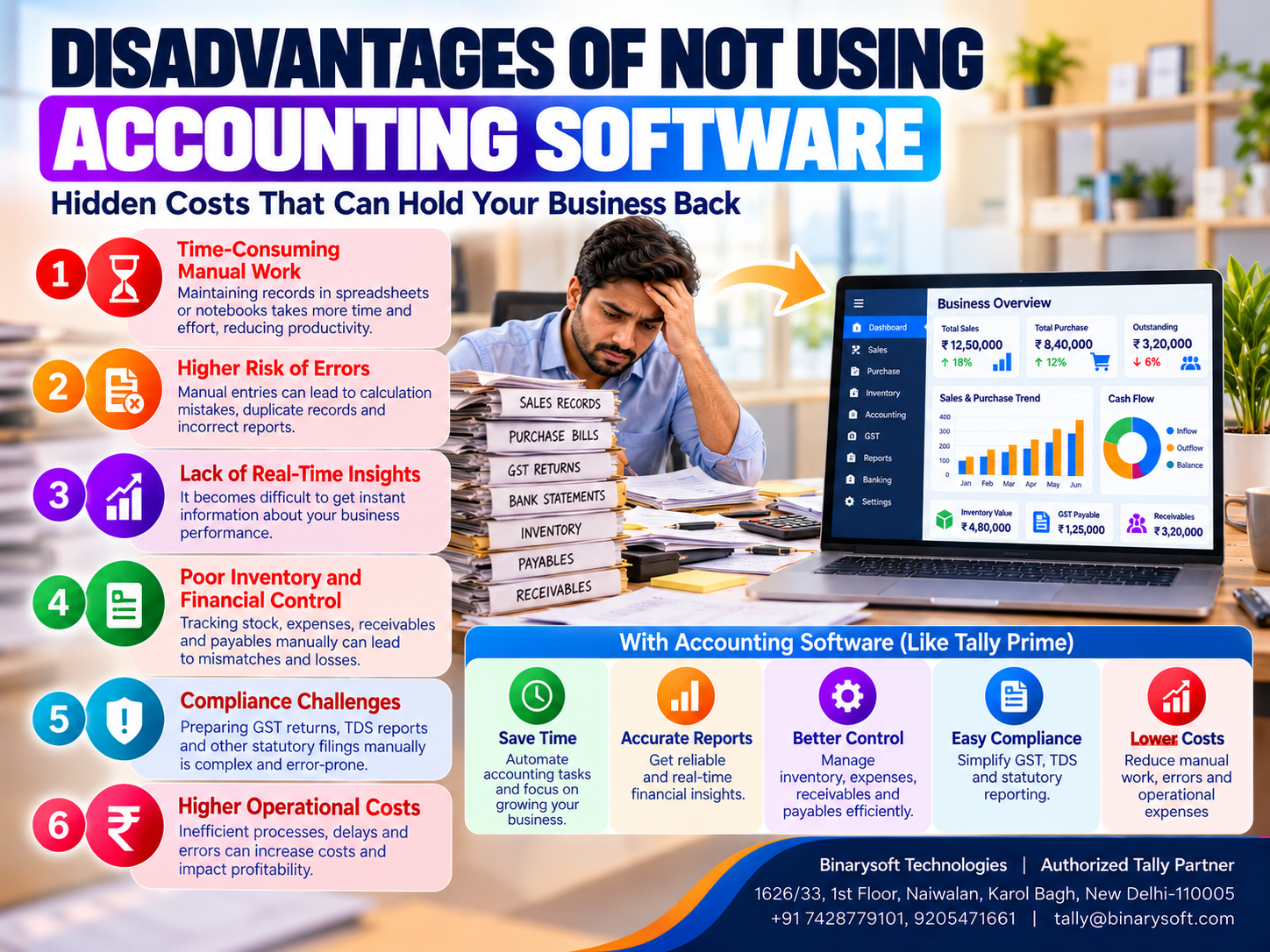
2. Fifteen Major Disadvantages of Not Using Accounting Software
Disadvantage 1: Increased Risk of Accounting Errors
Manual accounting requires employees to perform calculations and enter information repeatedly.
Mistakes may occur while recording invoices, calculating totals or updating ledger balances.
For example, an employee may record a customer payment against the wrong account.
Such errors can create confusion during reconciliation.
How Accounting Software Helps
Accounting software supports structured transaction recording and automatic calculations for supported processes.
Tally Prime helps businesses maintain accounting ledgers and generate financial reports from recorded transactions.
However, businesses must still verify entries and maintain appropriate controls.
Disadvantage 2: Time-Consuming Bookkeeping
Manual bookkeeping can require substantial administrative effort.
Employees may spend hours preparing invoices, updating registers and calculating account balances.
As transaction volumes increase, these activities become more demanding.
How Accounting Software Helps
Digital accounting simplifies routine transaction recording.
Relevant reports can be generated using information already entered into the system.
This allows employees to spend less time on repeated calculations and manual consolidation.
Disadvantage 3: Poor Cash Flow Visibility
Cash flow management is essential for business survival.
A company may generate substantial sales but still experience financial pressure when customers delay payments.
Without organized accounting records, business owners may struggle to identify available cash, outstanding receivables and upcoming liabilities.
How Accounting Software Helps
Tally Prime provides accounting reports that help businesses review customer balances, supplier obligations and recorded cash and bank positions.
Management can use this information for payment planning.
Advanced cash flow forecasting may require additional analysis.
Disadvantage 4: Difficulty Tracking Customer Outstanding Payments
Businesses offering credit sales must monitor unpaid invoices carefully.
Manual tracking can become complicated when customers make partial payments or have multiple outstanding bills.
Incorrect records may lead to payment disputes.
How Accounting Software Helps
Tally Prime supports bill-wise accounting and outstanding management for suitable transactions.
Businesses can review customer balances and identify pending amounts.
Regular reconciliation remains important.
Disadvantage 5: Delayed Financial Reporting
Business owners need timely information about profitability and financial performance.
Manual preparation of financial statements can require collecting records from multiple registers and spreadsheets.
This may delay important decisions.
How Accounting Software Helps
Accounting software can generate reports based on recorded transactions.
Tally Prime provides financial statements such as the Balance Sheet and Profit and Loss Account.
The reliability of these reports depends on complete and accurate accounting entries.
Disadvantage 6: Inventory Management Problems
Retailers, wholesalers and manufacturers must maintain accurate stock records.
When inventory and accounting information are maintained separately, discrepancies may arise.
Businesses may purchase products unnecessarily or promise customers stock that is unavailable.
How Accounting Software Helps
Tally Prime provides inventory features for maintaining stock items, stock groups, units of measurement and relevant stock movements.
Properly configured inventory records help businesses improve stock visibility.
Disadvantage 7: GST-Related Recordkeeping Challenges
Indian businesses must maintain appropriate records for applicable GST requirements.
Manual accounting may make it more difficult to organize taxable transactions, verify invoice details and reconcile tax-related information.
Incorrect classifications or incomplete records can create compliance difficulties.
How Accounting Software Helps
Tally Prime provides GST-related accounting and reporting features.
Businesses can maintain relevant tax details and review supported reports.
However, accounting software does not remove the responsibility to verify tax treatment, maintain records and meet statutory obligations.
Disadvantage 8: Difficulty Managing Supplier Payments
Supplier relationships depend on accurate payment records.
Manual accounting can make it difficult to track multiple invoices, advances and outstanding balances.
Delayed or disputed payments may affect supplier confidence.
How Accounting Software Helps
Accounting software helps maintain supplier ledgers and relevant payable information.
Tally Prime provides reports that can support supplier payment reviews.
Disadvantage 9: Limited Financial Transparency
When financial information is distributed across notebooks and spreadsheets, management may struggle to understand the complete financial position.
Different employees may maintain different versions of the same information.
This can create inconsistent reporting.
How Accounting Software Helps
A structured accounting system provides a common environment for recording relevant transactions.
Appropriate procedures and access controls can improve information consistency.
Disadvantage 10: Higher Administrative Costs
Manual bookkeeping may appear inexpensive because it does not require software licensing.
However, businesses should also consider the cost of employee time, repeated calculations, corrections and reconciliation.
As transaction volumes increase, these activities can become expensive.
How Accounting Software Helps
Digital accounting may reduce repetitive administrative work.
Businesses should compare actual labour savings with software licensing, implementation and maintenance costs.
Disadvantage 11: Difficulty Preparing for Audits
Audits and financial reviews require organized accounting records and supporting documentation.
Manual records can make transaction tracing and reconciliation more time-consuming.
Missing information may delay the review process.
How Accounting Software Helps
Accounting software provides structured transaction records and financial reports.
Businesses must still retain supporting documents and follow applicable recordkeeping requirements.
Disadvantage 12: Greater Risk of Losing Financial Records
Physical registers can be damaged, misplaced or destroyed.
Spreadsheets may also be lost through accidental deletion, hardware failure or inadequate backup practices.
How Accounting Software Helps
Digital accounting systems can support organized backup procedures.
Businesses using Tally Prime should establish reliable backup schedules and verify recovery processes.
Software alone does not guarantee data protection.
Disadvantage 13: Difficulty Managing Multiple Business Locations
Businesses operating several branches may maintain separate accounting records.
Consolidating information manually can be complicated.
How Accounting Software Helps
Suitable accounting and ERP systems can support more organized financial processes.
Businesses should evaluate the specific multi-location, consolidation and access capabilities they require.
Disadvantage 14: Limited Business Analysis
Manual accounting often focuses on recording transactions rather than analyzing performance.
Business owners may struggle to compare expenses, evaluate profitability or identify financial trends.
How Accounting Software Helps
Financial reports provide information that management can use for business analysis.
Tally Prime supports relevant accounting reports that help owners review business performance.
Disadvantage 15: Difficulty Supporting Business Growth
As a business expands, transaction volumes and operational responsibilities increase.
Manual systems that worked during the startup stage may become inefficient.
Businesses may need additional employees simply to maintain records.
How Accounting Software Helps
A suitable accounting system provides a more structured foundation for managing growing transaction volumes.
Organizations can evaluate additional functionality as requirements expand.
3. Manual Accounting vs Accounting Software: Key Differences
| Business Activity | Manual Accounting | Accounting Software |
|---|
| Transaction Recording |
Registers and spreadsheets |
Structured digital entries |
| Calculations |
Often manual |
Supported automatic calculations |
| Financial Reports |
Manual preparation |
Reports from recorded data |
| Customer Outstanding |
Manual reconciliation |
Outstanding reports |
| Supplier Payments |
Separate registers |
Payable information |
| Inventory Management |
Physical stock records |
Digital inventory records |
| GST-Related Records |
Manual compilation |
Supported tax-related reports |
| Data Backup |
Physical or spreadsheet copies |
Digital backup procedures |
| Business Analysis |
Manual consolidation |
Financial reporting tools |
| Scalability |
Increasing administrative effort |
More structured expansion |
The benefits depend on selecting suitable software and maintaining accurate records.
4. How Tally Prime Helps Businesses Overcome Manual Accounting Challenges
Tally Prime provides accounting and business management features that can support many Indian MSMEs.
Financial Accounting
Businesses can maintain ledgers and record sales, purchases, receipts, payments and other accounting transactions.
GST-Related Accounting
Supported features help maintain relevant tax-related transaction information.
Inventory Management
Stock groups, stock items, units and godown-related features help organize inventory records.
Customer Outstanding Management
Businesses can review relevant receivable information.
Supplier Accounting
Supplier ledgers and payable reports support payment planning.
Banking Records
Relevant accounting and banking features help maintain financial transaction information.
Financial Reporting
Management can review the Balance Sheet, Profit and Loss Account and other available reports.
User Security
Suitable security settings help restrict access to sensitive accounting information.
The exact functionality depends on the installed version, licensing and configuration.
5. How to Move From Manual Accounting to Tally Prime
Moving from manual bookkeeping to digital accounting requires planning.
Step 1: Review Existing Records
Collect accounting registers, invoices, customer balances and supplier information.
Step 2: Reconcile Financial Information
Verify ledger balances and investigate discrepancies.
Step 3: Prepare Accounting Masters
Organize customer, supplier, expense and other relevant ledger information.
Step 4: Prepare Inventory Records
Review stock items, units and available quantities.
Step 5: Configure Company Information
Set up the business in Tally Prime with relevant financial and tax details.
Step 6: Enter Verified Opening Balances
Use reconciled information to establish the opening accounting position.
Step 7: Configure Relevant Features
Enable and configure the accounting and inventory features required by the business.
Step 8: Train Employees
Explain transaction entry, reporting and backup procedures.
Step 9: Test Business Transactions
Record representative sales, purchases, receipts and payments.
Step 10: Review Reports
Verify financial balances and inventory information before relying on the new system for regular operations.
6. Case Study One: Manual Accounting Problems in a Wholesale Business
Business: Illustrative electrical goods distributor, Bhagirath Palace, Delhi
Business Challenge
A wholesale distributor maintained customer balances in notebooks and inventory information in spreadsheets.
As transaction volumes increased, employees struggled to reconcile records.
Some customer payments were updated late, creating confusion during collections.
Solution
The company introduced Tally Prime for accounting and inventory management.
Customer and supplier ledgers were organized.
Opening balances were reconciled, and employees received training.
The business also established procedures for recording daily transactions.
Business Benefits
Management gained clearer visibility into customer outstanding amounts and stock records.
Employees spent less time consolidating disconnected information.
The company improved consistency in its accounting processes.
Key Learning
Accurate customer records and organized inventory information are essential for wholesale business management.
This is an illustrative case study.
7. Case Study Two: Accounting Software for a Small Manufacturing Company
Business: Illustrative packaging manufacturer, Bawana Industrial Area, Delhi
Business Challenge
A manufacturing company maintained raw material purchases and financial transactions in separate registers.
Management found it difficult to review material expenses and supplier balances.
Financial reports were often prepared late.
Solution
The company introduced a structured accounting and inventory process using Tally Prime.
Relevant stock items and accounting ledgers were configured.
Employees received training on purchase recording, inventory entries and financial reporting.
Business Benefits
The company established more consistent accounting records.
Management could review financial information more efficiently.
The implementation also improved coordination between accounting and inventory employees.
Key Learning
Digital accounting can provide a stronger foundation for financial visibility and inventory control in manufacturing businesses.
This is an illustrative case study.
8. How Accounting Software Helps Improve Cash Flow
Cash flow problems are among the most serious challenges faced by small businesses.
Even companies generating regular sales may struggle when customer payments are delayed.
Accounting software helps organize the information required for cash flow management.
Monitor Customer Receivables
Outstanding reports help identify unpaid customer balances.
Review Supplier Payables
Businesses can identify pending supplier obligations.
Track Operating Expenses
Financial records help management understand regular expenditure.
Review Cash and Bank Positions
Relevant accounting reports provide information about recorded balances.
Prepare Financial Plans
Management can use accounting information to estimate upcoming cash requirements.
Tally Prime supports accounting and outstanding management, while detailed forecasting may require additional financial models.
9. The Hidden Financial Cost of Manual Accounting
Manual bookkeeping may seem inexpensive, but its indirect costs can be significant.
Consider an illustrative business where employees spend an additional 40 hours each month on repetitive bookkeeping and reconciliation.
If the estimated administrative cost is ₹200 per hour:
Monthly Administrative Cost = 40 × ₹200 = ₹8,000
Annual Administrative Cost = ₹8,000 × 12 = ₹96,000
This calculation is illustrative and does not represent guaranteed savings from accounting software.
Actual results depend on transaction volumes, employee responsibilities and implementation quality.
Businesses should compare these costs with software licensing, training and support expenses.
10. Why Accurate Accounting Matters for Business Decisions
Business decisions depend on reliable financial information.
Owners need to know whether sales are profitable, customers are paying on time and operating expenses remain manageable.
Without accurate accounting, management may make decisions using incomplete information.
For example, a business may purchase additional inventory without realizing that substantial funds are already tied up in unsold stock.
Another company may offer additional customer credit despite increasing outstanding balances.
Reliable accounting records help businesses evaluate these situations more carefully.
Tally Prime provides financial and inventory reports that can support informed decisions when records are maintained correctly.
11. Is Manual Accounting Suitable for Very Small Businesses?
Manual accounting may remain practical for some businesses with limited transactions and simple reporting requirements.
However, business owners should consider future growth.
Even a small business can benefit from organized digital records.
The decision should depend on transaction volumes, reporting requirements, budget and available expertise.
Businesses should avoid purchasing unnecessarily complex software.
Instead, they should select a solution that addresses their essential accounting needs.
12. Common Mistakes When Introducing Accounting Software
Migrating Incorrect Opening Balances
Businesses should reconcile existing records before migration.
Ignoring Employee Training
Users need to understand how to record transactions correctly.
Selecting Software Without Evaluating Requirements
The application should match business needs.
Failing to Configure Inventory Properly
Incorrect stock masters can create reporting problems.
Not Establishing Backup Procedures
Reliable backups are essential for business continuity.
Overlooking User Permissions
Sensitive financial information should be accessible only to authorized personnel.
Expecting Software to Correct Every Error Automatically
Accounting software supports better processes, but human review remains necessary.
13. Benefits of Cloud-Hosted Accounting for Growing Businesses
Some businesses require access to accounting information from multiple locations.
Compatible cloud-hosting arrangements can provide remote access to supported accounting applications.
For Tally Prime users, suitable hosting environments may help authorized employees access the accounting system remotely.
However, businesses should evaluate hosting costs, internet connectivity, data security, backup responsibilities and licensing requirements.
Cloud hosting does not eliminate the need for internal controls or reliable accounting procedures.
14. Best Practices for Maintaining Accurate Digital Accounting Records
Businesses should establish consistent accounting procedures after adopting software.
Record transactions promptly.
Reconcile bank accounts regularly.
Review customer and supplier balances.
Verify stock information periodically.
Maintain appropriate supporting documents.
Restrict access to sensitive information.
Create and test backups.
Train employees when business processes change.
Review financial reports at regular intervals.
These practices help businesses obtain greater value from accounting software.
15. The Future of Accounting Software for Indian MSMEs
Indian businesses are increasingly adopting digital accounting, electronic invoicing and integrated financial management tools.
Modern accounting applications continue to develop features that support business efficiency and information visibility.
Cloud hosting, connected services and automation are also influencing how organizations manage accounting processes.
However, technology should support sound financial practices rather than replace them.
For MSMEs, the foundation remains accurate bookkeeping, reliable reporting and disciplined financial management.
Businesses that establish these practices are better positioned to evaluate additional technology as their operations expand.
Conclusion
The disadvantages of not using accounting software can affect almost every part of business management.
Manual bookkeeping may increase administrative work, create accounting errors, delay financial reporting and make customer outstanding management more difficult.
Businesses may also face challenges involving inventory records, supplier payments, GST-related information and cash flow visibility.
As transaction volumes increase, these problems can become more serious.
Accounting software provides a structured way to record financial transactions and maintain relevant business information.
For Indian MSMEs, Tally Prime offers accounting, inventory, invoicing, outstanding management and reporting features that can support daily operations.
However, successful implementation requires accurate opening balances, suitable configuration, employee training and regular reconciliation.
The greatest risk of avoiding accounting software is not simply spending more time on bookkeeping. It is making important business decisions without accurate, timely and reliable financial information.
Powered by Binarysoft Technologies
Authorized Tally Partner
Location: 1626/33, 1st Floor, Naiwalan, Karol Bagh, New Delhi – 110005, INDIA
Contact Us: +91 7428779101, 9205471661
Email: tally@binarysoft.com
Business Hours: 10:00 AM – 6:00 PM, Monday to Friday
Frequently Asked Questions
What are the main disadvantages of not using accounting software?
The main disadvantages include increased accounting errors, time-consuming bookkeeping, delayed financial reporting, poor cash flow visibility and difficulty managing customer and supplier balances
Why is manual accounting risky for growing businesses?
As transaction volumes increase, manual accounting becomes more difficult to maintain accurately and consistently.
Can a small business operate without accounting software?
Yes. Some businesses with limited transactions can maintain manual records, but accounting software may provide greater efficiency and financial visibility.
How does accounting software reduce bookkeeping errors?
Accounting software supports structured transaction entry and automatic calculations for relevant processes, although accurate data entry and review remain essential.
CA. Ishaan Bagaria works closely with traders and service enterprises on accounting systems, GST compliance, and reporting processes. His focus is on improving record accuracy and simplifying day-to-day financial management.