Call CA Tally HelpDesk
+91 9205471661,
7428779101
Introduction: Why Modern Accounting Software Is More Than Bookkeeping
Every business depends on accurate financial information.
Whether an organization operates a retail shop, wholesale distribution business, manufacturing unit or professional services company, accounting plays an important role in daily operations.
However, business accounting involves much more than recording income and expenses.
Organizations must prepare invoices, manage inventory, track customer payments, monitor supplier obligations, reconcile bank transactions, calculate taxes and prepare financial reports.
When these activities are maintained through separate spreadsheets and manual registers, employees often spend considerable time reconciling information.
A sales invoice may be recorded in the accounting system, but inventory quantities may remain unchanged.
A customer may have overdue invoices, but the sales department may not have access to updated outstanding information.
A business owner may want to review profitability but must wait for the accountant to prepare multiple reports.
Modern accounting software addresses many of these challenges through specialized functional modules.
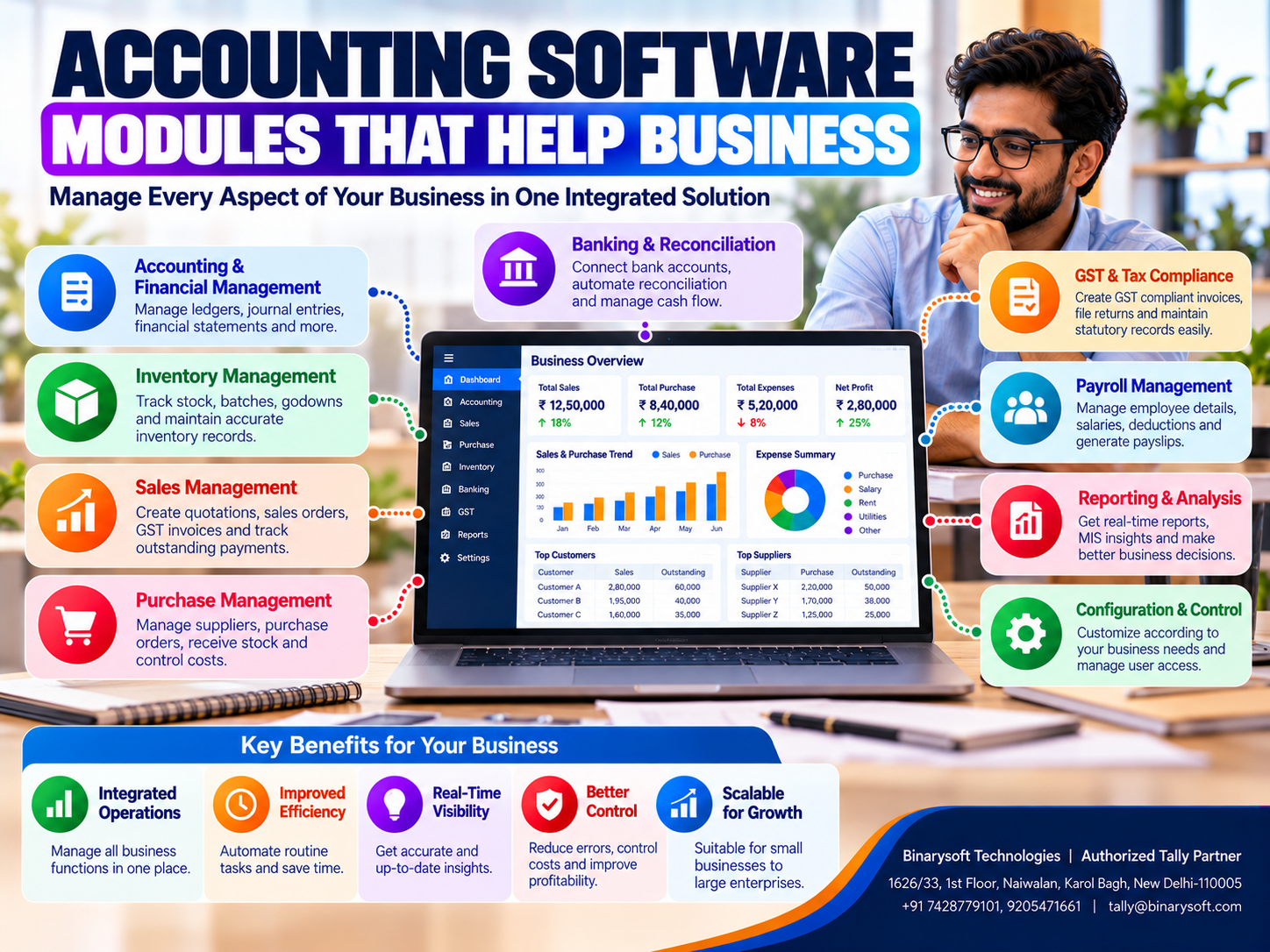
Accounting software modules are interconnected features designed to manage specific financial and operational activities.
These may include general ledger accounting, accounts receivable, accounts payable, inventory management, taxation, banking, payroll and financial reporting.
For Indian small and medium enterprises, understanding these modules is important when selecting or implementing business management software.
Tally Prime provides several integrated accounting and operational capabilities that help businesses maintain structured records and access useful information.
This guide explains the important modules of accounting software, their features, practical benefits and how businesses can use Tally Prime to improve everyday operations.
A Business Owner's Story: The Day an Unpaid Invoice Almost Stopped His Business
Sanjay operated a wholesale stationery distribution business in Sadar Bazar, New Delhi.
His father had started the company with a small shop supplying notebooks, registers and office stationery to nearby retailers.
Over the years, Sanjay expanded the business.
He began supplying products to schools, offices and wholesale customers across Delhi NCR.
Sales increased steadily.
The company employed additional staff and maintained a warehouse containing hundreds of products.
From the outside, the business appeared successful.
However, Sanjay faced a growing problem.
His sales team prepared invoices using one application.
Inventory records were maintained in spreadsheets.
Customer payments were tracked through a separate register.
The accountant recorded bank transactions at the end of each week.
One morning, an important supplier called Sanjay.
A payment had become overdue, and the supplier was unwilling to dispatch additional goods until the outstanding amount was cleared.
Sanjay immediately contacted his accountant.
He believed the company had sufficient money because sales had been strong.
However, the accountant explained that several major customers had not paid their invoices.
The company had recorded substantial revenue, but much of the money remained outstanding.
Sanjay felt helpless.
He had spent years building customer relationships and expanding the business.
Yet he could not confidently answer a simple question:
How much money was actually available to pay suppliers?
That evening, he reviewed the company's accounting procedures.
He realized that the problem was not merely delayed payments.
The business lacked a connected process for invoicing, customer outstanding management and banking.
With professional guidance, the company introduced more structured accounting procedures using Tally Prime.
Employees began maintaining bill-wise customer balances.
Supplier payments were reviewed regularly.
Inventory and accounting records were updated through consistent transaction procedures.
Over time, Sanjay gained better visibility into financial obligations.
He understood that software becomes valuable when its features work together to support business decisions.
A business does not become financially stronger simply by recording transactions. It becomes stronger when those records help the owner understand what needs attention.
This is an illustrative story based on common business challenges.
What Are Accounting Software Modules?
Accounting software modules are functional components of an accounting system that support specific business activities.
Each module focuses on a particular responsibility.
For example, the general ledger module maintains accounting records.
The accounts receivable module supports customer outstanding management.
The accounts payable module helps track supplier obligations.
The inventory module maintains stock-related information.
The financial reporting module helps management review business performance.
When modules are integrated, information recorded through one process may be reflected in other relevant records.
This reduces the need to maintain duplicate information manually.
However, the level of integration varies between software products.
Businesses should evaluate actual capabilities rather than assuming every application includes every module.
Why Accounting Software Modules Are Important
As businesses grow, financial transactions become more complex.
Managing these activities through disconnected systems can create inconsistencies.
Accounting software modules help organizations organize responsibilities.
They can support accurate transaction recording, faster reporting, improved payment monitoring and better inventory visibility.
Modules also allow employees to focus on functions relevant to their roles.
For example, a billing employee may primarily use invoicing features, while management reviews financial statements and outstanding reports.
This structured approach can improve operational coordination.
15 Essential Accounting Software Modules Every Business Should Understand
1. General Ledger Module
The general ledger is the foundation of financial accounting.
It maintains records of transactions classified under relevant accounts.
Businesses use the general ledger to organize income, expenses, assets, liabilities and capital.
Important Functions
Ledger creation and maintenance
Recording accounting vouchers
Reviewing account balances
Maintaining transaction histories
Supporting financial statements
How Tally Prime Helps
Tally Prime allows businesses to create ledgers under appropriate accounting groups.
Employees can record sales, purchases, receipts, payments, journals and other relevant vouchers.
These records support financial reporting.
Business Benefits
A structured general ledger helps maintain organized financial information and reduces dependence on manual accounting registers.
However, accuracy depends on correct ledger classification and transaction recording.
2. Accounts Receivable Module
Accounts receivable represents money owed to a business by customers.
For companies selling products or services on credit, receivables management is essential.
Important Functions
Customer balance tracking
Invoice-wise outstanding management
Payment allocation
Overdue balance review
Receivables reporting
Practical Example
A wholesale distributor supplies goods worth ₹2,00,000 to a retailer on 30-day credit.
The accounts team needs to monitor when the payment becomes due.
Tally Prime Application
Tally Prime supports bill-wise accounting and customer outstanding reports.
Businesses can review unpaid invoices and relevant balances.
Business Benefits
Regular receivables monitoring can support timely follow-up and better working capital planning.
3. Accounts Payable Module
Accounts payable represents amounts owed to suppliers and other creditors.
Businesses must manage payment obligations carefully to maintain supplier relationships.
Important Functions
Supplier invoice recording
Outstanding balance tracking
Payment allocation
Supplier ledger review
Payment planning
Tally Prime Application
Purchase and payment vouchers help maintain relevant supplier accounting records.
Bill-wise tracking supports outstanding analysis.
Business Benefits
Accurate payable information helps organizations plan payments and avoid overlooking important obligations.
4. Sales and Invoicing Module
Invoicing is one of the most frequently used business activities.
A suitable invoicing module helps organizations prepare customer invoices and maintain transaction records.
Important Functions
Customer selection
Product and service details
Quantity and rate entry
Discount recording
Applicable tax calculations
Invoice printing and sharing
Tally Prime Features
Tally Prime supports configurable sales invoices and relevant GST-related information.
Supported releases provide additional invoice-sharing and connected capabilities.
Business Benefits
Structured invoicing can improve consistency, reduce repetitive work and support customer service.
Employees should verify invoice details before issuing documents.
5. Purchase Management Module
Purchasing affects inventory availability, supplier relationships and business costs.
A purchase management module helps maintain procurement-related records.
Important Functions
Purchase order recording
Supplier transaction management
Purchase invoice accounting
Purchase analysis
Supplier outstanding review
Tally Prime Application
Tally Prime provides purchase vouchers, purchase order capabilities and supplier accounting.
Business Benefits
Structured purchasing records help organizations monitor procurement activities and review supplier transactions.
Advanced approval workflows may require additional tools or configuration.
6. Inventory Management Module
Inventory management is particularly important for retailers, wholesalers, distributors and manufacturers.
Businesses need accurate information about available stock.
Important Functions
Stock item management
Stock grouping
Units of measurement
Warehouse records
Inventory movements
Stock valuation
Inventory reporting
Tally Prime Features
Tally Prime supports stock items, stock groups, stock categories and godowns.
Relevant businesses can use batch-wise inventory features.
Practical Example
An electronics distributor maintains 2,000 different products.
Structured inventory records help employees review recorded quantities before processing customer orders.
Business Benefits
Better stock information can support purchasing decisions, reduce discrepancies and improve order fulfillment.
7. GST and Taxation Module
Indian businesses must maintain appropriate tax-related records.
GST-related accounting is important for many organizations.
Important Functions
GST-related invoice information
Tax ledger maintenance
Transaction classification
Relevant GST reports
Supported e-invoicing processes
Supported e-way bill processes
Tally Prime Application
Tally Prime provides GST-related accounting and invoicing capabilities.
Eligible businesses can use supported connected compliance features according to applicable requirements.
Important Consideration
Tax treatment depends on current law, transaction details and business circumstances.
Businesses should verify compliance requirements with qualified professionals.
8. Banking and Reconciliation Module
Banking transactions form an important part of business accounting.
Organizations must maintain accurate records of receipts, payments and bank balances.
Important Functions
Bank ledger management
Receipt and payment recording
Bank reconciliation
Cheque-related records
Supported electronic payment workflows
Tally Prime Features
Tally Prime provides banking and reconciliation capabilities.
Supported releases and banking arrangements offer additional connected services.
Business Benefits
Bank reconciliation helps businesses identify differences between accounting records and bank statements.
9. Financial Reporting Module
Financial reports help management understand business performance.
Without reliable reports, owners may struggle to evaluate profitability and financial position.
Important Reports
Profit and loss statement
Balance sheet
Trial balance
Cash flow-related reports
Sales and purchase summaries
Outstanding reports
Inventory summaries
Tally Prime Application
Tally Prime generates financial reports using recorded accounting information.
Applicable releases also provide dashboard features for selected business information.
Business Benefits
Regular reporting supports more informed financial decisions.
10. Payroll Management Module
Businesses employing staff may need payroll-related accounting.
A payroll module helps maintain employee salary information and relevant calculations.
Important Functions
Employee records
Salary structures
Attendance-related information
Payroll processing
Payroll reporting
Tally Prime Features
Tally Prime provides payroll capabilities for applicable business requirements.
Business Benefits
Structured payroll records can reduce repetitive calculations and improve employee-related accounting.
Statutory payroll obligations must be configured according to applicable requirements.
11. Budgeting and Cost Control Module
Businesses need to monitor expenditure against planned budgets.
A budgeting module helps organizations establish financial targets and compare them with actual results.
Important Functions
Budget preparation
Expense monitoring
Budget comparisons
Department-wise analysis
Cost allocation
Tally Prime Application
Tally Prime supports budgeting and cost centre-related capabilities.
Practical Example
A business establishes an annual administrative expense budget of ₹12,00,000.
Management can review relevant actual expenses periodically.
Business Benefits
Budget monitoring helps identify unexpected expenditure and supports financial discipline.
12. Fixed Asset Management
Fixed assets include machinery, computers, furniture, vehicles and other long-term business resources.
Businesses need accurate records of asset purchases, disposals and depreciation.
Important Functions
Asset classification
Acquisition records
Depreciation accounting
Disposal transactions
Asset-related reporting
Tally Prime Application
Tally Prime supports fixed asset ledgers and relevant accounting entries.
Businesses can record depreciation through appropriate accounting procedures.
Important Limitation
A complete automated fixed asset register with advanced asset lifecycle workflows may require additional tools or specialized software.
13. Cost Centre and Project Accounting
Some businesses need to analyze income and expenses by department, project or operating unit.
Important Functions
Department-wise expense allocation
Project-related cost tracking
Cost centre reporting
Financial performance analysis
Tally Prime Features
Cost centres can be used to allocate relevant accounting transactions.
Applicable cost category features support selected reporting structures.
Business Benefits
Project-wise and department-wise information can help management understand where resources are being consumed.
14. Manufacturing and Production-Related Accounting
Manufacturing businesses require additional records for materials and finished goods.
Important Functions
Raw material records
Finished goods inventory
Material consumption
Production-related inventory transactions
Relevant manufacturing cost analysis
Tally Prime Application
Tally Prime supports Bills of Materials and applicable manufacturing-related inventory vouchers.
Important Limitation
Advanced production scheduling, shop-floor automation and specialized manufacturing execution may require additional applications.
15. Security, Audit Trail and Data Management
Accounting systems contain sensitive business information.
Organizations need appropriate controls to protect records.
Important Functions
User access management
Authentication
Data protection
Change tracking
Backup procedures
Tally Prime Features
Tally Prime provides relevant security and user access capabilities.
TallyVault offers encryption-related protection.
Applicable product editions and configurations provide Edit Log capabilities.
Business Benefits
Security controls help organizations protect financial information and maintain accountability.
Reliable backups and secure infrastructure remain essential.
How Accounting Software Modules Work Together
The real value of accounting software often comes from the relationship between its functions.
Consider a wholesale distributor processing a customer order.
First, the sales employee reviews available inventory.
Next, the business prepares a sales invoice.
The transaction affects relevant sales accounting records.
Where inventory accounting is configured, recorded stock information is updated.
If the sale is on credit, the customer balance becomes outstanding.
When the customer pays, the receipt is recorded and allocated appropriately.
Management can then review sales, receivables, inventory and financial reports.
This connected process reduces the need for separate manual updates.
However, accurate results depend on correct configuration and consistent transaction procedures.
Benefits of Integrated Accounting Software Modules
Reduced Manual Work
Employees may spend less time transferring information between disconnected records.
Improved Data Consistency
Integrated processes can reduce duplicate entry and reconciliation difficulties.
Better Financial Visibility
Management can review recorded balances and reports more efficiently.
Improved Inventory Control
Inventory records can support purchasing and sales decisions.
Stronger Payment Management
Receivables and payables reports help organizations monitor financial obligations.
Better Operational Coordination
Departments can work with more consistent information.
Improved Scalability
Structured processes can help businesses manage increasing transaction volumes.
How Tally Prime Supports Integrated Business Management
Tally Prime provides several interconnected accounting and operational capabilities.
These include accounting vouchers, inventory management, invoicing, GST-related records, banking, outstanding management, budgeting, cost centres and financial reporting.
Businesses can enable relevant features according to their requirements.
For example, a service provider may focus on accounting and invoicing.
A wholesale distributor may additionally use inventory and outstanding management.
A manufacturing company may require selected manufacturing-related inventory functions.
The objective is to configure software around actual business processes.
Important Consideration
Tally Prime is not a complete replacement for every specialized enterprise application.
Advanced CRM, automated fixed asset lifecycle management, enterprise production planning and complex workflow automation may require additional software.
Case Study 1: Integrated Accounting for a Wholesale Distributor in Sadar Bazar
Business Type: Household goods wholesale distribution
Location: Sadar Bazar, New Delhi
Primary Challenges: Disconnected billing, inventory discrepancies and delayed customer payment reviews.
Business Background
Consider a wholesale distributor supplying household products to retailers across Delhi NCR.
The business maintains inventory in spreadsheets and customer outstanding balances separately.
Employees spend considerable time reconciling information.
Implementation Strategy
The company introduces structured accounting and inventory procedures using Tally Prime.
Stock items and groups are configured.
Sales and purchase transactions are recorded consistently.
Customer outstanding reports are reviewed regularly.
Employees receive practical training.
Illustrative Outcomes
Inventory information becomes easier to review.
Customer payment follow-up becomes more organized.
Accounting records become more consistent.
Management spends less time requesting separate reports.
Key Learning
Integrated accounting and inventory processes can improve business coordination.
This is an illustrative case study, not a verified customer implementation.
Case Study 2: Accounting Modules for a Manufacturing SME in Faridabad
Business Type: Industrial components manufacturing
Location: Faridabad, Haryana
Primary Challenges: Material tracking, expense classification and delayed financial reporting.
Business Background
Consider a manufacturing company producing industrial components.
The business maintains separate records for accounting, inventory and production-related material consumption.
Management struggles to review expenses consistently.
Implementation Strategy
Tally Prime is configured for relevant accounting and inventory requirements.
Stock items and applicable manufacturing-related records are established.
Cost centres are introduced where appropriate.
Employees receive role-based training.
Illustrative Outcomes
Material records become more organized.
Expense classifications become more consistent.
Management can review financial information more efficiently.
The company gains better visibility into selected operational costs.
Key Learning
Accounting software modules deliver better results when supported by accurate records and employee training.
This is an illustrative case study, not a verified customer implementation.
Which Accounting Software Modules Does Your Business Need?
Different businesses have different requirements.
| Business Type | Important Modules |
|---|
| Retail |
Billing, inventory, accounting, GST, reporting |
| Wholesale distribution |
Inventory, receivables, payables, purchasing, banking |
| Manufacturing |
Accounting, inventory, production-related records, costing, reporting |
| Professional services |
Invoicing, receivables, expenses, banking, reporting |
| Construction |
Accounting, project cost centres, purchasing, inventory, taxation |
| Multi-branch businesses |
Accounting, inventory locations, reporting, access controls |
Businesses should prioritize essential requirements rather than implementing every available feature.
How to Choose the Right Accounting Software
Step 1: Identify Business Requirements
List the financial and operational activities that need improvement.
Step 2: Review Essential Modules
Determine which capabilities are necessary for daily operations.
Step 3: Evaluate Integration
Check whether relevant modules share information appropriately.
Step 4: Consider Ease of Use
Employees should be able to perform their responsibilities efficiently.
Step 5: Verify Compliance Requirements
Confirm that the software supports applicable accounting and taxation needs.
Step 6: Evaluate Reporting
Review the financial and operational reports available.
Step 7: Assess Security
Check access controls, backups and data protection arrangements.
Step 8: Compare Total Costs
Include licensing, implementation, training, hosting and support.
Step 9: Conduct Practical Testing
Use realistic business transactions during demonstrations.
Step 10: Plan Employee Training
Ensure staff understand the relevant workflows.
Common Mistakes When Implementing Accounting Software Modules
Enabling Unnecessary Features
Too many features can complicate workflows.
Incorrect Ledger Setup
Poor accounting classifications can affect reports.
Inconsistent Inventory Masters
Duplicate stock items and incorrect units can create discrepancies.
Ignoring Customer Outstanding Reports
Unmonitored receivables can affect cash flow.
Inadequate Employee Training
Employees may struggle to use the system correctly.
Failing to Reconcile Records
Bank, inventory and accounting information should be reviewed regularly.
Ignoring Backup Procedures
Businesses need reliable data recovery arrangements.
How to Improve Accounting Software ROI
Businesses should evaluate whether their software investment produces measurable benefits.
These may include reduced administrative expenses, fewer transaction corrections, improved inventory control and lower financing costs.
A simple ROI formula is:
ROI (%) = [(Financial Benefits − Total Costs) ÷ Total Costs] × 100
For example, suppose a business incurs software-related costs of ₹1,50,000 over a defined period.
During the same period, it identifies measurable benefits worth ₹2,25,000.
Net benefit:
₹2,25,000 − ₹1,50,000 = ₹75,000
ROI:
(₹75,000 ÷ ₹1,50,000) × 100
ROI = 50%
This is an illustrative calculation.
Actual ROI should include relevant recurring expenses and avoid double-counting benefits.
Future of Accounting Software Modules in India
Business accounting is becoming increasingly connected.
Organizations expect more timely financial information and better integration between daily activities.
Cloud infrastructure can support suitable remote access arrangements.
Connected banking and digital invoicing can reduce selected manual processes.
Advanced analytics and AI-assisted tools may provide additional capabilities through supported applications and integrations.
However, not every accounting software product includes these features natively.
Businesses should verify actual capabilities before investing.
For Indian SMEs, accurate accounting, inventory management and financial reporting remain the foundation of effective digital business management.
Conclusion
Accounting software modules help businesses organize financial and operational activities through structured processes.
Important modules include general ledger accounting, accounts receivable, accounts payable, invoicing, purchasing, inventory management, taxation, banking, payroll and financial reporting.
When relevant functions are integrated, businesses can reduce repetitive work and improve information consistency.
For Indian small and medium enterprises, these improvements can support better cash flow management, inventory control and financial decision-making.
Tally Prime provides several capabilities that support everyday accounting and business operations.
However, successful implementation requires appropriate configuration, employee training and regular verification.
Businesses should select modules according to their actual requirements rather than focusing only on the number of features available.
The most valuable accounting software is not the one with the longest feature list. It is the system that helps a business maintain accurate records, understand its financial position and operate with greater confidence.
Powered by Binarysoft Technologies
Authorized Tally Partner
Location: 1626/33, 1st Floor, Naiwalan, Karol Bagh, New Delhi – 110005, INDIA
Contact: +91 7428779101, 9205471661
Email: tally@binarysoft.com
Business Hours: 10:00 AM – 6:00 PM, Monday to Friday
Frequently Asked Questions
What are the main modules of accounting software?
Important modules include general ledger, accounts receivable, accounts payable, invoicing, inventory, taxation, banking, payroll and financial reporting.
What are accounting software modules?
Accounting software modules are functional components that manage specific activities such as accounting, invoicing, inventory, banking and reporting.
Why are accounting software modules important?
They help businesses organize transactions, reduce repetitive work and maintain more consistent financial information.
Can accounting software improve cash flow?
Accounting software can support cash flow management through outstanding reports, banking records and financial information.
CA. Kairav Dalmia focuses on GST reporting, bookkeeping controls, and accounting automation for trading and service businesses. He translates technical accounting requirements into practical processes that businesses can follow in their daily operations.