Call CA Tally HelpDesk
+91 9205471661,
7428779101
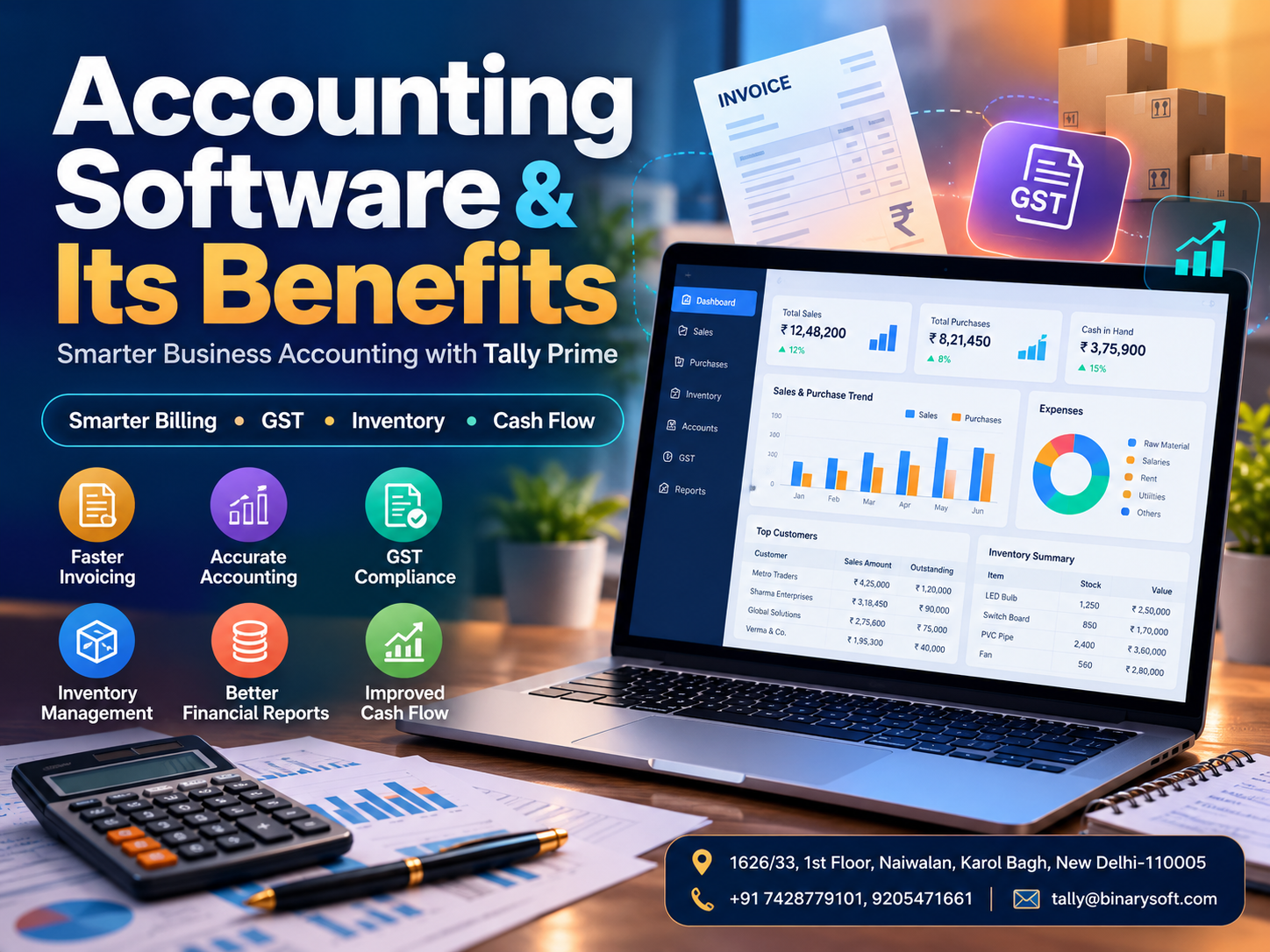
Introduction: Why Accounting Software Has Become Essential for Modern Businesses
Running a successful business requires more than generating sales and managing customers. Every transaction, expense, purchase, payment and tax obligation affects the financial health of an organization. As businesses expand, maintaining accurate records becomes increasingly challenging, particularly when accounting activities depend on spreadsheets, handwritten registers or disconnected systems.
In 2026, businesses face growing pressure to improve financial transparency, maintain organized GST records, manage inventory accurately and monitor cash flow. Even small accounting mistakes can result in delayed payments, incorrect reports or unnecessary compliance difficulties.
Modern accounting software helps businesses overcome these challenges by bringing financial information into one organized system.
Solutions such as Tally Prime simplify bookkeeping, invoicing, inventory management, taxation and financial reporting, allowing business owners to focus on growth rather than repetitive administrative tasks.
Understanding the benefits of accounting software is therefore an important step toward building a financially stronger and more efficient business.
A Business Owner's Story: When Financial Confusion Threatened Years of Hard Work
Rajesh operated a wholesale electrical goods business in Delhi. Over the years, he had developed strong relationships with customers and suppliers.
However, his accounting system had not kept pace with his growing business.
Sales invoices were prepared using spreadsheets, inventory records were maintained separately, and customer outstanding balances were tracked manually.
One afternoon, a supplier demanded payment for an overdue invoice. Rajesh believed the payment had already been completed, but he could not immediately locate the supporting records.
At the same time, an important customer disputed an outstanding balance.
Rajesh spent several hours searching through registers, bank statements and spreadsheets.
The situation became emotionally exhausting. Despite working hard and generating reasonable sales, he felt uncertain about the financial position of his own business.
He eventually decided to organize his accounting operations using Tally Prime.
After implementing a structured accounting process, he could review customer balances, supplier dues, inventory transactions and financial reports from one system.
The biggest improvement was not simply faster accounting.
It was the confidence of knowing where his business stood financially.
This is an illustrative story representing challenges commonly faced by growing businesses.
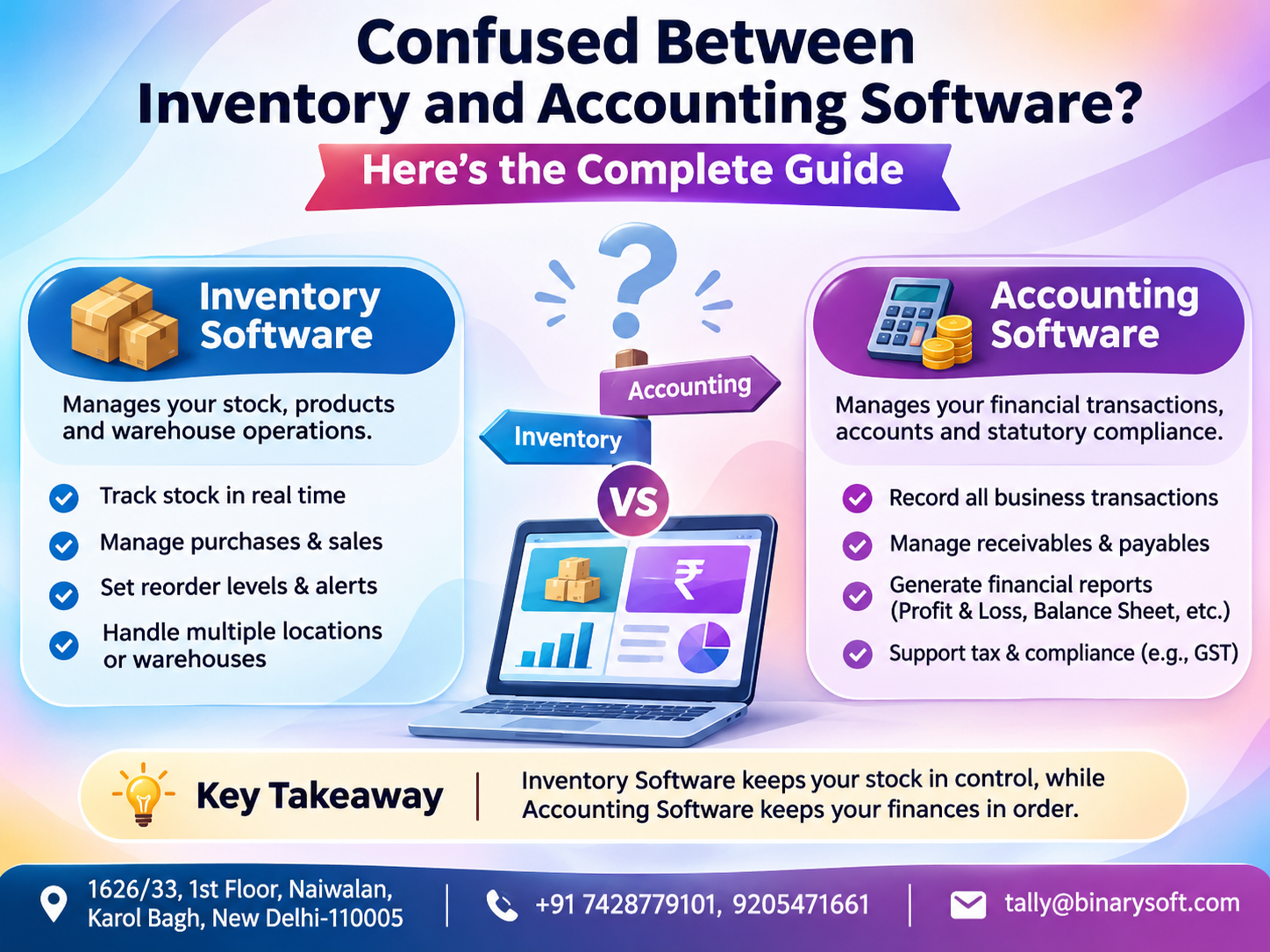
1. What Is Accounting Software?
Accounting software is a digital application designed to record, process, organize and report the financial transactions of a business.
It replaces or reduces dependence on manual accounting methods and helps maintain consistent financial information.
Accounting software commonly supports:
-
Recording sales and purchase transactions.
-
Maintaining customer and supplier accounts.
-
Tracking income and expenses.
-
Managing accounts receivable and payable.
-
Preparing financial statements.
-
Calculating applicable taxes.
-
Monitoring bank and cash transactions.
-
Generating financial and management reports.
-
Managing inventory where supported.
Modern accounting solutions can also integrate accounting with billing, inventory, banking and business reporting.
For example, when a business records a sales invoice in Tally Prime, the transaction can update the relevant accounting ledgers and inventory records according to its configuration.
This reduces duplicate data entry and improves consistency between financial and operational information.
2. Why Do Businesses Need Accounting Software?
As transaction volumes increase, manual accounting becomes difficult to manage.
A business processing hundreds of invoices every month may struggle to maintain accurate records using separate spreadsheets.
Accounting software helps address several operational problems.
Increasing transaction volume
Growing businesses need a system capable of handling regular sales, purchases, receipts and payments without unnecessary duplication.
Financial accuracy
Manual calculations can lead to incorrect balances, missing entries and reconciliation differences.
Accounting software reduces calculation errors through structured transaction processing.
Tax compliance
Businesses must maintain records required for applicable tax reporting and reconciliation.
Better financial visibility
Business owners need timely information about profitability, expenses, customer dues and available cash.
Operational efficiency
Reducing repetitive accounting work allows employees to spend more time on customer service, collections and business development.
For these reasons, accounting software is no longer useful only for large organizations. It has become an important operational tool for small and medium-sized enterprises.
3. Major Benefits of Accounting Software for Businesses
3.1 Improved Accounting Accuracy
One of the biggest benefits of accounting software is improved financial accuracy.
Manual bookkeeping creates opportunities for calculation mistakes, incorrect ledger posting and duplicated transactions.
Accounting software performs calculations systematically and maintains structured records.
In Tally Prime, businesses can create accounting ledgers and record transactions using appropriate vouchers.
This helps maintain consistent accounting information across reports.
However, software accuracy still depends on correct data entry, appropriate configuration and regular review.
3.2 Faster Invoice Generation
Preparing invoices manually can consume considerable time, especially for businesses handling frequent customer transactions.
Accounting software simplifies invoicing by maintaining customer information, product details, tax classifications and transaction records.
Tally Prime supports sales invoice preparation with configurable details such as item descriptions, quantities, rates and applicable taxes.
Businesses can use these features to create professional invoices while maintaining the corresponding accounting records.
Faster billing can improve customer service and reduce delays at sales counters.
3.3 Better Financial Reporting
Financial reports help business owners understand performance and identify potential problems.
Accounting software makes it easier to prepare important reports such as:
-
Balance Sheet
-
Profit and Loss Account
-
Trial Balance
-
Cash Book
-
Ledger Statements
-
Outstanding Receivables
-
Outstanding Payables
-
Stock Summary
Tally Prime provides financial reports based on recorded transactions.
These reports help management evaluate financial performance without manually compiling information from multiple registers.
3.4 Improved Cash Flow Management
A profitable business can still face financial difficulties if customer payments are delayed.
Accounting software helps businesses monitor money expected from customers and payments due to suppliers.
Tally Prime provides bill-wise tracking and outstanding reports that help identify unpaid invoices.
Business owners can review receivables and payables to plan collections and payment priorities.
Better visibility supports more disciplined cash flow management.
3.5 Reduced Administrative Work
Manual accounting frequently involves repetitive tasks such as posting transactions, calculating balances and preparing summaries.
Accounting software reduces these activities by using recorded transaction information across multiple reports.
For example, a correctly recorded purchase transaction can contribute to supplier balances, purchase reporting and stock records where inventory accounting is enabled.
This allows accounting teams to focus more on verification and analysis.
4. How Accounting Software Helps with GST Compliance
GST compliance is an important accounting responsibility for registered businesses in India.
Organizations need to maintain accurate records of taxable sales, purchases, input tax credit and tax liabilities.
Accounting software helps organize these records.
GST invoice preparation
Tally Prime supports GST-compliant invoicing based on the tax details and classifications configured for the transaction.
Tax calculation
The software can calculate applicable CGST, SGST, IGST and cess according to configured transaction details.
GST reporting
Businesses can use GST-related reports to review transactions and identify issues requiring correction.
Reconciliation
Accounting teams can compare purchase and tax information with relevant GST records using supported reconciliation workflows.
E-invoicing and e-way bills
Eligible businesses can use supported connected features and workflows, subject to configuration, subscription, statutory requirements and service availability.
Accounting software assists with compliance, but businesses remain responsible for checking applicable legal requirements and the accuracy of returns.
5. Inventory Management Benefits of Accounting Software
Inventory represents a significant investment for retailers, wholesalers, distributors and manufacturers.
Poor inventory visibility can lead to stock shortages, overstocking and unnecessary working capital requirements.
Accounting software with inventory functionality helps businesses maintain better control.
Tally Prime provides features such as stock groups, stock categories, units of measurement, godown management and stock reports.
Businesses can record inventory movement through relevant vouchers.
Better stock visibility
Stock Summary reports help users review available inventory.
Multiple locations
Godown features allow businesses to maintain inventory information for different storage locations.
Batch management
Businesses handling products requiring batch identification can configure applicable batch-wise tracking.
Inventory valuation
Supported valuation methods help businesses calculate stock values according to their accounting policies and configuration.
Combining inventory and accounting information can improve purchasing decisions and financial planning.
6. Better Customer and Supplier Management
Maintaining strong customer and supplier relationships requires accurate transaction records.
Businesses need to know which customers have unpaid invoices and which supplier payments are approaching their due dates.
Accounting software helps organize these obligations.
With Tally Prime, businesses can maintain separate ledgers for customers and suppliers and use bill-wise accounting to track individual transactions.
Outstanding reports can help accounting teams identify overdue amounts and prioritize follow-up.
For example, a distributor can review customer balances before approving additional credit sales.
Similarly, supplier outstanding reports can support payment scheduling.
This helps businesses maintain financial discipline while improving communication with trading partners.
7. Accounting Software vs Manual Accounting
|
Business Activity
|
Manual Accounting
|
Accounting Software
|
|---|
|
Transaction recording
|
Registers and spreadsheets
|
Structured digital vouchers
|
|
Financial calculations
|
Often manual
|
Automated calculations
|
|
Invoice preparation
|
Repetitive entry
|
Faster invoice creation
|
|
Financial reports
|
Manual compilation
|
Reports generated from recorded data
|
|
Outstanding tracking
|
Separate records
|
Ledger and bill-wise reports
|
|
Inventory tracking
|
Often disconnected
|
Integrated where configured
|
|
Data retrieval
|
Time-consuming
|
Searchable digital records
|
|
Error detection
|
Manual checking
|
Structured reports and verification tools
|
|
Data protection
|
Depends on physical records
|
Digital controls and backup options
|
Accounting software offers significant operational advantages, although effective implementation and regular review remain essential.
8. How Tally Prime Helps Businesses Manage Accounting
Tally Prime combines several accounting and business management functions within one application.
Its features can support different types of businesses.
Retail businesses
Retailers can use Tally Prime for sales billing, purchase recording, stock management and financial reporting.
Wholesale traders
Wholesalers can maintain customer ledgers, supplier accounts, inventory records and outstanding balances.
Manufacturing businesses
Manufacturers can use supported inventory and manufacturing features, including bill of materials and manufacturing journals, to track production-related transactions.
Service providers
Service businesses can record service invoices, expenses, receipts and applicable taxes.
Distributors
Distributors can manage stock across godowns, maintain customer accounts and review product movement.
Professional firms
Professional service organizations can use accounting ledgers, expense tracking and financial statements to organize their financial operations.
The appropriate setup depends on the organization's size, accounting requirements and operational complexity.
9. Step-by-Step Guide to Using Tally Prime for Accounting
Businesses can follow a structured implementation process.
Step 1: Create a company
Enter the company's basic information, financial year and other relevant details.
Step 2: Configure accounting features
Enable the accounting and inventory functions required by the business.
Step 3: Create ledgers
Create ledgers for customers, suppliers, banks, expenses, income and other necessary accounts.
Step 4: Configure GST
Where applicable, enter GST registration details and configure tax-related information.
Step 5: Create inventory masters
Businesses maintaining inventory can create stock items, units and godowns.
Step 6: Record transactions
Enter sales, purchases, receipts, payments, journals and other vouchers as required.
Step 7: Review financial reports
Use reports such as the Balance Sheet, Profit and Loss Account, Trial Balance and outstanding statements.
Step 8: Verify and reconcile records
Regularly review ledger balances, bank transactions, tax records and stock information.
Step 9: Maintain backups
Create and verify backups according to a documented schedule to reduce the risk of data loss.
A carefully planned implementation helps businesses obtain more value from their accounting software.
10. Benefits of Tally Prime on Cloud
Businesses operating from multiple locations may require access to accounting information beyond a single office.
A properly configured Tally Prime cloud-hosting environment can help authorized users access their accounting application remotely.
Potential benefits include:
Remote accessibility
Authorized employees can access the hosted accounting environment through supported remote-access arrangements.
Multi-location collaboration
Businesses with multiple branches can coordinate accounting activities through an appropriately configured centralized setup.
Reduced dependence on office computers
Cloud hosting can reduce reliance on a single office workstation for access to accounting applications.
Centralized administration
Depending on the hosting solution, businesses may benefit from centralized infrastructure administration and backup arrangements.
Business continuity
A suitable hosting and backup strategy can help reduce disruption caused by local computer failures.
Cloud hosting is not the same as automatic data protection. Security, backup frequency, access controls and recovery capabilities depend on the provider and service agreement.
Businesses should evaluate these factors before selecting a hosting plan.
11. Case Study 1: A Wholesale Distributor Improves Financial Visibility
Illustrative case study; figures are hypothetical.
A wholesale stationery distributor in Delhi was managing approximately 400 sales invoices every month.
Its accounting team maintained customer balances in spreadsheets while inventory records were updated separately.
This created several challenges.
Customer outstanding balances were difficult to verify, stock records frequently required manual reconciliation, and monthly financial reporting consumed considerable time.
The solution
The distributor implemented Tally Prime with structured customer ledgers, bill-wise accounting and inventory records.
The team also established a weekly process for reviewing outstanding balances and verifying stock movements.
Illustrative results
After three months, the business estimated that monthly accounting report preparation had fallen from approximately 12 hours to 4 hours.
The accounts team could identify overdue customer invoices more quickly, while management gained better visibility into inventory and receivables.
The main lesson was that integrated accounting records improved operational discipline.
12. Case Study 2: A Manufacturing Business Gains Better Cost Control
Illustrative case study; figures are hypothetical.
A small packaging manufacturer in Faridabad struggled to monitor raw material consumption and production-related expenses.
Purchase records, inventory information and accounting reports were maintained in different files.
Management found it difficult to estimate material requirements and compare production expenses with sales revenue.
The solution
The company introduced Tally Prime and configured stock items, raw materials, finished goods and appropriate manufacturing records.
Its accounting team also categorized major expenses and reviewed financial statements monthly.
Illustrative results
Within six months, management reported improved visibility into material consumption and stock balances.
Regular financial reviews helped identify avoidable purchasing and inventory holding costs.
The company also improved its ability to prepare management reports.
This example demonstrates how combining accounting with inventory processes can support more informed operational decisions.
13. How Accounting Software Supports Business Growth
Business growth requires reliable financial information.
Without accurate records, owners may struggle to determine whether increasing sales are actually improving profitability.
Accounting software supports growth in several ways.
Better decision-making
Management can review financial performance before making investment or expansion decisions.
Improved expense control
Expense ledgers and reports help identify major cost categories.
Stronger credit management
Outstanding reports support customer credit reviews and collection planning.
More organized operations
Structured transaction records reduce dependence on informal bookkeeping practices.
Greater financial transparency
Accurate accounting records can support discussions with accountants, lenders and other authorized stakeholders.
Improved scalability
As transaction volumes increase, a well-configured accounting system can accommodate more complex reporting and operational requirements.
However, software alone does not guarantee growth. Results depend on management practices, staff training and the quality of financial information.
14. Common Mistakes Businesses Should Avoid
Even powerful accounting software can produce unreliable results when used incorrectly.
Common mistakes include entering transactions under incorrect ledgers, using inappropriate GST classifications, failing to reconcile bank balances and neglecting regular data backups.
Businesses may also experience difficulties when employees are not adequately trained.
Another common problem is failing to review outstanding balances regularly.
Accounting software should be supported by clearly defined responsibilities and verification procedures.
A monthly accounting review can help identify discrepancies before they become more serious.
Businesses should also control user access according to employee responsibilities and maintain suitable data security practices.
15. How to Choose the Right Accounting Software
Selecting accounting software requires understanding the business's operational needs.
Important evaluation factors include transaction volume, GST requirements, inventory complexity, reporting needs, employee skills and implementation costs.
Businesses should consider whether the solution supports:
-
Required accounting and financial reports.
-
GST invoicing and relevant compliance workflows.
-
Inventory and warehouse management.
-
Customer and supplier outstanding tracking.
-
Banking and reconciliation processes.
-
Appropriate user access controls.
-
Reliable data backup and recovery.
-
Future expansion and integration requirements.
Tally Prime may be suitable for businesses seeking an integrated accounting and inventory management application.
However, businesses with highly specialized requirements should evaluate available features, integrations and customization needs before implementation.
16. The Future of Accounting Software in 2026 and Beyond
Accounting technology continues to evolve as businesses seek faster processes, better financial visibility and reduced manual work.
Several developments are influencing business accounting.
Increased automation
Businesses are adopting tools that reduce repetitive transaction entry and reconciliation activities.
Connected financial processes
Accounting systems are becoming more closely connected with banking, invoicing and tax-related workflows.
Improved reporting
Management increasingly expects timely financial information rather than reports prepared only at month-end.
Remote collaboration
Cloud-hosted applications and secure remote-access solutions are supporting geographically distributed accounting teams.
Stronger data security
Businesses are paying greater attention to access controls, backups and recovery planning.
Data-driven financial decisions
Accounting information is increasingly used to support purchasing, credit control, budgeting and operational planning.
For small businesses, the objective is not necessarily to adopt every new technology.
The priority should be choosing tools that solve real operational problems and improve financial reliability.
Conclusion
Accounting software has become an important foundation for efficient business management.
It helps organizations maintain accurate financial records, simplify invoicing, manage customer and supplier balances, monitor inventory and prepare meaningful reports.
For businesses still relying heavily on manual accounting, adopting a structured digital system can reduce administrative effort and improve financial visibility.
Tally Prime provides accounting, inventory, taxation and reporting capabilities that can support retailers, wholesalers, manufacturers, distributors and service businesses.
When combined with suitable training, verification procedures and data protection practices, these capabilities can help businesses operate more confidently.
The real value of accounting software is not limited to saving time. It enables business owners to understand their financial position, recognize potential risks and make better-informed decisions.
For organizations planning to modernize accounting operations, choosing an appropriate solution and implementing it carefully can be an important step toward sustainable business growth.
Powered by Binarysoft Technologies Authorized Tally Partner
Location: 1626/33, 1st Floor, Naiwalan, Karol Bagh, New Delhi – 110005, INDIA
Contact Us: +91 7428779101, 9205471661
Email: tally@binarysoft.com
Business Hours: 10:00 AM – 6:00 PM, Monday–Friday
Frequently Asked Questions
How can Binarysoft Technologies help businesses implement Tally Prime?
Binarysoft Technologies can assist businesses with Tally Prime-related implementation, configuration, training and support according to their accounting and operational requirements.
Does accounting software eliminate accounting errors?
No. It reduces many calculation and processing errors, but incorrect entries and configurations can still produce inaccurate reports. Regular verification remains necessary.
Is accounting software better than Excel?
For businesses requiring integrated transaction recording, inventory management, GST workflows and financial reporting, dedicated accounting software generally offers advantages over disconnected spreadsheets.
Can Tally Prime be accessed through cloud hosting?
Yes. Tally Prime can be deployed in a suitable cloud-hosted environment for remote access, depending on the hosting arrangement, licensing and configuration.
CA. Arnav Kankaria focuses on accounting automation, GST reconciliations, and financial record management. He helps businesses streamline routine accounting activities while maintaining reliable records for reporting and review.