Call CA Tally HelpDesk
+91 9205471661,
7428779101
Introduction: Why One-Size-Fits-All Software Is No Longer Enough
Every business operates differently. A manufacturing company needs production tracking and raw material management, while a wholesale distributor focuses on inventory, purchasing, customer payments and supplier relationships.
Similarly, a construction company may require project-wise expense monitoring, whereas a professional services organization needs client billing and cost allocation.
Despite these differences, many businesses continue using standard software that does not fully match their operational requirements.
Employees often compensate by maintaining additional spreadsheets, manually transferring information and creating complicated workarounds.
These practices consume valuable time and increase the possibility of errors.
In 2026, businesses are increasingly evaluating custom ERP solutions to improve operational efficiency and connect their business processes.
A custom Enterprise Resource Planning solution is designed or configured around an organization's specific requirements. It may involve developing specialized software, customizing an existing ERP platform or integrating business applications.
For Indian businesses, Tally Prime can serve as a reliable accounting and financial management foundation, while compatible external applications and integrations can address additional operational requirements.
Understanding the advantages of custom ERP solutions helps organizations make better technology investments, reduce unnecessary complexity and prepare for long-term growth.
A Business Owner's Story: When Standard Software Could Not Keep Up with a Growing Business
Rohit owned a manufacturing and distribution business in Faridabad.
He had started the company with five employees and a small rented warehouse.
Over fifteen years, the business expanded into a successful operation supplying industrial components across North India.
His workforce grew, customer orders increased and the company established relationships with several major manufacturers.
However, business growth created unexpected challenges.
The accounting department used accounting software, the warehouse maintained inventory spreadsheets and the production team recorded manufacturing information separately.
The sales department frequently called the warehouse to confirm product availability.
Every month, Rohit's accountant spent several days combining information from different departments.
One afternoon, an important customer requested an urgent delivery.
The sales team confirmed the order based on available records.
Unfortunately, the production department had already allocated the required materials to another order.
The delivery was delayed.
The customer threatened to move future orders to a competitor.
That evening, Rohit reviewed the situation with his managers.
He realized that his employees were working hard, but their systems were not working together.
He needed a solution that matched the way his company operated.
Instead of replacing every application, Rohit decided to retain Tally Prime for accounting and introduce a customized operational system for production tracking and order management.
The new system was designed to exchange relevant information with the accounting environment through supported integration methods.
Over time, the business improved coordination between sales, inventory, production and finance.
Employees spent less time requesting information from other departments.
Rohit could review operational information more consistently and make better purchasing decisions.
For him, the biggest improvement was not technology itself.
It was the confidence that his business could continue growing without becoming increasingly difficult to manage.
This fictional story illustrates how tailored business software and carefully planned integrations can address operational challenges.
What Is a Custom ERP Solution?
A custom ERP solution is a business management system designed, configured or extended to meet an organization's specific operational requirements.
Unlike a standard software package with predefined functionality, a custom ERP solution can be adapted to specialized workflows, reporting requirements and business processes.
Customization may involve:
- Developing specialized business modules
- Creating custom reports and dashboards
- Integrating accounting with operational software
- Automating approval workflows
- Connecting warehouse and inventory systems
- Developing industry-specific functionality
- Integrating external applications
- Configuring access permissions and controls
Custom ERP solutions can be developed from the beginning or created by extending an existing software platform.
The appropriate approach depends on business requirements, available technology, budget and long-term maintenance considerations.
Custom ERP vs Standard ERP Software
| Feature | Standard ERP Software | Custom ERP Solution |
|---|
| Business workflows |
Mostly predefined |
Tailored to requirements |
| Implementation |
Often faster |
May require more planning |
| Initial cost |
Generally more predictable |
Can be higher |
| Flexibility |
Depends on available configuration |
Greater design flexibility |
| Industry-specific functions |
May require additional modules |
Can be developed specifically |
| Integration |
Available supported integrations |
Custom integration possibilities |
| Maintenance |
Often vendor-managed |
May require dedicated support |
| Scalability |
Depends on platform |
Depends on architecture and design |
| User experience |
Standardized |
Can reflect business workflows |
Neither approach is automatically superior.
Businesses should select the option that delivers the greatest operational value at an acceptable total cost.
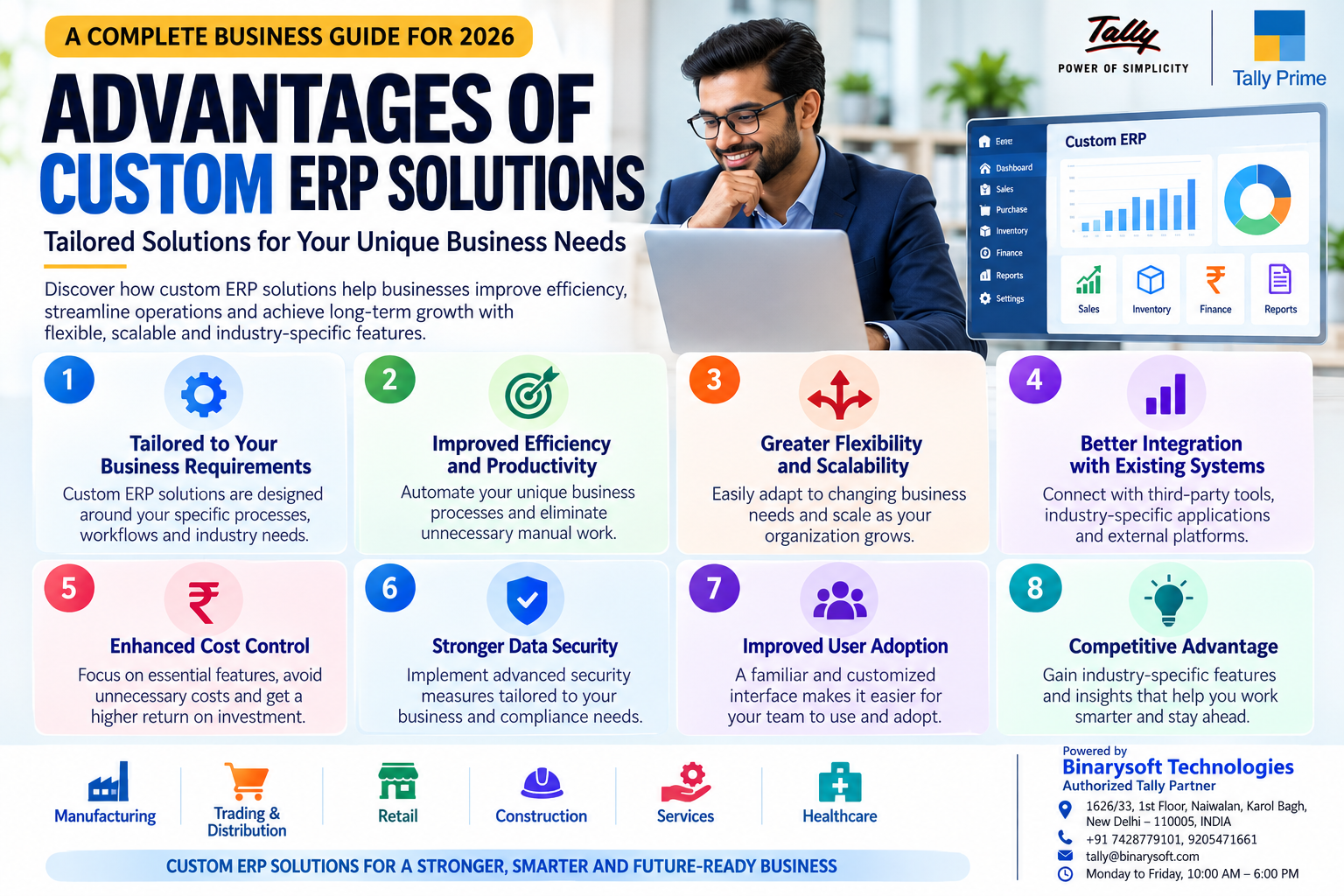
8 Major Advantages of Custom ERP Solutions
1. Tailored to Your Unique Business Requirements
The greatest advantage of a custom ERP solution is its ability to support specialized business processes.
Every industry has different operational requirements.
A pharmaceutical distributor may need batch tracking, while an engineering manufacturer may require detailed production-stage monitoring.
A standard application may not provide every required feature.
Custom ERP development allows businesses to design workflows around their actual operations.
Practical Example
An automobile spare-parts distributor manages thousands of products across multiple categories.
The company requires specialized product identification, warehouse allocation and customer-specific pricing.
A custom operational module can be designed to support these requirements.
How Tally Prime Can Help
Tally Prime can manage relevant accounting, inventory and financial records.
Where supported and appropriate, external applications can exchange information with Tally Prime through available integration mechanisms.
Business Benefits
Tailored software can reduce unnecessary workarounds, improve process consistency and support industry-specific requirements.
2. Improved Operational Efficiency and Employee Productivity
Employees often waste valuable time transferring information between disconnected applications.
For example, a sales employee may enter customer information into one system while an accountant enters the same information again.
Such duplication increases workload and creates opportunities for errors.
Custom ERP solutions can automate selected activities and connect related processes.
Common Automation Opportunities
Businesses may automate order processing, approval notifications, transaction transfers, inventory updates and management reporting.
Practical Example
A wholesale company receives orders through a separate customer ordering portal.
Instead of manually transferring every order into accounting records, a compatible integration can help transfer validated transaction information into the appropriate system.
Tally Prime Integration
Tally Prime supports integration capabilities that developers can use for suitable data exchange and business workflows.
The specific integration must be designed, tested and maintained according to supported technical interfaces.
Business Benefits
Automation can reduce repetitive work, improve transaction processing speed and allow employees to focus on customer service and operational analysis.
However, automated processes still require validation, exception handling and appropriate approvals.
3. Greater Flexibility and Scalability
Business requirements change as organizations grow.
A company operating from one warehouse may eventually establish multiple distribution centers.
A manufacturer may introduce additional product categories or expand production operations.
Custom ERP solutions can be designed to accommodate these changes.
Important Scalability Considerations
Scalable systems should account for increasing transaction volumes, additional users, new business locations, expanded reporting requirements and future integrations.
Practical Example
A retail distributor initially operates from Delhi.
After expanding into Jaipur, Chandigarh and Lucknow, the company requires more sophisticated inventory coordination.
A properly designed custom system can support additional locations and operational workflows.
How Tally Prime Helps
Tally Prime can provide the accounting foundation for many growing businesses.
Additional operational requirements may be handled through suitable external applications.
Business Benefits
A scalable architecture can reduce the need for repeated system replacements and support long-term business expansion.
Nevertheless, custom software is not automatically scalable. Its performance depends on technical architecture, infrastructure and ongoing maintenance.
4. Better Integration with Existing Business Systems
Many organizations already use multiple applications.
These may include accounting software, warehouse systems, e-commerce platforms, customer portals and specialized industry applications.
Replacing every application can be expensive and disruptive.
Custom ERP solutions can help connect existing systems.
Common Integration Requirements
Businesses may need to connect:
- Accounting and inventory systems
- Sales portals and order management
- Warehouse applications
- E-commerce platforms
- Customer relationship management software
- Banking and payment records
- Business reporting applications
Practical Example
An e-commerce distributor receives orders from several online marketplaces.
A customized application may consolidate order information and prepare validated accounting transactions for import or integration.
Tally Prime Integration Opportunities
Depending on the application and supported interfaces, businesses can use Tally Prime's import, export and integration capabilities.
Integration design should include data validation, duplicate prevention, error logging and reconciliation.
Business Benefits
Effective integration reduces information gaps and helps businesses maintain more consistent records across applications.
5. Enhanced Cost Control and Better Return on Investment
One important advantage of custom ERP solutions is the ability to focus technology spending on business requirements that deliver measurable value.
Standard ERP systems may include features that a particular organization rarely uses. Conversely, businesses sometimes purchase additional applications because their existing software lacks specific functionality.
A custom ERP solution can address these gaps.
How Custom ERP Helps Control Costs
Businesses can design solutions that prioritize essential features, reduce duplicate software subscriptions, automate repetitive processes and improve operational visibility.
For example, a manufacturing company may require production tracking, material consumption reports and project-wise cost analysis.
Rather than implementing an unnecessarily complex enterprise system, the company may choose a focused operational application integrated with its existing accounting software.
How Tally Prime Helps
Tally Prime can provide the accounting foundation for financial transactions, inventory valuation, cost centre accounting and financial reporting.
A customized application may handle specialized operational requirements while exchanging validated accounting information with Tally Prime.
Business Benefits
Custom ERP solutions may help businesses reduce administrative expenses, improve employee productivity and avoid unnecessary software functionality.
However, customization also introduces development, testing, maintenance and upgrade costs.
The financial advantage should be measured through total cost of ownership rather than initial software price alone.
6. Stronger Data Security and Business Control
Business information includes sensitive financial records, customer details, supplier transactions and operational information.
Protecting this information is essential.
Custom ERP solutions allow organizations to design security controls around specific responsibilities and workflows.
Important Security Features
A well-designed custom ERP system may include:
- Role-based access permissions
- Secure user authentication
- Approval workflows
- Transaction activity logs
- Data encryption
- Automated backup procedures
- Access monitoring
- Segregation of duties
Practical Example
A company employs separate sales, purchasing, warehouse and accounting teams.
Sales employees may require access to customer orders without needing permission to modify financial statements.
Similarly, warehouse employees may need inventory access without permission to change supplier banking information.
A customized system can enforce these responsibilities through suitable access controls.
How Tally Prime Helps
Tally Prime provides configurable user security features.
Organizations can establish appropriate permissions and use additional security controls within their wider IT environment.
Business Benefits
Properly implemented security features can reduce unauthorized access, improve accountability and protect important business records.
Custom development does not automatically provide stronger security. Poorly developed software may introduce vulnerabilities, so independent testing and ongoing maintenance are essential.
7. Improved User Experience and Employee Adoption
Employees are more likely to use software effectively when it supports their daily responsibilities.
Complicated interfaces and unnecessary features can increase training requirements and slow down operations.
Custom ERP solutions allow organizations to design screens, workflows and reports around employee needs.
User-Friendly Customization
Businesses can create simplified data-entry screens, department-specific dashboards, approval notifications and customized reports.
Practical Example
A warehouse employee may need only three primary functions:
- Receive inventory.
- Record stock transfers.
- Confirm dispatches.
A customized warehouse interface can focus on these tasks rather than displaying unrelated accounting features.
How Tally Prime Fits In
Tally Prime can continue handling accounting and financial transactions.
A separate operational interface may be developed for employees who do not require direct access to accounting software.
Business Benefits
A well-designed user experience can reduce training time, improve process consistency and encourage employees to use the system correctly.
Successful adoption also requires clear documentation, employee involvement and ongoing support.
8. Competitive Advantage Through Industry-Specific Functionality
Businesses often compete through specialized services, faster delivery, better customer experiences and efficient operations.
Custom ERP solutions can support these competitive strengths.
Instead of changing business processes entirely to match standard software, organizations can develop technology around their established operational advantages.
Industry-Specific Applications
Manufacturing: Production-stage monitoring, material requirements and specialized costing.
Wholesale distribution: Customer-specific pricing, warehouse coordination and order tracking.
Retail: Inventory synchronization, sales analysis and multi-location operations.
Construction: Project monitoring, material consumption and project-wise expenses.
Professional services: Project billing, resource allocation and client profitability analysis.
Healthcare: Specialized operational and administrative workflows, subject to appropriate privacy and regulatory controls.
Practical Example
An engineering company manufactures customized components according to customer specifications.
A tailored ERP solution can connect customer orders, production requirements and delivery schedules.
This may improve coordination and reduce delays.
Business Benefits
Industry-specific functionality can improve service quality, operational efficiency and responsiveness to customer requirements.
The competitive advantage comes from how effectively the technology supports the business—not simply from owning customized software.
Case Study 1: How a Delhi Wholesale Distributor Improved Operations with Custom ERP and Tally Prime
Business Background
A medium-sized electrical equipment distributor in Delhi supplied products to retailers and contractors across North India.
The company processed approximately 2,500 invoices monthly and maintained thousands of inventory records.
Accounting was handled through Tally Prime, while warehouse employees used spreadsheets to track operational information.
Major Challenges
The business experienced inventory discrepancies, delayed order processing and difficulties coordinating information between departments.
Management also struggled to monitor outstanding customer payments alongside operational activities.
Custom ERP Solution
The company introduced a customized order and warehouse management application.
The solution was designed to support order tracking, warehouse operations, customer-specific workflows and transaction validation.
Relevant financial information was exchanged with Tally Prime using suitable integration procedures.
Illustrative Results
| Performance Indicator | Before Implementation | After Implementation |
|---|
| Order processing |
Multiple manual steps |
More structured workflow |
| Inventory information |
Separate spreadsheets |
Coordinated records |
| Accounting integration |
Manual transfer |
Validated data exchange |
| Customer outstanding |
Periodic review |
More regular monitoring |
| Management reporting |
Manual consolidation |
Improved visibility |
Key Learning
The customized solution helped connect operational requirements with existing accounting processes.
Rather than replacing Tally Prime, the business extended its overall software environment.
This is a fictional case study illustrating potential outcomes. The results are not independently verified.
Case Study 2: How a Manufacturing Company Improved Production Visibility and Financial Control
Business Background
A manufacturing company in Faridabad produced industrial components for engineering and automobile businesses.
The organization managed multiple production processes and purchased raw materials from several suppliers.
Business Challenges
Production information was maintained separately from accounting records.
Management experienced difficulties tracking material consumption, production progress and operating expenses.
Custom ERP Implementation
The company introduced a customized production management application.
The system focused on production orders, material requirements, manufacturing stages and operational reporting.
Tally Prime remained responsible for accounting and relevant inventory-related financial transactions.
Illustrative Results
The company gained improved visibility into production progress, material requirements, purchasing activity and financial information.
Management could investigate delays and cost variations more systematically.
Key Learning
A focused custom ERP solution can complement existing accounting software and help manufacturers address specialized operational requirements.
This case study is illustrative rather than a verified customer implementation.
How Tally Prime Can Work with Custom ERP Solutions
Tally Prime can serve as an important component of an integrated business software environment.
Organizations can retain its accounting and financial management capabilities while developing additional applications for specialized workflows.
Step 1: Identify Business Requirements
Evaluate existing processes and identify activities that require customization.
Focus on operational problems rather than adding unnecessary functionality.
Step 2: Define the Role of Tally Prime
Determine which activities should remain within Tally Prime.
These may include financial accounting, sales and purchase transactions, inventory accounting, GST-related records and financial reporting.
Step 3: Identify Custom Modules
Determine whether the business requires additional applications for production management, warehouse operations, customer portals, approval workflows or specialized reporting.
Step 4: Design the Integration
Define which information must move between the custom application and Tally Prime.
Establish transaction formats, validation rules and synchronization procedures.
Step 5: Develop and Test
Develop the required functionality and test it using representative business scenarios.
Verify transaction accuracy, duplicate prevention, access controls and error handling.
Step 6: Migrate Relevant Data
Transfer necessary information carefully.
Verify opening balances, master records and transaction consistency.
Step 7: Train Employees
Provide practical training based on employee responsibilities.
Ensure that users understand the new workflows.
Step 8: Implement Security Controls
Configure appropriate permissions, backups and monitoring procedures.
Step 9: Deploy Gradually
Where practical, introduce the solution in phases.
This allows businesses to identify issues before expanding implementation.
Step 10: Monitor Performance
Review operational improvements, financial accuracy, employee adoption and ongoing maintenance costs.
Custom ERP vs Ready-Made ERP: Which Is Better for Your Business?
| Evaluation Factor | Ready-Made ERP | Custom ERP |
|---|
| Initial implementation |
Often faster |
Usually requires more planning |
| Business-specific workflows |
Limited to supported configuration |
Can be tailored |
| Development cost |
Generally lower initially |
May be higher |
| Maintenance responsibility |
Primarily software provider |
Depends on development agreement |
| Integration |
Standard supported options |
Specialized integrations possible |
| Employee training |
Standard workflows |
Business-specific workflows |
| Upgrade complexity |
Often simpler |
Custom components may require changes |
| Long-term flexibility |
Platform-dependent |
Architecture-dependent |
| Best suited for |
Common business processes |
Specialized operational requirements |
Which Option Should You Choose?
Businesses with standard accounting, sales and inventory requirements may find ready-made software sufficient.
Organizations with specialized manufacturing, distribution or operational processes may benefit from customized applications.
A hybrid approach—using Tally Prime for accounting and custom software for specialized operations—may provide a practical balance.
Important Challenges of Custom ERP Development
Custom ERP solutions offer flexibility, but businesses should understand the potential risks.
Development projects can exceed their budgets when requirements are unclear or frequently change.
Custom applications may also require ongoing technical support, security updates and compatibility testing.
Integration failures can create accounting discrepancies if transactions are not validated properly.
Another challenge is dependence on a single development provider.
Businesses should therefore establish clear documentation, ownership arrangements, maintenance responsibilities and support procedures.
Before beginning development, organizations should evaluate whether configuration or an existing software extension could solve the problem at a lower cost.
Future of Custom ERP Solutions in 2026 and Beyond
Custom ERP development is evolving as businesses demand greater integration, automation and flexibility.
Important technology trends include cloud-based applications, API-driven integration, workflow automation, business analytics and mobile-friendly interfaces.
Artificial intelligence may also support selected applications such as forecasting, anomaly detection and operational analysis.
However, businesses should distinguish between available functionality and features that require additional development.
For Indian organizations, financial accuracy, GST-related recordkeeping, data security and reliable integration remain important priorities.
The most successful custom ERP projects will be those that address clearly defined business requirements and provide measurable operational improvements.
Conclusion: Custom ERP Solutions Can Transform Business Operations
Custom ERP solutions offer significant advantages for organizations with specialized operational requirements.
Their major benefits include tailored workflows, improved productivity, greater flexibility, better integration, cost control, stronger security, improved user adoption and industry-specific functionality.
However, customization should be approached strategically.
Not every business requires a fully customized ERP system.
For many Indian small and medium-sized businesses, Tally Prime can provide the accounting and financial management foundation while carefully designed external applications address specialized requirements.
Successful implementation depends on proper planning, reliable integration, employee training, data security and ongoing technical support.
The greatest advantage of a custom ERP solution is its ability to make technology work around genuine business needs, helping organizations operate more efficiently and prepare for sustainable growth.
Powered by Binarysoft Technologies
Authorized Tally Partner
Location: 1626/33, 1st Floor, Naiwalan, Karol Bagh, New Delhi – 110005, INDIA
Contact Us: +91 7428779101, 9205471661
Email: tally@binarysoft.com
Business Hours: Monday to Friday, 10:00 AM – 6:00 PM
Frequently Asked Questions
What is the best approach to ERP customization?
Start by identifying specific business problems, evaluate existing software capabilities and customize only where the expected operational benefits justify the cost.
Does custom ERP support business expansion?
A properly designed custom ERP system can accommodate additional users, business locations, workflows and integrations, subject to its technical architecture.
How can businesses measure custom ERP success?
Businesses can evaluate processing time, error rates, employee productivity, operational costs, reporting accuracy and improvements in customer service.
What is the biggest risk of custom ERP implementation?
Major risks include unclear requirements, cost overruns, integration problems, inadequate testing and long-term maintenance dependencies.
CA. Yashvardhan Kedia focuses on taxation, business accounting, and compliance management for MSMEs. He helps business owners understand financial information and establish practical processes for maintaining accurate books.