Call CA Tally HelpDesk
+91 9205471661,
7428779101
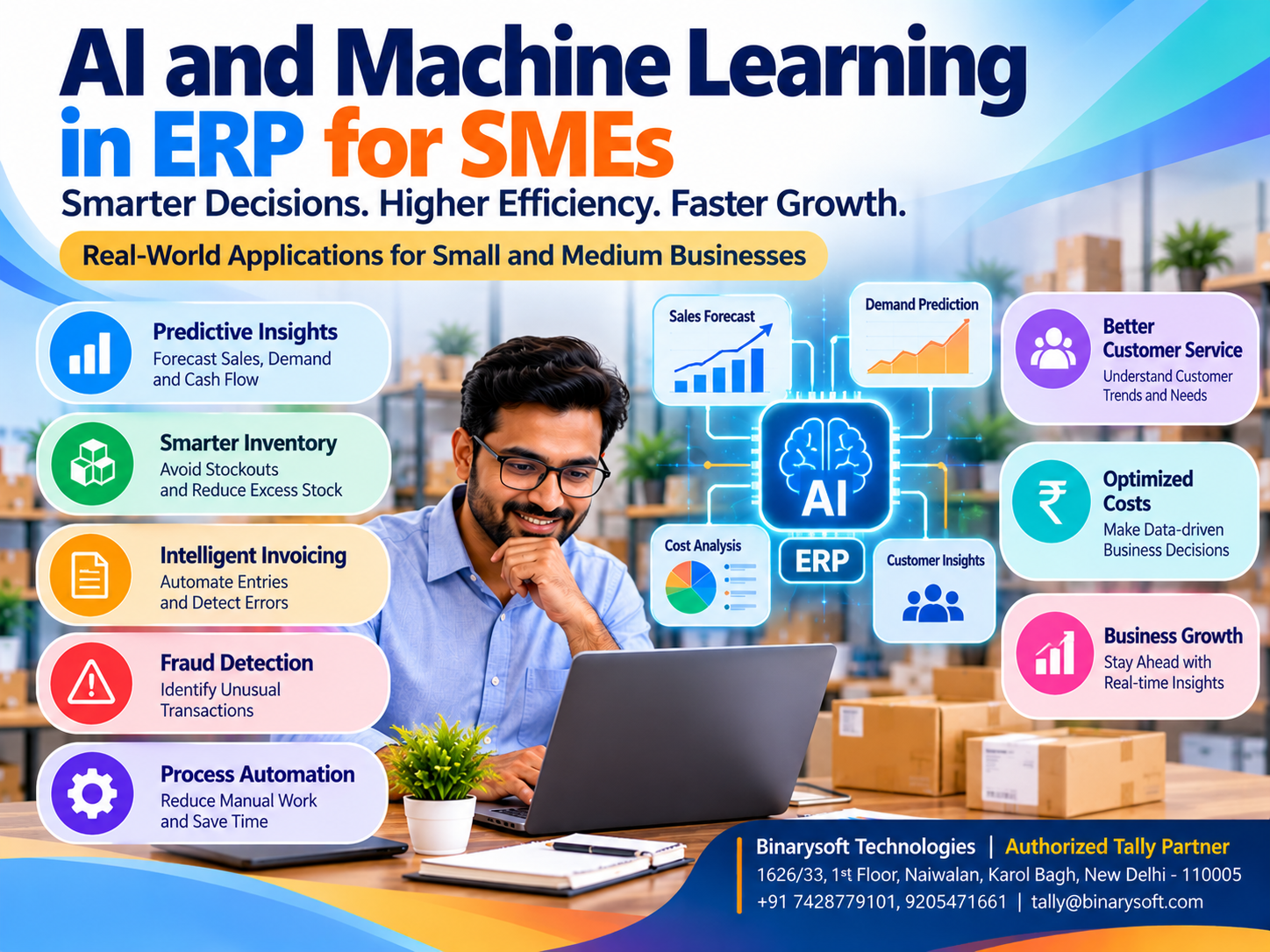
AI and Machine Learning in ERP: Real-World Applications for Small and Medium Businesses in 2026
Introduction: The Future of Business Management Is Becoming Intelligent
Imagine knowing which products your customers will demand next month, identifying delayed payments before they affect cash flow, and discovering accounting errors before they become expensive problems.
For many small and medium businesses, these capabilities once seemed possible only for large corporations with substantial technology budgets.
Today, artificial intelligence (AI) and machine learning (ML) are creating new opportunities for businesses of different sizes.
Traditional Enterprise Resource Planning (ERP) software helps organizations manage accounting, inventory, sales, purchases, manufacturing and financial reporting through integrated processes.
AI and machine learning can extend these capabilities by analyzing business information, identifying patterns, generating forecasts and recommending actions.
For Indian SMEs operating in competitive markets, intelligent business management can improve operational efficiency and support better decisions.
A wholesaler may use demand forecasting to prepare for seasonal sales. A manufacturer may use predictive maintenance to reduce unexpected equipment downtime. A retailer may analyze customer purchasing patterns to plan inventory more effectively.
Businesses using Tally Prime can also explore AI-enabled reporting and automation through compatible external tools and integrations, where supported.
However, not every AI capability described in this article is a built-in Tally Prime feature.
Understanding the opportunities, limitations and implementation requirements is essential before adopting intelligent ERP technology.
A Business Owner's Story: When One Wrong Inventory Decision Changed Everything
Rakesh owned a wholesale electronics distribution business in Nehru Place, Delhi.
His business supplied computer accessories, networking equipment and electronic components to retailers across North India.
For several years, the company experienced steady growth.
Rakesh managed accounting through business software, while his purchasing decisions depended largely on previous experience.
During the festive season, he expected strong demand for a particular category of electronic accessories.
He invested heavily in additional inventory.
Unfortunately, customer preferences changed.
Demand shifted toward newer products, leaving substantial quantities of older inventory unsold.
At the same time, several customers delayed their payments.
Rakesh faced a difficult situation.
His warehouse was full, but his available cash was limited.
He struggled to pay suppliers and became concerned about employee salaries.
One evening, while reviewing stock reports, he realized that the problem was not simply declining demand.
He lacked reliable forecasting.
He had historical sales information but was not using it systematically to understand changing purchasing patterns.
Rakesh began exploring data-driven inventory planning.
His team organized historical sales records, identified seasonal trends and reviewed product-level demand.
With suitable analytical tools, the company could estimate future requirements and identify products showing declining demand.
The business also introduced regular monitoring of customer outstanding balances.
Gradually, purchasing decisions became more disciplined.
Instead of relying entirely on intuition, Rakesh began combining experience with historical information and forecasting insights.
This illustrative story demonstrates an important lesson:
Businesses do not always fail because they lack sales. Sometimes they struggle because they cannot anticipate what comes next.
AI and machine learning can help address this challenge when businesses have reliable data and suitable technology.
What Is Artificial Intelligence in ERP?
Artificial intelligence refers to computer technologies designed to perform tasks that normally require aspects of human intelligence.
These tasks may include recognizing patterns, analyzing information, understanding language and generating recommendations.
When AI capabilities are integrated with ERP systems, businesses can use operational information to support intelligent workflows.
Examples include identifying unusual transactions, forecasting product demand, analyzing customer payment patterns and automatically categorizing business documents.
AI-enabled ERP systems can help employees understand large volumes of information more efficiently.
However, AI-generated outputs should be reviewed, particularly when they influence financial decisions, taxation or regulatory compliance.
What Is Machine Learning in ERP?
Machine learning is a branch of artificial intelligence that uses data to develop models capable of identifying patterns and making predictions.
Unlike traditional rule-based software, machine learning models can learn statistical relationships from historical examples.
For instance, a retailer may have three years of sales records.
A machine learning model can examine historical sales, seasonal demand and other relevant variables to estimate future product requirements.
Similarly, a business may analyze customer payment histories to identify invoices with a higher risk of delayed collection.
The accuracy of these predictions depends on the quality, relevance and quantity of available data.
Machine learning does not guarantee correct forecasts.
Its primary value is helping businesses make more informed decisions under uncertainty.
Difference Between AI, Machine Learning and Traditional ERP
Traditional ERP software focuses on recording transactions, coordinating processes and producing reports.
AI and machine learning add analytical and predictive capabilities.
| Business Activity | Traditional ERP | AI-Enabled ERP |
|---|
| Inventory |
Records stock movements |
Can forecast future demand |
| Accounting |
Records financial transactions |
Can identify unusual entries |
| Sales |
Maintains sales records |
Can predict sales trends |
| Purchases |
Tracks supplier transactions |
Can recommend purchasing quantities |
| Cash flow |
Reports receivables and payables |
Can estimate future cash requirements |
| Customer management |
Maintains customer records |
Can analyze customer behavior |
| Manufacturing |
Records production activities |
Can support predictive maintenance |
| Reporting |
Generates historical reports |
Can generate predictive insights |
These capabilities depend on the selected software, available data and integrations.
1. AI-Powered Inventory Demand Forecasting
Inventory management is one of the most valuable applications of machine learning for product-based businesses.
Many SMEs face two common problems.
The first is overstocking, where businesses purchase more inventory than customers require.
The second is stock shortages, where popular products become unavailable during periods of strong demand.
Both situations can affect profitability.
AI-based demand forecasting analyzes historical sales patterns and other relevant information.
Depending on the system, this may include seasonal trends, promotional activities, product categories and market conditions.
Example
A garment wholesaler in Gandhi Nagar, Delhi, supplies clothing to retailers across several states.
Demand changes significantly during festivals and seasonal transitions.
Instead of purchasing identical quantities every month, the business uses historical sales analysis to estimate demand.
A suitable forecasting model can highlight products likely to experience increased demand.
This supports better purchasing decisions and reduces unnecessary inventory accumulation.
How Tally Prime Can Help
Tally Prime supports stock summaries, sales records, inventory reports and product-level transaction information.
These records can provide useful inputs for forecasting.
Where compatible integration or export methods are available, businesses may analyze the information using external AI or machine learning tools.
Predictive forecasting should not be assumed to be a standard built-in Tally Prime capability.
2. Intelligent Accounting and Transaction Analysis
Accounting accuracy is essential for every business.
Incorrect entries can affect financial reports, customer balances and taxation records.
AI-enabled accounting tools can assist by analyzing transaction patterns.
For example, a system may identify unusually large expenses, possible duplicate invoices or transactions that differ significantly from historical behavior.
These alerts can help accountants prioritize their reviews.
Practical Application
Consider a distribution business processing hundreds of purchase invoices each month.
An AI-supported document processing system may extract invoice details and compare them with existing records.
Potential discrepancies can then be flagged for verification.
This reduces some manual work while keeping employees responsible for confirming accuracy.
Role of Tally Prime
Tally Prime provides structured accounting records, voucher management and financial reports.
Businesses can use these records as the foundation for external analytical workflows.
Automated document recognition, AI classification and anomaly detection require suitable supporting tools unless specifically included in the selected software configuration.
3. Predictive Cash Flow Management
Cash flow problems can affect profitable businesses.
A company may generate substantial sales but still struggle to meet financial obligations when customer payments are delayed.
AI-based cash flow forecasting can analyze historical receipts, payments, expenses and outstanding invoices.
The system may estimate future cash inflows and outflows.
Example
A wholesale distributor has significant customer receivables due within the next 30 days.
However, historical records show that some customers regularly pay late.
A predictive model may estimate the likely timing of collections rather than assuming every invoice will be paid on its due date.
This helps management plan supplier payments and maintain adequate working capital.
Tally Prime Application
Tally Prime supports customer outstanding reports, supplier balances, cash flow information and financial statements.
These records help businesses monitor their financial position.
External analytical tools can potentially use exported or integrated data for advanced forecasting.
Business owners should review all predictions before making significant financial commitments.
4. AI-Based Invoice Processing and Automation
Invoice processing is a repetitive activity for many SMEs.
Businesses may receive invoices through email, scanned documents and digital files.
Manually entering invoice information can consume considerable time.
AI-based document processing tools may recognize invoice numbers, supplier details, dates, amounts and tax information.
Extracted information can be prepared for review and further processing.
Benefits
Intelligent invoice processing may reduce repetitive data entry, accelerate document handling and help identify inconsistencies.
However, automated extraction can produce errors.
Human verification remains important, especially for tax classifications and financial amounts.
Integration with Tally Prime
Businesses may explore compatible invoice import solutions, integrations and document processing tools.
The availability of automated workflows depends on the external application and supported integration methods.
5. Machine Learning for Customer Payment Predictions
Delayed customer payments are a major concern for small businesses.
Traditional accounting systems show outstanding balances and overdue invoices.
Machine learning can potentially go further by analyzing payment behavior.
For example, a model may consider previous payment delays, invoice amounts, customer transaction history and seasonal patterns.
It can then estimate the probability of delayed payment.
Business Benefits
This information can help credit teams prioritize collection activities.
Businesses may also use the analysis to review credit terms and identify accounts requiring closer monitoring.
However, automated risk scores should not be treated as definitive judgments about customers.
Decisions should consider commercial relationships, current circumstances and the reliability of the model.
6. Predictive Maintenance in Manufacturing
Manufacturing businesses depend on equipment availability.
Unexpected machinery breakdowns can delay production and increase operating costs.
Predictive maintenance uses equipment information to estimate when maintenance may be required.
Machine learning models may analyze vibration, temperature, operating hours and other sensor readings.
Example
A manufacturing company in Faridabad operates several production machines.
Instead of relying exclusively on fixed maintenance schedules, the company introduces sensors and predictive monitoring software.
The system identifies unusual operating patterns that may indicate developing equipment problems.
Maintenance teams can investigate potential issues before major failures occur.
Important Consideration
Predictive maintenance generally requires equipment sensors, industrial monitoring systems and specialized analytical software.
Core accounting applications such as Tally Prime do not replace these technologies.
However, accounting and inventory records may support the financial analysis of maintenance expenses and spare parts consumption.
7. AI for Sales Forecasting and Business Planning
Sales forecasting helps businesses estimate future revenue and prepare operational plans.
Traditional forecasting often relies on historical averages and management experience.
Machine learning can analyze additional variables and complex patterns.
For example, a retailer may use sales history, promotional periods, seasonal trends and product availability to estimate future demand.
These predictions can support purchasing, staffing and financial planning.
For SMEs, even relatively simple forecasting models may provide value when compared with decisions based entirely on guesswork.
The objective should be better planning rather than perfect prediction.
8. AI-Based Fraud and Anomaly Detection
Businesses may face financial risks from duplicate payments, unusual transactions and unauthorized activities.
AI-based anomaly detection tools can identify patterns that differ from normal business behavior.
For example, an unusually large supplier payment or repeated invoice number may trigger an alert.
The accounting team can investigate the transaction.
Such systems are useful as additional monitoring mechanisms.
They do not replace internal controls, employee authorization procedures or financial audits.
False alerts are also possible.
Organizations should establish clear procedures for reviewing suspicious transactions.
9. AI for Customer Service and Business Communication
Customer service is another area where AI can assist SMEs.
AI-powered assistants can help answer routine enquiries, organize service requests and provide information from approved business records.
For example, a distributor may use a customer support application to respond to common questions about product availability or order status.
Where appropriately integrated, the system may retrieve relevant information from authorized business databases.
Businesses must ensure that customer information is protected and that automated responses are accurate.
Sensitive financial information should not be exposed through unrestricted AI tools.
10. AI-Powered Business Reporting
Traditional ERP reports explain what has already happened.
AI-supported analysis may help businesses explore why performance changed and what could happen next.
For example, a business owner may want to understand why profitability declined despite increasing sales.
An analytical system can examine relevant data such as sales margins, purchase costs and operating expenses.
It may identify relationships that deserve further investigation.
Natural-language interfaces can also make certain analytical tasks easier.
However, generated explanations must be checked against underlying records.
AI systems can produce incorrect interpretations even when their responses sound convincing.
Case Study 1: AI-Based Inventory Planning for an Electronics Distributor
Business Type: Electronics wholesale distribution
Location: Nehru Place, New Delhi
Business Challenge: Excess inventory, unpredictable demand and working capital pressure.
Background
Consider an electronics distributor maintaining approximately 3,500 products.
The business supplies computer accessories, networking equipment and electronic components.
Purchasing decisions are primarily based on employee experience.
During certain periods, the company purchases excessive quantities of slow-moving products.
At other times, popular products become unavailable.
Implementation
The distributor organizes its sales and inventory records in Tally Prime.
Historical sales information is reviewed for accuracy.
Relevant data is then analyzed through a separate forecasting application.
The forecasting process examines product demand, seasonal patterns and inventory movement.
Management compares model recommendations with supplier lead times and commercial expectations.
Illustrative Outcomes
The business gains a clearer understanding of product demand patterns.
Purchasing decisions become more structured.
Slow-moving inventory receives greater management attention.
Employees can use historical information and forecasts together when planning purchases.
Key Learning
AI-based forecasting can support inventory planning, but its usefulness depends on reliable records and regular evaluation.
This is an illustrative case study, not a claim of measured results from an actual implementation.
Case Study 2: Predictive Cash Flow Planning for a Manufacturing SME
Business Type: Industrial components manufacturing
Location: Faridabad, Haryana
Business Challenge: Delayed customer payments and uncertain working capital requirements.
Background
Consider a manufacturing company supplying industrial components to several large customers.
The business purchases raw materials regularly and must pay employees and suppliers on fixed schedules.
Customer payments, however, are often received later than expected.
This creates uncertainty about available cash.
Implementation
The company maintains accounting, customer outstanding and supplier payment records through Tally Prime.
Historical payment information is reviewed and prepared for analysis.
A separate forecasting model examines collection patterns and expected financial obligations.
Management uses the forecasts alongside actual receivables and payables reports.
Illustrative Outcomes
The finance team becomes more proactive in reviewing overdue invoices.
Management gains additional information for planning supplier payments.
Potential cash shortages can be investigated earlier.
The company improves its approach to working capital planning.
Key Learning
Predictive analysis can support financial planning, but business decisions must remain grounded in verified accounting information.
How Tally Prime Can Support AI-Ready Business Operations
Tally Prime provides several capabilities that can help businesses establish organized financial and operational data.
Accurate Financial Records
Reliable accounting information is essential for meaningful AI analysis.
Tally Prime helps businesses maintain ledgers, vouchers and financial statements.
Integrated Inventory Management
Businesses can maintain product information, stock movements and inventory reports.
These records can support external demand analysis.
Sales and Purchase History
Historical transactions provide valuable information for understanding business patterns.
Customer Outstanding Reports
Receivables information can help businesses examine payment behavior.
Financial Reporting
Profit and loss statements, balance sheets and other reports provide a foundation for business analysis.
Data Integration Opportunities
Where supported, businesses may use exports, compatible connectors or custom integrations to analyze data through external applications.
Any integration should be tested carefully for accuracy, security and compatibility.
Important: Tally Prime should not be presented as automatically providing all the AI capabilities discussed in this article. Advanced machine learning generally requires additional technology, integration and implementation.
Challenges of Implementing AI in ERP Systems
Despite its potential benefits, AI implementation creates practical challenges.
Poor Data Quality
Incomplete or inaccurate records can produce unreliable predictions.
Businesses should improve accounting and inventory data quality before adopting advanced analytics.
Implementation Costs
AI projects may involve software subscriptions, integration work, employee training and ongoing maintenance.
SMEs should evaluate the expected return on investment.
Data Privacy and Security
Financial and customer information requires appropriate protection.
Businesses should evaluate access permissions, data handling practices and relevant legal obligations.
Employee Training
Employees need to understand how to interpret AI-generated insights.
Training should explain the limitations of predictions and the importance of verification.
Model Accuracy
AI models can become less accurate when market conditions change.
Forecasting systems require monitoring and periodic evaluation.
Integration Complexity
Connecting ERP records with external AI tools may require technical expertise.
Businesses should confirm compatibility before committing to implementation.
How SMEs Can Start Using AI with ERP Data
Small businesses do not need to implement every AI capability immediately.
A practical approach begins with identifying one operational problem.
For example, a distributor may focus on forecasting demand for its most important products.
A service provider may begin with expense analysis.
A manufacturer may prioritize working capital forecasting.
The business should first verify the quality of its existing data.
Next, it should select a suitable analytical tool and define measurable objectives.
A limited pilot project can help evaluate accuracy, costs and employee acceptance.
If the results are useful, the organization can gradually expand the implementation.
This phased approach reduces risk and allows management to understand the technology before making larger investments.
The Future of AI and Machine Learning in ERP
AI and machine learning are likely to play an increasing role in business software.
Potential developments include more accessible forecasting tools, intelligent document processing, natural-language reporting and improved workflow automation.
For Indian SMEs, these technologies may make advanced analytical capabilities more affordable and practical.
However, successful adoption will depend on reliable data, responsible implementation and appropriate human oversight.
Businesses should avoid purchasing technology simply because it is described as AI-powered.
The most valuable solutions will address genuine operational problems and produce measurable improvements.
Conclusion
Artificial intelligence and machine learning are creating new possibilities for ERP software and business management.
From inventory demand forecasting and cash flow prediction to invoice processing, anomaly detection and customer analysis, intelligent technologies can help SMEs use business information more effectively.
However, AI does not eliminate the need for accurate accounting, disciplined operations or experienced management.
It builds upon these foundations.
Tally Prime supports essential accounting, inventory, taxation and reporting processes that can provide useful data for external analytical applications.
With appropriate integrations and careful planning, businesses can explore intelligent workflows suited to their requirements.
For Indian SMEs, the most practical strategy is to begin with accurate records, identify a specific problem and introduce AI where it can deliver meaningful value.
The future of business management is not simply about replacing manual work with technology.
It is about combining human experience, reliable information and intelligent analysis to make better decisions.
Powered by Binarysoft Technologies
Authorized Tally Partner
Location: 1626/33, 1st Floor, Naiwalan, Karol Bagh, New Delhi – 110005, INDIA
Contact: +91 7428779101, 9205471661
Email: tally@binarysoft.com
Business Hours: 10:00 AM – 6:00 PM, Monday to Friday
Frequently Asked Questions
How can Binarysoft Technologies help businesses?
Binarysoft Technologies, an Authorized Tally Partner, can assist businesses with Tally Prime implementation, accounting and inventory configuration, reporting requirements and evaluation of suitable integration approaches.
How should SMEs begin adopting AI in ERP?
Businesses should identify a specific problem, improve data quality, select a suitable tool, conduct a limited pilot and measure results before expanding.
Can manufacturing companies benefit from AI-enabled ERP?
Yes. Manufacturing businesses may use AI for demand forecasting, maintenance planning, quality analysis and financial forecasting, depending on available systems.
What is the difference between AI and machine learning?
Artificial intelligence is a broader field concerned with intelligent computer capabilities. Machine learning is a subset of AI that develops models using data.
CA. Rishaan Lodha focuses on accounting controls, taxation, and financial reporting for trading and service organizations. He helps businesses improve transaction recording, reconciliations, and documentation for efficient financial management.