Call CA Tally HelpDesk
+91 9205471661,
7428779101
Introduction: Why Growing Businesses Need ERP Software More Than Ever
Running a business in India has become increasingly complex. Customers expect faster deliveries, suppliers demand timely payments, compliance responsibilities require attention, and business owners need accurate financial information to make confident decisions.
In 2026, businesses are also facing growing pressure to reduce manual work, improve data accuracy and maintain visibility across daily operations. Traditional accounting registers, disconnected spreadsheets and separate inventory records can make these challenges harder to manage.
Imagine a wholesale distributor receiving dozens of orders every day. Sales employees promise deliveries without checking actual stock, accountants struggle to reconcile outstanding payments, and purchase managers reorder products that are already available in the warehouse.
These problems are not always caused by a lack of effort. Often, they result from disconnected business information.
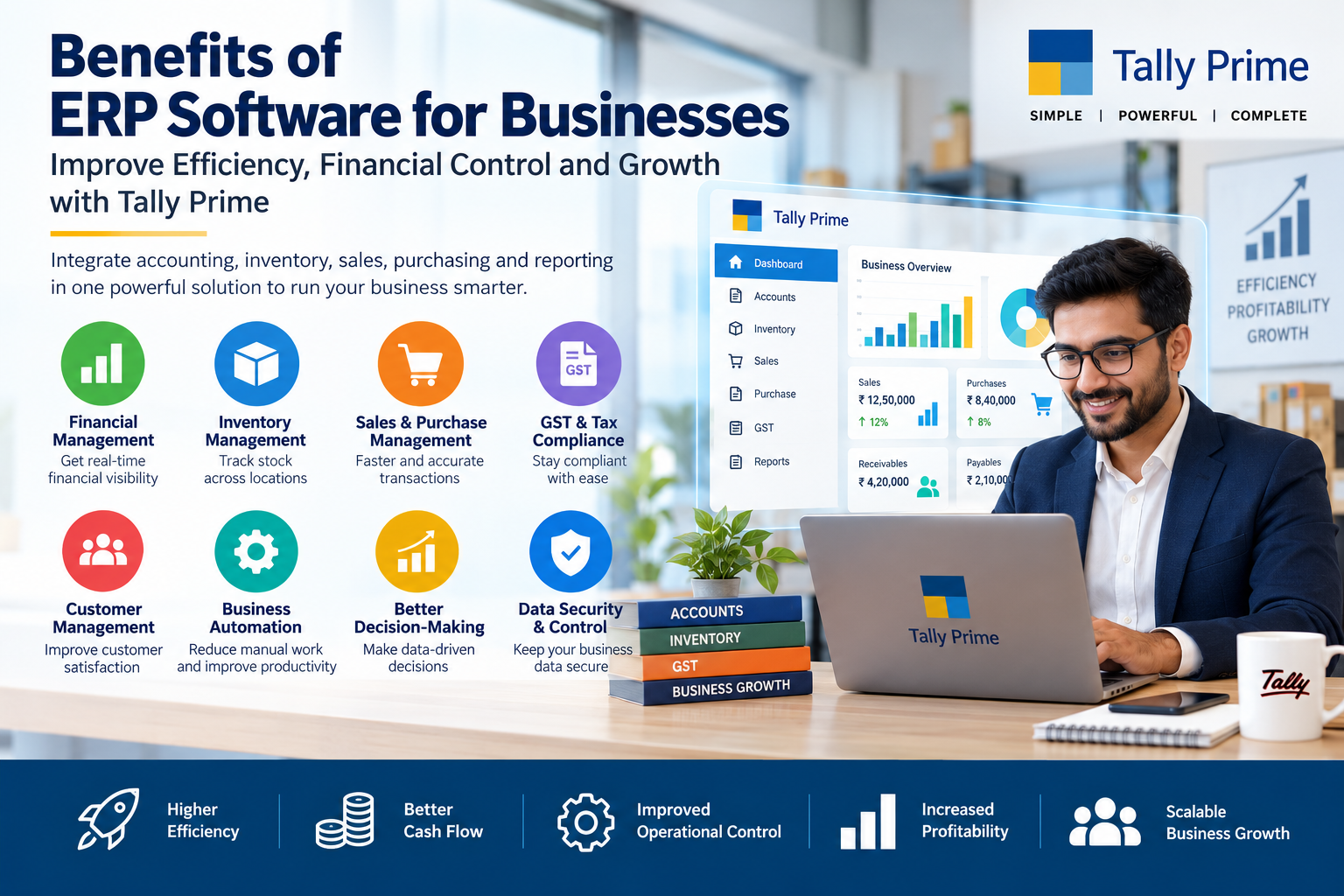
Enterprise Resource Planning (ERP) software helps businesses bring important operations together, reduce repetitive tasks and improve coordination.
For Indian businesses, Tally Prime offers integrated accounting, inventory, billing, taxation and reporting capabilities that support many core ERP requirements.
Understanding the benefits of ERP software can help business owners build more efficient, profitable and financially controlled organizations.
A Business Owner's Story: When Growth Became a Financial Burden
Rajesh operated a successful electrical goods distribution business in Delhi. After years of hard work, he had built strong relationships with retailers, contractors and suppliers.
His business was growing, but his peace of mind was disappearing.
Every evening, Rajesh stayed at his office reviewing invoices, checking stock registers and calling employees about pending customer payments.
One afternoon, an important customer placed a large order for electrical cables. The sales team confirmed availability based on an outdated spreadsheet.
When the warehouse team prepared the delivery, they discovered that the required quantity was unavailable.
The customer cancelled the order.
A few days later, Rajesh discovered another problem. Several customers had exceeded their payment terms, while supplier payments were approaching.
Although sales were increasing, available cash was insufficient.
He began worrying about employee salaries, business commitments and the future of the company he had spent years building.
Rajesh eventually introduced a more integrated business management process using Tally Prime.
His team started recording purchases, sales, inventory movements and customer outstanding balances in one connected accounting environment.
Over time, he gained clearer visibility into stock availability, receivables and financial performance.
The biggest improvement was not simply faster accounting.
It was the confidence of knowing what was happening inside his business.
This is an illustrative story showing how integrated business management can help a growing enterprise.
1. What Is ERP Software?
Enterprise Resource Planning, commonly known as ERP, is a business management approach supported by software that connects multiple operational functions through integrated information and processes.
Instead of managing every department independently, ERP systems allow businesses to coordinate important activities using shared business data.
Typical ERP functions include:
-
Financial accounting and reporting
-
Sales and invoicing
-
Purchase management
-
Inventory and warehouse management
-
Customer and supplier information
-
Order processing
-
Production planning
-
Payroll and human resources
-
Taxation and compliance
-
Business performance analysis
The specific functions available depend on the ERP product, modules and implementation.
For example, when a business records a sales transaction, an integrated system may update accounting records, stock balances, customer receivables and relevant tax information.
This reduces the need to enter the same information repeatedly.
How ERP differs from traditional accounting software
Traditional accounting software primarily focuses on financial transactions, ledgers and reports.
ERP systems generally provide broader coordination across operational departments, potentially including manufacturing, procurement, logistics and human resources.
Tally Prime provides integrated financial and operational capabilities suitable for many small and medium-sized businesses. However, it should not be assumed to replace every specialized enterprise ERP module.
2. Major Benefits of ERP Software for Businesses
Benefit 1: Centralized Business Information
One of the biggest advantages of ERP software is the ability to organize important business information within a connected system.
Without integration, sales teams may maintain customer records separately, accountants may use another application, and warehouse employees may rely on spreadsheets.
This creates inconsistencies.
For example, a customer may have already paid an invoice, but the sales team may still see the payment as outstanding because the information has not been updated.
Integrated business software reduces these information gaps.
How Tally Prime helps
Tally Prime maintains connected records for financial transactions, inventory, customer accounts and supplier balances.
Businesses can access relevant information through reports such as:
-
Balance Sheet
-
Profit and Loss Account
-
Stock Summary
-
Sales Register
-
Purchase Register
-
Outstanding Receivables
-
Outstanding Payables
When transactions are recorded correctly, these reports provide a more consistent view of business performance.
Benefit 2: Reduced Manual Work and Better Productivity
Manual data entry consumes valuable time and increases the possibility of mistakes.
Employees may spend hours copying information from invoices into spreadsheets, updating stock records or preparing financial summaries.
ERP software helps reduce repetitive activities through integrated transaction processing.
For example, a properly configured sales invoice can simultaneously contribute to revenue accounting, customer balances, inventory records and tax calculations.
This reduces duplicate entry.
How Tally Prime helps
Tally Prime supports efficient voucher entry, invoicing, ledger management and automated calculations.
Businesses can use predefined masters, accounting configurations and voucher features to standardize daily work.
The result can be faster processing, fewer repetitive activities and more time for customer service and business development.
Benefit 3: Improved Financial Management
Financial visibility is essential for sustainable business growth.
A company may generate strong sales but still struggle because customers delay payments or expenses increase faster than revenue.
ERP systems help owners understand financial performance through integrated records and reports.
Important financial indicators include profitability, expenses, receivables, payables, cash balances and working capital.
How Tally Prime helps
Tally Prime provides financial statements and accounting reports that help businesses examine income, expenses and outstanding balances.
Business owners can review financial performance regularly instead of waiting until the end of the financial year.
This supports better budgeting, expense control and financial planning.
Benefit 4: Better Inventory Management
Inventory is one of the most important investments for manufacturers, retailers, wholesalers and distributors.
Excess inventory blocks working capital, while insufficient inventory creates missed sales opportunities.
Poor stock visibility can also cause duplicate purchases, stock discrepancies and delivery delays.
ERP inventory features help businesses monitor quantities, movements and stock values.
How Tally Prime helps
Tally Prime supports stock groups, stock categories, units of measurement, godowns or locations, stock items and inventory vouchers.
Depending on configuration and business requirements, businesses can also use batch-wise details and expiry information.
These capabilities help monitor stock across products and storage locations.
For example, a pharmaceutical distributor can use batch information to support better inventory tracking, while an electronics wholesaler can monitor product quantities across warehouses.
Benefit 5: Faster Sales and Purchase Processing
Sales and purchasing are closely connected to business profitability.
If purchase records are delayed, stock information may become inaccurate.
If sales invoices are prepared incorrectly, customer disputes and accounting reconciliation problems may increase.
Integrated systems improve coordination between purchasing, billing and accounting.
How Tally Prime helps
Tally Prime supports purchase and sales vouchers, order processing, invoice generation and related accounting entries.
Businesses can configure order-processing workflows to track purchase orders, sales orders, receipts and deliveries.
This improves transaction visibility and helps teams maintain more organized records.
Benefit 6: Improved Customer Satisfaction
Customer satisfaction depends on reliable delivery, accurate billing and responsive service.
When employees cannot access current information, they may provide incorrect delivery commitments or struggle to answer payment-related questions.
Integrated business systems make relevant records easier to access.
How Tally Prime helps
Tally Prime enables businesses to review customer ledgers, invoice records, bill-wise outstanding balances and sales transactions.
Employees can identify pending invoices and review previous transactions without searching through multiple manual registers.
This helps businesses respond more confidently to customer queries.
Benefit 7: Stronger Credit Control and Cash Flow
Credit sales are common in Indian wholesale and distribution businesses.
However, uncontrolled credit can create serious financial pressure.
A business may show high turnover while struggling to pay suppliers because customers have not cleared their dues.
ERP-supported credit management helps businesses monitor payment commitments and outstanding balances.
How Tally Prime helps
Tally Prime supports bill-wise accounting, credit periods, credit limits and receivables reporting.
Businesses can identify overdue invoices, review customer balances and follow up on collections.
Credit control features help employees recognize payment risks before extending additional credit.
These controls are most effective when customer records and receipts are updated consistently.
Benefit 8: Better GST and Tax Compliance Management
Tax compliance is a major operational responsibility for Indian businesses.
Incorrect GST classification, missing invoice details and inconsistent records can create reconciliation challenges.
Integrated accounting software can reduce some of these difficulties by connecting taxation information with business transactions.
How Tally Prime helps
Tally Prime supports GST-related accounting, tax calculations, GST invoice preparation and relevant reports.
Businesses can maintain GST details for parties and items, examine transactions and prepare information for compliance activities.
Available connected services and return-related functions depend on the software release, subscription and configuration.
Final tax classifications, return accuracy and filing responsibilities still require appropriate review.
Benefit 9: More Accurate Business Decisions
Successful businesses depend on timely and reliable information.
Without proper reports, owners may make decisions based on assumptions.
For example, a retailer may believe a product is highly profitable because it sells frequently, while overlooking purchase costs and associated expenses.
ERP software supports data-based decision-making.
How Tally Prime helps
Tally Prime provides accounting and inventory reports that can be examined by period, ledger, item and other available dimensions.
Owners can analyze sales trends, stock movement, expenses and profitability.
These insights help identify areas requiring attention.
Benefit 10: Improved Coordination Between Departments
When departments work independently, communication gaps can affect operations.
Sales employees may confirm orders without knowing warehouse availability.
Purchase teams may reorder items without reviewing existing inventory.
Accounts teams may approve payments without understanding immediate cash requirements.
Integrated processes reduce such gaps by connecting operational information.
How Tally Prime helps
Tally Prime can provide a shared accounting and inventory environment for authorized users, subject to licensing and deployment arrangements.
Appropriate user permissions and defined workflows help departments coordinate more effectively.
For complex manufacturing, logistics or enterprise approval processes, additional specialized systems or integrations may be necessary.
3. Additional Benefits of ERP Software for Growing Businesses
Benefit 11: Better Data Security and Access Control
Business information includes customer records, supplier balances, pricing details and financial transactions.
Unauthorized access or accidental changes can create operational and financial risks.
ERP systems often provide access controls that help businesses determine which employees can view or modify particular information.
How Tally Prime helps
Tally Prime provides security controls, user-level permissions and features such as TallyVault for company data encryption.
Businesses can configure access based on employee responsibilities.
Regular backups, secure infrastructure and appropriate password management remain essential.
Benefit 12: Greater Scalability
A business that handles 100 invoices per month may eventually process thousands.
As transaction volumes increase, manual systems become difficult to manage.
ERP software provides structured processes that can support business expansion.
Tally Prime can help growing businesses maintain organized records as customers, products and transactions increase.
However, the suitability of any software for large-scale operations depends on transaction volume, users, infrastructure and integration requirements.
Benefit 13: Improved Cost Control
Many businesses lose money through unnecessary purchases, delayed collections, stock discrepancies and avoidable administrative expenses.
ERP systems make these costs easier to identify.
Tally Prime allows businesses to examine expense ledgers, cost centres where configured, inventory valuation and financial reports.
Managers can compare expenses over time and investigate unusual changes.
This supports more disciplined financial management.
Benefit 14: Easier Auditing and Financial Transparency
Accurate records are important for internal reviews, statutory audits and management reporting.
When transactions are maintained across disconnected files, reconciliation becomes time-consuming.
Integrated accounting systems provide a more structured record of business activities.
Tally Prime supports voucher-level information, accounting reports and applicable audit-related features, helping authorized users review transactions.
Proper controls, documentation and reconciliation remain necessary to maintain reliable records.
4. How Tally Prime Supports ERP-Like Business Management
Tally Prime combines several important financial and operational functions in one application.
For businesses primarily concerned with accounting, billing, purchasing, inventory and taxation, it can serve as a central business management system.
|
Business requirement
|
Tally Prime capability
|
|---|
|
Financial management
|
Ledgers, vouchers, financial statements
|
|
Sales management
|
Invoices, sales orders, receivables
|
|
Purchase management
|
Purchase orders, bills, payables
|
|
Inventory control
|
Stock items, locations, batches
|
|
GST management
|
Tax accounting and GST reports
|
|
Credit management
|
Bill-wise tracking, credit limits
|
|
Banking
|
Bank records and reconciliation features
|
|
Management reporting
|
Financial and inventory reports
|
|
Multi-user operations
|
Shared access under suitable licensing
|
|
Data security
|
User permissions and encryption features
|
A major advantage is that related transactions can contribute to multiple reports without requiring entirely separate recordkeeping processes.
For example, when a distributor records a correctly configured sales invoice, the transaction can update sales accounting, customer outstanding balances, stock records and GST information.
This integration makes daily business management more efficient.
5. Practical Steps to Implement ERP Processes Using Tally Prime
Businesses should approach software implementation as an operational improvement project rather than simply installing an application.
Step 1: Identify existing business problems
Start by examining areas where employees spend unnecessary time or make repeated errors.
These may include inaccurate stock records, delayed invoices, overdue customer payments and inconsistent financial reports.
Prioritize the problems that affect profitability and customer service.
Step 2: Organize business master data
Create accurate customer, supplier, ledger and inventory records.
Review opening balances, stock quantities, units of measurement and relevant tax details.
Reliable master data is essential because inaccurate information can affect every connected report.
Step 3: Configure accounting and inventory
Set up appropriate accounting groups, inventory classifications, locations and transaction configurations.
Enable only the features required by the business.
Unnecessary complexity can make implementation harder for employees.
Step 4: Standardize transaction recording
Define clear procedures for entering purchases, sales, receipts, payments and inventory movements.
Employees should understand when transactions must be recorded and who is responsible for verifying them.
Step 5: Configure credit management
Maintain appropriate customer credit periods and limits.
Use bill-wise accounting to track invoices and collections.
Review overdue balances regularly.
Step 6: Establish reporting routines
Decide which reports management should examine daily, weekly and monthly.
Daily monitoring may focus on cash, bank balances, sales and collections.
Monthly reviews may include profitability, expenses, inventory valuation and outstanding balances.
Step 7: Train employees
Software produces better results when employees understand how to use it correctly.
Provide practical training using real business scenarios.
Step 8: Review performance and improve
Compare operational performance before and after implementation.
Useful measures include invoice processing time, overdue receivables, stock discrepancies and reporting delays.
Continue refining workflows as the business grows.
6. Case Study 1: Electrical Goods Wholesaler Improves Inventory and Credit Control
Illustrative case study — figures are hypothetical, not verified customer results.
Business: Electrical goods wholesaler, Delhi
Challenge: Inaccurate stock information and delayed customer collections
A wholesale electrical distributor handled products such as cables, switches, lighting accessories and circuit protection equipment.
The company used spreadsheets for inventory management and separate accounting records for financial transactions.
Sales employees frequently contacted warehouse staff to confirm stock availability.
Customer payments were also difficult to monitor because outstanding balances were reviewed manually.
Solution
The business introduced structured inventory and accounting processes using Tally Prime.
Stock items were organized into categories, warehouse locations were configured, and customer invoices were maintained with bill-wise references.
Management began reviewing receivables and stock reports regularly.
Illustrative results
|
Performance indicator
|
Before
|
After
|
|---|
|
Monthly stock discrepancies
|
18
|
5
|
|
Average invoice preparation
|
12 minutes
|
5 minutes
|
|
Overdue receivables
|
₹18 lakh
|
₹11 lakh
|
|
Monthly reporting preparation
|
3 days
|
1 day
|
These hypothetical results demonstrate the kinds of improvements businesses can target through better processes and consistent software usage.
Key learning
Inventory visibility and disciplined credit monitoring can improve both customer service and working capital management.
7. Case Study 2: Manufacturing Business Strengthens Financial Visibility
Illustrative case study — figures are hypothetical.
Business: Small manufacturing company, Faridabad
Challenge: Difficulty tracking raw materials, purchases and production-related costs
A manufacturer of industrial components maintained separate records for raw materials, finished goods and accounting.
Purchase managers struggled to identify available stock before ordering additional materials.
Management also lacked timely information about operating expenses and financial performance.
Solution
The company adopted Tally Prime for integrated accounting and inventory management.
It configured raw material and finished goods records, relevant inventory vouchers, expense classifications and financial reporting procedures.
Where appropriate, manufacturing-related inventory entries were incorporated into the workflow.
Illustrative results
Within six months, the company targeted a reduction in unnecessary purchases, faster monthly reporting and improved visibility into material consumption.
A hypothetical 15% reduction in avoidable raw material purchases and a reduction in monthly reporting time from four days to one day would represent meaningful operational improvements.
Key learning
Better material accounting and financial reporting can help manufacturers understand costs and make more informed purchasing decisions.
Businesses requiring advanced production scheduling, machine-level tracking or complex manufacturing resource planning may need additional specialized applications.
8. ERP Software vs Manual Business Management
|
Factor
|
Manual or disconnected systems
|
Integrated ERP approach
|
|---|
|
Data entry
|
Often repeated
|
Reduced duplication
|
|
Stock visibility
|
Requires manual updates
|
Connected inventory records
|
|
Financial reporting
|
Multiple reconciliations
|
Integrated reports
|
|
Credit monitoring
|
Spreadsheet-based
|
Structured receivables
|
|
Error detection
|
Often delayed
|
Easier reconciliation
|
|
Department coordination
|
Separate records
|
Shared information
|
|
Growth management
|
Increasing administrative work
|
More standardized processes
|
|
Decision-making
|
Delayed information
|
More timely insights
|
ERP software does not automatically eliminate errors. Benefits depend on accurate transactions, employee training, suitable configurations and regular management review.
9. Which Businesses Benefit Most from ERP Software?
ERP software can benefit organizations across many industries.
Retail businesses can use integrated billing, inventory tracking and financial reports to understand sales and stock availability.
Wholesale distributors can monitor large product catalogs, customer credit balances, purchasing activities and warehouse inventory.
Manufacturing companies can improve material accounting, stock monitoring and cost visibility.
Service businesses can organize customer billing, expenses, receivables and financial reporting.
Trading and import businesses can maintain purchase records, inventory information, supplier balances and relevant accounting details.
Growing MSMEs can benefit from standardized financial processes without immediately adopting a highly complex enterprise platform.
The appropriate software depends on the business model, operational complexity and future requirements.
10. Common ERP Implementation Challenges and How to Avoid Them
Although ERP software offers significant benefits, implementation can create difficulties if businesses do not prepare properly.
Inaccurate opening data
Incorrect customer balances, stock quantities or ledger classifications can affect reporting from the beginning.
Businesses should reconcile important opening information before migration.
Insufficient employee training
Employees may continue using manual records if they do not understand the new workflow.
Practical training and clear responsibilities improve adoption.
Excessive customization
Complicated configurations can increase maintenance requirements and make daily work difficult.
Businesses should prioritize essential requirements before introducing advanced customizations.
Weak backup procedures
Important business data must be protected against accidental deletion, hardware failure and other disruptions.
A documented backup and restoration process is essential.
Lack of management involvement
ERP implementation should not be treated as an accounts department project alone.
Owners and managers should define reporting requirements, review implementation progress and support consistent usage.
11. How to Measure the Return on Investment from ERP Software
Before selecting business management software, owners should consider both implementation costs and potential benefits.
Costs may include software licensing, infrastructure, employee training, data migration, customization and ongoing support.
Potential benefits include time savings, reduced errors, improved collections and lower inventory-related losses.
Consider an illustrative business that saves 40 employee hours per month through improved transaction processing.
If the average relevant employee cost is ₹250 per hour, the estimated monthly productivity value is:
40 × ₹250 = ₹10,000
The annual estimated productivity value would be ₹1,20,000.
Additional savings may arise from better collections and reduced stock discrepancies.
However, these should be measured separately and should not be assumed without supporting data.
A simple ROI calculation is:
ROI (%) = (Total Measurable Benefits − Total Costs) ÷ Total Costs × 100
Businesses should use realistic assumptions and evaluate results over a suitable period.
12. Future of ERP Software for Indian Businesses
ERP software is evolving as businesses demand greater accessibility, automation and analytical capabilities.
Several developments are influencing business management systems.
Cloud-enabled access
Businesses increasingly want authorized employees to access information from different locations.
Tally Prime can be used in suitable remote or hosted environments, subject to licensing, connectivity, security and infrastructure arrangements.
Cloud hosting can support distributed teams, but service reliability and data protection must be evaluated carefully.
Greater automation
Businesses are seeking ways to reduce repetitive accounting, reconciliation and reporting tasks.
Automation can improve productivity when processes are properly configured and verified.
Better business analytics
Management increasingly needs timely information about profitability, working capital and operational efficiency.
Connected reports can help businesses identify financial and operational trends.
Stronger compliance processes
Digital records and changing regulatory requirements make structured accounting and compliance procedures increasingly important.
Businesses should maintain current software, verify applicable requirements and review tax-related information carefully.
Integrated business applications
Growing organizations may need connections between accounting, e-commerce, customer management and specialized operational systems.
Integration requirements should be evaluated before selecting or customizing a platform.
13. Why Tally Prime Is a Practical Choice for Many Indian MSMEs
For many Indian businesses, adopting a large enterprise ERP platform may introduce unnecessary complexity and cost.
Tally Prime can be a practical option where the primary requirements involve accounting, invoicing, inventory, purchasing, GST and financial reporting.
Its integrated transaction structure can reduce duplication and help business owners maintain more organized financial records.
It also supports operational practices such as credit monitoring, inventory classification and structured reporting.
However, businesses with complex human resource management, advanced supply chain planning, specialized manufacturing or extensive enterprise integrations should evaluate whether additional software is required.
The best approach is to choose technology according to actual business needs rather than assuming that one application must manage every function.
Conclusion: ERP Software Can Transform the Way Businesses Operate
The benefits of ERP software extend beyond faster accounting or computerized billing.
A well-implemented system can improve financial visibility, inventory control, customer service, employee productivity and operational coordination.
For growing Indian businesses, these improvements can reduce uncertainty and help management make decisions based on more reliable information.
Tally Prime provides integrated accounting, inventory, billing, taxation and reporting capabilities that can support many everyday business management requirements.
The real value comes from combining suitable software with accurate records, trained employees and consistent processes.
Businesses that invest in better information management today can build a stronger foundation for sustainable growth tomorrow.
Powered by Binarysoft Technologies
Authorized Tally Partner
Location: 1626/33, 1st Floor, Naiwalan, Karol Bagh, New Delhi – 110005, INDIA
Contact us: +91 7428779101, 9205471661
Email us: tally@binarysoft.com
Business Hours: 10:00 AM – 6:00 PM, Monday–Friday
Frequently Asked Questions
How can Binarysoft Technologies help businesses implement Tally Prime?
Binarysoft Technologies, an Authorized Tally Partner, can assist businesses with Tally Prime-related requirements, including software selection, configuration, training and support according to the services agreed upon.
What should businesses consider before choosing ERP software?
Businesses should evaluate required features, total costs, scalability, integration capabilities, security, reporting needs, employee usability and available support.
How long does ERP implementation take?
Implementation time depends on business size, data quality, operational complexity, employee training and customization requirements. A small accounting-focused implementation may be much simpler than a comprehensive enterprise deployment.
Can Tally Prime be accessed through cloud hosting?
Tally Prime can be deployed in suitable hosted environments, subject to licensing and technical requirements. Businesses should evaluate security, performance, backups and provider reliability.
CA. Ronav Maheshwari works with small and mid-sized businesses on accounting processes, GST compliance, and financial reporting. His focus is on simplifying routine accounting workflows and helping business owners maintain accurate and audit-ready records.