Call CA Tally HelpDesk
+91 9205471661,
7428779101
Introduction: Why Accurate Payroll Management Matters More Than Ever
For an employee, salary is more than a monthly bank credit. It pays household bills, supports children's education, covers medical expenses and provides financial security. For an employer, payroll represents a major responsibility involving accurate calculations, timely payments, confidential employee information and statutory compliance.
In 2026, Indian businesses are managing increasingly complex salary structures, changing workforce requirements, digital payments and evolving employment regulations. Even a small payroll error can create confusion, employee dissatisfaction or compliance difficulties.
Many small and medium-sized businesses still depend on spreadsheets, manual attendance registers and separate accounting records. These methods can become difficult to manage as employee numbers increase.
A structured payroll management system helps businesses calculate salaries, organize employee records, record deductions, generate payslips and maintain payroll-related accounting information.
TallyPrime provides payroll and accounting capabilities that can support these activities when the relevant features are available and correctly configured.
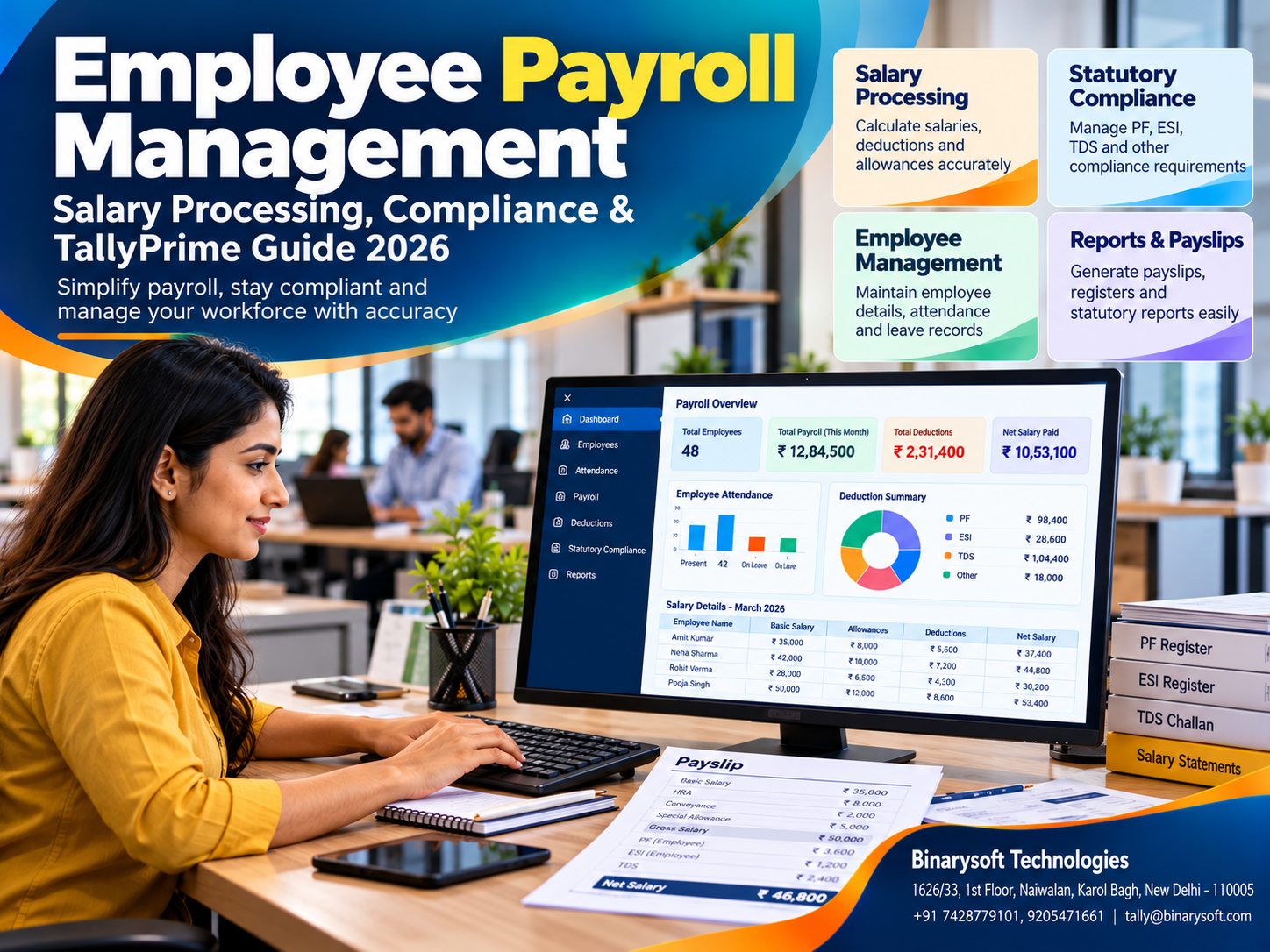
This guide explains employee payroll management, salary processing, essential components, best practices, common mistakes and how TallyPrime can help businesses establish a dependable payroll process.
1. What Is Employee Payroll Management?
Employee payroll management is the process of calculating, recording and paying employee compensation while maintaining the required financial and statutory records.
It involves more than transferring salaries into bank accounts.
Payroll administration may include maintaining employee information, processing attendance, calculating earnings, recording deductions, preparing payslips and accounting for employer contributions.
For example, a company employing 40 people may have different salary structures for managers, accountants, sales executives and warehouse employees.
Some employees may receive fixed monthly salaries, while others receive overtime, incentives or variable allowances.
Payroll management ensures that these components are processed according to applicable policies, employment terms and laws.
An effective payroll system should produce accurate calculations, maintain confidentiality and support timely salary payments.
2. Why Payroll Management Is Important for Businesses
Payroll directly affects employee confidence and organizational stability.
When employees receive accurate salaries on time, they can plan their personal finances with greater certainty.
From a business perspective, organized payroll records help management understand employment costs and prepare financial reports.
Effective payroll management also supports statutory compliance, reduces calculation errors and improves accountability.
A business that does not maintain reliable payroll information may struggle to reconcile salary expenses, employee advances and statutory liabilities.
Payroll is therefore both a human resources responsibility and an important accounting function.
3. Major Components of Employee Payroll
A salary structure may contain several earnings and deduction components.
|
Payroll component
|
Description
|
|---|
|
Basic salary
|
Fixed component of employee compensation
|
|
House Rent Allowance
|
Allowance provided according to salary structure
|
|
Special allowance
|
Additional earnings under employment terms
|
|
Conveyance or other allowances
|
Applicable employee benefits
|
|
Overtime
|
Payment for eligible additional working hours
|
|
Incentives and bonuses
|
Performance-related or contractual earnings
|
|
Provident Fund
|
Contributions where applicable
|
|
Employee State Insurance
|
Contributions for covered employees
|
|
Professional Tax
|
State-specific deduction where applicable
|
|
Income-tax TDS
|
Tax deducted according to applicable rules
|
|
Loan or advance recovery
|
Authorized employee-related deductions
|
Not every component applies to every employee.
Businesses should configure payroll structures according to employment contracts, applicable laws and current statutory requirements.
4. Understanding Gross Salary, Deductions and Net Salary
Payroll calculations generally begin with employee earnings.
Gross salary represents the total earnings included in the payroll calculation before employee deductions.
Net salary is the amount payable after applicable deductions.
The basic relationship is:
\[ \text{Net Salary}=\text{Gross Earnings}-\text{Employee Deductions} \]
Illustrative Salary Calculation
|
Particulars
|
Monthly amount
|
|---|
|
Basic salary
|
₹25,000
|
|
House Rent Allowance
|
₹10,000
|
|
Special allowance
|
₹12,000
|
|
Other allowance
|
₹3,000
|
|
Gross earnings
|
₹50,000
|
|
Illustrative PF deduction
|
₹3,000
|
|
Illustrative income-tax TDS
|
₹1,500
|
|
Net salary
|
₹45,500
|
The deductions above are hypothetical figures for explaining payroll arithmetic. Actual PF contributions, tax withholding and other deductions must be determined from current applicable rules and the employee's circumstances.
Employer contributions are accounted for separately where required.
5. Step-by-Step Employee Salary Processing
A reliable payroll cycle follows a consistent sequence.
Step 1: Update employee records. Verify employee names, joining dates, departments, salary structures and bank details.
Step 2: Finalize attendance. Review working days, paid leave, unpaid leave and applicable overtime.
Step 3: Calculate earnings. Determine fixed salary, allowances, incentives and other eligible payments.
Step 4: Calculate deductions. Apply authorized recoveries and applicable statutory deductions.
Step 5: Review calculations. Compare payroll amounts with employee contracts, attendance records and previous months.
Step 6: Obtain approval. Have an authorized manager review the payroll summary.
Step 7: Process payments. Transfer approved net salaries using the company's payment procedures.
Step 8: Generate payslips. Provide employees with clear details of earnings and deductions.
Step 9: Record payroll liabilities. Maintain accounting records for salary expenses and applicable statutory obligations.
Step 10: Complete reconciliation. Verify payments, payroll reports and relevant bank transactions.
Following a documented process reduces dependence on individual employees and makes payroll easier to review.
6. Attendance, Leave and Overtime Management
Attendance information is an important input for salary processing.
Businesses may maintain daily attendance, shift records, approved leave and overtime information.
For example, an employee may receive a fixed monthly salary but have two days of unpaid leave.
The deduction must follow the organization's documented policy and applicable employment law.
Overtime should also be calculated according to the employee's eligibility and relevant legal requirements.
TallyPrime supports attendance-related payroll records where the payroll functionality is enabled and configured.
Businesses using biometric devices or advanced shift scheduling may require separate attendance software or compatible integration.
7. Payroll Compliance in India
Payroll compliance may involve several legal and statutory responsibilities.
Provident Fund
Provident Fund requirements depend on the applicable legal framework, establishment coverage, employee eligibility and contribution rules.
Employers should verify current contribution rates, wage definitions and remittance procedures.
Employee State Insurance
ESI applies to covered establishments and eligible employees according to the prevailing rules.
Eligibility and contribution calculations must be verified before processing.
Income-Tax TDS
Salary-related TDS depends on estimated taxable income, applicable tax provisions, declarations and other relevant information.
Professional Tax
Professional Tax requirements differ by state and may not apply in every location.
Employment and Wage Regulations
Businesses must also consider applicable wage, working-hour, leave and payment requirements.
Because statutory rules can change, payroll configurations should be reviewed regularly rather than relying on old assumptions.
8. An Emotional Story: The Salary Delay That Changed a Business Owner's Perspective
Ramesh operated a small packaging company in Delhi with 32 employees.
He had built the business gradually, beginning with one machine and a rented workshop.
Most employees had worked with him for several years.
He knew their families and understood how much they depended on their monthly salaries.
But the company still processed payroll through spreadsheets.
Attendance records were collected manually, overtime calculations were prepared separately and salary figures were transferred into accounting records at the end of each month.
One month, the accountant handling payroll became unexpectedly unavailable.
Salary calculations were delayed.
On the usual payday, several employees checked their bank accounts and found that their wages had not arrived.
A machine operator named Imran approached Ramesh quietly.
He explained that his daughter's school fees were due the following morning.
He was not angry. He simply wanted to know when the salary would arrive.
Ramesh felt deeply uncomfortable.
He had always considered his company a family, yet a weak administrative process had created financial uncertainty for the people who trusted him.
That evening, he stayed in the office reviewing attendance sheets and salary calculations.
He realized that payroll could no longer depend on one spreadsheet or one employee.
Over the following weeks, the company introduced a structured payroll process.
Employee records were verified, salary components were standardized and attendance information was reviewed before each payroll cycle.
The accounting team configured appropriate payroll and accounting functions in TallyPrime.
A second employee was trained to review payroll calculations, and a fixed approval schedule was established.
In the following months, salaries were processed more consistently.
Ramesh also began reviewing payroll expenses and liabilities before payment dates.
One afternoon, Imran thanked him for making the process more dependable.
Ramesh replied, "Your salary is not just an expense in our accounts. It is a responsibility we must respect."
This fictional story illustrates the human importance of accurate and timely payroll processing.
9. How TallyPrime Helps with Employee Payroll Management
TallyPrime provides payroll-related functionality for businesses using a supported configuration.
It can help maintain employee masters, salary structures, attendance information and payroll vouchers.
Employee Records
Businesses can organize employee information through relevant employee and employee-group masters.
Salary Structures
Pay heads can represent earnings and deductions, including basic salary, allowances and applicable contributions.
Attendance Records
Attendance and production-related payroll inputs can be maintained according to the selected payroll configuration.
Payroll Processing
Payroll vouchers support salary calculation and recording based on configured pay heads and employee information.
Payslips and Reports
Supported payroll reports can help businesses review employee earnings, deductions and payroll expenses.
Accounting Integration
Payroll transactions can be reflected in the company's accounting records, helping management review employment costs.
Feature availability and statutory configurations should be verified for the installed TallyPrime edition and release.
10. Setting Up Payroll in TallyPrime: Practical Steps
Businesses should follow a structured implementation process.
Step 1: Review payroll requirements. Identify employee categories, salary structures, attendance policies and statutory obligations.
Step 2: Enable applicable payroll functionality. Confirm that the installed TallyPrime configuration supports the required payroll features.
Step 3: Create employee groups. Organize employees by department or other suitable classifications.
Step 4: Create employee masters. Maintain relevant employee details and payroll information.
Step 5: Configure pay heads. Define earnings, allowances and deductions using the correct calculation methods.
Step 6: Set up salary details. Assign appropriate salary components to employees.
Step 7: Record attendance. Enter approved attendance or other applicable payroll inputs.
Step 8: Process payroll vouchers. Calculate salary transactions for the selected period.
Step 9: Verify payslips. Check earnings, deductions and net pay before approval.
Step 10: Record payments and reconcile. Complete salary payments and verify accounting records.
Businesses should test sample calculations before processing their first live payroll cycle.
11. Payroll Best Practices Every Employer Should Follow
Establish a Fixed Payroll Calendar
Define attendance deadlines, calculation dates, approval schedules and payment dates.
Maintain Accurate Employee Information
Verify salary structures, joining dates, bank information and relevant employee records.
Separate Preparation and Approval
Where practical, one employee should prepare payroll while another authorized person reviews it.
Reconcile Attendance and Salary Records
Payroll inputs should match approved attendance, leave and overtime information.
Protect Employee Confidentiality
Salary details, identification information and bank records should be accessible only to authorized personnel.
Review Statutory Settings
Tax and contribution calculations should be checked whenever applicable regulations or employee circumstances change.
Maintain Backups and Supporting Records
Preserve payroll records according to applicable legal and organizational requirements.
Provide Clear Payslips
Employees should be able to understand their earnings, deductions and net salary.
These practices help businesses reduce disputes and improve payroll reliability.
12. Case Study One: A Delhi Manufacturing Company Improves Payroll Accuracy
Illustrative case study based on common manufacturing payroll challenges.
Business Background
A manufacturing unit in Bawana Industrial Area, Delhi, employed factory operators, supervisors and administrative staff.
Employees worked different shifts, and some were eligible for overtime.
Challenges
Attendance was maintained manually, while salary calculations were prepared in spreadsheets.
Overtime information frequently reached the accounts department late.
This created payroll corrections and delays.
Solution
The company standardized attendance approval procedures and introduced structured payroll records using TallyPrime.
Employee groups and salary components were configured according to documented employment terms.
The accounting team introduced a payroll review checklist.
Business Outcome
Salary calculations became more consistent, and payroll discrepancies were easier to investigate.
Management gained better visibility into recorded employment expenses.
Key lesson: Payroll accuracy depends on reliable attendance inputs, correct salary configuration and systematic approval.
13. Case Study Two: A Service Company Strengthens Salary Processing and Financial Control
Illustrative case study demonstrating payroll process improvements.
Business Background
A consulting company in Noida employed 45 people across sales, administration and client service departments.
The company had fixed salaries, performance incentives and employee expense reimbursements.
Challenges
Salary information was maintained in multiple spreadsheets.
Management struggled to reconcile payroll expenses with accounting records.
Solution
The company established standardized salary structures and monthly payroll approval procedures.
TallyPrime was configured for suitable payroll and accounting transactions.
Employee reimbursements and variable earnings were reviewed separately before payroll finalization.
Business Outcome
The company improved consistency in salary records and financial reporting.
Payroll expenses became easier to review by department.
Employees also received clearer information about their salary components.
Key lesson: Connecting payroll procedures with financial accounting improves transparency and management control.
14. Payroll Management Software vs Manual Salary Processing
|
Factor
|
Manual payroll
|
Structured payroll software
|
|---|
|
Salary calculation
|
Spreadsheet formulas and manual checks
|
Configured calculations
|
|
Employee records
|
Often maintained separately
|
Organized employee masters
|
|
Attendance processing
|
Manual consolidation
|
Structured attendance inputs
|
|
Payslip generation
|
Individual preparation
|
Standardized reports
|
|
Payroll accounting
|
Separate entries may be required
|
Potential accounting integration
|
|
Error investigation
|
May require reviewing several files
|
More organized transaction records
|
|
Scalability
|
Increasing administrative effort
|
Better capacity with proper setup
|
Payroll software does not eliminate the need for verification.
Incorrect salary structures or attendance inputs can still produce incorrect results.
15. Payroll Accounting and Financial Reporting
Payroll represents a significant operating expense for many businesses.
Accurate accounting helps management understand departmental costs and financial obligations.
For example, a company with 50 employees and an average monthly gross salary of ₹35,000 has gross monthly payroll of:
50 × ₹35,000 = ₹17,50,000
Annual gross payroll, assuming unchanged staffing and salaries, would be:
₹17,50,000 × 12 = ₹2,10,00,000
This excludes employer contributions, bonuses and other employment-related expenses.
TallyPrime can help record payroll expenses and relevant liabilities.
Cost centres may also support departmental expense analysis where appropriately configured.
16. Payroll Data Security and Employee Privacy
Payroll information is confidential.
It may contain employee addresses, bank details, identification information and salary records.
Businesses should apply suitable access controls and restrict payroll administration to authorized employees.
Passwords, backups and recovery arrangements should be maintained carefully.
When payroll information is shared with external accountants or service providers, appropriate confidentiality and security procedures should be followed.
Organizations should also establish procedures for removing access when employees change roles or leave the company.
17. Common Payroll Mistakes Businesses Should Avoid
Frequent payroll mistakes include incorrect attendance records, outdated salary structures, missed deductions and delayed approvals.
Another common problem is failing to reconcile payroll totals with bank payments and accounting records.
Businesses may also overlook changes in employee eligibility for statutory deductions.
Some employers assume that payroll software automatically guarantees compliance.
In reality, accurate payroll depends on correct configuration, updated legal information and regular review.
18. Payroll Management for Small Businesses and Growing MSMEs
Small businesses may initially manage salaries through spreadsheets.
However, as the workforce grows, manual processing becomes more difficult.
Businesses should consider adopting structured payroll procedures when employee categories, variable earnings or statutory requirements become more complex.
A growing MSME may benefit from standardized employee masters, pay heads, attendance records and accounting integration.
The objective is not to purchase the most complicated system.
It is to establish a dependable payroll process that matches the organization's size and requirements.
19. How Binarysoft Technologies Helps with TallyPrime Payroll
Binarysoft Technologies, an Authorized Tally Partner based in New Delhi, assists businesses with TallyPrime implementation, accounting configuration and employee training.
Organizations can seek guidance on payroll setup, employee masters, salary structures, accounting integration and reporting, subject to supported product functionality.
Businesses may also require assistance reviewing existing payroll records and preparing for software migration.
Statutory payroll configurations should be verified against current applicable requirements, with specialist professional advice where necessary.
Conclusion
Employee payroll management is an essential responsibility that affects financial accuracy, employee trust and organizational stability.
A dependable payroll process requires correct salary structures, accurate attendance, appropriate deductions, timely approvals and clear payslips.
TallyPrime can support payroll-related records and accounting integration when the required features are available and properly configured.
However, software alone cannot replace careful review, employee confidentiality and statutory compliance procedures.
Businesses that establish consistent payroll practices can reduce avoidable mistakes, improve financial reporting and strengthen employee confidence.
Behind every salary payment is an employee and a family depending on the employer's commitment. Accurate payroll management is therefore not just an accounting process; it is a responsibility that deserves care and precision.
Powered by Binarysoft Technologies
Authorized Tally Partner
Location: 1626/33, 1st Floor, Naiwalan, Karol Bagh, New Delhi – 110005, INDIA
Contact Us: +91 7428779101, 9205471661
Email: tally@binarysoft.com
Business Hours: 10:00 AM – 6:00 PM, Monday to Friday
Frequently Asked Questions
What is employee payroll management?
Employee payroll management is the process of calculating salaries, recording earnings and deductions, making payments and maintaining related accounting and statutory records.
Can TallyPrime manage employee payroll?
TallyPrime supports payroll-related functionality in applicable configurations, including employee records, pay heads, payroll vouchers and reports.
What is the difference between gross salary and net salary?
Gross salary represents earnings before employee deductions. Net salary is the amount payable after applicable deductions.
Can payroll software calculate PF and ESI?
Payroll applications may support statutory calculations, but employers must verify applicability, eligibility, contribution rules and current configuration.
CA. Aditya Khatod focuses on accounting automation, taxation, and financial reporting for MSMEs. He helps businesses organize transactions, improve reconciliation processes, and maintain structured records for compliance and management purposes.