Call CA Tally HelpDesk
+91 9205471661,
7428779101
Introduction: Why Indian Manufacturers Need Smarter ERP Software in 2026
A factory can receive hundreds of customer orders, operate expensive machinery and employ skilled workers yet struggle to understand its actual production costs. Rising raw material prices, unexpected wastage, delayed deliveries and inaccurate inventory records can quietly reduce profitability.
In 2026, Indian manufacturers face growing pressure to improve production efficiency, maintain reliable financial records and respond quickly to changing customer requirements. Small and medium-sized factories must balance procurement, production, inventory, labour, quality control and GST compliance while protecting working capital.
Traditional registers and disconnected spreadsheets often make these responsibilities difficult to coordinate.
A production manager may report that an order is complete while the accounting department has not recorded the material consumed. Purchasing employees may order additional raw materials without knowing what is already available in another warehouse.
Such problems affect cash flow, customer satisfaction and profitability.
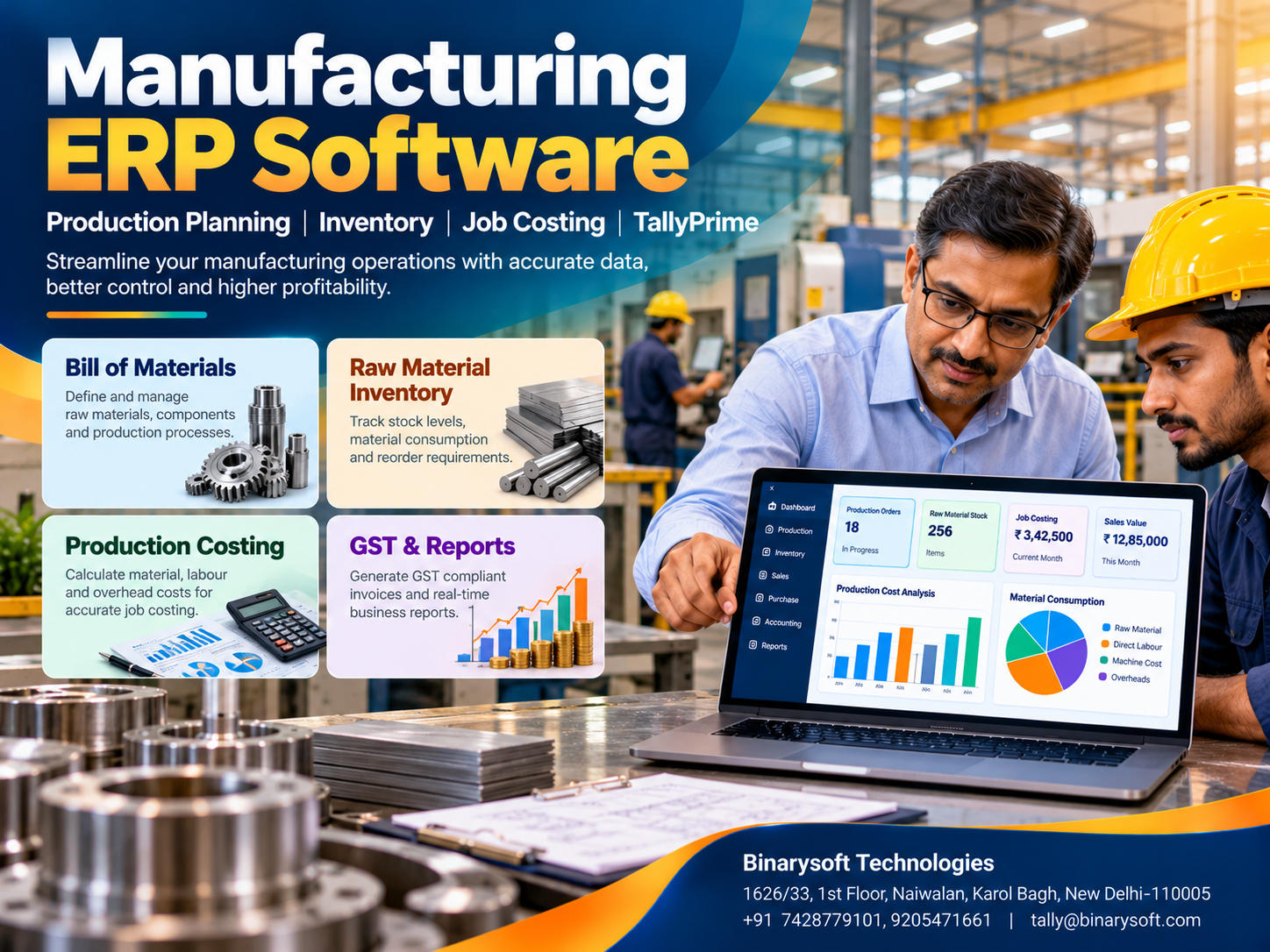
Manufacturing ERP software helps businesses connect production-related information with inventory, purchasing, sales and financial management.
TallyPrime offers useful capabilities for manufacturing businesses, including Bills of Materials, manufacturing vouchers, inventory management, cost centres, accounting and GST invoicing.
This guide explains manufacturing ERP software, its essential features, practical applications and how TallyPrime can help Indian manufacturers improve operational and financial control.
1. What Is ERP Software for the Manufacturing Industry?
Enterprise Resource Planning, or ERP, is an integrated approach to managing business processes through connected software and information.
Manufacturing ERP focuses on the activities involved in converting raw materials into finished products.
These activities may include procurement, inventory management, production planning, material consumption, quality control, dispatch and financial accounting.
Consider a factory producing electrical distribution boxes.
The business purchases metal sheets, switches, wires and other components. Employees assemble the products, perform inspections and dispatch finished units.
An ERP system helps coordinate the information associated with these activities.
A comprehensive manufacturing ERP may also include machine scheduling, production capacity planning, maintenance and shop-floor monitoring.
Not every accounting application provides all these specialized functions.
TallyPrime supports core accounting, inventory and manufacturing-related records, while advanced factory automation may require complementary software.
2. Common Challenges Faced by Manufacturing Businesses
Raw Material Shortages
Inaccurate inventory records can interrupt production and delay customer orders.
Excess Inventory
Purchasing more materials than required increases storage costs and ties up working capital.
Production Wastage
Damaged materials, rejected products and inefficient processes increase manufacturing expenses.
Inaccurate Job Costing
Without proper cost allocation, businesses may underestimate the cost of producing finished goods.
Production Delays
Poor coordination between purchasing, manufacturing and dispatch departments can affect delivery commitments.
Manual Recordkeeping
Repeated data entry across departments increases administrative work and the possibility of errors.
Limited Financial Visibility
Management may know monthly sales but lack reliable information about product-wise profitability.
Manufacturing ERP systems address these challenges by establishing more consistent operational records and reporting processes.
3. Essential Features of Manufacturing ERP Software
|
ERP feature
|
Business benefit
|
|---|
|
Raw material inventory
|
Monitors material quantities and values
|
|
Bill of Materials
|
Defines standard product requirements
|
|
Purchase management
|
Organizes supplier procurement
|
|
Production records
|
Tracks manufacturing transactions
|
|
Job costing
|
Evaluates production expenses
|
|
Warehouse management
|
Maintains location-wise stock information
|
|
Finished goods inventory
|
Tracks completed products
|
|
Sales order management
|
Records customer demand
|
|
GST invoicing
|
Supports tax-related sales records
|
|
Financial reporting
|
Reviews profitability and liabilities
|
|
Quality management
|
Helps document product inspections
|
|
Production scheduling
|
Coordinates manufacturing activities
|
Quality management and detailed production scheduling generally require specialized workflows or software beyond basic accounting and inventory functionality.
4. Production Planning and Material Requirements
Production planning determines what products must be manufactured, when they are needed and which resources will be required.
A manufacturer should consider customer orders, existing finished goods, raw material availability and production capacity.
Practical Example
A company receives an order for 1,000 electrical panels.
Each panel requires:
The standard requirements are therefore 2,000 metal sheets, 4,000 switches, 6,000 metres of wire and 1,000 cartons.
The business must then account for existing stock, expected wastage and available production resources.
TallyPrime can support inventory records and Bills of Materials. More advanced material requirements planning, capacity scheduling and automatic procurement proposals may require additional tools.
5. Bill of Materials: The Foundation of Manufacturing Cost Control
A Bill of Materials, commonly called BOM, defines the standard components and quantities required to manufacture a product.
It helps businesses maintain consistent material requirements.
For example, a furniture manufacturer producing one office desk may require wooden panels, screws, adhesive and metal fittings.
A properly configured BOM helps the business understand standard material consumption.
How TallyPrime Helps
TallyPrime supports BOM configuration for applicable manufactured stock items.
Manufacturing vouchers can record raw material consumption and finished goods production.
Businesses should review BOM quantities whenever product specifications or manufacturing methods change.
A BOM alone does not automatically account for every labour, machine or overhead cost.
These expenses must be recorded and allocated appropriately.
6. Manufacturing Costing: Calculating the True Cost of Production
Production costing is essential for setting selling prices and evaluating profitability.
Manufacturing costs generally include direct materials, direct labour and relevant production overheads.
Practical Example: Manufacturing 500 Metal Cabinets
|
Cost component
|
Amount
|
|---|
|
Metal sheets
|
₹2,50,000
|
|
Locks and fittings
|
₹60,000
|
|
Paint and consumables
|
₹40,000
|
|
Direct labour
|
₹90,000
|
|
Machine operating expenses
|
₹45,000
|
|
Allocated factory overhead
|
₹65,000
|
|
Total production cost
|
₹5,50,000
|
Cost per cabinet:
₹5,50,000 ÷ 500 = ₹1,100
If each cabinet sells for ₹1,500, excluding GST:
Total revenue = ₹7,50,000.
Gross manufacturing margin before selling and administrative expenses = ₹2,00,000.
The calculation assumes all 500 cabinets are saleable and that the listed costs are complete and not duplicated.
Accurate costing helps manufacturers avoid accepting orders at unprofitable prices.
7. An Emotional Story: The Factory Owner Who Feared Losing His Father's Legacy
For twenty-two years, Suresh operated a small engineering components factory in Faridabad.
His father had started the business with two machines and a handful of workers.
Over time, the factory expanded and began supplying components to automobile and industrial equipment manufacturers.
Suresh was proud of the business.
He remembered watching his father work late into the night, carefully checking every finished component before dispatch.
But growing production volumes created new challenges.
Raw material records were maintained in spreadsheets, while machine operators used handwritten registers.
The accounting department recorded purchases and expenses but could not easily determine the actual cost of individual production jobs.
One month, the factory received a large customer order.
Suresh accepted it because the quoted price appeared profitable.
During production, however, raw material wastage increased and machine repairs caused delays.
By the time the order was completed, the business had earned much less than expected.
A few days later, Suresh struggled to arrange funds for supplier payments and employee salaries.
He sat alone in the factory office, looking at an old photograph of his father standing beside their first machine.
He wondered whether the business his father had built was becoming too difficult to manage.
His daughter, who had recently joined the company, suggested reviewing the factory's accounting and inventory systems.
Together, they introduced more structured production records and material consumption procedures.
TallyPrime was configured for inventory accounting, Bills of Materials, manufacturing vouchers and financial reporting.
The production team also began maintaining job-progress and wastage records.
Gradually, Suresh gained a clearer understanding of manufacturing costs.
He could compare material requirements with actual consumption and review financial reports more frequently.
The business still faced rising costs and demanding customers, but he no longer relied only on assumptions when preparing quotations.
One evening, his daughter showed him a production cost report.
Suresh smiled and said, "Your grandfather taught us how to make good products. Now we are learning how to measure the cost of making them."
This fictional story illustrates how organized production records and financial visibility can help protect a family manufacturing business.
8. How TallyPrime Supports Manufacturing Businesses
TallyPrime provides several capabilities that help manufacturers maintain organized production and accounting records.
Raw Material Inventory: Stock items, groups and godowns help monitor materials and inventory locations.
Bills of Materials: Standard component quantities can be defined for manufactured products.
Manufacturing Vouchers: Supported inventory vouchers record material consumption and finished goods production.
Purchase Management: Purchase orders and purchase vouchers help maintain procurement records.
Sales Order Management: Customer orders and pending quantities can be tracked.
Cost Centres: Relevant expenses can be allocated to jobs, departments or projects.
GST Accounting: Manufacturers can maintain GST-related purchase and sales records.
Financial Reporting: Balance Sheets, Profit & Loss Accounts and stock reports support management reviews.
These capabilities provide a foundation for manufacturing accounting. Advanced shop-floor scheduling, machine monitoring and automated quality inspection generally require specialized systems.
9. Step-by-Step Manufacturing Setup in TallyPrime
Step 1: Create the company. Enter business details, financial year and relevant accounting configuration.
Step 2: Configure inventory. Enable the inventory features required for the manufacturing workflow.
Step 3: Create stock groups. Organize raw materials, components, work-in-progress and finished goods appropriately.
Step 4: Create stock items. Enter products and materials with suitable units of measurement.
Step 5: Set up godowns. Maintain separate inventory locations where required.
Step 6: Define Bills of Materials. Configure standard raw material quantities for applicable finished goods.
Step 7: Record purchases. Enter raw material purchase transactions and verify stock receipts.
Step 8: Record production. Use suitable manufacturing vouchers to account for consumed materials and manufactured output.
Step 9: Allocate costs. Record relevant labour, machine and overhead expenses through appropriate accounting procedures.
Step 10: Review reports. Examine stock balances, production-related records, outstanding orders and profitability.
For complex manufacturing environments, additional customization or integration may be necessary.
10. Inventory Management for Manufacturing Units
Inventory management is essential because manufacturers hold different categories of stock.
Raw materials are purchased for production.
Work-in-progress represents partially completed products.
Finished goods are available for sale or dispatch.
Manufacturers may also maintain spare parts, packing materials and consumables.
TallyPrime supports inventory classifications, units and godown-wise records.
Regular physical verification helps identify shortages, excess stock and discrepancies.
Businesses should also establish procedures for damaged materials, rejected output and obsolete inventory.
Accurate inventory records improve both production planning and financial reporting.
11. Production Wastage and Cost Control
Production wastage can significantly affect manufacturing profitability.
Common causes include incorrect machine settings, damaged raw materials, rejected products and inefficient processes.
Manufacturers should establish standard consumption quantities and compare them with actual usage.
For example, if a product normally requires 2 kilograms of raw material, producing 1,000 units would require 2,000 kilograms before any separately calculated wastage allowance.
If actual consumption reaches 2,150 kilograms, management should investigate the additional 150 kilograms.
The difference may result from normal process loss, rejected output or inaccurate recording.
TallyPrime can record material consumption, while detailed variance analysis may require additional reports or specialized production systems.
12. Case Study One: A Faridabad Engineering Manufacturer Improves Cost Visibility
Illustrative case study based on common engineering manufacturing challenges.
Business Background
An engineering components manufacturer in Faridabad supplied precision parts to industrial customers.
The company handled multiple raw materials and production jobs.
Challenges
Material consumption records were maintained separately from accounting transactions.
Management struggled to compare estimated production costs with actual expenditure.
Solution
The company introduced structured stock records and Bills of Materials in TallyPrime.
Manufacturing-related inventory transactions were recorded consistently, and relevant expenses were allocated through cost centres.
Business Outcome
Management gained better visibility into material consumption and production expenses.
Cost discrepancies became easier to investigate.
The business could review pricing decisions using more organized information.
Key lesson: Reliable material and accounting records are essential for effective manufacturing cost control.
13. Case Study Two: A Packaging Manufacturer Strengthens Inventory Management
Illustrative case study demonstrating practical inventory improvements.
Business Background
A packaging manufacturer in Bawana Industrial Area, Delhi, produced corrugated boxes for retailers and distributors.
The company maintained different grades of paper, adhesives and packing materials.
Challenges
Material shortages occasionally delayed production.
The purchasing department did not always have updated information about warehouse stock.
Solution
The company standardized stock item classifications and introduced godown-wise inventory records in TallyPrime.
Employees received training on purchase entries, material consumption and stock verification.
Production supervisors maintained additional records for job progress and wastage.
Business Outcome
The business improved visibility into available raw materials.
Inventory discrepancies became easier to identify, and procurement decisions were supported by more reliable information.
Key lesson: Better inventory control helps manufacturers reduce avoidable production interruptions.
14. Manufacturing ERP vs Traditional Accounting Software
|
Feature
|
Traditional accounting software
|
Manufacturing ERP
|
|---|
|
Financial accounting
|
Core capability
|
Usually integrated
|
|
Inventory management
|
Varies
|
Typically integrated
|
|
Bills of Materials
|
May be limited
|
Common feature
|
|
Production planning
|
Often limited
|
May include advanced scheduling
|
|
Material consumption
|
Depends on software
|
Integrated with production
|
|
Job costing
|
May require additional setup
|
Often purpose-built
|
|
Machine monitoring
|
Generally unavailable
|
Available in some systems
|
|
Quality management
|
Usually separate
|
May be integrated
|
TallyPrime offers accounting, inventory and selected manufacturing capabilities, but it should not be assumed to provide every function of a specialized manufacturing ERP.
15. TallyPrime on Cloud for Multi-Location Manufacturing Businesses
Manufacturers may operate factories, warehouses and administrative offices at different locations.
A suitable cloud-hosting arrangement can allow authorized employees to access a centralized TallyPrime environment remotely.
This can support collaboration between accounting teams and business management.
For example, a business owner may review inventory values and financial reports while travelling.
However, businesses should assess licensing, data security, access permissions, connectivity and backup procedures.
Cloud access does not automatically provide live machine monitoring or advanced production scheduling.
16. How to Choose the Right Manufacturing ERP Software
Manufacturers should evaluate their operational requirements before selecting software.
A small factory may primarily need accounting, inventory, Bills of Materials and GST invoicing.
A medium-sized manufacturer may require cost-centre analysis, multiple warehouses and more detailed production records.
A larger factory may need production scheduling, quality management, maintenance planning and machine integration.
Important selection criteria include ease of use, functionality, reporting, implementation costs, scalability and support availability.
Businesses should also evaluate data migration, employee training and integration requirements.
The best solution is one that addresses actual manufacturing problems while remaining manageable for the organization.
17. Common ERP Implementation Mistakes
One common mistake is implementing software without reviewing existing manufacturing processes.
Another is creating inaccurate Bills of Materials or transferring incorrect opening inventory balances.
Businesses may also overlook employee training and physical stock verification.
Some manufacturers expect accounting software to automatically calculate every production cost without establishing appropriate allocation methods.
Others purchase complex ERP systems without having sufficient staff or procedures to maintain them.
Successful implementation requires reliable data, clear responsibilities and regular management reviews.
18. How Binarysoft Technologies Supports Manufacturing Businesses
Binarysoft Technologies, an Authorized Tally Partner based in New Delhi, assists businesses with TallyPrime licensing, implementation, inventory configuration and financial reporting.
Manufacturers can seek support for stock item setup, Bills of Materials, manufacturing-related accounting workflows, cost centres and GST configuration.
Businesses may also explore cloud-hosting arrangements, software upgrades and suitable customization requirements.
Professional implementation helps align accounting and inventory records with manufacturing operations.
Specialized production automation requirements should be evaluated separately.
Conclusion
Manufacturing businesses depend on accurate material records, efficient production processes and reliable financial information.
Without organized systems, raw material shortages, excessive wastage and incorrect costing can reduce profitability.
Manufacturing ERP software helps connect production-related activities with inventory, purchasing, sales and accounting.
TallyPrime provides useful capabilities for Bills of Materials, manufacturing vouchers, inventory management, cost centres, GST invoicing and financial reporting.
For businesses requiring advanced machine scheduling, quality control or live shop-floor monitoring, specialized manufacturing software may complement these features.
The objective is to establish a system that helps management understand production costs, control inventory and make informed decisions.
When manufacturers understand what they produce, what it costs and where resources are being used, they can build stronger and more sustainable businesses.
Powered by Binarysoft Technologies
Authorized Tally Partner
Location: 1626/33, 1st Floor, Naiwalan, Karol Bagh, New Delhi – 110005, INDIA
Contact Us: +91 7428779101, 9205471661
Email: tally@binarysoft.com
Business Hours: 10:00 AM – 6:00 PM, Monday to Friday
Frequently Asked Questions
What is ERP software for the manufacturing industry?
Manufacturing ERP software integrates business activities such as inventory, purchasing, production, sales and financial accounting.
Can TallyPrime calculate manufacturing costs?
TallyPrime supports material valuation, accounting and cost-centre allocation. Complete manufacturing cost analysis may require additional expense allocation and supporting calculations.
Can TallyPrime manage production wastage?
Material consumption and inventory adjustments can be recorded. Detailed wastage analysis may require additional operational reports.
How can Binarysoft Technologies help manufacturing businesses?
Binarysoft Technologies can assist with TallyPrime implementation, inventory configuration, Bills of Materials, manufacturing accounting workflows, GST setup, financial reporting, cloud-hosting consultation and employee training.
CA. Nivaan Agrawal works with MSMEs on bookkeeping, GST reporting, receivable management, and accounting automation. His professional focus is on making financial information easier for business owners to understand and manage.