Call CA Tally HelpDesk
+91 9205471661,
7428779101
Introduction: Why Accurate General Ledger Accounting Is Essential for Business Success
Every successful business depends on accurate financial information.
Whether an organization operates a retail shop, wholesale distribution company, manufacturing unit or professional services business, financial transactions occur every day.
Customers purchase goods and services.
Suppliers issue invoices.
Employees receive salaries.
Businesses pay rent, electricity bills, transportation charges and other expenses.
Banks process receipts and payments.
Each transaction affects the financial position of the organization.
When these activities are recorded through manual registers or disconnected spreadsheets, maintaining accurate accounts can become challenging.
A single incorrect entry may affect financial reports. Missing purchase transactions may create differences in supplier balances. Incorrect expense classifications may distort profitability calculations.
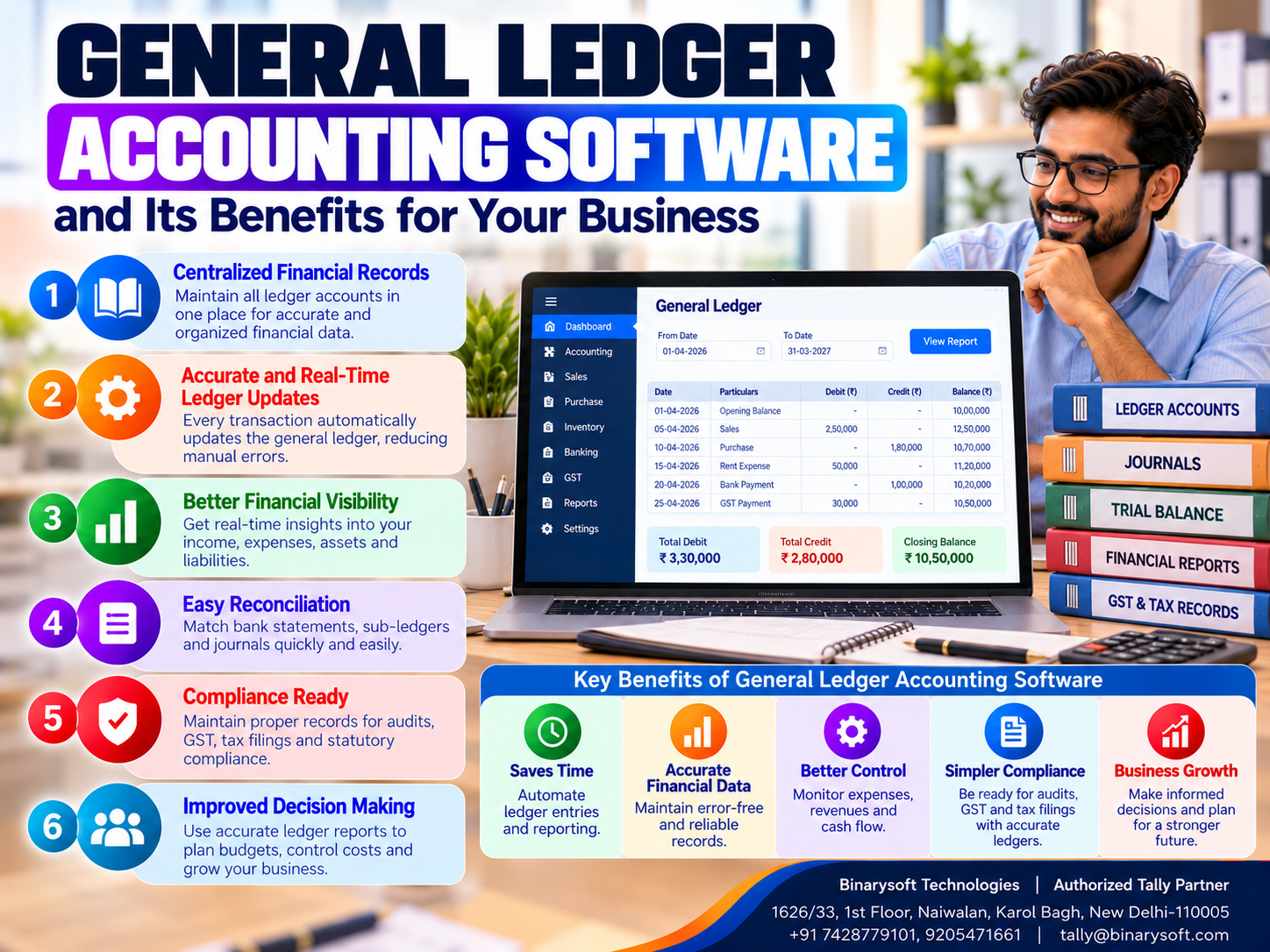
General ledger accounting software helps businesses organize these financial activities within a structured accounting system.
The general ledger is the central record of financial transactions classified into individual accounts.
It forms the foundation for preparing important reports such as the trial balance, profit and loss statement and balance sheet.
Modern accounting software makes general ledger management more efficient by supporting double-entry bookkeeping, transaction classification, account balances and financial reporting.
For Indian small and medium enterprises, Tally Prime provides useful general ledger accounting capabilities alongside invoicing, inventory management, banking and other business functions.
This article explains the meaning, structure, features, advantages and practical applications of general ledger accounting software.
It also explores how Tally Prime can help businesses maintain organized financial records and make better decisions.
A Business Owner's Story: The Missing Entry That Changed Everything
Deepak operated a wholesale electrical equipment business in Karol Bagh, New Delhi.
His father had established the company more than twenty years earlier.
The business began with a small shop selling electrical accessories to local contractors.
Over time, Deepak expanded operations.
He started supplying electrical products to retailers, commercial contractors and industrial customers across Delhi NCR.
Sales were increasing.
The warehouse was busy.
Employees were processing more transactions than ever before.
Deepak believed the business was performing well.
However, one evening, his accountant approached him with an unexpected problem.
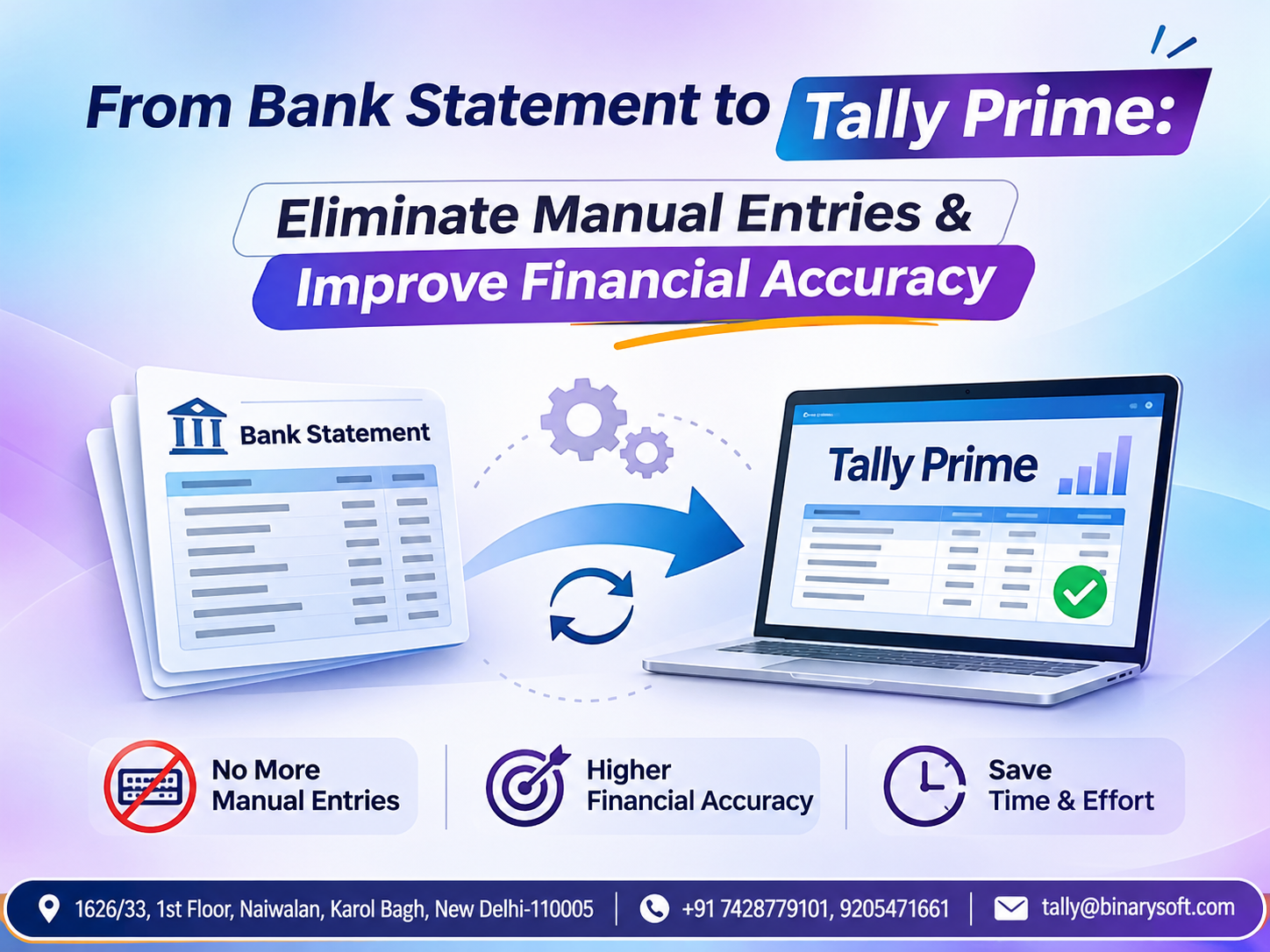
The bank balance in the accounting records did not match the bank statement.
Several customer payments had been received, but some entries were recorded against incorrect ledgers.
A supplier invoice had also been entered twice.
The accountant needed additional time to reconcile the records.
Deepak felt worried.
He had promised an important supplier that payment would be released the following morning.
Without reliable financial information, he could not confidently determine how much money was available.
He remembered his father's advice:
"A business owner should always know where the money comes from and where it goes."
Deepak realized that the company had become dependent on scattered financial records.
He decided to improve its accounting procedures.
The business introduced structured ledger classifications, regular bank reconciliation and consistent voucher recording using Tally Prime.
Employees received training in selecting the correct ledgers and reviewing transactions.
The accounts team began checking balances regularly instead of waiting until month-end.
Over time, financial information became easier to verify.
Deepak could review customer balances, supplier obligations and expenses with greater confidence.
The experience taught him that accounting accuracy was not simply an administrative requirement.
It was essential for protecting the business.
A growing business needs more than increasing sales. It needs financial records that owners can trust when important decisions must be made.
This is an illustrative story created to explain common accounting challenges.
What Is a General Ledger?
A general ledger, commonly called a GL, is the central accounting record containing transactions classified under individual accounts.
It organizes financial information into categories such as assets, liabilities, capital, income and expenses.
Every financial transaction affects one or more ledger accounts.
Under double-entry accounting, each transaction is recorded with corresponding debit and credit effects.
For example, when a business purchases office furniture for cash, the furniture account is debited and the cash account is credited.
This maintains the fundamental accounting equation:
Assets = Liabilities + Equity
The general ledger provides the information needed to prepare financial statements.
It also allows accountants to review account balances and investigate transactions.
What Is General Ledger Accounting Software?
General ledger accounting software is a digital application designed to record, classify, organize and report financial transactions.
It helps businesses maintain accounting records without depending entirely on handwritten books.
Modern accounting software supports ledger creation, voucher recording, debit and credit accounting, transaction searches and financial reporting.
Many applications also integrate general ledger accounting with invoicing, inventory, taxation and banking.
Tally Prime provides these capabilities through its accounting and business management environment.
How General Ledger Accounting Works
The general ledger operates through a systematic accounting process.
Step 1: Identify the Transaction
The business identifies a financial event, such as a sale, purchase, receipt or payment.
Step 2: Determine the Accounts
The accountant identifies the relevant ledger accounts.
Step 3: Apply Debit and Credit Rules
The transaction is recorded using the appropriate double-entry treatment.
Step 4: Post the Transaction
The accounting entry affects the relevant ledger balances.
Step 5: Review Account Balances
Accountants verify transactions and investigate discrepancies.
Step 6: Prepare the Trial Balance
The trial balance summarizes ledger balances for review.
Step 7: Generate Financial Statements
The recorded information supports preparation of financial reports.
Example of General Ledger Accounting
Suppose a business purchases office equipment worth ₹50,000 through its bank account.
The accounting entry is:
Office Equipment Account Dr. ₹50,000
To Bank Account ₹50,000
The office equipment asset increases, while the bank balance decreases.
Now suppose the business receives ₹80,000 from a customer against an existing outstanding invoice.
The entry is:
Bank Account Dr. ₹80,000
To Customer Account ₹80,000
The bank balance increases, while the customer receivable decreases.
These transactions demonstrate how general ledger accounting maintains financial relationships.
Structure of a General Ledger
A general ledger generally contains five major account categories.
1. Assets
Assets represent resources controlled by a business.
Examples include cash, bank balances, inventory, machinery, furniture and receivables.
2. Liabilities
Liabilities represent financial obligations.
Examples include supplier payables, loans and outstanding expenses.
3. Equity
Equity represents the owners' residual interest in the business.
It includes relevant capital and accumulated earnings.
4. Income
Income accounts record revenue and other applicable earnings.
Examples include sales revenue, service income and interest income.
5. Expenses
Expense accounts record costs incurred in operating the business.
Examples include salaries, rent, electricity, transportation and repairs.
Proper classification is essential for reliable reporting.
12 Important Features of General Ledger Accounting Software
1. Automated Double-Entry Accounting
Double-entry accounting is the foundation of modern bookkeeping.
General ledger software helps maintain corresponding debit and credit effects through appropriate transaction recording.
How Tally Prime Helps
Tally Prime supports double-entry accounting through its voucher-based system.
Relevant ledger balances are updated when transactions are recorded.
Business Benefit
Structured double-entry accounting supports consistency and reduces the need for manual ledger posting.
However, incorrect transaction selection can still create accounting errors.
2. Ledger Creation and Management
Businesses require separate accounts for customers, suppliers, expenses, assets and liabilities.
General ledger software allows accountants to create and maintain these accounts.
Tally Prime Application
Tally Prime supports ledger creation under appropriate accounting groups.
Businesses can maintain customer, supplier, expense and other ledgers.
Business Benefit
Organized ledger structures make financial information easier to review.
3. Voucher-Based Transaction Recording
Businesses perform different types of financial transactions.
Accounting software provides relevant transaction-entry methods.
Common Voucher Types
Sales vouchers record sales transactions.
Purchase vouchers record purchases.
Receipt vouchers record money received.
Payment vouchers record outgoing payments.
Journal vouchers support applicable accounting adjustments.
Contra vouchers support relevant cash and bank transfers.
Business Benefit
Voucher-based recording helps employees maintain consistent accounting procedures.
4. Trial Balance Generation
A trial balance summarizes ledger balances at a particular date.
It helps accountants verify whether total debit balances equal total credit balances.
Tally Prime Application
Tally Prime provides trial balance reporting based on recorded transactions.
Important Consideration
A balanced trial balance does not guarantee that every transaction is correct.
Errors involving wrong accounts, omissions or incorrect classifications may remain undetected.
5. Profit and Loss Reporting
Businesses need to understand whether they are generating profits.
The profit and loss statement summarizes relevant income and expenses over a selected period.
Business Benefit
Management can review revenue, expenses and profitability.
Tally Prime Application
Tally Prime generates profit and loss reports using recorded accounting information.
6. Balance Sheet Preparation
A balance sheet presents the financial position of a business at a specific date.
It includes assets, liabilities and equity.
Business Benefit
Business owners can review financial obligations, resources and capital.
Tally Prime Application
Tally Prime provides balance sheet reporting based on accounting records.
7. Bank Reconciliation
Businesses must compare bank transactions recorded in accounting software with bank statements.
Differences may arise from timing, missing entries or incorrect records.
Tally Prime Application
Tally Prime provides banking and reconciliation capabilities.
Supported releases may offer enhanced reconciliation features.
Business Benefit
Regular reconciliation helps identify discrepancies and supports more reliable bank balances.
8. Accounts Receivable and Payable Integration
General ledger accounting is closely connected with customer and supplier balances.
Accounts Receivable
Businesses monitor money owed by customers.
Accounts Payable
Organizations track amounts payable to suppliers.
Tally Prime Features
Bill-wise accounting and outstanding reports help maintain relevant receivable and payable information.
Business Benefit
Better outstanding management supports cash flow planning.
9. Cost Centre Accounting
Some businesses need to track expenses by department, project or business unit.
Cost centres support this requirement.
Tally Prime Application
Businesses can configure cost centres for relevant financial analysis.
For example, a company may allocate expenses to sales, administration and production departments.
Business Benefit
Cost centre reports can help management investigate expenditure patterns.
10. GST and Tax-Related Accounting
Indian businesses must maintain appropriate tax records.
General ledger software can support tax-related transaction classifications.
Tally Prime Application
Tally Prime provides GST-related accounting and relevant TDS capabilities.
Important Consideration
Correct tax treatment depends on applicable law and transaction details.
Businesses should verify specialized tax matters with qualified professionals.
11. Security and User Access
Financial information contains sensitive business details.
Accounting software should provide appropriate access controls.
Tally Prime Features
Tally Prime supports relevant user security settings.
TallyVault provides encryption-related protection.
Applicable editions and configurations offer Edit Log capabilities.
Business Benefit
Security controls can help protect records and support employee accountability.
12. Financial Reporting and Analysis
General ledger software allows businesses to review accounting information across different periods.
Common Reports
Ledger statements
Trial balance
Profit and loss statement
Balance sheet
Cash and bank summaries
Outstanding reports
Cost centre reports
Business Benefit
Regular financial reporting supports better management decisions.
Major Benefits of General Ledger Accounting Software
Improved Accounting Accuracy
Structured transaction recording can reduce some manual bookkeeping errors.
Faster Financial Reporting
Reports can be generated using recorded accounting information.
Better Expense Monitoring
Businesses can review expenses through relevant ledger accounts.
Improved Cash Flow Visibility
Bank balances and outstanding reports support financial planning.
Easier Financial Reconciliation
Accountants can investigate differences between recorded transactions and external statements.
Better Management Decisions
Reliable financial information supports pricing, budgeting and investment decisions.
Reduced Administrative Work
Digital ledger management can reduce repetitive manual posting.
Improved Financial Transparency
Organized records make it easier to review transactions.
Support for Business Growth
Structured accounting procedures can help organizations manage increasing transaction volumes.
Better Audit Preparation
Properly maintained ledgers and supporting records can make financial review more efficient.
General Ledger vs Journal: Understanding the Difference
A journal records accounting transactions in chronological order.
A general ledger organizes transactions by account.
| Basis | Journal | General Ledger |
|---|
| Primary purpose |
Initial transaction recording |
Account-wise classification |
| Organization |
Chronological |
Ledger account |
| Main information |
Transaction details |
Account activity and balances |
| Accounting role |
Records entries |
Supports account summaries |
| Reporting use |
Transaction verification |
Financial statement preparation |
In modern accounting software, the relationship between journals and ledgers is managed through integrated transaction processing.
General Ledger vs Trial Balance
A general ledger contains detailed account transactions.
A trial balance summarizes account balances.
The general ledger helps accountants investigate individual transactions.
The trial balance helps review debit and credit balances.
Both are important components of the accounting process.
How Tally Prime Helps Businesses Manage General Ledger Accounting
Tally Prime provides a structured environment for maintaining accounting records.
Ledger Management
Businesses can create and organize ledgers under relevant accounting groups.
Voucher Recording
Sales, purchases, payments, receipts and journal transactions can be recorded through suitable vouchers.
Financial Reporting
Profit and loss statements, balance sheets and trial balances can be generated from recorded data.
Banking
Relevant bank reconciliation features support transaction verification.
Outstanding Management
Bill-wise accounting helps monitor customer and supplier balances.
Cost Centre Reporting
Businesses can allocate selected expenses to departments or projects.
Inventory Integration
Where inventory accounting is configured, relevant stock transactions can be reflected in accounting and inventory records.
Security
Appropriate user access controls can help protect financial information.
Important Limitation
General ledger software does not automatically guarantee accurate financial statements.
Correct accounting treatment, reconciliations, adjustments and professional review remain necessary.
Case Study 1: General Ledger Accounting for a Wholesale Distributor in Sadar Bazar
Business Type: Wholesale distribution
Location: Sadar Bazar, New Delhi
Primary Challenges: Incorrect ledger classifications, delayed reconciliation and inconsistent financial reporting.
Business Background
Consider a wholesale distributor supplying household products to retailers.
The company processes numerous sales and purchase transactions every day.
Employees maintain some records in spreadsheets and others in accounting software.
Management frequently experiences delays in obtaining reliable reports.
Implementation Strategy
The business standardizes its ledger structure.
Customer and supplier accounts are reviewed.
Expense ledgers are classified appropriately.
Employees receive training in voucher recording.
Tally Prime is used for relevant accounting and reporting requirements.
Illustrative Outcomes
Accounting records become more organized.
Ledger balances are easier to verify.
Financial reporting becomes more consistent.
Management can review customer and supplier information more efficiently.
Key Learning
Accurate ledger classification and regular reconciliation are essential for dependable financial reporting.
This is an illustrative case study, not a verified customer implementation.
Case Study 2: General Ledger Management for a Manufacturing SME in Faridabad
Business Type: Industrial components manufacturing
Location: Faridabad, Haryana
Primary Challenges: Expense classification, bank reconciliation and delayed financial analysis.
Business Background
Consider a manufacturing company producing industrial components.
The organization maintains several expense accounts but does not consistently classify production and administrative expenditure.
Management struggles to analyze operating costs.
Implementation Strategy
The company reviews its accounting structure.
Relevant expense ledgers are established.
Cost centres are introduced where appropriate.
Bank reconciliation procedures are standardized.
Employees receive training in accounting entries and report verification.
Illustrative Outcomes
Expense information becomes easier to analyze.
Financial records become more consistent.
Management gains better visibility into operating expenditure.
Monthly reporting requires less manual consolidation.
Key Learning
General ledger accuracy is important for both financial reporting and operational cost analysis.
This is an illustrative case study, not a verified customer implementation.
How to Set Up General Ledger Accounting in Tally Prime
Step 1: Create the Company
Enter appropriate business details and configure relevant accounting features.
Step 2: Review Accounting Groups
Understand the available groups and their financial reporting implications.
Step 3: Create Ledgers
Create relevant customer, supplier, asset, liability, income and expense accounts.
Step 4: Configure Opening Balances
Enter verified opening balances where applicable.
Step 5: Enable Relevant Features
Configure bill-wise accounting, cost centres, taxation and inventory features according to requirements.
Step 6: Record Transactions
Use appropriate vouchers for daily financial activities.
Step 7: Review Ledger Statements
Check transaction classifications and balances regularly.
Step 8: Reconcile Bank Accounts
Compare accounting records with bank statements.
Step 9: Review the Trial Balance
Investigate unusual or incorrect balances.
Step 10: Generate Financial Reports
Prepare and review relevant financial statements.
Common General Ledger Accounting Mistakes
Incorrect Ledger Classification
Recording transactions under inappropriate accounts can distort reports.
Duplicate Transactions
Entering the same invoice twice may overstate balances.
Missing Entries
Unrecorded transactions can create inaccurate financial information.
Incorrect Opening Balances
Wrong opening figures affect subsequent reports.
Delayed Bank Reconciliation
Unreconciled bank accounts may contain unidentified differences.
Improper Journal Adjustments
Incorrect adjustments can affect assets, liabilities, income and expenses.
Ignoring Supporting Documents
Accounting entries should be supported by relevant records.
Inadequate Employee Training
Employees need to understand basic accounting principles and software procedures.
Best Practices for Accurate General Ledger Management
Businesses should establish clear accounting procedures.
Ledger names and classifications should follow a consistent structure.
Employees should use appropriate voucher types.
Customer and supplier balances should be reviewed regularly.
Bank reconciliation should be performed at suitable intervals.
Significant journal adjustments should be verified.
Financial statements should be reviewed for unusual balances.
Relevant records should be backed up securely.
Access permissions should reflect employee responsibilities.
These practices help improve accounting reliability.
How General Ledger Software Supports Business Decisions
General ledger information supports several important management activities.
Expense Control
Businesses can identify increasing operating expenses.
Profitability Analysis
Financial reports help management understand overall profitability.
Cash Flow Planning
Bank and outstanding information supports payment planning.
Budget Preparation
Historical expenses provide useful information for future budgets.
Business Expansion
Financial statements can support decisions about additional investment.
Supplier Management
Payable balances help organizations plan supplier payments.
Customer Credit Control
Receivable information helps management monitor outstanding customer amounts.
Choosing the Right General Ledger Accounting Software
Businesses should evaluate software according to their accounting requirements.
Important considerations include:
-
Double-entry accounting support
-
Ledger management capabilities
-
Voucher recording
-
Financial reporting
-
Bank reconciliation
-
Accounts receivable and payable
-
GST-related accounting
-
Inventory integration
-
Cost centre reporting
-
Data security
-
Backup procedures
-
Ease of use
-
Scalability
-
Implementation support
-
Total cost of ownership
Businesses should test realistic transactions before selecting software.
Future of General Ledger Accounting Software in India
Digital accounting systems are making financial records easier to maintain and review.
Connected banking features can support more efficient reconciliation.
Cloud infrastructure may help authorized employees access accounting systems from different locations.
Advanced analytics and AI-assisted tools may support selected accounting workflows through compatible applications.
However, these capabilities vary between products.
Businesses should not assume that every accounting application provides advanced automation.
The most important requirement remains accurate financial data.
Reliable ledger management depends on correct transaction recording, regular reconciliation and consistent accounting procedures.
Conclusion
General ledger accounting software plays an essential role in modern business financial management.
It helps organizations record transactions, classify accounts, maintain balances and prepare financial reports.
For retailers, wholesalers, manufacturers and service providers, accurate general ledger information supports financial control and better decision-making.
Tally Prime provides useful capabilities for ledger management, voucher recording, banking, outstanding tracking, cost centres and financial reporting.
However, software must be supported by proper accounting procedures and employee training.
Businesses should regularly review ledger balances, reconcile transactions and verify financial reports.
By maintaining structured accounting records, organizations can reduce avoidable errors and improve financial visibility.
A successful business is not measured only by the money it earns, but also by how accurately it records, manages and understands that money.
Powered by Binarysoft Technologies
Authorized Tally Partner
Location: 1626/33, 1st Floor, Naiwalan, Karol Bagh, New Delhi – 110005, INDIA
Contact: +91 7428779101, 9205471661
Email: tally@binarysoft.com
Business Hours: 10:00 AM – 6:00 PM, Monday to Friday
Frequently Asked Questions
What is general ledger accounting software?
General ledger accounting software helps businesses record, classify and report financial transactions through structured ledger accounts.
What are the main features of general ledger software?
Important features include ledger management, voucher recording, double-entry accounting, trial balance generation and financial reporting.
How can Binarysoft Technologies help with Tally Prime general ledger accounting?
Binarysoft Technologies, an Authorized Tally Partner, can assist businesses with Tally Prime ledger configuration, accounting setup, financial reporting, bank reconciliation procedures, employee training and implementation support.
Can Tally Prime track customer outstanding balances?
Yes. Bill-wise accounting and outstanding reports help businesses review unpaid customer invoices.
CA. Lakshy Vermaa advises small and mid-sized businesses on accounting discipline, tax compliance, and process improvement. With exposure to retail and trading environments, he writes practical articles aimed at helping business owners gain better financial visibility and control.