Call CA Tally HelpDesk
+91 9205471661,
7428779101
Introduction: Why Affordable Business Management Software Matters in 2026
Running a small business in India requires more than selling products or providing services.
Business owners must manage accounting records, customer invoices, supplier payments, inventory, GST-related transactions, employee responsibilities and financial reporting.
For many startups and MSMEs, managing these activities manually becomes increasingly difficult as business operations expand.
A retailer may struggle to maintain accurate stock information. A wholesaler may face delays in customer payment collections. A manufacturer may find it challenging to monitor material purchases and production-related expenses.
These challenges often create unnecessary administrative work and financial uncertainty.
However, small businesses may hesitate to invest in expensive enterprise software.
They need solutions that provide essential functionality without creating excessive licensing, implementation or maintenance expenses.
This is where affordable business management software becomes important.
A suitable application can help businesses organize financial records, improve billing accuracy, monitor inventory and make informed decisions.
Tally Prime is one option Indian businesses can evaluate for accounting, invoicing, inventory management and GST-related requirements.
This guide explains how to choose cost-effective business software, which features matter most and how to avoid unnecessary technology expenses.
A Small Business Owner's Story: When Every Rupee Mattered
Deepak owned a small electrical accessories shop in Karol Bagh, New Delhi.
His father had started the business more than twenty years earlier.
After completing his education, Deepak joined the family business with a dream of expanding it into a successful wholesale operation.
However, managing daily transactions was becoming increasingly difficult.
Customer invoices were prepared manually. Supplier balances were maintained in notebooks, and inventory records were updated using spreadsheets.
During busy periods, employees sometimes forgot to update stock information.
Deepak frequently spent evenings checking invoices and calculating outstanding payments.
One month, he discovered that several customers had delayed payments while supplier bills were approaching their due dates.
He knew the business was generating sales, but he could not clearly understand its available cash position.
His family depended on the shop's income.
The uncertainty made him anxious about paying suppliers, meeting household expenses and investing in additional stock.
Deepak considered purchasing business management software but worried about the cost.
He believed that professional accounting systems were designed only for large companies.
After discussing his requirements with an accounting software specialist, he realized that he did not need an expensive enterprise platform.
He needed a practical system that could manage invoices, accounting records, stock information and customer outstanding balances.
He introduced a structured accounting process and trained his employees to record transactions consistently.
Gradually, financial information became easier to review.
Instead of spending hours reconciling notebooks, Deepak could focus more attention on customers and business development.
His experience demonstrates an important lesson:
Affordable business software is not necessarily the cheapest application available. It is the solution that provides the right capabilities at a sustainable cost.
1. What Is Business Management Software?
Business management software is a digital application designed to help organizations manage routine operational and administrative activities.
Depending on the product, it may provide accounting, invoicing, inventory management, customer records, purchasing, reporting and other business functions.
Some applications focus primarily on accounting.
Others provide broader enterprise resource planning capabilities.
Common Business Management Activities
Small businesses generally need to manage:
-
Sales invoices and customer billing.
-
Purchase transactions.
-
Accounting ledgers.
-
Customer outstanding balances.
-
Supplier payments.
-
Inventory quantities.
-
GST-related records.
-
Cash and bank transactions.
-
Financial reports.
-
Business expenses.
A suitable software solution helps businesses organize these activities using consistent records.
However, not every product includes every function.
Businesses should evaluate the actual capabilities of each application before purchasing.
2. Why Small Businesses Need Affordable Management Software
Limited Technology Budgets
Small businesses must carefully manage expenses.
Investing heavily in software can create financial pressure, particularly during the early stages of business development.
Affordable solutions help organizations adopt digital processes without committing to unnecessary functionality.
Increasing Transaction Volumes
As sales increase, manual recordkeeping becomes difficult.
Digital accounting systems can simplify transaction recording and reporting.
Need for Accurate Financial Information
Business owners require reliable information about income, expenses, receivables and liabilities.
Inventory Challenges
Retailers, wholesalers and distributors need visibility into stock availability and movement.
GST-Related Requirements
Indian businesses must maintain appropriate transaction records and comply with applicable tax obligations.
Business Expansion
As organizations grow, they may need additional users, locations or reporting capabilities.
Software should support reasonable expansion without requiring frequent replacement.
3. Important Features of Affordable Business Management Software
Accounting Management
Accounting is one of the most important business functions.
A suitable application should help businesses record financial transactions and maintain organized ledgers.
Sales and Purchase Management
Businesses need to record sales invoices, purchase bills, returns and relevant adjustments.
GST Billing
Software should support applicable GST invoice information and relevant tax calculations.
Businesses must still verify classifications, rates and compliance requirements.
Inventory Management
Inventory features help organizations maintain stock records and review available quantities.
Customer Outstanding Management
Businesses should be able to review customer balances and identify overdue amounts.
Supplier Payment Tracking
Payable reports help management understand outstanding obligations.
Financial Reporting
Important reports may include the Balance Sheet, Profit and Loss Account and other accounting summaries.
User Security
Suitable access controls help restrict sensitive information to authorized employees.
Data Backup
Reliable backup and recovery procedures are essential for protecting business information.
Ease of Use
Employees should be able to learn routine operations without excessive technical training.
4. Affordable Business Management Software vs Manual Accounting
| Business Activity | Manual Management | Software-Based Management |
|---|
| Sales Invoices |
Handwritten or spreadsheet-based |
Digital invoice preparation |
| Purchase Records |
Separate registers |
Organized purchase entries |
| Customer Balances |
Manual calculations |
Outstanding reports |
| Inventory |
Physical stock registers |
Digital stock records |
| Financial Statements |
Manual consolidation |
Reports based on recorded transactions |
| GST Records |
Separate calculations |
Supported tax-related records |
| Data Backup |
Physical document storage |
Digital backup procedures |
| Business Analysis |
Time-consuming review |
Faster access to financial information |
Software does not eliminate the need for accurate data entry, reconciliation or internal controls.
Its value depends on correct implementation and consistent usage.
5. How Tally Prime Helps Small Businesses Manage Operations
Tally Prime provides accounting and business management capabilities suitable for many Indian trading, retail, wholesale and service businesses.
Accounting and Bookkeeping
Businesses can maintain accounting ledgers and record receipts, payments, sales, purchases and other financial transactions.
GST-Related Accounting
Tally Prime supports GST-related transaction recording and reporting features.
Businesses should ensure that tax settings reflect applicable requirements.
Inventory Management
Stock groups, stock items, units of measurement and relevant inventory features help businesses maintain organized stock records.
Sales and Purchase Invoicing
Businesses can record sales and purchase transactions using supported voucher and invoice functionality.
Outstanding Management
Customer and supplier outstanding reports help businesses review receivables and payables.
Banking and Financial Records
Relevant banking and accounting features support the recording and reconciliation of financial transactions.
Business Reports
Financial reports help owners understand business performance.
Multi-User Operations
Suitable licensing arrangements support businesses requiring multiple authorized users.
Important: Businesses should evaluate the applicable Tally Prime edition, licensing terms and feature availability before purchasing.
6. How to Choose Low-Cost Business Management Software
Choosing software based only on its initial price can lead to unexpected expenses.
A better approach is to evaluate functionality and long-term value.
Step 1: Identify Essential Requirements
Prepare a list of activities that the software must support.
For example, a small retailer may prioritize billing, inventory and accounting.
Step 2: Establish a Realistic Budget
Consider the total amount the business can spend on software, implementation and support.
Step 3: Compare Available Features
Evaluate whether each application provides the required functionality.
Step 4: Review Implementation Requirements
Some applications require extensive configuration or data migration.
Step 5: Evaluate Employee Training
Choose software that employees can use effectively.
Step 6: Consider Future Growth
Review whether the solution can accommodate additional users and business activities.
Step 7: Verify Support Availability
Reliable technical assistance can reduce operational disruption.
Step 8: Calculate Total Cost of Ownership
Include licensing, training, maintenance, infrastructure and additional services.
7. Understanding the Real Cost of Business Management Software
The cost of business software extends beyond the initial purchase.
Software Licensing
Some applications use subscription pricing, while others offer different licensing arrangements.
Implementation Charges
Businesses may require professional assistance with installation and configuration.
Data Migration
Transferring records from existing software may involve additional work.
Employee Training
Training helps employees understand transaction procedures.
Customization
Specialized requirements may involve additional development expenses.
Hosting Infrastructure
Cloud-hosted or server-based environments may create recurring infrastructure costs.
Technical Support
Support arrangements should be reviewed before implementation.
Maintenance and Upgrades
Businesses should understand the costs and conditions associated with ongoing software maintenance.
The most affordable option is the one that provides the required functionality at a manageable total cost.
8. Low-Cost Software vs Free Business Management Software
Free applications may appear attractive to startups.
However, businesses should evaluate their limitations carefully.
Some free products provide only basic invoicing or bookkeeping features.
Others may restrict users, transaction volumes, reporting capabilities or support.
Potential Benefits of Free Software
Free applications may be suitable for businesses with very limited requirements.
They can also help entrepreneurs become familiar with digital recordkeeping.
Potential Limitations
Businesses may encounter restricted functionality, limited support, integration difficulties or unexpected charges for additional features.
Advantages of Paid Software
Paid applications may offer broader functionality, professional support and more suitable options for growing organizations.
However, higher prices do not automatically guarantee better software.
Businesses should compare actual capabilities rather than relying on pricing alone.
9. Affordable Business Software for Retail Shops
Retail businesses require efficient billing and inventory management.
Common challenges include frequent customer transactions, stock shortages and maintaining accurate purchase records.
Tally Prime can help retailers organize accounting, invoicing and inventory information.
Businesses can maintain stock items, record purchases and review relevant sales reports.
Retailers requiring advanced point-of-sale hardware integration, loyalty programs or specialized checkout workflows should verify whether additional compatible solutions are needed.
10. Affordable Business Software for Wholesale Traders
Wholesale businesses often manage large inventories, multiple suppliers and customer credit transactions.
Their software requirements may include purchase accounting, stock management, invoicing and outstanding tracking.
Tally Prime provides relevant accounting and inventory features that can support these activities.
For wholesalers, the ability to review receivables and payables is particularly valuable.
Better financial visibility helps management plan collections and supplier payments.
11. Affordable Business Software for Manufacturers
Manufacturing businesses must manage raw materials, finished goods, purchases and production-related expenses.
Their requirements can be more complex than those of trading businesses.
Tally Prime provides inventory and accounting features that may support suitable manufacturing-related processes.
However, advanced production scheduling, shop-floor monitoring and complex manufacturing resource planning may require specialized software.
Businesses should evaluate their production requirements before selecting an application.
12. Affordable Business Software for Service Companies
Service organizations often prioritize customer billing, expense management and financial reporting.
Examples include consulting firms, professional service providers, maintenance companies and agencies.
Tally Prime can support relevant accounting and invoicing requirements.
Businesses requiring detailed appointment scheduling, project collaboration or specialized service management may need additional applications.
The objective should be to choose software according to operational requirements.
13. Case Study One: Affordable Accounting Software for a Retail Business
Business: Illustrative electrical accessories retailer, Karol Bagh, New Delhi
Business Challenge
A small retail shop maintained accounting records in notebooks and spreadsheets.
The owner experienced difficulties tracking customer balances and stock availability.
Purchasing expensive enterprise software was not financially practical.
Solution
The business evaluated its essential requirements and selected a suitable accounting and inventory solution.
The implementation focused on ledger creation, stock masters, invoice preparation and employee training.
Unnecessary customization was avoided.
Business Benefits
The company established more consistent accounting procedures.
Employees could review stock records and customer balances more efficiently.
Management gained better visibility into financial information.
Key Learning
Small businesses can improve operations by implementing essential software features without investing in unnecessary complexity.
This is an illustrative case study.
14. Case Study Two: Cost-Effective Business Management for a Wholesale Distributor
Business: Illustrative hardware distributor, Sadar Bazar, Delhi
Business Challenge
A wholesale distributor managed hundreds of products and numerous customer transactions.
The accounting team used separate spreadsheets for inventory and outstanding payments.
Management wanted better financial control without introducing an expensive enterprise platform.
Solution
The company implemented Tally Prime for relevant accounting and inventory activities.
Customer and supplier ledgers were organized.
Stock records were standardized, and employees received training on transaction entry and reporting.
Business Benefits
The distributor gained clearer information about customer balances and inventory records.
Accounting procedures became more consistent.
The business also reduced dependence on disconnected spreadsheets.
Key Learning
Choosing software according to actual business requirements can improve financial management while controlling implementation expenses.
This is an illustrative case study.
15. How Affordable Business Software Improves Cash Flow
Cash flow is one of the most important concerns for small businesses.
A company may generate sales but still experience financial pressure when customer payments are delayed.
Customer Outstanding Reports
Businesses can review unpaid customer balances.
Supplier Payable Information
Management can identify upcoming payment obligations.
Expense Monitoring
Organized accounting records help businesses understand regular expenditure.
Bank and Cash Records
Accurate financial entries support better visibility into available funds.
Financial Planning
Business owners can use accounting information to prepare cash flow estimates.
Tally Prime supports relevant accounting and outstanding reports, although advanced forecasting may require additional financial planning tools.
16. How Business Software Helps Reduce Administrative Work
Manual recordkeeping often requires repeated calculations and reconciliation.
Digital software can simplify routine accounting processes.
For example, a sales transaction recorded correctly in an integrated accounting and inventory environment can contribute to relevant financial and stock records.
This reduces the need to maintain disconnected registers.
However, automation depends on correct configuration and accurate transaction entry.
Businesses should also establish review procedures to detect errors.
The objective is not to eliminate human supervision but to make routine operations more efficient.
17. Cloud-Hosted Business Software for Small Companies
Cloud-hosted environments can be useful for businesses requiring remote access.
For example, a business owner may need to review accounting information while travelling.
A company with multiple offices may require access from different locations.
Compatible Tally Prime cloud-hosting arrangements can support remote access to the accounting environment.
Potential Benefits
Cloud hosting may reduce dependence on a single office workstation and improve accessibility.
Important Considerations
Businesses should evaluate hosting charges, internet reliability, security, backups and licensing requirements.
Cloud hosting is not automatically the cheapest option.
Organizations should compare the total cost of cloud and local deployment before deciding.
18. Common Mistakes When Choosing Affordable Business Software
Selecting Software Only Because It Is Cheap
A low purchase price does not guarantee suitable functionality.
Ignoring Essential Features
Businesses should verify accounting, billing and inventory requirements before purchasing.
Underestimating Training Costs
Employees may require time and assistance to learn the application.
Purchasing Unnecessary Modules
Additional features can increase costs without providing meaningful value.
Ignoring Data Migration
Transferring existing accounting information may require planning and professional support.
Overlooking Backup Requirements
Reliable backup and recovery procedures are essential.
Failing to Review Scalability
Software should support reasonable future expansion.
Ignoring Technical Support
Poor support can create unnecessary downtime and frustration.
19. How to Calculate the Return on Investment of Business Software
Return on investment helps businesses evaluate whether software expenditure is justified.
A basic calculation is:
ROI (%) = [(Financial Benefits − Total Software Costs) ÷ Total Software Costs] × 100
Financial benefits may include measurable labour savings, reduced errors and lower administrative expenses.
For example, suppose a business spends ₹30,000 on software-related costs during a defined period.
If the business identifies ₹45,000 in measurable benefits during the same period:
ROI = [(₹45,000 − ₹30,000) ÷ ₹30,000] × 100
ROI = 50%
This is an illustrative calculation, not an estimate of Tally Prime pricing or guaranteed business results.
Businesses should use actual costs and documented benefits when calculating ROI.
20. Best Practices for Implementing Low-Cost Business Software
A successful implementation begins with clear requirements.
Businesses should first identify their most important accounting and operational problems.
Next, they should select software that addresses those requirements.
Existing records should be reviewed before migration.
Accounting masters, stock items and opening balances must be verified.
Employees should receive training before regular operations begin.
Management should test invoices, purchases, payments and reports.
Finally, the business should monitor software usage and review whether the expected benefits are being achieved.
A structured implementation can help organizations obtain greater value from their software investment.
21. Future of Affordable Business Management Software in India
Indian MSMEs are increasingly adopting digital tools to manage accounting and business operations.
Demand for convenient billing, reliable financial reporting, inventory visibility and remote access continues to influence software development.
Businesses are also exploring integrations and automation to reduce repetitive administrative work.
However, advanced technology is valuable only when it addresses genuine operational requirements.
Small businesses should prioritize accurate accounting, reliable data and employee adoption before investing in complex functionality.
Affordable software solutions will remain important for organizations seeking sustainable digital growth.
Conclusion
Affordable business management software helps small businesses improve accounting accuracy, organize inventory, manage customer payments and strengthen financial visibility.
However, affordability should not be measured only by the initial purchase price.
Businesses must consider software functionality, implementation expenses, employee training, technical support and long-term maintenance.
For Indian retailers, wholesalers, service providers and suitable manufacturing businesses, Tally Prime offers accounting, invoicing, inventory and GST-related capabilities worth evaluating.
The right solution should match current business requirements while providing room for future expansion.
A small business does not need the most expensive software to operate professionally. It needs reliable technology that solves real problems, protects financial information and delivers sustainable value.
Featured Image and Short Description
Featured Image Title: Affordable Business Management Software for Small Businesses in India 2026
Suggested Image Size: 800 × 600 pixels
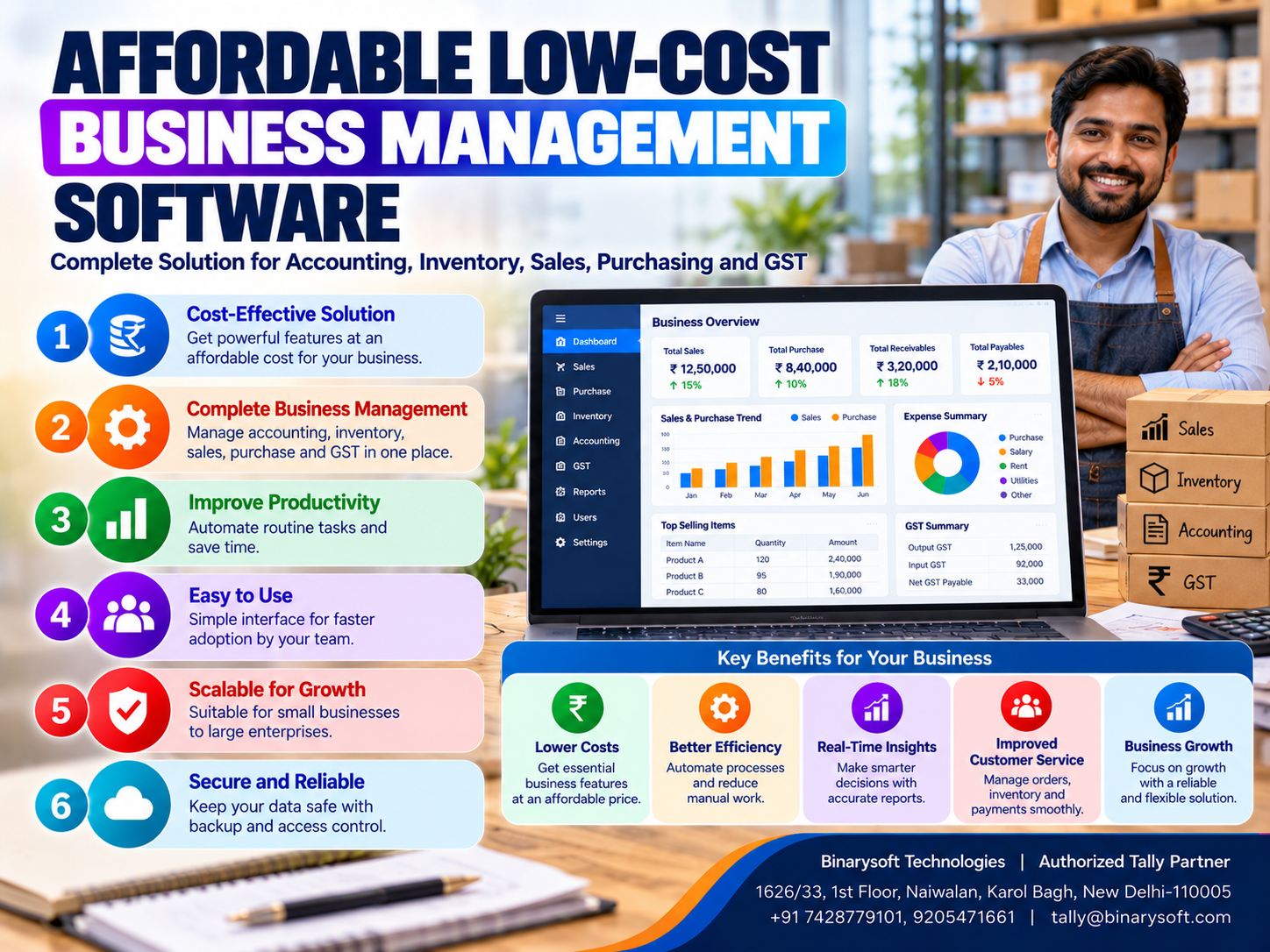
Image Description: Professional business management software infographic featuring a small business owner, accounting dashboard, GST invoices, inventory records, financial reports and cost-effective digital solutions.
Image Alt Text: Affordable business management software for Indian small businesses showing accounting, GST billing, inventory management and financial reporting.
Short Description
Discover affordable business management software for Indian startups and MSMEs. Learn how Tally Prime supports accounting, GST invoicing, inventory tracking, customer outstanding management and financial reporting while helping businesses control technology expenses and improve operational efficiency.
Powered by Binarysoft Technologies
Authorized Tally Partner
Location: 1626/33, 1st Floor, Naiwalan, Karol Bagh, New Delhi – 110005, INDIA
Contact Us: +91 7428779101, 9205471661
Email: tally@binarysoft.com
Business Hours: 10:00 AM – 6:00 PM, Monday to Friday
Frequently Asked Questions
What is affordable business management software?
Affordable business management software is an application that provides essential business functions, such as accounting, billing, inventory management and reporting, at a manageable total cost.
Why do small businesses need management software?
Small businesses use management software to organize transactions, improve record accuracy, track inventory and monitor financial performance.
Is Tally Prime suitable for small businesses?
Yes. Tally Prime provides accounting, invoicing, inventory and GST-related features that can support many Indian small businesses.
What features should low-cost business software include?
Important features may include accounting, billing, inventory management, customer outstanding tracking, financial reporting, security and backups.
CA. Shaurya Venkataraman specializes in business accounting, GST consultancy, and financial analysis. His articles focus on simplifying complex financial concepts and helping businesses improve operational efficiency.