Call CA Tally HelpDesk
+91 9205471661,
7428779101
Introduction: When Generations of Business Experience Meet Digital Accounting in 2026
For generations, family-owned businesses have formed the backbone of India's commercial economy.
From wholesale markets in Delhi and textile businesses in Surat to manufacturing units in Ludhiana and traditional retail establishments across the country, countless enterprises have grown through family relationships, customer trust and disciplined financial management.
Many of these businesses began with handwritten account books, physical invoices and personal relationships with suppliers.
The first generation built the foundation through dedication and experience. The second generation expanded operations, while the third generation increasingly introduces technology, digital payments and modern management practices.
However, transitioning from traditional accounting to digital business management is not always easy.
Business owners often worry about losing historical records, making accounting mistakes, increasing operating expenses or disrupting established processes.
At the same time, GST compliance, digital payments, inventory management and growing customer expectations make organized accounting increasingly important.
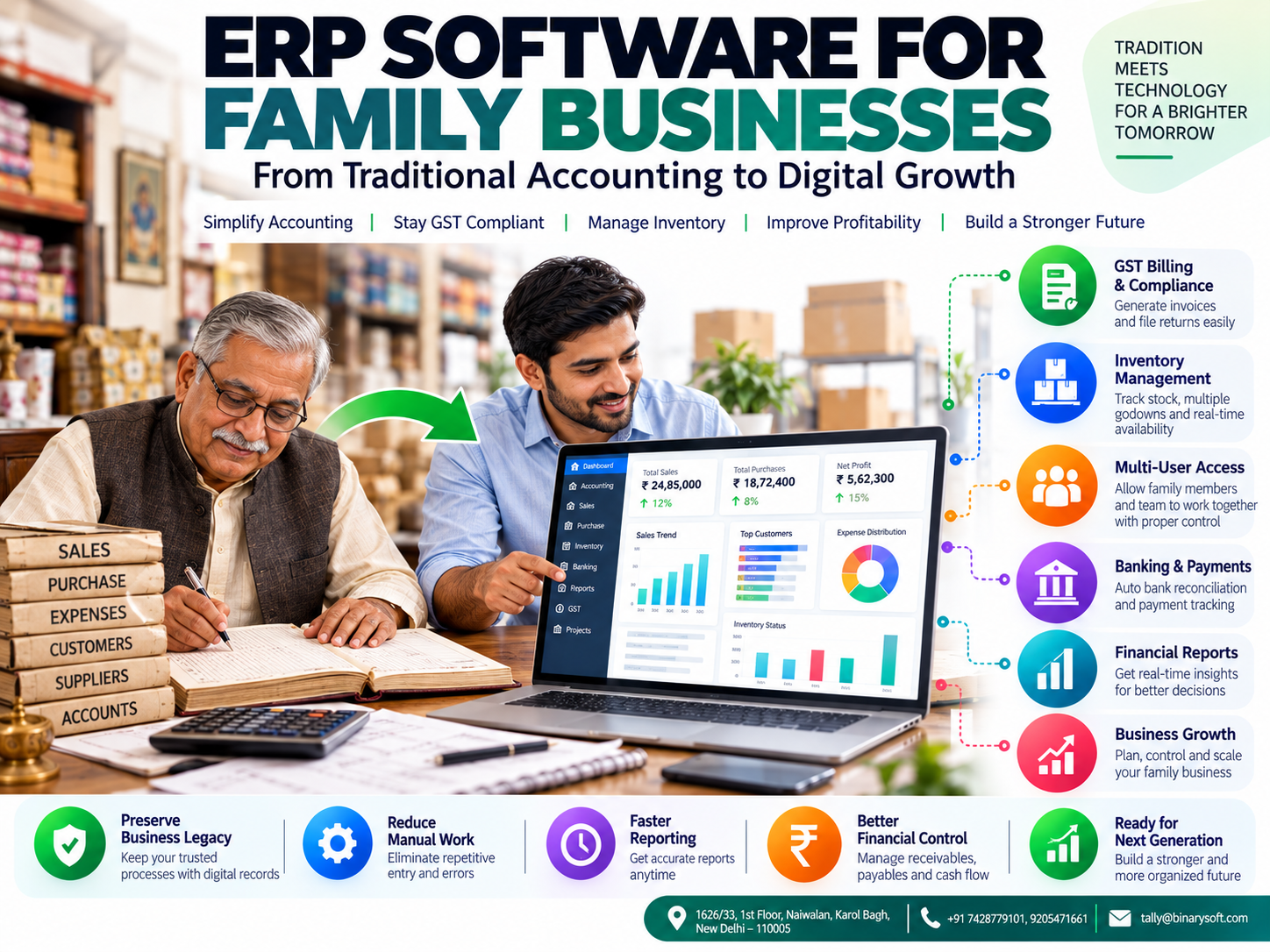
The right ERP software helps family businesses preserve their traditional strengths while introducing the financial visibility and operational efficiency required for modern growth.
Tally Prime provides integrated accounting, inventory, GST, banking and reporting capabilities that can support this transition.
For businesses operating across generations, digital accounting is not simply about replacing paper registers.
It is about protecting the business legacy while preparing the next generation for future opportunities.
1. Why Family Businesses Need Digital Accounting in 2026
Traditional family businesses often operate through established processes developed over many years.
Senior family members may manage purchasing and supplier relationships.
Younger family members may handle sales, digital marketing and business expansion.
A trusted accountant may maintain financial records.
While this arrangement can work effectively, growing transaction volumes create additional challenges.
Common Problems with Traditional Accounting
Manual accounting errors: Handwritten entries and repeated calculations increase the possibility of mistakes.
Delayed financial reporting: Preparing accurate financial statements may require considerable time.
Limited inventory visibility: Business owners may not know the exact stock available across different locations.
Outstanding payment difficulties: Customer credit balances can become difficult to monitor.
GST compliance pressure: Tax reporting requires accurate and organized transaction information.
Business succession challenges: Financial information may depend heavily on one experienced family member or accountant.
Digital accounting helps businesses establish structured records that can be reviewed by authorized individuals.
2. An Emotional Story: A Father's Ledger and His Son's Digital Dream
For nearly forty years, Harish ran a wholesale textile business in Chandni Chowk, Delhi.
His father had started the business with a small shop and a few loyal customers.
Harish inherited not only the business but also a thick collection of handwritten account books.
Every evening, he sat behind his wooden desk, carefully recording sales, purchases and customer payments.
He trusted those registers because they represented decades of hard work.
His son, Arjun, joined the business after completing his education.
Arjun wanted to expand online sales, introduce digital accounting and improve inventory management.
But whenever he discussed new software, Harish became uncomfortable.
"What will happen to our old records?" he asked.
"Your grandfather maintained these accounts. I have used the same system for years."
Arjun understood his father's attachment.
Those books were more than financial records.
They represented the family's history.
One afternoon, a major customer requested an updated outstanding statement.
The accountant needed several hours to reconcile different registers.
Meanwhile, another customer placed an order for fabric that appeared available but had already been sold.
The confusion resulted in a delayed delivery.
That evening, Arjun showed his father how a digital accounting system could maintain customer balances, record stock movement and generate financial reports.
He explained that the old registers would be preserved and that the transition could happen gradually.
After several discussions, Harish agreed to begin with current-year accounting in Tally Prime.
The family verified opening balances, organized customer ledgers and created inventory records.
The accountant received training, and the business continued maintaining its traditional documents during the initial transition.
A few months later, Harish asked Arjun to show him the outstanding balance of a long-standing customer.
Arjun opened the report.
The information appeared within moments.
Harish looked at the screen and smiled.
For the first time, he realized that technology was not replacing the values on which his father had built the business.
It was helping preserve them.
The most successful digital transformation respects business traditions while making everyday operations more dependable.
This fictional story illustrates the emotional and operational challenges involved in family business modernization.
3. What Makes ERP Software Suitable for Family Businesses?
Family-owned businesses often have different requirements from large corporate organizations.
They may not need complicated enterprise systems with hundreds of modules.
Instead, they generally benefit from software that is practical, reliable and easy to understand.
Important requirements include:
-
Simple accounting workflows
-
GST invoicing and reporting
-
Inventory management
-
Customer and supplier ledgers
-
Multiple-user access
-
Financial reporting
-
Banking and reconciliation
-
Data backup and recovery
-
Security and access permissions
-
Scalability as the business grows
Tally Prime combines many of these capabilities within one business management application.
However, businesses requiring advanced production planning, customer relationship management or specialized industry workflows may need additional software.
4. Why Tally Prime Is a Practical Choice for Traditional Businesses
Tally Prime is designed to support common accounting and business management requirements.
Its integrated approach can reduce the need to maintain separate systems for basic financial accounting and inventory records.
4.1 Familiar Accounting Structure
Traditional businesses are accustomed to ledgers, vouchers, debit and credit entries, cash books and financial statements.
Tally Prime uses established accounting concepts while providing digital transaction recording and reporting.
4.2 GST Accounting
Businesses can configure applicable GST details and generate GST-related invoices and reports.
4.3 Inventory Management
Stock items, groups, categories and godowns help businesses maintain organized inventory records.
4.4 Financial Reporting
Business owners can review Balance Sheets, Profit and Loss Accounts, Trial Balances and outstanding reports.
4.5 Multi-User Capabilities
Appropriate multi-user licensing and configuration allow authorized employees or family members to work with company data.
4.6 Security Controls
Supported user permissions and security features help restrict access to sensitive accounting information.
These capabilities make Tally Prime suitable for many small and medium-sized family businesses.
5. Moving from Handwritten Ledgers to Digital Accounting
The transition from manual accounting should be planned carefully.
Businesses should avoid entering incomplete historical information without verification.
Step 1: Review Existing Records
Collect important accounting information, including:
-
Customer balances
-
Supplier balances
-
Cash balances
-
Bank balances
-
Inventory quantities
-
Outstanding loans
-
Fixed assets
-
Tax-related balances
Step 2: Select a Transition Date
Choose a suitable date for beginning digital accounting.
Many businesses prefer the beginning of a financial year, although migration can also be performed during the year with appropriate reconciliation.
Step 3: Verify Opening Balances
Compare opening balances with existing records and supporting documents.
Step 4: Create Accounting Ledgers
Set up customer, supplier, income, expense, asset and liability ledgers.
Step 5: Configure Inventory
Create stock groups, items, units and godowns where applicable.
Step 6: Begin Transaction Recording
Record sales, purchases, receipts, payments and other transactions consistently.
Step 7: Reconcile Records
Compare digital reports with source records during the initial transition period.
Step 8: Preserve Historical Documents
Retain old registers and supporting records according to applicable legal and business requirements.
A gradual and controlled transition reduces the risk of disruption.
6. GST Billing and Compliance for Family Businesses
GST compliance is an important requirement for many Indian family-owned businesses.
Manual invoice preparation and tax calculations can create reporting difficulties.
Tally Prime supports GST-enabled invoicing, accounting and relevant compliance workflows.
Practical Example
A family-owned electrical trading business in Delhi sells taxable goods worth ₹75,000 to a customer within Delhi.
Assuming an applicable GST rate of 18%:
Taxable value: ₹75,000
CGST at 9%: ₹6,750
SGST at 9%: ₹6,750
Total invoice amount: ₹88,500
With correct configuration, Tally Prime can calculate and record the applicable tax.
Businesses must verify the relevant product classification, GST rate and statutory requirements.
For businesses covered by mandatory e-invoicing rules, suitable software configuration and compliance processes become particularly important.
7. Inventory Management for Multi-Generation Businesses
Family businesses frequently expand from a single shop into multiple warehouses, branches or retail outlets.
As operations grow, inventory becomes more difficult to monitor.
Tally Prime supports:
Business Example
A family-owned garment wholesaler operates three locations.
Delhi warehouse: 1,500 units
Noida warehouse: 900 units
Gurugram warehouse: 600 units
Location-wise stock reporting helps management understand where products are available.
This supports purchasing decisions and reduces unnecessary stock transfers.
8. Multi-User Access for Family Members and Employees
Family businesses often involve several people in financial operations.
For example:
The founder may review profitability and major expenses.
A family member may manage sales and customer relationships.
An accountant may record financial transactions.
A warehouse employee may handle inventory-related work.
Tally Prime supports user-level security and access controls, subject to the applicable edition and configuration.
Businesses can assign permissions according to responsibilities.
This helps protect sensitive information while allowing employees to perform their assigned tasks.
Multi-user access should be configured carefully to maintain accountability and prevent unauthorized changes.
9. Customer Credit and Outstanding Payment Management
Many family businesses develop long-term relationships with customers.
Credit sales are often based on mutual trust.
However, increasing transaction volumes make it difficult to remember every outstanding invoice.
Tally Prime supports bill-wise outstanding tracking and receivables ageing analysis.
Example
A wholesale business has customer receivables totaling ₹15 lakh.
An ageing report identifies:
0–30 days: ₹6 lakh
31–60 days: ₹4 lakh
61–90 days: ₹3 lakh
Above 90 days: ₹2 lakh
Management can prioritize collection efforts and review credit arrangements for customers with repeated delays.
Digital records help preserve customer relationships while improving financial discipline.
10. Case Study One: Traditional Textile Business Moves to Digital Accounting
Business Background
A hypothetical family-owned textile business has operated for more than thirty years.
The company supplies fabric to retailers and maintains a warehouse alongside its main shop.
Challenges
Accounting information is maintained through handwritten registers and spreadsheets.
Customer outstanding statements take considerable time to prepare.
Inventory records are updated inconsistently.
Solution Using Tally Prime
The business begins by verifying customer and supplier balances.
Stock items are organized into suitable categories.
Sales and purchase transactions are recorded through appropriate vouchers.
Bill-wise outstanding tracking is introduced.
The accountant receives training, and management begins reviewing reports regularly.
Operational Improvements
The business gains clearer visibility into receivables and inventory.
Financial reporting becomes more organized.
Family members can review relevant information without depending entirely on handwritten registers.
Key Learning
Digital accounting can strengthen traditional businesses without requiring them to abandon their established customer relationships.
This illustrative case study does not represent independently verified customer results.
11. Case Study Two: Family Manufacturing Business Improves Financial Control
Business Background
A hypothetical family-owned manufacturing company produces packaging materials.
The first generation manages supplier relationships, while the second generation oversees production and sales.
Challenges
Raw material consumption records are maintained separately from accounting information.
Management struggles to understand production-related expenses.
Financial reports are often prepared late.
Solution Using Tally Prime
The company organizes raw materials and finished goods as separate stock items.
Suitable bills of materials and manufacturing-related inventory workflows are configured.
Cost centres are used for relevant expense allocation.
Management begins reviewing inventory and financial reports monthly.
Operational Improvements
The company gains better visibility into material accounting, expenses and financial performance.
The transition also improves coordination between family members responsible for different operations.
Key Learning
Combining traditional manufacturing experience with organized financial information can improve operational decision-making.
This case study is illustrative and does not claim measured financial savings.
12. Tally Prime on Cloud for Modern Family Businesses
Many family businesses now operate across multiple locations.
One family member may manage the original shop, while another oversees a warehouse or branch.
Some businesses also have family members working remotely.
Tally Prime can be accessed through compatible hosted desktop infrastructure, subject to licensing and technical configuration.
Potential advantages include:
-
Remote access for authorized users
-
Centralized hosting arrangements
-
Support for distributed accounting teams
-
Reduced dependence on one office computer
-
Managed backup options
-
Flexible access from supported locations
However, cloud hosting does not automatically guarantee data security or uninterrupted availability.
Businesses should evaluate hosting reliability, access controls, backup procedures and technical support.
13. Data Security and Business Continuity
Financial records are among the most valuable assets of a family business.
Losing accounting data can disrupt customer collections, supplier payments and statutory reporting.
Businesses should establish clear data protection procedures.
Important measures include:
Regular backups: Maintain copies of accounting information according to a defined schedule.
Access permissions: Restrict sensitive information to authorized users.
Password security: Use strong authentication practices.
Recovery testing: Verify that backups can actually be restored.
Software updates: Keep supported software releases current.
Employee training: Explain basic cybersecurity and data-handling responsibilities.
A business should not depend entirely on one computer or one employee for access to critical financial information.
14. Financial Reports That Help Family Businesses Grow
Digital accounting provides management with more timely access to important financial information.
Balance Sheet
Shows assets, liabilities and capital.
Profit and Loss Account
Helps evaluate income, expenses and profitability.
Trial Balance
Provides a summary of ledger balances.
Customer Outstanding Report
Helps monitor unpaid customer invoices.
Supplier Payables Report
Supports payment planning.
Stock Summary
Shows inventory quantities and values.
Cash and Bank Books
Provide transaction-level visibility into financial activity.
Cost Centre Reports
Help evaluate allocated income and expenses.
Regular review of these reports can improve financial discipline across generations.
15. When Should a Family Business Upgrade to ERP Software?
There is no single turnover level at which every business must implement ERP software.
The decision depends on operational complexity.
Common indicators include:
-
Increasing daily transaction volumes
-
Multiple branches or warehouses
-
Frequent inventory differences
-
Delayed customer collections
-
Difficulty preparing financial statements
-
Growing GST compliance responsibilities
-
Several employees handling accounts
-
Expansion into online selling
-
Involvement of the next generation in management
Businesses should evaluate software requirements before existing processes become difficult to control.
16. Common Mistakes During Digital Accounting Migration
Family businesses sometimes underestimate the importance of implementation planning.
One common mistake is migrating inaccurate opening balances.
Another is creating duplicate customer or supplier ledgers.
Some organizations introduce digital accounting without training employees.
Others stop maintaining backups after the initial setup.
Businesses may also attempt to automate every activity immediately, creating unnecessary complexity.
A better approach is to begin with core accounting processes, validate records and introduce additional features gradually.
Successful digital transformation requires consistent procedures and employee participation.
17. How Digital Accounting Supports Business Succession
Business succession is an important consideration for multi-generation family enterprises.
Financial knowledge is sometimes concentrated with senior family members.
When records are maintained informally, transferring responsibilities to the next generation can become difficult.
Digital accounting helps preserve structured information about customers, suppliers, inventory and financial performance.
Authorized family members can review relevant reports and understand business obligations.
Documented accounting procedures also reduce dependence on individual employees.
This makes succession planning more organized and helps protect the continuity of the business.
18. The Future of Family Businesses in Digital India
Indian family businesses are increasingly adopting digital payments, electronic invoicing, online selling and connected accounting systems.
Younger generations often bring technological knowledge, while senior family members contribute experience, supplier relationships and market understanding.
The strongest businesses can benefit from combining these capabilities.
Digital accounting provides a foundation for improved financial reporting, inventory management and business planning.
Future technologies may introduce additional automation and analytical capabilities.
However, reliable accounting records and disciplined business processes will remain essential.
Technology becomes most valuable when it strengthens the experience, trust and relationships that helped a family business succeed in the first place.
Conclusion
Family-owned businesses represent generations of dedication, experience and entrepreneurial commitment.
As these organizations grow, traditional accounting methods may become increasingly difficult to manage.
Manual records, disconnected spreadsheets and delayed financial reporting can create unnecessary risks.
ERP-style accounting software helps businesses organize transactions, maintain accurate inventory records, monitor outstanding payments and improve financial visibility.
Tally Prime provides integrated accounting, GST, inventory, banking and reporting capabilities that make it a practical option for many Indian family businesses.
With appropriate implementation, training and data protection procedures, businesses can transition gradually from manual accounting to digital financial management.
The objective is not to replace traditional business values.
It is to preserve them while introducing better systems for the future.
For family businesses preparing the next generation to lead, digital accounting is an investment in continuity, financial discipline and sustainable growth.
Powered by Binarysoft Technologies
Authorized Tally Partner
Location: 1626/33, 1st Floor, Naiwalan, Karol Bagh, New Delhi – 110005, INDIA
Contact Us: +91 7428779101, 9205471661
Email: tally@binarysoft.com
Business Hours: 10:00 AM – 6:00 PM, Monday to Friday
Frequently Asked Questions
How long does migration to Tally Prime take?
Implementation time depends on transaction volume, data quality, inventory complexity, employee training and migration requirements.
Is digital accounting secure for family businesses?
Digital accounting can be secure when businesses implement suitable access controls, backups, software updates and recovery procedures.
Is historical accounting data lost during migration?
Not necessarily. Businesses can preserve historical records and migrate supported data according to a planned process. Data compatibility and accuracy should be verified before migration.
Can a family business move from handwritten ledgers to Tally Prime?
Yes. Businesses can establish digital accounting records by verifying opening balances, creating ledgers and entering or importing supported information.
CA. Krishiv Bansode works closely with startups and MSMEs on accounting, taxation, and compliance matters. He regularly writes about cloud accounting, automation, and financial management strategies.