Call CA Tally HelpDesk
+91 9205471661,
7428779101
Introduction: Why Construction Businesses Need Better Financial and Project Management
Construction is one of the most challenging industries to manage financially and operationally.
Unlike a retail shop or a traditional trading business, construction companies handle multiple activities simultaneously.
Builders must coordinate labour, construction materials, contractors, suppliers, equipment, project budgets, customer payments and government compliance requirements.
A small delay in material delivery can affect the entire construction schedule.
An unexpected increase in steel or cement prices can reduce project profitability.
Delayed payments from customers may create cash flow problems, while inaccurate contractor records can lead to disputes.
For builders managing multiple projects, these challenges become even more complicated.
This is where construction management software becomes valuable.
A suitable construction management system helps builders organize project information, monitor expenses, manage resources and improve financial visibility.
Specialized construction platforms may also provide project scheduling, site coordination, document management and contractor collaboration.
For Indian builders, Tally Prime can support important financial activities such as accounting, project-wise expense tracking, inventory records, GST-related accounting and payment management.
However, construction project scheduling and advanced site management may require additional specialized applications.
This guide explains why construction businesses need management software, its important features and how Tally Prime can help builders improve financial control.
A Builder's Story: When Rising Construction Costs Threatened a Family Business
For fifteen years, Rajiv had worked hard to build his construction company in Delhi NCR.
What began as a small contracting business had gradually expanded into residential construction projects across Rohini, Dwarka and Gurugram.
Rajiv was proud of his achievements.
His employees trusted him, customers appreciated his work, and his family believed the company would continue growing.
However, as the business expanded, financial management became increasingly difficult.
One morning, Rajiv received a call from a supplier demanding payment for construction materials delivered several weeks earlier.
Later that afternoon, a contractor complained that an outstanding bill had not been cleared.
At the same time, the site supervisor requested additional cement and steel for an ongoing project.
Rajiv opened his spreadsheets and discovered that the actual project expenses were significantly higher than his original estimate.
Several material purchases had been recorded without clear project references.
Some contractor payments were maintained in separate registers.
He could not immediately determine which construction site was generating profit and which was exceeding its budget.
That evening, Rajiv sat alone in his office.
He was worried about paying workers, meeting supplier commitments and completing projects on time.
His biggest fear was disappointing the customers who had trusted him with their savings.
Rajiv realized that hard work alone was no longer enough.
His growing business needed better financial systems.
He introduced project-wise accounting, organized supplier records and standardized construction material tracking.
With clearer reports and better expense visibility, he could identify financial problems earlier.
His experience highlights an important lesson:
Construction businesses do not become profitable simply by completing more projects. They become financially stronger when every project is managed with accurate information and disciplined cost control.
1. What Is Construction Management Software?
Construction management software is a digital system designed to help builders, contractors and construction companies organize project-related activities.
Depending on the application, it may support project planning, budgeting, procurement, material management, workforce coordination, financial reporting and document management.
The primary objective is to improve visibility and coordination across construction projects.
Important Construction Management Activities
Construction businesses commonly need to manage:
-
Project budgets and estimates.
-
Construction material purchases.
-
Supplier and contractor payments.
-
Labour expenses.
-
Equipment and machinery costs.
-
Project schedules and milestones.
-
Customer billing.
-
GST-related accounting.
-
Project-wise profitability.
-
Financial reporting.
A specialized construction management application may combine several of these activities into one platform.
Other businesses use accounting software alongside dedicated project management tools.
The appropriate solution depends on company size, project complexity and operational requirements.
2. Why Builders Need Construction Management Software
Better Project Cost Control
Construction projects involve numerous expenses.
These include cement, steel, bricks, sand, labour, transportation, equipment and subcontractor charges.
Without proper accounting, expenses can exceed the approved budget.
Construction management software helps businesses organize cost information and identify potential overruns.
Improved Material Management
Construction materials represent a major component of project expenditure.
Poor material tracking can lead to shortages, unnecessary purchases and wastage.
Digital inventory records help businesses monitor purchases, receipts and consumption.
Contractor Payment Management
Builders often work with multiple contractors and subcontractors.
Maintaining accurate records of bills, advances and payments helps reduce disputes.
Better Cash Flow Visibility
Construction businesses frequently incur expenses before receiving corresponding customer payments.
Financial reports help management understand available funds and upcoming obligations.
Improved Project Coordination
Specialized construction software can help teams coordinate activities, deadlines and responsibilities.
Accurate Financial Reporting
Organized accounting records support financial analysis and business decisions.
Greater Business Transparency
Project-wise information helps owners understand where money is being spent.
3. Important Features of Construction Management Software
Project Budgeting
Project budgeting helps builders estimate expected expenses before construction begins.
A budget may include material costs, labour charges, contractor payments and other overheads.
Management can compare actual expenditure against planned amounts.
Construction Material Tracking
Material tracking helps businesses monitor receipts, issues and available quantities.
Contractor and Supplier Management
Builders can maintain records of suppliers, subcontractors and payment obligations.
Project Scheduling
Dedicated construction platforms may provide timelines, task dependencies and milestone tracking.
Document Management
Construction projects generate drawings, contracts, quotations, approvals and other documents.
Document management features help organize relevant files.
Financial Accounting
Accounting functionality helps businesses record expenses, receipts, liabilities and income.
Reporting and Analysis
Management reports help builders evaluate costs, payment obligations and financial performance.
User Access Control
Appropriate permissions help protect confidential financial and project information.
4. Construction Management Software vs Traditional Manual Processes
| Business Activity | Manual Management | Software-Based Management |
|---|
| Project Expenses |
Separate registers |
Organized financial records |
| Material Purchases |
Manual purchase records |
Digital purchase transactions |
| Supplier Payments |
Spreadsheet tracking |
Payable reports |
| Customer Billing |
Manual calculations |
Software-generated invoices |
| Financial Reporting |
Time-consuming preparation |
Reports from recorded transactions |
| Inventory Records |
Physical registers |
Digital stock information |
| Project Profitability |
Manual consolidation |
Project-wise analysis where configured |
| Data Access |
Paper files |
Controlled digital access |
Software can improve information management, but results depend on accurate data entry and suitable configuration.
5. How Tally Prime Helps Construction Businesses
Tally Prime provides accounting, inventory, GST-related and financial reporting features that can support many construction business requirements.
Construction Accounting
Builders can record expenses, customer receipts, supplier payments and other financial transactions.
Project-Wise Cost Tracking
Cost centres and related accounting features can help businesses classify relevant income and expenses by project.
For example, a builder managing three construction sites can establish separate project cost centres.
Transactions can then be allocated appropriately to support project-wise expense analysis.
Supplier Management
Builders can maintain supplier ledgers and review outstanding liabilities.
Contractor Accounting
Contractor-related transactions can be recorded using suitable accounting ledgers and voucher entries.
Material Inventory
Relevant inventory features can help maintain records of construction materials.
GST Accounting
Tally Prime supports GST-related transaction recording and reporting.
Builders must ensure that tax classifications and compliance procedures reflect applicable requirements.
Financial Statements
Management can review the Balance Sheet, Profit and Loss Account and other financial reports.
Important Limitation
Tally Prime is primarily an accounting and business management application.
It should not be treated as a complete replacement for specialized construction scheduling, site collaboration, architectural planning or advanced project execution software.
6. How to Set Up Project-Wise Accounting in Tally Prime
Project-wise accounting helps construction companies understand financial performance across different sites.
Step 1: Create the Company
Set up the construction business in Tally Prime with relevant financial and tax information.
Step 2: Create Accounting Ledgers
Prepare ledgers for material purchases, labour expenses, contractor charges, transportation and other relevant costs.
Step 3: Enable Cost Centre Features
Configure cost centre functionality where appropriate.
Step 4: Create Project Cost Centres
For example:
Project A: Residential Apartments, Rohini
Project B: Commercial Building, Noida
Project C: Independent Villas, Gurugram
Step 5: Allocate Expenses
Record applicable expenses against the relevant project cost centre.
Step 6: Review Cost Centre Reports
Use available reports to review project-wise accounting information.
Step 7: Compare Costs With Budgets
Where budgeting features and configuration support the requirement, compare relevant actual expenses with planned amounts.
Businesses should verify the treatment of direct costs, overhead allocations and work-in-progress with their accounting professionals.
7. Construction Material Management and Inventory Control
Construction projects require careful control of materials.
Common materials include cement, steel, bricks, tiles, electrical fittings, plumbing supplies and finishing products.
Problems Caused by Poor Material Tracking
Material shortages can delay construction activities.
Excessive purchases can increase working capital requirements.
Incorrect stock records may create accounting differences.
Unrecorded consumption can make project cost calculations unreliable.
How Software Helps
Digital inventory records can support material classification, purchase recording and stock movement analysis.
Tally Prime provides inventory features that can be configured for relevant material-tracking requirements.
For businesses requiring detailed site-wise consumption tracking, additional processes or compatible specialized tools may be necessary.
8. Managing Contractor and Labour Payments
Construction companies frequently work with subcontractors for electrical work, plumbing, painting, flooring and structural activities.
Managing these payments requires accurate records.
Contractor Payment Challenges
Builders may need to track advances, bills, deductions, retention amounts and outstanding balances.
Accounting Support
Tally Prime can help maintain contractor ledgers and relevant payment transactions.
However, specialized contract administration, measurement-book workflows and automated certification processes may require additional solutions.
Better Payment Planning
Regular payable reports help management identify upcoming financial obligations.
This supports cash flow planning and supplier relationships.
9. Managing Construction Project Cash Flow
Cash flow management is essential for construction businesses.
Expenses may arise throughout the project, while customer payments may depend on agreed milestones.
A profitable project can still experience financial pressure if receipts are delayed.
Common Cash Flow Challenges
Builders may face increasing material costs, delayed customer installments, unexpected contractor expenses and overlapping project commitments.
How Accounting Software Helps
Tally Prime provides financial reports and outstanding information that can help businesses review receivables, payables and cash positions.
Management can use this information to plan payments and identify potential liquidity problems.
For advanced project cash flow forecasting, additional financial models or specialized applications may be appropriate.
10. Case Study One: Construction Accounting for a Residential Builder
Business: Illustrative residential construction company, Rohini, Delhi
Business Challenge
A builder managed three residential construction projects simultaneously.
Material purchases, labour payments and contractor expenses were maintained in separate spreadsheets.
Management struggled to calculate project-wise expenditure.
Solution
The company introduced organized accounting procedures using Tally Prime.
Separate project cost centres were created.
Relevant expenses were classified and allocated to the appropriate projects.
Supplier ledgers and payment records were also standardized.
Business Benefits
Management gained clearer information about project-related costs.
The accounting team could review expenses and supplier balances more efficiently.
The company also established regular project cost reviews.
Key Learning
Project-wise accounting helps builders understand financial performance and identify potential cost overruns.
This is an illustrative case study.
11. Case Study Two: Material and Contractor Management for a Commercial Project
Business: Illustrative commercial construction contractor, Noida
Business Challenge
A contractor managed a commercial building project involving several suppliers and subcontractors.
Material purchases were recorded manually, while contractor payment information was maintained in separate registers.
This created reconciliation difficulties.
Solution
The company introduced structured purchase accounting and contractor ledger management.
Construction materials were organized into relevant inventory categories.
The accounting team began reviewing outstanding supplier and contractor balances regularly.
Business Benefits
The business improved financial record consistency.
Management gained better visibility into purchasing expenses and pending payments.
Employees also followed more standardized transaction procedures.
Key Learning
Organized accounting and material records can improve financial control across complex construction activities.
This is an illustrative case study.
12. How Construction Software Helps Reduce Project Cost Overruns
Cost overruns occur when actual project expenditure exceeds the approved budget.
Common causes include material price increases, inaccurate estimates, project delays, wastage and unplanned work.
Construction management software can help businesses identify these problems earlier.
Establish Clear Budgets
Prepare realistic estimates before construction begins.
Track Actual Expenses
Record project-related costs consistently.
Monitor Material Consumption
Review purchases, issues and available quantities.
Review Contractor Payments
Maintain accurate records of contractor bills and payment obligations.
Compare Planned and Actual Costs
Conduct periodic budget reviews.
Investigate Variances
Identify the reasons behind unexpected expenses.
Early identification of cost differences allows management to take corrective action.
13. Construction Management Software for Small Builders
Small construction businesses may not require a complex enterprise system.
Their immediate priorities often include accurate accounting, supplier management, expense tracking and customer billing.
For such businesses, Tally Prime can provide useful financial management capabilities.
As operations expand, builders may evaluate additional software for project scheduling, document management and site coordination.
The objective should be to select software according to actual requirements rather than purchasing unnecessary functionality.
14. Construction Management Software for Large Builders
Larger construction companies often manage multiple projects, contractors and departments.
They may require more extensive systems covering procurement approvals, project scheduling, resource planning, document control and consolidated reporting.
Specialized construction ERP applications may provide these capabilities.
Accounting software such as Tally Prime may form part of the financial management environment where suitable integrations and processes are available.
Businesses should evaluate integration compatibility, security and reporting requirements before selecting a technology architecture.
15. How to Choose the Right Construction Management Software
Selecting construction software requires careful evaluation.
Identify Business Requirements
Determine whether the primary requirement is accounting, project scheduling, material tracking or complete construction project management.
Evaluate Accounting Features
Review financial reporting, supplier management and project-wise expense tracking.
Assess Inventory Capabilities
Determine whether the software supports the required material management processes.
Review Project Management Features
For complex projects, evaluate scheduling, task management and collaboration capabilities.
Consider Implementation Costs
Compare licensing, configuration, training and maintenance expenses.
Evaluate Scalability
Choose software that can support reasonable future business expansion.
Review Technical Support
Reliable implementation and support services are important.
Test Real Business Scenarios
Request demonstrations using representative construction transactions.
16. Common Mistakes Builders Should Avoid
Maintaining Separate Financial Records
Disconnected spreadsheets can create inconsistent information.
Ignoring Project-Wise Expenses
Without proper cost allocation, management may struggle to identify project profitability.
Poor Material Reconciliation
Inaccurate material records can affect cost estimates and purchasing decisions.
Delayed Contractor Accounting
Late transaction recording may create payment disputes.
Inadequate Budget Monitoring
Builders should review actual expenses against planned costs regularly.
Selecting Software Without Proper Evaluation
Not every accounting application provides complete construction project management functionality.
Ignoring Employee Training
Employees need clear procedures for recording transactions and reviewing reports.
17. Benefits of Cloud-Hosted Accounting for Construction Businesses
Construction teams often work across offices and project sites.
Remote access to accounting information can help authorized employees review financial records without being physically present at the main office.
Compatible Tally Prime cloud-hosting arrangements may support remote access to the accounting environment.
Potential benefits include improved accessibility and reduced dependence on office-based workstations.
However, businesses should evaluate internet reliability, access security, hosting responsibilities, licensing and backup arrangements.
Cloud hosting does not automatically provide advanced construction project management functionality.
18. Future of Construction Management Software in India
Construction businesses are increasingly exploring digital solutions to improve project visibility and operational coordination.
Technologies such as mobile project applications, cloud collaboration, digital document management and integrated reporting are influencing software requirements.
Advanced construction platforms may also provide scheduling analysis, equipment monitoring and project forecasting capabilities.
However, the value of technology depends on implementation quality and accurate information.
For Indian builders, reliable accounting, disciplined expense tracking and clear project responsibilities remain essential.
Businesses should establish these foundations before investing in advanced software functionality.
19. Why Financial Visibility Is Essential for Construction Profitability
Construction profitability depends on more than the difference between the contract value and estimated material expenses.
Builders must consider labour costs, subcontractor charges, equipment expenses, transportation, administrative overheads and financing costs.
Unexpected expenses can reduce profit margins.
Project-wise accounting helps management understand how costs are distributed.
Regular financial reviews can identify potential problems before they become serious.
Tally Prime can support relevant accounting and reporting activities when transactions are classified and recorded correctly.
For detailed contract profitability, work-in-progress valuation and revenue recognition, builders should follow applicable accounting standards and obtain professional guidance.
Conclusion
Construction management software helps builders improve financial visibility, material management, project coordination and operational control.
As construction businesses grow, managing projects through disconnected spreadsheets and manual registers becomes increasingly difficult.
A suitable software environment can help organizations organize project information, monitor expenses and maintain reliable financial records.
For Indian builders and contractors, Tally Prime provides useful accounting, inventory, GST-related and financial reporting features.
Project-wise cost centres, supplier ledgers and structured accounting processes can support better financial management.
However, advanced construction scheduling, site collaboration and specialized contract management may require additional applications.
Successful construction businesses do not rely only on completing projects. They build long-term profitability by controlling costs, managing payments and making informed decisions throughout every stage of construction.
Featured Image and Short Description
Featured Image Title: Why Builders Need Construction Management Software in 2026
Suggested Image Size: 800 × 600 pixels
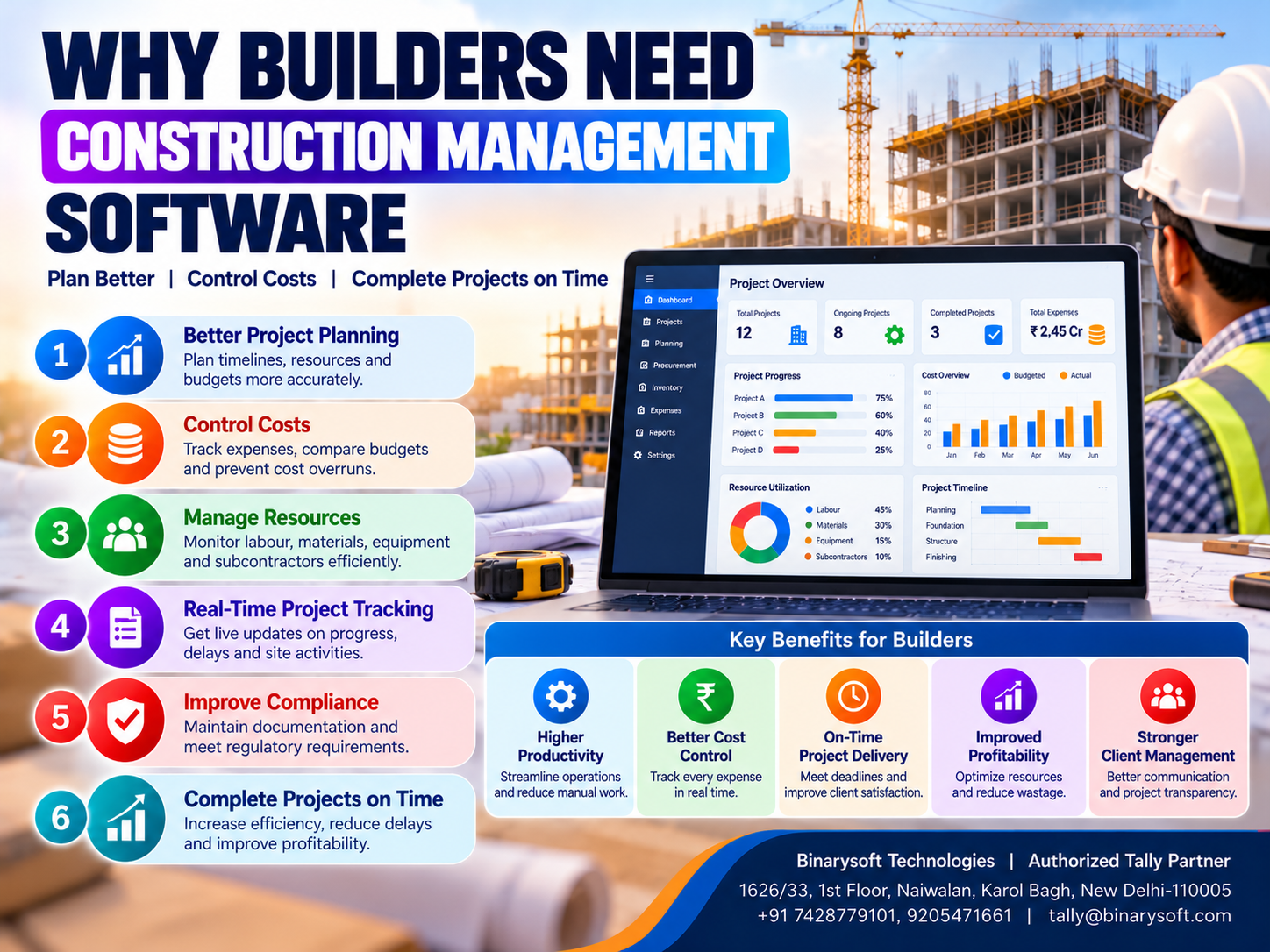
Image Description: Professional construction management infographic featuring a modern building project, construction engineer, financial dashboard, material inventory, contractor payments and project cost monitoring.
Image Alt Text: Construction management software for builders showing project budgeting, material tracking, contractor payments and financial reporting.
Short Description
Discover why builders and construction companies need construction management software to control project expenses, track materials, manage contractors and improve cash flow. Learn how Tally Prime supports project-wise accounting, GST billing, inventory records and financial reporting for construction businesses.
Powered by Binarysoft Technologies
Authorized Tally Partner
Location: 1626/33, 1st Floor, Naiwalan, Karol Bagh, New Delhi – 110005, INDIA
Contact Us: +91 7428779101, 9205471661
Email: tally@binarysoft.com
Business Hours: 10:00 AM – 6:00 PM, Monday to Friday
Frequently Asked Questions
What is construction management software?
Construction management software helps builders and contractors organize project planning, budgeting, materials, payments, financial records and other construction-related activities.
Why do builders need construction management software?
Builders need software to improve project visibility, control expenses, track materials, manage contractor payments and maintain reliable business records.
Can Tally Prime be used by construction companies?
Yes. Tally Prime supports accounting, inventory, GST-related transactions and financial reporting that can be useful for construction businesses.
Can Tally Prime track construction project expenses?
Tally Prime provides cost centre functionality that can help businesses classify and analyze relevant expenses by project.
CA. Aarav Bhandari specializes in GST compliance, accounting systems, and business advisory services. He regularly writes about tax updates, accounting automation, and financial best practices to help businesses improve efficiency and maintain statutory compliance.