In 2026, managing business taxation requires accuracy, timely reporting and a clear understanding of changing compliance requirements. Indian businesses must handle GST invoices, input tax credit, e-invoicing, e-Way Bills, TDS, TCS and statutory records while continuing to focus on customers, sales and profitability.
For many business owners, the biggest challenge is not calculating tax on a single invoice. It is maintaining consistent tax information across hundreds or thousands of transactions.
A small mistake in GST classification, an incorrect invoice detail or an overlooked reconciliation difference can create unnecessary compliance difficulties.
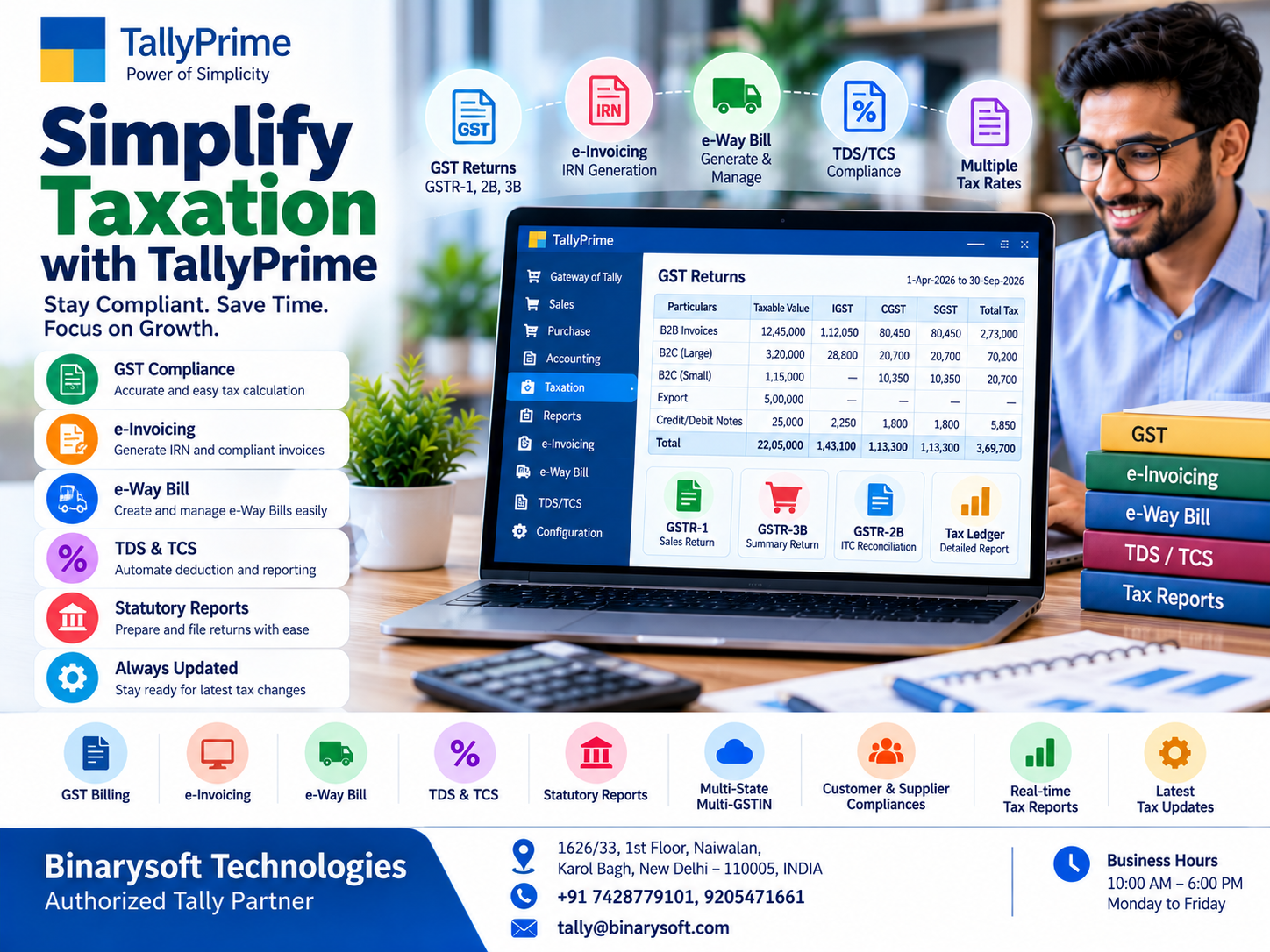
TallyPrime helps businesses manage taxation-related accounting through integrated transaction recording, tax calculations, GST reports and supported connected services.
From preparing GST returns and reviewing input tax credit to generating eligible e-invoices and managing tax deduction records, TallyPrime provides tools that can reduce repetitive work and improve financial visibility.
This guide explores its major taxation features, practical applications, two illustrative business case studies and the steps organizations can take to build more reliable tax compliance processes.
1. What Are the Taxation Features of TallyPrime?
TallyPrime is accounting and business management software that helps Indian businesses record transactions, calculate applicable taxes, maintain statutory information and prepare taxation-related reports.
Tax management becomes easier when accounting and taxation information are maintained within the same system.
For example, when a business records a GST sales invoice with the correct tax classification, the relevant information can be reflected in accounting ledgers and GST reports.
This reduces the need to maintain separate taxation records manually.
Major Taxation Features
-
GST-compliant sales and purchase accounting.
-
Automatic tax calculation based on configured rates.
-
Support for CGST, SGST, UTGST and IGST.
-
GSTR-1 and GSTR-3B preparation workflows.
-
GSTR-2A and GSTR-2B reconciliation support.
-
Input tax credit analysis.
-
E-invoicing for eligible businesses.
-
E-Way Bill generation and management.
-
TDS and TCS accounting.
-
Multiple GST registration management.
-
GST-related exception reporting.
-
Tax ledgers and statutory reports.
-
Supported connected GST services.
These features help businesses organize taxation activities while reducing unnecessary manual work.
However, software does not replace professional tax judgment. Businesses must ensure that their configurations and transactions comply with applicable laws.
2. An Emotional Story: The GST Mistake That Kept a Business Owner Awake All Night
Sanjay owned a wholesale electrical equipment business in Delhi.
His father had established the company nearly thirty years earlier.
What started as a small shop had gradually become a distribution business supplying products to retailers, contractors and corporate customers.
Sanjay was proud of the company's reputation.
Customers trusted his family, and suppliers appreciated the long-standing relationships.
But as the business expanded, accounting responsibilities became increasingly complicated.
The company generated hundreds of invoices every month.
Its accountant maintained GST information in spreadsheets and manually compared purchase records with supplier invoices.
One evening, just before an important compliance deadline, Sanjay received an urgent call from his accountant.
Several purchase invoices were not matching the available GST records.
Some supplier details were incorrect.
A few transactions had been recorded under inappropriate tax classifications.
The accountant needed additional time to investigate the differences.
Sanjay became worried.
He had already committed funds to supplier payments and employee salaries.
Now he feared that inaccurate tax records might create unexpected financial pressure.
That night, he sat alone in his office reviewing old invoices.
He remembered how his father had carefully maintained every transaction in handwritten registers.
His father always said, "A business becomes strong when its accounts are trustworthy."
Sanjay realized that his growing business needed more structured accounting processes.
He decided to improve the company's GST accounting workflow using TallyPrime.
The team reviewed customer and supplier GSTIN details, corrected master information, standardized tax classifications and established monthly reconciliation procedures.
They also began reviewing GST reports before preparing returns.
Over time, the company reduced its dependence on scattered spreadsheets.
Accounting employees could identify exceptions earlier and investigate them systematically.
For Sanjay, the greatest benefit was confidence.
He could focus on growing the family business while knowing that the accounting team had a more reliable process for reviewing taxation information.
The lesson: Tax compliance is not merely about meeting deadlines. It is about protecting business continuity, financial confidence and the relationships built through years of hard work.
This story is illustrative and represents common taxation challenges faced by businesses.
3. GST Accounting in TallyPrime
Goods and Services Tax is a major part of business accounting in India.
Registered businesses must record relevant transactions according to applicable GST rules.
TallyPrime supports GST accounting through company configuration, ledger masters, stock-item classifications and transaction vouchers.
CGST and SGST
For applicable intrastate transactions, Central GST and State GST may be calculated according to the relevant tax treatment.
IGST
For applicable interstate transactions, Integrated GST is generally used.
UTGST
Union Territory GST applies in relevant circumstances.
Tax Classification
Businesses can configure applicable GST rates and classifications for goods and services.
Accounting Integration
Tax amounts calculated during voucher entry are reflected in the relevant accounting records.
Practical Benefits
Businesses can reduce repetitive tax calculations, maintain more consistent transaction information and prepare taxation reports using recorded accounting data.
Accurate GST accounting depends on correct classification, place-of-supply treatment and transaction details.
4. GST-Compliant Invoice Generation
Invoices are important documents for taxation, accounting and customer communication.
TallyPrime helps businesses create invoices containing relevant GST information.
Common GST Invoice Details
A properly configured invoice may include:
-
Supplier name and address.
-
Supplier GSTIN.
-
Customer details.
-
Customer GSTIN, where applicable.
-
Invoice number.
-
Invoice date.
-
Product or service description.
-
HSN or SAC classification.
-
Quantity and taxable value.
-
Applicable GST rate.
-
CGST, SGST, UTGST or IGST amounts.
-
Total invoice value.
-
Other required statutory particulars.
Example
A Delhi-based wholesaler sells taxable goods to a registered customer in another state.
The accounting team records the transaction with the appropriate customer details and tax classification.
TallyPrime calculates the applicable tax according to the configured information.
The resulting invoice can then be reviewed and issued.
Businesses should verify that the invoice satisfies the statutory requirements applicable to the transaction.
5. GST Return Preparation with TallyPrime
Preparing GST returns requires accurate transaction information.
Businesses need to review sales, purchases, adjustments and tax liabilities before filing.
TallyPrime provides GST-related reports that help organize this process.
GSTR-1
GSTR-1 contains relevant outward supply information.
TallyPrime helps businesses review recorded sales transactions and prepare supported return information.
GSTR-3B
GSTR-3B is a summary return covering applicable tax liabilities and input tax credit information.
TallyPrime provides relevant reporting and preparation capabilities.
GSTR-2A and GSTR-2B
These statements help businesses review supplier-reported information and available input tax credit details.
Supported TallyPrime functionality can assist with reconciliation.
Why Return Preparation Matters
Businesses should identify incorrect GSTIN details, classification errors and transaction differences before submitting returns.
Depending on the installed release and connected-service eligibility, certain return-related activities may be performed through supported online workflows.
Important: Preparing return data and successfully filing a statutory return are separate activities. Businesses should confirm submission status and acknowledgements through the appropriate official process.
6. GSTR-2B Reconciliation and Input Tax Credit Management
Input tax credit can significantly affect a business's tax liability and working capital.
However, businesses must satisfy applicable eligibility conditions before claiming credit.
What Is GSTR-2B Reconciliation?
GSTR-2B reconciliation involves comparing relevant purchase records with the information available in GSTR-2B.
The objective is to identify differences requiring investigation.
Common Reconciliation Differences
Missing Supplier Invoices
An invoice recorded in the purchase register may not appear in the relevant GST statement.
Incorrect GSTIN
Supplier or recipient registration details may be inconsistent.
Invoice Number Differences
Invoice numbers may have formatting or entry differences.
Tax Amount Mismatches
The tax recorded in accounting may differ from supplier-reported information.
Duplicate Transactions
The same invoice may have been entered more than once.
How TallyPrime Helps
Supported reconciliation features can assist businesses in comparing accounting records with available GST information.
Benefits
-
Earlier identification of mismatches.
-
Better purchase record verification.
-
Reduced dependence on manual comparisons.
-
Improved supplier follow-up.
-
More organized input tax credit reviews.
Businesses must apply the current legal conditions for claiming input tax credit rather than relying solely on a software-generated amount.
7. E-Invoicing in TallyPrime
E-invoicing is an important compliance requirement for businesses covered by the applicable GST rules.
It involves reporting eligible invoice information through the prescribed Invoice Registration Portal process and obtaining an Invoice Reference Number.
TallyPrime supports e-invoicing workflows for eligible transactions.
How the Process Works
Step 1: Create the relevant sales invoice.
Step 2: Verify customer GSTIN, invoice details and applicable taxation information.
Step 3: Use the supported e-invoicing functionality.
Step 4: Submit the required invoice information through the applicable process.
Step 5: Obtain the Invoice Reference Number and associated details after successful registration.
Step 6: Review the registered invoice information.
Benefits
-
Reduced repetitive data preparation.
-
More structured invoice registration.
-
Improved consistency between accounting and e-invoice records.
-
Convenient access to supported e-invoicing information.
Businesses should verify their e-invoicing applicability, current turnover thresholds, reporting timelines and document requirements.
These rules can change and should not be assumed from historical thresholds.
8. E-Way Bill Generation and Management
An e-Way Bill is required for certain movements of goods under applicable GST rules.
Businesses involved in manufacturing, wholesale distribution and transportation may need to generate e-Way Bills regularly.
TallyPrime supports relevant e-Way Bill workflows.
Common Information Required
-
Supplier details.
-
Recipient details.
-
Dispatch and delivery information.
-
Document number and date.
-
Goods description.
-
HSN classification.
-
Taxable value.
-
Transporter information.
-
Vehicle details, where applicable.
How TallyPrime Helps
Businesses can use recorded transaction information to prepare supported e-Way Bill details.
This can reduce repeated entry of information already available in accounting records.
Business Benefits
-
More organized transport documentation.
-
Reduced repetitive data preparation.
-
Better coordination between billing and dispatch teams.
-
Improved transaction record consistency.
Businesses must verify current e-Way Bill applicability, validity, distance rules and transport requirements.
9. TDS Management in TallyPrime
Tax Deducted at Source is relevant to many business payments.
Depending on the transaction and applicable law, businesses may need to deduct tax when making or crediting certain payments.
TallyPrime supports TDS-related accounting.
Common Business Applications
How TallyPrime Helps
Businesses can configure relevant TDS information and record applicable deductions through supported accounting workflows.
Practical Example
A company engages a professional consultant.
The accounts department records the professional fee and applies the appropriate TDS treatment, subject to the relevant legal conditions.
The transaction is reflected in the accounting records.
Benefits
-
More structured TDS accounting.
-
Reduced manual calculations.
-
Better tracking of deductions.
-
Relevant statutory reporting support.
-
Improved consistency in accounting records.
TDS rates, thresholds, exemptions and reporting obligations should always be verified against the law applicable to the transaction.
10. TCS Accounting and Compliance
Tax Collected at Source applies to specified transactions under applicable tax laws.
Businesses covered by relevant TCS provisions must maintain accurate collection and accounting records.
TallyPrime supports TCS-related accounting functionality.
Key Applications
Businesses can configure relevant TCS information and record applicable transactions.
Benefits
-
Structured tax collection accounting.
-
Better transaction tracking.
-
Reduced manual calculation work.
-
Support for relevant statutory reports.
TCS applicability varies by transaction type and statutory provision.
Businesses should verify the current rules before configuring tax collection.
11. Multiple GST Registrations in TallyPrime
Businesses operating in multiple states may maintain separate GST registrations.
Managing these registrations requires accurate transaction classification and reporting.
Supported TallyPrime releases provide functionality for handling multiple GST registrations within the relevant accounting environment.
Potential Benefits
Centralized Accounting Management
Businesses can organize accounting information while maintaining appropriate registration-wise details.
Registration-Specific Reporting
Relevant GST information can be reviewed according to the configured registration.
Improved Transaction Classification
Transactions can be recorded with the appropriate registration details.
Reduced Administrative Complexity
Businesses can avoid unnecessary duplication of certain accounting activities.
However, GST registrations remain legally distinct for applicable compliance purposes.
Businesses must ensure that transactions and returns are attributed to the correct registration.
12. Case Study One: A Wholesale Distributor Improves GST Reconciliation
Business Type: Electrical goods distributor
Location: Delhi
Primary Challenge: Purchase invoice mismatches and delayed GST reviews
The Problem
A wholesale distributor purchased goods from several suppliers.
The accounting team recorded purchase invoices but relied heavily on spreadsheets for reconciliation.
During monthly reviews, employees frequently discovered differences between purchase records and available GST statements.
Investigating these differences required significant time.
The Solution
The company introduced a structured TallyPrime GST accounting process.
The implementation included:
-
Reviewing supplier GSTIN information.
-
Standardizing purchase invoice entry.
-
Verifying HSN classifications.
-
Reviewing tax ledger configuration.
-
Using supported reconciliation functionality.
-
Investigating unmatched invoices.
-
Establishing monthly review procedures.
-
Maintaining exception records.
The Outcome
The company developed a more consistent reconciliation process.
Employees could identify differences earlier and communicate with suppliers more systematically.
Management also gained better visibility into unresolved purchase-related issues.
Key Learning: Accurate purchase accounting and regular reconciliation are essential for responsible input tax credit management.
This case study is illustrative and does not represent a verified customer implementation.
13. Case Study Two: A Manufacturing Company Simplifies E-Invoicing and E-Way Bill Workflows
Business Type: Industrial components manufacturer
Location: Faridabad
Primary Challenge: Repetitive documentation and dispatch delays
The Problem
A manufacturing company supplied industrial components to distributors and corporate buyers.
Its accounting team prepared invoices, while dispatch employees handled transportation documentation.
Information was repeatedly entered into different systems.
Occasional differences between invoice and dispatch information created additional work.
The Solution
The company reviewed its TallyPrime configuration and established a structured invoicing and dispatch process.
The project included:
-
Standardizing customer GSTIN records.
-
Reviewing item classifications.
-
Verifying invoice information.
-
Configuring supported e-invoicing workflows.
-
Establishing e-Way Bill preparation procedures.
-
Coordinating billing and dispatch responsibilities.
-
Training employees.
-
Reviewing processing exceptions.
The Outcome
The company reduced unnecessary repetition in document preparation.
Employees followed clearer procedures for verifying invoice and dispatch information.
Management gained greater confidence in the consistency of transaction records.
Key Learning: Integrating accounting information with supported statutory document workflows can improve operational efficiency.
This case study is illustrative. Actual results depend on configuration and statutory requirements.
14. How to Configure GST in TallyPrime
A properly configured accounting environment is essential for reliable GST records.
Step 1: Create or Select the Company
Open TallyPrime and select the appropriate company.
Step 2: Enable GST
Access the relevant company features and enable GST functionality.
Step 3: Enter Registration Information
Provide the applicable GST registration details.
Step 4: Configure Tax Ledgers
Create or review the required GST ledgers.
Step 5: Configure Stock Items and Services
Enter appropriate HSN or SAC information and applicable tax classifications.
Step 6: Verify Customer and Supplier Masters
Review GSTIN details and registration information.
Step 7: Record Sample Transactions
Test representative sales and purchase transactions.
Step 8: Review GST Reports
Confirm that transactions appear in the expected reports.
Step 9: Train Employees
Explain correct voucher entry and verification procedures.
The exact menu options may vary depending on the installed release.
15. How TallyPrime Helps Identify Taxation Errors
Taxation errors can arise from incorrect master information, inconsistent transaction entry or missing records.
TallyPrime provides reporting and exception-review capabilities that help businesses identify potential problems.
Incorrect GSTIN Information
Customer or supplier registration details may require correction.
Missing Tax Classifications
Goods or services may have incomplete GST information.
Inconsistent Tax Rates
An incorrect rate can affect invoice values and taxation reports.
Uncertain Transaction Treatment
Some transactions may require additional review.
Reconciliation Differences
Purchase records may not match available GST information.
Duplicate Invoices
Repeated entries can distort accounting records.
Businesses should investigate exceptions rather than assuming that every warning represents a statutory violation.
16. Connected GST Services in TallyPrime
Supported TallyPrime releases offer connected GST capabilities that help eligible businesses interact with relevant GST-related information and services.
These capabilities may include supported data retrieval, reconciliation and return-related workflows.
Potential Benefits
Reduced Manual Data Handling
Connected workflows can reduce repeated downloading and importing of information.
Improved Reconciliation
Businesses can compare relevant accounting records with available GST information.
Better Exception Identification
Differences can be reviewed more systematically.
More Convenient Return Preparation
Supported workflows can help organize relevant return information.
Important Considerations
Connected services may require authentication, authorization, internet access and applicable subscription eligibility.
Feature availability varies by release and service configuration.
Businesses should verify current capabilities before relying on a particular connected workflow.
17. Taxation Reports for Better Financial Control
Tax reports are valuable not only for compliance but also for financial management.
TallyPrime provides accounting and taxation reports that help businesses review relevant information.
GST Liability Reports
These help businesses understand recorded tax obligations.
Input Tax Credit Reports
These support review of purchase-related tax information.
Sales and Purchase Registers
These provide transaction-level information for verification.
TDS and TCS Reports
These support review of relevant tax deductions and collections.
Ledger Reports
Tax ledgers help accountants examine recorded balances.
Financial Statements
The Balance Sheet and Profit and Loss Account provide broader financial information.
Regular review helps management identify unusual balances and investigate discrepancies before they become more difficult to resolve.
18. TallyPrime Taxation on Cloud
Businesses with multiple offices or remote accounting teams may consider using TallyPrime through a compatible cloud hosting environment.
A suitable hosting arrangement can provide authorized access to centrally maintained accounting records.
Potential Benefits
-
Centralized accounting information.
-
Access for authorized users.
-
Improved coordination between locations.
-
Reduced dependence on one office computer.
-
Suitable backup and recovery arrangements.
-
Flexible accounting operations.
However, cloud hosting does not automatically guarantee statutory compliance.
Businesses remain responsible for accurate records, timely submissions and appropriate data protection.
Hosting compatibility, licensing and connected-service requirements should be verified before implementation.
19. Best Practices for GST and Tax Compliance in 2026
Businesses can improve taxation processes by following consistent procedures.
Maintain Accurate Master Data
Review GSTIN information, ledger classifications and item details.
Verify Tax Rates
Ensure that applicable rates and classifications are correct.
Record Transactions Promptly
Delayed entries can complicate reconciliation.
Review GST Reports Monthly
Regular reviews help identify differences before filing deadlines.
Reconcile Purchase Information
Compare relevant purchase records with available GST statements.
Verify E-Invoice Requirements
Check applicability and reporting obligations.
Review E-Way Bill Details
Ensure that transport-related information is accurate.
Monitor TDS and TCS Obligations
Verify relevant provisions, rates and thresholds.
Maintain Secure Backups
Protect accounting records against accidental loss.
Train Accounting Employees
Employees should understand the configured taxation workflow.
These practices help businesses maintain more reliable compliance records.
20. Why Professional TallyPrime Taxation Setup Matters
Taxation configuration requires both accounting knowledge and an understanding of applicable statutory requirements.
An incorrect tax ledger or classification can affect numerous transactions.
Professional implementation assistance can help businesses establish more reliable processes.
Areas Where Support May Be Valuable
-
GST company configuration.
-
GSTIN and master data verification.
-
HSN and SAC configuration.
-
Sales and purchase voucher setup.
-
E-invoicing configuration.
-
E-Way Bill workflow setup.
-
TDS and TCS accounting.
-
GST reconciliation procedures.
-
Multi-registration configuration.
-
Accounting data migration.
-
Employee training.
-
Technical troubleshooting.
Businesses should also consult qualified tax professionals when interpreting statutory requirements or resolving complex compliance matters.
21. The Future of Digital Tax Compliance
Taxation-related accounting is becoming increasingly connected with digital reporting and reconciliation processes.
Businesses need accurate information that can support both everyday accounting and statutory compliance.
Modern accounting software can reduce repetitive work and help identify inconsistencies.
However, digital automation does not eliminate the need for human review.
The most effective taxation process combines:
Accurate transaction recording.
Reliable master information.
Appropriate tax configuration.
Regular reconciliation.
Timely statutory review.
Secure accounting records.
Professional oversight when necessary.
For growing businesses, this combination creates a stronger foundation for financial control and responsible compliance.
Conclusion: Simplify Taxation and Strengthen Business Confidence with TallyPrime
TallyPrime provides a range of taxation features designed to help Indian businesses manage GST accounting, e-invoicing, e-Way Bills, TDS, TCS and statutory reporting.
By maintaining taxation information within an integrated accounting environment, businesses can reduce repetitive work and improve transaction consistency.
Supported reconciliation and connected-service capabilities can also help accounting teams investigate differences more efficiently.
However, successful tax management requires more than software.
Businesses must maintain accurate records, verify statutory requirements, review exceptions and meet applicable filing obligations.
For organizations seeking to improve taxation workflows in 2026, TallyPrime can provide a valuable foundation for more organized accounting and compliance management.
Better taxation processes create stronger financial records. Stronger records support business confidence. And greater confidence helps business owners focus on sustainable growth.
Get TallyPrime GST, Taxation and Accounting Support
Powered by Binarysoft Technologies
Authorized Tally Partner
Location: 1626/33, 1st Floor, Naiwalan, Karol Bagh, New Delhi – 110005, INDIA
Contact Us: +91 7428779101, 9205471661
Email Us: tally@binarysoft.com
Business Hours: 10:00 AM – 6:00 PM, Monday to Friday
Binarysoft Technologies provides assistance with TallyPrime installation, GST configuration, e-invoicing setup, e-Way Bill workflows, TDS and TCS accounting, data migration, troubleshooting and suitable cloud deployment requirements.