Call CA Tally HelpDesk
+91 9205471661,
7428779101

Introduction: Why Inventory Management Determines Business Success
Imagine owning a growing business where customer orders are increasing every month.
Sales appear healthy, employees are busy, and suppliers regularly deliver new products.
Yet the business faces an unexpected problem: money is becoming increasingly difficult to manage.
Some products remain unsold for months, while frequently requested items are unavailable. Warehouse employees struggle to locate goods, and purchasing decisions are based on assumptions rather than accurate information.
This situation demonstrates why inventory management is essential for business profitability.
Effective inventory management ensures that businesses maintain sufficient stock to meet customer demand without unnecessarily blocking capital in excess inventory.
For Indian manufacturers, retailers, wholesalers and distributors, inventory management affects purchasing, sales, accounting and customer satisfaction.
Following proven inventory management best practices can reduce avoidable losses, improve stock visibility and support sustainable growth.
With Tally Prime, businesses can maintain structured inventory records, monitor stock movements, manage multiple locations and generate useful reports.
This guide explores practical techniques that businesses can implement to improve inventory performance.
1. What Is Inventory Management?
Inventory management is the process of planning, purchasing, receiving, storing, tracking and controlling goods held by a business.
Inventory may include raw materials, work-in-progress, finished products, trading goods and consumable supplies.
The objective is to maintain suitable stock levels while controlling storage costs and ensuring product availability.
For example, an electrical distributor needs enough cables, switches and lighting products to fulfil customer orders.
However, purchasing excessive quantities may block working capital and increase storage expenses.
Inventory management helps balance these competing requirements.
A reliable system also connects inventory records with purchasing, sales and financial reporting.
2. Why Inventory Management Best Practices Matter
Inventory is often one of the largest investments made by a trading or manufacturing business.
Poor stock management can lead to lost sales, production interruptions, obsolete goods and inaccurate financial records.
Effective inventory practices help organizations improve operational control.
They also provide management with information about purchasing requirements, stock availability and product movement.
For small businesses, even modest improvements can be valuable.
Reducing unnecessary stock may release money for supplier payments, employee salaries or business expansion.
The following best practices provide a practical framework for improving inventory management.
3. Best Practice One: Maintain Accurate Inventory Records
Accurate inventory information is the foundation of every successful stock management process.
Businesses should record purchases, sales, returns, transfers and adjustments promptly.
If transactions are missing or incorrectly entered, inventory reports become unreliable.
For example, a warehouse may physically contain 250 units while the system displays 320.
This difference can lead to incorrect delivery commitments.
Businesses should establish clear responsibilities for recording stock movements.
In Tally Prime, stock items and relevant inventory vouchers help maintain structured quantity records.
Regular verification is necessary to ensure that recorded balances reflect actual inventory.
4. Best Practice Two: Classify Inventory Using ABC Analysis
ABC analysis helps businesses prioritize inventory according to relative importance.
Products are commonly classified using annual consumption value.
Category A: High-value items requiring closer monitoring.
Category B: Moderately important items requiring regular review.
Category C: Lower-value items that may need simpler controls.
For example, a hardware distributor may classify expensive industrial equipment as Category A and inexpensive accessories as Category C.
This allows management to focus attention where financial exposure is greatest.
However, classification should also consider operational importance.
A low-cost component that can stop production may require close monitoring despite its modest value.
5. Best Practice Three: Establish Reorder Levels
Reorder levels help businesses identify when additional inventory should be purchased.
Without clear replenishment rules, purchasing decisions may occur too late or too early.
A basic reorder point formula is:
Reorder Point = Average Daily Demand × Supplier Lead Time + Safety Stock
Suppose a product sells 20 units daily.
Supplier Lead Time: 5 days.
Safety Stock: 40 units.
Reorder Point:
20 × 5 + 40 = 140 units.
Management should consider replenishment when the relevant inventory position approaches this threshold.
Tally Prime supports reorder-level settings and related inventory reports.
Businesses should review reorder settings periodically because demand and supplier lead times can change.
6. Best Practice Four: Avoid Excessive Stock Purchases
Buying large quantities may appear attractive when suppliers offer discounts.
However, excessive inventory creates additional costs.
These may include storage expenses, handling, insurance, damage and obsolescence.
Businesses should evaluate whether bulk purchasing savings justify the associated holding costs.
For example, purchasing six months of inventory may be unnecessary when demand is uncertain.
Regular analysis of slow-moving items helps identify products occupying capital without generating sufficient sales.
Better purchasing decisions can improve liquidity without reducing customer service.
7. Best Practice Five: Maintain Appropriate Safety Stock
Safety stock provides protection against unexpected demand or supply delays.
However, maintaining too much safety stock increases inventory investment.
Businesses should evaluate demand variability, supplier reliability and the consequences of shortages.
Critical production materials may require larger buffers than easily replaceable products.
Safety stock should be reviewed using actual business experience.
It should not remain unchanged indefinitely.
The objective is to balance shortage risk against inventory holding costs.
8. Best Practice Six: Monitor Fast-Moving and Slow-Moving Products
Not every product sells at the same speed.
Fast-moving products generally require frequent replenishment.
Slow-moving products may remain in storage for extended periods.
Management should review stock movement reports regularly.
For example, a retailer may discover that one product sells 500 units monthly while another sells only 15.
These differences should influence purchasing decisions.
Tally Prime provides stock movement and inventory reports that can support this analysis.
Identifying slow-moving inventory early allows businesses to reconsider future purchases or develop suitable sales strategies.
9. Best Practice Seven: Organize Warehouses and Godowns
Poor warehouse organization increases searching time and handling errors.
Businesses should establish clear storage locations for different product categories.
Frequently requested items should generally remain easily accessible.
Products should be labelled consistently.
Appropriate racks, shelves and aisles help improve movement.
For businesses operating multiple warehouses, location-wise inventory records are especially important.
Tally Prime supports godown management and stock transfers between locations.
This helps organizations identify where products are available and maintain more accurate storage records.
10. Best Practice Eight: Conduct Regular Physical Stock Verification
Inventory software records what employees enter.
It cannot independently confirm that every product physically exists.
Businesses should therefore conduct periodic physical stock counts.
Stock verification helps identify shortages, excess quantities, damaged products and recording errors.
Some businesses conduct annual counts.
Others use cycle counting, where selected products are checked throughout the year.
High-value or frequently moving items may require more regular verification.
Tally Prime provides Physical Stock vouchers for recording verified quantities and making appropriate inventory adjustments.
Differences should be investigated before adjustments are approved.
11. Best Practice Nine: Apply Suitable Stock Rotation
Inventory rotation is particularly important for products that expire or become obsolete.
FIFO, or First-In, First-Out, generally prioritizes older stock for physical dispatch.
FEFO, or First-Expired, First-Out, prioritizes products approaching expiry.
For example, a food distributor should monitor expiry dates carefully to reduce avoidable wastage.
Businesses handling electronics may instead focus on product ageing and changing specifications.
The appropriate approach depends on the nature of the goods.
Physical rotation policies should also be distinguished from accounting inventory valuation methods.
12. Best Practice Ten: Improve Supplier Coordination
Inventory management depends heavily on supplier reliability.
A supplier delivering materials late can disrupt production or customer orders.
Businesses should monitor delivery performance, product quality and order accuracy.
Clear purchase orders help communicate requirements.
Maintaining alternative suppliers for critical materials may also reduce risk.
Tally Prime supports purchase orders and outstanding order tracking.
These features help purchasing teams monitor expected deliveries and identify pending supplier commitments.
Strong supplier relationships improve planning and reduce uncertainty.
13. An Emotional Story: The Stockroom That Put a Family's Dreams at Risk
For sixteen years, Suresh operated a small electrical goods business in Delhi.
He started with a modest shop and gradually expanded into wholesale distribution.
His wife helped manage accounts, while his son handled customer enquiries.
Business was growing, but Suresh had developed a habit of purchasing additional stock whenever suppliers offered discounts.
Over time, the godown became overcrowded.
Some products remained unsold for months.
Meanwhile, popular items frequently ran out.
One afternoon, an important contractor requested an urgent delivery.
The required products appeared in the inventory records, but employees could not locate them.
The contractor cancelled the order.
That evening, Suresh reviewed his bank balance and supplier payments.
He realized that much of the company's money was tied up in products customers no longer wanted.
His son found him sitting alone in the office.
“Papa, why are you so worried?” he asked.
Suresh replied, “I have worked all my life to build this business. I don't want one mistake to affect everyone depending on us.”
Instead of purchasing more stock, the family decided to improve inventory control.
They verified physical quantities, organized the godown and identified slow-moving products.
They introduced reorder levels and began reviewing inventory reports regularly.
The improvements took time.
Gradually, purchasing became more disciplined, product availability improved and unnecessary stock accumulation declined.
Months later, Suresh received another large customer order.
This time, his team confirmed availability and completed the delivery.
As the customer thanked him, Suresh felt something he had not experienced for months: confidence.
For Suresh, better inventory management was not simply about reducing stock. It was about protecting his family's future and the trust his business had earned.
This is a fictional illustrative story.
14. Case Study One: Retail Business Reduces Excess Inventory
Business Background
A hypothetical household goods retailer maintains approximately 1,000 stock items.
The Challenge
Purchasing decisions rely heavily on estimates.
Some products remain unsold while popular items experience frequent shortages.
The Solution
The retailer introduces ABC classification, reorder levels and monthly stock reviews.
Tally Prime is used to maintain inventory records and examine stock movement.
Illustrative Financial Outcome
Initial Inventory Value: ₹15,00,000
Revised Inventory Value: ₹12,00,000
Reduction:
₹15,00,000 − ₹12,00,000 = ₹3,00,000
Percentage Reduction:
₹3,00,000 ÷ ₹15,00,000 × 100 = 20%.
The example assumes product availability remains satisfactory.
Business Lesson
Structured inventory planning can reduce unnecessary stock investment and improve working capital.
This case study is hypothetical.
15. Case Study Two: Manufacturer Improves Raw Material Availability
Business Background
A hypothetical furniture manufacturer purchases wood, fittings and packaging materials from multiple suppliers.
The Challenge
Production occasionally stops because essential components are unavailable.
The Solution
The company establishes reorder levels for critical materials.
It also improves supplier follow-up and records material consumption consistently.
Illustrative Operational Outcome
Previous Production Interruptions: 12 per quarter.
Revised Production Interruptions: 5 per quarter.
Reduction:
12 − 5 = 7 interruptions.
Percentage Reduction:
7 ÷ 12 × 100 = 58.3%.
These results are hypothetical and depend on several operational factors.
Business Lesson
Better stock planning and supplier coordination can reduce avoidable production disruptions.
This case study is illustrative.
16. Best Practice Eleven: Use Inventory Forecasting
Inventory forecasting estimates future product requirements.
Businesses can examine historical sales, seasonal demand and expected customer orders.
For example, an electrical retailer may experience increased demand for fans during summer.
A garment retailer may need additional inventory before festive periods.
Forecasts should also consider promotional activities and market changes.
However, historical sales alone may not reflect lost demand caused by previous stockouts.
Management should therefore combine reports with practical business knowledge.
Tally Prime inventory and sales reports can provide useful historical information for forecasting exercises.
17. Best Practice Twelve: Track Inventory Turnover
Inventory turnover measures how frequently inventory is sold or consumed during a period.
Inventory Turnover Ratio = Cost of Goods Sold ÷ Average Inventory
Suppose:
Cost of Goods Sold = ₹30,00,000.
Average Inventory = ₹6,00,000.
Inventory Turnover:
₹30,00,000 ÷ ₹6,00,000 = 5 times.
This indicates that inventory turned over five times during the period.
A low ratio may suggest slow-moving stock, although appropriate turnover varies by industry.
A very high ratio may indicate efficient movement or insufficient inventory buffers.
Businesses should compare turnover with historical performance and industry characteristics.
18. Best Practice Thirteen: Connect Inventory with Accounting
Inventory affects business profitability and financial reporting.
Incorrect stock values can distort cost of goods sold and closing inventory.
Businesses should maintain consistent records of purchases, sales, returns and adjustments.
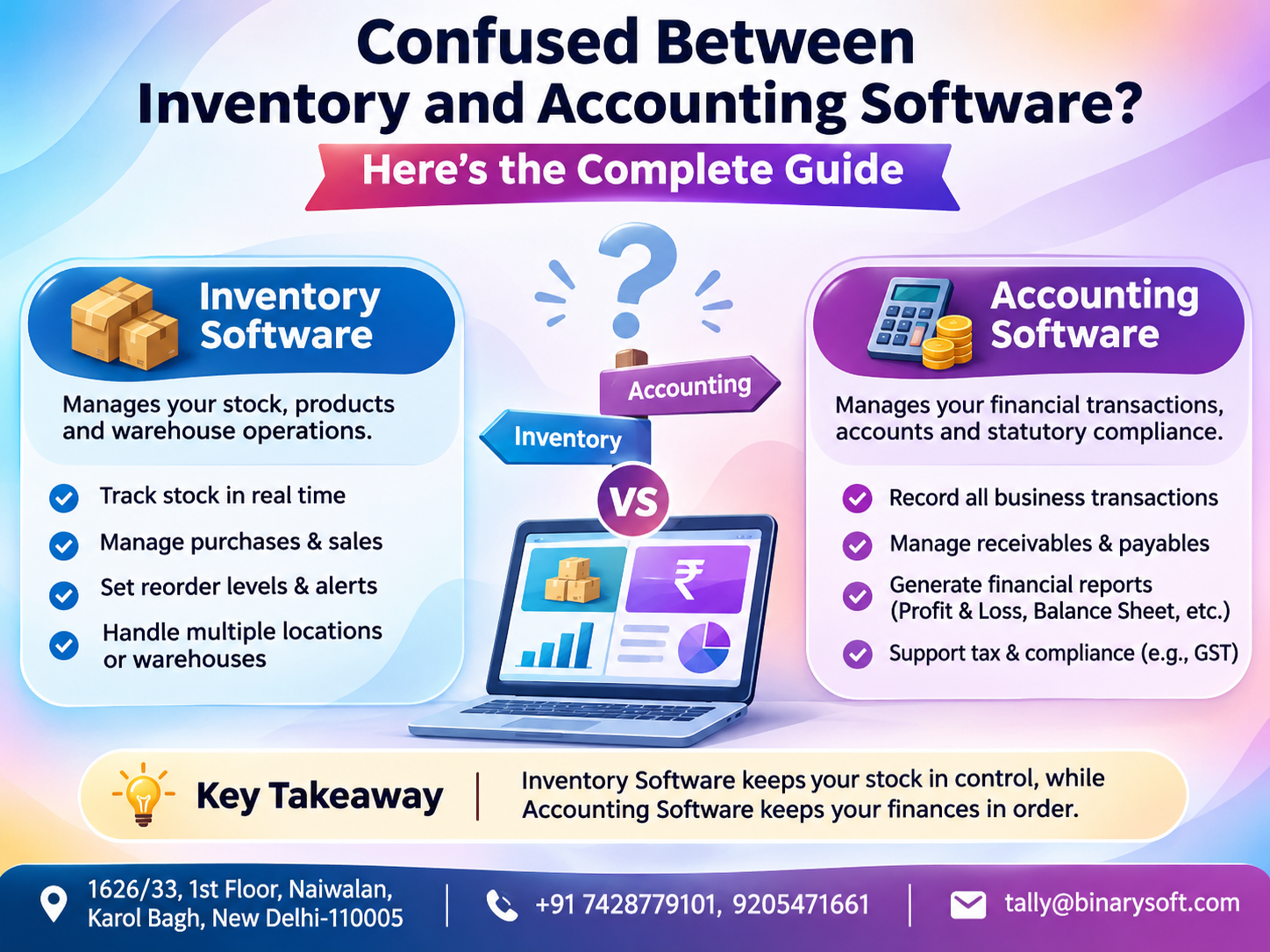
Tally Prime supports inventory records alongside accounting transactions.
This helps businesses review stock quantities and relevant financial information.
However, accurate reporting still requires suitable valuation policies, proper transaction recording and periodic verification.
Inventory management and accounting should operate as connected processes rather than separate activities.
19. Best Practice Fourteen: Monitor Inventory Performance Indicators
Businesses should evaluate inventory performance using relevant measurements.
Important indicators include inventory turnover, stockout frequency, inventory accuracy and holding costs.
Order fulfilment performance is also useful.
For example, management can monitor the percentage of customer orders delivered completely and on time.
Stock accuracy can be measured by comparing verified physical quantities with recorded quantities.
The most useful indicators depend on business objectives.
A manufacturer may prioritize material availability.
A retailer may focus on product availability and slow-moving stock.
Regular reviews help identify problems before they become expensive.
20. Best Practice Fifteen: Use Suitable Inventory Management Software
Manual inventory records become increasingly difficult to maintain as businesses grow.
Spreadsheets may work for simple operations but can create difficulties when several employees update separate files.
Inventory management software provides a more structured approach.
Tally Prime helps businesses maintain stock masters, record transactions and generate inventory reports.
Its capabilities include stock groups, stock categories, units of measurement, godowns, batch-wise details, reorder levels and inventory vouchers.
Businesses should configure these features according to actual operational requirements.
Software implementation should also include employee training, access controls and reliable backup procedures.
Technology delivers better results when supported by consistent business processes.
21. How to Implement Inventory Best Practices in Tally Prime
Businesses can begin with a practical setup process.
Step 1: Create Stock Groups
Organize products into meaningful categories.
Step 2: Create Stock Items
Enter accurate product names, units and relevant details.
Step 3: Configure Godowns
Create separate locations where warehouse-wise tracking is required.
Step 4: Record Opening Stock
Enter verified opening quantities and values.
Step 5: Maintain Inventory Transactions
Record purchases, sales, stock transfers and adjustments consistently.
Step 6: Configure Reorder Levels
Set replenishment thresholds for important items.
Step 7: Review Stock Summary
Monitor available quantities and inventory values.
Step 8: Analyse Stock Movement
Identify fast-moving and slow-moving products.
Step 9: Conduct Physical Verification
Compare actual quantities with recorded balances.
Step 10: Review Reports Regularly
Use inventory information to improve purchasing and operational decisions.
The exact options available depend on the installed Tally Prime release and company configuration.
22. Common Inventory Management Mistakes to Avoid
Even experienced businesses make inventory mistakes.
One common problem is purchasing excessive stock because of supplier discounts.
Another is failing to update inventory records after physical movements.
Businesses may also ignore slow-moving products or use inconsistent item names.
Poor supplier coordination can create unexpected shortages.
Inadequate physical verification allows discrepancies to accumulate.
Finally, some organizations implement software without training employees properly.
Avoiding these mistakes requires management attention, clear procedures and regular review.
The objective is to create dependable inventory information that supports practical decisions.
Conclusion
Inventory management best practices help businesses maintain the right balance between product availability and financial efficiency.
Accurate stock records, ABC analysis, reorder planning, supplier coordination and physical verification all contribute to stronger inventory control.
Monitoring stock movement and inventory turnover can also improve purchasing decisions.
Tally Prime supports these activities through structured stock masters, godown management, reorder levels, inventory vouchers and relevant reports.
For retailers, effective inventory control can reduce lost sales.
For manufacturers, it can support uninterrupted production.
For wholesalers, it can improve stock visibility and working capital management.
Successful inventory management is not about keeping the largest quantity of products. It is about keeping the right products, in the right quantities, at the right time, while protecting business profitability and customer trust.
Powered by Binarysoft Technologies
Authorized Tally Partner
Binarysoft Technologies helps businesses implement and use Tally Prime for accounting, inventory management, purchasing, warehouse tracking, GST-related workflows and financial reporting.
Organizations seeking to improve stock accuracy, inventory planning and business efficiency can benefit from appropriate Tally Prime configuration and structured inventory procedures.
Location:
1626/33, 1st Floor, Naiwalan, Karol Bagh, New Delhi – 110005, INDIA
Contact Us:
+91 7428779101, 9205471661
Email:
tally@binarysoft.com
Business Hours:
10:00 AM – 6:00 PM, Monday to Friday
Frequently Asked Questions
Can Tally Prime manage inventory?
Yes. Tally Prime supports stock items, inventory transactions, godowns, reorder levels and inventory reporting.
How does Tally Prime help with warehouse management?
Its godown functionality supports location-wise inventory tracking and stock transfers.
Why is physical stock verification necessary?
It helps identify differences between actual inventory and recorded quantities, supporting more reliable stock information.
How can Binarysoft Technologies help improve inventory management?
Binarysoft Technologies can assist with Tally Prime implementation, inventory configuration, warehouse tracking, stock reporting and accounting workflows.
CA. Praneet Bansaal is a Chartered Accountant with experience in taxation, accounting controls, and financial process reviews. He has advised businesses on aligning inventory movement with accounting and GST requirements. His content focuses on compliance, accuracy, and long-term sustainability.