Call CA Tally HelpDesk
+91 9205471661,
7428779101
Introduction: Why Every Manufacturer Needs an Accurate Bill of Materials
Imagine receiving an order for 500 wooden chairs.
Your customer expects timely delivery, consistent quality and competitive pricing.
Before production begins, your team must determine how much wood, how many screws, what quantity of adhesive and which other components are required.
If even one essential material is missing, production may stop.
If quantities are calculated incorrectly, the business may purchase excess stock or underestimate manufacturing costs.
This is where a Bill of Materials (BOM) becomes essential.
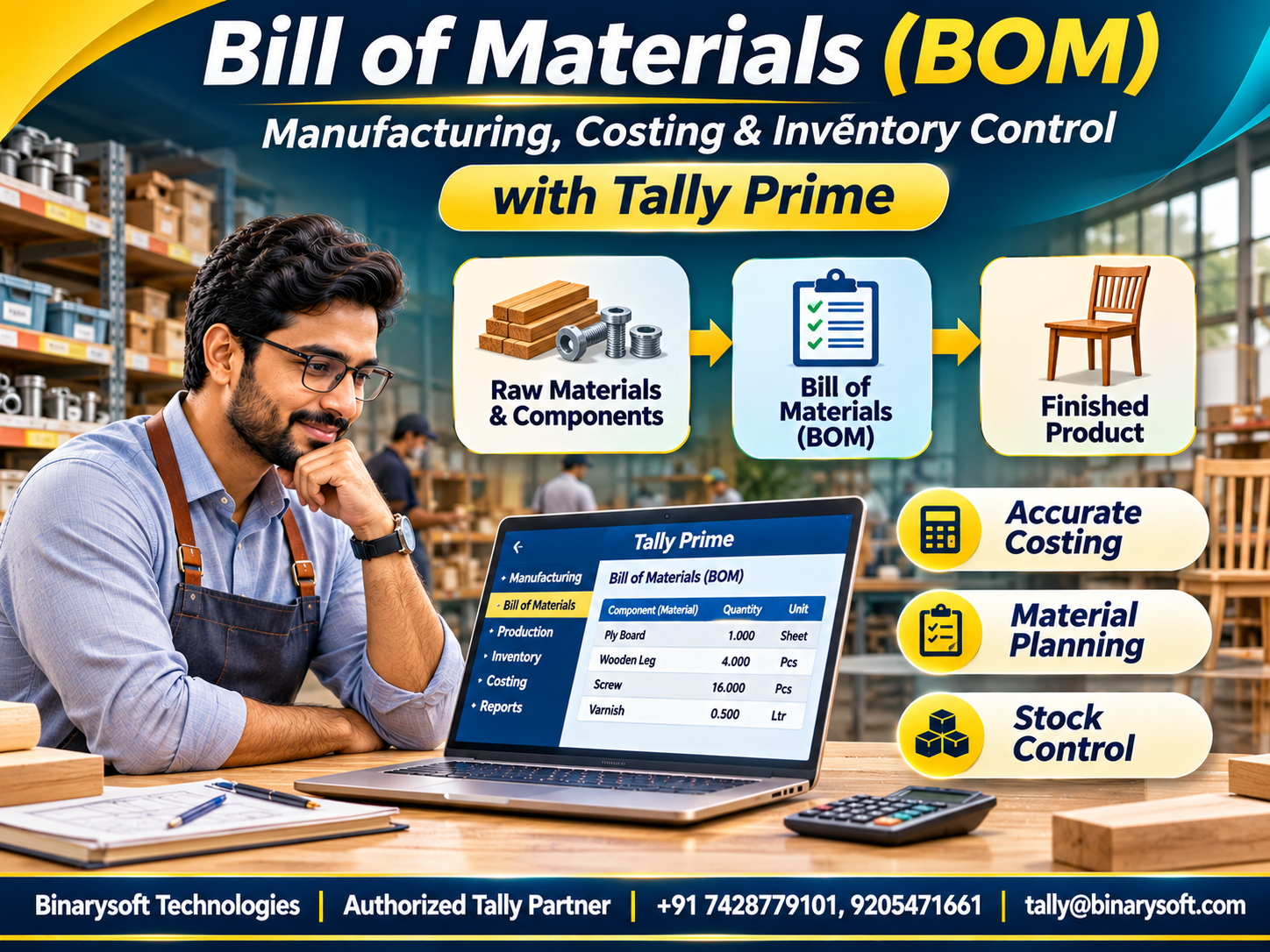
A BOM provides a structured list of the materials, components and quantities needed to manufacture a finished product.
It serves as a practical reference for production planning, purchasing, inventory management and cost estimation.
For small and medium manufacturers, a well-maintained BOM can improve coordination between purchasing, production, stores and accounting teams.
Tally Prime supports BOM-based manufacturing workflows, helping businesses record material consumption and finished-goods production more systematically.
1. What Is a Bill of Materials?
A Bill of Materials is a detailed list of items required to manufacture or assemble a product.
It typically identifies raw materials, components, subassemblies and the quantities required for a defined output.
For example, a furniture manufacturer producing one table may require a tabletop, four legs, screws, adhesive and finishing materials.
The BOM specifies these requirements before manufacturing begins.
A BOM is sometimes described as a product recipe because it explains what goes into a finished item.
However, it is more than a purchasing checklist.
A properly maintained BOM also supports production consistency, cost analysis and inventory planning.
The level of detail depends on the complexity of the product and the business's manufacturing process.
2. Why Is a Bill of Materials Important?
Manufacturing involves coordinating multiple resources.
Without clear material requirements, businesses may depend heavily on employee memory or informal calculations.
This creates unnecessary operational risk.
Accurate Material Planning
A BOM helps estimate the quantities required for production.
Better Purchasing Decisions
Purchasing teams can identify material requirements before placing orders.
Reduced Production Delays
Early identification of missing components helps prevent avoidable interruptions.
Improved Cost Estimation
Material requirements provide a foundation for estimating product costs.
Inventory Control
Businesses can compare production requirements with available raw materials.
Consistent Product Quality
Standardized component lists help maintain manufacturing consistency.
Better Coordination
Production, stores, purchasing and accounting teams can work from common information.
An accurate BOM therefore supports both operational efficiency and financial discipline.
3. Essential Components of a BOM
A practical BOM should contain enough information to identify each required material.
Finished Product Name
Identifies the product being manufactured.
Component Name
Specifies the raw material or part required.
Item Code
Provides a unique reference for identifying materials.
Quantity
Indicates the amount required for the defined production output.
Unit of Measurement
Specifies whether the material is measured in pieces, kilograms, metres, litres or another unit.
Subassembly Information
Identifies intermediate assemblies where applicable.
Revision Details
Helps distinguish different versions of a product specification.
Wastage Allowance
May be included in planning where material losses are expected.
Material Cost
Can support estimated manufacturing cost calculations.
Not every organization needs the same level of detail.
The objective is to maintain information that is accurate, useful and easy to understand.
4. Types of Bills of Materials
Different BOM structures serve different business requirements.
Engineering BOM
An engineering BOM describes a product from a design perspective.
It may include components and assemblies defined during product development.
Manufacturing BOM
A manufacturing BOM focuses on materials and assemblies required during production.
It may reflect how a product is actually manufactured.
Single-Level BOM
A single-level BOM lists components directly required for a finished product.
It is suitable for relatively simple manufacturing processes.
Multi-Level BOM
A multi-level BOM represents products containing subassemblies.
For example, a machine may contain several assemblies, each requiring multiple components.
Configurable BOM
A configurable BOM supports product variations based on selected specifications.
The appropriate structure depends on product complexity and the software used to manage manufacturing information.
5. Bill of Materials Example: Manufacturing a Wooden Chair
Consider a furniture manufacturer producing a wooden chair.
An illustrative BOM for one chair might contain:
| Component | Quantity | Unit |
|---|
| Wooden seat panel |
1 |
Piece |
| Wooden legs |
4 |
Pieces |
| Backrest assembly |
1 |
Piece |
| Screws |
16 |
Pieces |
| Wood adhesive |
0.10 |
Kilogram |
| Varnish |
0.25 |
Litre |
If the company receives an order for 100 chairs, the basic material requirements can be multiplied accordingly.
For example, 100 chairs would require 400 legs and 1,600 screws.
However, actual procurement should also consider available stock, wastage, supplier packaging and production requirements.
This example demonstrates how a BOM transforms a finished-product order into identifiable material needs.
6. How a BOM Supports Production Planning
Production planning begins with understanding what must be manufactured and which resources are required.
A BOM provides the material information needed for this process.
Suppose a manufacturer receives an order for 200 finished products.
The production team can use the BOM to estimate component requirements.
The stores department can then compare these requirements with available inventory.
Purchasing can identify materials that need replenishment.
This coordination helps reduce uncertainty.
However, a BOM alone does not provide a complete production schedule.
Businesses must also consider labour, machinery, production capacity and delivery commitments.
A BOM is therefore a foundational planning tool rather than a complete manufacturing management system.
7. An Emotional Story: A Father's Workshop and the Order That Almost Failed
Sanjay operated a small furniture manufacturing workshop in Delhi.
His father had started the business with two carpenters and a few basic machines.
Over the years, the workshop earned a reputation for dependable craftsmanship.
When Sanjay took responsibility for operations, he wanted to expand the business without losing its personal character.
One day, a school placed a large order for desks and chairs.
The order represented an important opportunity.
Sanjay promised delivery before the new academic session.
Production began enthusiastically.
However, halfway through the work, employees discovered that several essential fittings were unavailable.
The purchasing team had underestimated the requirement.
Some materials had also been used in greater quantities than expected.
The workshop faced an unexpected delay.
Sanjay felt devastated.
He remembered his father's advice that every commitment made to a customer represented the family's reputation.
That evening, he sat alone in the workshop, surrounded by unfinished furniture.
His father visited and listened patiently.
Instead of criticizing him, he asked whether the workshop had a written material plan for every product.
Sanjay realized that the business still relied too heavily on experience and memory.
The next morning, he gathered the team.
They prepared standardized component lists for frequently manufactured products.
They reviewed available stock and established a process for checking material requirements before accepting production schedules.
The school order was eventually completed after the team communicated revised arrangements and worked carefully to resolve the shortage.
The experience changed Sanjay's approach to manufacturing.
He understood that craftsmanship and systematic planning were equally important.
For Sanjay, a Bill of Materials became more than a document. It became a way to protect his father's legacy and the trust customers placed in their workshop.
This fictional story illustrates the value of disciplined material planning.
8. How Tally Prime Helps Manufacturers Manage BOMs
Tally Prime provides inventory and manufacturing features that support BOM-based workflows.
Businesses can define component requirements for manufactured stock items.
Stock Item Creation
Manufacturers can create separate stock items for raw materials and finished products.
Bill of Materials Configuration
A component list can be associated with an appropriate finished-goods stock item.
Single or Multiple BOMs
Different BOMs can be maintained for a product when alternative material combinations are required.
Manufacturing Journal
Manufacturers can record material consumption and finished-goods production.
Godown Management
Configured storage locations help businesses monitor material movements.
Cost Estimation
Supported reports help businesses review estimated manufacturing costs.
By-Products and Scrap
Manufacturing transactions can account for relevant co-products, by-products and scrap.
These capabilities support more organized manufacturing inventory records.
9. How to Create a Bill of Materials in Tally Prime
The following general workflow applies to supported Tally Prime configurations.
Step 1: Create Raw Material Masters
Create stock items for the materials and components used in production.
Assign appropriate units of measurement.
Step 2: Create the Finished Product
Open the stock item creation or alteration screen.
Enter the finished product's name, stock group and unit.
Step 3: Enable BOM Details
Use the relevant stock item configuration to enable component-list details.
Step 4: Name the BOM
Create a meaningful BOM name that identifies the intended specification.
Step 5: Specify Manufacturing Quantity
Define the quantity of finished goods to which the component list applies.
Step 6: Enter Components
Select the required raw materials and specify their quantities.
Step 7: Review the Information
Verify item names, units and material requirements.
Step 8: Save the BOM
Save the completed stock item details.
The exact navigation may vary according to the software release and configuration.
10. Recording Manufacturing with a BOM in Tally Prime
After defining a BOM, businesses can use the Manufacturing Journal workflow.
Open voucher creation and select the appropriate Stock Journal or Manufacturing Journal mode.
Choose the finished product.
Select the relevant BOM.
Enter the quantity being manufactured.
The application can populate component-consumption details based on the selected BOM.
Users should review quantities and other transaction information before saving.
Where applicable, the voucher can also include details of co-products, by-products or scrap.
This process helps record the conversion of raw materials into finished goods.
Importantly, creating a BOM alone does not mean that production has occurred.
Actual stock consumption and finished-goods recording depend on the relevant manufacturing transactions.
11. Single BOM vs Multiple BOM in Tally Prime
A single BOM is suitable when a product uses a consistent set of materials.
For example, a standard wooden chair may always use the same basic components.
Multiple BOMs are useful when a finished product can be manufactured using different material combinations.
A furniture manufacturer may produce the same chair model using alternative approved materials.
Different BOMs can represent those variations.
During manufacturing, the appropriate BOM can be selected.
This flexibility helps businesses maintain separate material specifications.
However, alternative BOMs should be reviewed carefully.
Different materials may affect product quality, manufacturing costs and customer requirements.
12. Case Study One: BOM Management in a Furniture Manufacturing Unit
Illustrative Case Study
Business Background
A small furniture manufacturer produces chairs, tables and office desks.
The Challenge
Material requirements are calculated manually.
Occasional shortages interrupt production, while unused components accumulate in storage.
The Approach
The company standardizes component lists for frequently manufactured products.
Raw materials and finished goods are maintained as stock items in Tally Prime.
BOMs are configured for suitable products.
Manufacturing transactions are recorded through the appropriate voucher workflow.
Expected Outcome
The business can improve material visibility and make purchasing decisions using more consistent information.
Business Lesson
A reliable BOM helps convert manufacturing knowledge into repeatable operational processes.
13. Case Study Two: Component Planning for an Electrical Assembly Business
Illustrative Case Study
Business Background
An electrical equipment manufacturer assembles distribution boxes using switches, wiring, enclosures and other components.
The Challenge
Different customer specifications require varying component combinations.
The business needs a clearer way to manage these variations.
The Approach
The manufacturer reviews product specifications and creates suitable alternative BOMs.
Tally Prime is used to maintain component records and document relevant manufacturing transactions.
The accounting team reviews material consumption and manufacturing costs.
Expected Outcome
The company can improve consistency in component selection and gain better visibility into material usage.
Business Lesson
Multiple BOMs can help manufacturers manage approved product variations without relying entirely on informal instructions.
Both case studies are illustrative rather than verified customer results.
14. How a BOM Helps Calculate Manufacturing Costs
A BOM provides the component quantities needed for material-cost estimation.
Suppose a product requires:
| Material | Estimated Cost |
|---|
| Main component |
₹500 |
| Secondary components |
₹200 |
| Fasteners |
₹50 |
| Packaging |
₹30 |
| Total Direct Material Cost |
₹780 |
If direct labour costs ₹150 and allocated manufacturing overhead is ₹120, the illustrative total manufacturing cost becomes ₹1,050.
This calculation assumes the amounts are applicable to one finished unit.
Actual manufacturing costs may also depend on wastage, production volume, scrap recovery and other factors.
Tally Prime's manufacturing and cost-estimation features can support relevant analysis.
Businesses should distinguish estimated costs from actual recorded costs.
15. BOM and Inventory Management
A BOM connects finished-product requirements with raw material quantities.
This relationship helps businesses identify material needs before production.
For example, a manufacturer planning 500 units can calculate the required components using the relevant BOM.
The stores team can compare these requirements with available stock.
Purchasing can then review shortages.
However, material requirements should not be confused with automatic purchasing decisions.
Outstanding orders, supplier lead times, safety stock and actual production schedules must also be considered.
Tally Prime inventory reports can support stock visibility when transactions are recorded accurately.
16. Common BOM Management Mistakes
Businesses should avoid several common mistakes.
Incorrect Quantities: Small errors can multiply across large production orders.
Outdated Specifications: Old BOMs may not reflect current product requirements.
Inconsistent Units: Confusing kilograms, grams, metres and pieces can distort calculations.
Missing Components: Omitted items may cause production interruptions.
Uncontrolled Changes: Unauthorized modifications can create inconsistent manufacturing records.
Ignoring Wastage: Material planning may be unrealistic when normal losses are overlooked.
Poor Master Data: Duplicate or unclear stock item names increase confusion.
Regular review and clear approval procedures help reduce these risks.
17. Best Practices for Effective BOM Management
Manufacturers should establish a structured BOM management process.
Use Clear Item Names: Maintain understandable descriptions and unique references.
Verify Quantities: Confirm requirements with production personnel.
Maintain Version Control: Record important specification changes.
Review Alternative Materials: Ensure substitutions meet quality requirements.
Update BOMs Promptly: Reflect approved product changes.
Coordinate Departments: Involve purchasing, production, stores and accounting teams.
Reconcile Consumption: Compare expected material usage with actual manufacturing records.
Review Costs: Reassess material costs when prices or production processes change.
These practices help businesses maintain accurate and useful BOM information.
18. The Future of BOM Management
Manufacturing businesses are increasingly exploring connected planning, inventory and production systems.
Digital BOMs can support consistent information across departments.
Suitable integrations may help organizations connect product specifications with purchasing and manufacturing workflows.
Advanced systems may also support revision management, demand planning and production scheduling.
However, these capabilities depend on the software and implementation.
For businesses using Tally Prime, BOMs and Manufacturing Journals provide practical tools for maintaining manufacturing-related inventory records.
Organizations with more complex requirements may evaluate additional systems or suitable integrations.
The most important objective remains unchanged: accurate information about what is required to manufacture each product.
Conclusion
A Bill of Materials is one of the most important documents in manufacturing.
It identifies the components and quantities needed to produce finished goods.
Accurate BOMs support purchasing, inventory control, cost estimation and consistent production.
They also help reduce the risks associated with informal material calculations.
Tally Prime supports manufacturing workflows through stock items, single or multiple BOMs, Manufacturing Journals, godown tracking and cost-estimation reports.
However, successful BOM management requires careful configuration, accurate master data and regular verification.
Manufacturers should combine software capabilities with disciplined production planning and clear responsibilities.
A well-maintained Bill of Materials does more than describe a product. It helps transform manufacturing knowledge into consistent quality, better cost control and dependable customer commitments.
Powered by Binarysoft Technologies
Authorized Tally Partner
Binarysoft Technologies helps manufacturing businesses improve accounting and inventory management through Tally Prime implementation, configuration, customization, technical support and cloud-based accounting solutions.
Our services support manufacturers seeking better material tracking, reliable inventory records and improved production-cost visibility.
Location:
1626/33, 1st Floor, Naiwalan, Karol Bagh, New Delhi – 110005, INDIA
Contact Us:
+91 7428779101, 9205471661
Email:
tally@binarysoft.com
Business Hours:
10:00 AM – 6:00 PM, Monday to Friday
Frequently Asked Questions
Does creating a BOM automatically reduce inventory?
No. A BOM defines material requirements. Relevant manufacturing transactions record actual stock consumption.
How does a BOM help with product costing?
It identifies required material quantities, which can be combined with relevant cost information to estimate manufacturing costs.
Can a BOM help prevent raw material shortages?
It supports material planning, but reliable replenishment also requires accurate stock records, purchasing controls and supplier coordination.
What is the difference between a BOM and a purchase order?
A BOM defines the materials required to manufacture a product. A purchase order communicates a purchasing requirement to a supplier.
CA. Priya Tanvi specializes in accounting compliance, GST advisory, and business reporting for small and growing enterprises. She works with business owners to improve record-keeping and financial clarity. Her articles focus on practical compliance solutions and operational discipline.