Call CA Tally HelpDesk
+91 9205471661,
7428779101
When Every Kilogram Matters to Your Business
In India's growing food processing industry, success depends on more than producing delicious, safe and affordable products. Behind every packet of spices, bottle of juice, bag of flour or box of snacks lies a complicated financial journey involving raw materials, production expenses, wastage, packaging, inventory, taxation and customer payments.
For a food manufacturer, even a small mistake in calculating production costs can significantly affect profitability.
Imagine purchasing 1,000 kilograms of raw materials but receiving only 850 kilograms of finished products after processing. Where did the remaining quantity go? Was it normal moisture loss, cleaning waste, rejected material or an avoidable production inefficiency?
Without accurate accounting and inventory records, answering these questions becomes difficult.
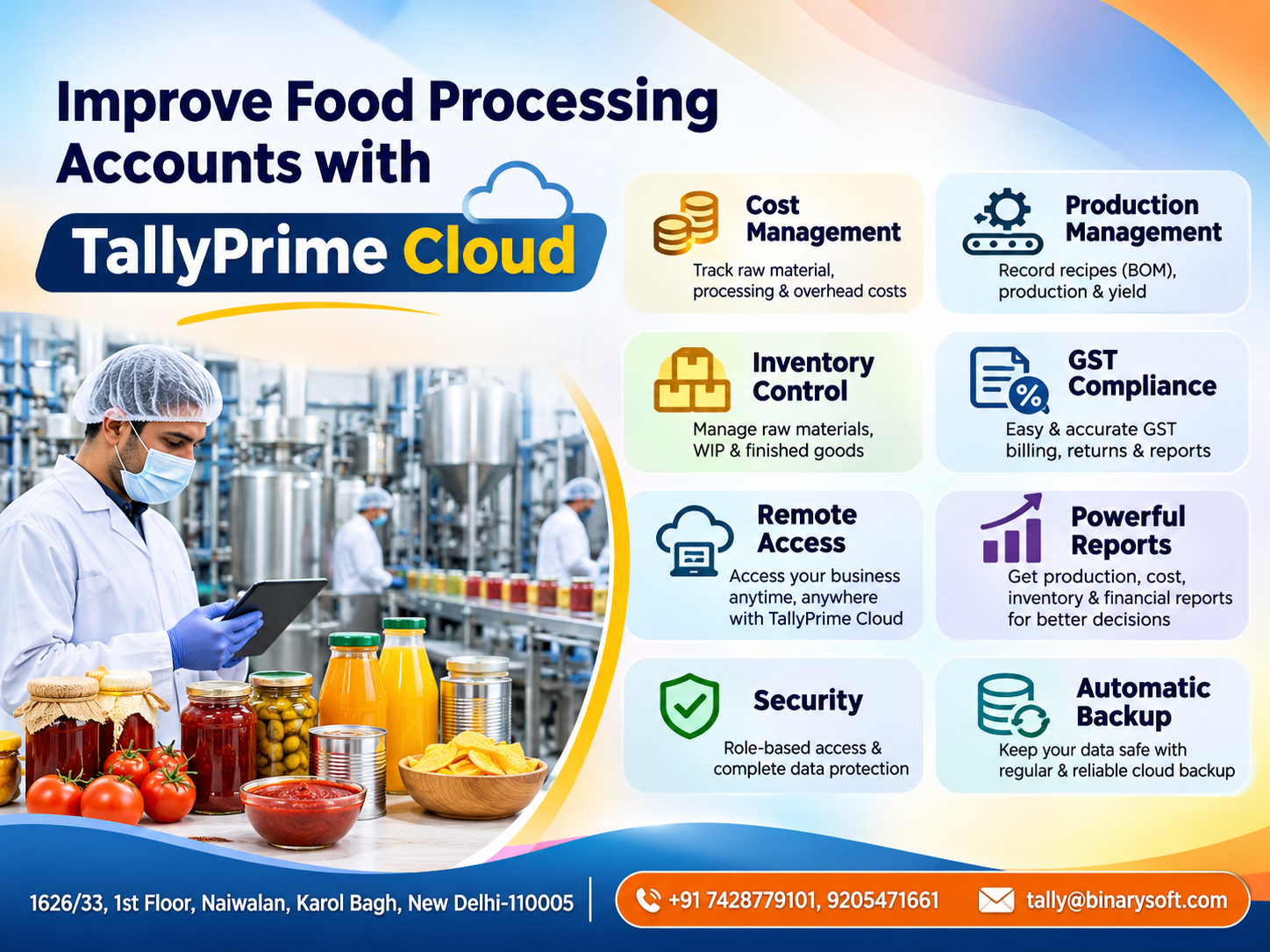
This is where TallyPrime Cloud for food processing businesses can make a meaningful difference.
By combining TallyPrime's accounting, inventory, manufacturing and reporting capabilities with a properly configured cloud-hosted environment, businesses can manage financial operations more efficiently while enabling authorized employees to access their accounting system remotely.
From small spice manufacturers in Delhi to growing packaged food companies operating across India, a structured digital accounting system can help improve cost visibility, stock control, GST compliance and management decisions.
1. Understanding Accounting Challenges in the Food Processing Industry
Food processing accounting is different from ordinary trading or retail accounting because raw materials undergo physical transformation before becoming finished goods.
A food manufacturer may purchase wheat, spices, edible oil, vegetables, milk or fruits and convert them into packaged products through multiple production activities.
Every stage introduces financial and operational challenges.
Major accounting challenges
-
Raw material price fluctuations: Seasonal demand, agricultural supply and transportation expenses can change purchase costs.
-
Production wastage: Moisture loss, trimming, cleaning and rejected material affect actual output.
-
Multiple production stages: Mixing, grinding, cooking, drying, cooling and packaging require accurate cost allocation.
-
Batch tracking: Manufacturers need to identify production batches for quality and traceability.
-
Expiry management: Perishable materials and finished products require careful stock monitoring.
-
GST compliance: Tax classification, invoice accuracy and return reconciliation require attention.
-
Credit management: Distributor and retailer payments may remain outstanding for weeks.
-
Multiple locations: Factories, warehouses and offices must coordinate inventory and financial records.
Traditional spreadsheets and disconnected software systems can make these processes time-consuming.
TallyPrime helps businesses maintain integrated accounting and inventory records, reducing the need to repeatedly enter the same transaction across separate systems.
2. How TallyPrime Cloud Helps Food Processing Businesses
TallyPrime Cloud generally refers to TallyPrime operating through a hosted desktop or remote-access environment. It is not a separate replacement for the TallyPrime accounting application.
With a suitable hosting arrangement, authorized users can access the accounting environment from different locations using supported devices and secure connectivity.
Benefits for food manufacturers
Centralized accounting: Purchase transactions, sales invoices, expenses, inventory and financial reports can be maintained within one accounting environment.
Remote business access: Owners and accountants can work from the factory, corporate office or another location without depending entirely on physical access to one office computer.
Improved coordination: Production, warehouse and accounts personnel can work with consistent records when user permissions and workflows are configured correctly.
Better financial visibility: Business owners can review sales, expenses, outstanding payments and stock valuations.
Business continuity: Managed hosting, scheduled backups and recovery arrangements can reduce operational disruption.
Actual remote-access performance, simultaneous-user capacity, backup availability and security controls depend on the hosting provider, licensing and configuration.
3. Managing Raw Material Purchases and Inventory
Raw material management is one of the most important responsibilities in food processing.
A biscuit manufacturer may need flour, sugar, edible oil, milk powder, flavors and packaging materials. Each item has a different purchase price, storage requirement and consumption pattern.
TallyPrime allows businesses to create stock items, stock groups, units of measurement and godowns or locations.
Practical inventory setup
|
Inventory category
|
Example items
|
Accounting purpose
|
|---|
|
Raw materials
|
Flour, sugar, spices
|
Track purchases and consumption
|
|
Packaging materials
|
Pouches, cartons, labels
|
Monitor packing costs
|
|
Work-in-progress
|
Partially processed material
|
Track intermediate production where configured
|
|
Finished goods
|
Biscuits, snacks, sauces
|
Record production and sales
|
|
Rejected materials
|
Damaged or unusable stock
|
Monitor losses and adjustments
|
For example, a spice manufacturer can maintain separate stock records for raw turmeric, processed turmeric powder and packaged turmeric products.
Purchase invoices increase raw material stock, manufacturing entries record consumption and finished goods production, and sales invoices reduce finished goods inventory.
Batch details, where enabled and appropriately configured, can support batch identification and stock tracking. Advanced expiry alerts, FEFO allocation and end-to-end food traceability may require additional controls or integrations.
4. Calculating Accurate Food Production Costs
Production costing is essential because the selling price alone does not determine profitability.
Food manufacturers must consider direct materials, direct labor, packaging and appropriate manufacturing overheads.
Example: Cost of manufacturing 1,000 packets of snacks
|
Cost component
|
Amount
|
|---|
|
Raw potatoes and ingredients
|
₹18,000
|
|
Edible oil and seasoning
|
₹7,500
|
|
Packaging materials
|
₹4,000
|
|
Direct labor
|
₹5,000
|
|
Electricity and fuel
|
₹3,500
|
|
Allocated factory overheads
|
₹2,000
|
|
Total production cost
|
₹40,000
|
Cost per packet = ₹40,000 ÷ 1,000 = ₹40
If the manufacturer sells each packet at ₹55 before applicable taxes, the difference is ₹15 per packet before selling, distribution, administrative and other unallocated expenses.
TallyPrime's manufacturing journal and bill of materials features can help record material consumption and finished goods output.
Businesses can also maintain appropriate expense ledgers and cost centers for production-related expenses. Detailed product-level allocation of labor and overhead may require a defined costing procedure or customization.
Accurate costing helps management identify unprofitable products, review selling prices and reduce unnecessary expenses.
5. Managing Production with Bills of Materials
A Bill of Materials (BOM) specifies the quantities of ingredients or components required to manufacture a product.
For example, a packaged namkeen manufacturer may define a standard recipe containing gram flour, edible oil, salt, spices and packaging materials.
TallyPrime can maintain BOM information for finished stock items and use it in manufacturing entries.
This provides a structured way to compare expected material requirements with actual production activity.
When using manufacturing journals, businesses can record raw material consumption, finished goods quantities and applicable additional costs.
However, standard BOM functionality should not be confused with a complete manufacturing execution system. Complex recipe versioning, automated shop-floor measurements and advanced quality control may need specialized applications.
6. Controlling Wastage and Improving Production Yield
Food processing inevitably involves some material loss.
Vegetables lose weight during peeling, grains may lose moisture during drying, and products may be rejected during quality checks.
The important question is whether losses remain within acceptable production standards.
Consider a manufacturer processing 2,000 kilograms of fresh tomatoes and producing 1,300 kilograms of usable processed output.
Production yield can be calculated as:
Production Yield (%) = (Usable Finished Output ÷ Raw Material Input) × 100
Production Yield = (1,300 ÷ 2,000) × 100 = 65%
If the expected yield is 72%, management should investigate the difference.
TallyPrime can help record material consumption and finished quantities, while separately maintained production records can support yield analysis.
By reviewing these figures regularly, businesses can identify excessive wastage, equipment inefficiency or inconsistencies in raw material quality.
7. GST Billing and Compliance for Food Manufacturers
GST compliance is particularly important in the food processing industry because tax treatment can vary according to the product, HSN classification, packaging and applicable notifications.
Manufacturers selling flour, spices, snacks, beverages or processed foods should verify the correct GST classification before generating invoices.
TallyPrime helps businesses maintain GST-related ledgers, configure tax details, generate tax invoices and review GST reports.
How TallyPrime supports GST accounting
-
Maintain customer and supplier GSTIN details.
-
Configure applicable HSN codes and GST rates.
-
Generate invoices with CGST, SGST or IGST, as applicable.
-
Record purchase transactions and input tax credit details.
-
Review GST-related exceptions and reconciliation reports.
-
Prepare relevant GST return data using supported features.
-
Support e-invoicing and e-way bill processes where applicable.
Businesses should regularly reconcile their accounting records with GST portal information and verify eligibility for input tax credit.
Accurate GST accounting helps reduce avoidable errors, supports timely compliance and improves financial transparency.
8. An Emotional Story: A Father's Dream and a Factory's Second Chance
When Rajesh started his small pickle manufacturing business, his dream was simple: build a successful company that his daughter could proudly inherit.
Every morning, he reached his factory before sunrise. He personally checked raw mango deliveries, supervised workers and negotiated with packaging suppliers.
His products were popular, and orders were increasing.
Yet something was wrong.
Despite rising sales, his bank balance remained unpredictable. Raw materials frequently went missing from stock records. Some products expired before dispatch, and distributor payments were difficult to track.
One evening, his daughter asked him, "Papa, if we are selling more every month, why are you still worried about paying everyone?"
Rajesh had no clear answer.
The business had grown, but its accounting system had not.
His daughter suggested implementing a structured inventory and accounting process using TallyPrime with cloud access.
They began recording raw material purchases, production consumption, packaging expenses, batch information and customer outstanding balances.
Over time, Rajesh gained a clearer understanding of which products earned money and which consumed too many resources.
He could review business reports while visiting suppliers, and his daughter could help manage accounts from another location.
The most meaningful change was not technological.
It was the evening Rajesh returned home early, sat with his family and realized that running a successful business no longer had to mean worrying about every transaction.
This is an illustrative fictional story representing challenges commonly faced by small food manufacturers.
9. Case Study One: Spice Manufacturing Business in Delhi
Illustrative case study — figures are hypothetical
A medium-sized spice manufacturer produces turmeric, coriander and red chilli powder for wholesalers.
Business challenges
The company purchases agricultural commodities at changing prices and processes them into packaged products.
Its major difficulties include inconsistent production costing, unrecorded grinding losses, packaging expenses and stock differences between the factory and warehouse.
TallyPrime implementation
The business introduces separate stock groups for raw spices, processed powders and packaging materials.
Bills of Materials are created for standard production requirements, while manufacturing journals record consumption and finished output.
Godown records help distinguish factory stock from warehouse inventory.
Cost centers and expense ledgers support analysis of grinding, packaging and other operational costs.
Illustrative results
|
Performance indicator
|
Before
|
After
|
|---|
|
Monthly inventory discrepancies
|
₹75,000
|
₹22,000
|
|
Production cost calculation
|
3 days
|
1 day
|
|
Wastage rate
|
8%
|
5%
|
|
Monthly accounting review
|
12 hours
|
5 hours
|
The example demonstrates how improved recording procedures and regular stock reconciliation could help reduce discrepancies.
The improvements depend on disciplined processes, employee training and management review rather than software alone.
10. Case Study Two: Packaged Snacks Manufacturer Expanding Across India
Illustrative case study — figures are hypothetical
A packaged snacks manufacturer operates a production facility in Haryana and supplies distributors in Delhi, Rajasthan and Uttar Pradesh.
Business challenges
As the company expands, management faces difficulties coordinating inventory, tracking distributor payments and accessing reports outside the factory.
Its accountant works from the head office, while production records originate at the manufacturing facility.
Cloud accounting solution
The company adopts a properly configured TallyPrime cloud-hosting environment.
Authorized staff can access the accounting system remotely, while management reviews sales, receivables and inventory reports.
Distributor ledgers are maintained with bill-wise references to support payment follow-ups.
Illustrative improvements
-
Customer outstanding reviews become more frequent.
-
Sales and purchase entries are available to authorized users without transferring accounting files manually.
-
Stock reports support replenishment decisions.
-
Management spends less time waiting for financial information.
-
Scheduled backups and documented recovery procedures improve business continuity.
The company gains a more coordinated accounting workflow as its distribution network expands.
11. Remote Access for Factory Owners and Accountants
Food manufacturers often operate from multiple locations.
The factory may be situated in an industrial area, while the owner works from a city office and the accountant occasionally works remotely.
With suitable TallyPrime cloud hosting, authorized employees can access the accounting environment through supported remote desktop or browser-based arrangements.
A business owner may review financial reports while traveling, while the accountant records transactions and the warehouse team updates authorized inventory entries.
This flexibility can improve communication between departments.
However, businesses should confirm user licensing, simultaneous access requirements, internet reliability and access permissions before selecting a hosting plan.
12. Financial Reports That Support Better Decisions
Financial reporting helps food manufacturers understand whether business growth is producing sustainable profits.
TallyPrime provides several useful reports, including:
Profit and Loss Account: Helps management evaluate revenue, expenses and overall profitability.
Balance Sheet: Shows assets, liabilities and financial position.
Stock Summary: Provides information about inventory quantities and values.
Godown Summary: Helps compare inventory held at different locations.
Outstanding Receivables: Identifies customer invoices awaiting payment.
Outstanding Payables: Helps plan supplier payments.
Cash Flow Reports: Support liquidity monitoring and financial planning.
Cost Centre Reports: Help analyze expenses allocated to departments or business activities.
For meaningful production profitability analysis, businesses should maintain accurate expense classifications, inventory values and cost allocations.
Regular reporting can reveal whether rising sales are accompanied by increasing wastage, excessive inventory or delayed collections.
13. Security and Backup for Food Processing Accounts
Accounting information is among a manufacturer's most valuable business assets.
It includes supplier prices, customer balances, production costs, inventory values and financial records.
Losing this information can interrupt operations and create serious compliance difficulties.
A secure TallyPrime hosting arrangement should include appropriate access controls, protected connections, regular backups and documented recovery procedures.
Recommended security practices
-
Create individual user accounts instead of sharing passwords.
-
Restrict access according to employee responsibilities.
-
Use multifactor authentication wherever supported.
-
Maintain scheduled backups and separate recovery copies.
-
Test data restoration periodically.
-
Apply software and operating system security updates.
-
Review user access when employees change roles or leave.
Cloud hosting does not automatically eliminate cybersecurity risks. Security also depends on configuration, employee practices and the hosting provider's safeguards.
14. How Much Does TallyPrime Cloud Cost for Food Manufacturers?
The total cost depends on the required TallyPrime license, hosting service, number of users, computing resources, storage, backup arrangements and support requirements.
Businesses should distinguish between the accounting software license and cloud-hosting charges.
Additional expenses may include initial configuration, data migration, employee training, customized reports and integrations.
A small food manufacturer may require only a few accounting users, while a larger organization may need simultaneous access for finance, inventory and management teams.
Instead of selecting a plan solely by its monthly subscription amount, manufacturers should compare overall operating costs, reliability, data security, support availability and scalability.
15. How to Implement TallyPrime for a Food Processing Business
Successful implementation begins with understanding the manufacturer's operational workflow.
Step 1: Analyze existing operations. Identify raw materials, production stages, inventory locations, sales channels and accounting requirements.
Step 2: Configure company accounts. Create necessary ledgers, tax settings, stock groups, stock items and units.
Step 3: Organize manufacturing records. Establish Bills of Materials, production voucher procedures and wastage recording methods.
Step 4: Set up inventory tracking. Configure godowns and relevant batch details, including manufacturing and expiry information where required.
Step 5: Configure cloud access. Define users, permissions, licensing requirements and secure remote connectivity.
Step 6: Train employees. Ensure purchase, production, warehouse and accounting teams understand their responsibilities.
Step 7: Review reports regularly. Monitor production costs, stock differences, customer payments and financial performance.
Businesses should also document quality-control procedures and statutory compliance processes outside the accounting system where necessary.
16. Why Food Manufacturers Should Modernize Their Accounting
Food processing businesses operate in a competitive environment where margins can be affected by raw material prices, transportation expenses, wastage and customer payment delays.
An organized accounting system helps owners understand these pressures before they become serious financial problems.
TallyPrime provides a foundation for accounting, inventory management, manufacturing records, taxation and financial reporting.
When combined with suitable cloud hosting, it can also support more flexible access and collaboration.
The objective is not simply to digitize bookkeeping. It is to build reliable financial information that supports purchasing decisions, production planning, pricing and sustainable business growth.
Conclusion: Build a More Profitable and Organized Food Processing Business
Every successful food processing company needs control over its materials, manufacturing expenses, inventory, customer payments and financial records.
Without accurate information, even a business experiencing strong sales can struggle with cash flow and profitability.
TallyPrime Cloud can help food manufacturers establish better accounting discipline, improve inventory visibility, monitor production costs and access important business information remotely.
Whether a company manufactures spices, snacks, bakery products, dairy products, pickles or packaged foods, the right accounting structure can support more confident decision-making.
With appropriate implementation, employee training, security controls and ongoing support, manufacturers can spend less time resolving accounting problems and more time improving products, serving customers and expanding their businesses.
Get Expert Assistance from Binarysoft Technologies
Looking to improve accounting, production costing, inventory management and remote business access for your food processing company?
Binarysoft Technologies helps businesses evaluate and implement TallyPrime solutions according to their accounting and operational requirements.
Powered by Binarysoft Technologies
Authorized Tally Partner
Location: 1626/33, 1st Floor, Naiwalan, Karol Bagh, New Delhi – 110005, INDIA
Contact Us: +91 7428779101, 9205471661
Email: tally@binarysoft.com
Business Hours: 10:00 AM – 6:00 PM, Monday to Friday
Frequently Asked Questions
Is TallyPrime suitable for food processing businesses?
Yes. TallyPrime can help food processing businesses manage accounting, raw material inventory, production entries, purchase transactions, sales invoices, GST records and financial reporting.
Can TallyPrime calculate food manufacturing costs?
Yes. Businesses can record raw material consumption and manufacturing-related expenses. Detailed product-level costing depends on appropriate configuration and expense allocation procedures.
CA. Darshit Malhotraa has hands-on experience in GST compliance, accounting reviews, and MSME consulting. He regularly works with businesses transitioning from manual systems to digital accounting platforms. His content emphasizes real-world problem solving and operational efficiency.