Call CA Tally HelpDesk
+91 9205471661,
7428779101

Introduction: Why Businesses Need One System for Stock and Sales
Every business owner wants to know three important things: how much stock is available, which products are selling, and how much money the business is earning.
Yet many retailers, wholesalers, distributors, and manufacturers still maintain stock records and sales information in separate systems.
Sales invoices may be recorded in accounting software, while inventory quantities are maintained in spreadsheets or handwritten registers.
This disconnected approach can create confusion.
A salesperson may promise delivery of an item that is no longer available. A purchasing manager may order products that are already sitting in the warehouse. An accountant may struggle to reconcile sales figures with inventory movement.
As businesses grow, these problems become more serious.
Tracking stock and sales in one place helps businesses connect product movement with financial transactions, improve inventory accuracy, and make better purchasing decisions.
Integrated accounting and inventory software reduces the need to enter the same information repeatedly.
Tally Prime provides stock-item management, sales and purchase accounting, inventory vouchers, GST invoicing, godown tracking, and business reporting within a connected accounting environment.
For Indian businesses dealing with increasing product varieties, customer expectations, and compliance requirements, these capabilities can improve operational control.
This guide explains how integrated stock and sales tracking works, how to implement it in Tally Prime, and how businesses can use inventory information to improve profitability.
A Father's Promise: How Better Stock Control Saved a Family Business
In Delhi's Sadar Bazaar, Rajesh managed a wholesale household goods business that his father had established more than twenty-five years earlier.
The business supplied products to retailers across Delhi and nearby markets.
Over time, Rajesh expanded the product range from a few dozen items to several hundred.
But while sales increased, inventory management became increasingly difficult.
His employees maintained stock quantities in spreadsheets, while sales invoices were recorded separately.
One morning, an important customer placed a large order for kitchen storage containers.
The stock register showed sufficient quantities, and Rajesh promised delivery the following day.
However, when warehouse employees began preparing the order, they discovered that many cartons were missing.
Some had already been sold, but the spreadsheet had not been updated.
Rajesh felt helpless.
The customer was disappointed, and the delayed delivery affected their long-standing business relationship.
That evening, Rajesh returned home late.
His father noticed that he seemed unusually worried.
When Rajesh explained the problem, his father reminded him that customers had trusted their family business for decades.
He said that growth was valuable only when the business could continue honouring its commitments.
Those words stayed with Rajesh.
He decided to reorganize the company's accounting and inventory processes.
The business introduced structured stock-item records in Tally Prime and began recording sales and purchases through an integrated workflow.
Warehouse employees received training in inventory vouchers, while the accounts team reviewed stock reports regularly.
Gradually, Rajesh gained clearer information about available quantities and product movement.
A few months later, the same customer placed another large order.
This time, Rajesh checked the stock position before confirming delivery.
The goods were dispatched as promised.
For Rajesh, the greatest achievement was not simply improved reporting.
It was restoring the confidence of a customer who had trusted his family for years.
This is an illustrative story reflecting common inventory challenges faced by growing Indian businesses.
1. What Does Tracking Stock and Sales in One Place Mean?
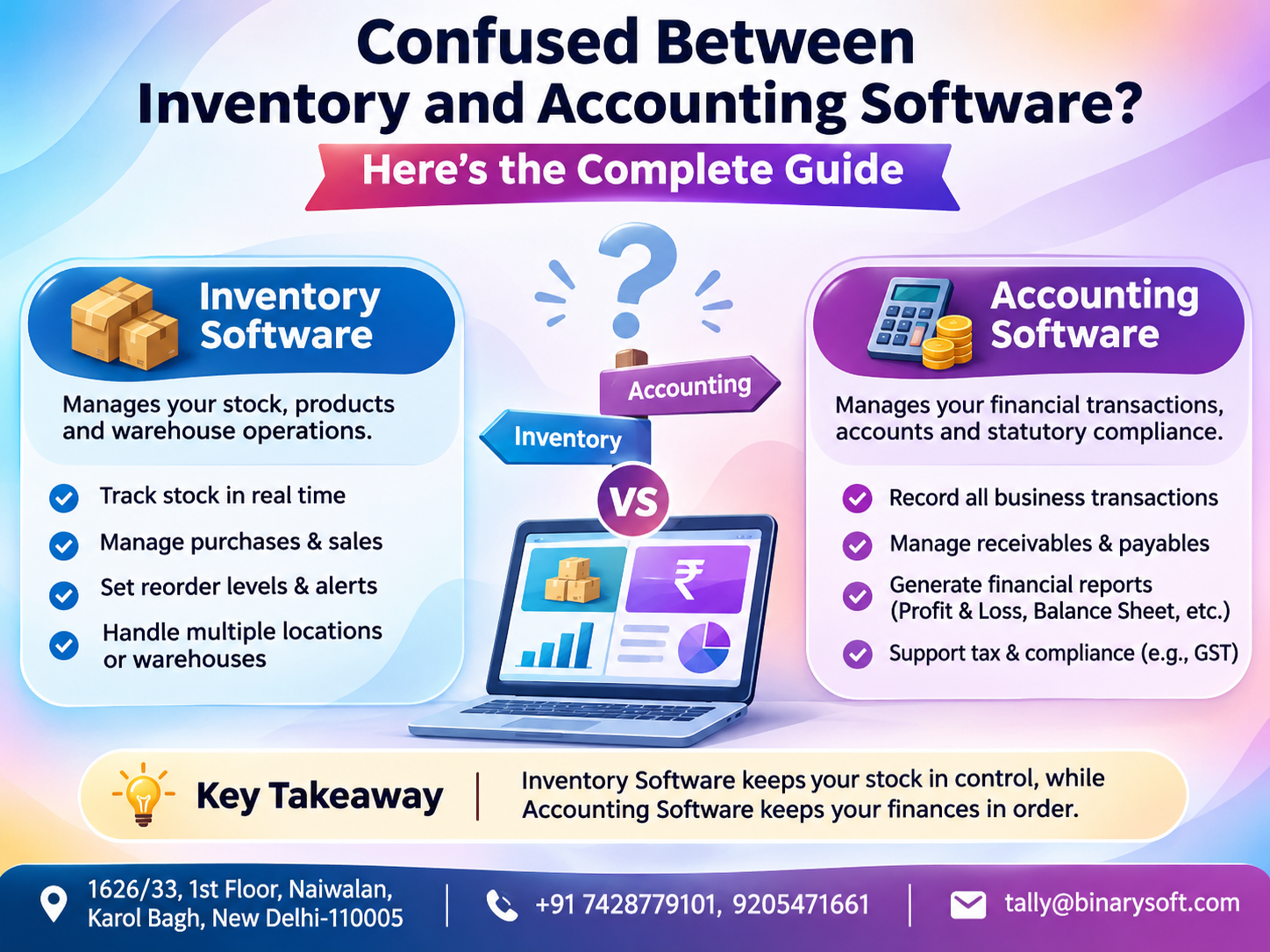
Integrated stock and sales tracking means recording inventory movement and sales transactions within a connected business system.
When a product is purchased, the relevant stock quantity increases through the recorded purchase or receipt transaction.
When a product is sold through an inventory-linked sales voucher, the quantity decreases.
The same transaction can also update customer balances, sales accounts, tax information, and relevant financial reports.
This creates a connection between physical inventory movement and accounting records.
For example, a retailer selling five ceiling fans can record the transaction once.
The system can then reflect the sale in the appropriate sales reports and reduce the recorded stock quantity.
However, stock accuracy still depends on correct opening balances, timely transaction entry, and proper handling of returns, adjustments, and transfers.
Integrated software reduces duplication but does not eliminate the need for regular verification.
2. Problems Caused by Separate Stock and Sales Records
Businesses using disconnected records often experience recurring operational problems.
Incorrect stock availability
A spreadsheet may show products as available even after they have been sold.
Duplicate data entry
Employees may record the same transaction in accounting software and inventory registers.
Delayed reporting
Management may need to combine information from several sources before understanding sales performance.
Purchasing mistakes
Without reliable stock information, businesses may order unnecessary goods or overlook important shortages.
Difficult reconciliation
Differences between physical inventory and accounting records can take considerable time to investigate.
Poor customer experience
Incorrect availability information can lead to delayed deliveries and cancelled orders.
A connected inventory and accounting system helps businesses reduce these risks by maintaining more consistent transaction records.
3. How Tally Prime Connects Inventory and Sales Accounting
Tally Prime combines financial accounting with inventory management, allowing businesses to maintain related information in one environment.
Businesses can create stock items, organize them into stock groups, define units of measurement, and record transactions through appropriate vouchers.
For example, a wholesale electrical dealer may create stock items for switches, wires, fans, lighting equipment, and electrical accessories.
When purchases are recorded using inventory-linked vouchers, stock quantities can increase.
When sales are recorded, the relevant stock quantities can decrease.
Tally Prime also maintains associated financial information, including sales values, customer balances, purchase expenses, and applicable GST details.
This helps management review inventory and financial performance without maintaining completely separate records.
The accuracy of these reports depends on selecting the correct voucher types, stock items, quantities, and accounting configurations.
4. Important Inventory Management Features in Tally Prime
Stock item creation
Stock items represent individual products maintained in the inventory system.
Businesses can create separate items for products with different specifications, sizes, models, or other relevant characteristics.
Stock groups
Stock groups help organize products into categories.
For example, an electronics retailer may create groups for mobile accessories, computer peripherals, speakers, and networking equipment.
Units of measurement
Tally Prime supports units such as pieces, kilograms, metres, litres, cartons, and other suitable measurements.
Correct units help maintain consistent stock quantities.
Godown management
Businesses can maintain location-wise inventory information using godowns.
This is useful for organizations operating warehouses, branches, or multiple storage locations.
Batch-wise tracking
Where applicable, batch details can help businesses maintain inventory information for products requiring batch identification.
Stock valuation
Inventory reports provide information about stock values according to the configured valuation methods and recorded transactions.
Inventory vouchers
Stock journals and other relevant vouchers help businesses record transfers, adjustments, and inventory movements.
Together, these capabilities provide a foundation for structured inventory accounting.
5. Step-by-Step Guide to Track Stock and Sales in Tally Prime
Businesses can establish an integrated workflow through the following process.
Step 1: Create the company. Enter the required company information and configure the applicable accounting and inventory settings.
Step 2: Create stock groups. Organize products into meaningful categories that reflect the business's product range.
Step 3: Define units of measurement. Use consistent units for products to avoid quantity-related errors.
Step 4: Create stock items. Enter product names, relevant classifications, units, and opening quantities where applicable.
Step 5: Configure godowns if required. Establish appropriate storage locations for location-wise inventory tracking.
Step 6: Record purchases. Use suitable purchase vouchers to record goods acquired from suppliers.
Step 7: Record sales. Select the relevant stock items, quantities, rates, and applicable GST information in inventory-linked sales vouchers.
Step 8: Review stock summaries. Examine available quantities, inward movement, outward movement, and closing stock information.
Step 9: Review sales reports. Compare sales activity across products, customers, and reporting periods.
Step 10: Reconcile physical inventory. Conduct regular stock checks and investigate differences before recording authorized adjustments.
This structured approach helps businesses maintain consistency between inventory and financial records.
6. How Integrated Sales Tracking Improves Business Decisions
Sales reports are more valuable when they can be interpreted alongside inventory information.
A retailer may discover that one product generates frequent sales but regularly runs out of stock.
Another product may remain unsold for several months.
These findings can guide purchasing decisions.
For example, a business selling electrical accessories may notice that LED bulbs sell faster than certain decorative lighting products.
Management can use this information to review reorder quantities and reduce unnecessary investment in slow-moving inventory.
Tally Prime provides sales and stock reports that help businesses examine recorded transactions.
Businesses can also compare product movement across different periods to identify seasonal patterns.
However, demand forecasts and automatic reorder decisions may require additional analysis or specialized functionality.
7. GST Billing and Inventory Tracking in One System
GST invoicing is an important part of retail and wholesale operations in India.
When inventory and accounting are connected, businesses can record product quantities, sales values, and applicable tax information within the same transaction.
Tally Prime supports GST-related invoicing and reporting.
A properly configured sales voucher can contain customer information, stock items, quantities, rates, and applicable tax details.
The completed transaction contributes to relevant accounting and inventory records.
This reduces the need to maintain unrelated billing and stock registers.
However, the correct GST treatment must be determined according to the nature of the goods, transaction, and applicable law.
Businesses should regularly review tax classifications and reconcile their accounting information before preparing returns.
8. Managing Purchases and Supplier Records
Purchasing decisions affect inventory availability and working capital.
Businesses need to know which products require replenishment and which items are already available in sufficient quantities.
Tally Prime supports purchase accounting and supplier ledger management.
When goods are purchased, businesses can record the relevant items, quantities, purchase values, and applicable taxes.
Supplier balances can be monitored through accounting reports.
This helps management connect procurement activity with financial obligations.
For businesses operating on supplier credit, accurate purchase records also support payment planning.
Regular review of inventory quantities and outstanding supplier balances can help prevent unnecessary purchases and avoidable cash flow pressure.
9. Stock Tracking Across Multiple Godowns and Branches
Many businesses store goods in more than one location.
A distributor may maintain a central warehouse and several smaller storage locations.
A retailer may operate a showroom and a separate storeroom.
Without location-wise records, employees may know the total quantity of a product but not where it is stored.
Tally Prime supports godown-wise inventory management.
Businesses can record stock quantities at different locations and use appropriate inventory vouchers to document transfers.
This helps management review recorded stock availability by location.
For organizations requiring live synchronization across geographically separate systems, additional deployment or integration arrangements may be necessary.
Location-wise accounting should not be confused with automatic real-time synchronization between independent installations.
10. Case Study One: Retail Electronics Store in Rohini, Delhi
Illustrative case study.
A retail electronics store in Rohini sold home appliances, mobile accessories, and electrical products.
The business used separate spreadsheets for stock tracking and accounting software for sales invoices.
The challenge
Employees frequently entered product quantities into the spreadsheet at the end of the day.
During busy periods, some transactions were overlooked.
Management sometimes discovered inventory shortages only after customers placed orders.
The solution
The store introduced structured stock-item records in Tally Prime.
Employees began using inventory-linked sales and purchase vouchers.
Products were organized into stock groups, and management reviewed stock summaries regularly.
A weekly physical stock verification process was also introduced.
The outcome
The store developed more consistent inventory records and reduced its dependence on duplicate data entry.
Management could review product movement and investigate stock differences earlier.
The example demonstrates how connecting sales and inventory accounting can improve retail operations.
11. Case Study Two: Wholesale Distributor in Chawri Bazar, Delhi
Illustrative case study.
A wholesale distributor in Chawri Bazar supplied hardware and industrial products to retailers and contractors.
The company maintained inventory records for hundreds of products across two storage locations.
The challenge
The sales team often lacked reliable information about stock available at each location.
Purchasing decisions were based partly on employee estimates.
This sometimes resulted in excess inventory for certain products and shortages of others.
The solution
The business standardized stock-item masters and introduced godown-wise inventory records in Tally Prime.
Purchase and sales transactions were recorded using consistent procedures.
Stock transfers were documented, and management began reviewing item-wise movement reports.
The accounting team also monitored customer outstanding balances.
The outcome
Management gained better visibility into recorded stock quantities and sales activity.
Purchasing decisions became more structured, and employees could identify where products were recorded as available.
The case illustrates the operational benefits of combining inventory, sales, and accounting information.
12. How Stock and Sales Tracking Supports Cash Flow Management
Inventory directly affects business cash flow.
When a company purchases goods, money becomes invested in stock until the products are sold and customer payments are collected.
Excess inventory can therefore create financial pressure even when reported sales are increasing.
Integrated inventory and accounting records help management examine stock values alongside customer receivables and supplier payables.
For example, a wholesaler may identify that a large amount of capital is tied up in slow-moving products.
Management can then review purchasing plans and consider appropriate sales strategies.
Tally Prime provides inventory valuation, accounting, and outstanding reports that can support these decisions.
Effective cash flow management also requires attention to payment terms, operating expenses, and actual bank balances.
13. How to Identify Fast-Moving and Slow-Moving Products
Fast-moving products generally sell frequently or move through inventory quickly.
Slow-moving products remain in stock for longer periods.
Businesses can examine item-wise sales and inventory movement reports to identify these patterns.
For example, a footwear retailer may find that certain shoe sizes sell more quickly than others.
A hardware distributor may discover that particular industrial components have limited demand.
These observations can guide future purchases.
However, sales quantity alone does not determine profitability.
Businesses should also consider purchase cost, selling price, discounts, carrying costs, and customer demand.
A product that sells frequently may still generate a low margin.
Combining inventory movement with financial analysis provides a more complete understanding of business performance.
14. Common Mistakes in Stock and Sales Management
Even an integrated accounting system can produce inaccurate information when employees follow inconsistent procedures.
Common mistakes include duplicate stock-item creation, incorrect units of measurement, delayed purchase entry, and recording sales against the wrong product.
Other problems may arise when stock transfers are not documented or damaged goods remain included in available inventory.
Businesses should also review opening stock quantities before beginning a new accounting process.
Incorrect opening balances can affect future stock reports even when subsequent transactions are recorded correctly.
Regular employee training, master-data review, and physical stock verification can reduce these problems.
Management should establish clear responsibilities for transaction entry and inventory adjustments.
15. Best Practices for Accurate Stock and Sales Tracking
Businesses can improve inventory reliability by adopting consistent operating procedures.
-
Maintain unique and meaningful stock-item names.
-
Use appropriate stock groups and units of measurement.
-
Record purchases and sales promptly.
-
Verify product quantities before completing invoices.
-
Document stock transfers and authorized adjustments.
-
Conduct regular physical stock verification.
-
Review slow-moving and high-value inventory.
-
Monitor customer receivables and supplier payables.
-
Maintain protected backups of accounting information.
-
Train employees whenever important workflows change.
These practices help ensure that inventory reports remain useful for operational and financial decisions.
16. Can Tally Prime Support Barcode-Based Inventory Tracking?
Tally Prime can support certain barcode-based item-selection workflows using compatible scanners and stock-item identifiers.
For example, a business may associate a barcode identifier with a stock-item alias.
A compatible scanner can then help select the relevant item during voucher entry.
However, specialized barcode label generation, advanced POS workflows, handheld warehouse scanning, and certain automation requirements may need additional software or customization.
Retailers should test scanner compatibility and transaction workflows before implementing barcode systems.
Barcode technology is most effective when product masters are accurate and employees follow consistent procedures.
17. The Future of Integrated Stock and Sales Management
Retail and wholesale businesses increasingly expect accounting software to provide connected information about inventory, sales, purchasing, taxation, and financial performance.
Digital invoicing, barcode scanning, automated data exchange, and analytical reporting are becoming important components of modern business operations.
For Indian MSMEs, the first step does not necessarily require complex technology.
A properly configured integrated accounting and inventory system can already reduce many problems caused by disconnected records.
Tally Prime provides a foundation for maintaining financial and stock information together.
As businesses grow, they can evaluate additional integrations, reporting tools, and deployment arrangements according to their operational requirements.
The long-term objective is to create reliable information that supports timely business decisions.
Conclusion
Tracking stock and sales in one place is an important step toward improving business efficiency, inventory accuracy, and financial control.
Businesses that maintain disconnected records often experience duplicate data entry, delayed reporting, incorrect stock availability, and avoidable purchasing mistakes.
Tally Prime helps connect sales, purchases, inventory, GST accounting, customer balances, and financial reporting within a structured business system.
Its stock-item management, godown tracking, inventory vouchers, and reporting capabilities can help retailers, wholesalers, manufacturers, and distributors maintain better operational visibility.
The two illustrative case studies demonstrate how integrated inventory and sales records can improve product availability information and purchasing decisions.
The real value of stock and sales management is not simply knowing how many products are available. It is having reliable information to serve customers, protect working capital, and make confident business decisions.
With correct configuration, employee training, regular reconciliation, and appropriate data protection practices, Tally Prime can become an important part of an organization's inventory and financial management process.
Powered by Binarysoft Technologies Authorized Tally Partner
Location: 1626/33, 1st Floor, Naiwalan, Karol Bagh, New Delhi – 110005, INDIA
Contact us: +91 7428779101, 9205471661
Email us: tally@binarysoft.com
Business Hours: 10:00 AM – 6:00 PM, Monday to Friday
Frequently Asked Questions
How can businesses start integrated stock and sales tracking?
Begin by organizing stock masters, configuring appropriate inventory settings, entering verified opening balances, recording transactions consistently, and reviewing reports regularly.
How often should businesses verify physical stock?
The appropriate frequency depends on inventory value, transaction volume, product risk, and internal control requirements. Regular verification is recommended.
Can barcode scanners be used with Tally Prime?
Compatible barcode scanners can support certain stock-item selection workflows. Specialized barcode operations may require additional tools.
Can Tally Prime help manage customer outstanding payments?
Yes. Customer ledger and bill-wise outstanding reports can help businesses review unpaid invoices and receivables.
Is Tally Prime suitable for manufacturing businesses?
Yes. It supports accounting and inventory capabilities relevant to raw materials, finished goods, and manufacturing-related transactions.
CA. Dhruv Bhandekar works with businesses on bookkeeping controls, GST reporting, and month-end accounting processes. His focus is on creating structured financial workflows that improve accuracy and reduce reconciliation issues.