Call CA Tally HelpDesk
+91 9205471661,
7428779101
Introduction: The Hidden Cost of Keeping Too Much Inventory
Every business wants sufficient inventory to satisfy customer demand. Retailers maintain products for daily sales, wholesalers purchase goods in bulk, and manufacturers store raw materials to ensure uninterrupted production.
However, maintaining inventory involves more than the original purchase price.
Every product stored in a warehouse occupies space, requires handling, consumes working capital and creates potential financial risks.
These additional expenses are known as inventory carrying costs, also called inventory holding costs.
Many businesses focus on purchasing products at attractive prices without considering how much it costs to keep those products until they are sold.
For example, a distributor may purchase inventory worth ₹50 lakh to obtain a supplier discount. However, if a significant portion remains unsold for several months, the business continues paying for storage, financing, insurance, handling and stock deterioration.
The apparent purchasing advantage may disappear because of these additional expenses.
Understanding inventory carrying costs helps businesses maintain optimal stock levels, improve cash flow and make better purchasing decisions.
Modern accounting software such as Tally Prime supports this process through inventory reports, stock ageing analysis, reorder-level management and inventory movement tracking.
This guide explains the meaning, components, formulas, calculations and practical methods of reducing inventory carrying costs.
What Are Inventory Carrying Costs?
Inventory carrying costs are the expenses and economic costs associated with holding products in storage before they are sold, consumed or used in production.
They include the cost of warehouse space, capital invested in inventory, insurance, storage operations and potential inventory losses.
For example, suppose a business maintains average inventory worth ₹20 lakh.
During the year, it incurs ₹2 lakh in storage expenses, ₹1.5 lakh in financing costs, ₹50,000 in insurance and ₹1 lakh in inventory-related losses.
Its total annual inventory carrying cost is ₹5 lakh.
This means the business spends an amount equivalent to 25% of its average inventory value annually on holding that inventory.
These costs are important because they reduce the economic benefit of maintaining excessive stock.
Inventory carrying cost is a management-accounting measure. It should not automatically be treated as an additional component of inventory valuation under financial reporting standards.
Why Inventory Carrying Costs Matter
1. They Directly Affect Profitability
Higher storage and financing expenses reduce the profit generated from product sales.
A business may earn a reasonable gross margin but still struggle financially because inventory remains unsold for too long.
2. They Block Working Capital
Money invested in excess stock cannot be used for other important requirements, including supplier payments, salaries, marketing or business expansion.
3. They Increase Financial Risk
Products may become damaged, obsolete, expired or difficult to sell.
The longer inventory remains in storage, the greater some of these risks may become.
4. They Influence Purchasing Decisions
A supplier may offer attractive discounts for large orders.
However, businesses must compare the discount with additional carrying expenses before deciding whether bulk purchasing is beneficial.
5. They Affect Warehouse Efficiency
Excess inventory occupies valuable storage space and increases handling requirements.
Better inventory control helps businesses use warehouse capacity more efficiently.
An Emotional Story: When a Full Warehouse Nearly Destroyed a Family Business
The Business Had Products, but No Money to Pay Its Employees
Vikram operated a small electrical goods distribution company in Delhi.
His father had established the business more than twenty years earlier, and Vikram was determined to expand it.
Whenever suppliers offered bulk discounts, he purchased additional stock.
He believed that a warehouse full of products represented business strength.
Within a few years, his warehouse contained thousands of electrical components, switches, cables and accessories.
But despite increasing inventory, the company's financial position began deteriorating.
Warehouse rent increased, supplier payments became difficult and slow-moving products occupied valuable storage space.
One afternoon, Vikram's accountant informed him that the business might struggle to pay employee salaries.
That evening, Vikram walked through the warehouse.
He saw rows of cartons containing products that had remained untouched for months.
He remembered his father's words: "A business survives because customers trust it and employees believe in it."
For the first time, Vikram understood that excessive inventory could threaten both.
Instead of purchasing more products, he decided to investigate the true cost of holding stock.
He reviewed warehouse expenses, financing costs, product movement and inventory ageing.
With help from his accountant, Vikram began monitoring inventory through Tally Prime.
He identified slow-moving products, reduced unnecessary purchases and introduced reorder-level planning.
Over the following months, inventory investment gradually declined while availability of important products improved.
The most emotional moment came when Vikram paid his employees on time after several difficult months.
He realised that protecting a business was not about filling every warehouse shelf.
It was about ensuring that every rupee invested in inventory served a meaningful purpose.
This fictional story illustrates the financial and emotional challenges caused by excessive inventory investment.
Four Major Components of Inventory Carrying Costs
1. Capital Costs
Capital cost represents the financing expense or opportunity cost of money invested in inventory.
If a business borrows money to purchase stock, interest and related financing expenses may contribute to its carrying cost.
Even when inventory is purchased using internal funds, the business sacrifices opportunities to use that money elsewhere.
For example, ₹20 lakh invested in slow-moving inventory could otherwise support expansion, debt reduction or other productive activities.
2. Storage and Warehousing Costs
Storage costs include expenses associated with maintaining inventory in warehouses or storage facilities.
Common expenses include warehouse rent, electricity, security, equipment, storage racks and inventory handling.
Businesses should allocate shared warehouse expenses reasonably rather than assuming every facility expense changes directly with inventory quantity.
3. Inventory Service Costs
Inventory service costs may include insurance, applicable inventory-related taxes, stock administration and other expenses associated with maintaining stored goods.
The exact classification varies depending on the business and its internal costing policy.
4. Inventory Risk Costs
Inventory risk costs arise from potential losses caused by damage, expiry, theft, shrinkage and obsolescence.
For example, a food distributor may incur substantial losses when packaged products expire before being sold.
Similarly, an electronics distributor may face reduced selling prices when older models become obsolete.
Inventory Carrying Cost Formula
The basic formula is:
\[ \text{Carrying Cost Rate}=\frac{\text{Annual Carrying Costs}}{\text{Average Inventory Value}}\times100 \]
Total annual carrying costs generally include relevant capital, storage, service and risk costs.
Average inventory value can be estimated using:
\[ \text{Average Inventory}=\frac{\text{Opening Inventory}+\text{Closing Inventory}}{2} \]
This simple average is useful when inventory levels remain reasonably stable. Businesses with significant seasonal fluctuations should consider monthly or more frequent averages.
Practical Calculation Example
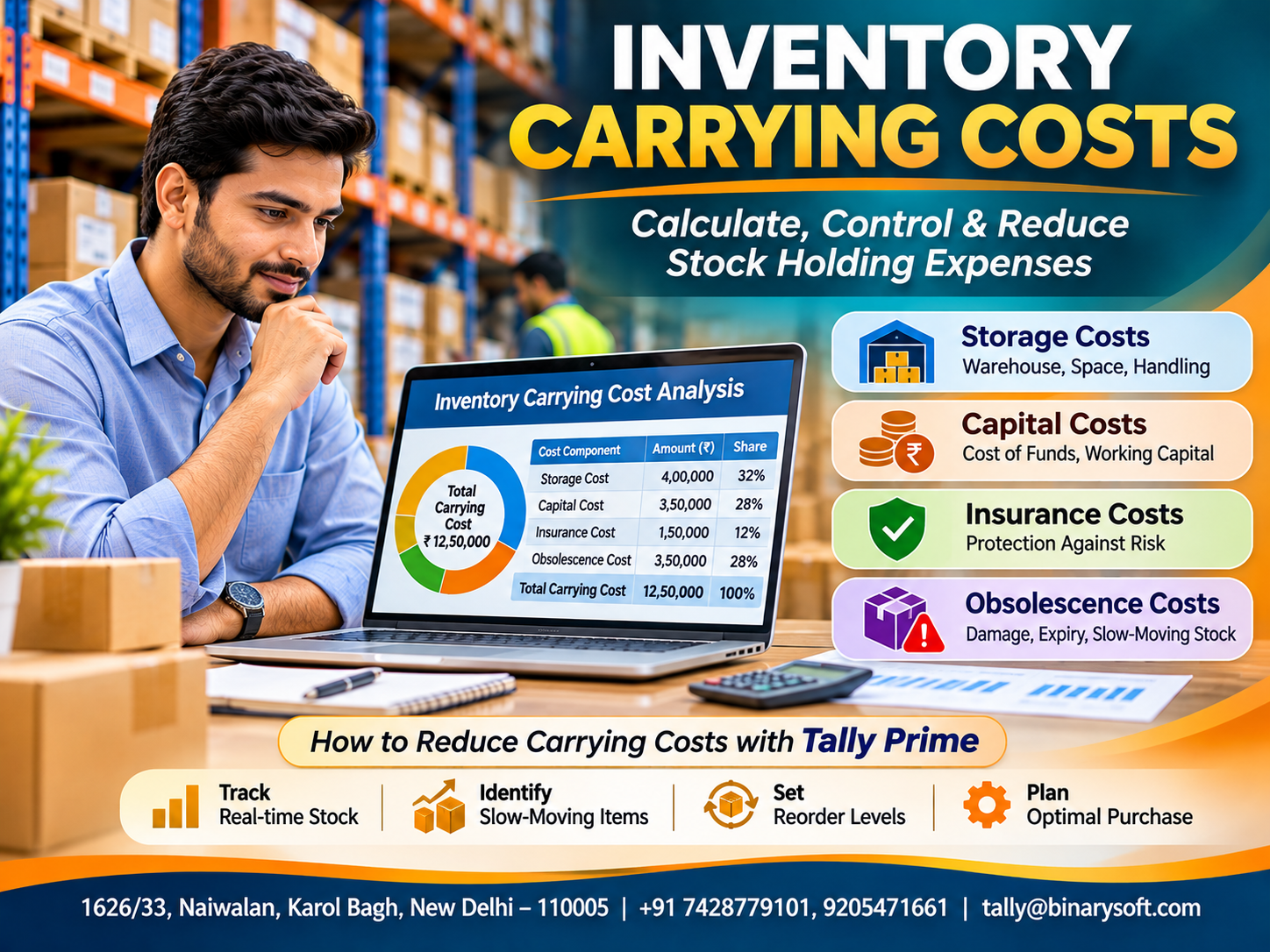
Suppose a wholesale distributor maintains average inventory worth ₹50,00,000.
Its annual carrying expenses are:
|
Cost component
|
Annual amount
|
|---|
|
Warehouse storage
|
₹4,00,000
|
|
Capital cost
|
₹3,50,000
|
|
Insurance and services
|
₹1,50,000
|
|
Damage and obsolescence
|
₹3,50,000
|
|
Total carrying cost
|
₹12,50,000
|
Carrying Cost Rate = (₹12,50,000 ÷ ₹50,00,000) × 100
Inventory Carrying Cost Rate = 25% annually.
This means the business incurs annual holding costs equivalent to one-quarter of its average inventory value.
The percentage is an example, not a universal benchmark.
Interactive Inventory Carrying Cost Calculator
Enter your business's inventory value and annual holding expenses to estimate the carrying cost percentage.
Annual carrying cost rate
25.00%
Total annual carrying cost
₹12,50,000
Average monthly carrying cost
₹1,04,167
Illustrative management calculation. Ensure expenses are measured over the same annual period and avoid double-counting capital or risk costs.
How to Reduce Inventory Carrying Costs
1. Improve Demand Forecasting
Businesses should analyse historical sales, seasonal patterns and customer requirements before purchasing stock.
Accurate forecasts help prevent unnecessary inventory accumulation.
2. Identify Slow-Moving Inventory
Products that remain unsold for extended periods consume warehouse space and working capital.
Regular stock ageing reviews help management identify these products.
3. Implement ABC Analysis
ABC analysis classifies products according to annual consumption value.
High-value items receive closer monitoring, while lower-value products can follow simpler replenishment procedures.
4. Establish Reorder Levels
Reorder levels help businesses purchase stock when replenishment becomes necessary rather than relying on guesswork.
Appropriate reorder points consider demand, supplier lead time and safety stock.
5. Improve Supplier Coordination
Reliable suppliers and shorter delivery times may allow businesses to maintain lower inventory levels without increasing shortages.
6. Reduce Damage and Obsolescence
Proper storage, handling procedures, batch tracking and regular physical verification help minimise avoidable inventory losses.
7. Optimise Warehouse Space
Businesses can improve storage layouts, remove unnecessary stock and consolidate warehouse operations where practical.
8. Monitor Inventory Turnover
Inventory turnover measures how frequently inventory is sold or consumed.
A common formula is:
\[ \text{Inventory Turnover}=\frac{\text{Cost of Goods Sold}}{\text{Average Inventory}} \]
Higher turnover may indicate more efficient inventory utilisation, although appropriate turnover levels vary by industry.
How Tally Prime Helps Reduce Inventory Carrying Costs
Tally Prime provides inventory management and accounting capabilities that support stock control and carrying cost analysis.
1. Stock Summary Report
Stock Summary displays stock quantities and values, helping businesses understand how much capital is invested in inventory.
Open Tally Prime, press Alt+G and select Stock Summary to review inventory balances.
2. Stock Ageing Analysis
Stock Ageing reports help identify inventory that has remained in storage for extended periods.
Businesses can use these reports to investigate slow-moving products and consider appropriate corrective actions.
3. Movement Analysis
Movement Analysis reports help businesses understand stock inflows and outflows.
These reports support purchasing decisions and help identify products with limited movement.
4. Reorder Level Management
Tally Prime supports reorder levels and minimum order quantities.
Businesses can use the Reorder Status report to monitor replenishment requirements and avoid unnecessary bulk purchases.
5. Godown-Wise Stock Monitoring
Godown management allows businesses to track inventory across multiple storage locations.
This helps identify available stock before purchasing additional quantities.
6. Batch-Wise Inventory Tracking
Businesses handling products with expiry dates can use batch-wise tracking to monitor stock more effectively.
This supports better dispatch planning and helps reduce expiry-related losses.
7. Financial Expense Tracking
Warehouse rent, insurance, financing expenses and other relevant costs can be recorded under suitable accounting ledgers.
Businesses can analyse these expenses alongside inventory values to estimate carrying costs.
8. Inventory and Accounting Reports
Combining stock reports with financial information provides a more complete view of inventory investment and related expenses.
Tally Prime supplies useful underlying data, but a complete carrying cost percentage calculation may require a separate worksheet or customised report.
Case Study 1: Reducing Carrying Costs in an Electrical Wholesale Business
Illustrative case study
A Delhi-based electrical goods distributor maintained average inventory worth ₹60 lakh.
The company frequently purchased products in bulk to obtain supplier discounts.
However, slow-moving inventory occupied substantial warehouse space and increased financing expenses.
Management reviewed Stock Summary and Stock Ageing reports, introduced ABC analysis and established reorder levels.
The business also reduced unnecessary purchases of low-demand products.
After six months, illustrative results included:
|
Performance indicator
|
Before
|
After
|
|---|
|
Average inventory value
|
₹60 lakh
|
₹48 lakh
|
|
Annualised carrying cost
|
₹15 lakh
|
₹11 lakh
|
|
Carrying cost rate
|
25%
|
22.9%
|
The example demonstrates how better purchasing discipline can reduce both inventory investment and holding expenses.
Case Study 2: Inventory Cost Control in a Food Distribution Company
Illustrative case study
A packaged food distributor faced frequent losses caused by expired products and excess seasonal stock.
The company maintained large quantities to avoid customer shortages, but demand forecasts were often inaccurate.
Management introduced batch-wise tracking, stock ageing reviews and more frequent purchasing cycles.
Tally Prime reports supported monitoring of available inventory and product movement.
Illustrative results after several months included a reduction in monthly expiry-related losses from ₹85,000 to ₹32,000.
The company also reduced unnecessary storage requirements and improved coordination with suppliers.
This example highlights how carrying cost control can improve financial efficiency without sacrificing customer service.
Common Mistakes When Calculating Carrying Costs
Businesses sometimes exclude capital costs, ignore inventory deterioration or use year-end inventory instead of an appropriate average.
Other mistakes include double-counting expenses, applying the same carrying cost percentage to every product and confusing accounting inventory valuation with management carrying cost analysis.
A reliable calculation should use consistent time periods, appropriate cost allocations and documented assumptions.
Inventory Carrying Costs vs Ordering Costs
Inventory carrying costs arise from holding stock, while ordering costs arise from purchasing and replenishment activities.
Ordering costs may include purchase order processing, supplier communication, receiving administration and relevant procurement expenses.
Reducing order frequency through bulk purchases may lower ordering costs but increase carrying costs.
Businesses should therefore balance these two cost categories rather than attempting to minimise either one independently.
Conclusion
Inventory carrying costs represent an important but frequently overlooked expense for businesses maintaining physical stock.
Storage, financing, insurance, handling and inventory-related risks can significantly affect profitability and working capital.
By calculating carrying costs regularly, businesses can identify excessive stock investment and improve purchasing decisions.
Techniques such as ABC analysis, demand forecasting, stock ageing reviews, reorder-level planning and supplier coordination help reduce unnecessary holding expenses.
Tally Prime supports these activities through inventory reports, stock movement analysis, godown management, batch tracking and accounting records.
Effective inventory management is not about keeping the maximum possible stock. It is about maintaining enough inventory to satisfy customers while minimising unnecessary financial costs.
Professional Tally Prime Inventory Management Support
Powered by Binarysoft Technologies
Authorized Tally Partner
Binarysoft Technologies helps businesses improve stock management, inventory reporting, accounting processes and operational efficiency using Tally Prime.
Location: 1626/33, 1st Floor, Naiwalan, Karol Bagh, New Delhi – 110005, INDIA
Contact us: +91 7428779101, 9205471661
Email us: tally@binarysoft.com
Business Hours: 10:00 AM – 6:00 PM, Monday to Friday
Frequently Asked Questions
What is a good inventory carrying cost percentage?
There is no universal ideal percentage. The appropriate rate depends on the industry, product characteristics, financing arrangements and storage requirements.
How can businesses reduce inventory carrying costs?
Businesses can improve demand forecasting, reduce slow-moving stock, optimise reorder levels, improve supplier coordination and control warehouse expenses.
How does Tally Prime help manage inventory holding costs?
Tally Prime provides Stock Summary, Stock Ageing, Movement Analysis, Reorder Status and godown-wise inventory reports that support stock monitoring and cost analysis.
How often should carrying costs be calculated?
Businesses may calculate carrying costs monthly, quarterly or annually, depending on inventory complexity and reporting requirements.
CA. Priya Tanvi specializes in accounting compliance, GST advisory, and business reporting for small and growing enterprises. She works with business owners to improve record-keeping and financial clarity. Her articles focus on practical compliance solutions and operational discipline.