Call CA Tally HelpDesk
+91 9205471661,
7428779101
Introduction: Why Inventory Control Has Become Essential for Indian Businesses in 2026
A business can have strong sales, loyal customers and a growing product range yet still face serious financial difficulties because of poor inventory control. Too much stock blocks working capital, while insufficient stock can lead to missed orders, delayed production and dissatisfied customers.
In 2026, Indian businesses continue to manage changing customer demand, procurement costs, supplier lead times and increasing expectations for faster delivery. Retailers, wholesalers, manufacturers and distributors need accurate information about what is available, what is moving and what should be reordered.
Inventory control provides a structured approach to maintaining the right quantity of stock at the right location and time. It helps businesses avoid unnecessary purchases while maintaining sufficient inventory to meet demand.
Modern accounting and inventory systems, including Tally Prime, support these activities through stock records, godown management, inventory reports and reorder-related information.
This guide explains inventory control objectives, methods, formulas, implementation steps and practical examples. It also explores how businesses can use Tally Prime to improve stock visibility and make more informed financial decisions.
A Business Owner's Story: When a Warehouse Full of Goods Could Not Save a Customer Order
Vikram operated an electrical equipment distribution business in Delhi's Bhagirath Palace market.
For years, he had worked hard to establish relationships with contractors, retailers and small manufacturers. His warehouse was always full, and he believed maintaining large quantities of inventory would protect his business from supply shortages.
One afternoon, a major customer placed an urgent order for industrial switches and electrical cables.
Vikram confidently accepted the order because his inventory records showed sufficient stock.
However, when the warehouse team started preparing the shipment, they discovered that the required switches were unavailable. The warehouse contained hundreds of similar products, but the specific model requested by the customer had not been replenished.
At the same time, several slow-moving items had remained unsold for months.
Vikram faced an uncomfortable reality. His business had invested substantial money in inventory but could not fulfil an important customer order.
That evening, he reviewed the warehouse records and realized that purchasing decisions had been based on assumptions rather than actual stock movement.
He introduced minimum stock levels, reorder planning, product classification and regular physical verification.
His team also began using structured inventory records and reports in Tally Prime.
Gradually, the company developed a clearer understanding of fast-moving products, slow-moving stock and purchasing requirements.
This illustrative story demonstrates an important lesson: inventory control is not about keeping the maximum quantity of goods. It is about maintaining the right inventory for actual business needs.
1. What Is Inventory Control?
Inventory control is the process of monitoring, organizing and regulating stock quantities to ensure that a business maintains sufficient inventory while avoiding unnecessary holding costs.
It involves tracking stock receipts, issues, transfers, consumption and closing balances.
The primary objective is to balance product availability with inventory investment.
For example, a retailer selling 20 units of a product every day must consider demand, supplier delivery time and safety stock before deciding when to place another order.
Without proper control, the retailer may either run out of products or purchase more inventory than necessary.
Inventory control is an important part of overall inventory management.
2. Why Do Businesses Maintain Inventory?
Businesses hold inventory for several operational and commercial reasons.
Manufacturers require raw materials to maintain uninterrupted production.
Wholesalers and retailers maintain finished goods to meet customer demand.
Some businesses purchase materials in larger quantities to benefit from favourable procurement terms.
Seasonal businesses may also need to build inventory before periods of increased demand.
Inventory can protect against supplier delays and unexpected changes in customer orders.
However, every inventory decision involves a cost.
Businesses must therefore evaluate the benefits of holding stock against storage expenses, financing costs, damage, obsolescence and the risk of unsold goods.
3. Main Objectives of Inventory Control
Effective inventory control has several important objectives.
Maintaining Product Availability
Businesses must maintain sufficient stock to fulfil customer orders and production requirements.
Stock shortages can result in lost sales and damaged customer relationships.
Reducing Inventory Holding Costs
Excess inventory increases warehouse expenses, insurance costs, handling requirements and working capital investment.
Improving Purchasing Decisions
Inventory control helps determine which products should be ordered, when orders should be placed and how much should be purchased.
Supporting Production Continuity
Manufacturers need timely access to raw materials and components to prevent interruptions.
Improving Inventory Accuracy
Regular stock verification helps identify differences between recorded and physical quantities.
Protecting Working Capital
By reducing unnecessary stock accumulation, businesses can make more funds available for other operational requirements.
4. Importance of Inventory Control for Small and Medium Businesses
Small businesses often operate with limited working capital.
A large amount of unsold inventory can create financial pressure even when the business is profitable on paper.
For example, a distributor may have ₹15 lakh invested in inventory but insufficient cash to pay suppliers on time.
If a significant portion of that inventory is slow-moving, the business may struggle to convert stock into cash.
Inventory control helps management identify these situations earlier.
It also supports better customer service by improving visibility into available products.
For growing businesses, consistent stock control becomes increasingly important as product ranges, warehouses and transaction volumes expand.
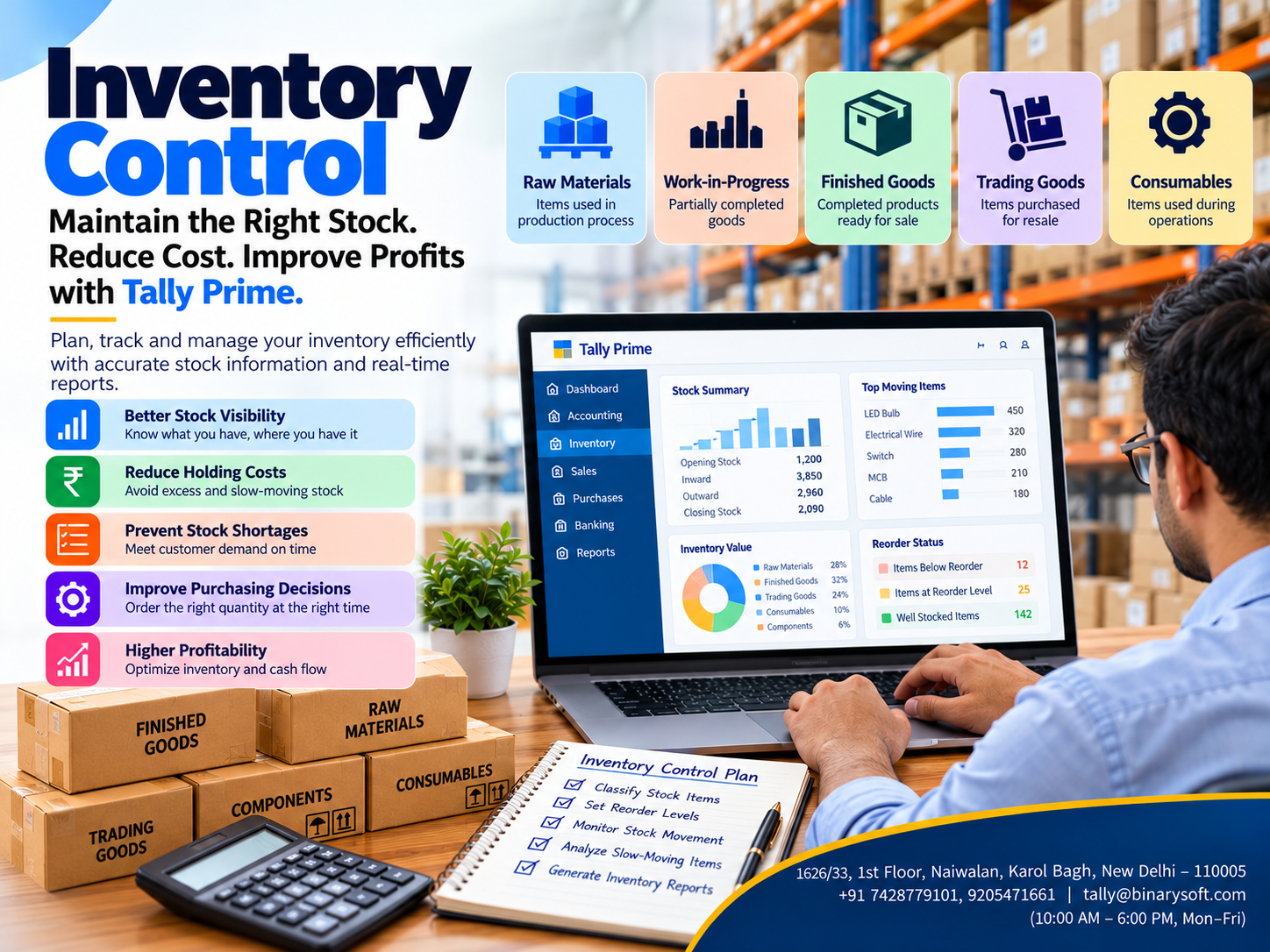
5. Types of Inventory That Require Control
Different inventory types require different control procedures.
|
Inventory type
|
Description
|
Example
|
|---|
|
Raw materials
|
Inputs used in production
|
Steel, fabric, chemicals
|
|
Work-in-progress
|
Partially completed products
|
Unfinished furniture
|
|
Finished goods
|
Completed products ready for sale
|
Appliances, garments
|
|
Trading goods
|
Products purchased for resale
|
Mobile phones, switches
|
|
Consumables
|
Materials consumed during operations
|
Lubricants, packaging
|
|
Spare parts
|
Components used for repair or maintenance
|
Bearings, machine parts
|
A manufacturing business may require separate controls for raw materials, production inventory and finished goods.
A retail business may focus more heavily on product availability, stock movement and reorder planning.
6. ABC Analysis: Controlling Inventory Based on Value
ABC analysis classifies inventory according to its annual consumption value or another relevant measure of financial importance.
Annual Consumption Value is calculated as:
Annual Consumption Value = Annual Quantity Consumed × Unit Cost
A items represent high-value inventory requiring closer monitoring.
B items have moderate financial importance.
C items generally represent a lower share of total inventory consumption value.
An illustrative ABC distribution is:
|
Category
|
Share of items
|
Share of annual value
|
|---|
|
A
|
20%
|
80%
|
|
B
|
30%
|
15%
|
|
C
|
50%
|
5%
|
These percentages are examples and vary between businesses.
Practical Application
A wholesale electronics distributor may classify expensive industrial controllers as A items.
Moderately priced electrical accessories may fall into B, while inexpensive fasteners may be classified as C.
A items usually require tighter review, more accurate forecasts and stronger purchasing controls.
How Tally Prime Helps
Businesses can use stock reports and exported inventory data to calculate consumption values and prepare ABC classifications.
Stock groups and categories can also help organize products for reporting.
7. Economic Order Quantity (EOQ)
Economic Order Quantity is a technique used to estimate an order quantity that minimizes the combined cost of ordering and holding inventory under a set of assumptions.
The basic formula is:
\[ EOQ=\sqrt{\frac{2DS}{H}} \]
Where:
-
D = Annual demand in units
-
S = Ordering cost per order
-
H = Annual holding cost per unit
Practical Example
Suppose a distributor has annual demand of 12,000 units.
Ordering cost per order is ₹500, and annual holding cost per unit is ₹20.
\[ EOQ=\sqrt{\frac{2\times12000\times500}{20}} \]
\[ EOQ\approx775\text{ units} \]
The estimated economic order quantity is approximately 775 units per order.
This simplified model assumes relatively stable demand, constant ordering and holding costs, and no quantity discounts or stock shortages.
Actual purchasing decisions should also consider supplier minimum order quantities, lead times and storage limitations.
8. Just-in-Time (JIT) Inventory Control
Just-in-Time inventory control aims to receive materials close to the time they are needed for production or sale.
This approach can reduce inventory holding costs and unnecessary stock accumulation.
For example, a furniture manufacturer may arrange regular deliveries of materials based on its production schedule instead of maintaining several months of inventory.
JIT works best when suppliers are reliable and demand can be forecast with reasonable accuracy.
However, it also creates risks.
Supplier delays, transport disruptions and unexpected demand can interrupt production.
Businesses should assess these risks before adopting a low-inventory operating model.
9. FSN Analysis: Fast-Moving, Slow-Moving and Non-Moving Stock
FSN analysis classifies inventory according to movement frequency.
Fast-moving products experience frequent sales or consumption.
Slow-moving products have limited activity.
Non-moving products show no movement during the selected review period.
For example, a mobile accessories distributor may classify charging cables as fast-moving, older phone cases as slow-moving and discontinued accessories as non-moving.
How Tally Prime Helps
Tally Prime provides stock movement and ageing-related reports that can help identify inventory requiring attention.
Management can use these reports to review purchasing policies and investigate products that remain unsold for extended periods.
10. Minimum Stock Level and Maximum Stock Level
Minimum stock level represents a threshold below which inventory should generally not fall under normal operating conditions.
Maximum stock level represents a planned upper limit intended to prevent excessive inventory accumulation.
These levels should consider customer demand, supplier lead times, storage capacity and the cost of maintaining stock.
For example, a distributor may establish a minimum stock level of 100 units and a maximum level of 500 units for a particular product.
The appropriate limits depend on actual business requirements.
11. Reorder Point: Knowing When to Purchase Again
A reorder point indicates the inventory position at which a replenishment order should be initiated.
A common formula is:
Reorder Point = Average Demand During Lead Time + Safety Stock
Suppose a business sells 20 units daily and supplier lead time is seven days.
Expected demand during lead time = 20 × 7 = 140 units.
If safety stock is 60 units:
Reorder Point = 140 + 60 = 200 units
The business should generally initiate replenishment when its inventory position reaches 200 units, taking account of outstanding orders and commitments.
How Tally Prime Helps
Tally Prime supports reorder-related inventory information and reports that help businesses evaluate stock requirements.
Users can review current quantities and relevant reorder details before making purchasing decisions.
12. Safety Stock: Protecting Against Unexpected Demand
Safety stock is additional inventory maintained to reduce the risk of stock shortages caused by demand fluctuations or supplier delays.
For example, a pharmaceutical distributor may maintain additional stock of essential medicines because delivery delays could affect customer requirements.
A simplified safety stock formula is:
Safety Stock = (Maximum Daily Demand × Maximum Lead Time) − (Average Daily Demand × Average Lead Time)
Suppose:
|
Particulars
|
Value
|
|---|
|
Maximum daily demand
|
50 units
|
|
Maximum lead time
|
8 days
|
|
Average daily demand
|
35 units
|
|
Average lead time
|
6 days
|
Safety Stock = (50 × 8) − (35 × 6)
Safety Stock = 190 units
This formula provides a planning estimate. More advanced methods account for demand variability and desired service levels.
13. Inventory Turnover Ratio
Inventory turnover measures how frequently a business sells or consumes its average inventory during a period.
\[ \text{Inventory Turnover}=\frac{\text{COGS}}{\text{Average Inventory}} \]
Suppose annual Cost of Goods Sold is ₹24,00,000 and average inventory is ₹6,00,000.
Inventory Turnover = ₹24,00,000 ÷ ₹6,00,000
Inventory Turnover = 4 times
A higher turnover may indicate efficient inventory utilization, but excessively high turnover can also increase stockout risk.
Businesses should compare turnover with historical performance and relevant industry benchmarks.
14. Inventory Control vs Inventory Management
Although closely related, inventory control and inventory management have different scopes.
|
Inventory control
|
Inventory management
|
|---|
|
Focuses on stock availability and accuracy
|
Covers the broader inventory lifecycle
|
|
Monitors quantities and movements
|
Includes procurement and planning
|
|
Establishes reorder levels
|
Coordinates purchasing and operations
|
|
Controls storage and stock discrepancies
|
Supports overall supply chain decisions
|
|
Helps prevent stock shortages
|
Optimizes inventory operations
|
Inventory control is an essential component of inventory management.
15. How Tally Prime Helps Businesses Improve Inventory Control
Tally Prime supports inventory-related accounting through structured stock masters, vouchers and reports.
Stock Item Management
Businesses can create stock items with appropriate names, units of measurement, stock groups and categories.
This helps organize inventory and maintain consistent product records.
Multiple Godown Management
Organizations operating multiple warehouses can use godown functionality to maintain location-wise inventory records.
Stock transfers can be recorded using suitable inventory vouchers.
Purchase and Sales Tracking
Purchase and sales transactions can update inventory records when configured appropriately.
This reduces the need for repeated manual updates in separate stock registers.
Stock Summary
The Stock Summary report provides information about inventory quantities and values.
Management can use it to review stock availability and identify products requiring attention.
Physical Stock Verification
Physical Stock vouchers can be used to record verified quantities and reconcile discrepancies with system records.
Inventory Reorder Status
Reorder-related reports can help businesses assess replenishment requirements.
Batch-Wise Inventory
Businesses dealing with batch-controlled products can maintain relevant batch details, including manufacturing and expiry information where applicable.
These features support inventory control, but accurate results depend on correct configuration, complete transaction records and periodic physical verification.
16. Step-by-Step Inventory Control Process for Small Businesses
A structured inventory control process can be implemented gradually.
Step 1: Identify Inventory Items
Prepare a complete list of products, raw materials, finished goods and relevant consumables.
Step 2: Classify Products
Organize stock by product group, value, movement frequency and operational importance.
Step 3: Verify Opening Quantities
Conduct physical verification and reconcile opening inventory records.
Step 4: Establish Reorder Policies
Determine minimum levels, reorder points and safety stock based on demand and supplier lead times.
Step 5: Record Every Stock Movement
Maintain accurate purchase, sales, return, transfer and adjustment transactions.
Step 6: Review Inventory Reports
Analyze stock quantities, slow-moving products and discrepancies regularly.
Step 7: Improve Purchasing Decisions
Use actual consumption and stock information to support replenishment planning.
17. Case Study One: Electrical Distributor Reduces Stock Shortages
Illustrative case study
A wholesale electrical distributor in Delhi supplied cables, switches and lighting equipment to retailers and contractors.
The company maintained substantial inventory but frequently experienced shortages of popular products.
Management discovered that purchasing decisions were based primarily on employee estimates.
The Solution
The distributor classified inventory using ABC and FSN analysis.
It established reorder levels for frequently demanded products and introduced monthly inventory reviews.
The company also began maintaining purchase, sales and godown records through Tally Prime.
The Outcome
The improved process helped employees identify replenishment requirements earlier.
Management gained better visibility into slow-moving stock and could review purchasing decisions using recorded transactions.
Key lesson: Inventory control works best when replenishment decisions are based on demand and accurate stock records rather than assumptions.
18. Case Study Two: Garment Manufacturer Improves Material Planning
Illustrative case study
A garment manufacturer in Noida produced uniforms and ready-made garments for wholesale customers.
Its production team frequently experienced delays because essential fabrics and accessories were unavailable.
At the same time, large quantities of less frequently used materials remained in storage.
The Solution
The manufacturer classified raw materials according to consumption and operational importance.
It established minimum stock levels for critical materials and introduced regular reviews of supplier lead times.
Using suitable Tally Prime inventory and manufacturing workflows, the business organized material receipts, consumption and finished goods records.
The Outcome
The company developed a clearer view of material requirements and inventory movement.
Production planning became more structured, while management could identify excess materials requiring attention.
Key lesson: Effective manufacturing inventory control requires coordination between purchasing, production and accounting.
19. Common Inventory Control Mistakes
Businesses should avoid several recurring mistakes.
Overstocking: Purchasing excessive quantities increases holding costs and blocks working capital.
Understocking: Insufficient inventory can interrupt sales and production.
Incorrect Stock Records: Missing transactions or duplicate stock items can distort available quantities.
Ignoring Lead Times: Reorder decisions must consider how long suppliers take to deliver products.
Infrequent Physical Verification: Unrecorded damage, losses and errors can create discrepancies.
Poor Inventory Classification: Treating every product identically may result in inefficient purchasing decisions.
Ignoring Slow-Moving Stock: Products that remain unsold for extended periods may lose value or become obsolete.
Regular reviews and clear operational responsibilities help reduce these problems.
20. Best Practices for Effective Inventory Control in 2026
Businesses should combine accurate stock records with practical inventory control policies.
High-value and critical products should receive closer attention.
Reorder levels should be reviewed when demand patterns or supplier lead times change.
Inventory transactions should be recorded promptly, and physical stock counts should be conducted periodically.
Businesses should also monitor damaged, expired and obsolete inventory.
Employees responsible for purchasing, warehousing, sales and accounting should follow consistent procedures.
Management should use inventory reports alongside cash flow and profitability information.
The objective is not simply to minimize inventory. It is to maintain a balance between product availability, customer satisfaction and working capital efficiency.
21. The Future of Inventory Control and Digital Stock Management
Inventory control is becoming increasingly data-driven.
Businesses are adopting structured stock records, barcode-based identification, digital reporting and more systematic purchasing procedures.
Advanced inventory planning may also involve demand forecasting and automated replenishment recommendations.
However, technology cannot compensate for incorrect product masters or incomplete transaction records.
Reliable inventory management begins with accurate information.
For businesses using Tally Prime, properly configured stock items, godowns, inventory vouchers and reports provide a foundation for more organized stock control.
As operations grow, businesses can build upon these records with additional analytical and operational processes.
Conclusion
Inventory control is an essential business activity that helps organizations maintain sufficient stock without investing unnecessarily in excess inventory.
Techniques such as ABC analysis, Economic Order Quantity, Just-in-Time inventory, FSN analysis, safety stock and reorder planning help businesses make better purchasing and storage decisions.
For Indian retailers, wholesalers, manufacturers and distributors, effective stock control can support customer satisfaction, working capital management and operational efficiency.
Tally Prime helps businesses organize inventory records, monitor stock movements, manage multiple godowns and review inventory information through relevant reports.
However, successful inventory control requires more than software. Businesses must maintain accurate records, establish practical stock policies and regularly review performance.
With disciplined processes and suitable technology, organizations can reduce avoidable inventory problems and make more informed decisions about sustainable business growth.
Powered by Binarysoft Technologies
Authorized Tally Partner
Location: 1626/33, 1st Floor, Naiwalan, Karol Bagh, New Delhi – 110005, INDIA
Contact: +91 7428779101, 9205471661
Email: tally@binarysoft.com
Business Hours: 10:00 AM – 6:00 PM, Monday–Friday
Frequently Asked Questions
What is inventory control?
Inventory control is the process of monitoring and regulating stock quantities to maintain sufficient inventory while minimizing unnecessary costs.
What are the main objectives of inventory control?
The primary objectives include maintaining product availability, reducing holding costs, improving purchasing decisions and supporting accurate inventory records.
What are the four common inventory control methods?
ABC analysis, Economic Order Quantity (EOQ), Just-in-Time (JIT) and Fast-Slow-Non-moving (FSN) analysis are four commonly used methods.
What is the difference between inventory control and inventory management?
Inventory control focuses on stock availability, movement and accuracy, while inventory management covers the broader process of planning, purchasing, storing and using inventory.
CA. Shaurya Venkataraman specializes in business accounting, GST consultancy, and financial analysis. His articles focus on simplifying complex financial concepts and helping businesses improve operational efficiency.