Call CA Tally HelpDesk
+91 9205471661,
7428779101
Introduction: Why Smart Inventory Management Is Essential for Business Success
Every successful business depends on having the right products available at the right time. Whether a company operates a retail shop, wholesale distribution network, manufacturing unit or e-commerce business, inventory plays a crucial role in profitability and customer satisfaction.
However, managing inventory is not simply about counting products in a warehouse. It involves balancing customer demand, purchasing decisions, storage costs, product movement and working capital.
Imagine a wholesale distributor who purchases large quantities of products expecting strong demand. Unfortunately, sales slow down, and the warehouse becomes filled with unsold inventory. Meanwhile, another popular product goes out of stock, causing customers to purchase from competitors.
Both situations represent poor inventory management.
Modern inventory management techniques help businesses avoid these challenges through systematic stock monitoring, demand planning, accurate valuation and timely replenishment.
With Tally Prime, businesses can combine inventory tracking with accounting, purchase management, sales invoicing and financial reporting to gain better visibility into everyday operations.
This guide explains practical inventory management methods, their advantages, implementation strategies and how businesses can use Tally Prime to improve stock control.
What Is Inventory Management?
Inventory management is the systematic process of purchasing, receiving, storing, monitoring and selling goods while maintaining optimal stock levels.
Its primary objective is to ensure that sufficient inventory is available to meet business requirements without unnecessarily blocking capital in excess stock.
Inventory generally includes four categories:
-
Raw materials: Components purchased for manufacturing.
-
Work-in-progress: Partially manufactured products.
-
Finished goods: Products ready for sale.
-
Maintenance and operating supplies: Materials required for daily operations.
Effective inventory management connects purchasing, warehousing, production, sales and accounting into one coordinated business process.
Why Inventory Management Techniques Matter
Inventory represents a significant investment for many Indian businesses. Poor stock management can create financial pressure even when sales appear healthy.
Effective inventory control offers several advantages.
1. Improved Cash Flow
Reducing unnecessary stock releases money that can be used for supplier payments, business expansion and daily expenses.
2. Reduced Storage Costs
Maintaining appropriate inventory levels reduces warehouse expenses, insurance costs, handling charges and product deterioration.
3. Better Customer Satisfaction
Accurate stock information helps businesses fulfil orders on time and avoid unexpected product shortages.
4. Improved Purchasing Decisions
Historical sales and inventory reports help businesses determine which products require replenishment.
5. Higher Profitability
Businesses can identify slow-moving products, reduce wastage and concentrate investment on profitable inventory.
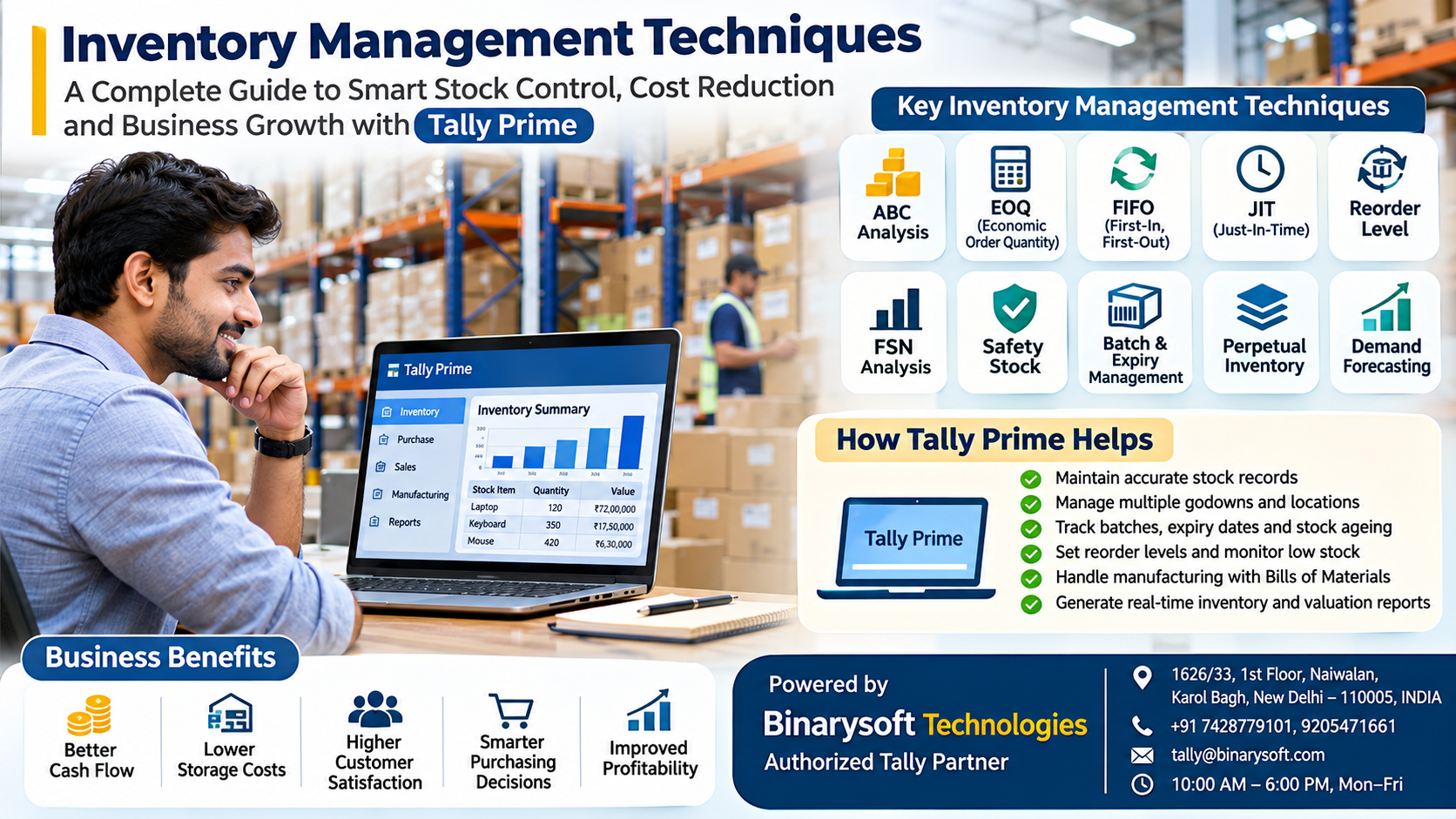
10 Important Inventory Management Techniques
1. ABC Analysis: Prioritising Inventory Based on Value
ABC analysis classifies inventory according to its annual consumption value.
Illustrative annual inventory consumption value
High-value items requiring close monitoring
Moderate-value items requiring regular reviews
Lower-value items managed with simpler controls
Illustrative distribution only; actual classifications depend on business data.
Category A products generally require strict purchasing controls and frequent reviews. Category B products need moderate supervision, while Category C products can often be managed through simpler replenishment procedures.
For example, an electronics distributor may classify expensive laptops as Category A, accessories as Category B and inexpensive cables as Category C.
Using Tally Prime: Businesses can analyse stock values, quantities and movement reports, export relevant data where necessary and classify products according to their contribution to inventory investment.
2. Economic Order Quantity (EOQ)
Economic Order Quantity determines an appropriate purchasing quantity that balances ordering expenses against inventory holding costs.
The formula is:
\[ EOQ=\sqrt{\frac{2DS}{H}} \]
Where:
-
D = Annual demand in units
-
S = Cost of placing one order
-
H = Annual holding cost per unit
Suppose a business sells 12,000 units annually, spends ₹500 per purchase order and incurs ₹20 annual holding cost per unit.
The calculated EOQ is approximately 775 units per order.
This provides a useful purchasing benchmark under stable-demand assumptions.
Tally Prime can supply historical consumption, purchase quantities and stock information for EOQ calculations. The mathematical EOQ calculation may be performed separately in a spreadsheet or planning tool.
3. First-In, First-Out (FIFO)
FIFO assumes that the earliest inventory purchased is consumed or sold first.
This method is particularly useful for businesses dealing with food products, medicines, cosmetics and other goods that may become obsolete or expire.
For example, a grocery distributor purchases 100 units at ₹80 and another 100 units at ₹90. Under FIFO valuation, the first 100 units sold are costed at ₹80 each.
FIFO helps businesses maintain a consistent inventory valuation approach. Physical stock rotation should also be managed separately to ensure older products are dispatched first.
Tally Prime application: Businesses can use suitable stock valuation settings, batch tracking and inventory reports to monitor stock quantities and values.
4. Just-In-Time (JIT) Inventory Management
Just-In-Time inventory management focuses on receiving materials close to the time they are required.
Instead of storing large quantities, businesses coordinate purchasing with actual demand or production schedules.
For example, a furniture manufacturer may purchase certain components only after receiving confirmed customer orders.
Benefits include lower storage costs, reduced wastage and improved working capital.
However, JIT depends on reliable suppliers, predictable lead times and effective communication. Unexpected delivery delays can interrupt production.
Tally Prime supports purchasing records, order tracking and inventory visibility that help businesses coordinate a JIT-oriented process.
5. Reorder Level Technique
A reorder level identifies the stock quantity at which a business should initiate replenishment.
A basic formula is:
\[ \text{Reorder Point}=(\text{Daily Demand}\times\text{Lead Time})+\text{Safety Stock} \]
For example, if a business sells 20 units daily, supplier delivery takes seven days and safety stock is 60 units:
Reorder point = (20 × 7) + 60 = 200 units.
When the inventory position reaches the reorder point, the purchasing team should review replenishment requirements.
Tally Prime allows businesses to configure reorder levels and minimum order quantities and review Inventory Reorder Status reports to identify potential shortages.
6. Fast-Moving, Slow-Moving and Non-Moving (FSN) Analysis
FSN analysis categorises products according to their consumption or sales movement.
Fast-moving products sell frequently and require regular replenishment. Slow-moving products experience limited demand and need careful purchasing decisions. Non-moving products remain unsold for extended periods and may require discounts, promotions or disposal.
For example, a footwear wholesaler may discover that everyday sandals sell quickly while certain seasonal designs remain unsold.
By examining Movement Analysis and Stock Ageing reports in Tally Prime, businesses can identify inventory movement patterns and make better purchasing decisions.
7. Safety Stock Management
Safety stock is additional inventory maintained to protect against unexpected demand or supplier delays.
It is particularly important for businesses dealing with seasonal products, uncertain transportation schedules or fluctuating customer requirements.
However, excessive safety stock increases carrying costs.
Businesses should calculate safety stock using demand variability, supplier reliability and acceptable service levels rather than maintaining arbitrary quantities.
Tally Prime provides historical stock movement information that can support these calculations.
8. Batch and Expiry Date Management
Batch management helps businesses identify products according to manufacturing batches, purchase batches and expiry dates.
This technique is essential for pharmaceutical distributors, food wholesalers and businesses selling perishable goods.
Tally Prime supports batch-wise stock tracking, manufacturing dates, expiry dates and batch-level inventory reports.
Businesses can also follow the First-Expiry, First-Out (FEFO) principle to prioritise products approaching expiry.
9. Perpetual Inventory Management
Perpetual inventory management maintains continuously updated stock records as transactions occur.
When purchases, sales, stock transfers and adjustments are recorded correctly, inventory balances reflect those transactions without waiting for a monthly physical count.
Tally Prime supports perpetual inventory records through inventory vouchers, sales invoices, purchase transactions and stock journals.
Physical stock verification remains important because damaged goods, theft, recording errors and unrecorded movements can cause differences between system balances and actual stock.
10. Demand Forecasting and Seasonal Planning
Demand forecasting estimates future inventory requirements using historical sales, market conditions and seasonal trends.
For example, an air-conditioner distributor may experience higher demand during summer, while a clothing retailer may see increased sales during festive seasons.
Businesses can analyse historical sales and stock reports in Tally Prime to identify trends.
More advanced forecasting calculations can be performed using exported data and external analytical tools.
How Tally Prime Helps Businesses Implement Inventory Management Techniques
Tally Prime combines inventory records with financial accounting, helping businesses understand both product movement and its financial impact.
Stock Groups and Categories
Businesses can organise products into meaningful groups and categories.
For example, a hardware distributor may create groups for electrical products, plumbing materials and construction supplies.
Categories can provide additional classification by brand, size or other relevant attributes.
Multiple Godown Management
Companies operating warehouses in different locations can track stock separately.
Stock Journal vouchers support transfers between locations, while Godown Summary reports provide visibility into available inventory.
Purchase and Sales Order Management
Businesses can record purchase orders and sales orders to improve coordination between purchasing and customer fulfilment.
This helps teams monitor pending commitments and plan stock replenishment.
Manufacturing and Bill of Materials
Manufacturers can define Bills of Materials specifying the components required to produce finished goods.
Manufacturing Journal entries help record raw material consumption, finished production, by-products and scrap.
Inventory Reports and Financial Analysis
Important reports include Stock Summary, Movement Analysis, Stock Ageing, Inventory Reorder Status and Godown Summary.
Together, these reports help management monitor stock availability, purchasing requirements and inventory costs.
Practical Example: Inventory Planning for a Wholesale Distributor
Consider a distributor maintaining 500 different products.
Without systematic stock management, purchasing decisions may depend on assumptions rather than actual sales performance.
The business can improve operations by identifying its highest-value products through ABC analysis, examining slow-moving items, setting reorder levels and reviewing supplier lead times.
Using Tally Prime, the distributor can maintain product-wise stock records, monitor inventory across warehouses and compare purchasing decisions against actual stock movement.
The result is a more disciplined inventory process that supports customer service and working capital management.
Case Study 1: How a Delhi Electronics Distributor Improved Inventory Control
Illustrative case study based on a realistic business scenario; figures are hypothetical.
A medium-sized electronics distributor in Delhi handled laptops, computer accessories and networking products.
The company frequently experienced two problems: popular products became unavailable, while expensive accessories remained unsold for months.
Its purchasing team relied heavily on manual records and informal stock updates.
The distributor introduced ABC classification, regular stock ageing reviews and reorder planning.
Using Tally Prime, the business organised products into stock groups, maintained warehouse-wise records and reviewed purchasing requirements.
Illustrative results after six months
Excess inventory reduction
22%
Stockout incidents reduction
35%
Example outcomes for explanation, not verified customer results or guaranteed savings.
The business also gained better visibility into slow-moving products and could redirect purchasing budgets towards items with stronger demand.
The key lesson was that accurate inventory information helped improve purchasing discipline without requiring the company to increase overall stock investment.
Case Study 2: Inventory Management for a Manufacturing Business
Illustrative case study; business and results are hypothetical.
A small furniture manufacturer in Faridabad produced office desks, cabinets and storage units.
The business faced frequent production delays because raw materials were not always available when required.
At the same time, excess quantities of certain components occupied valuable warehouse space.
Management introduced Bills of Materials, reorder planning and regular physical stock verification.
Tally Prime was used to record raw materials, finished goods, manufacturing consumption and warehouse movements.
The company could then estimate component requirements before accepting larger production commitments.
In this illustrative scenario, raw material wastage decreased by 15%, while production planning became more predictable.
The experience demonstrates how combining manufacturing records with inventory planning can improve operational efficiency.
A Story of Hope: When Better Inventory Planning Saved a Family Business
The following is a fictional story illustrating the human impact of inventory management.
For more than twenty years, Rajesh operated a small wholesale business in Delhi. He had built his reputation through personal relationships, hard work and reliable customer service.
But changing market conditions gradually created problems.
Some products remained unsold for months. Others disappeared from shelves just when customers needed them most.
Supplier payments became difficult, and Rajesh started using personal savings to manage business expenses.
One evening, his daughter noticed him sitting alone in the warehouse, surrounded by cartons of unsold goods.
She asked why the business was struggling despite regular customer orders.
Rajesh replied, "We have products everywhere, but somehow we never have the products customers want."
Together, they decided to reorganise the business.
They classified products according to demand, reviewed old inventory, established reorder levels and began maintaining systematic stock records.
Instead of purchasing based on intuition, they started using actual sales and inventory information.
Gradually, unnecessary purchases decreased. Customer orders became easier to fulfil, and supplier payments became more predictable.
The biggest change was not simply financial.
Rajesh regained confidence in his business.
His story reflects an important lesson: inventory management is not only about products and numbers. It is also about protecting livelihoods, reducing uncertainty and helping business owners plan for the future.
Best Practices for Successful Inventory Management
Businesses should establish consistent procedures rather than relying on software alone.
-
Review stock availability and pending orders regularly.
-
Establish reorder levels for important products.
-
Monitor ageing and slow-moving inventory.
-
Conduct periodic physical stock verification.
-
Maintain accurate purchase and sales records.
-
Train employees to record inventory transactions correctly.
-
Evaluate supplier delivery performance.
-
Review inventory investment alongside profitability.
Businesses should also monitor inventory turnover, stockout frequency and carrying costs to evaluate whether their inventory policies are working.
Common Inventory Management Mistakes to Avoid
One common mistake is purchasing excessive stock simply because suppliers offer bulk discounts.
A discount may appear attractive, but storage costs, blocked working capital and potential obsolescence can eliminate the benefit.
Another mistake is ignoring slow-moving inventory until products become difficult to sell.
Businesses should also avoid maintaining inconsistent product names, failing to record stock transfers and postponing physical verification.
Most importantly, management should not assume that implementing software automatically creates effective inventory control.
Reliable information depends on accurate transactions, disciplined procedures and regular management review.
Conclusion
Effective inventory management is essential for improving profitability, maintaining customer satisfaction and protecting business cash flow.
Techniques such as ABC analysis, EOQ, FIFO, JIT, FSN analysis, safety stock planning and reorder level management help businesses maintain the right inventory at the right time.
Tally Prime supports these strategies through stock classification, inventory vouchers, batch management, multiple godowns, manufacturing records and analytical reports.
For Indian retailers, wholesalers, distributors and manufacturers, combining structured inventory techniques with accurate accounting information can create a stronger foundation for sustainable business growth.
The objective is not to maintain the largest possible inventory. It is to maintain the right inventory, in the right quantity, at the right location and at the right time.
Powered by Binarysoft Technologies
Authorized Tally Partner
Location: 1626/33, 1st Floor, Naiwalan, Karol Bagh, New Delhi – 110005, INDIA
Contact us: +91 7428779101, 9205471661
Email us: tally@binarysoft.com
Business Hours: 10:00 AM – 6:00 PM, Monday–Friday
Frequently Asked Questions
How can businesses reduce excess inventory?
Businesses can reduce excess stock through demand forecasting, reorder planning, slow-moving stock reviews and better coordination with suppliers.
Does Tally Prime support manufacturing inventory?
Yes. It supports Bills of Materials, manufacturing transactions, raw material consumption, finished goods and related inventory records.
What is the importance of inventory reorder levels?
Reorder levels help businesses identify when additional stock should be purchased to reduce the risk of shortages while avoiding unnecessary purchases.
Can inventory management improve business profitability?
Yes. Effective inventory management can reduce storage expenses, minimise wastage, improve product availability and release working capital for other business requirements.
CA. Rohin Mehtaal is a Chartered Accountant with experience in accounting systems, audit support, and GST compliance. He has assisted businesses in adopting structured financial processes and improving inventory accuracy. His writing emphasizes clarity, control, and data-driven decision making.