Call CA Tally HelpDesk
+91 9205471661,
7428779101
Introduction: Why Job Costing Is Essential for Business Profitability
Imagine completing a large customer project worth ₹10 lakh.
The customer is satisfied, your employees have worked hard, and the payment has been received.
But when you calculate the expenses, you discover that the project generated almost no profit.
Material prices increased, labour costs exceeded estimates, and additional expenses were never included in the original quotation.
This is a common challenge for construction contractors, manufacturers, interior designers, printing businesses and service providers.
Job costing is an accounting method that helps businesses calculate and monitor the expenses associated with individual jobs, projects or customer orders.
Instead of examining only the company's total expenses, job costing identifies how much each assignment costs and whether it is profitable.
For Indian small and medium businesses, accurate job costing can improve quotations, expense control, budgeting and management decisions.
Tally Prime supports relevant job-costing workflows through cost centres, inventory records, accounting vouchers and financial reports.
1. What Is Job Costing?
Job costing is a cost accounting technique used to determine the cost of a specific job, contract, project or customer assignment.
It is particularly useful when products or services are customized.
For example, an interior design company may complete several projects simultaneously.
Each project requires different materials, labour hours and subcontractor services.
Job costing helps the company record these expenses separately.
The objective is to understand the financial performance of each assignment.
Businesses can then compare actual costs with estimated budgets and identify opportunities for improvement.
2. Main Components of Job Costing
Job costing generally includes three major cost categories.
Direct Material Costs
These are materials directly consumed in completing a particular job.
Examples include timber used in furniture manufacturing, steel used in fabrication and electrical fittings installed during a construction project.
Direct Labour Costs
These are labour expenses directly attributable to the job.
Examples include wages for carpenters, machine operators and technicians working on a specific assignment.
Manufacturing or Project Overheads
Overheads are indirect expenses associated with production or project execution.
Examples may include factory electricity, equipment depreciation, supervision and workshop rent.
Overheads should be allocated using a reasonable and consistently applied basis.
Together, these components help determine the total job cost.
3. Job Costing Formula
The basic formula is:
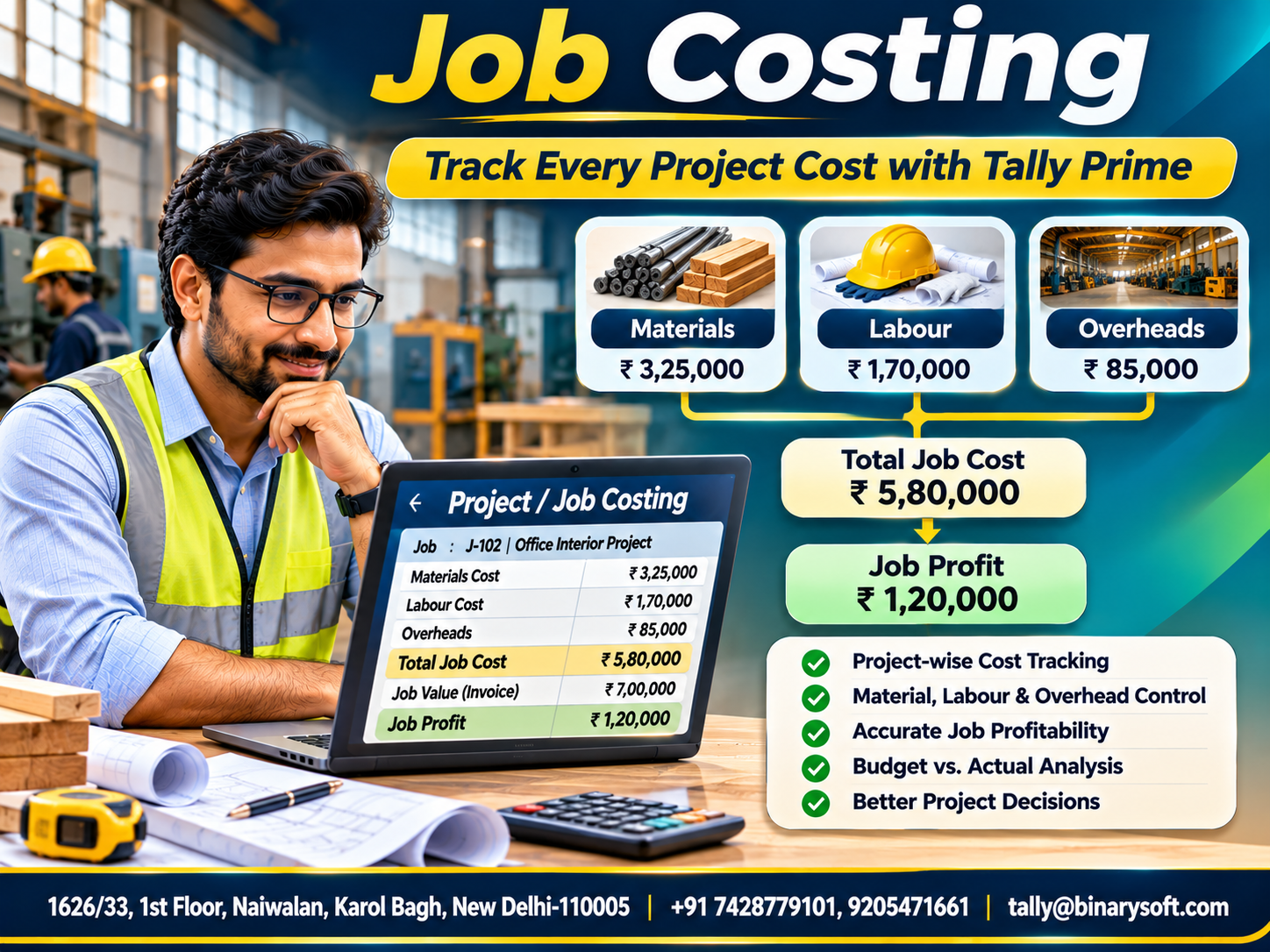
Total Job Cost = Direct Materials + Direct Labour + Allocated Overheads
Suppose an interior contractor completes an office renovation project.
| Cost Component | Amount |
|---|
| Direct materials |
₹3,25,000 |
| Direct labour |
₹1,70,000 |
| Allocated overheads |
₹85,000 |
| Total job cost |
₹5,80,000 |
If the customer is charged ₹7,00,000, the job profit before any additional unallocated costs is:
₹7,00,000 − ₹5,80,000 = ₹1,20,000
The job profit margin is approximately 17.14% of revenue.
This example excludes GST from the revenue and cost comparison and assumes the listed amounts represent the relevant job costs.
4. How the Job Costing Process Works
An effective job costing process follows a structured sequence.
Create a Job Reference: Assign a unique identification number to each project.
Prepare an Estimate: Calculate expected material, labour and overhead expenses.
Record Material Usage: Track materials purchased or consumed for the job.
Monitor Labour: Record relevant employee or contractor costs.
Allocate Overheads: Assign indirect expenses using an appropriate method.
Review Actual Costs: Compare recorded expenses with the original estimate.
Calculate Profitability: Compare job revenue with the relevant job costs.
Close and Evaluate: Review completed projects to improve future quotations.
Consistent documentation is essential throughout the process.
5. Types of Businesses That Use Job Costing
Job costing is useful in industries where assignments differ in scope or requirements.
Construction Companies
Contractors can monitor materials, labour, machinery and subcontracting expenses for individual projects.
Furniture Manufacturers
Businesses can calculate the cost of customized furniture orders.
Printing Businesses
Printers can track paper, ink, design and production expenses for specific customer orders.
Interior Design Firms
Interior contractors can monitor project-wise material and installation costs.
Engineering Workshops
Fabrication units can calculate the cost of individual manufacturing assignments.
Professional Service Providers
Consultancies and agencies can monitor staff time and directly attributable project expenses.
The costing structure should reflect the nature of each business.
6. Job Costing vs Process Costing
Job costing and process costing serve different purposes.
Job costing is suitable when individual assignments can be identified and their costs tracked separately.
Process costing is commonly used when businesses produce large quantities of similar products through continuous or repetitive processes.
For example, a customized furniture manufacturer may use job costing for individual orders.
A business producing large volumes of identical products may find process costing more suitable.
Some manufacturers use a combination of methods.
The appropriate approach depends on production characteristics and reporting requirements.
7. An Emotional Story: The Contractor Who Nearly Lost His Family Business
Amit owned a small interior contracting company in Delhi.
His father had established the business with two workers and a reputation for dependable service.
Amit wanted to expand operations and provide better opportunities for his employees.
One day, he received an office renovation contract worth ₹18 lakh.
It was the largest assignment his company had ever accepted.
Amit believed the project would provide enough profit to purchase new equipment and improve his family's financial security.
However, several unexpected expenses emerged.
Material prices increased.
Additional workers were required.
Transport and installation costs exceeded the original estimate.
Because expenses were not tracked separately, Amit did not realize how quickly the project budget was being exhausted.
When the work was completed, the customer appreciated the result.
But Amit's accountant revealed that the profit was far lower than expected.
Amit felt devastated.
He remembered his father's sacrifices and worried about paying his employees on time.
That evening, his daughter found him sitting quietly with a pile of invoices.
She asked why he looked unhappy after completing such a large project.
Amit explained that receiving a large payment did not necessarily mean earning a good profit.
The next morning, he decided to change his accounting process.
Every new project received a separate reference number.
Material purchases, labour expenses and subcontractor bills were recorded against the relevant assignment.
The team began reviewing estimated and actual costs weekly.
Over time, Amit developed greater confidence in his quotations.
He could identify rising costs before they became serious problems.
One evening, his daughter noticed him smiling while reviewing a project report.
He told her that the company was finally measuring success through profitability rather than contract value alone.
For Amit, job costing became more than an accounting technique. It became a way to protect his father's legacy, support his employees and secure his family's future.
This fictional story illustrates why accurate project-cost information matters.
8. Benefits of Job Costing
Better Cost Visibility
Businesses can identify the expenses associated with each project.
Improved Quotations
Historical job costs provide useful information for preparing future estimates.
Stronger Budget Control
Management can compare actual expenses with planned costs.
Better Profitability Analysis
Job-wise reporting helps identify profitable and loss-making assignments.
Improved Resource Planning
Businesses can review material consumption and labour requirements.
Greater Accountability
Project managers can monitor expenses within their responsibilities.
Better Business Decisions
Management can use completed-job information when selecting future assignments.
Job costing is most effective when expenses are recorded accurately and reviewed regularly.
9. How Tally Prime Helps with Job Costing
Tally Prime provides accounting and inventory features that can support job-wise cost tracking.
Cost Centres
Businesses can create cost centres to identify expenses and income associated with projects or departments.
Cost Categories
Where appropriate, cost categories support additional dimensions of cost-centre reporting.
Purchase Vouchers
Material purchases and other expenses can be recorded through suitable accounting vouchers.
Inventory Management
Stock items and inventory transactions help businesses monitor material quantities and movements.
Stock Journals
Relevant stock transfers and consumption can be recorded through supported inventory workflows.
Accounting Reports
Cost Centre Break-up and other reports help review allocated amounts.
Project Profitability Analysis
Businesses can combine appropriately allocated revenue and cost information to assess job performance.
The level of automation depends on the configuration, transaction structure and business requirements.
10. How to Set Up Job Costing in Tally Prime
Businesses can begin with a structured accounting configuration.
Step 1: Enable Cost Centres
Open the relevant company accounting features and enable cost-centre functionality.
Step 2: Create Project Cost Centres
Create a separate cost centre for each job or project.
For example:
Project J-101 – Office Renovation
Project J-102 – Residential Interior
Project J-103 – Factory Maintenance
Step 3: Create Relevant Ledgers
Maintain suitable expense and income ledgers.
Step 4: Allocate Transactions
When entering supported vouchers, allocate relevant amounts to the correct project cost centre.
Step 5: Record Inventory Movements
Maintain appropriate stock transactions for materials issued or consumed.
Step 6: Review Reports
Examine cost-centre reports and relevant inventory information.
Step 7: Reconcile Costs
Confirm that job-related expenses have been recorded and allocated correctly.
Exact navigation and options may vary by Tally Prime release and configuration.
11. Material Cost Tracking in Tally Prime
Materials are often a major component of job cost.
For example, a construction contractor may purchase cement, steel, electrical fittings and plumbing materials for different projects.
Accurate tracking requires clear material records.
Tally Prime can help businesses maintain stock items, purchase transactions and inventory movements.
However, a purchase recorded in inventory does not automatically prove that the material has been consumed by a particular project.
Businesses should establish procedures for recording actual material issues and job-wise consumption.
Where additional project-level inventory tracking is required, the workflow may need careful configuration or suitable customization.
12. Labour and Overhead Allocation
Labour costs may be recorded using wages, salary or contractor expense ledgers.
Relevant amounts can be allocated to project cost centres where supported.
Businesses should maintain separate timesheets or attendance records when labour hours must be tracked in detail.
Overhead allocation requires particular care.
For example, workshop rent may be distributed across jobs using labour hours, machine hours or another reasonable basis.
The chosen method should reflect how the business consumes resources.
Tally Prime can record allocated accounting amounts, but businesses must establish appropriate costing policies.
13. Case Study One: Job Costing for a Construction Contractor
Illustrative Case Study
Business Background
A small construction contractor handles residential renovation projects.
The Challenge
The company struggles to identify which projects generate adequate profit.
Material and subcontractor expenses are recorded without consistent project references.
The Approach
Management creates separate project cost centres in Tally Prime.
Relevant expenses are allocated to the correct projects.
Material movements are documented using appropriate inventory procedures.
The accounting team reviews project-wise reports regularly.
Expected Outcome
Management can gain clearer visibility into project expenses and compare costs across assignments.
Business Lesson
Accurate project references and disciplined transaction allocation are essential for useful job-cost reports.
14. Case Study Two: Custom Furniture Manufacturing
Illustrative Case Study
Business Background
A furniture manufacturer produces customized office tables, cabinets and workstations.
The Challenge
Different customer orders require different materials and labour efforts.
The company finds it difficult to estimate profitability consistently.
The Approach
The business creates job references for customer orders.
Material requirements are reviewed before production.
Relevant expenses are recorded against the appropriate cost centres.
Tally Prime inventory and accounting reports support cost review.
Expected Outcome
The manufacturer can develop more consistent job-cost estimates and identify expensive production activities.
Business Lesson
Job costing helps customized manufacturers understand the actual financial performance of individual orders.
Both case studies are illustrative rather than verified customer results.
15. Job Cost Sheet: Meaning and Example
A job cost sheet summarizes expenses associated with a specific assignment.
A practical cost sheet may include:
| Particulars | Amount |
|---|
| Direct materials |
₹2,40,000 |
| Direct labour |
₹1,20,000 |
| Direct expenses |
₹40,000 |
| Allocated overheads |
₹60,000 |
| Total job cost |
₹4,60,000 |
| Job revenue |
₹5,75,000 |
| Job profit |
₹1,15,000 |
The job profit margin is 20%.
Businesses may also compare estimated and actual amounts in the same report.
A well-designed job cost sheet helps management identify cost overruns and improve future pricing.
16. Common Job Costing Mistakes
Several errors can reduce the reliability of job costing.
Incorrect Cost Allocation: Expenses may be assigned to the wrong project.
Missing Material Consumption: Purchased materials may not be recorded as consumed.
Ignoring Indirect Costs: Overheads may be excluded from profitability calculations.
Inaccurate Labour Records: Employee time may not be assigned correctly.
Poor Job Identification: Inconsistent references can make transactions difficult to trace.
Delayed Data Entry: Late recording prevents timely cost reviews.
Confusing Cash Flow with Profit: Customer receipts do not necessarily represent earned profit.
Businesses should establish clear documentation and review procedures.
17. Job Costing Best Practices
Effective job costing requires consistent operational discipline.
Create a unique reference for every assignment.
Prepare detailed estimates before beginning work.
Record direct expenses against the relevant job.
Maintain reliable material-consumption records.
Use appropriate labour documentation.
Allocate overheads consistently.
Review budget-versus-actual differences regularly.
Investigate significant cost overruns.
Reconcile accounting records before closing a job.
Use completed-job information when preparing future quotations.
These practices help improve the quality of job-wise financial information.
18. How Job Costing Improves Pricing Decisions
Pricing should reflect the resources required to complete an assignment.
Without accurate cost information, businesses may quote prices that are too low.
Historical job-cost reports can help identify typical material requirements, labour expenses and overhead allocations.
For example, a contractor may discover that transport expenses consistently exceed estimates.
Future quotations can incorporate more realistic assumptions.
Similarly, a manufacturer may identify products requiring unusually high labour input.
Job costing does not determine the ideal selling price automatically.
Market conditions, competition, customer requirements and business strategy must also be considered.
However, reliable cost information provides a stronger foundation for pricing decisions.
19. The Future of Job Costing
Digital accounting systems are making job-wise financial information easier to organize and review.
Businesses are increasingly exploring integrated project reporting, automated data collection and budget-monitoring tools.
However, technology cannot compensate for missing or incorrectly classified transactions.
For Tally Prime users, cost centres, inventory records and accounting reports provide useful foundations for project-cost analysis.
Businesses with more complex requirements may evaluate additional project-management systems or suitable integrations.
The objective is to connect operational activity with financial results.
When businesses understand the cost of individual assignments, they can make more informed decisions about pricing, resources and future growth.
Conclusion
Job costing is an important accounting method for businesses handling customized products, contracts and projects.
It helps identify direct material costs, direct labour expenses and allocated overheads for individual assignments.
Accurate job costing supports budgeting, quotation preparation, expense control and profitability analysis.
Tally Prime can assist through cost centres, accounting vouchers, inventory records and financial reports.
However, reliable job costing also requires accurate transaction allocation, appropriate overhead policies and regular reconciliation.
Businesses should review project expenses throughout execution rather than waiting until work is completed.
A successful project is not simply one that generates high revenue. It is one that delivers customer value while earning a sustainable profit.
Powered by Binarysoft Technologies
Authorized Tally Partner
Binarysoft Technologies helps businesses improve accounting, project-cost tracking and financial management through Tally Prime implementation, configuration, customization, technical support and cloud-based accounting solutions.
Our services support contractors, manufacturers, service providers and project-based businesses seeking reliable financial records and improved cost visibility.
Location:
1626/33, 1st Floor, Naiwalan, Karol Bagh, New Delhi – 110005, INDIA
Contact Us:
+91 7428779101, 9205471661
Email:
tally@binarysoft.com
Business Hours:
10:00 AM – 6:00 PM, Monday to Friday
Frequently Asked Questions
What is the difference between job costing and process costing?
Job costing tracks identifiable assignments separately, while process costing is generally used for continuous production of similar goods.
How does job costing improve profitability?
It helps businesses identify cost overruns, prepare better estimates and evaluate the financial performance of individual jobs.
Can labour costs be tracked project-wise in Tally Prime?
Relevant labour expenses can be allocated through suitable accounting and cost-centre workflows. Detailed time tracking may require additional records or systems.
Does Tally Prime automatically calculate every project cost?
Not necessarily. Reliable job-cost analysis depends on correct configuration, transaction allocation and appropriate treatment of inventory and overheads.
CA. Rishubh Talrejaa specializes in GST, business accounting, and compliance advisory for growing enterprises. With experience in handling real-time transactional data and audits, he writes practical insights on inventory control, taxation, and digital transformation for Indian businesses operating in competitive markets.








