Call CA Tally HelpDesk
+91 9205471661,
7428779101

Introduction: Why Choosing the Right Inventory System Matters
Imagine running a growing business where sales are increasing, customers are placing larger orders, and your warehouse is becoming busier every month.
Everything appears successful until an important customer requests a product your records show as available.
Your employees search the warehouse but cannot find it.
Meanwhile, another product occupies valuable storage space despite remaining unsold for months.
These problems often occur when inventory management systems fail to keep pace with business growth.
For manufacturers, retailers, wholesalers and startups, accurate inventory records are essential for controlling costs and maintaining customer trust.
The right inventory management system helps businesses monitor stock quantities, track product movement, prevent shortages and make informed purchasing decisions.
Businesses generally use three fundamental inventory management approaches: manual, periodic and perpetual.
Each method has advantages, limitations and suitable applications.
This guide explains these systems, compares their effectiveness and demonstrates how Tally Prime helps businesses manage inventory more systematically.
1. What Is an Inventory Management System?
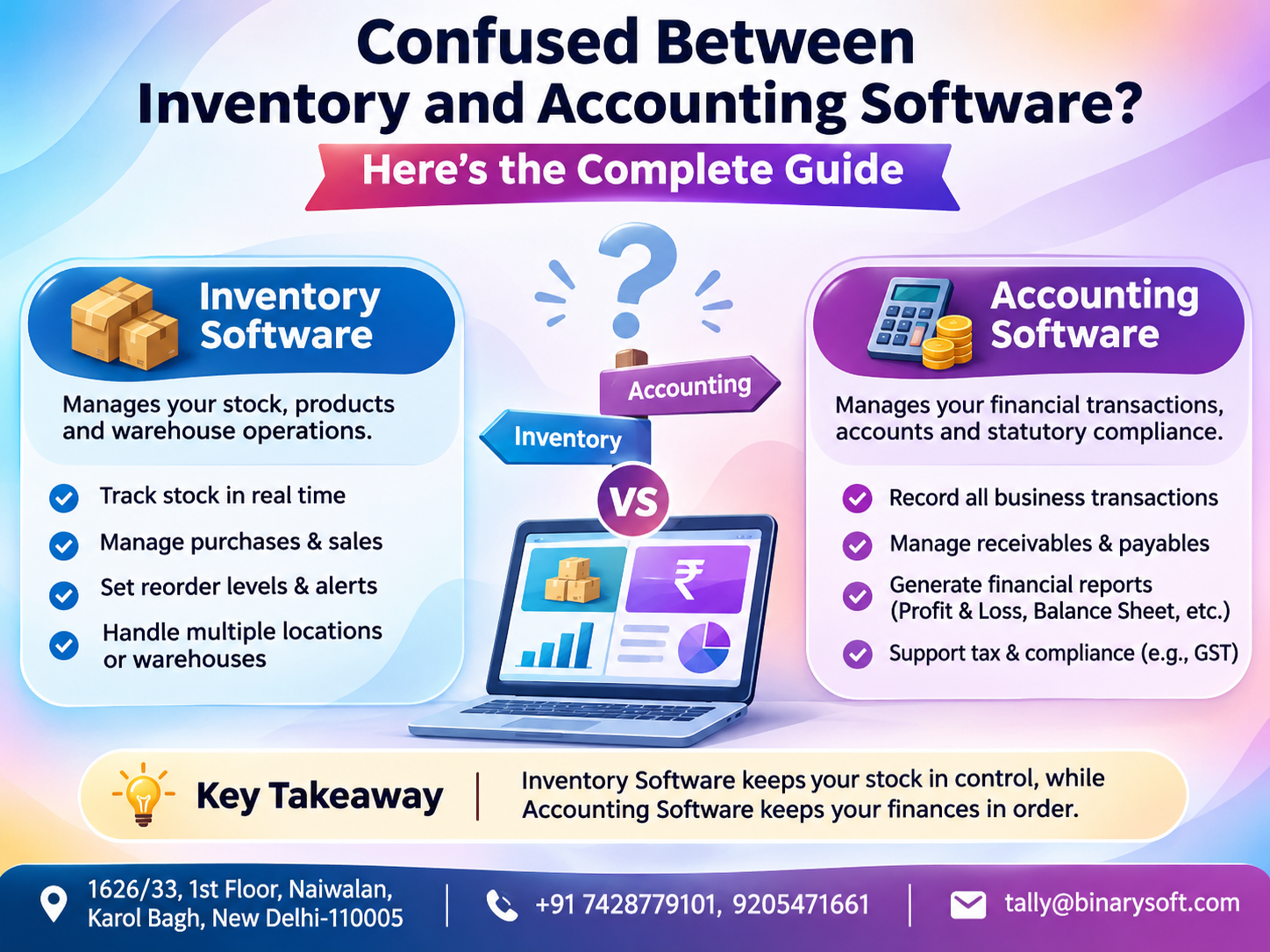
An inventory management system is a structured process used to record, monitor and control goods held by a business.
Inventory may include raw materials, work-in-progress, finished products, trading goods and consumable supplies.
The system helps answer important questions:
How much stock is available?
Which products are selling quickly?
Which items require replenishment?
Where are products stored?
How much capital is invested in inventory?
Accurate answers support purchasing, sales, production planning and financial reporting.
An inventory system may involve handwritten registers, spreadsheets or dedicated business software.
The most suitable approach depends on inventory volume, operational complexity and available resources.
2. The Three Main Types of Inventory Management Systems
The three fundamental approaches are:
-
Manual inventory management.
-
Periodic inventory management.
-
Perpetual inventory management.
These categories describe different aspects of inventory control.
Manual inventory management describes how records are maintained.
Periodic and perpetual inventory systems describe when inventory records are updated and how stock balances are determined.
Therefore, a business can use manual procedures within a periodic system.
Understanding this distinction helps businesses compare available methods correctly.
3. Manual Inventory Management System
A manual inventory management system relies primarily on handwritten records, physical counting and employee-maintained documentation.
For example, a small stationery shop may record incoming and outgoing products in a register.
When new notebooks arrive, the owner increases the recorded quantity.
When notebooks are sold, the quantity is reduced.
This approach can work for businesses handling a limited number of products and transactions.
Advantages of Manual Inventory Management
Manual systems require little initial technology investment.
Employees can maintain records without specialized software.
They may also be suitable for very small businesses with simple inventory requirements.
Disadvantages of Manual Inventory Management
Manual records are vulnerable to calculation mistakes, missing entries and inconsistent updates.
Searching historical transactions can become time-consuming.
As product volumes increase, maintaining accurate information becomes difficult.
Manual systems also provide limited reporting capabilities.
For growing businesses, these limitations can create operational problems.
4. Periodic Inventory Management System
A periodic inventory system determines inventory balances at selected intervals rather than continuously updating stock and cost records after every transaction.
Businesses may conduct physical stock counts weekly, monthly, quarterly or annually.
For example, a small retailer may count all products at the end of each month.
The business uses the count to determine closing inventory.
Under a basic periodic inventory accounting method:
Cost of Goods Sold = Opening Inventory + Net Purchases − Closing Inventory
Suppose:
Opening Inventory: ₹2,00,000
Net Purchases: ₹5,00,000
Closing Inventory: ₹1,50,000
Cost of Goods Sold:
₹2,00,000 + ₹5,00,000 − ₹1,50,000 = ₹5,50,000.
The result depends on accurate physical counts and appropriate inventory valuation.
Advantages
Periodic systems can be simpler for businesses with limited inventory.
They may require fewer transaction-level inventory records.
Limitations
Management may not know exact stock balances between counts.
Shortages, damage and recording errors may remain unidentified for longer periods.
This makes periodic systems less suitable for businesses requiring continuous stock visibility.
5. Perpetual Inventory Management System
A perpetual inventory system updates inventory records as relevant transactions occur.
Purchases increase recorded stock.
Sales and consumption reduce recorded stock.
Transfers change quantities between storage locations.
For example, an electrical distributor receives 500 switches.
The receipt is recorded in the inventory system.
Later, 150 switches are sold.
The system reflects the remaining quantity based on recorded transactions.
This provides more current information than a basic periodic system.
Advantages
Perpetual systems improve stock visibility and support faster purchasing decisions.
Businesses can monitor product movement, identify shortages and review inventory values more frequently.
Limitations
They require consistent transaction recording, suitable software and employee training.
Incorrect entries can still produce inaccurate balances.
A perpetual inventory system does not eliminate the need for physical stock verification.
Its reliability depends on accurate records and disciplined procedures.
6. Manual vs Periodic vs Perpetual Inventory Systems
| Feature | Manual | Periodic | Perpetual |
|---|
| Main approach |
Human-maintained records |
Inventory determined at intervals |
Continuous transaction recording |
| Stock visibility |
Depends on recordkeeping |
Limited between counts |
More current |
| Initial complexity |
Usually low |
Low to moderate |
Moderate |
| Error risk |
Higher with growing volumes |
Counting and timing risks |
Data-entry and configuration risks |
| Reporting |
Limited |
Period-based |
Detailed transaction-based |
| Suitable businesses |
Very small operations |
Simple, low-volume operations |
Growing and complex businesses |
The appropriate system depends on business needs.
A small shop may manage simple inventory through periodic counting.
A distributor handling thousands of transactions may benefit from perpetual records.
Businesses should choose based on operational requirements rather than assuming that the most complex system is always necessary.
7. Why Inventory Management Systems Are Important
Inventory management affects nearly every business department.
Purchasing teams need accurate information to avoid unnecessary orders.
Sales teams need reliable stock availability before promising deliveries.
Manufacturers need materials at the right production stages.
Accounts teams require dependable inventory values for financial reporting.
Poor inventory information can create stockouts, excessive purchases, delayed deliveries and incorrect business decisions.
A suitable inventory management system improves coordination.
It also helps management understand which products deserve greater attention.
8. Understanding Other Inventory Control Methods
In addition to the three fundamental inventory systems, businesses use several inventory control techniques.
ABC Analysis
Classifies products according to relative importance, commonly based on annual consumption value.
FIFO
First-In, First-Out is a method that may be used for physical stock rotation or inventory valuation, depending on the context.
FEFO
First-Expired, First-Out prioritizes goods with earlier expiry dates for dispatch.
Just-in-Time
JIT aims to reduce inventory by coordinating replenishment closely with actual requirements.
Economic Order Quantity
EOQ estimates an order quantity that balances ordering and holding costs under specified assumptions.
Reorder Point Planning
Establishes thresholds indicating when replenishment should be considered.
These techniques complement inventory systems rather than replace them.
9. How to Choose the Right Inventory System
Businesses should evaluate several factors before selecting an inventory system.
Number of Products
A business managing ten products has different requirements from one managing thousands.
Transaction Volume
Frequent purchases, sales and transfers increase the need for timely records.
Warehouse Locations
Multiple godowns require accurate location-wise information.
Product Characteristics
Perishable goods may need batch and expiry tracking.
Available Budget
Software, training and implementation involve costs.
Growth Plans
A system suitable today should ideally accommodate reasonable business expansion.
Reporting Requirements
Management may need stock valuation, movement analysis and reorder information.
The best system is one employees can maintain consistently.
10. An Emotional Story: When a Missing Stock Register Threatened a Family Business
For twenty years, Ramesh operated a small hardware distribution business in Delhi.
He began with one rented shop and gradually built relationships with contractors and retailers.
His wife managed accounts, while his son helped with customer orders.
For many years, inventory was maintained through handwritten registers.
The process worked when the business sold only a few products.
However, as the company expanded, hundreds of stock items entered the warehouse.
One morning, an important customer requested a large quantity of electrical fittings.
The register showed that the required products were available.
Ramesh confidently promised delivery.
But when employees checked the godown, several cartons were missing.
Some had been sold without updating the register.
Others had been moved to a different storage area.
The customer cancelled the order.
That evening, Ramesh sat quietly in his office.
His son noticed his disappointment.
Ramesh said, “I built this business with honesty and hard work. I never imagined a missing stock entry could damage someone's trust in us.”
His son suggested replacing the old recording process with a structured inventory system.
The family began verifying stock quantities and creating consistent product records.
They introduced location-wise tracking and started recording purchases and sales promptly.
Employees initially found the new procedures unfamiliar.
But with training, the process became easier.
Several months later, another important customer placed an urgent order.
This time, the team checked recorded availability, confirmed the physical location and completed the delivery.
When the customer thanked him, Ramesh felt relieved.
His son smiled and said, “Papa, your experience built the business. Now our systems will help protect it.”
For Ramesh, modern inventory management was not about replacing traditional values. It was about protecting the trust and livelihoods created through years of dedication.
This story is fictional and illustrates a common business challenge.
11. Case Study One: Retailer Moves from Manual to Perpetual Inventory
Business Background
A hypothetical electronics retailer maintains approximately 800 products.
The Challenge
Inventory records are maintained through spreadsheets and occasional physical counts.
Employees struggle to identify shortages quickly.
The Solution
The retailer introduces transaction-based inventory recording using Tally Prime.
Stock items are classified into groups, and purchases and sales are recorded consistently.
Illustrative Outcome
Suppose monthly inventory discrepancies previously averaged 25.
After improving the recording process, discrepancies decline to 10.
Reduction:
25 − 10 = 15 discrepancies.
Percentage Reduction:
15 ÷ 25 × 100 = 60%.
These figures are hypothetical.
Business Lesson
A structured inventory system can improve record accuracy when supported by proper procedures and employee training.
12. Case Study Two: Manufacturer Improves Raw Material Visibility
Business Background
A hypothetical furniture manufacturer stores wood, fittings and finished products in separate locations.
The Challenge
Materials move between production areas without consistent documentation.
Management struggles to determine actual stock availability.
The Solution
The company creates separate godowns in Tally Prime.
Stock transfers are recorded using appropriate inventory vouchers.
Periodic physical verification is introduced.
Illustrative Outcome
Suppose the company previously experienced 12 material-related production interruptions per quarter.
After improving inventory controls, interruptions decline to five.
Reduction:
12 − 5 = 7 interruptions.
Percentage Reduction:
7 ÷ 12 × 100 = 58.3%.
Actual results depend on purchasing, production and supplier conditions.
Business Lesson
Accurate inventory records and location-wise tracking can support better production planning.
Both case studies are illustrative.
13. How Tally Prime Supports Perpetual Inventory Management
Tally Prime provides transaction-based inventory management capabilities.
Businesses can record stock purchases, sales, transfers and adjustments.
Relevant reports update based on recorded transactions.
Important capabilities include:
Stock Items: Maintain individual product records.
Stock Groups: Organize similar products.
Stock Categories: Classify products across additional reporting dimensions.
Units of Measurement: Record quantities in suitable units.
Godowns: Track inventory across locations.
Stock Journals: Record transfers and relevant inventory movements.
Reorder Levels: Identify replenishment requirements.
Batch Tracking: Maintain batch-wise information where applicable.
Stock Summary: Review inventory quantities and values.
These capabilities help businesses manage stock alongside accounting operations.
14. How to Create Stock Items in Tally Prime
Creating accurate stock masters is an important first step.
Step 1: Open the relevant company.
Step 2: Press Alt+G (Go To).
Step 3: Select Create Master.
Step 4: Choose Stock Item.
Step 5: Enter the product name.
Step 6: Select the appropriate stock group.
Step 7: Specify the unit of measurement.
Step 8: Enter verified opening stock details, where applicable.
Step 9: Press Ctrl+A to save.
Businesses should establish consistent naming conventions.
For example, different sizes or specifications should be distinguishable.
Clear product masters reduce confusion during purchasing and sales.
15. How to Monitor Inventory Using Stock Summary
The Stock Summary report helps businesses review recorded inventory balances.
To access it:
Step 1: Press Alt+G.
Step 2: Search for Stock Summary.
Step 3: Select the relevant report.
Step 4: Review quantities, stock values and movements.
Step 5: Drill down into stock groups or individual items.
The report reflects transactions recorded in the software.
For example, if a business purchases 500 units and records sales of 175 units, the resulting balance is 325 units, assuming no other movements.
This information supports purchasing and customer-order decisions.
16. Managing Multiple Godowns in Tally Prime
Businesses operating several warehouses need location-wise stock visibility.
Tally Prime supports godown creation and hierarchical storage structures.
For example:
Main Warehouse
Raw Material Section
Finished Goods Section
Retail Outlet
External Storage Location
To create a godown, open Alt+G > Create Master > Godowns.
Enter the location name and relevant parent godown.
Save the record.
Stock can then be allocated to locations during applicable transactions.
Businesses can review location-wise quantities through Godown Summary.
This helps employees identify where products are stored.
17. Recording Stock Transfers Between Locations
Inventory frequently moves between warehouses, shops or production areas.
These movements should be recorded promptly.
In Tally Prime, open Create Voucher and select Stock Journal.
Under the source section, specify the item, quantity and originating godown.
Under the destination section, enter the receiving location.
Save the transaction.
For example, transferring 100 units from Warehouse A to Warehouse B changes their recorded location.
It does not, by itself, represent a sale.
Accurate transfer records help maintain reliable godown-wise balances.
18. Using Reorder Levels to Prevent Stockouts
Reorder levels help businesses identify when stock should be replenished.
A basic formula is:
Reorder Point = Average Daily Demand × Lead Time + Safety Stock
Suppose:
Average Daily Demand: 20 units.
Supplier Lead Time: 5 days.
Safety Stock: 40 units.
Reorder Point:
20 × 5 + 40 = 140 units.
The business should review replenishment when its relevant inventory position approaches this level.
Tally Prime supports reorder-level configuration and a Reorder Status report.
The report can consider stock availability and outstanding purchase and sales orders.
This helps businesses make more informed purchasing decisions.
19. Why Physical Stock Verification Is Still Necessary
Even a perpetual inventory system can contain incorrect information.
Employees may forget to record movements.
Products may be damaged, lost or incorrectly counted.
Physical verification helps identify these differences.
Businesses can compare actual stock with recorded quantities.
Tally Prime provides Physical Stock vouchers for recording verified quantities and making appropriate adjustments.
However, discrepancies should be investigated before adjustments are approved.
Regular cycle counts are particularly useful for important or frequently moving products.
Accurate software records depend on accurate physical processes.
20. Inventory Management and Business Cash Flow
Inventory represents money invested in products and materials.
Excessive stock blocks capital that could otherwise support daily operations.
Insufficient stock may result in lost sales.
A reliable inventory management system helps businesses review product movement and purchasing requirements.
For example, identifying slow-moving products may prevent unnecessary repeat purchases.
Monitoring reorder levels may also reduce emergency buying.
These improvements can support cash flow and profitability.
However, inventory software does not automatically guarantee financial savings.
Management must use the information to make appropriate decisions.
21. Common Inventory System Implementation Mistakes
Businesses should avoid introducing software without planning.
Common mistakes include inaccurate opening balances, inconsistent product names and incomplete transaction recording.
Employees may also forget to record stock transfers or returns.
Some businesses create overly complicated stock classifications.
Others fail to review reports after implementation.
The solution is to begin with accurate master data and clear procedures.
Employees should understand who records purchases, sales, transfers and adjustments.
Regular management reviews help maintain system reliability.
22. The Future of Inventory Management Systems
Inventory management is becoming increasingly digital.
Businesses increasingly expect timely information about product availability, warehouse movement and purchasing requirements.
Barcode-supported processes, integrated business software and automated reporting can improve efficiency when implemented appropriately.
However, the most advanced technology is not necessarily the best starting point.
Small businesses should first establish accurate stock records and consistent operating procedures.
Tally Prime can provide a structured foundation for inventory and accounting management.
As operations expand, businesses can evaluate additional capabilities according to their requirements.
Conclusion
Choosing the right inventory management system is essential for efficient business operations.
Manual systems may suit very small businesses with limited transactions.
Periodic systems provide inventory information at selected intervals.
Perpetual systems offer more current stock visibility through transaction-based records.
For growing businesses, accurate inventory information supports purchasing, sales, warehouse management and financial planning.
Tally Prime helps organizations record inventory movements, manage multiple godowns, monitor reorder requirements and review stock reports.
For retailers, these capabilities support product availability.
For manufacturers, they improve raw material visibility.
For wholesalers, they support better stock control and order fulfilment.
The best inventory management system is not simply the most sophisticated one. It is the system that provides dependable information, supports daily operations and helps a business grow without losing control of its stock.
Powered by Binarysoft Technologies
Authorized Tally Partner
Binarysoft Technologies helps businesses implement and use Tally Prime for accounting, inventory management, warehouse tracking, stock transfers, purchasing and financial reporting.
Businesses seeking to move from manual stock records to a structured inventory system can benefit from suitable Tally Prime configuration and employee training.
Location:
1626/33, 1st Floor, Naiwalan, Karol Bagh, New Delhi – 110005, INDIA
Contact Us:
+91 7428779101, 9205471661
Email:
tally@binarysoft.com
Business Hours:
10:00 AM – 6:00 PM, Monday to Friday
Frequently Asked Questions
Can Tally Prime manage inventory?
Yes. Tally Prime supports stock items, inventory transactions, godowns, reorder levels and inventory reports.
What is a manual inventory management system?
It is a method of maintaining inventory records primarily through handwritten registers, physical counting and manually updated documentation.
What is a perpetual inventory system?
A perpetual system updates recorded stock balances as relevant purchases, sales and inventory movements occur.
Which inventory management system is best for small businesses?
The best choice depends on product variety, transaction volume, budget and reporting requirements. Growing businesses often benefit from transaction-based inventory software.
CA. Aaryan Kanodia focuses on GST reporting, bookkeeping systems, and financial process improvement. He works with businesses to simplify routine accounting activities and maintain records suitable for compliance and internal review.