Call CA Tally HelpDesk
+91 9205471661,
7428779101
Introduction: The Hidden Expense Behind Unsold Inventory
Imagine running a successful wholesale business where your warehouse is filled with products, suppliers offer attractive discounts and customers regularly place orders.
Everything appears profitable.
However, when your accountant prepares the monthly financial reports, an unexpected problem emerges.
Despite healthy sales, cash is becoming difficult to manage.
Warehouse rent is increasing, employees spend more time handling unsold products, and several items have remained untouched for months.
The problem may not be insufficient sales. It may be excessive inventory carrying costs.
Inventory carrying cost is the total expense a business incurs to hold and maintain inventory before it is sold or consumed.
These expenses include storage, financing, insurance, handling, deterioration and the risk of products becoming obsolete.
For Indian retailers, manufacturers, wholesalers and startups, understanding carrying costs is essential for protecting working capital.
Tally Prime helps businesses monitor stock values, analyse inventory movement and make purchasing decisions that can reduce unnecessary holding expenses.
This guide explains inventory carrying costs, their components, calculation methods and practical reduction strategies.
1. What Is Inventory Carrying Cost?
Inventory carrying cost, also called inventory holding cost, represents the expense of keeping goods in stock over a particular period.
Purchasing inventory is only the beginning of the financial commitment.
Businesses must also store, protect, manage and finance those products until they are sold.
For example, a distributor may purchase electrical accessories worth ₹10 lakh.
If the products remain unsold, the business continues paying warehouse expenses, handling costs and other charges.
The invested capital also remains unavailable for alternative business activities.
Carrying costs therefore represent an important part of inventory management.
Businesses should calculate these expenses regularly rather than focusing exclusively on purchase prices.
2. Why Inventory Carrying Costs Matter
High inventory carrying costs can reduce profitability even when sales remain strong.
They may create several problems.
Reduced Cash Availability: Money invested in unsold products cannot easily support daily operations.
Higher Warehouse Expenses: Excess inventory may require additional storage space.
Greater Obsolescence Risk: Products can lose market relevance over time.
Additional Handling: Employees spend more time organizing and moving goods.
Lower Financial Flexibility: Businesses may struggle to purchase fast-moving products.
For startups with limited capital, these consequences can be particularly serious.
Understanding carrying costs helps management identify whether inventory investment is financially justified.
3. The Four Major Components of Inventory Carrying Cost
Inventory carrying costs are commonly divided into four categories.
Capital Costs
These represent the financing or opportunity cost of money invested in inventory.
Storage Costs
These include warehouse rent, utilities, handling equipment and relevant storage expenses.
Inventory Service Costs
These may include inventory-related insurance, administration and management systems.
Inventory Risk Costs
These include shrinkage, damage, spoilage and obsolescence.
The exact classification may vary between businesses.
The important requirement is to identify relevant expenses consistently and avoid counting the same cost twice.
4. Capital Cost: The Price of Money Locked in Stock
Capital cost is often a significant component of inventory holding expenses.
When a business purchases goods, it commits money that could otherwise support operations or other investments.
If inventory is financed through borrowing, interest expenses may be relevant.
If the business uses its own funds, management may estimate an appropriate opportunity cost.
Example
Average Inventory Investment: ₹10,00,000
Assumed Annual Cost of Capital: 12%
Annual Capital Cost:
₹10,00,000 × 12% = ₹1,20,000.
This is an illustrative management calculation.
Businesses should use an appropriate rate reflecting their financing circumstances.
They should also avoid counting both borrowing interest and an overlapping opportunity-cost estimate for the same funds.
5. Storage Costs: More Than Warehouse Rent
Storage costs include expenses necessary to keep inventory in suitable conditions.
Examples include warehouse rent, electricity, security, storage equipment and handling.
Certain products require refrigeration, humidity control or specialized facilities.
These requirements can increase expenses.
For example, a food distributor may incur significant electricity costs to maintain temperature-controlled storage.
A hardware distributor may require additional racks and handling equipment.
Some storage expenses remain fixed even when inventory quantities decline.
Others change with stock volume.
Businesses should identify which costs can actually be reduced through better inventory planning.
6. Inventory Service Costs
Inventory service costs arise from maintaining and administering stock.
They may include insurance, inventory-related administration and relevant technology expenses.
For example, a business may insure warehouse inventory against specified risks.
It may also employ staff to maintain stock records and manage inventory transactions.
Not every administrative expense should automatically be allocated to inventory carrying costs.
Management should include costs that are reasonably attributable to holding and maintaining inventory.
Consistent classification makes period-to-period comparisons more meaningful.
7. Inventory Risk Costs
Inventory can lose value while it remains in storage.
Common risks include:
-
Physical damage.
-
Theft or unexplained shortages.
-
Expiry and deterioration.
-
Technological obsolescence.
-
Changes in customer preferences.
-
Products becoming difficult to sell.
For example, an electronics retailer may purchase accessories for a particular device model.
If customer demand shifts toward newer models, the older accessories may require discounting.
Inventory risk costs help businesses understand the financial consequences of holding products for extended periods.
8. Inventory Carrying Cost Formula
The most useful calculation expresses annual holding expenses as a percentage of average inventory value.
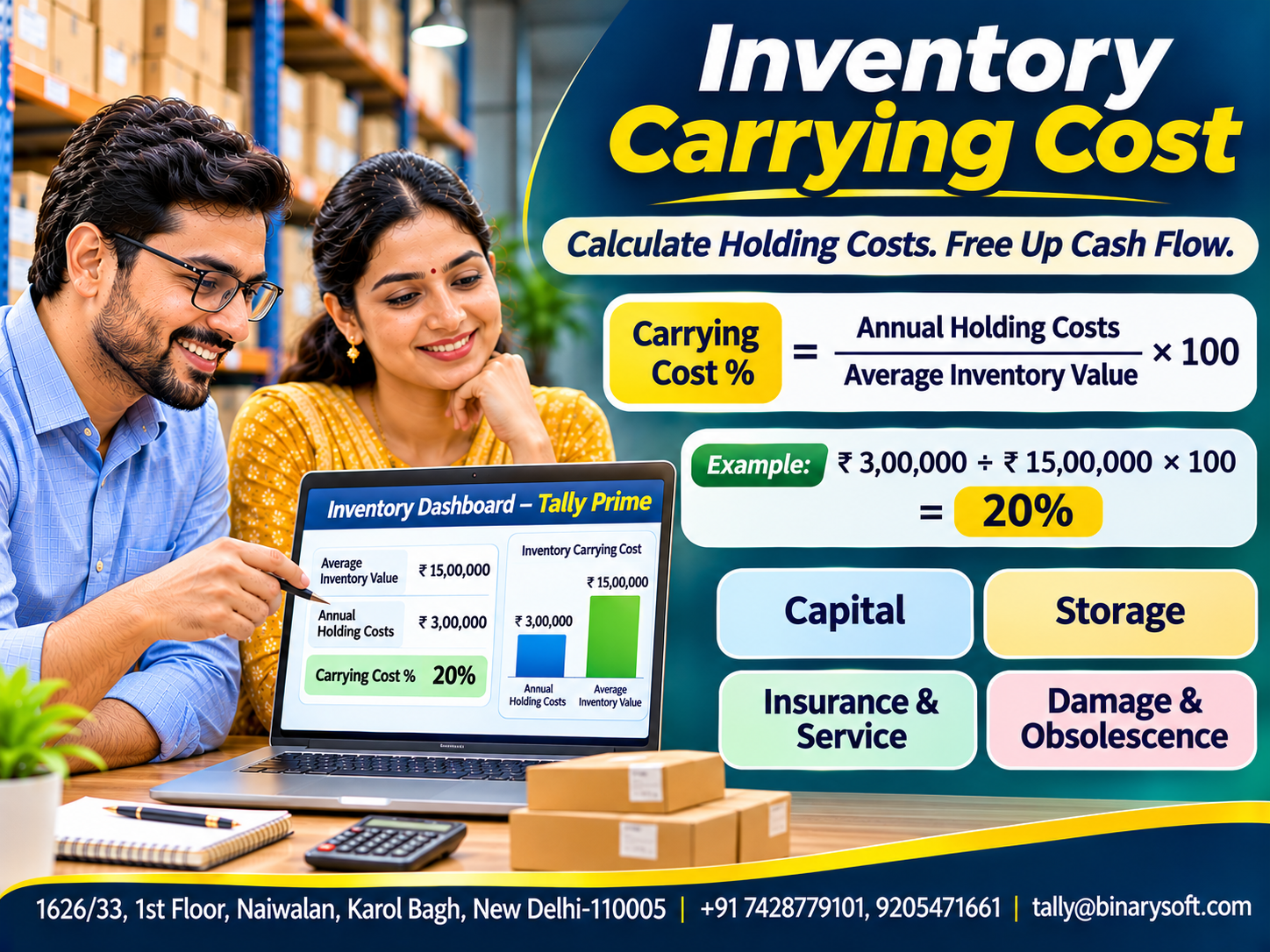
Inventory Carrying Cost (%) = (Total Annual Inventory Holding Costs ÷ Average Inventory Value) × 100
Where:
Total Annual Holding Costs include relevant capital, storage, service and risk expenses.
Average Inventory Value represents the average cost value of inventory held during the period.
For a basic estimate:
Average Inventory Value = (Opening Inventory + Closing Inventory) ÷ 2
When stock levels fluctuate significantly, monthly or more frequent inventory averages provide a more representative figure.
Businesses should use matching time periods and consistent cost classifications.
9. Step-by-Step Inventory Carrying Cost Calculation
Consider a hypothetical wholesale distributor.
Average Inventory Value: ₹15,00,000
Annual Capital Cost: ₹1,20,000
Warehouse Storage Cost: ₹90,000
Insurance and Administration: ₹30,000
Damage and Obsolescence: ₹60,000
Step 1: Calculate Total Holding Costs
₹1,20,000 + ₹90,000 + ₹30,000 + ₹60,000
Total Annual Holding Costs = ₹3,00,000
Step 2: Apply the Formula
Carrying Cost Percentage:
(₹3,00,000 ÷ ₹15,00,000) × 100
Inventory Carrying Cost = 20%
This means the business incurs approximately ₹20 in annual holding costs for every ₹100 of average inventory investment.
The percentage is a management indicator, not an additional amount automatically payable on every purchase.
10. How Much Inventory Carrying Cost Is Acceptable?
Inventory carrying cost varies by industry, product type and operating model.
Some businesses use an annual carrying-cost estimate of approximately 15%–30% for initial planning.
However, this range is not a universal standard.
Perishable products, specialized storage requirements and expensive financing may increase costs.
Businesses with efficient warehouses and rapid inventory turnover may experience lower rates.
Management should calculate actual expenses and compare results over time.
A lower carrying-cost percentage is useful only when inventory availability and customer service remain satisfactory.
Reducing inventory too aggressively can create shortages and lost sales.
11. Inventory Carrying Cost vs Inventory Purchase Cost
Inventory purchase cost and carrying cost are different.
Purchase cost represents the amount spent acquiring goods, including relevant directly attributable acquisition costs.
Carrying cost represents the ongoing economic burden of holding inventory.
For example:
Product Purchase Cost: ₹1,000
Assumed Annual Carrying Rate: 20%
Estimated Annual Holding Cost:
₹1,000 × 20% = ₹200.
If the product remains in stock for six months, a simple proportional estimate is ₹100.
Actual expenses may not accrue evenly throughout the year.
This calculation helps management understand why slow-moving products can become expensive.
12. An Emotional Story: The Warehouse That Was Full but the Cash Box Was Empty
For nineteen years, Sandeep operated a family-owned electrical distribution business in Delhi.
He began with a small shop and gradually expanded into a warehouse supplying contractors and retailers.
His wife managed accounts, while his son handled purchasing.
Sandeep believed that buying larger quantities would always improve profitability.
Whenever suppliers offered discounts, he placed substantial orders.
Soon, the warehouse was filled with cartons.
However, several products remained unsold for months.
Meanwhile, customer demand shifted toward newer electrical accessories.
One afternoon, the accountant informed Sandeep that supplier payments were approaching and available cash was insufficient.
Sandeep looked around the warehouse.
There were products everywhere, yet the business lacked money.
That evening, his son found him sitting alone.
Sandeep said, “I spent my life filling this warehouse because I thought more stock meant a stronger business.”
His son replied, “Papa, perhaps we should calculate what keeping all this stock is costing us.”
Together, they reviewed inventory values, warehouse expenses and slow-moving products.
They discovered that substantial money was tied up in goods that customers rarely requested.
The family introduced regular stock reviews, adjusted purchasing quantities and began clearing selected ageing inventory.
The improvements were gradual.
Some products required discounts, and supplier negotiations took time.
But the business slowly regained financial flexibility.
Several months later, Sandeep was able to purchase urgently needed fast-moving products without arranging additional borrowing.
When his wife asked how the business was progressing, he smiled.
“We finally understand that the value of our business is not measured by how full the warehouse looks.”
For Sandeep, controlling inventory carrying costs became a way to protect his family's future, employee livelihoods and the business he had spent decades building.
This is a fictional story illustrating a common business challenge.
13. Case Study One: Retail Distributor Reduces Holding Expenses
Business Background
A hypothetical household accessories distributor maintains inventory across two warehouses.
The Challenge
Excessive purchasing creates slow-moving stock and high storage expenses.
The Solution
Management reviews stock ageing, inventory movement and supplier ordering patterns.
Purchases are adjusted, and selected excess products are cleared.
Illustrative Outcome
Initial Average Inventory: ₹20,00,000
Revised Average Inventory: ₹15,00,000
Assumed Carrying Rate: 20%
Initial Annual Carrying Cost:
₹20,00,000 × 20% = ₹4,00,000.
Revised Estimated Carrying Cost:
₹15,00,000 × 20% = ₹3,00,000.
Potential Annual Reduction = ₹1,00,000
This assumes the carrying rate remains unchanged and relevant costs decline proportionately.
Fixed warehouse costs may not decrease immediately.
Business Lesson
Reducing unnecessary inventory can lower the economic cost of holding stock.
14. Case Study Two: Manufacturer Improves Material Planning
Business Background
A hypothetical furniture manufacturer purchases wood, fittings and packaging materials.
The Challenge
Management holds excessive quantities of some materials while frequently running short of others.
The Solution
The company introduces reorder planning, supplier coordination and monthly inventory reviews.
Illustrative Outcome
Initial Average Inventory: ₹30,00,000
Revised Average Inventory: ₹24,00,000
Assumed Annual Carrying Rate: 18%
Initial Estimated Holding Cost:
₹30,00,000 × 18% = ₹5,40,000.
Revised Estimated Holding Cost:
₹24,00,000 × 18% = ₹4,32,000.
Potential Annual Reduction = ₹1,08,000
The calculation is illustrative and assumes no material deterioration in production reliability.
Business Lesson
Better inventory planning can reduce unnecessary capital investment while supporting operational continuity.
Both case studies are hypothetical.
15. How Tally Prime Helps Control Inventory Carrying Costs
Tally Prime provides inventory management and reporting capabilities that help businesses identify unnecessary stock investment.
Important features include:
Stock Summary: Review inventory quantities and values.
Stock Ageing Analysis: Identify inventory held for extended periods.
Movement Analysis: Examine inward and outward stock movement.
Reorder Levels: Establish replenishment thresholds.
Reorder Status: Review stock shortfalls and purchasing requirements.
Godown Summary: Monitor inventory across locations.
Batch Tracking: Maintain batch information and expiry details where applicable.
Purchase Order Tracking: Review pending supplier orders.
These features support better decisions about stock quantities, storage and replenishment.
Tally Prime does not automatically calculate every business's complete economic carrying-cost percentage from all four cost categories.
Management must identify relevant expenses and calculate the rate using suitable financial information.
16. How to Check Inventory Value in Tally Prime
Businesses can review recorded inventory values through Stock Summary.
Step 1: Open the relevant company.
Step 2: Press Alt+G (Go To).
Step 3: Search for Stock Summary.
Step 4: Select the required reporting period.
Step 5: Review stock groups and individual items.
Step 6: Examine closing stock quantities and values.
Step 7: Repeat for appropriate dates to estimate average inventory value.
The report reflects recorded transactions and configured valuation methods.
Businesses should verify unusual balances and maintain consistent inventory costing policies.
17. How to Identify Slow-Moving Inventory
Slow-moving products frequently contribute to unnecessary carrying costs.
To investigate them in Tally Prime:
Step 1: Press Alt+G.
Step 2: Search for Stock Ageing Analysis.
Step 3: Select the relevant stock group.
Step 4: Review ageing periods.
Step 5: Identify products held for unusually long periods.
Step 6: Compare findings with Movement Analysis.
Management can then evaluate discounts, supplier returns or reduced future purchasing.
However, products should not be classified as unnecessary solely because they have low sales volumes.
Some critical spare parts must remain available despite infrequent demand.
18. How to Use Reorder Levels to Reduce Excess Stock
Reorder levels help businesses purchase inventory at more appropriate times.
A basic formula is:
Reorder Point = Average Daily Demand × Supplier Lead Time + Safety Stock
Suppose:
Daily Demand: 15 units.
Supplier Lead Time: 6 days.
Safety Stock: 30 units.
Reorder Point:
15 × 6 + 30 = 120 units.
Management can review replenishment when the relevant inventory position approaches 120 units.
Tally Prime supports reorder-level configuration and a Reorder Status report.
Businesses should review reorder settings regularly as demand changes.
19. Improve Inventory Turnover
Inventory turnover indicates how frequently stock is sold or consumed.
Inventory Turnover Ratio = Cost of Goods Sold ÷ Average Inventory Value
Suppose:
Annual Cost of Goods Sold: ₹60,00,000
Average Inventory: ₹15,00,000
Inventory Turnover:
₹60,00,000 ÷ ₹15,00,000 = 4 times.
Higher turnover may indicate faster inventory movement.
However, excessively high turnover can also suggest insufficient safety stock.
Businesses should interpret turnover alongside customer demand, supplier reliability and product availability.
20. Practical Ways to Reduce Inventory Carrying Costs
Improve Demand Forecasting
Review historical sales, seasonal demand and confirmed customer orders.
Reduce Unnecessary Bulk Purchasing
Evaluate supplier discounts against the additional cost of holding inventory.
Identify Dead Stock
Investigate products with little realistic future demand.
Improve Warehouse Organisation
Efficient storage can reduce handling time and unnecessary space usage.
Review Supplier Lead Times
Reliable suppliers may allow smaller inventory buffers.
Use Appropriate Safety Stock
Maintain enough reserve stock without excessive accumulation.
Monitor Inventory Reports
Review ageing, movement and replenishment requirements regularly.
Train Employees
Accurate transaction recording is essential for reliable inventory information.
These measures work best when implemented together.
21. Inventory Carrying Cost and Cash Flow Management
Inventory investment affects working capital.
Purchasing excessive goods reduces available cash.
Businesses may then need additional financing to meet operational expenses.
Carrying-cost analysis helps management evaluate whether inventory quantities are economically justified.
For example, reducing average inventory investment by ₹5 lakh may release working capital as goods are sold or unnecessary purchases are avoided.
However, releasing capital does not automatically produce an equal accounting profit.
The financial benefit depends on avoided expenses, financing costs and inventory disposal results.
Management should distinguish cash-flow improvements from reported profitability.
22. Common Inventory Carrying Cost Calculation Mistakes
Businesses should avoid several errors.
One is using sales value instead of inventory cost value in the denominator.
Another is comparing annual expenses with a single unusually high or low month-end inventory balance.
Some businesses omit financing costs or inventory obsolescence.
Others count the same warehouse or administrative expense twice.
A further mistake is assuming that reducing stock will immediately eliminate fixed warehouse rent.
Businesses should calculate carrying costs using consistent periods and reasonable expense allocations.
Accurate calculations support better decisions.
23. A Monthly Inventory Carrying Cost Review Plan
Businesses can establish a practical monthly review process.
First, review stock values and inventory movement.
Next, identify slow-moving and ageing products.
Then examine warehouse expenses, financing costs and inventory-related losses.
Compare inventory investment with recent sales and expected demand.
Review reorder levels and outstanding purchase orders.
Finally, document purchasing changes and assign responsibility for follow-up.
Tally Prime can provide the inventory and accounting information needed for much of this review.
Consistent monitoring helps businesses identify problems before they become expensive.
Conclusion
Inventory carrying cost is an important financial measure that every inventory-based business should understand.
It represents the ongoing expense of holding goods before they are sold or consumed.
Capital costs, storage expenses, inventory services and stock-related risks contribute to the total.
Calculating carrying costs helps businesses identify unnecessary inventory investment and evaluate opportunities for improvement.
Tally Prime supports this process through Stock Summary, Stock Ageing, Movement Analysis, Godown Summary and Reorder Status.
These reports help management understand stock availability, product movement and replenishment requirements.
However, successful cost reduction also requires appropriate purchasing policies, supplier coordination and regular financial review.
The goal is not to maintain the lowest possible inventory. It is to maintain the right inventory at a sustainable cost, protect customer service and keep working capital available for business growth.
Powered by Binarysoft Technologies
Authorized Tally Partner
Binarysoft Technologies helps businesses implement and use Tally Prime for accounting, inventory management, warehouse tracking, stock reporting, purchasing and financial analysis.
Businesses seeking to reduce excess inventory, improve stock visibility and manage working capital can benefit from appropriate Tally Prime configuration and structured inventory management procedures.
Location:
1626/33, 1st Floor, Naiwalan, Karol Bagh, New Delhi – 110005, INDIA
Contact Us:
+91 7428779101, 9205471661
Email:
tally@binarysoft.com
Business Hours:
10:00 AM – 6:00 PM, Monday to Friday
Frequently Asked Questions
How can businesses reduce inventory carrying costs?
Businesses can improve demand forecasting, reduce unnecessary purchases, monitor ageing stock, optimise warehouse space and establish appropriate reorder levels.
Can Tally Prime calculate inventory carrying costs?
Tally Prime provides inventory values, stock reports and accounting information that support the calculation. A complete carrying-cost percentage may require additional management calculations.
What is the relationship between inventory turnover and carrying cost?
Faster inventory turnover can reduce the time goods remain in storage, potentially lowering holding expenses. However, businesses must also maintain adequate product availability.
How can Binarysoft Technologies help reduce inventory costs?
Binarysoft Technologies can assist with Tally Prime implementation, stock reporting, reorder planning, godown management and inventory analysis to support more efficient stock control.
CA. Ishaan Bagaria works closely with traders and service enterprises on accounting systems, GST compliance, and reporting processes. His focus is on improving record accuracy and simplifying day-to-day financial management.