Call CA Tally HelpDesk
+91 9205471661,
7428779101
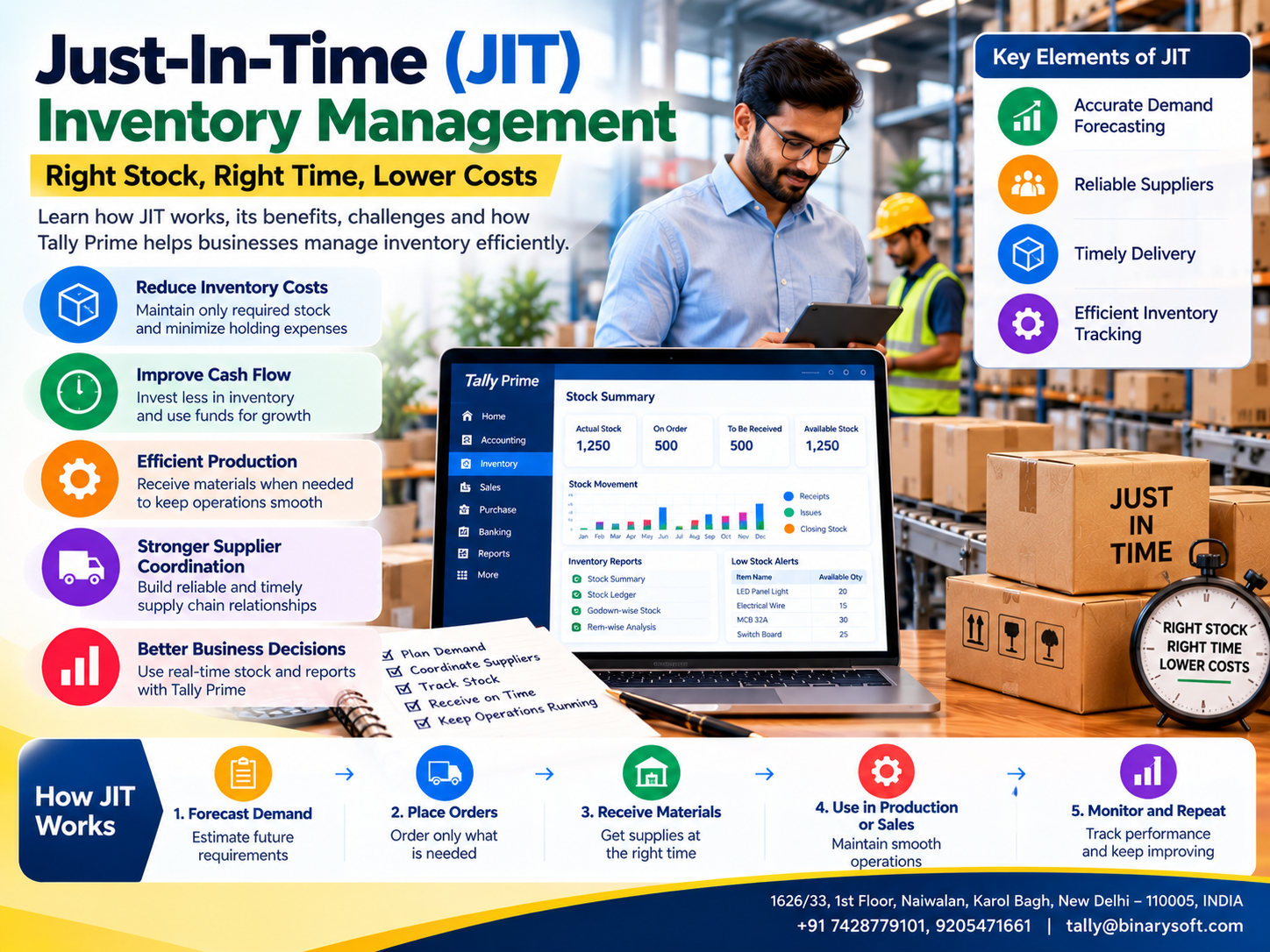
Introduction: Why Just-in-Time Inventory Management Matters in 2026
For many Indian businesses, inventory represents one of their largest investments. Manufacturers purchase raw materials, wholesalers maintain product stocks, and retailers keep goods available for customers. However, holding more inventory than necessary can create financial pressure, increase warehouse expenses and reduce working capital.
In 2026, businesses are focusing on improving operational efficiency while managing changing customer demand, supplier lead times and transportation uncertainties.
This has increased interest in Just-in-Time inventory management, commonly known as JIT.
JIT is an inventory and production approach in which materials and products are received or produced close to the time they are needed. Instead of maintaining large quantities of inventory as a precaution, businesses coordinate purchasing, production and delivery around actual requirements.
The objective is to reduce unnecessary inventory without disrupting operations.
However, successful JIT implementation requires accurate demand information, dependable suppliers, disciplined processes and effective coordination.
Tally Prime can support these activities through inventory records, purchase orders, stock reports, godown management and accounting information.
This guide explains the meaning of JIT, how it works, its advantages, limitations and practical applications for Indian businesses.
1. What Is Just-in-Time (JIT) Inventory Management?
Just-in-Time inventory management is a business approach designed to ensure that materials and products become available when they are required for production or customer fulfilment.
Rather than purchasing large quantities far in advance, a business plans replenishment around expected or confirmed demand.
For example, a furniture manufacturer may require 500 metal fittings to complete a scheduled production batch.
Under a traditional inventory approach, the manufacturer might purchase several thousand fittings and store them for future use.
Under a JIT-oriented approach, the business coordinates with its supplier to receive the required fittings shortly before production begins.
This can reduce storage requirements and the amount of money tied up in unused materials.
JIT is closely associated with lean manufacturing, waste reduction and continuous process improvement.
Its central principle is straightforward:
Maintain the inventory needed to support operations while minimizing unnecessary stock.
JIT does not necessarily mean maintaining absolutely zero inventory. Appropriate buffers may still be needed to manage supply risks.
2. An Emotional Business Story: The Warehouse That Consumed a Business Owner's Savings
Amit operated a small automotive components manufacturing business in Faridabad.
His father had started the company with two machines and a handful of employees. Over the years, Amit expanded the operation and began supplying components to larger manufacturers.
To avoid production interruptions, he purchased raw materials in substantial quantities.
Whenever suppliers offered bulk discounts, Amit ordered additional stock.
He believed a warehouse filled with materials represented business security.
But slowly, the financial situation changed.
The company had enough materials to support months of production, yet it struggled to pay electricity bills, salaries and supplier invoices on time.
Some materials remained unused because customer specifications had changed.
One evening, Amit walked through the warehouse and saw rows of cartons containing products that might never be required.
He realized that much of the company's working capital was sitting on shelves.
The following month, he began reviewing production schedules and supplier delivery arrangements.
His team introduced more frequent purchasing for selected materials, improved stock recording and started monitoring inventory through Tally Prime.
They also established clear communication with dependable suppliers.
Over time, Amit became more confident about purchasing decisions and inventory availability.
He understood that a successful manufacturing business did not need the largest possible warehouse.
It needed the right materials, available at the right time, supported by reliable processes.
This is an illustrative business story.
3. How Does Just-in-Time Inventory Management Work?
JIT connects customer demand, purchasing, production and delivery.
The process requires businesses to understand what materials are needed, when they are needed and how quickly suppliers can deliver them.
A simplified JIT workflow includes five stages.
JIT inventory workflow
Demand
Identify requirements
Order
Coordinate suppliers
Stage 1: Identify demand
Businesses examine confirmed orders, production schedules and expected customer requirements.
Stage 2: Plan purchasing
Materials are ordered according to the quantities and delivery dates needed.
Stage 3: Coordinate deliveries
Suppliers deliver materials within agreed time windows.
Stage 4: Use inventory efficiently
Materials move into production or goods are prepared for sale without unnecessary storage delays.
Stage 5: Monitor performance
Management reviews stock availability, delivery reliability, inventory costs and production interruptions.
The process repeats as demand changes.
4. Key Principles of Just-in-Time Inventory Management
Successful JIT systems are based on several connected principles.
Demand-driven operations
Purchasing and production should respond closely to actual requirements rather than unsupported assumptions.
Waste reduction
Businesses aim to reduce unnecessary inventory, excess movement, waiting time and other inefficient activities.
Reliable suppliers
Suppliers must provide the correct materials, quantities and quality within agreed delivery schedules.
Consistent quality
Defective materials can cause significant problems when businesses maintain limited inventory buffers.
Short replenishment cycles
Frequent, dependable replenishment allows businesses to reduce average stock levels.
Continuous improvement
Organizations regularly evaluate their processes and eliminate recurring inefficiencies.
These principles require cooperation between purchasing, warehouse, production, sales and accounting teams.
5. Benefits of Just-in-Time Inventory Management
JIT can provide meaningful benefits when implemented under suitable operating conditions.
Reduced inventory holding costs
Lower average inventory can reduce warehouse space requirements, handling expenses and financing costs.
Improved cash flow
Businesses may avoid investing large amounts in materials long before they are needed.
Less obsolete inventory
Purchasing closer to demand can reduce the risk of products becoming outdated before use or sale.
Better space utilization
Warehouse space can be used more efficiently when unnecessary stock accumulation is reduced.
Improved process visibility
JIT encourages businesses to examine purchasing schedules, supplier performance and production requirements.
Faster identification of problems
With smaller inventory buffers, quality and supply issues may become visible sooner, encouraging corrective action.
However, these benefits must be weighed against the possibility of higher transportation costs, frequent ordering and supply interruptions.
6. Traditional Inventory Management vs Just-in-Time
|
Factor
|
Traditional inventory approach
|
JIT inventory approach
|
|---|
|
Stock quantity
|
Often maintains larger buffers
|
Targets lower inventory levels
|
|
Purchasing
|
Frequently based on forecasts and stock targets
|
Closely aligned with demand and schedules
|
|
Warehouse needs
|
May require more storage
|
Can reduce storage requirements
|
|
Working capital
|
More funds may be tied up in stock
|
May reduce inventory investment
|
|
Supplier dependency
|
Inventory buffers provide some protection
|
Requires dependable replenishment
|
|
Supply disruption
|
Larger buffers may absorb delays
|
Delays can affect operations quickly
|
|
Operational focus
|
Inventory availability and protection
|
Flow efficiency and waste reduction
|
Neither approach is automatically superior in every situation.
Businesses with highly uncertain demand or unreliable supply chains may need greater safety stock.
A hybrid approach is often more practical than applying strict JIT principles to every product.
7. Practical Example of JIT Inventory Management
Consider a packaging manufacturer that requires 1,000 cardboard sheets each working day.
The business operates for 25 days per month.
Monthly material consumption is:
1,000 × 25 = 25,000 sheets.
Under its existing policy, the company maintains 20 working days of material inventory.
That represents 20,000 sheets.
Suppose each sheet costs ₹20.
The inventory investment is:
20,000 × ₹20 = ₹4,00,000.
After improving supplier coordination, the company reduces its normal inventory target to five working days.
The new inventory quantity is:
1,000 × 5 = 5,000 sheets.
The revised inventory investment is:
5,000 × ₹20 = ₹1,00,000.
Illustrative inventory investment comparison
₹3,00,000 less capital tied up in inventory
This example assumes unchanged material prices and excludes additional ordering, transport and disruption costs. It is not a guaranteed saving.
The example demonstrates how reducing average inventory can release working capital.
However, the company must still evaluate delivery reliability, order frequency and the cost of maintaining lower stock levels.
8. Role of Demand Forecasting in JIT
Accurate demand information is essential for JIT inventory planning.
Businesses need to understand customer requirements and likely consumption patterns.
Demand forecasting may involve historical sales, confirmed orders, seasonal trends and production schedules.
For example, a garment manufacturer may experience higher demand before festive seasons.
A strict JIT policy based only on average monthly demand could create shortages during peak periods.
The business should therefore adjust purchasing plans to reflect expected demand fluctuations.
Tally Prime sales and inventory reports can provide useful historical information for forecasting.
More advanced statistical forecasting may require separate analytical tools or customized solutions.
9. How Tally Prime Supports Just-in-Time Inventory Management
Tally Prime provides accounting and inventory-management capabilities that can support a JIT-oriented business process.
Although JIT is primarily an operational strategy, accurate software records are essential for implementing it effectively.
Stock Summary
The Stock Summary helps businesses examine stock quantities and values.
Managers can review available inventory and identify products requiring attention.
Purchase Order management
Purchase Orders help businesses document purchasing requirements and coordinate supplier commitments.
Inventory movement tracking
Purchases, sales, stock transfers and relevant inventory vouchers help maintain records of material movement.
Godown-wise inventory
Businesses operating multiple warehouses can track stock at different locations.
Reorder levels
Reorder-level functionality can help businesses identify products approaching their replenishment thresholds.
Financial reports
Accounting reports help management examine purchases, inventory investment, supplier balances and cash flow.
Tally Prime does not automatically establish a complete JIT system. Supplier scheduling, production planning, demand forecasting and advanced delivery alerts may require additional procedures or integrated solutions.
10. Step-by-Step: Implementing JIT with Tally Prime
Businesses can introduce JIT gradually instead of changing their entire inventory system immediately.
Step 1: Organize stock items. Create accurate stock masters with appropriate names, groups and units of measurement.
Step 2: Review sales and consumption. Examine historical sales and material usage to identify predictable demand patterns.
Step 3: Identify suitable products. Start with frequently used items that have reliable suppliers and relatively stable demand.
Step 4: Determine replenishment requirements. Consider average demand, supplier lead time and necessary safety stock.
Step 5: Configure relevant reorder information. Use appropriate inventory settings and reports to support stock monitoring.
Step 6: Create Purchase Orders. Record purchasing commitments in Tally Prime according to agreed supplier delivery schedules.
Step 7: Record material receipts. Update inventory records promptly when goods arrive.
Step 8: Monitor stock movements. Review Stock Summary, purchase records and godown-wise information.
Step 9: Evaluate performance. Track shortages, delayed deliveries, inventory levels and purchasing costs.
Step 10: Improve gradually. Adjust purchasing quantities and replenishment schedules based on actual results.
11. JIT and Inventory Reorder Levels
JIT does not eliminate the need for reorder planning.
A business must understand how much stock will be consumed before its next replenishment arrives.
A commonly used reorder-point calculation is:
\[ \text{Reorder Point}=\text{Demand During Lead Time}+\text{Safety Stock} \]
Example
A distributor sells an average of 50 units per day.
Its supplier normally takes four days to deliver.
The company maintains safety stock of 100 units.
Reorder point:
(50 × 4) + 100 = 300 units.
The business should consider placing a replenishment order when its relevant inventory position reaches 300 units.
Safety stock is particularly important when demand or supplier lead times are uncertain.
A JIT-oriented business may seek to reduce unnecessary buffers, but it should not eliminate protection against realistic supply risks without careful evaluation.
12. JIT vs Economic Order Quantity (EOQ)
JIT and Economic Order Quantity are both inventory-management approaches, but they address different concerns.
EOQ uses a mathematical model to determine an order quantity that minimizes combined ordering and holding costs under specified assumptions.
JIT focuses on coordinating material availability with actual operational requirements and reducing unnecessary inventory.
EOQ may recommend larger purchase quantities when ordering costs are high.
JIT may encourage smaller and more frequent deliveries when suppliers and operations can support them efficiently.
Businesses can use EOQ calculations as one input while designing a broader JIT purchasing strategy.
The appropriate approach depends on demand patterns, supplier reliability, transportation expenses and storage requirements.
13. Case Study One: An Automotive Components Manufacturer Improves Material Flow
Illustrative case study
An automotive components manufacturer in Faridabad supplied precision parts to industrial customers.
The company purchased metal components, fasteners and packaging materials from several suppliers.
The challenge
The manufacturer maintained substantial raw-material inventory to avoid production delays.
However, changing customer schedules created excess stock, while some critical materials still became unavailable unexpectedly.
The solution
Management classified materials according to demand predictability and supplier reliability.
Frequently used components were assigned more regular replenishment schedules.
Tally Prime was used to maintain stock records, purchase transactions and inventory reports.
The purchasing team also improved communication with key suppliers.
The outcome
The business developed better coordination between production schedules and material purchasing.
Management gained clearer visibility into inventory requirements and reduced dependence on unplanned bulk purchases.
The example demonstrates how JIT principles can support manufacturing operations when supplier relationships and inventory records are reliable.
14. Case Study Two: An Electronics Distributor Reduces Slow-Moving Inventory
Illustrative case study
An electronics distributor in Nehru Place, Delhi, supplied computer accessories and related products to retailers.
The company frequently purchased large quantities to obtain supplier discounts.
The challenge
Some products became outdated before they were sold.
Warehouse space was occupied by slow-moving items, and working capital remained tied up in inventory.
The solution
The distributor reviewed product-wise sales patterns and identified items suitable for more frequent replenishment.
Management reduced purchasing quantities for selected products and coordinated delivery schedules with dependable suppliers.
Tally Prime inventory reports helped the business monitor stock balances and purchasing activity.
The outcome
The company developed a more disciplined approach to inventory replenishment.
Employees could identify products requiring attention and make purchasing decisions using recent sales information.
The case illustrates how JIT-oriented purchasing can help businesses reduce exposure to product obsolescence.
15. Challenges and Risks of JIT Inventory Management
Despite its advantages, JIT can expose businesses to operational risks.
Supplier delays
Late deliveries may interrupt production or prevent timely customer fulfilment.
Transportation disruptions
Traffic restrictions, extreme weather and logistics problems can affect replenishment schedules.
Unexpected demand
Sudden increases in customer orders may exceed available inventory.
Quality problems
Defective materials can create significant delays when replacement stock is limited.
Supplier dependency
Businesses may become heavily dependent on a small number of reliable suppliers.
Higher ordering frequency
Smaller, frequent orders may increase transportation and purchasing expenses.
Limited protection against disruptions
Low inventory buffers can make businesses more vulnerable to supply-chain interruptions.
Businesses should evaluate these risks before introducing aggressive stock-reduction targets.
16. How to Reduce JIT Implementation Risks
A successful JIT strategy requires risk management.
Businesses should evaluate supplier reliability before reducing inventory buffers.
Critical materials may require additional safety stock or alternative sourcing arrangements.
Supplier lead times should be reviewed regularly, especially when delivery performance changes.
Quality inspections should identify problems before materials enter production.
Management should also maintain contingency plans for transportation disruptions and unexpected demand.
For some products, a hybrid approach combining JIT principles with strategic safety stock may be more suitable.
The objective should be reliable inventory flow rather than minimizing stock at any cost.
17. JIT Inventory Management for Different Industries
Manufacturing businesses
Manufacturers can coordinate raw-material deliveries with production schedules to reduce unnecessary storage.
Wholesale distributors
Wholesalers may use more frequent replenishment for products with predictable demand and dependable suppliers.
Retail businesses
Retailers can use recent sales information to adjust purchasing quantities and reduce excess stock.
Electronics businesses
JIT can help limit exposure to products that may become obsolete quickly.
Garment businesses
Manufacturers and distributors can coordinate purchasing with seasonal production requirements.
Pharmaceutical businesses
JIT principles may help reduce excess inventory, but product availability, expiry management, regulatory requirements and supply continuity must receive particular attention.
The suitability of JIT varies across products and industries.
18. Using Tally on Cloud for JIT Inventory Coordination
Businesses operating across several locations may benefit from centrally accessible inventory information.
A suitably configured Tally on Cloud environment can allow authorized users to access hosted accounting and inventory records.
For example, a manufacturing business may operate its production unit in Faridabad while its purchasing and accounting teams work from Delhi.
Centralized access can help employees review relevant stock and purchase information without relying on a single office computer.
Potential benefits include improved coordination, access to shared records and more consistent transaction recording.
However, cloud hosting alone does not guarantee real-time supplier integration, automated replenishment or uninterrupted availability.
Businesses still require suitable operational procedures, access controls, connectivity and backup arrangements.
19. Key Performance Indicators for JIT Inventory Management
Businesses should measure whether JIT is improving operations.
Important performance indicators include:
|
KPI
|
What it measures
|
|---|
|
Inventory turnover
|
How frequently inventory is sold or consumed
|
|
Inventory holding cost
|
Cost of maintaining inventory
|
|
Supplier on-time delivery
|
Reliability of supplier deliveries
|
|
Stockout frequency
|
How often required items are unavailable
|
|
Order fulfilment rate
|
Ability to meet customer requirements
|
|
Average inventory value
|
Capital invested in inventory
|
|
Material lead time
|
Time between ordering and receiving materials
|
|
Production downtime
|
Interruptions caused by material unavailability
|
These measures help businesses determine whether lower inventory levels are producing genuine operational improvements.
A reduction in inventory value should not be considered successful if it causes repeated production stoppages or lost customer orders.
20. Best Practices for Successful JIT Implementation
Businesses should begin with products that have stable demand and dependable suppliers.
Stock records should be maintained accurately, and purchasing decisions should be based on realistic consumption information.
Supplier relationships should be strengthened through clear communication and delivery expectations.
Inventory buffers should be reduced gradually rather than eliminated immediately.
Employees should understand the importance of timely transaction recording and material coordination.
Management should regularly review supplier performance, stock availability, transportation expenses and customer fulfilment.
JIT works best when purchasing, warehouse, production, sales and accounting teams operate through coordinated processes.
21. The Future of Just-in-Time Inventory Management
Inventory management continues to evolve as businesses adopt digital accounting systems, connected supply chains and more advanced analytical tools.
Demand forecasting, automated purchasing workflows and supplier communication systems can help organizations improve replenishment planning.
However, recent supply-chain disruptions have also demonstrated the importance of operational resilience.
Many businesses now recognize that the most effective inventory strategy is not necessarily the one with the lowest possible stock.
Instead, it is the strategy that balances inventory efficiency with dependable customer service and business continuity.
For small and medium enterprises, Tally Prime can provide a practical foundation for maintaining accurate inventory records and reviewing purchasing activity.
When combined with appropriate planning and reliable supplier relationships, these capabilities can support a more disciplined JIT-oriented approach.
Conclusion
Just-in-Time inventory management is an approach that helps businesses align purchasing, production and product availability with actual requirements.
By reducing unnecessary stock, organizations may lower inventory holding costs, improve working capital utilization and reduce waste.
However, JIT requires reliable suppliers, accurate demand information, consistent quality and effective operational coordination.
Tally Prime supports several important elements of this process through inventory tracking, Purchase Orders, stock reports, godown management and financial information.
Businesses should introduce JIT gradually, maintain suitable safety stock where necessary and evaluate performance regularly.
A successful inventory strategy is not simply about holding fewer products.
It is about ensuring that the right materials are available at the right time, in the right quantities, without creating unnecessary financial or operational risk.
Powered by Binarysoft Technologies
Authorized Tally Partner
Location: 1626/33, 1st Floor, Naiwalan, Karol Bagh, New Delhi – 110005, INDIA
Contact Us: +91 7428779101, 9205471661
Email: tally@binarysoft.com
Business Hours: 10:00 AM – 6:00 PM, Monday to Friday
Frequently Asked Questions
What is Just-in-Time inventory management?
Just-in-Time inventory management is an approach in which materials and products are received or produced close to the time they are required, helping reduce unnecessary inventory.
What is the main objective of JIT?
The main objective is to improve inventory efficiency by reducing waste and unnecessary stock while maintaining reliable production and customer fulfilment.
What are the disadvantages of JIT?
JIT can increase vulnerability to supplier delays, transportation disruptions, unexpected demand and quality problems when inventory buffers are limited.
What is the difference between JIT and traditional inventory management?
Traditional approaches may maintain larger inventory buffers, while JIT emphasizes replenishment aligned closely with operational requirements.
CA. Rohin Mehtaal is a Chartered Accountant with experience in accounting systems, audit support, and GST compliance. He has assisted businesses in adopting structured financial processes and improving inventory accuracy. His writing emphasizes clarity, control, and data-driven decision making.