Call CA Tally HelpDesk
+91 9205471661,
7428779101
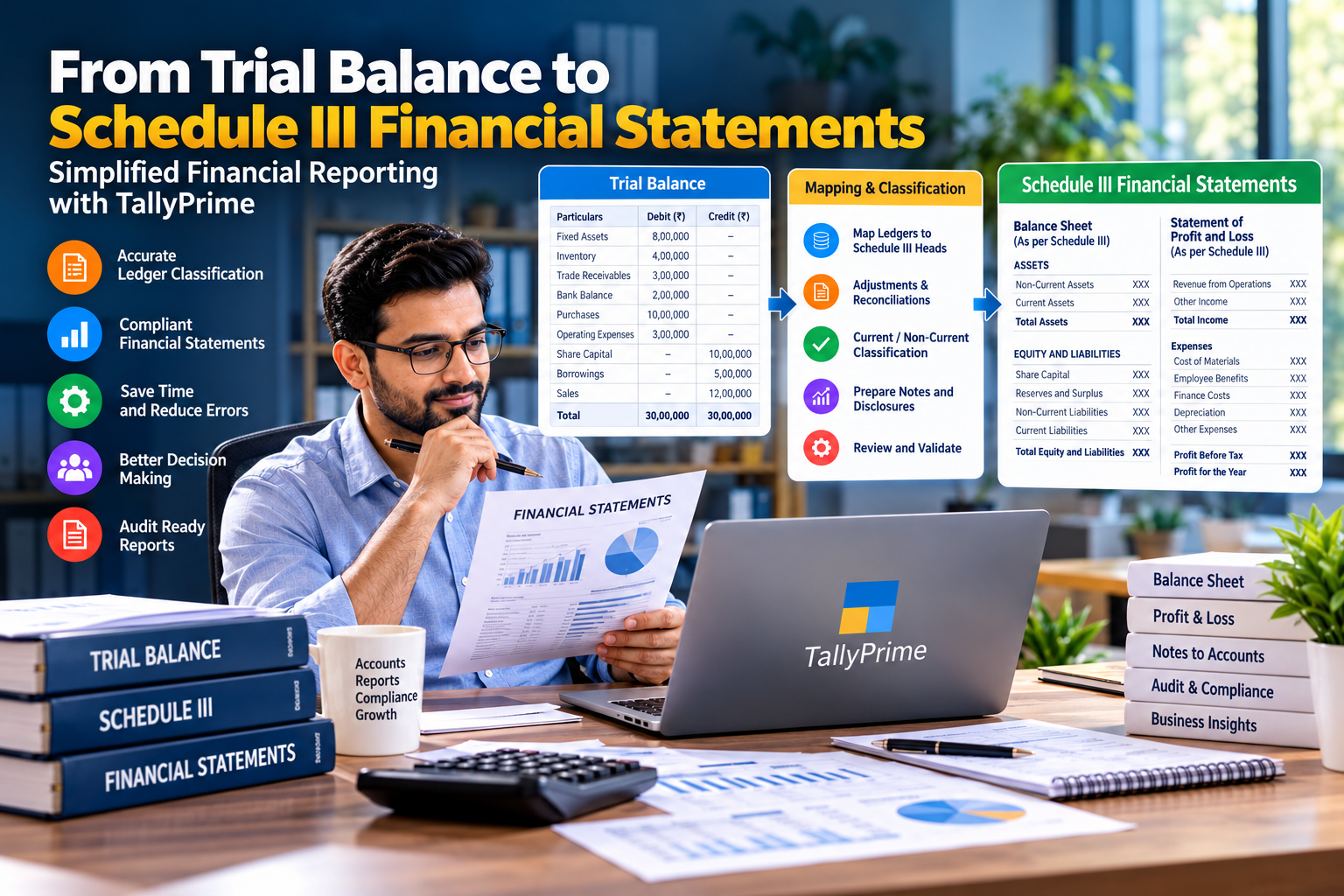
Introduction: Why Converting Trial Balance into Schedule III Financial Statements Matters
Every financial year, thousands of Indian companies face the responsibility of preparing accurate financial statements.
For accountants and finance professionals, the process often begins with a Trial Balance containing hundreds or even thousands of ledger balances.
However, a Trial Balance is not the final financial statement.
It provides the accounting foundation, while Schedule III of the Companies Act, 2013 prescribes presentation and disclosure requirements for companies to which it applies.
Transforming accounting data into compliant financial statements requires careful classification, reconciliation, adjustments and presentation.
A single incorrect ledger mapping can affect the Balance Sheet, Statement of Profit and Loss or supporting notes.
For businesses using TallyPrime, integrated accounting records and financial reports can make the process more organised.
With appropriate reporting workflows and, where necessary, Excel-based or customised automation, finance teams can reduce repetitive work and improve financial reporting accuracy.
The goal is not merely to prepare statements quickly. It is to create reliable financial information that management, auditors, investors and other stakeholders can trust.
1. What Is a Trial Balance?
A Trial Balance is an accounting report containing ledger balances for a selected period.
It is used to check whether total debit balances equal total credit balances and to support the preparation of financial statements.
The Trial Balance generally includes balances relating to assets, liabilities, equity, income and expenses.
For example:
|
Ledger
|
Debit (₹)
|
Credit (₹)
|
|---|
|
Fixed Assets
|
8,00,000
|
—
|
|
Inventory
|
4,00,000
|
—
|
|
Trade Receivables
|
3,00,000
|
—
|
|
Bank Balance
|
2,00,000
|
—
|
|
Purchases
|
10,00,000
|
—
|
|
Operating Expenses
|
3,00,000
|
—
|
|
Share Capital
|
—
|
10,00,000
|
|
Borrowings
|
—
|
5,00,000
|
|
Trade Payables
|
—
|
3,00,000
|
|
Sales
|
—
|
12,00,000
|
|
Total
|
30,00,000
|
30,00,000
|
This is an illustrative Trial Balance.
Although debit and credit totals agree, this does not guarantee that every accounting entry is correct.
Incorrect classifications, omitted transactions and offsetting errors may still exist.
Therefore, additional verification is essential before preparing financial statements.
2. What Is Schedule III Under the Companies Act, 2013?
Schedule III provides the prescribed format and disclosure framework for financial statements of companies covered by the relevant provisions of the Companies Act, 2013.
It establishes presentation requirements for financial information, helping improve consistency and comparability.
Schedule III is divided into three divisions.
|
Division
|
Applicability
|
|---|
|
Division I
|
Companies preparing financial statements under applicable Accounting Standards
|
|
Division II
|
Companies preparing financial statements under Indian Accounting Standards (Ind AS)
|
|
Division III
|
Applicable Non-Banking Financial Companies following Ind AS
|
The correct division depends on the company's applicable financial reporting framework.
Companies must also consider relevant accounting standards, amendments, disclosure requirements and regulatory instructions.
3. Difference Between Trial Balance and Schedule III Financial Statements
|
Particulars
|
Trial Balance
|
Schedule III Statements
|
|---|
|
Purpose
|
Summarises ledger balances
|
Presents statutory financial information
|
|
Structure
|
Ledger-based
|
Prescribed classification
|
|
Primary users
|
Accountants and finance teams
|
Management, auditors and stakeholders
|
|
Disclosures
|
Limited
|
Detailed notes and disclosures
|
|
Adjustments
|
May be pending
|
Must reflect required adjustments
|
|
Comparatives
|
Optional reporting view
|
Required as applicable
|
A Trial Balance is therefore the starting point, not a substitute for statutory financial statements.
4. An Emotional Story: The Finance Manager Who Almost Missed an Important Reporting Deadline
Neha worked as the finance manager of a growing manufacturing company in Delhi.
For several years, she had managed the company's accounting records, monthly reconciliations and financial reporting responsibilities.
As the financial year ended, management requested the company's Schedule III financial statements for the annual audit.
Neha exported the Trial Balance and began preparing the reports manually.
Initially, the task appeared manageable.
However, as she reviewed the ledger balances, several complications emerged.
Some expenses had been grouped incorrectly. Certain borrowings required classification between current and non-current liabilities. Fixed asset balances needed reconciliation with depreciation records.
The financial statements also required comparative figures and supporting disclosures.
Late one evening, Neha remained in the office reviewing spreadsheets.
Her daughter called and asked, “Mummy, will you come home before I sleep today?”
Neha looked at the unfinished reports and struggled to answer.
She realised that the problem was not a lack of effort. It was the amount of repetitive manual work involved in transforming accounting data into financial statements.
She discussed the issue with her team and began improving the reporting process.
The company standardised ledger classifications, established a reporting checklist and introduced structured mapping between accounting balances and financial statement headings.
TallyPrime reports provided the underlying accounting information, while a controlled reporting workbook helped organise the Schedule III presentation.
Over time, the reporting process became more predictable.
Neha still reviewed the figures carefully, but she spent less time repeatedly copying and rearranging balances.
For her, the improvement was not simply about saving time.
It meant greater confidence in her work and more evenings spent with her family.
This is an illustrative story created to explain the practical and emotional challenges of financial reporting.
5. Step-by-Step Process: Trial Balance to Schedule III Financial Statements
Converting a Trial Balance into Schedule III financial statements requires a structured process.
Step 1: Finalise accounting entries
Before preparing financial statements, ensure that all relevant accounting entries have been recorded.
These may include depreciation, outstanding expenses, prepaid expenses, accrued income, provisions, tax adjustments and other year-end entries.
Step 2: Review ledger classifications
Verify that ledgers are classified under appropriate accounting groups.
For example, long-term borrowings should not automatically be treated as entirely non-current. The portion payable within the applicable period may require separate current classification.
Step 3: Export the Trial Balance
In TallyPrime, open the Trial Balance report, select the appropriate reporting period and export the information using an available supported format.
Ensure that the exported balances reconcile with the report displayed in the software.
Step 4: Prepare a Schedule III mapping structure
Create a mapping between accounting ledgers and the applicable Schedule III headings.
|
Accounting Ledger
|
Illustrative Schedule III Classification
|
|---|
|
Equity Share Capital
|
Share Capital
|
|
General Reserve
|
Reserves and Surplus
|
|
Plant and Machinery
|
Property, Plant and Equipment
|
|
Sundry Debtors
|
Trade Receivables
|
|
Sundry Creditors
|
Trade Payables
|
|
Bank Current Account
|
Cash and Cash Equivalents, where appropriate
|
|
Sales Revenue
|
Revenue from Operations
|
|
Salary Expenses
|
Employee Benefits Expense
|
|
Depreciation
|
Depreciation and Amortisation Expense
|
Classification must be determined from the underlying transaction, applicable accounting framework and supporting records.
Step 5: Prepare the Balance Sheet
For Division I, the Balance Sheet broadly presents equity and liabilities together with assets, divided into prescribed categories.
Current and non-current classifications must be reviewed carefully.
Step 6: Prepare the Statement of Profit and Loss
Classify income and expenses according to the applicable Schedule III requirements.
Common headings include revenue from operations, other income, cost of materials consumed, purchases of stock-in-trade, changes in inventories, employee benefits expense, finance costs, depreciation and other expenses.
Step 7: Prepare notes to accounts
Notes provide supporting explanations and detailed disclosures.
They may include share capital information, property and equipment movement, trade receivables ageing, trade payables ageing, borrowing details and other relevant disclosures.
Step 8: Reconcile and validate
Compare financial statement totals with the final adjusted Trial Balance and supporting schedules.
Investigate differences before approving the statements.
6. How TallyPrime Helps in Schedule III Financial Reporting
TallyPrime can support the financial reporting process by maintaining organised accounting data and providing reports required for analysis.
Trial Balance reporting
The Trial Balance report helps accountants review ledger balances and identify unusual classifications or balances requiring investigation.
Balance Sheet and Profit & Loss reports
TallyPrime provides financial reports that can be used as a starting point for preparing statutory financial statements.
However, standard accounting reports should not automatically be assumed to contain every Schedule III presentation and disclosure requirement.
Ledger and group management
Proper ledger grouping helps improve the quality of financial information.
A consistent chart of accounts also simplifies mapping to statutory reporting headings.
Receivables and payables analysis
Bill-wise records and outstanding reports can assist finance teams in preparing supporting schedules.
Additional information may be needed to distinguish disputed balances, credit quality, MSME classifications and other disclosure categories.
Fixed asset accounting
Relevant asset ledgers, depreciation entries and supporting records can assist in preparing property, plant and equipment disclosures.
A detailed fixed asset register may still be necessary.
Excel export and reporting automation
TallyPrime accounting reports can be exported for use in structured financial reporting workbooks.
Excel-based formulas, mapping tables and validation controls can help automate repetitive classification and aggregation tasks.
Specialised TDL or integration solutions may provide additional automation, but their capabilities depend on the actual implementation.
7. Example: Mapping Trial Balance Balances to Schedule III
Consider a company with the following adjusted balances.
|
Ledger
|
Amount
|
|---|
|
Share Capital
|
₹20,00,000
|
|
Reserves and Surplus
|
₹8,00,000
|
|
Long-term Borrowings
|
₹12,00,000
|
|
Trade Payables
|
₹5,00,000
|
|
Property, Plant and Equipment (Net)
|
₹25,00,000
|
|
Inventory
|
₹8,00,000
|
|
Trade Receivables
|
₹7,00,000
|
|
Cash and Bank Balances
|
₹5,00,000
|
Assuming the classifications are appropriate, the illustrative Balance Sheet would be:
Illustrative Schedule III Balance Sheet
Selected Division I headings — ₹ in lakh
|
Equity and Liabilities
|
Amount
|
| Share Capital |
20 |
| Reserves and Surplus |
8 |
| Long-term Borrowings |
12 |
| Trade Payables |
5 |
|
Total
|
45
|
|
Assets
|
Amount
|
| Property, Plant and Equipment |
25 |
| Inventory |
8 |
| Trade Receivables |
7 |
| Cash and Bank Balances |
5 |
|
Total
|
45
|
Balance Sheet Difference
₹0
Illustrative totals match
This simplified illustration excludes required comparative columns, note references and detailed statutory disclosures. It is not a complete Schedule III statement.
The example demonstrates how ledger balances can be grouped into financial statement headings.
In actual reporting, supporting schedules, disclosures and accounting adjustments must also be considered.
8. Important Schedule III Disclosures Businesses Should Review
Schedule III reporting extends beyond the main Balance Sheet and Statement of Profit and Loss.
Depending on applicability, companies may need to prepare detailed information relating to trade receivables and payables ageing, promoter shareholding, property and equipment, capital work-in-progress, borrowings and financial ratios.
Additional regulatory disclosures may also be required concerning specified loans, transactions with struck-off companies, utilisation of borrowed funds and other prescribed matters.
Financial ratio disclosures may include the current ratio, debt-equity ratio, inventory turnover ratio and other prescribed ratios, together with the required explanations.
Ministry of Corporate Affairs
A properly designed reporting process should collect these details from supporting records rather than relying only on Trial Balance balances.
9. Case Study One: Manufacturing Company Reduces Financial Reporting Delays
Illustrative case study using hypothetical figures.
A manufacturing company operating in Bawana Industrial Area maintained approximately 850 accounting ledgers.
Its finance department prepared annual financial statements using manual spreadsheet classifications.
Challenges
The team faced inconsistent ledger mapping, repeated reconciliation work and delays in preparing supporting schedules.
Financial statement preparation required significant manual effort.
Improvement strategy
The company standardised ledger groups, exported accounting data from TallyPrime and introduced a controlled Schedule III mapping workbook.
Each ledger was assigned to an appropriate reporting heading, with review procedures for exceptional balances.
Illustrative results
|
Reporting Activity
|
Before
|
After
|
|---|
|
Ledger mapping
|
18 hours
|
6 hours
|
|
Statement preparation
|
16 hours
|
8 hours
|
|
Reconciliation
|
12 hours
|
7 hours
|
|
Total effort
|
46 hours
|
21 hours
|
Illustrative financial reporting effort
Total staff-hours before and after structured reporting automation.
015304560Manual processStructured process
The hypothetical improvement reduced reporting effort by approximately 54%.
TallyPrime supported the process through organised accounting records and exportable reports, while the mapping and validation workbook handled additional reporting tasks.
The company still required professional review of classifications and disclosures.
10. Case Study Two: Trading Company Improves Schedule III Accuracy
Illustrative case study based on a hypothetical trading company.
A trading company in Naraina Industrial Area handled transactions involving inventory, customers, suppliers and bank borrowings.
During annual reporting, its finance team discovered that several balances required reclassification.
Challenges
Trade receivables included overdue balances requiring ageing analysis.
Borrowings needed classification based on repayment terms.
Certain expenses required year-end adjustments.
Corrective measures
The company reviewed ledger classifications, reconciled outstanding balances and prepared supporting schedules using accounting reports and additional records.
It introduced a documented approval process before finalising financial statements.
Illustrative outcome
The revised process helped the company identify reporting differences earlier and reduce last-minute adjustments.
Management gained greater confidence in the financial information presented for audit.
The case demonstrates that automation is most valuable when combined with accurate source data and disciplined review procedures.
11. Common Challenges in Trial Balance to Schedule III Conversion
Incorrect ledger mapping
A ledger may be placed under an unsuitable financial statement heading, resulting in misleading presentation.
Incomplete year-end adjustments
Missing depreciation, provisions or accruals can affect reported financial results.
Current and non-current classification errors
Assets and liabilities must be classified according to the applicable reporting framework and their underlying characteristics.
Missing supporting disclosures
A Trial Balance alone generally cannot provide all information required for Schedule III notes.
Spreadsheet errors
Manual formulas, inconsistent mapping and accidental changes can create reporting differences.
Lack of reconciliation controls
Without appropriate checks, financial statements may contain errors even when the Trial Balance agrees.
12. Best Practices for Accurate Schedule III Reporting
Businesses should establish a consistent year-end financial reporting process.
Maintain an organised chart of accounts and review ledger classifications regularly.
Complete bank, customer, supplier, inventory and tax reconciliations before finalising accounts.
Prepare a documented mapping between Trial Balance ledgers and Schedule III headings.
Use controlled reporting workbooks with validation checks, version control and review responsibilities.
Ensure that comparative financial information is presented correctly.
Review applicable disclosure requirements and obtain supporting documentation.
Finally, have the completed statements reviewed by appropriately qualified finance professionals and auditors, as applicable.
13. Why Financial Reporting Automation Is Valuable for Growing Companies
As companies expand, accounting transactions and reporting requirements become more complex.
A manual reporting process that works for a small business may become difficult to manage when the organisation has multiple branches, departments or large numbers of ledgers.
Structured reporting automation can help reduce repetitive classification work and improve consistency.
It can also make it easier to identify unusual balances, reconcile financial statement headings and prepare recurring reporting schedules.
However, automation should support professional judgement rather than replace it.
The quality of the final financial statements depends on accurate accounting data, suitable classification rules and appropriate review.
14. Conclusion
Converting a Trial Balance into Schedule III financial statements is an important responsibility for Indian companies.
The process involves much more than transferring ledger balances into a prescribed format.
It requires accurate accounting entries, appropriate classifications, reconciliation, supporting disclosures and careful review.
TallyPrime provides a useful accounting foundation through its Trial Balance, Balance Sheet, Profit and Loss, ledger and outstanding reports.
When combined with structured mapping, Excel-based reporting workflows or appropriately designed customisation, these capabilities can help reduce repetitive work and improve reporting efficiency.
For finance teams and accountants, the objective should be to create a reporting process that is accurate, transparent, repeatable and easier to manage.
Better financial reporting begins with reliable accounting records and ends with well-reviewed financial statements.
Powered by Binarysoft Technologies Authorized Tally Partner
Location: 1626/33, 1st Floor, Naiwalan, Karol Bagh, New Delhi – 110005, INDIA
Contact us: +91 7428779101, 9205471661
Email us: tally@binarysoft.com
Business Hours: 10:00 AM – 6:00 PM, Monday–Friday
Frequently Asked Questions
How can Binarysoft Technologies help businesses with TallyPrime financial reporting?
Binarysoft Technologies, an Authorized Tally Partner, can assist with TallyPrime implementation, accounting configuration, reporting workflows, data export and evaluation of suitable customisation requirements for financial reporting.
How frequently should companies review Schedule III classifications?
Companies should review classifications throughout the year and perform a comprehensive review during annual financial statement preparation. Interim reporting may require additional reviews.
Can Excel automation help prepare Schedule III statements?
Yes. Structured Excel workbooks can assist with ledger mapping, aggregation, reconciliation and presentation. Appropriate controls and professional review remain necessary.
Does a balanced Trial Balance guarantee accurate financial statements?
No. A Trial Balance may agree even when transactions have been omitted, incorrectly classified or recorded with offsetting errors.
CA. Lakshy Vermaa advises small and mid-sized businesses on accounting discipline, tax compliance, and process improvement. With exposure to retail and trading environments, he writes practical articles aimed at helping business owners gain better financial visibility and control.