Call CA Tally HelpDesk
+91 9205471661,
7428779101
Introduction: Why Advance Tax Planning Matters for Indian Businesses
For many Indian business owners, paying income tax becomes a major concern near the end of the financial year. However, income tax is not always payable only when filing the annual return.
Under India's advance tax system, eligible taxpayers must estimate their annual tax liability and pay the required amount during the financial year.
This applies to many business owners, professionals, companies and other taxpayers whose estimated tax liability exceeds the prescribed threshold.
For FY 2026–27, advance tax planning is particularly important because taxpayers need to consider the provisions applicable to the relevant assessment year, including the Income-tax Act, 2025, effective from 1 April 2026.
Missing instalment deadlines or underestimating liability may result in interest and unexpected cash flow pressure.
With accurate accounting records and regular profit reviews, businesses can prepare for tax payments more effectively.
Tally Prime supports this process through profit and loss reports, ledger management, expense tracking and financial statements.
This guide explains advance tax calculation, online payment procedures, due dates, common mistakes and practical accounting methods for Indian businesses.
A Story: How an Unexpected Tax Payment Disrupted a Small Business
Anil owned a packaging materials business in Delhi.
His company supplied cartons, labels and packing products to manufacturers and online sellers.
Business had improved significantly during the year.
Orders were increasing, and Anil had invested in additional machinery to handle customer demand.
He was pleased with the company's growth and focused most of his attention on production and customer deliveries.
However, he had not reviewed his estimated income tax liability during the year.
As the financial year approached its end, his accountant informed him that a substantial amount of tax remained payable.
Anil was surprised.
He had already committed money toward raw materials, machinery instalments and employee salaries.
Paying the entire amount at once would place pressure on working capital.
His accountant explained that regular advance tax calculations could have helped distribute the payments across the year.
Anil introduced a monthly financial review process.
He began examining profit and loss statements in Tally Prime, discussing tax estimates with his accountant and setting aside money for upcoming obligations.
The following year, tax payments became a planned business expense rather than an unexpected financial emergency.
The lesson was simple: a profitable business should prepare for its tax obligations before payment deadlines arrive.
This is an illustrative story based on common financial planning challenges faced by Indian MSMEs.
1. What Is Advance Tax?
Advance tax is income tax paid during the financial year in which income is earned, rather than paying the entire liability after the year ends.
It is commonly described as the pay-as-you-earn system.
Advance tax is calculated using estimated annual taxable income and the applicable tax rates.
The amount payable is reduced by eligible tax credits, including expected TDS and TCS, subject to the relevant provisions.
Who Is Required to Pay Advance Tax?
Generally, taxpayers whose estimated tax liability is ₹10,000 or more after eligible tax credits are required to pay advance tax.
This may include salaried individuals with additional taxable income, business owners, professionals, partnership firms, LLPs and companies.
Resident senior citizens aged 60 years or above who do not have income from business or profession are generally exempt from advance tax.
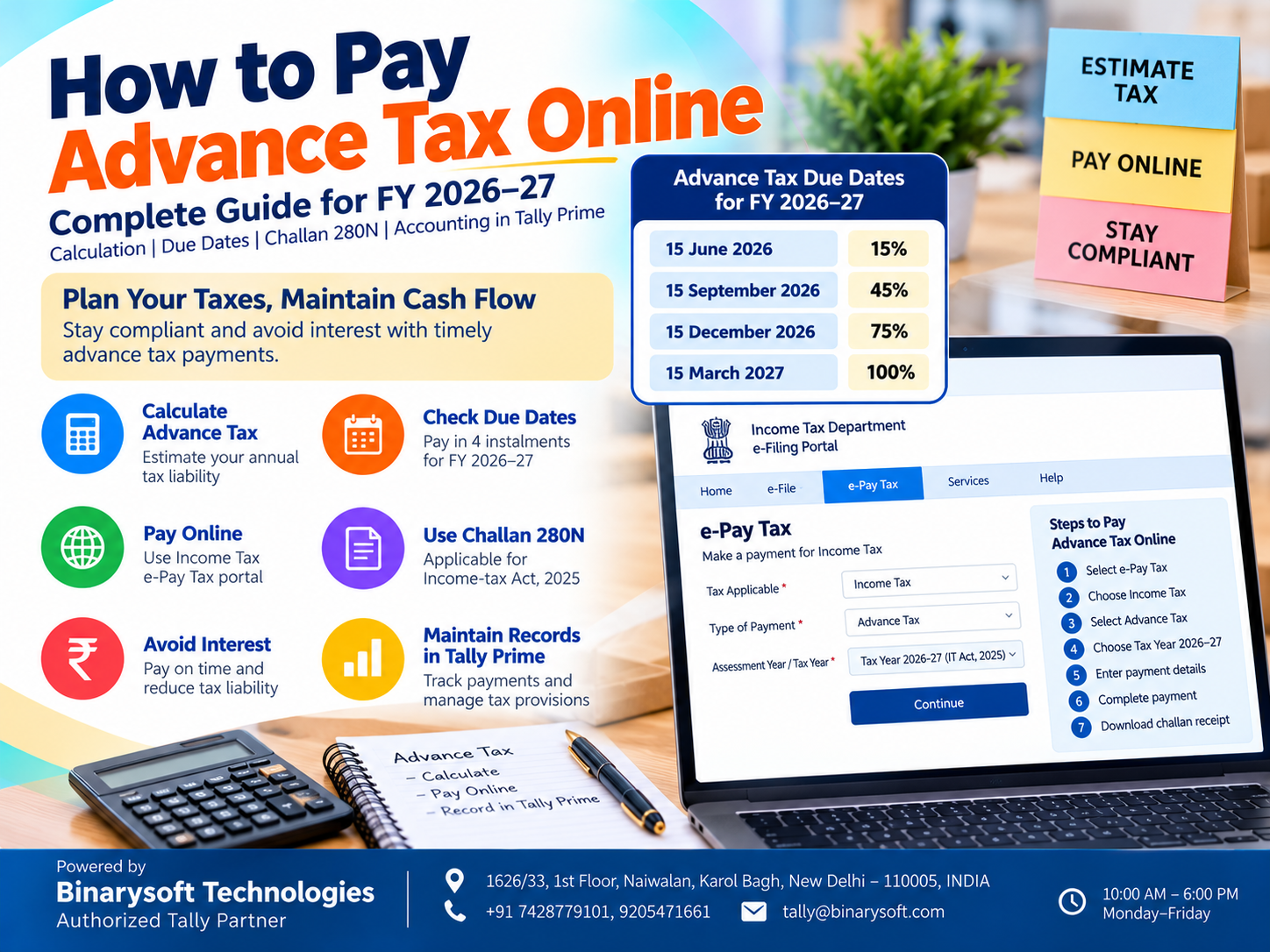
2. Advance Tax Due Dates for FY 2026–27
For most taxpayers, advance tax is payable in four instalments.
|
Due date
|
Cumulative tax required
|
|---|
|
15 June 2026
|
15%
|
|
15 September 2026
|
45%
|
|
15 December 2026
|
75%
|
|
15 March 2027
|
100%
|
These percentages are cumulative, not separate instalment percentages.
For example, if estimated annual advance tax is ₹1,00,000, the payment schedule would be:
|
Due date
|
Amount payable during instalment
|
|---|
|
15 June
|
₹15,000
|
|
15 September
|
₹30,000
|
|
15 December
|
₹30,000
|
|
15 March
|
₹25,000
|
|
Total
|
₹1,00,000
|
Eligible presumptive taxation taxpayers under Section 58 of the Income-tax Act, 2025, generally pay the entire advance tax liability by 15 March.
Payments made by 31 March are treated as advance tax for that financial year, although paying after an instalment deadline can still attract interest.
3. How to Calculate Advance Tax
Advance tax calculation begins with estimating total taxable income.
Step 1: Estimate Annual Income
Include applicable income from business or profession, salary, house property, capital gains and other sources.
Step 2: Deduct Eligible Expenses and Deductions
Calculate taxable income after considering eligible business expenses, depreciation, exemptions and deductions under the applicable tax regime.
Step 3: Apply Relevant Income Tax Rates
Use the rates applicable to the taxpayer's category and the relevant tax year.
Individuals, firms and companies may have different tax treatments.
Step 4: Add Applicable Surcharge and Cess
Include health and education cess and any applicable surcharge.
Step 5: Adjust Eligible Tax Credits
Deduct eligible TDS, TCS and other allowable credits.
Illustrative Calculation
|
Particulars
|
Amount
|
|---|
|
Estimated total income tax, including cess
|
₹2,40,000
|
|
Expected TDS/TCS credit
|
₹40,000
|
|
Estimated advance tax payable
|
₹2,00,000
|
The business would plan instalments based on the estimated ₹2,00,000 liability.
Actual liability depends on the applicable law, tax rates, taxpayer status and final income.
4. How to Pay Advance Tax Online: Step-by-Step Process
Advance tax can be paid using the Income Tax Department's e-Pay Tax service.
For tax year 2026–27, the portal uses the challan structure applicable under the Income-tax Act, 2025.
Step 1: Open the Income Tax e-Filing Portal
Visit the official Income Tax Department e-Filing portal.
Select e-Pay Tax from the available services.
Step 2: Log In or Continue Without Login
Registered taxpayers can sign in using their credentials.
The portal also provides a pre-login payment facility using PAN or TAN details and mobile OTP verification.
Step 3: Select New Payment
Open the e-Pay Tax section and select the option to create a new payment.
Step 4: Choose the Applicable Tax Category
Select Income Tax or Corporation Tax, depending on the taxpayer category.
Choose Advance Tax as the payment type.
Step 5: Select the Correct Tax Year
For income earned during FY 2026–27, select Tax Year 2026–27 under the Income-tax Act, 2025.
This is an important distinction from earlier years, when challans were generally selected using the assessment year.
Step 6: Enter Payment Details
Enter the relevant tax amount and any applicable components.
Review the PAN, taxpayer name, tax year and payment type carefully.
Step 7: Select Payment Method
Choose an available payment method, such as net banking, debit card or a supported payment gateway.
Available options may include UPI and other permitted methods.
Step 8: Complete Payment
Review the information and authorise the transaction.
Step 9: Download the Challan Receipt
After successful payment, save the challan receipt and its payment reference details.
The receipt should be retained for accounting, reconciliation and income tax return preparation.
5. Challan 280 vs Challan 280N: What Changed?
An important change applies to payments under the Income-tax Act, 2025.
Under the earlier Income-tax Act, 1961, taxpayers commonly used Challan ITNS 280 for income tax payments.
For payments under the new Act, the Income Tax Department has introduced Challan ITNS 280N.
The payment system distinguishes between the applicable Acts and tax periods.
|
Particulars
|
Earlier framework
|
FY 2026–27 framework
|
|---|
|
Governing law
|
Income-tax Act, 1961
|
Income-tax Act, 2025
|
|
Income tax challan
|
ITNS 280
|
ITNS 280N
|
|
Period selection
|
Assessment Year
|
Tax Year
|
|
Advance tax payment
|
Supported
|
Supported
|
Selecting the wrong period or payment type can create reconciliation difficulties.
6. Interest for Late or Insufficient Advance Tax
Failure to pay adequate advance tax may result in interest.
For FY 2026–27, the relevant provisions are Sections 424 and 425 of the Income-tax Act, 2025, corresponding broadly to Sections 234B and 234C under the earlier law.
Interest for Default in Advance Tax
Interest under Section 424 generally applies where advance tax is not paid as required or is below the prescribed percentage of assessed tax.
The applicable rate is generally 1% per month or part of a month for the relevant period.
Interest for Deferment of Instalments
Section 425 deals with insufficient payment by prescribed instalment dates.
The calculation depends on the amount of shortfall, instalment and statutory period.
Certain income types and circumstances receive specific treatment.
Businesses should calculate interest using the applicable provisions rather than assuming a single fixed penalty.
7. Difference Between Advance Tax and Self-Assessment Tax
|
Basis
|
Advance Tax
|
Self-Assessment Tax
|
|---|
|
Payment timing
|
During the financial year
|
After determining final liability
|
|
Calculation
|
Estimated income
|
Final computed liability
|
|
Purpose
|
Pay expected tax in advance
|
Settle remaining tax
|
|
Common use
|
Instalment payments
|
Before filing the return when balance tax remains
|
Advance tax reduces the final tax amount payable, subject to correct credit being available.
If the final tax liability exceeds advance tax and other eligible credits, the taxpayer may need to pay the balance as self-assessment tax.
8. How Tally Prime Helps in Advance Tax Planning
Tally Prime is an accounting system, not a substitute for income tax computation or the official payment portal.
However, it can help businesses maintain the financial information needed to estimate taxable income.
Profit and Loss Analysis
The Profit and Loss Account provides information about sales, purchases, income and expenses.
This helps business owners review estimated accounting profit.
Expense Tracking
Businesses can record salaries, rent, administrative expenses, professional fees and other transactions under appropriate ledgers.
Depreciation Records
Fixed asset and depreciation records support accounting reviews.
Tax depreciation may differ from book depreciation, so separate tax adjustments may be necessary.
Cash and Bank Reports
Cash and bank information helps businesses plan upcoming tax payments without disrupting operational commitments.
Financial Statements
The Balance Sheet and other financial reports provide additional information for discussions with accountants and tax professionals.
9. How to Record Advance Tax Payments in Tally Prime
Advance income tax should be recorded according to the legal entity and applicable accounting treatment.
For a company, advance income tax payments are generally recorded as a tax asset or advance tax balance until adjusted against the relevant tax liability.
Illustrative Company Entry
Suppose a company pays ₹50,000 as advance income tax from its bank account.
Accounting entry:
|
Particulars
|
Debit
|
Credit
|
|---|
|
Advance Income Tax A/c
|
₹50,000
|
|
|
Bank A/c
|
|
₹50,000
|
Narration: Being advance income tax paid for Tax Year 2026–27.
Steps in Tally Prime
-
Create an appropriate ledger for Advance Income Tax under the relevant asset grouping.
-
Open the company and select the Payment Voucher.
-
Enter the payment date.
-
Debit the Advance Income Tax ledger.
-
Credit the relevant bank ledger.
-
Enter the challan reference in the narration or supporting details.
-
Save the voucher and retain the challan receipt.
For proprietorships, personal income tax is generally treated as a proprietor's drawing or capital-related transaction rather than a business expense. Partnership and other entity treatments also require appropriate consideration.
Businesses should confirm the accounting treatment with their accountant.
10. How to Reconcile Advance Tax Payments
After payment, businesses should verify that the amount has been successfully processed and correctly recorded.
The accounting team should compare the payment challan with the bank transaction and the advance tax ledger.
The payment should also be checked against the relevant tax records when available.
Important Reconciliation Checks
Confirm the PAN and tax year.
Verify the payment amount and challan reference.
Ensure that the bank debit matches the recorded transaction.
Check that the payment appears under the correct tax category.
Investigate discrepancies promptly.
Proper reconciliation helps prevent incorrect tax credit claims and accounting differences.
11. Advance Tax Planning for MSMEs
MSMEs frequently face irregular sales cycles, delayed customer payments and seasonal expenses.
A business may earn substantial profit during one quarter and experience lower demand during another.
Advance tax estimates should therefore be reviewed periodically.
Practical Planning Strategies
Maintain updated monthly accounting records.
Review estimated annual profitability before each instalment deadline.
Consider expected TDS and TCS credits.
Maintain a separate cash provision for tax obligations.
Recalculate the estimated liability when profits change significantly.
Consult a qualified tax professional where calculations involve complex deductions, capital gains or other adjustments.
These practices can reduce unexpected tax payments and support healthier working capital management.
12. Case Study One: Wholesale Distributor Improves Tax Planning
Illustrative case study
A wholesale electrical products distributor in Delhi experienced fluctuating monthly sales.
The business initially calculated income tax only near the end of the year.
Challenges
Tax payments created unexpected pressure on cash reserves.
The owner had limited visibility into estimated annual taxable profit.
Financial planning focused mainly on purchases and customer collections.
Implementation
The business began reviewing monthly profit and loss reports in Tally Prime.
Its accountant prepared updated income tax estimates before each instalment date.
Management maintained a separate tax provision in its cash flow planning.
Outcome
Advance tax became a scheduled financial obligation rather than a year-end surprise.
The owner gained better visibility into cash requirements and could plan supplier payments more carefully.
13. Case Study Two: Service Company Strengthens Tax Compliance
Illustrative case study
A Delhi-based IT services company generated revenue from annual contracts and project-based assignments.
Its profits varied throughout the year.
Challenges
The finance team relied on outdated profit estimates.
Expected TDS credits were not consistently reviewed.
Tax payments were sometimes delayed while waiting for updated calculations.
Implementation
The company used Tally Prime to maintain updated income and expense records.
Its accountant reviewed estimated taxable income, applicable credits and upcoming instalments.
Tax payments were recorded and reconciled against challans and bank statements.
Outcome
The company established a more disciplined advance tax planning process.
Management gained greater clarity over tax obligations and upcoming cash requirements.
14. Common Mistakes to Avoid While Paying Advance Tax Online
One common mistake is selecting the wrong tax period.
For FY 2026–27, businesses must pay attention to the new tax-year-based challan process.
Another mistake is choosing self-assessment tax instead of advance tax.
Taxpayers may also underestimate income, overlook additional income sources or incorrectly calculate expected TDS credits.
Other errors include entering the wrong PAN, failing to save the challan receipt and not verifying payment status.
Businesses should review all payment information before authorising the transaction.
15. Advance Tax and Business Cash Flow Management
Advance tax is a statutory obligation, but it also affects working capital.
Businesses that fail to reserve funds may experience difficulty meeting supplier payments or other commitments.
A simple approach is to estimate annual tax liability and set aside appropriate funds each month.
For example, if a business estimates an annual advance tax requirement of ₹2,40,000, it may reserve an average of ₹20,000 per month as part of its internal cash planning.
Actual statutory instalments must still be paid according to the prescribed deadlines.
Tally Prime cash and bank reports can help business owners monitor available funds and upcoming financial commitments.
16. How Tally on Cloud Can Support Tax Preparation
Businesses operating from multiple locations may require authorised access to common accounting records.
A properly configured Tally on Cloud environment can support remote access to centrally hosted Tally Prime data.
This may help accountants and business owners review financial statements without exchanging multiple accounting files.
For example, a business owner in Delhi and an accountant working from another location may access the same hosted accounting environment, subject to appropriate user permissions.
This can improve coordination during advance tax estimation and reconciliation.
However, Tally on Cloud does not itself calculate or submit advance tax payments automatically.
Tax computation and payment still require the appropriate processes and verification.
17. Why Advance Tax Compliance Supports Business Growth
Timely advance tax planning is part of responsible financial management.
It helps businesses avoid unnecessary interest, improves cash flow forecasting and reduces last-minute financial pressure.
Regular tax reviews can also encourage better accounting practices.
Businesses that maintain accurate records are generally better positioned to understand profitability, borrowing requirements and operational performance.
For MSMEs, tax compliance should be treated as an ongoing financial responsibility rather than an annual administrative task.
Conclusion
Advance tax is an important component of India's income tax system.
Eligible taxpayers must estimate their annual liability and pay the required amount during the financial year.
For FY 2026–27, taxpayers should pay particular attention to the Income-tax Act, 2025, the applicable tax-year selection and the updated challan process.
The prescribed instalment dates help businesses distribute tax payments across the year.
Tally Prime supports advance tax planning by providing reliable accounting records, profit and loss reports, expense information and cash flow visibility.
When businesses combine accurate accounting with timely tax estimates and payment reconciliation, they can reduce compliance risks and improve financial discipline.
Advance tax should not be an unexpected burden at the end of the year. With proper planning, it becomes a manageable part of business operations.
Powered by Binarysoft Technologies Authorized Tally Partner
Location: 1626/33, 1st Floor, Naiwalan, Karol Bagh, New Delhi – 110005, INDIA
Contact: +91 7428779101, 9205471661
Email: tally@binarysoft.com
Business Hours: 10:00 AM – 6:00 PM, Monday–Friday
Frequently Asked Questions
Why should MSMEs plan advance tax payments early?
Early planning helps businesses maintain adequate cash reserves, reduce the risk of interest and avoid unexpected pressure on working capital.
Can Tally on Cloud help with advance tax preparation?
Yes. It can support authorised remote access to accounting records needed for tax estimates and reconciliation, subject to the hosting configuration.
How should advance tax be recorded in Tally Prime?
The accounting treatment depends on the legal entity. Companies generally record advance income tax as a tax asset, while proprietors generally treat personal income tax payments as drawings or capital-related transactions.
Can Tally Prime calculate advance income tax automatically?
Tally Prime provides accounting information for estimating taxable income, but income tax computation may require additional calculations and professional review.
CA. Rudransh Suryavanshi focuses on GST compliance, financial management, and internal controls. He regularly contributes content on business accounting solutions and effective tax planning strategies.








