Call CA Tally HelpDesk
+91 9205471661,
7428779101
Introduction: Why Businesses Are Rethinking Social Media Growth in 2026
A business may have thousands of Instagram followers, impressive social media engagement and regular online visibility, yet struggle to generate consistent sales.
This creates an important question for Indian entrepreneurs: Does having a large audience actually mean having a strong customer base?
In 2026, businesses are increasingly recognising the difference between attracting attention and developing meaningful customer relationships.
Social media platforms help businesses reach new audiences, but algorithms determine how widely individual posts are distributed. A business may invest months building followers without being able to communicate reliably with all of them.
Direct communication channels, including permission-based WhatsApp communities, customer support conversations and email lists, offer a different opportunity.
They allow businesses to build ongoing relationships with customers who have expressed genuine interest in their products or services.
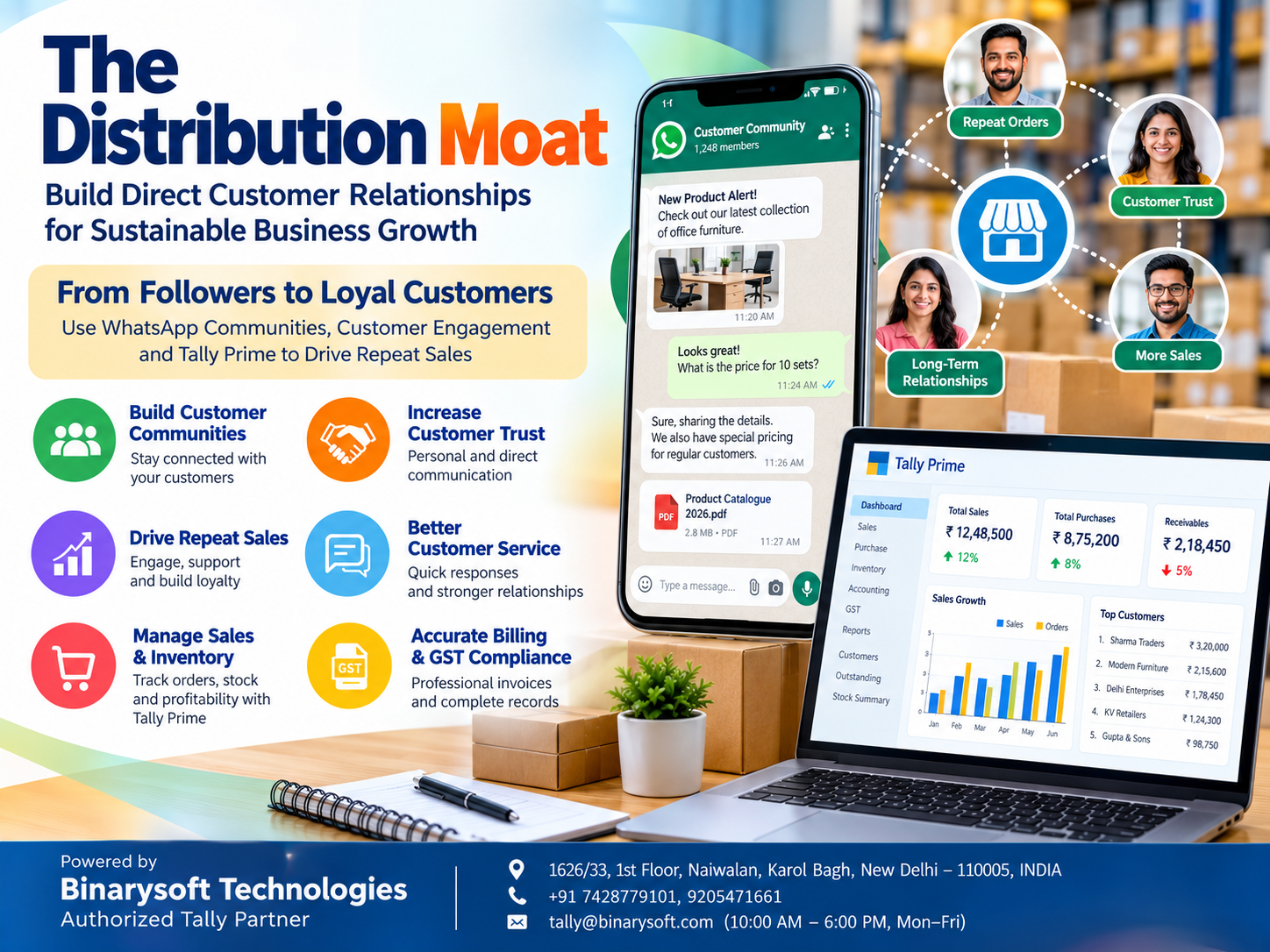
This relationship-based approach can create what business strategists call a distribution moat: a competitive advantage built around trusted, repeatable access to customers.
When combined with accurate accounting, customer records, sales analysis and inventory management through Tally Prime, this strategy can help Indian MSMEs connect marketing activities with measurable business performance.
A Story: The Business Owner Who Had 50,000 Followers but Could Not Pay His Suppliers
Rohit owned a small home décor business in Delhi. His company sold decorative lamps, wall art, furniture accessories and gifting products.
After years of effort, his Instagram page reached 50,000 followers.
Friends congratulated him. Suppliers believed his business was expanding rapidly. Every new post received likes, comments and encouraging messages.
But behind the attractive photographs and social media statistics, Rohit faced a difficult financial reality.
His warehouse was full of unsold products.
Advertising expenses were increasing.
Supplier payments were becoming overdue.
One evening, while reviewing outstanding bills, Rohit realised that his business had become dependent on social media visibility.
Whenever he stopped advertising, customer enquiries declined.
His accountant explained that followers did not automatically translate into revenue or cash flow.
Rohit began changing his approach.
Instead of focusing only on follower growth, he invited interested customers to join an opt-in WhatsApp community.
He shared useful home decoration ideas, product care instructions, seasonal collections and genuine customer experiences.
He also encouraged existing customers to ask questions before purchasing.
Over time, conversations became more meaningful.
Customers began returning for additional purchases and recommending his products to friends.
Meanwhile, Rohit's accounting team used Tally Prime to review sales, customer outstanding balances and product movement.
He started paying attention to repeat purchases and actual profitability rather than simply counting likes.
The most important change was not technological.
It was emotional.
Rohit stopped treating customers as anonymous followers and started treating them as people whose trust mattered.
His business began moving from chasing attention toward building lasting relationships.
This is an illustrative story created to explain the challenges and opportunities of community-led business growth.
1. What Is a Distribution Moat in Business?
A distribution moat is a competitive advantage that helps a business consistently reach, engage and retain customers more effectively than its competitors.
In traditional business models, distribution advantages often came from exclusive dealership networks, retail locations, established wholesalers or strong logistics infrastructure.
Digital businesses can develop similar advantages through customer relationships, trusted communities and direct communication channels.
For example, two businesses may sell similar products at comparable prices.
The first business depends entirely on paid advertisements to attract customers.
The second business maintains a community of existing customers who regularly interact with the company, provide feedback and recommend its products.
The second business may benefit from lower repeat-acquisition costs and stronger customer loyalty.
However, a distribution moat is not simply a large contact list. Its strength depends on customer trust, relevance, consent and the business's ability to deliver consistent value.
2. Social Media Followers vs Direct Customer Relationships
Social media is useful for awareness, discovery and attracting new customers.
However, businesses do not control platform algorithms or guarantee that every follower will see every post.
Direct customer relationships offer a different type of engagement.
|
Business Factor
|
Social Media Followers
|
Opt-In WhatsApp Community
|
|---|
|
Primary purpose
|
Discovery and awareness
|
Conversation and retention
|
|
Communication
|
Influenced by algorithms
|
Direct messaging within platform rules
|
|
Customer interaction
|
Often public
|
More personal and conversational
|
|
Customer feedback
|
Comments and reactions
|
Questions and direct responses
|
|
Relationship building
|
Depends on ongoing visibility
|
Depends on continued relevance and trust
|
|
Business control
|
Limited platform control
|
More direct communication, but still platform-dependent
|
Neither approach should replace the other completely.
A practical strategy uses social media to attract interested audiences and permission-based communication channels to develop stronger relationships.
3. Why WhatsApp Communities Matter for Indian MSMEs
WhatsApp is familiar to many Indian customers and business owners.
It provides a convenient environment for product enquiries, service questions, order updates and customer support.
For small businesses, direct conversations can reduce communication barriers.
A customer purchasing industrial equipment may want technical clarification before placing an order.
A clothing retailer's customer may need assistance selecting a size.
A wholesale buyer may want information about product availability or delivery arrangements.
A well-managed WhatsApp channel can help businesses respond to these requirements.
Important Benefits
Customer Convenience: Customers can ask questions through a familiar communication platform.
Relationship Development: Regular, useful interactions can strengthen familiarity.
Product Feedback: Businesses can understand customer preferences and recurring problems.
Repeat Sales Opportunities: Existing customers can learn about relevant new products.
Service Support: Businesses can provide updates and answer post-purchase questions.
These advantages depend on respectful communication rather than excessive promotional messaging.
4. Why Trust Is More Valuable Than Follower Count
A large audience may create brand visibility, but purchasing decisions usually depend on additional factors.
Customers consider product quality, pricing, reliability, delivery performance and previous experiences.
Trust develops when businesses consistently meet expectations.
For example, a supplier who provides accurate product information, delivers orders on time and resolves complaints responsibly is more likely to earn repeat business.
WhatsApp communities can support this process by making communication easier.
However, trust cannot be created through messages alone.
Businesses must support their communication with reliable operations.
This is where accounting, inventory management and customer records become important.
Tally Prime can help businesses maintain transaction information that supports accurate billing, outstanding tracking and operational decisions.
5. How Community-Led Marketing Can Improve Sales Conversion
Community-led marketing focuses on developing relationships before requesting a purchase.
Instead of continuously promoting products, businesses provide useful information and respond to customer needs.
Consider an electronics distributor launching a new range of office printers.
A traditional promotional campaign might show advertisements to thousands of people.
A community-led approach could involve explaining printer maintenance, comparing suitable models and answering questions from interested buyers.
Customers who receive relevant information may become more confident about purchasing.
Measuring Conversion Performance
Conversion rate can be calculated as:
Conversion Rate = (Number of Customers Who Purchase ÷ Number of Qualified Prospects) × 100
For example, if 200 qualified prospects generate 20 purchases:
Conversion rate = (20 ÷ 200) × 100 = 10%.
Businesses should compare conversion performance across channels using their own records.
Universal claims about WhatsApp outperforming other platforms should not be treated as guaranteed results.
6. Building a WhatsApp Community That Customers Value
Successful communities require a clear purpose.
A business should explain what members can expect before inviting them to join.
A wholesale supplier might create a community focused on product availability, market information and useful purchasing guidance.
A professional service provider might share educational updates and practical business tips.
Six Practical Steps
-
Identify the Audience: Understand which customers would benefit from regular communication.
-
Define the Purpose: Establish whether the community provides education, product updates or customer support.
-
Invite Members with Consent: Allow customers to choose whether to participate.
-
Share Useful Content: Prioritise relevant information rather than constant advertisements.
-
Encourage Conversations: Respond to genuine questions and feedback.
-
Measure Results: Review enquiries, qualified leads, sales and repeat purchases.
Businesses should respect privacy, provide opt-out options and follow applicable messaging policies.
7. Why Customer Retention Supports Long-Term Profitability
Acquiring new customers often involves advertising, sales effort and introductory communication.
Existing customers may already understand the company's products and service standards.
Maintaining these relationships can therefore be commercially valuable.
Customer retention measures how successfully a business maintains relationships over time.
A commonly used formula is:
Customer Retention Rate = [(Customers at Period End − New Customers Acquired) ÷ Customers at Period Start] × 100
Suppose a business begins with 500 customers, acquires 100 new customers and finishes with 550 customers.
Retention rate = [(550 − 100) ÷ 500] × 100 = 90%.
This simplified calculation assumes consistent definitions of active customers.
Businesses should analyse retention alongside repeat revenue, customer profitability and outstanding payments.
8. How Tally Prime Helps Support Community-Led Business Growth
Tally Prime is primarily an accounting and business management application, not a dedicated community-management platform.
However, its financial and operational features can support businesses implementing customer relationship strategies.
Customer Ledger Management
Businesses can maintain customer ledgers containing relevant accounting and transaction information.
These records help teams review customer-related financial activity.
Sales Analysis
Sales reports can help businesses understand revenue patterns and product performance.
Outstanding Receivables
Tally Prime supports bill-wise receivables and outstanding reports.
Businesses can identify pending payments and review customer credit exposure.
Inventory Management
Stock reports help businesses understand product availability before confirming customer orders.
GST Invoicing
Businesses can generate applicable GST invoices while maintaining connected accounting records.
Financial Reporting
Profit and loss statements, balance sheets and other reports help management evaluate business performance.
For advanced CRM, campaign tracking, customer segmentation or WhatsApp automation, additional tools or suitable integrations may be required.
9. Connecting Customer Conversations with Business Operations
Customer communication becomes more valuable when businesses can fulfil the commitments they make.
Imagine a distributor receiving a WhatsApp enquiry for 500 units of a particular product.
Before confirming the order, the sales team should verify available inventory, applicable pricing and delivery requirements.
Tally Prime can help authorised staff review recorded stock quantities and relevant transaction information.
Once the order is accepted, the business can follow its normal order processing and invoicing workflow.
This creates better coordination between customer communication, inventory and accounting.
Businesses should avoid promising immediate stock availability unless physical and recorded quantities have been appropriately verified.
10. Using Customer Data Responsibly
Customer information is valuable, but businesses must handle it responsibly.
Contact details collected for billing should not automatically be treated as permission to send marketing messages.
Businesses should obtain appropriate consent for promotional communication.
They should also protect personal information, limit unnecessary data sharing and respect customer preferences.
WhatsApp groups may expose members' phone numbers to other participants.
Businesses should consider whether channels, individual messages or another communication method would provide better privacy.
Customer trust can be damaged quickly when communication becomes intrusive.
A strong distribution moat should be built on permission and transparency.
11. Case Study One: Garment Wholesaler Builds Repeat Customer Relationships
Illustrative case study
A garment wholesaler operating in Gandhi Nagar, Delhi, supplied clothing products to retailers across North India.
The business depended heavily on seasonal exhibitions, sales representatives and occasional advertisements.
Customer communication was inconsistent, and many retailers were unaware of new collections.
Implementation
The wholesaler introduced an opt-in WhatsApp communication programme for interested retail buyers.
The company shared product catalogues, fabric information, availability updates and seasonal collection announcements.
Its accounting team used Tally Prime to maintain sales records, review customer outstanding amounts and monitor stock movement.
Business Impact
Retailers could obtain product information more conveniently.
The sales team gained opportunities to maintain regular relationships with existing customers.
Management could review recorded sales and outstanding balances when evaluating customer activity.
The case illustrates how customer communication and reliable business records can complement each other.
12. Case Study Two: Electronics Distributor Improves Customer Service
Illustrative case study
An electronics distributor in Nehru Place supplied networking accessories, computer peripherals and office equipment.
Customers frequently contacted the company to ask about product specifications, stock availability and delivery schedules.
Employees handled these enquiries through separate phone conversations, making follow-up difficult.
Implementation
The company established a structured customer communication process using WhatsApp Business.
Customers who opted in received relevant product information and service updates.
The business also standardised its accounting and inventory processes in Tally Prime.
Business Impact
The sales team could respond more consistently to product enquiries.
Stock information was easier to review through recorded inventory data.
Customer invoices and outstanding payments were managed through structured accounting workflows.
The business gained a clearer separation between customer communication and financial recordkeeping.
13. Measuring the Financial Performance of a Distribution Moat
Community growth should be evaluated through business outcomes rather than membership numbers alone.
Important performance indicators include:
|
Metric
|
What It Measures
|
|---|
|
Qualified enquiries
|
Genuine purchasing interest
|
|
Conversion rate
|
Percentage of prospects purchasing
|
|
Repeat purchase rate
|
Customers purchasing again
|
|
Customer acquisition cost
|
Cost of obtaining a new customer
|
|
Average order value
|
Average revenue per order
|
|
Customer retention rate
|
Ability to retain customers
|
|
Gross profit
|
Revenue remaining after direct costs
|
|
Outstanding receivables
|
Customer payments still pending
|
Tally Prime can support financial and sales-related analysis.
However, metrics such as WhatsApp engagement, lead sources and campaign conversion generally require additional tracking.
Businesses can combine these datasets to evaluate whether community activities are producing commercially meaningful results.
14. Understanding Customer Acquisition Cost
Customer acquisition cost helps businesses understand how much they spend to acquire customers.
Customer Acquisition Cost = Total Customer Acquisition Expenditure ÷ Number of New Customers Acquired
For example:
Marketing and sales expenditure: ₹60,000
New customers acquired: 120
Customer acquisition cost = ₹500.
If a community-led initiative produces new customers with lower incremental expenditure, acquisition economics may improve.
However, community management is not free.
Employee time, content creation, customer support and software costs should also be considered.
15. WhatsApp Marketing vs Paid Advertising
Businesses should not assume that direct communities eliminate the need for advertising.
Paid advertising can help companies reach customers who have never heard of their products.
Communities are generally better suited to maintaining relationships with people who already have some connection with the business.
A balanced strategy may use advertising for discovery, educational content for trust building and permission-based conversations for customer engagement.
Businesses should evaluate each channel according to its actual performance.
The objective is not to abandon social media but to reduce excessive dependence on any single source of customer demand.
16. Common Mistakes in Community-Led Marketing
Businesses often struggle when they treat WhatsApp communities as unrestricted advertising channels.
Sending repeated promotional messages can cause customers to mute notifications or leave.
Other mistakes include sharing irrelevant information, ignoring questions, adding people without consent and failing to measure actual sales.
Some businesses also focus on increasing community membership without improving customer service.
A successful community should provide continuing value.
Customer relationships become stronger when businesses listen, respond and deliver reliably.
17. Creating a 30-Day Distribution Moat Action Plan
Identify your customer segments, review existing communication channels and define the purpose of your community.
Invite interested customers, establish communication guidelines and begin sharing genuinely useful information.
Review enquiries, stock availability, sales records and customer outstanding amounts. Improve coordination between communication and accounting teams.
Evaluate participation, qualified leads, purchases and customer feedback. Refine content and service processes based on actual results.
This initial plan helps businesses establish a foundation. A defensible distribution advantage normally develops through consistent effort over a longer period.
18. Tally on Cloud for Growing Distribution Businesses
As businesses expand across offices, warehouses and sales locations, access to centralised accounting information becomes increasingly important.
A properly configured Tally on Cloud environment can allow authorised employees to access centrally hosted Tally Prime data remotely.
For example, a distributor with offices in Delhi and Noida may use a shared accounting environment to review sales, customer balances and stock records.
Practical Benefits
Centralised data can improve coordination between sales and accounting teams.
Remote access can support authorised employees working from different locations.
Suitable multi-user arrangements can reduce dependence on separately maintained company files.
Managed hosting may also support backup and security processes, depending on the selected provider and plan.
Businesses should verify licensing, security controls, backup arrangements and hosting performance before implementation.
19. The Future of Distribution Moats for Indian Businesses
The competitive advantage of a business increasingly depends on its ability to build trust and deliver consistent customer experiences.
Digital communication makes it easier for smaller organisations to maintain direct relationships with customers.
However, communication alone is insufficient.
Businesses also require accurate inventory records, dependable order fulfilment, transparent billing and financial discipline.
Community-led marketing works best when it is supported by reliable operational systems.
Tally Prime can contribute through accounting, inventory management, GST invoicing, outstanding tracking and financial reporting.
The strongest businesses will combine customer relationships with disciplined operations rather than treating marketing and accounting as separate activities.
Conclusion
A distribution moat is not created simply by accumulating social media followers or sending promotional messages.
It develops when businesses build trusted customer relationships that competitors cannot easily replicate.
WhatsApp communities and other direct communication channels can help Indian MSMEs maintain meaningful contact with customers, understand purchasing requirements and encourage long-term loyalty.
However, businesses must prioritise consent, relevance, service quality and measurable commercial outcomes.
Tally Prime supports the financial and operational side of this strategy through customer ledgers, sales records, inventory management, invoicing and reporting.
For manufacturers, wholesalers, retailers, distributors and service providers, the long-term opportunity lies in connecting customer trust with reliable business execution.
The most valuable audience is not necessarily the largest. It is the audience that trusts the business enough to return, purchase and recommend it.
Powered by Binarysoft Technologies Authorized Tally Partner
Location: 1626/33, 1st Floor, Naiwalan, Karol Bagh, New Delhi – 110005, INDIA
Contact: +91 7428779101, 9205471661
Email: tally@binarysoft.com
Business Hours: 10:00 AM – 6:00 PM, Monday–Friday
Frequently Asked Questions
What is the biggest mistake businesses make with community marketing?
A common mistake is treating customer communities only as promotional channels instead of providing useful information, responding to questions and building genuine relationships.
How long does it take to build a strong customer community?
It depends on the business, audience and communication strategy. Meaningful trust and customer loyalty generally require consistent effort over time.
Can Tally on Cloud help businesses with multiple locations?
Yes. A properly configured hosted Tally Prime environment can support authorised remote access to centralised accounting and inventory data.
Is customer consent necessary for WhatsApp marketing?
Businesses should obtain appropriate consent, respect opt-out preferences and comply with applicable privacy requirements and messaging platform policies.
CA. Tanishq Saraf works with traders and service businesses on GST compliance, ledger scrutiny, and accounting automation. His focus is on simplifying financial processes and improving the quality of business accounting records.