Call CA Tally HelpDesk
+91 9205471661,
7428779101
Introduction: When Artificial Intelligence Meets Human Intelligence
Imagine a business where invoices are processed automatically, financial reports are generated within seconds, inventory requirements are predicted in advance and suspicious transactions are identified before they create financial problems.
This is the promise of artificial intelligence.
Businesses across industries are increasingly exploring AI-powered technologies to reduce repetitive work, improve productivity and make faster decisions.
However, an important question remains:
Should artificial intelligence make every business decision independently?
The answer is not always yes.
AI systems can process enormous amounts of information, identify patterns and recommend actions. Nevertheless, they may misunderstand unusual circumstances, interpret incomplete data incorrectly or produce recommendations that require additional verification.
This is where Human-in-the-Loop (HITL) AI architecture becomes important.
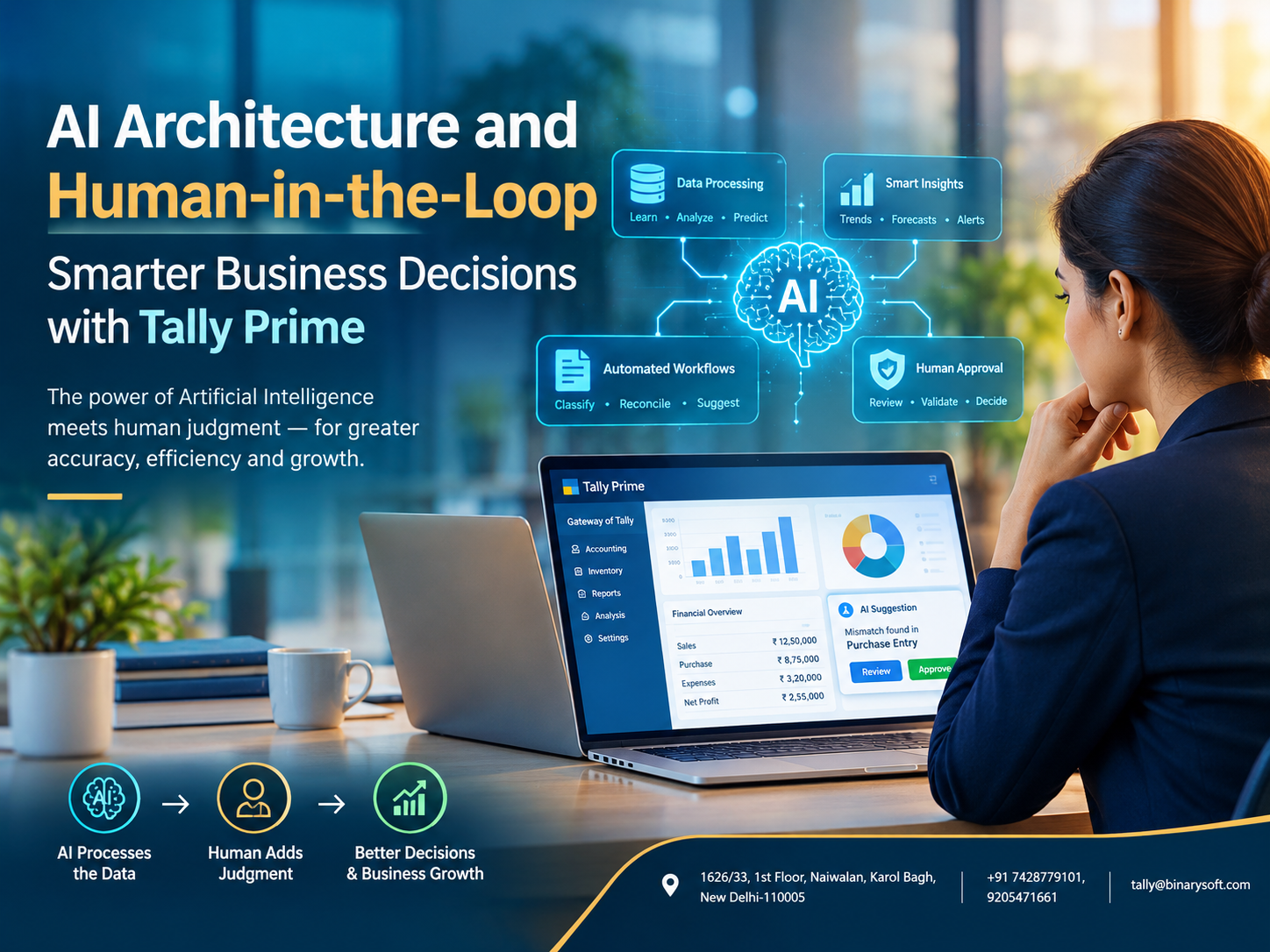
Human-in-the-loop architecture combines artificial intelligence with human supervision, allowing businesses to benefit from automation while retaining control over critical decisions.
For accounting professionals, business owners and financial managers, this approach is particularly valuable.
Financial transactions involve regulatory requirements, customer relationships, business policies and professional judgment. Even when technology accelerates processing, human oversight remains essential.
With business management software such as Tally Prime, organisations can establish structured accounting workflows, maintain financial records and review transactions before making important decisions.
Understanding how AI architecture and human oversight work together can help businesses build more reliable digital operations.
1. What Is AI Architecture?
AI architecture refers to the structural design of an artificial intelligence system.
It defines how information enters the system, how AI models process that information, how decisions are generated and how results are delivered to users or connected applications.
A well-designed AI architecture ensures that different components work together efficiently.
Important Components of AI Architecture
Data Collection Layer
This layer collects information from business applications, accounting records, customer databases, inventory systems and other authorised sources.
The quality of collected information directly influences AI performance.
Data Processing Layer
Raw information is cleaned, organised and converted into formats suitable for analysis.
Duplicate records, missing values and inconsistent information must be handled carefully.
AI Model Layer
Machine learning models analyse processed information to identify patterns, classify transactions, predict outcomes or generate recommendations.
Decision-Making Layer
The system converts AI-generated insights into proposed actions.
These may include identifying unusual expenses, recommending stock replenishment or highlighting overdue customer payments.
Human Review Layer
Authorised employees examine important recommendations and determine whether to approve, modify or reject them.
Monitoring and Feedback Layer
The system records outcomes and evaluates performance. Approved feedback may be used to improve future model behaviour.
Together, these components establish the foundation for intelligent business automation.
2. What Is Human-in-the-Loop Artificial Intelligence?
Human-in-the-loop artificial intelligence is an approach in which people participate in selected stages of an AI system's operation.
Instead of allowing software to make every decision independently, businesses establish checkpoints where human judgment is required.
For example, an AI-powered accounting workflow may identify an invoice as potentially duplicated.
Rather than automatically deleting the transaction, the system can notify an accountant.
The accountant reviews the invoice, verifies supporting documents and determines the correct action.
This approach combines the speed of machines with the contextual understanding of humans.
Three Common Human Oversight Models
Human-in-the-Loop
Human approval is required before selected decisions are finalised.
Human-on-the-Loop
AI performs routine activities while humans monitor performance and intervene when necessary.
Human-in-Command
Humans define the objectives, boundaries and authority of the AI system, including when automation may operate.
Businesses can combine these models according to the financial, operational and regulatory risks involved.
3. An Emotional Story: The Invoice That Almost Destroyed a Customer Relationship
Rajesh operated a growing electrical equipment distribution business in Delhi.
After years of hard work, he had established strong relationships with contractors, retailers and institutional buyers.
His business depended on accurate billing and timely payments.
As sales increased, Rajesh introduced automated invoice processing to reduce administrative work.
Initially, everything appeared successful.
Invoices were processed faster, employees spent less time entering information and management reports became easier to prepare.
One afternoon, however, a major customer received an unexpected payment reminder.
The system had incorrectly classified an adjusted invoice as unpaid.
The customer had already settled the amount through an agreed credit adjustment.
Unfortunately, the automated reminder did not recognise the arrangement.
The customer called Rajesh angrily.
After several years of business cooperation, he felt that his integrity was being questioned.
Rajesh immediately contacted his accountant.
The accountant examined the original invoice, credit adjustment and customer ledger.
Within minutes, the problem became clear.
The automated workflow had processed transaction information without understanding the commercial arrangement.
Rajesh personally apologised to the customer and corrected the records.
The relationship was saved, but the experience changed his understanding of automation.
He realised that faster processing was not enough.
Important financial decisions needed verification.
Rajesh subsequently introduced a review process for disputed balances, unusual adjustments and sensitive customer communications.
His team continued using automation, but employees reviewed exceptional transactions before action was taken.
The lesson was powerful:
Technology can process information quickly, but human understanding protects relationships, trust and business reputation.
This illustrative story demonstrates why human-in-the-loop systems are valuable in financial operations.
4. Why Human-in-the-Loop Architecture Matters for Businesses
AI can improve operational efficiency, but its recommendations depend on available data, model design and business context.
Human oversight helps address these limitations.
Improved Decision Accuracy
AI systems may identify patterns without fully understanding unusual circumstances.
Human reviewers can consider supporting documents, customer agreements and operational realities before approving recommendations.
Better Financial Control
Businesses can establish approval requirements for high-value payments, unusual expenses and sensitive accounting adjustments.
Reduced Operational Risk
Incorrect automated decisions may cause financial losses, compliance problems or customer dissatisfaction.
Human checkpoints help identify potential mistakes before they affect business operations.
Greater Accountability
Clear approval responsibilities make it easier to determine who reviewed a transaction and why a decision was made.
Stronger Customer Confidence
Customers value accurate communication and fair treatment.
Human intervention helps businesses resolve exceptional situations more thoughtfully.
Continuous Improvement
Reviewers can identify recurring AI errors and provide feedback to improve system performance.
5. How Human-in-the-Loop AI Architecture Works
A typical HITL workflow follows a structured sequence.
Step 1: Business Data Collection
Information is collected from authorised sources such as invoices, purchase records, inventory databases and accounting applications.
Step 2: AI-Based Analysis
AI models analyse the information and identify patterns, inconsistencies or opportunities.
Step 3: Risk Classification
The system evaluates whether a recommendation is routine, unusual or potentially high-risk.
Step 4: Human Verification
Transactions requiring additional attention are presented to authorised employees.
Step 5: Approval or Correction
The reviewer approves, modifies or rejects the recommendation.
Step 6: Business System Update
Once authorised, the approved action is recorded in the appropriate business application.
Step 7: Monitoring and Feedback
The organisation evaluates outcomes and improves its processes.
For example, a business may allow low-risk inventory recommendations to appear automatically while requiring managerial approval before purchase orders are issued.
This arrangement improves efficiency without sacrificing control.
6. Important Business Applications of Human-in-the-Loop AI
Accounting and Financial Management
AI can help identify unusual ledger entries, possible duplicate invoices and inconsistencies in financial records.
Accountants can review these findings before making corrections.
Invoice Processing
AI-powered document processing tools can extract supplier names, invoice numbers, amounts and tax details.
Employees verify extracted information before transactions are recorded.
Inventory Management
AI models can analyse sales patterns and recommend replenishment quantities.
Inventory managers can adjust recommendations according to seasonal demand, supplier availability and market conditions.
Credit Management
AI can help identify customers with increasing outstanding balances.
Credit managers can evaluate payment history and business relationships before changing credit policies.
Fraud Detection
AI systems can flag suspicious transaction patterns.
Authorised professionals investigate these alerts before concluding that fraudulent activity has occurred.
Financial Forecasting
AI can analyse historical financial information and generate forecasts.
Management can evaluate assumptions and incorporate market conditions before making investment decisions.
These applications demonstrate how AI and human expertise can complement one another.
7. How Tally Prime Supports Human-Controlled Business Automation
Tally Prime provides accounting, inventory management, invoicing, GST-related functionality and financial reporting capabilities.
Although Tally Prime should not be considered a complete human-in-the-loop AI platform by itself, it can serve as an important financial system within a broader AI-assisted business architecture.
AI capabilities generally require separately configured applications, integrations or specialised tools.
Accurate Accounting Records
Tally Prime helps businesses maintain organised financial information, including sales, purchases, expenses, receipts and payments.
Reliable accounting records provide a stronger foundation for AI-assisted analysis.
Financial Reporting
Businesses can generate reports such as:
- Balance Sheet
- Profit and Loss Account
- Cash Flow Statement
- Outstanding Receivables
- Outstanding Payables
- Stock Summary
- Ledger Reports
These reports help managers evaluate AI-generated recommendations against actual financial information.
Inventory Monitoring
Tally Prime enables businesses to track stock quantities, stock movements and inventory values.
An external AI system can analyse appropriately exported inventory information and recommend purchasing decisions.
Managers can verify recommendations before placing orders.
Credit and Outstanding Management
Businesses can monitor customer balances and outstanding invoices.
AI-based tools may help prioritise collection activities, while employees retain responsibility for sensitive customer communication.
GST and Tax-Related Workflows
Tally Prime supports GST-related accounting and reporting functions.
Accountants can use these capabilities to verify transaction information and review compliance-related reports.
Any external AI-generated tax recommendations should be independently checked against applicable regulations.
User Access and Operational Controls
Tally Prime offers user-access and security capabilities that can help organisations establish responsibilities for financial activities.
Specific approval workflows and AI integration capabilities depend on the software configuration, edition and any additional applications used.
The key advantage is that Tally Prime can maintain structured business records while human professionals remain responsible for important financial decisions.
8. Case Study 1: How a Manufacturing Business Improved Invoice Verification
Illustrative case study
A medium-sized manufacturing company processed approximately 1,500 supplier invoices every month.
Its accounting team frequently encountered duplicate invoice submissions, incorrect tax classifications and mismatches between purchase orders and supplier bills.
Management wanted to reduce manual verification time without compromising financial accuracy.
The Challenge
Employees spent considerable time checking invoices against purchase records.
Occasional errors resulted in payment delays and supplier disputes.
The Solution
The company introduced an external AI-assisted document processing system alongside its accounting workflow.
The system extracted invoice details and highlighted possible discrepancies.
Accountants reviewed flagged transactions before recording or correcting the relevant entries in Tally Prime.
Role of Tally Prime
Tally Prime supported the process through purchase accounting, supplier ledgers, outstanding reports and financial recordkeeping.
The accounting team compared AI-generated observations with actual transaction records.
Illustrative Outcome
After implementing the workflow, the company estimated that routine verification time had decreased by approximately 35%.
Employees could devote more attention to unusual transactions and supplier reconciliation.
The company also improved the consistency of its invoice review process.
Key Learning
AI-assisted verification can reduce repetitive work, but human approval remains important when financial records are incomplete or inconsistent.
9. Case Study 2: How a Retail Distributor Improved Inventory Decisions
Illustrative case study
A retail distribution company operated several warehouses and supplied products to hundreds of customers.
The business frequently experienced stock shortages during seasonal demand periods.
At the same time, slow-moving products occupied valuable warehouse space.
The Challenge
Inventory decisions were based mainly on historical sales and employee experience.
Management needed better visibility into purchasing requirements.
The Solution
The company introduced an external forecasting application that analysed historical sales and inventory information.
The application generated suggested reorder quantities.
Warehouse managers reviewed recommendations against supplier lead times, seasonal demand and current customer commitments.
Role of Tally Prime
Tally Prime maintained inventory transactions, stock balances, purchase information and sales records.
Relevant information was exported through an authorised process for analysis.
After reviewing the recommendations, employees created the appropriate purchasing transactions.
Illustrative Outcome
The business reported an estimated 20% reduction in avoidable stock shortages during the initial evaluation period.
Managers also gained better visibility into slow-moving inventory.
Key Learning
AI can improve forecasting, but human judgment remains valuable when unexpected market conditions influence purchasing decisions.
10. Challenges of Implementing Human-in-the-Loop AI
Despite its advantages, HITL architecture requires careful planning.
Poor Data Quality
AI recommendations become less reliable when business records contain errors or missing information.
Businesses should maintain accurate accounting and inventory records.
Excessive Human Intervention
Requiring approval for every routine activity can reduce the benefits of automation.
Organisations should prioritise human review according to risk.
Employee Training
Employees must understand AI limitations and know how to evaluate recommendations.
Integration Complexity
Connecting accounting applications with external AI systems may require technical expertise, compatible interfaces and secure data-handling arrangements.
Information Security
Financial records contain sensitive business information.
Businesses should implement access restrictions, encryption where appropriate and secure data-transfer practices.
Overdependence on AI
Employees should avoid accepting recommendations without examining their reliability.
Regular monitoring and clear accountability are essential.
11. Best Practices for Building Reliable HITL Systems
Businesses should begin with a clearly defined operational problem.
For example, improving invoice verification may provide a more manageable starting point than automating the entire finance department.
Establish measurable objectives such as processing time, error frequency and review workload.
Define which decisions require human approval.
Maintain detailed records of important recommendations and reviewer actions.
Train employees to recognise incomplete information and unexpected AI behaviour.
Protect sensitive financial information through appropriate technical and organisational safeguards.
Finally, review system performance regularly.
Successful implementation depends on combining reliable technology with well-designed business processes.
12. The Future of AI Architecture in Accounting and Business Management
Artificial intelligence is expected to play an increasingly important role in financial analysis, document processing, operational forecasting and business reporting.
However, greater automation does not eliminate the importance of professional expertise.
Accountants will continue to interpret financial information, assess compliance requirements and advise management.
Business owners will continue to evaluate commercial relationships, investment risks and strategic priorities.
Human-in-the-loop architecture provides a practical framework for balancing these responsibilities.
Businesses that maintain accurate records in Tally Prime and carefully introduce compatible AI-assisted workflows may improve productivity while retaining appropriate financial control.
The objective should not be to replace human judgment.
It should be to make human judgment better informed.
Conclusion
AI architecture and human-in-the-loop systems represent an important approach to responsible business automation.
Artificial intelligence can analyse information quickly, identify patterns and recommend actions.
Human professionals contribute contextual understanding, ethical judgment, accountability and practical experience.
Together, these capabilities can improve operational efficiency and decision quality.
For businesses using Tally Prime, the opportunity lies in combining dependable accounting and inventory management with carefully designed AI-assisted processes.
Organisations should prioritise accurate financial records, secure integrations, employee training and appropriate approval controls.
The future of business automation is not simply artificial intelligence replacing people. It is intelligent technology helping people make better decisions.
Powered by Binarysoft Technologies
Authorized Tally Partner
Location: 1626/33, 1st Floor, Naiwalan, Karol Bagh, New Delhi – 110005, INDIA
Contact Us: +91 7428779101, 9205471661
Email: tally@binarysoft.com
Business Hours: 10:00 AM – 6:00 PM, Monday to Friday
Binarysoft Technologies helps businesses adopt Tally Prime and improve their accounting, inventory management, financial reporting and business processes.
Frequently Asked Questions
What does human-in-the-loop mean?
Human-in-the-loop refers to an AI operating model in which people review, correct or approve selected AI-generated decisions.
Why is human oversight important in accounting?
Human oversight helps prevent incorrect financial entries, supports compliance verification and ensures that unusual business circumstances receive appropriate attention.
Can Tally Prime be integrated with AI applications?
Tally Prime can participate in certain external application workflows through supported integration or data-exchange methods. The available capabilities depend on the software version, configuration and integration approach.
Does Tally Prime automatically provide AI-powered decision-making?
Tally Prime provides business management and accounting capabilities. Advanced AI analysis and human-in-the-loop orchestration may require additional software or custom integration.
CA. Vedant Jhaveri works on GST compliance, accounting systems, and business reporting for growing enterprises. His approach combines accounting discipline with practical workflows suited to everyday business operations.