Call CA Tally HelpDesk
+91 9205471661,
7428779101
Introduction: Why Choosing the Right Cloud Service Provider Matters
In today's competitive business environment, organizations need technology that supports faster operations, secure data management and uninterrupted access to essential applications.
Whether a company manages accounting, inventory, customer information, online sales or financial reporting, reliable digital infrastructure has become an important part of business success.
Traditional office-based systems may create limitations when employees need remote access, businesses expand to multiple locations or management requires timely financial information.
Cloud computing offers an alternative.
By using cloud infrastructure, businesses can access computing resources, storage and applications without maintaining every component on their own premises.
However, choosing a cloud service provider involves more than comparing monthly subscription charges.
The right cloud service provider should deliver an appropriate combination of performance, security, reliability, scalability, technical support and cost transparency.
A poor hosting decision can result in slow applications, unexpected expenses, difficult migrations and operational disruptions.
For businesses using Tally Prime, cloud-hosting decisions are particularly important because accounting data supports billing, GST compliance, inventory management and financial decision-making.
This article explains how businesses can evaluate cloud providers, avoid common mistakes and select infrastructure that supports long-term efficiency.
A Business Story: When One Server Failure Threatened Years of Hard Work
Rajesh owned a growing wholesale distribution business in Delhi.
He started with a small rented shop and gradually expanded into a company supplying electrical products to retailers across northern India.
Every successful order represented years of dedication.
His accounting team used Tally Prime to manage sales invoices, purchase records, inventory and outstanding payments.
For several years, the software operated on a computer located in the company's main office.
As the business expanded, Rajesh opened another warehouse and hired additional employees.
The accounting team frequently needed to exchange information between locations.
Employees sent reports through email, waited for updates and occasionally worked with outdated figures.
One Monday morning, the office computer suddenly stopped working.
The accounting team could not access important business records.
Customers were waiting for invoices, suppliers were requesting payment updates and warehouse employees needed stock information.
Rajesh felt helpless.
He had worked for years to build customer confidence, yet a single technical failure had interrupted important operations.
Fortunately, the company had a recent backup, and its technology consultant helped restore the information.
However, the disruption exposed weaknesses in the company's existing infrastructure.
Rajesh decided to evaluate cloud-hosting options.
Instead of choosing the cheapest available service, he compared providers based on security, backup arrangements, application performance and technical support.
He eventually selected a hosting arrangement suitable for the company's accounting requirements.
The implementation included authorized remote access, defined user permissions and documented recovery procedures.
His employees could now access approved accounting functions from different locations.
Rajesh also understood the importance of regularly verifying backups and maintaining clear operational responsibilities.
The biggest lesson was simple: business continuity depends on choosing technology partners who understand the importance of protecting business operations.
This is an illustrative story created to explain common business challenges.
What Is a Cloud Service Provider?
A cloud service provider is an organization that offers computing services through remotely managed infrastructure.
These services may include servers, storage, databases, networking, application hosting and related security capabilities.
Instead of purchasing and maintaining all infrastructure internally, businesses can obtain resources according to their requirements.
Cloud services can support different activities, including:
-
Hosting business applications
-
Managing databases
-
Storing and backing up information
-
Supporting remote employees
-
Running customer portals
-
Operating enterprise software
-
Managing development environments
-
Supporting analytics and reporting
Cloud providers differ in pricing, infrastructure design, service coverage, security responsibilities and technical support.
Businesses should evaluate these differences before making a decision.
Understanding the Main Types of Cloud Services
Cloud computing generally includes three major service models.
1. Infrastructure as a Service (IaaS)
Infrastructure as a Service provides computing resources such as virtual servers, storage and networking.
Businesses can configure operating systems and applications according to their requirements.
This model offers flexibility but may require technical expertise.
For example, a company may use a virtual server to host an internal business application.
2. Platform as a Service (PaaS)
Platform as a Service provides an environment for developing, testing and deploying applications.
The provider manages certain infrastructure components, allowing developers to focus more on application functionality.
PaaS can be useful for businesses building custom software or customer portals.
3. Software as a Service (SaaS)
Software as a Service delivers applications through a subscription or service arrangement.
The provider generally manages the underlying application infrastructure.
Businesses access the software according to the service's supported methods.
The responsibilities for security, backup, configuration and maintenance vary by service model.
Understanding these differences helps organizations select suitable cloud solutions.
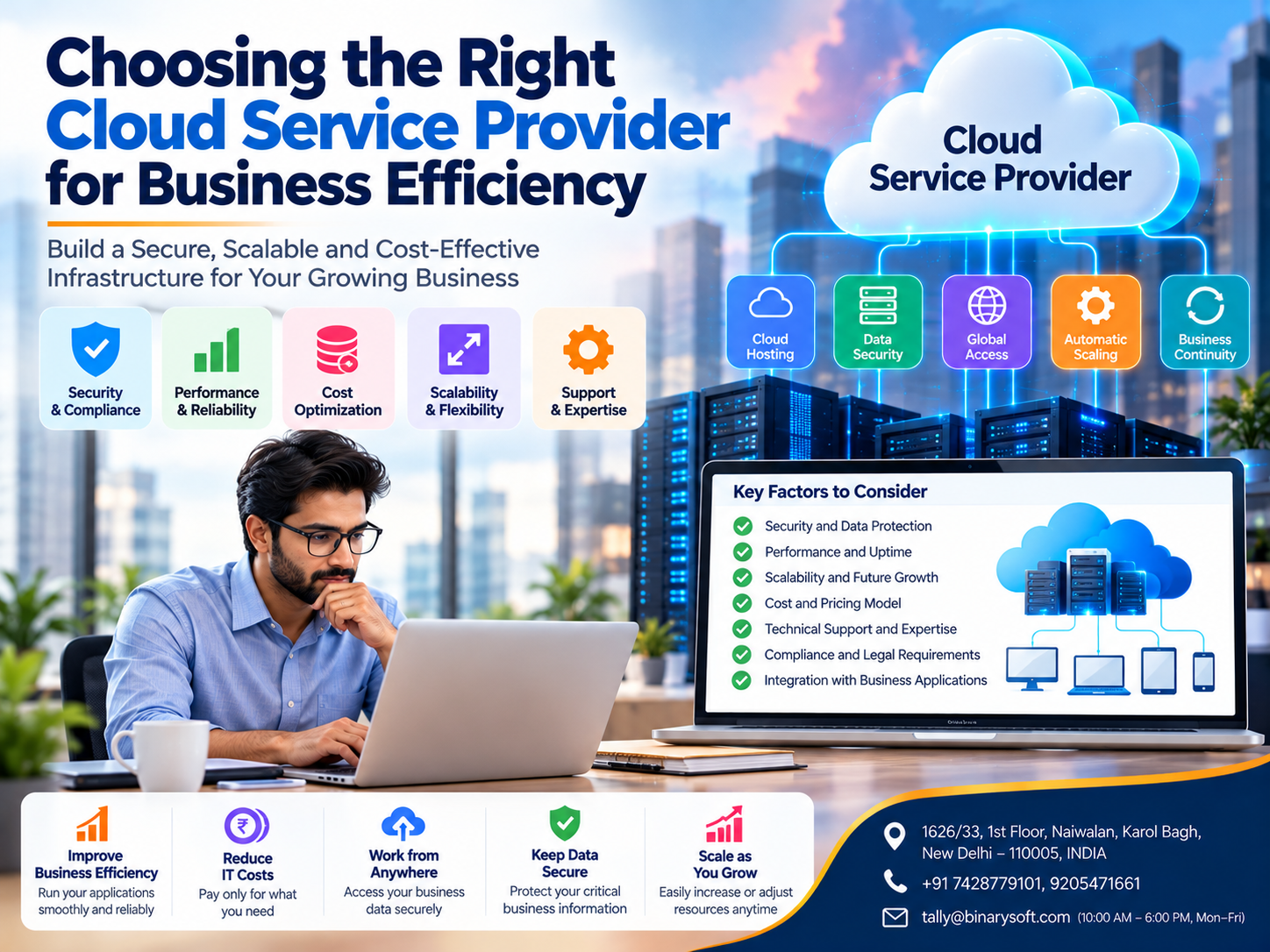
12 Important Factors to Consider When Choosing a Cloud Service Provider
1. Security and Data Protection
Security should be one of the first considerations.
Cloud environments may contain confidential financial information, customer records and business documents.
Businesses should evaluate the provider's approach to authentication, access controls, encryption, monitoring and vulnerability management.
Important questions include:
-
How is customer information protected?
-
Are administrative permissions restricted?
-
What authentication mechanisms are available?
-
How are security incidents handled?
-
Are backups protected from unauthorized access?
Businesses should also understand which security responsibilities remain with them.
Cloud hosting does not automatically eliminate cybersecurity risks.
2. Reliability and Service Availability
Business applications must remain accessible when employees need them.
A provider's availability commitments should be evaluated through its service-level agreement.
Businesses should review uptime commitments, maintenance procedures, service exclusions and remedies for outages.
High availability generally requires suitable infrastructure design, not merely a provider's marketing claim.
3. Application Performance
A cloud provider should offer adequate computing, memory, storage and network resources.
Slow application performance can affect employee productivity and customer service.
For accounting applications, businesses should consider concurrent users, transaction volumes and reporting requirements.
Performance testing can help determine whether the proposed hosting environment is appropriate.
4. Scalability and Flexibility
Business requirements change over time.
A small company may initially require limited resources but later need additional processing capacity, storage or user access.
The cloud provider should offer suitable expansion options.
However, businesses should confirm whether scaling requires downtime, additional licensing or changes to their hosting plan.
5. Transparent Pricing
Cloud costs can include more than a basic monthly hosting charge.
Additional expenses may arise from storage, backups, data transfer, technical support, software licenses and resource upgrades.
Businesses should request a clear breakdown of expected charges.
The lowest advertised price may not represent the lowest total cost.
6. Technical Support
Reliable support becomes especially important when critical business applications experience problems.
Organizations should evaluate support availability, response procedures, escalation options and technical expertise.
For accounting applications, access to professionals familiar with the software can be valuable.
7. Backup and Disaster Recovery
A dependable cloud arrangement should include a documented backup and recovery strategy.
Businesses should clarify backup frequency, retention periods, storage locations and restoration procedures.
They should also understand the difference between backup availability and guaranteed recovery.
Periodic restoration testing is essential.
8. Compliance and Legal Requirements
Businesses must consider applicable data protection, taxation and industry-specific obligations.
A cloud provider's certifications may support due diligence but do not automatically establish compliance for every customer.
Organizations should review data processing arrangements, contractual terms and relevant legal requirements.
9. Data Centre Location
The location of cloud infrastructure can influence network latency, data handling arrangements and regulatory considerations.
Businesses serving primarily Indian customers may wish to evaluate hosting regions in India.
However, geographical proximity alone does not guarantee superior performance.
Connectivity, architecture and infrastructure quality also matter.
10. Integration Capabilities
Cloud-hosted applications may need to communicate with accounting software, inventory systems, customer management tools and payment services.
Businesses should evaluate compatibility and supported integration methods.
Custom integrations may require additional development and testing.
11. Migration Assistance
Moving business applications to a new environment requires planning.
The provider should explain how existing information will be transferred, validated and made available.
A migration plan should address backups, testing, user access and potential downtime.
12. Vendor Exit and Data Portability
Businesses should understand how they can retrieve their information if they change providers.
Contracts should clarify data export options, migration assistance, retention and deletion procedures.
A suitable exit strategy reduces unnecessary dependence on a single hosting provider.
Cloud Hosting vs Traditional On-Premises Infrastructure
| Feature | Cloud Hosting | On-Premises Infrastructure |
|---|
| Initial Infrastructure Investment |
Often lower |
May require hardware investment |
| Remote Access |
Can support remote access |
Requires suitable remote-access configuration |
| Scalability |
Flexible service options |
Often requires hardware expansion |
| Maintenance |
Shared with provider |
Primarily managed internally |
| Backup |
Provider or customer-managed arrangements |
Internally or externally managed |
| Security |
Shared responsibility |
Organization-managed responsibilities |
| Costs |
Recurring service charges |
Hardware, maintenance and operating expenses |
| Business Continuity |
Depends on architecture and service |
Depends on internal recovery arrangements |
Neither approach is automatically superior.
The appropriate choice depends on business requirements, available expertise, costs and operational risks.
How Cloud Computing Improves Business Efficiency
Faster Access to Business Information
Cloud-hosted applications can allow authorized employees to access relevant information from different locations.
This may reduce delays caused by manually transferring files between offices.
Better Team Collaboration
Teams can work with centrally maintained business systems rather than relying on disconnected copies of information.
Appropriate access controls remain essential.
Reduced Infrastructure Management
Managed cloud services can reduce certain hardware maintenance responsibilities.
This allows internal teams to focus on other business priorities.
Improved Business Flexibility
Cloud services can support changing operational requirements, including new branches and additional users.
Better Continuity Planning
Appropriate backup, redundancy and recovery arrangements can help organizations prepare for disruptions.
However, these capabilities must be included in the selected service and properly configured.
More Predictable Resource Planning
Cloud providers may offer tools for monitoring resource consumption and estimating infrastructure expenses.
This can help management evaluate technology costs.
How Tally Prime on Cloud Supports Business Operations
Tally Prime helps businesses manage accounting, inventory, taxation and financial reporting.
Cloud-hosted access can make these functions available to authorized users outside the main office, depending on the selected solution.
Tally Prime on Cloud refers to an appropriately configured hosting or cloud-access arrangement; features vary by provider and service.
1. Access Accounting Information from Different Locations
Business owners and authorized accountants may need financial information while working remotely.
A suitable cloud-access arrangement can support this requirement.
Employees should use approved access methods and follow company security policies.
2. Support Multi-User Accounting
Businesses with multiple accountants require reliable concurrent access.
The hosting environment should be sized according to user activity, data requirements and supported Tally Prime licensing.
3. Improve Sales and Purchase Management
Tally Prime supports sales and purchase accounting.
Employees can record transactions and review relevant business information according to their assigned permissions.
Cloud access can support teams operating from different locations.
4. Manage GST-Related Accounting
Tally Prime includes capabilities for GST accounting and reporting.
Businesses can use these functions to maintain tax-related transaction information.
Correct configuration, accurate entries and compliance reviews remain important.
5. Monitor Inventory
Tally Prime supports inventory records, stock movements and related reports.
Businesses with warehouses or multiple operating locations can benefit from controlled access to relevant stock information.
6. Review Financial Reports
Management can use Tally Prime reports to understand profitability, outstanding receivables, payables and business performance.
Cloud-hosted access can make these reports more convenient to review remotely.
7. Strengthen Access Management
Tally Prime provides user-level security features.
Businesses should combine appropriate application permissions with secure hosting access controls.
8. Plan Data Backup and Recovery
Accounting information requires reliable backup procedures.
Businesses should confirm whether backups are included in their hosting arrangement and who is responsible for testing restoration.
9. Support Business Expansion
As organizations add branches or employees, their infrastructure requirements may increase.
A scalable hosting arrangement can make it easier to review and adjust available resources.
10. Improve Operational Coordination
Cloud access can help accounting teams, management and authorized employees work with centrally maintained information.
This may reduce delays and improve coordination across business locations.
How to Evaluate a Cloud Provider for Tally Prime
Businesses should use a structured assessment before selecting a Tally Prime hosting solution.
| Evaluation Area | Questions to Ask |
|---|
| Compatibility |
Does the service support the required Tally Prime version and licensing arrangement? |
| Performance |
Can the environment support expected concurrent users? |
| Security |
How are user access and financial data protected? |
| Backup |
What are the backup frequency and retention policies? |
| Recovery |
How quickly can information be restored after an incident? |
| Support |
Is technical assistance available during business-critical hours? |
| Pricing |
Are software, storage, support and backup charges clearly explained? |
| Connectivity |
What network requirements affect remote performance? |
| Migration |
How will existing company data be transferred and verified? |
| Exit Plan |
Can company data be retrieved in a usable format? |
A trial or proof of concept can be valuable when available.
Businesses should test realistic accounting activities rather than evaluating only the login process.
Case Study 1: Retail Distributor Improves Accounting Coordination with Cloud Hosting
Business: Illustrative consumer electronics distributor
Location: New Delhi
Challenge: Disconnected offices and delayed accounting updates
A growing electronics distributor operated from three locations.
The company's accounting team maintained records at its head office.
Warehouse employees regularly contacted accountants to confirm stock information and transaction details.
Management frequently received reports later than expected.
Solution
The company evaluated cloud-hosting providers based on application compatibility, security, performance and support.
It selected a hosting arrangement suitable for its Tally Prime operations.
The implementation included authorized user access, data migration checks and defined backup procedures.
Illustrative Results
After implementation, the company experienced:
-
More convenient access to accounting information
-
Improved coordination between offices
-
Reduced dependence on transferring report files
-
Better visibility into transaction records
-
Clearer backup and support responsibilities
Key Lesson
Choosing a cloud provider based on business requirements can improve coordination and reduce operational delays.
This case study is hypothetical and does not represent verified customer results.
Case Study 2: Manufacturing Company Selects a More Reliable Cloud Environment
Business: Illustrative packaging manufacturer
Location: Gurugram, Haryana
Challenge: Application slowdowns and uncertainty about data recovery
A manufacturing company used several business applications, including Tally Prime.
Its existing hosting environment performed adequately during normal working hours.
However, month-end reporting and increased concurrent activity sometimes caused delays.
Management was also uncertain about backup retention and recovery procedures.
Solution
The company reviewed alternative hosting providers.
Its evaluation focused on processing capacity, memory, storage performance, backup policies and technical support.
The selected provider helped assess workload requirements and establish a documented migration plan.
The company tested important accounting activities before completing the transition.
Illustrative Results
The business achieved:
-
More consistent application responsiveness
-
Better understanding of hosting costs
-
Clearer recovery procedures
-
Improved visibility into resource requirements
-
Greater confidence in technical support arrangements
Key Lesson
Reliable cloud hosting requires more than selecting a powerful server. Performance monitoring, recovery planning and provider accountability are equally important.
This case study is illustrative.
Common Mistakes to Avoid When Choosing a Cloud Provider
Choosing Only by Price
Low-cost hosting may be suitable for some workloads.
However, businesses should not ignore performance, backup arrangements or technical support.
Ignoring Security Responsibilities
A provider may secure its infrastructure while customers remain responsible for user accounts, application settings and data handling.
Responsibilities should be clearly documented.
Failing to Test Application Performance
Businesses should test important workflows under realistic conditions.
A hosting environment that works well for one user may behave differently with many concurrent users.
Overlooking Backup Restoration
Creating backups is not enough.
Businesses must confirm that information can be restored correctly.
Ignoring Hidden Charges
Additional costs may apply for storage expansion, support, data transfer and other services.
Failing to Plan Migration
Poorly planned migrations can cause operational disruption or data inconsistencies.
Depending Entirely on One Provider
Businesses should maintain suitable data portability and exit arrangements.
A Practical Cloud Provider Selection Checklist
Before signing a cloud-hosting agreement, businesses should confirm the following:
-
Business requirements and expected workloads are documented.
-
The proposed service supports required applications.
-
Security responsibilities are clearly defined.
-
Access controls and authentication are appropriate.
-
Performance expectations have been evaluated.
-
Backup and recovery procedures are documented.
-
Technical support commitments are understood.
-
Pricing includes relevant additional charges.
-
Compliance and data handling requirements have been reviewed.
-
Migration and exit procedures are available.
This checklist helps organizations compare providers using consistent criteria.
The Future of Cloud Services for Indian Businesses
Cloud computing continues to support business modernization across India.
Small businesses, manufacturers, distributors and professional service organizations are exploring ways to improve access to applications and business information.
Modern cloud environments increasingly offer flexible computing resources, automated monitoring and managed infrastructure services.
Artificial intelligence may also help organizations analyze infrastructure consumption and identify opportunities for optimization.
However, businesses should evaluate these capabilities according to practical requirements.
Technology investments should solve real operational problems rather than follow trends without clear objectives.
For organizations using Tally Prime, cloud-hosting decisions should prioritize accounting reliability, secure access, data protection and responsive technical support.
The most valuable cloud environment is one that supports daily business activities consistently while allowing room for future growth.
Conclusion: Choose a Cloud Partner That Supports Long-Term Business Success
Selecting the right cloud service provider is an important business decision.
The chosen environment can influence application performance, financial data protection, employee productivity and operational continuity.
Businesses should evaluate providers based on security, reliability, scalability, pricing transparency, technical support and recovery capabilities.
For organizations using Tally Prime, a suitable cloud-hosting arrangement can support authorized remote accounting, inventory management, GST-related activities and financial reporting.
However, successful cloud adoption requires appropriate planning, configuration and ongoing management.
The best cloud service provider is not necessarily the cheapest or the largest. It is the provider whose services, responsibilities and capabilities align with your business requirements.
A thoughtful cloud strategy can help businesses improve efficiency, manage risks and prepare for future expansion.
Simplify Your Business Operations with Tally Prime on Cloud
Looking for professional assistance with Tally Prime, accounting management, GST reporting, inventory control or cloud-hosting requirements?
Binarysoft Technologies helps businesses evaluate and implement suitable Tally Prime solutions according to their operational needs.
Powered by Binarysoft Technologies
Authorized Tally Partner
Location: 1626/33, 1st Floor, Naiwalan, Karol Bagh, New Delhi – 110005, INDIA
Contact Us: +91 7428779101, 9205471661
Email: tally@binarysoft.com
Business Hours: 10:00 AM – 6:00 PM, Monday to Friday
Frequently Asked Questions
Is cloud hosting better than a local server?
The appropriate option depends on business requirements, connectivity, security responsibilities, infrastructure costs and available technical expertise.
Can multiple employees use Tally Prime on Cloud?
Multi-user access may be supported when the software licensing and hosting configuration are appropriate.
What should businesses check in a cloud service agreement?
Review service availability, security responsibilities, support commitments, backup policies, data ownership, pricing and termination procedures.
What is the most important factor when selecting a cloud provider?
There is no single factor suitable for every business. Security, reliability, application compatibility, total cost and support should be evaluated together.
CA. Yashvardhan Kedia focuses on taxation, business accounting, and compliance management for MSMEs. He helps business owners understand financial information and establish practical processes for maintaining accurate books.