Call CA Tally HelpDesk
+91 9205471661,
7428779101
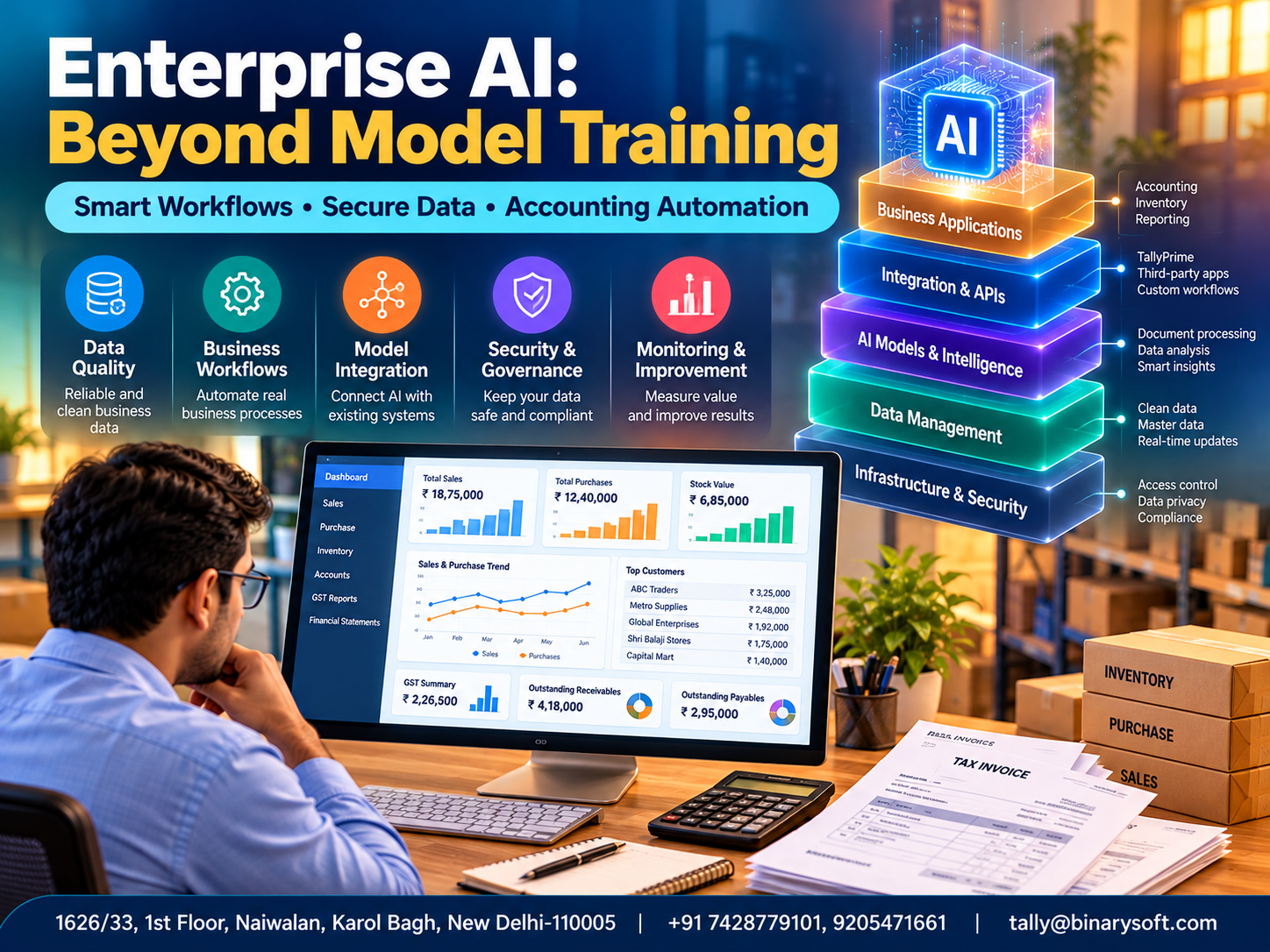
Introduction: Why Building a Powerful AI Model Is Not Enough for Business Success
Artificial intelligence is changing how organisations operate, communicate, analyse information and make decisions. From automated customer support to intelligent document processing, AI has become an important part of business technology.
However, many organisations misunderstand what successful Enterprise AI implementation actually requires.
They assume that selecting a powerful Large Language Model, training it with business information and connecting it to existing applications will automatically improve productivity.
In reality, Enterprise AI is not just about training models. It is about building reliable systems that turn artificial intelligence into practical business results.
A sophisticated AI model cannot independently correct inaccurate accounting records, resolve poorly designed workflows or guarantee that financial decisions comply with applicable regulations.
Businesses need dependable data, secure integrations, clearly defined processes, performance monitoring and human supervision.
For Indian small and medium-sized enterprises, these requirements are especially important.
A wholesale trader may want AI to simplify purchase invoice processing. A manufacturer may need intelligent inventory analysis. A chartered accountant may wish to automate financial document classification.
Yet every business must ensure that automation produces accurate, traceable and useful information.
TallyPrime can support this transformation by providing structured accounting records, GST management, inventory tracking and financial reporting.
This article explores the essential components of Enterprise AI, practical implementation strategies and how intelligent automation can complement TallyPrime in modern business operations.
1. What Is Enterprise AI?
Enterprise AI refers to the use of artificial intelligence within an organisation's operational systems, business processes and decision-making activities.
Unlike an experimental chatbot used for general questions, Enterprise AI must function within established business requirements.
It may need to process confidential information, communicate with existing software, follow business rules and provide dependable results.
Enterprise AI applications can include invoice data extraction, financial anomaly detection, inventory forecasting, document classification, customer service assistance and management reporting.
The objective is not simply to generate intelligent responses.
It is to make business processes more efficient, accurate and scalable.
A successful Enterprise AI system combines several components:
-
AI models suited to specific business tasks.
-
Reliable and appropriately governed data.
-
Secure application integration.
-
Workflow automation and exception handling.
-
Human verification and approval.
-
Monitoring, maintenance and continuous improvement.
Without these elements, even an advanced model may deliver limited business value.
2. Why AI Model Training Is Only the Beginning
Training an AI model is an important technical activity, but it represents only one stage of enterprise implementation.
A model may perform well during testing and still encounter difficulties when deployed in a real business environment.
Business Data May Be Incomplete
Financial records often contain inconsistent descriptions, duplicate documents and missing information.
AI systems trained on clean examples may struggle with such conditions.
Workflows May Be Complicated
Business transactions frequently involve multiple departments and approval stages.
For example, a purchase invoice may require verification by procurement, inventory and accounting teams.
Integration Can Be Difficult
An AI application must exchange information correctly with accounting software, databases and document management systems.
Compliance Requires Additional Controls
Accounting and GST-related decisions may involve statutory requirements that cannot be handled safely through unrestricted AI predictions.
Performance Must Be Monitored
Model behaviour can change as document formats, business requirements and operational conditions evolve.
These challenges demonstrate why businesses should treat AI as an operational system rather than a one-time model development project.
3. The Five Essential Foundations of Successful Enterprise AI
Reliable Data
Accurate records and clear ownership
Model Intelligence
Task-specific AI and evaluation
System Integration
Secure connections and business rules
Governance
Privacy, approvals and audit trails
Continuous Monitoring and Improvement
Accuracy, exceptions, costs, security and business outcomes
Foundation 1: High-Quality Business Data
AI systems depend on the quality of the information they receive.
For accounting applications, this includes accurate supplier ledgers, customer details, tax classifications, invoice records and inventory masters.
Poor data quality can result in misleading recommendations and incorrect transaction preparation.
Foundation 2: Appropriate AI Models
Not every business task requires the largest available language model.
Some activities can be handled more efficiently through smaller models, conventional software rules or specialised machine-learning systems.
Businesses should choose technology according to accuracy, cost, speed and security requirements.
Foundation 3: Reliable Integration
AI becomes more useful when it can work with existing applications through supported interfaces and carefully designed workflows.
Integration should include input validation, error handling and controlled permissions.
Foundation 4: Governance and Security
Organisations need policies defining who can access information, what the AI system may do and which actions require approval.
Foundation 5: Continuous Evaluation
AI implementation is not complete when the software goes live.
Businesses must review errors, monitor performance and improve the system as operational requirements change.
4. How Data Quality Determines Enterprise AI Success
Consider an organisation that wants AI to analyse overdue customer payments.
The system receives accounting records containing duplicate customer ledgers, missing invoice references and incorrectly adjusted receipts.
Even an advanced AI model cannot reliably determine outstanding balances when the underlying records are inconsistent.
This creates a fundamental principle:
AI can analyse information, but it cannot guarantee the correctness of information that was recorded inaccurately.
Before implementing AI, businesses should review their data management practices.
Customer and supplier records should use consistent naming conventions.
Accounting masters should be maintained carefully.
Duplicate transactions should be investigated, and opening balances should be reconciled.
Inventory information should reflect actual business movements.
In TallyPrime, properly maintained ledgers, bill-wise details and stock records provide a stronger foundation for financial reporting and future automation.
5. Why Enterprise AI Requires More Than a Chatbot
A chatbot can answer questions and explain information, but enterprise applications often require additional capabilities.
For example, an accounts payable assistant may need to read a purchase invoice, identify the supplier, check for duplicate invoice numbers, compare amounts and prepare a draft accounting entry.
Each action involves different technical requirements.
Document recognition may extract invoice text.
Business rules may verify arithmetic calculations.
A language model may interpret descriptions.
An integration service may prepare data for accounting software.
An employee may approve the final transaction.
This combination is often more dependable than asking a single AI model to perform every task independently.
Enterprise AI succeeds when different technologies work together within a controlled business process.
6. How TallyPrime Can Support Enterprise AI and Business Automation
TallyPrime provides an accounting and business management environment that organisations can use alongside carefully designed automation solutions.
It is important to distinguish TallyPrime's existing features from advanced AI capabilities that may require separate applications or integrations.
Accounting and Financial Management
TallyPrime supports sales, purchases, receipts, payments, journals and other accounting transactions.
These records provide structured information for financial analysis.
GST Billing and Reporting
Businesses can create GST invoices, maintain relevant tax information and use applicable GST reporting and reconciliation features.
AI-based tools may assist with document interpretation, but statutory decisions and transaction accuracy require verification.
Inventory Management
TallyPrime supports stock items, inventory movements, stock valuation and applicable warehouse or batch tracking.
This information can support inventory analysis and business planning.
Banking and Reconciliation
Supported banking features help businesses maintain bank-related accounting records and reconcile transactions.
Business Reporting
Balance Sheets, Profit and Loss Accounts, ledger reports and outstanding statements provide information for management decisions.
Integration Opportunities
TallyPrime supports relevant integration and customisation approaches, including TDL and supported data exchange methods.
Businesses can evaluate external AI solutions for authorised data analysis or transaction preparation.
However, integrations should include validation, access restrictions and approval controls.
7. An Emotional Story: When a Business Owner Realised AI Could Not Fix Broken Processes
Consider the illustrative story of Rajesh, a second-generation wholesale trader in Delhi's Sadar Bazaar.
His father established the business with a small shop and a reputation for dependable service.
Over the years, Rajesh expanded operations, introduced digital accounting and hired additional employees.
He wanted the business to become more efficient.
After hearing about artificial intelligence, he invested in an experimental system intended to simplify invoice processing.
The demonstration looked impressive.
The software could read documents, identify supplier information and generate organised responses.
Rajesh believed the company's accounting difficulties would soon disappear.
However, the real implementation was disappointing.
Some supplier records were duplicated. Several invoices used inconsistent product descriptions. Employees followed different approval procedures.
The AI system produced information, but the underlying business processes remained disorganised.
One evening, Rajesh stayed late to investigate a payment discrepancy.
His young daughter called and asked whether he would attend her school function the following morning.
He promised to try.
As he looked at the unfinished work, he remembered his father working late during the early years of the business.
He realised that purchasing new technology would not solve every problem.
The company needed accurate records, clearly defined responsibilities and reliable accounting procedures.
Rajesh reorganised supplier masters, improved invoice verification and established structured approval workflows.
His team used TallyPrime reports to review accounting records and identify outstanding transactions.
Only after these improvements did the business resume testing automation.
The technology became more useful because the surrounding processes were better organised.
Rajesh eventually found more time to focus on customers, employees and family.
The lesson is simple: artificial intelligence creates meaningful value when businesses first establish reliable systems, accurate information and responsible working practices.
8. Case Study 1: Wholesale Distributor Improves AI-Assisted Invoice Processing
Illustrative case study — figures are hypothetical and do not represent verified customer results.
Business Background
An electronics distributor in Nehru Place processes approximately 2,400 purchase invoices every month.
The business wants to reduce repetitive invoice entry and improve accounting accuracy.
Existing Challenges
Supplier invoices arrive in different formats.
The accounting department also encounters duplicate documents, inconsistent item descriptions and missing information.
Implementation Approach
The company first standardises supplier masters and accounting procedures in TallyPrime.
It then evaluates an external AI document-processing solution.
The AI extracts invoice information, while validation rules check arithmetic consistency and required fields.
Transactions with uncertain classifications are flagged for review.
Verified information is entered through supported accounting workflows.
Illustrative Comparison
|
Performance indicator
|
Before
|
Target after implementation
|
|---|
|
Monthly invoices
|
2,400
|
2,400
|
|
Average processing time
|
4 minutes
|
2 minutes
|
|
Monthly processing effort
|
160 hours
|
80 hours
|
|
Potential time saving
|
—
|
80 hours
|
These figures are planning assumptions, not guaranteed savings.
Business Benefits
The distributor could reduce repetitive work, improve document organisation and establish more consistent accounting procedures.
The case demonstrates that successful automation depends on both technology and reliable operational processes.
9. Case Study 2: Manufacturing MSME Uses Better Data for Intelligent Inventory Analysis
Illustrative case study — proposed business scenario.
Business Background
A packaging manufacturer in Bawana Industrial Area manages raw materials, finished goods and production-related expenses.
Management wants better visibility into stock consumption and purchasing trends.
Business Challenges
Inventory reports are reviewed manually, and inconsistent item descriptions make comparisons difficult.
The company also needs to improve coordination between warehouse and accounting employees.
Proposed Solution
The manufacturer standardises inventory masters and transaction procedures in TallyPrime.
Authorised reports are then used in a separately developed analytical system.
The AI application highlights unusual stock movements and possible purchasing trends.
Employees verify the findings before making operational decisions.
Expected Benefits
The company establishes targets to improve inventory review speed, reduce master-data inconsistencies and identify unusual transactions earlier.
Key Learning
AI-assisted analysis becomes more useful when inventory records are accurate and employees follow consistent procedures.
10. Data Security and Governance in Enterprise AI
Financial information is among the most sensitive categories of business data.
It may include customer balances, supplier agreements, banking information and confidential pricing.
Enterprise AI systems should protect this information through suitable security measures.
Important controls include role-based access, encryption where appropriate, secure integrations, audit logs and data retention policies.
Businesses should also understand whether an AI service processes information locally or transmits it to external infrastructure.
Vendor agreements should clarify how data is stored, accessed and used.
For accounting applications, human approval should remain part of workflows involving material financial transactions.
Strong governance helps organisations adopt AI without unnecessarily increasing operational risk.
11. How to Implement Enterprise AI Successfully
A practical implementation should follow a structured process.
Step 1: Identify the business problem. Focus on a measurable operational challenge, such as invoice processing delays or manual report preparation.
Step 2: Review existing workflows. Document how information moves between employees, departments and software systems.
Step 3: Improve data quality. Correct inconsistent masters, duplicate records and incomplete transaction information.
Step 4: Select suitable technology. Evaluate whether the task requires AI, conventional automation or a combination.
Step 5: Design integration controls. Define permitted data access, validation requirements and approval responsibilities.
Step 6: Run a pilot project. Test the system with representative transactions before wider deployment.
Step 7: Measure performance. Review accuracy, processing time, exception rates and operational costs.
Step 8: Expand gradually. Increase automation only after demonstrating reliable results.
This approach helps businesses reduce implementation risks and avoid unnecessary technology expenditure.
12. Measuring the Real Return on Investment from Enterprise AI
Enterprise AI should be evaluated according to measurable business outcomes.
A model's technical sophistication does not automatically translate into financial benefits.
Businesses should assess the time saved, reduction in avoidable errors, improvement in processing consistency and cost of operating the solution.
For example, if automation saves 50 working hours per month, management should compare the value of that time with software, infrastructure, integration and maintenance expenses.
Additional considerations include employee training, security controls and ongoing monitoring.
The most useful AI investment is not necessarily the one with the largest model.
It is the solution that reliably improves an important business process at a sustainable cost.
13. Common Enterprise AI Implementation Mistakes
Businesses sometimes adopt AI before clearly defining the problem they want to solve.
Other mistakes include relying on inaccurate data, overlooking integration complexity and allowing automated decisions without sufficient review.
Organisations may also underestimate the cost of maintaining AI systems.
A further risk is treating successful demonstrations as proof of production readiness.
Real business environments contain exceptions, incomplete documents and unexpected conditions.
Testing must therefore reflect actual operating requirements.
14. The Future of Enterprise AI in Indian Accounting
Enterprise AI is moving towards more specialised, integrated and operationally focused applications.
Potential developments include intelligent document handling, automated exception identification, financial anomaly detection and improved management analysis.
Smaller models, hybrid architectures and rule-based validation may help organisations balance capability, cost and security.
For Indian MSMEs, the opportunity lies in applying these technologies to practical business challenges.
Businesses using TallyPrime can prepare by maintaining reliable accounting records, strengthening internal controls and evaluating supported integration opportunities.
AI should complement professional judgment rather than replace accountability.
15. How Binarysoft Technologies Can Help Businesses
Binarysoft Technologies supports businesses with TallyPrime accounting, GST invoicing, inventory management, financial reporting and related implementation requirements.
Organisations exploring intelligent automation can begin by reviewing existing accounting processes and identifying areas where better data management or workflow improvements would provide value.
Suitable implementation planning should consider software compatibility, data security, employee training and transaction verification.
The objective is to create dependable business systems that support efficiency, financial visibility and sustainable growth.
Conclusion
Enterprise AI is far more than the process of training a powerful artificial intelligence model.
Successful implementation requires reliable business data, secure integrations, well-designed workflows, appropriate governance and continuous performance monitoring.
For accounting-intensive businesses, these foundations are particularly important because financial accuracy directly affects compliance, profitability and business confidence.
TallyPrime provides established accounting, GST, inventory and reporting capabilities that can complement suitable automation solutions.
However, technology delivers its greatest value when organisations combine it with accurate records, disciplined procedures and experienced employees.
The future of Enterprise AI belongs to businesses that focus not only on how intelligent their models are, but also on how reliably that intelligence improves everyday operations.
Powered by Binarysoft Technologies Authorized Tally Partner
Location: 1626/33, 1st Floor, Naiwalan, Karol Bagh, New Delhi – 110005, INDIA
Contact us: +91 7428779101, 9205471661
Email: tally@binarysoft.com
Business Hours: 10:00 AM – 6:00 PM, Monday to Friday
Frequently Asked Questions
Can AI automatically process purchase invoices?
AI-assisted systems can extract invoice information and prepare transaction data, but accounting entries should undergo appropriate validation and approval.
How should a business begin its Enterprise AI journey?
Start by identifying a specific operational problem, improving data quality, testing a limited solution and measuring its results before wider deployment. Binarysoft Technologies can assist with evaluating TallyPrime-related accounting and implementation requirements.
What are the main risks of Enterprise AI?
Risks include inaccurate outputs, insecure data handling, integration errors, unexpected operating costs and insufficient human oversight.
How can TallyPrime support AI-based business automation?
TallyPrime provides structured accounting, GST, inventory and reporting capabilities that may be used alongside supported or separately developed automation integrations.
CA. Harshit Gaurwaadi is a practicing Chartered Accountant with hands-on experience in accounting systems, GST compliance, and MSME advisory. He regularly works with small and mid-sized businesses to streamline inventory, billing, and statutory processes using modern accounting software. His articles focus on practical, ground-level challenges faced by Indian traders and professionals.