Call CA Tally HelpDesk
+91 9205471661,
7428779101
Introduction: Why Cloud Operations Need Artificial Intelligence
Imagine arriving at your office on Monday morning, ready to process customer orders, generate invoices and review financial reports.
Suddenly, employees begin reporting that business applications are responding slowly.
Some users cannot access important files.
Others experience unexpected connection failures.
Your IT team starts investigating the problem, but the underlying cause remains unclear.
Was it a network issue? A server overload? Insufficient memory? A storage problem?
Every minute of disruption affects productivity.
For businesses that depend on cloud-hosted applications, even temporary downtime can interrupt important operations.
Traditional IT monitoring systems help administrators observe infrastructure performance. However, modern cloud environments can generate enormous volumes of monitoring data.
Manually analysing every warning, log and performance metric can become difficult.
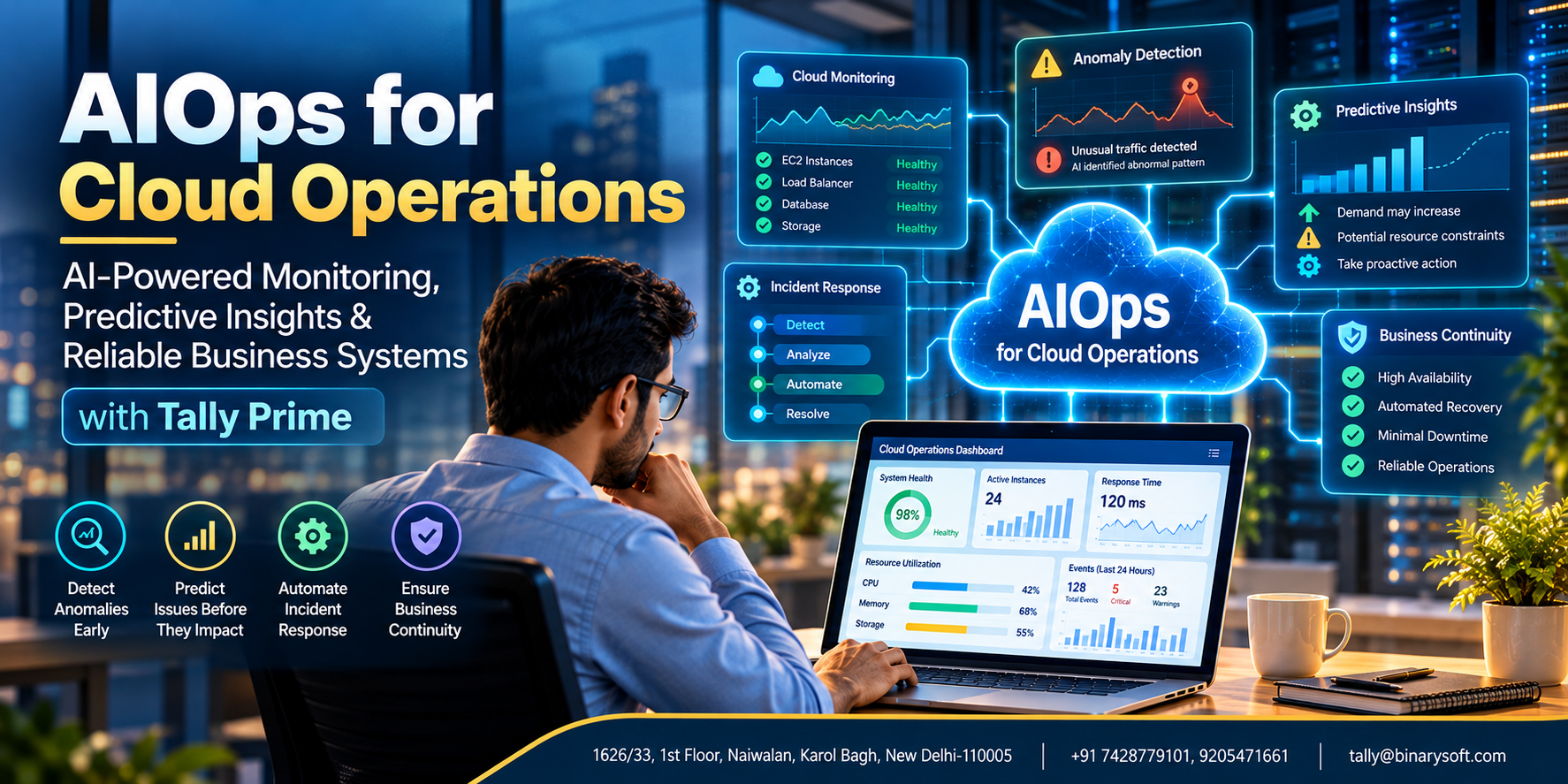
This is where Artificial Intelligence for IT Operations (AIOps) becomes valuable.
AIOps combines artificial intelligence, machine learning and operational analytics to help IT teams understand complex technology environments.
Instead of relying entirely on manual investigation, organisations can use AI-assisted systems to identify abnormal patterns, correlate related alerts and support faster incident resolution.
For businesses using Tally Prime through an appropriately configured cloud-hosted or remote-access environment, reliable infrastructure is particularly important.
Accounting records, inventory information, invoices and financial reports must remain accessible to authorised employees.
Understanding AIOps can help businesses make better decisions about cloud reliability, infrastructure management and operational continuity.
1. What Is AIOps?
AIOps stands for Artificial Intelligence for IT Operations.
It refers to the application of artificial intelligence, machine learning and advanced analytics to IT operations management.
AIOps platforms analyse information generated by servers, applications, networks, databases and cloud services.
The objective is to help IT professionals identify operational problems, understand their causes and respond more efficiently.
For example, a conventional monitoring system may generate separate alerts for high CPU usage, increased application response times and database connection failures.
An AIOps platform may identify relationships between these events and suggest that they share a common underlying cause.
This helps administrators focus on the most relevant information.
Important Functions of AIOps
AIOps commonly supports:
- Infrastructure monitoring and performance analysis.
- Anomaly detection and alert correlation.
- Incident investigation and root-cause analysis.
- Predictive capacity planning.
- Automated operational responses.
- Application performance monitoring.
- IT service management and operational reporting.
AIOps does not guarantee that every incident can be predicted or resolved automatically.
Its effectiveness depends on monitoring coverage, data quality, model accuracy and operational controls.
2. An Emotional Story: The Server Failure That Threatened a Family Business
Rajiv operated a successful wholesale trading business in Delhi.
His father had started the company more than twenty years earlier with a small warehouse and a handful of customers.
After joining the business, Rajiv worked hard to modernise operations.
He introduced digital accounting, organised inventory records and gradually expanded the customer base.
Eventually, the company adopted a cloud-hosted business application environment so employees could access authorised systems from different locations.
For several months, everything worked smoothly.
Then came the final week of the financial reporting period.
Rajiv's accounting team was preparing important statements while the sales department processed a large volume of orders.
Suddenly, employees started experiencing severe application delays.
Within an hour, several users could no longer connect.
The office became tense.
Accountants worried about unfinished reconciliation work.
Sales employees could not complete their normal activities.
Rajiv repeatedly called the technical support team.
His greatest concern was not simply the temporary interruption.
He feared losing access to the financial records his family had spent years maintaining.
The technical team eventually discovered that the hosting server had experienced increasing resource pressure over several days.
Performance warnings had appeared earlier, but they had not been investigated promptly.
After restoring normal operations, Rajiv decided to improve infrastructure monitoring.
The company introduced more structured performance monitoring, automated alerts and an AI-assisted operational analysis service.
The new arrangement helped technical administrators recognise unusual trends and investigate potential problems earlier.
Rajiv also established backup verification and recovery procedures.
The experience changed his understanding of technology.
He realised that moving an application to the cloud was only one part of digital transformation.
Keeping that environment dependable required continuous attention.
For Rajiv, reliable technology was not merely an IT requirement. It protected his employees' work, customer relationships and the business his father had built.
This fictional story illustrates why proactive cloud monitoring and business continuity planning matter.
3. How AIOps Works in Cloud Environments
AIOps uses information from different technology components to generate operational insights.
A typical workflow includes several stages.
Step 1: Data Collection
Monitoring systems collect operational information from cloud servers, applications, databases and networks.
This information may include CPU utilisation, memory consumption, disk performance, application errors and network latency.
Step 2: Data Processing
Collected information is organised and prepared for analysis.
Duplicate events and irrelevant information may be filtered.
Step 3: Pattern Recognition
Machine learning models analyse historical and current operational data.
They may identify patterns associated with normal system behaviour.
Step 4: Anomaly Detection
The system highlights unusual activity.
For example, unexpectedly high memory usage or rapidly increasing application response times may trigger further investigation.
Step 5: Event Correlation
Related alerts are grouped to help administrators understand whether multiple symptoms share a common cause.
Step 6: Incident Prioritisation
The system may rank incidents according to severity, affected services or estimated business impact.
Step 7: Automated or Human-Controlled Response
Depending on the configuration, the platform may recommend corrective actions or execute approved automation.
Step 8: Continuous Improvement
Operational outcomes can be evaluated to improve monitoring rules and analytical models.
This process helps IT teams move from purely reactive troubleshooting toward more proactive operations.
4. Important Components of AIOps Architecture
AIOps architecture generally combines several technologies.
Data Ingestion Layer
This component receives logs, metrics, events and traces from monitored systems.
Data Storage and Processing
Operational information is stored and processed for analysis.
Machine Learning Engine
AI models identify patterns, unusual behaviour and potential relationships between incidents.
Event Correlation Engine
Related events are grouped to reduce unnecessary alert duplication.
Incident Management Layer
The system creates or updates incident records and supports investigation workflows.
Automation Engine
Approved operational actions may be executed through scripts, orchestration tools or infrastructure management services.
Monitoring Dashboard
IT teams use dashboards to review infrastructure health, application performance and incident status.
A successful architecture requires appropriate security controls, reliable data collection and clearly defined operational responsibilities.
5. AIOps vs Traditional IT Operations
Traditional IT operations often depend on predefined monitoring thresholds and manual investigation.
AIOps introduces analytical capabilities that can help teams interpret larger volumes of information.
| Feature | Traditional IT Operations | AIOps-Enabled Operations |
|---|
| Monitoring |
Primarily predefined alerts |
Alerts combined with analytical insights |
| Incident detection |
Threshold-based monitoring |
Thresholds and anomaly detection |
| Root-cause analysis |
Often manual investigation |
AI-assisted correlation and investigation |
| Capacity planning |
Historical reports and estimates |
Predictive analysis may support planning |
| Alert management |
Individual alerts |
Related alerts can be grouped |
| Automation |
Rules and scripts |
Rules combined with AI-assisted recommendations |
| Human involvement |
Essential |
Still essential for oversight and critical decisions |
AIOps does not eliminate the need for conventional monitoring.
Instead, it builds on monitoring data and established operational processes.
6. Major Benefits of AIOps for Cloud Operations
Proactive Problem Detection
AIOps can help identify unusual performance trends before they develop into major incidents.
Reduced Alert Fatigue
Event correlation can reduce the time administrators spend examining repetitive alerts.
Faster Incident Investigation
AI-assisted analysis can help identify likely causes and affected services.
Improved Resource Planning
Historical usage patterns can support decisions about computing capacity, memory and storage requirements.
Better Application Reliability
Early identification of operational problems may help reduce avoidable disruptions.
Operational Efficiency
Automation can reduce repetitive administrative activities.
Improved Business Continuity
AIOps can support monitoring and incident response, although dependable continuity also requires backups, disaster recovery planning and tested restoration procedures.
7. How AIOps Can Support Tally Prime Cloud Operations
Tally Prime provides accounting, invoicing, inventory management, GST-related functionality and financial reporting capabilities.
Businesses may use Tally Prime in supported local, networked or remotely accessible environments.
When an organisation uses a compatible cloud-hosted setup, infrastructure reliability becomes an important consideration.
AIOps is not a built-in Tally Prime feature. It is an external IT operations capability that may be used to monitor the infrastructure supporting business applications.
Cloud Server Performance Monitoring
AIOps platforms can analyse server CPU utilisation, memory consumption, disk activity and other infrastructure metrics.
This helps administrators identify potential performance bottlenecks affecting hosted applications.
Application Availability Monitoring
Monitoring systems can check whether relevant application services and remote-access components remain available.
Alerts can notify administrators when a monitored service becomes unavailable.
Predictive Capacity Planning
AIOps can analyse historical infrastructure utilisation and identify trends.
For example, increasing resource consumption during month-end reporting may indicate a need to review server capacity.
Network Performance Analysis
Remote employees depend on reliable network connectivity.
Monitoring tools can help identify unusual latency, packet loss or connection instability.
Incident Investigation
When users report slow application performance, AIOps can help administrators correlate infrastructure events and identify likely causes.
Security Monitoring
AIOps-related operational analytics may complement security monitoring tools by identifying unusual infrastructure behaviour.
However, dedicated cybersecurity controls remain necessary.
Backup and Recovery Monitoring
Monitoring tools can track backup-job results, storage availability and recovery-related infrastructure events.
Businesses must still test backup restoration procedures independently.
Better Multi-User Experience
A properly configured hosting environment can help multiple authorised users access Tally Prime according to their licensing and deployment arrangements.
AIOps may help technical teams monitor the infrastructure supporting that environment.
The practical benefit is improved operational visibility rather than automatic enhancement of Tally Prime's internal functionality.
8. Example: AIOps Monitoring for a Cloud-Hosted Accounting Environment
Consider a distribution company with employees working from Delhi, Jaipur and Mumbai.
The organisation uses a compatible hosted environment to provide authorised remote access to its accounting application.
Its IT team introduces an AIOps-enabled monitoring platform.
The workflow may operate as follows.
Step 1: Infrastructure Monitoring
Monitoring agents collect information about server performance, network connectivity and storage utilisation.
Step 2: Anomaly Detection
The analytical platform identifies an unusual increase in memory consumption.
Step 3: Event Correlation
The system compares the memory alert with application response times and other infrastructure events.
Step 4: Incident Notification
An alert is sent to the technical administrator.
Step 5: Human Investigation
The administrator examines the relevant services and determines whether corrective action is required.
Step 6: Controlled Remediation
An approved operational procedure is performed, such as investigating an overloaded service or adjusting infrastructure capacity.
Step 7: Verification
The administrator confirms that application performance has returned to acceptable levels.
Step 8: Documentation
The incident and corrective actions are recorded for future analysis.
This approach can help organisations respond more systematically to infrastructure problems.
9. Case Study 1: How a Trading Company Improved Cloud Application Reliability
Illustrative case study
A medium-sized trading company operated from four locations.
Its employees accessed accounting and inventory applications through a hosted environment.
The organisation frequently experienced performance complaints during busy reporting periods.
The Challenge
The technical team received repeated complaints about slow application response times.
Administrators relied primarily on manual investigation.
Performance problems were sometimes discovered only after employees reported them.
The Solution
The company introduced centralised infrastructure monitoring with AI-assisted anomaly detection.
The system analysed server resource utilisation, storage performance and network conditions.
Alerts were configured for unusual behaviour.
Technical administrators investigated significant events before performing corrective actions.
Role of Tally Prime
Tally Prime continued to support the company's accounting, invoicing and inventory management activities.
The AIOps solution monitored the hosting infrastructure rather than modifying the accounting application's internal processes.
Illustrative Results
During a three-month evaluation, the company estimated that average infrastructure incident investigation time decreased by approximately 35%.
Administrators gained better visibility into recurring performance patterns.
Employees experienced fewer prolonged interruptions associated with previously unidentified infrastructure problems.
Key Learning
Proactive monitoring can help reduce operational uncertainty and improve technical response processes.
10. Case Study 2: How a Manufacturing Company Strengthened Business Continuity
Illustrative case study
A manufacturing company relied on cloud-hosted applications for accounting, inventory coordination and operational reporting.
Its IT infrastructure supported several departments and remote users.
The Challenge
The company experienced occasional storage-capacity warnings and inconsistent backup-job monitoring.
Management was concerned about the potential impact of infrastructure failures on financial operations.
The Solution
The organisation introduced an AIOps-assisted monitoring platform.
The platform analysed infrastructure trends and generated alerts for unusual resource consumption.
The IT team also improved backup monitoring, recovery testing and incident documentation.
Role of Tally Prime
Tally Prime maintained the company's financial and inventory records.
The infrastructure monitoring platform helped administrators observe the technical environment supporting application access.
Illustrative Results
The company estimated a 40% reduction in the time required to identify and classify infrastructure incidents.
Administrators also improved their ability to detect unsuccessful backup jobs.
Key Learning
AIOps can support business continuity, but it must operate alongside dependable backup policies, recovery procedures and human oversight.
11. Challenges of Implementing AIOps
Despite its advantages, AIOps introduces several challenges.
Poor Monitoring Data
Incomplete or inaccurate monitoring information can reduce the reliability of AI-generated insights.
False Alerts
Anomaly detection systems may occasionally classify normal activity as suspicious.
Administrators must evaluate alert quality.
Integration Complexity
Organisations may use multiple cloud platforms, operating systems and applications.
Connecting these systems can require technical expertise.
Implementation Costs
AIOps platforms may involve software subscriptions, data-processing charges, monitoring infrastructure and implementation expenses.
Security and Privacy
Operational logs may contain sensitive information.
Businesses should apply appropriate access controls and data-retention policies.
Overdependence on Automation
Automatically restarting services or modifying infrastructure without appropriate safeguards can create additional risks.
Skills and Training
IT teams need to understand monitoring systems, incident management and AI-assisted recommendations.
AIOps works best when experienced professionals remain responsible for critical operational decisions.
12. Best Practices for Successful AIOps Implementation
Businesses should begin by identifying their most important applications and infrastructure components.
Monitoring should prioritise systems whose failure would significantly affect business operations.
Organisations should establish performance baselines before introducing anomaly detection.
Clear incident severity levels help administrators prioritise operational problems.
Automation should initially focus on low-risk activities.
High-impact infrastructure changes should require appropriate approval.
Businesses should maintain secure logging and monitoring configurations.
Backup and disaster recovery procedures should be tested regularly.
AIOps performance should be evaluated using measurable indicators such as incident detection time, investigation time and service availability.
For organisations hosting Tally Prime, infrastructure changes should be reviewed for compatibility with supported software configurations and licensing requirements.
13. AIOps, Cloud Security and Business Continuity
AIOps can contribute to operational resilience by improving visibility into infrastructure behaviour.
However, it should not replace dedicated cybersecurity or disaster recovery solutions.
Cloud security requires appropriate authentication, access management, encryption, patching and vulnerability management.
Business continuity requires reliable backups, documented recovery procedures and periodic restoration testing.
AIOps can help identify unusual operational conditions and alert technical teams.
When combined with established security and recovery practices, it can support a more dependable IT environment.
For businesses maintaining financial records, this layered approach is especially important.
Accounting information must remain accurate, protected and recoverable.
14. The Future of AIOps in Cloud Operations
Cloud infrastructure continues to become more complex.
Organisations increasingly use distributed applications, remote-access platforms, multiple cloud services and automated deployment systems.
These environments generate large amounts of operational information.
AIOps can help IT teams interpret this information more efficiently.
Future developments may improve incident correlation, capacity forecasting and automated troubleshooting.
Generative AI may also assist administrators by summarising incidents and recommending investigation steps.
Nevertheless, AI-generated operational recommendations must be evaluated carefully.
Incorrect automation can disrupt important services.
For businesses using hosted accounting applications, the priority should remain dependable infrastructure, secure access and consistent financial operations.
AIOps provides tools to support these objectives, but professional oversight remains essential.
Conclusion
Artificial Intelligence for IT Operations is changing how organisations manage cloud infrastructure.
By combining monitoring information with machine learning and operational analytics, AIOps can help technical teams identify unusual behaviour, investigate incidents and plan infrastructure resources.
Its benefits include improved operational visibility, more efficient incident management and better support for proactive maintenance.
For organisations using Tally Prime in a compatible cloud-hosted environment, AIOps can help monitor the servers, networks and supporting services on which application access depends.
However, reliable operations require more than artificial intelligence.
Businesses must maintain appropriate security controls, dependable backups, recovery procedures and trained technical personnel.
The future of cloud operations is not simply about responding to failures faster. It is about understanding infrastructure behaviour early enough to make better decisions and protect business continuity.
Powered by Binarysoft Technologies
Authorized Tally Partner
Location: 1626/33, 1st Floor, Naiwalan, Karol Bagh, New Delhi – 110005, INDIA
Contact Us: +91 7428779101, 9205471661
Email: tally@binarysoft.com
Business Hours: 10:00 AM – 6:00 PM, Monday to Friday
Binarysoft Technologies helps businesses implement Tally Prime, improve accounting processes, manage inventory information and evaluate suitable software deployment environments.
Frequently Asked Questions
What is the difference between AIOps and traditional monitoring?
Traditional monitoring primarily relies on predefined rules and thresholds. AIOps adds analytical techniques such as anomaly detection and event correlation.
Does Tally Prime include built-in AIOps capabilities?
Tally Prime should not be treated as a dedicated AIOps platform. External monitoring solutions may be used to observe compatible hosting infrastructure.
Can AIOps improve Tally Prime Cloud performance?
AIOps can help identify infrastructure-related performance problems. Actual improvements depend on technical investigation and appropriate corrective actions.
How does AIOps support business continuity?
It can help detect operational problems earlier and improve incident response. Backups and disaster recovery planning remain necessary.
CA. Ronav Maheshwari works with small and mid-sized businesses on accounting processes, GST compliance, and financial reporting. His focus is on simplifying routine accounting workflows and helping business owners maintain accurate and audit-ready records.