Call CA Tally HelpDesk
+91 9205471661,
7428779101
Introduction: When One Small Software Error Becomes a Big Business Problem
Imagine running a successful business where hundreds of invoices, payments, inventory transactions and financial reports are processed daily.
Everything appears normal until a customer discovers an incorrect invoice amount. The accounting team investigates and finds that a software update introduced a calculation error.
Suddenly, employees must verify transactions manually, customers begin questioning invoice accuracy, and management worries about financial reporting.
This situation highlights an important business reality: software quality directly influences operational efficiency, financial accuracy and customer confidence.
Traditional software testing helps prevent these problems, but modern applications are becoming increasingly complex. Testing teams must verify thousands of combinations involving user inputs, workflows, permissions, integrations and business rules.
Artificial intelligence offers a new approach.
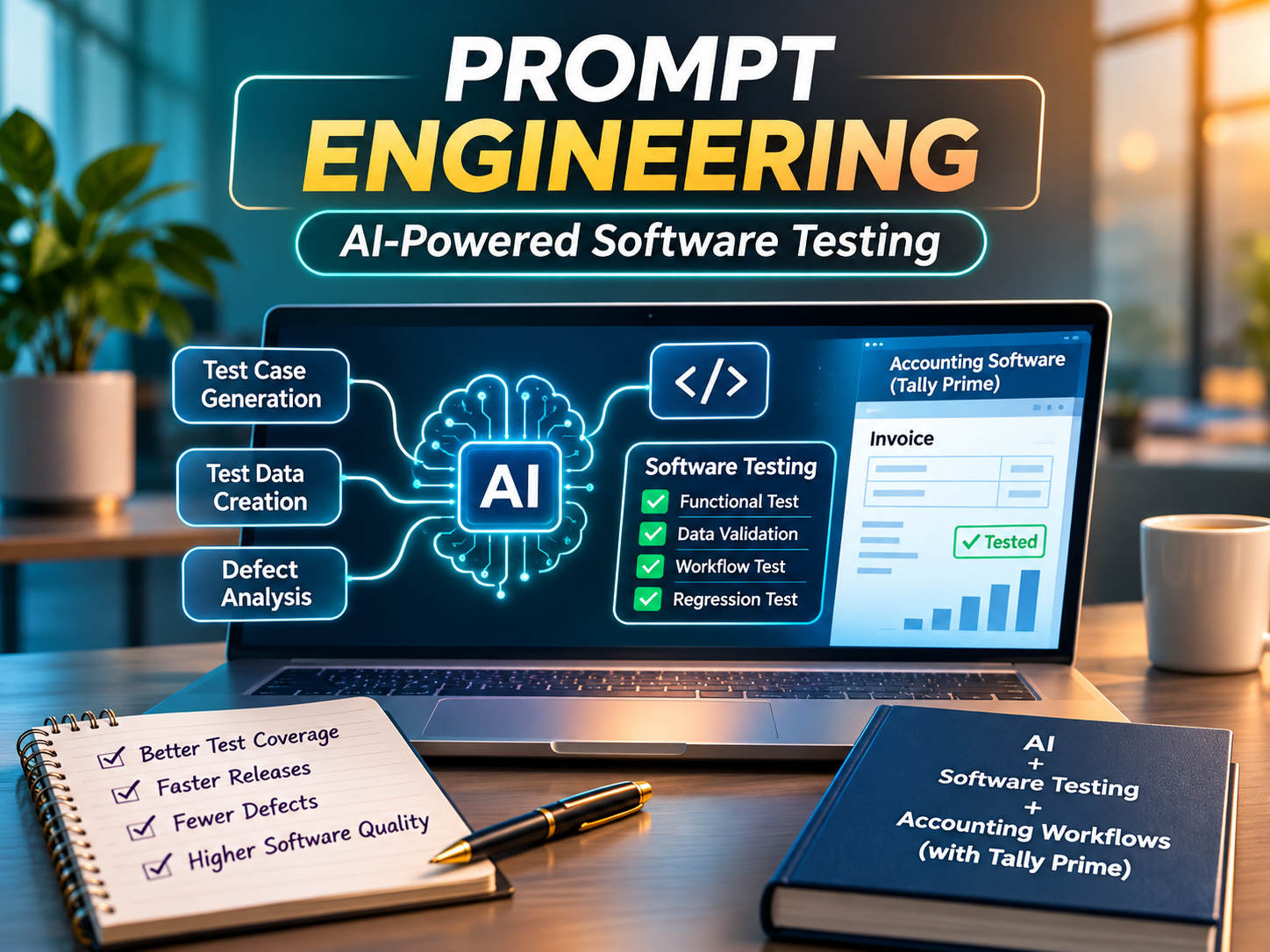
Prompt engineering for software testing enables testers to communicate with AI systems using structured instructions to generate test cases, analyze requirements, identify risks and improve quality assurance.
Rather than replacing experienced testers, AI can help them work faster and concentrate on complex scenarios requiring human judgment.
For businesses using Tally Prime, these principles are particularly relevant when validating customized accounting workflows, GST calculations, inventory transactions and integrations.
Understanding prompt engineering can help organizations build more reliable software while protecting business-critical information.
1. What Is Prompt Engineering in Software Testing?
Prompt engineering is the practice of designing clear, structured instructions that guide an AI system toward useful and relevant outputs.
In software testing, these instructions help AI understand application requirements, expected behavior, possible failures and testing objectives.
A tester might ordinarily spend hours preparing test cases for a billing application.
With an appropriately designed prompt, an AI assistant can produce an initial collection of test scenarios covering normal transactions, invalid inputs, boundary conditions and potential security concerns.
Example of a Basic Testing Prompt
"Generate test cases for an invoice creation form."
This instruction is understandable but lacks important details.
Example of an Improved Testing Prompt
"Act as a senior software quality assurance engineer. Generate functional, negative and boundary test cases for an invoice creation module containing customer name, invoice date, product quantity, unit price, discount and tax fields. Include expected results, validation requirements and test priorities."
The second prompt provides:
-
A defined professional role.
-
Clear testing objectives.
-
Specific application functionality.
-
Required test categories.
-
Expected output structure.
-
Relevant business rules.
These details make the AI-generated response more actionable.
However, generated test cases must still be reviewed against actual software requirements before execution.
2. Why Prompt Engineering Matters in Modern Software Testing
Software testing has traditionally involved substantial manual effort.
Testers examine requirements, prepare scenarios, execute tests, document defects and verify corrections.
As applications grow, maintaining comprehensive coverage becomes more difficult.
Prompt engineering can support several important improvements.
Faster Test Case Preparation
AI can transform structured requirements into preliminary test scenarios within minutes.
This allows testers to spend more time validating complex workflows.
Better Identification of Edge Cases
Carefully designed prompts encourage AI to consider unusual combinations, including empty fields, unexpected values, duplicate submissions and incorrect permissions.
Reduced Repetitive Documentation
AI can help prepare test summaries, defect descriptions, acceptance criteria and regression testing checklists.
Improved Communication
Developers, testers and business analysts can use structured prompts to clarify requirements and identify missing information.
Stronger Risk Awareness
AI-assisted analysis can highlight potential failure scenarios that deserve further investigation.
The main advantage is not simply speed. It is the opportunity to improve testing consistency while preserving human oversight.
3. How Prompt Engineering Works in the Software Testing Lifecycle
Prompt engineering can support multiple stages of software development.
Requirement Analysis
Before testing begins, teams must understand what the application should accomplish.
AI can examine approved requirements and identify unclear conditions, missing validations and conflicting expectations.
For example, an invoice module may specify a discount field without defining whether discounts apply before or after tax calculations.
A well-designed prompt can identify this ambiguity before development progresses.
Test Planning
Testing teams can use AI to organize testing activities according to application modules, business risks and available resources.
Test Case Generation
AI can prepare structured test cases covering positive, negative, boundary and integration scenarios.
Test Data Preparation
AI can generate synthetic sample records for customers, products, invoices and transactions.
Sensitive production information should not be shared with public AI tools without appropriate authorization and safeguards.
Defect Analysis
When a test fails, AI can help analyze error messages, application logs and expected behavior.
Its suggestions should be treated as hypotheses until verified.
Regression Testing
After software modifications, AI can assist in identifying existing workflows that may require retesting.
This is particularly useful when changes affect interconnected accounting or inventory modules.
4. Essential Prompt Engineering Techniques for Software Testers
Different testing objectives require different prompting approaches.
Role-Based Prompting
Role-based prompting asks AI to respond from a particular professional perspective.
Example:
"Act as an experienced QA engineer specializing in financial applications. Identify potential testing risks in a GST invoice generation module."
This establishes a relevant context for the response.
Context-Rich Prompting
AI produces more useful results when it receives sufficient application information.
For example, instead of requesting generic payment testing scenarios, specify supported payment methods, transaction limits, approval rules and expected error messages.
Step-by-Step Prompting
Complex testing requirements can be divided into manageable tasks.
A tester might first request requirement analysis, then functional test cases, followed by negative scenarios and regression coverage.
Example-Based Prompting
Providing sample test cases helps AI understand the required format.
A team can supply an approved example containing test ID, scenario, input, expected result and priority.
AI can then prepare additional cases following the same structure.
Iterative Prompt Refinement
The first response may not be complete.
Testers can improve results by asking AI to identify missing cases, remove duplicates, explain assumptions or prioritize high-risk scenarios.
Effective prompt engineering is an iterative process involving instruction, evaluation, refinement and verification.
5. Practical Example: Generating Test Cases for a GST Invoice
Consider a business application that generates GST invoices.
The testing team needs to validate tax calculations, invoice details and transaction processing.
A structured prompt could be:
"Generate comprehensive test cases for a GST invoice module. Include customer GSTIN validation, item quantity, taxable value, discounts, CGST, SGST, IGST, invoice numbering, rounding and cancellation. Cover positive, negative and boundary scenarios. Present test cases with expected results and priorities."
The resulting test plan should consider several situations.
Scenario 1: Valid Intrastate Transaction
Verify that applicable CGST and SGST amounts are calculated according to the configured tax rules.
Scenario 2: Interstate Transaction
Check whether IGST is applied correctly when relevant.
Scenario 3: Invalid Customer Information
Verify that required fields and GSTIN validation rules behave as specified.
Scenario 4: Discount Calculation
Confirm whether discounts affect taxable values according to the applicable transaction rules.
Scenario 5: Duplicate Invoice Submission
Ensure repeated requests do not unintentionally create duplicate invoices.
Scenario 6: Invoice Cancellation
Verify that cancellation updates transaction status and related accounting records appropriately.
The AI-generated scenarios provide a starting point.
Final expected results must be checked against current GST requirements and the application's approved business rules.
6. The Emotional Side of Software Quality: A Business Owner's Story
Rajesh owned a growing wholesale distribution business in Delhi.
For years, he had built his reputation through timely deliveries, transparent billing and dependable customer relationships.
His company gradually expanded from a small operation into a business handling hundreds of transactions every week.
One month, the company introduced a customized order-processing system.
The new system promised faster billing and reduced manual work.
Initially, everything appeared successful.
Then customers began reporting discrepancies between ordered quantities and invoice amounts.
Some invoices reflected incorrect discounts, while others contained inconsistent totals.
Rajesh watched his employees work late into the evening, checking invoices and reassuring worried customers.
He remembered the early years when every transaction represented an opportunity to earn someone's trust.
The possibility of losing that trust troubled him more than the immediate financial inconvenience.
His technology team eventually discovered that several important testing scenarios had been overlooked.
The application had been tested using normal transactions but not enough unusual combinations of discounts, quantities and repeated submissions.
The team redesigned its quality assurance process.
Using structured AI prompts, testers prepared additional scenarios, documented expected results and created a more comprehensive regression checklist.
Every generated scenario was reviewed and executed by the testing team.
Over time, the business established a stronger process for validating software changes before deployment.
Rajesh learned an important lesson:
Technology creates business value only when customers can trust the results it produces.
This illustrative story demonstrates why comprehensive software testing matters beyond technical performance.
It protects relationships, employee confidence and business continuity.
7. How Tally Prime Supports Reliable Accounting Workflows
Tally Prime helps businesses manage accounting, invoicing, taxation, inventory and financial reporting.
Although prompt engineering is not a standard built-in AI testing capability of Tally Prime, organizations can use external AI-assisted testing methods to validate workflows surrounding their accounting systems.
This is especially valuable when businesses implement customizations, integrations or automated data exchange.
Invoice and Billing Validation
Businesses can create test scenarios for invoice entry, discount calculations, tax configurations and transaction totals.
Testers can compare approved expected results with actual outputs from Tally Prime.
GST Accounting Verification
Testing teams can verify whether configured tax treatments, ledger allocations and invoice information produce the intended accounting results.
Inventory Transaction Testing
Organizations can validate stock movement, purchase entries, sales entries, units of measurement and inventory valuation settings.
Ledger and Financial Reporting Checks
AI-assisted test planning can help identify scenarios involving ledger classification, voucher posting and report reconciliation.
Customization Testing
Businesses using Tally Definition Language (TDL) customizations can prepare targeted test cases for modified screens, fields, validations and reports.
Integration Testing
Where authorized integrations connect Tally Prime with external applications, testing teams can validate data consistency, duplicate prevention and error handling.
The key distinction is that AI helps design and analyze tests, while actual verification occurs through approved testing tools, application interfaces and human review.
8. Case Study One: Improving GST Billing Accuracy in a Distribution Business
Illustrative Case Study
Business Background
A medium-sized electrical goods distributor processes approximately 1,500 invoices monthly.
The company uses Tally Prime for accounting, inventory management and GST-related records.
A customized order-entry application transfers approved sales information into the accounting workflow.
The Challenge
The technology team noticed occasional mismatches involving discounts and tax calculations.
Testing had concentrated mainly on standard transactions.
Unusual combinations involving multiple discounts, different tax treatments and modified quantities received limited attention.
The Solution
The company introduced structured AI-assisted test case preparation.
Testers developed prompts covering:
-
Intrastate and interstate transactions.
-
Multiple discount conditions.
-
Zero and fractional quantities.
-
Duplicate order submissions.
-
Invoice modifications and cancellations.
-
Ledger and inventory reconciliation.
The team reviewed generated cases, created synthetic test data and executed approved scenarios in a controlled testing environment.
The Outcome
The revised process helped identify previously overlooked validation conditions before subsequent software releases.
It also created a reusable regression testing checklist for future updates.
Business Lesson
AI-assisted test design can improve testing coverage when combined with knowledgeable testers, verified business rules and controlled execution.
9. Case Study Two: Strengthening Inventory and Accounting Integration
Illustrative Case Study
Business Background
A manufacturing company maintains inventory and financial accounts in Tally Prime.
Its production management application exchanges approved transaction information with the accounting system.
The Challenge
After a software modification, the company experienced inconsistencies between production records and inventory movements.
The technology team needed to verify multiple transaction scenarios without overlooking important dependencies.
The Solution
The testing team created structured prompts describing purchase receipts, material consumption, production output and stock adjustments.
AI helped generate scenarios for incorrect units, missing references, repeated submissions and partial transaction failures.
Testers then executed the relevant cases and reconciled results with approved accounting records.
The Outcome
The company developed a clearer testing procedure for integration changes.
The process improved traceability between application requirements, test cases and observed results.
Business Lesson
Prompt engineering can support reliable integrations by helping teams identify risks that might otherwise remain hidden until daily operations are affected.
10. Using AI Prompts to Test Tally Prime Customizations
Businesses often customize accounting software to support industry-specific requirements.
These changes may introduce additional validations, approval workflows or specialized reports.
Before deploying a customization, testing teams should evaluate its effect on existing functionality.
For example, consider a customized sales voucher containing an additional approval field.
A suitable AI prompt could be:
"Prepare functional, negative, permission-based and regression test cases for a customized Tally Prime sales voucher that requires managerial approval above a configured transaction limit. Include unauthorized access, missing approval, voucher modification, cancellation and audit verification scenarios."
The resulting test cases can guide controlled validation.
Teams should verify that unauthorized users cannot bypass approval requirements and that approved transactions remain consistent with accounting records.
Where TDL or external integrations are involved, technical implementation details should be reviewed by qualified developers.
AI-generated scripts should never be deployed directly to a production accounting environment without testing, authorization and appropriate backups.
11. Best Practices for Effective AI-Assisted Software Testing
Successful prompt engineering requires discipline and clear processes.
Define the Testing Objective
Every prompt should identify the functionality being tested and the intended outcome.
Provide Accurate Requirements
Use approved specifications rather than assumptions about application behavior.
Specify Output Format
Request structured test cases with identifiers, preconditions, inputs, steps and expected results.
Include Negative Scenarios
Testing should cover invalid inputs, missing values, duplicate transactions and unauthorized actions.
Prioritize Business Risks
Financial calculations, customer information, permissions and data integrity deserve particular attention.
Protect Confidential Information
Use synthetic or appropriately anonymized data when interacting with AI systems.
Verify AI-Generated Results
AI can produce incorrect assumptions or incomplete scenarios.
Human review remains essential.
Maintain Regression Coverage
Important scenarios should be retained and updated as applications evolve.
Test in Controlled Environments
Software changes should be validated before being introduced into live business operations.
Document Evidence
Maintain records of executed tests, observed results, defects and approvals.
These practices help convert AI-generated suggestions into dependable quality assurance activities.
12. Common Challenges and Limitations of Prompt Engineering
Despite its advantages, prompt engineering introduces several challenges.
Inaccurate Outputs: AI may generate plausible but incorrect expected results.
Incomplete Coverage: Important business scenarios may be missed if requirements are unclear.
Inconsistent Responses: Similar prompts may produce different outputs across executions.
Security Risks: Confidential information may be exposed through inappropriate AI usage.
Automation Limitations: Generated test scripts may require substantial modification before execution.
Regulatory Complexity: Taxation and financial requirements must be verified using authoritative, current rules.
Organizations should therefore treat AI as an assistant rather than an independent quality assurance authority.
13. The Future of Prompt Engineering in Software Testing
AI-assisted software testing is likely to become increasingly integrated into development workflows.
Potential applications include intelligent test generation, automated documentation, defect classification, regression analysis and risk-based test selection.
More advanced systems may connect approved requirements with test management platforms and continuous integration pipelines.
For accounting applications, this could support better validation of transaction processing, financial reports and integration workflows.
However, financial accuracy requires more than convincing AI-generated explanations.
Businesses will continue to need deterministic calculations, reliable test evidence, access controls and qualified human oversight.
The strongest testing strategies will combine AI assistance with established engineering practices.
Conclusion
Prompt engineering is creating new opportunities to improve software testing efficiency, consistency and coverage.
By designing structured instructions, testing teams can use AI to generate test scenarios, analyze requirements, document defects and identify potential risks.
For businesses relying on Tally Prime, these methods can support validation of customized accounting processes, GST workflows, inventory operations and external integrations.
AI does not replace the need for reliable accounting software, knowledgeable professionals or verified testing procedures.
Instead, it provides another way to strengthen quality assurance and reduce avoidable errors.
Organizations that combine prompt engineering with disciplined testing practices can build greater confidence in their software and the business decisions supported by it.
About Binarysoft Technologies
Powered by Binarysoft Technologies
Authorized Tally Partner
Binarysoft Technologies supports businesses with Tally Prime solutions, accounting software implementation, customization, technical assistance and cloud-based accounting requirements.
Our focus is to help organizations improve accounting efficiency, business visibility and operational reliability.
Location:
1626/33, 1st Floor, Naiwalan, Karol Bagh, New Delhi – 110005, INDIA
Contact Us:
+91 7428779101, 9205471661
Email:
tally@binarysoft.com
Business Hours:
10:00 AM – 6:00 PM, Monday to Friday
Frequently Asked Questions
Is AI-generated testing completely reliable?
No. AI-generated scenarios may contain mistakes or omit important conditions. Human review and actual test execution remain necessary.
How can businesses test GST invoice calculations?
Businesses can prepare scenarios involving tax configurations, taxable values, discounts, transaction locations and rounding, then verify results against applicable rules.
What are the main benefits of AI-assisted testing?
Potential benefits include faster test preparation, improved documentation, broader scenario exploration and reduced repetitive effort.
Can prompt engineering be used with Tally Prime?
Yes. External AI tools can help prepare test plans for Tally Prime workflows, customizations and integrations. This does not mean that Tally Prime includes built-in prompt-based testing.
CA. Ankit Vardiya works closely with traders, wholesalers, and service businesses on accounting automation, GST reporting, and audit readiness. His professional exposure to day-to-day business operations allows him to translate complex accounting concepts into practical guidance for Indian business owners.