Call CA Tally HelpDesk
+91 9205471661,
7428779101
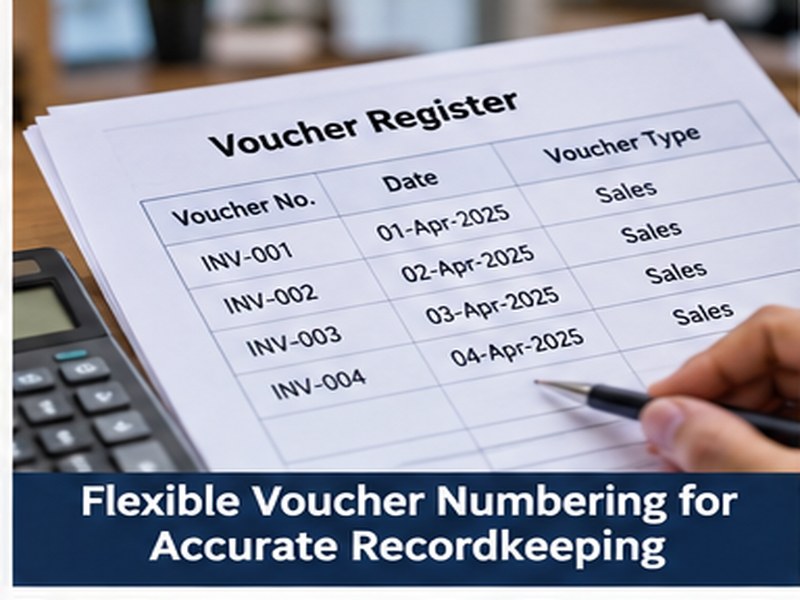
Introduction: Why Every Voucher Number Matters in Business Accounting
Imagine running a successful wholesale business where hundreds of invoices, payment receipts, purchase entries, and accounting transactions are recorded every day. Business is growing, customers are increasing, and financial transactions are becoming more complicated.
Everything appears to be running smoothly until your accountant discovers that two invoices have the same number.
Suddenly, finding the correct transaction becomes difficult. The accounts team spends hours checking records, customers request clarifications, and management begins questioning the accuracy of financial reports.
This situation demonstrates why accurate voucher numbering is essential for reliable business accounting.
Voucher numbers are more than simple identification codes. They establish a structured system for tracking transactions, verifying financial information, supporting audits, and maintaining accountability.
Tally Prime provides flexible voucher numbering capabilities that allow businesses to organize their accounting records according to operational requirements.
Whether a company handles ten transactions daily or thousands of transactions every month, a properly configured voucher numbering system helps maintain consistency, reduce administrative effort, and improve financial visibility.
This guide explains how flexible voucher numbering works in Tally Prime, its advantages, configuration methods, practical applications, and how businesses can use it to strengthen financial control.
1. What Is Voucher Numbering in Accounting?
Voucher numbering is the process of assigning a unique identification number to an accounting transaction.
Every transaction recorded in accounting software is represented by a voucher. Depending on the nature of the transaction, it may belong to different categories.
Common accounting vouchers include:
-
Sales vouchers for customer invoices.
-
Purchase vouchers for supplier transactions.
-
Payment vouchers for outgoing payments.
-
Receipt vouchers for incoming payments.
-
Contra vouchers for transfers between cash and bank accounts.
-
Journal vouchers for accounting adjustments.
-
Debit notes and credit notes for transaction corrections and adjustments.
For example, a business may use the following numbering structure:
|
Voucher Type
|
Example Number
|
|---|
|
Sales
|
SAL/2026/0001
|
|
Purchase
|
PUR/2026/0001
|
|
Payment
|
PAY/2026/0001
|
|
Receipt
|
REC/2026/0001
|
|
Journal
|
JRN/2026/0001
|
This structure makes it easier for accountants to identify transactions without opening every voucher individually.
A well-organized numbering system also helps businesses locate supporting documents, verify entries, and investigate accounting discrepancies.
2. Understanding Flexible Voucher Numbering in Tally Prime
Flexible voucher numbering allows businesses to choose how voucher numbers are generated and managed.
Instead of depending on a single numbering format for every accounting transaction, organizations can configure numbering methods according to their requirements.
Tally Prime supports voucher numbering approaches such as automatic, manual, automatic with manual override, and no numbering.
Automatic Voucher Numbering
In automatic numbering, Tally Prime generates voucher numbers based on the configured sequence.
For example:
INV/2026/001
INV/2026/002
INV/2026/003
This approach is useful for businesses that process large transaction volumes and want to reduce manual data entry.
Manual Voucher Numbering
Manual numbering allows users to enter voucher numbers themselves.
This is useful when businesses need to follow an existing document numbering system or enter transactions originating from external sources.
However, manual numbering requires additional checks to avoid duplicate or incorrect references.
Automatic Numbering with Manual Override
This method combines automated numbering with the flexibility to modify voucher numbers when necessary.
It can be useful during migration, special documentation processes, or exceptional accounting situations.
Because users can intervene in the sequence, appropriate permissions and review procedures are important.
No Voucher Numbering
Some internal accounting processes may not require a displayed voucher number.
Tally Prime can support this approach for suitable voucher types, although businesses should consider traceability requirements before using it.
3. Why Flexible Voucher Numbering Is Important for Businesses
Prevents Confusion Between Transactions
When accounting entries are recorded without a consistent identification system, locating specific transactions becomes difficult.
Structured numbering helps distinguish sales invoices, purchases, payments, and journal entries.
Improves Accounting Accuracy
Automatically generated voucher numbers reduce the need for repeated manual entry.
This minimizes certain clerical errors and helps accountants maintain consistent records.
However, accurate numbering does not replace the need to verify transaction dates, amounts, ledgers, and supporting documents.
Simplifies Financial Audits
During an audit, auditors may request supporting information for specific transactions.
A clear numbering structure helps accountants retrieve records quickly and establish the relationship between vouchers and their supporting documents.
Supports Better Financial Reporting
Consistent voucher references make it easier to investigate transactions appearing in ledgers, day books, and other accounting reports.
Helps Maintain Compliance
Businesses operating under GST and other regulatory frameworks must maintain appropriate documentation.
For Indian GST tax invoices, businesses should ensure that invoice serial numbers meet applicable requirements, including uniqueness within the financial year and prescribed numbering rules.
The numbering of internal accounting vouchers should not automatically be treated as equivalent to statutory tax invoice numbering.
4. An Emotional Story: How One Missing Invoice Number Changed a Business Owner's Approach
Rajesh operated a growing electrical goods distribution business in Delhi.
For nearly fifteen years, he had built his company through hard work, personal relationships, and dependable customer service.
His employees respected him, and customers trusted his commitment to delivering products on time.
As the business expanded, the number of daily transactions increased dramatically.
The accounting team continued using a combination of handwritten references and manually entered invoice numbers.
One afternoon, an important customer called Rajesh regarding a payment discrepancy.
The customer claimed that an invoice had already been paid, while the accounting records showed an outstanding balance.
Rajesh asked his accountant to investigate.
After several hours of searching, the team discovered that two different transactions had been recorded using confusingly similar references.
The problem was not necessarily the payment itself. It was the difficulty of establishing which transaction belonged to which supporting document.
The customer became frustrated.
Rajesh felt disappointed because he had spent years building trust, yet a basic accounting process was creating uncertainty.
That evening, he sat in his office looking at piles of invoices.
He realized that business growth required stronger systems, not simply longer working hours.
His accountant recommended establishing a structured voucher numbering process in Tally Prime.
The business introduced separate voucher series for sales, purchases, receipts, and payments, along with routine reconciliation checks.
Over time, employees became more confident when searching for transactions, and customer queries could be investigated more efficiently.
For Rajesh, the greatest improvement was not merely saving time.
It was knowing that his team had a clearer process for protecting the trust he had worked so hard to build.
This is an illustrative story showing how structured accounting practices can affect everyday business operations.
5. Key Features of Flexible Voucher Numbering in Tally Prime
5.1 Multiple Voucher Numbering Methods
Different voucher types can use different numbering methods.
For example, a business may prefer automatic numbering for sales invoices and manual references for certain adjustment entries.
This flexibility allows organizations to align accounting processes with their documentation needs.
5.2 Prefix and Suffix Configuration
Businesses can create meaningful voucher identifiers by adding prefixes and suffixes.
For example:
DEL/INV/0001/26-27
Here:
DEL identifies the business location.
INV identifies the invoice category.
0001 represents the sequential number.
26-27 identifies the financial year.
The actual format should be designed around the organization's operational and compliance requirements.
5.3 Period-Based Numbering
Tally Prime provides options for configuring voucher numbering periods and restarting sequences where supported by the selected voucher type and numbering method.
For example, a company may adopt a new numbering sequence at the beginning of a financial year.
A properly designed prefix can distinguish one financial year's documents from another.
5.4 Separate Numbering for Voucher Types
Sales, purchase, payment, receipt, and journal vouchers can maintain separate numbering arrangements.
This makes it easier to organize financial documents and identify transactions.
5.5 Handling Deleted or Cancelled Vouchers
Businesses should carefully configure how voucher numbering behaves when transactions are deleted, cancelled, or inserted with earlier dates.
Some automatic numbering arrangements can cause subsequent voucher numbers to change when transactions are modified.
Where available and suitable, configurations designed to retain existing voucher numbers can help protect document references.
For statutory invoices, cancellation procedures and numbering controls should be reviewed carefully to preserve the necessary audit trail.
5.6 Supporting Business Growth
As businesses expand into additional departments, locations, or operational units, a well-designed numbering policy can accommodate increasing transaction volumes.
Voucher types and series can be structured to support different processes without losing consistency.
6. How to Configure Voucher Numbering in Tally Prime
Configuring voucher numbering correctly is an important step toward accurate financial recordkeeping.
The following general procedure can be used.
Step 1: Open Tally Prime
Launch Tally Prime and select the company where voucher numbering needs to be configured.
Step 2: Access Voucher Types
Navigate to:
Gateway of Tally → Alter → Voucher Type
Select the relevant voucher type, such as Sales, Purchase, Payment, or Receipt.
Menu wording and available options may vary depending on the installed version and configuration.
Step 3: Choose the Numbering Method
Locate the voucher numbering settings and select the appropriate method.
Available methods may include automatic, manual, automatic with manual override, or none.
Step 4: Configure the Numbering Format
Where supported, configure the starting number, prefix, suffix, and applicable numbering period.
For example:
Prefix: INV/26-27/
Starting Number: 0001
Resulting Number: INV/26-27/0001
The displayed number format depends on the configuration and number-width options available.
Step 5: Review Additional Numbering Controls
Review settings related to maintaining or renumbering vouchers, duplicate references, and other numbering behaviors.
Choose settings that suit the organization's accounting and compliance processes.
Step 6: Save the Configuration
Accept the voucher type configuration.
Step 7: Test the Numbering Sequence
Create a sample voucher and verify that the number is generated correctly.
Before using the configuration in live accounting, test its behavior when vouchers are edited, cancelled, or entered with earlier dates.
This helps avoid unexpected numbering changes after transactions have already been shared with customers or suppliers.
7. How Tally Prime Helps Improve Accurate Recordkeeping
Flexible voucher numbering becomes even more valuable when combined with Tally Prime's other accounting capabilities.
Integrated Accounting and Inventory Management
Businesses can record financial transactions and inventory movements within an integrated accounting environment.
Sales vouchers can reflect stock movements where inventory features are enabled and appropriately configured.
This helps reduce the need to maintain disconnected accounting and stock records.
Faster Transaction Identification
Accountants can use voucher numbers, dates, ledger names, and transaction details to locate entries.
This is especially useful when handling customer disputes or supplier reconciliation.
Improved Financial Visibility
Tally Prime provides reports such as:
-
Day Book
-
Sales Register
-
Purchase Register
-
Ledger Reports
-
Outstanding Receivables
-
Outstanding Payables
-
Cash and Bank Books
-
Profit and Loss Account
-
Balance Sheet
These reports help management review transactions and investigate inconsistencies.
GST Accounting Support
For Indian businesses, Tally Prime supports GST-related accounting and invoicing workflows.
When configured correctly, businesses can use the software to prepare GST invoices, maintain transaction details, and review tax-related information.
Appropriate voucher numbering supports the organization of documents used in these processes.
Better Internal Controls
Tally Prime's user access and security capabilities can help organizations limit who can create, modify, or review accounting records.
Businesses should combine access restrictions with regular backups, reconciliation, and supervisory review.
8. Case Study 1: How a Wholesale Distributor Improved Invoice Tracking
Business Type: Electrical Equipment Wholesale Distribution
Location: New Delhi, India
Challenge: Inconsistent voucher references and difficulty tracking customer invoices.
A medium-sized electrical equipment distributor processed approximately 150 sales transactions daily.
Its accounting team used manual invoice references, which became increasingly difficult to manage as transaction volumes grew.
Employees occasionally entered incorrect references, and locating older invoices required additional effort.
The Solution
The business adopted Tally Prime with a structured voucher numbering policy.
The accounting team introduced separate series for sales invoices, purchase vouchers, payment vouchers, and receipts.
For example:
Sales: SAL/26-27/0001
Purchase: PUR/26-27/0001
Payment: PAY/26-27/0001
Receipt: REC/26-27/0001
Employees received training on voucher creation, verification, and correction procedures.
The company also introduced daily reviews of accounting entries.
The Outcome
The improved process made transactions easier to identify and reduced dependence on manually maintained reference registers.
Customer queries could be investigated using consistent voucher numbers.
Accountants also found it easier to match supporting documents with recorded transactions.
Management gained greater confidence in the organization's accounting procedures.
Key Learning: Consistent numbering, combined with employee training and reconciliation, can improve transaction traceability.
This case study is an illustrative business scenario, not a documented customer implementation.
9. Case Study 2: A Growing Retail Business Strengthens Financial Control
Business Type: Garment Retail and Wholesale
Location: Jaipur, Rajasthan
Challenge: Managing increasing transaction volumes across multiple business activities.
A growing garment business handled retail sales, wholesale orders, supplier purchases, customer advances, and returns.
Initially, employees maintained transaction references using spreadsheets and manual records.
As operations expanded, locating individual transactions became more time-consuming.
The accounting team also struggled to distinguish references belonging to different transaction categories.
The Solution
The business implemented a structured accounting process using Tally Prime.
Separate voucher types were configured for major transaction categories.
The team introduced a consistent numbering format and established procedures for reviewing entries before finalizing invoices.
Management also implemented regular reconciliation of sales, purchases, customer balances, and supplier accounts.
The Outcome
The business developed a clearer method for organizing financial documents.
Accountants could locate transactions more efficiently, while management gained better visibility into financial activities.
The company also became better prepared to handle increased transaction volumes without relying entirely on manual registers.
Key Learning: Flexible voucher numbering can support growing businesses when combined with standardized accounting procedures.
This is an illustrative case study. Outcomes will vary depending on implementation and internal controls.
10. Best Practices for Managing Voucher Numbers
A reliable numbering system requires thoughtful planning.
Use a consistent format. Select numbering conventions that employees can understand and follow.
Separate transaction categories. Maintain distinct numbering arrangements for sales, purchases, receipts, and other relevant voucher types.
Avoid unnecessary changes. Frequently changing numbering formats can make historical records difficult to interpret.
Restrict modification permissions. Allow only authorized employees to change voucher numbering settings or finalized transactions.
Review cancelled transactions. Maintain appropriate documentation when invoices are cancelled or corrected.
Perform regular reconciliation. Compare accounting records with bank statements, supplier records, and supporting documents.
Maintain backups. Protect accounting information through a documented backup and recovery process.
Review statutory requirements. Ensure invoice numbering follows applicable tax and recordkeeping regulations.
11. Common Voucher Numbering Mistakes and How to Avoid Them
Duplicate Voucher References
Duplicate references may occur when manual numbering is used without sufficient verification.
Businesses should implement duplicate checks and review numbering settings before processing transactions.
Incorrect Prefixes
A poorly designed prefix can create confusion between financial years, business locations, or transaction categories.
Prefixes should remain meaningful and consistent.
Uncontrolled Manual Changes
Allowing employees to modify voucher numbers without authorization can weaken recordkeeping controls.
Businesses should establish approval procedures for exceptional changes.
Unexpected Renumbering
Certain automatic numbering configurations may renumber subsequent vouchers when earlier transactions are modified.
Before finalizing a numbering policy, businesses should test how the software handles backdated entries, deletion, and cancellation.
Ignoring Financial Year Changes
Businesses should review their numbering policy at the beginning of each financial year.
For Indian GST invoices, the selected format must comply with applicable statutory numbering requirements.
12. Flexible Voucher Numbering for Different Industries
Different industries have different accounting requirements.
|
Industry
|
Practical Application
|
|---|
|
Retail
|
Organizing daily sales and returns
|
|
Wholesale
|
Tracking customer invoices and supplier purchases
|
|
Manufacturing
|
Identifying purchases, sales, and production-related accounting entries
|
|
Professional Services
|
Maintaining service invoice references
|
|
E-commerce
|
Organizing online sales, refunds, and payment records
|
|
Distribution
|
Managing high-volume transactions
|
|
Construction
|
Tracking project-related accounting entries
|
|
Hospitality
|
Organizing sales, purchases, receipts, and payments
|
Tally Prime's voucher configuration options allow businesses to establish processes suited to their operations.
13. How Flexible Voucher Numbering Supports Business Automation
Modern accounting software helps businesses reduce repetitive administrative activities.
Automatic voucher numbering eliminates the need to manually assign a number to every eligible transaction.
When supported by proper configuration, this can improve data entry efficiency and reduce certain clerical mistakes.
Businesses can combine voucher numbering with other Tally Prime capabilities, including accounting reports, inventory records, invoice generation, and bank reconciliation workflows.
For example, a distributor receiving multiple customer orders can create sales vouchers using a predefined numbering system.
The accounting team can then use the resulting references when investigating customer balances or retrieving supporting documents.
However, voucher numbering alone does not automate the complete accounting process.
Accurate financial records still depend on correct transaction classification, supporting documentation, regular reconciliation, and employee oversight.
14. Why Businesses Should Choose Tally Prime for Voucher Management
Tally Prime provides a practical accounting environment for organizations that want greater control over transaction recording.
Its voucher numbering capabilities help businesses establish consistent identification methods without depending entirely on manually maintained registers.
The software can also support broader accounting requirements, including financial reporting, inventory management, statutory accounting, and receivables and payables tracking.
For growing organizations, these capabilities can reduce administrative complexity and make accounting information easier to access.
A successful implementation requires more than installing accounting software.
Businesses should carefully configure voucher types, define numbering policies, train employees, and periodically review their financial controls.
With the right approach, Tally Prime can become an important part of a reliable and scalable accounting system.
15. Conclusion: Build Stronger Financial Records with Flexible Voucher Numbering
Accurate financial recordkeeping is essential for every successful business.
Whether an organization processes a few invoices daily or manages thousands of transactions, every accounting entry should be identifiable, traceable, and supported by appropriate documentation.
Flexible voucher numbering in Tally Prime helps businesses create structured transaction references, reduce manual numbering effort, and improve the organization of accounting records.
Automatic numbering, configurable formats, separate voucher types, and suitable numbering controls allow organizations to establish processes aligned with their operational needs.
When combined with regular reconciliation, employee training, appropriate access permissions, and proper documentation, these capabilities can improve accounting efficiency and strengthen financial control.
For business owners, accurate recordkeeping means more than maintaining organized accounts.
It means greater confidence when reviewing financial information, responding to customers, preparing for audits, and making important business decisions.
A well-designed voucher numbering system is a small operational improvement that can make a meaningful difference to long-term business reliability.
Powered by Binarysoft Technologies
Authorized Tally Partner
Location: 1626/33, 1st Floor, Naiwalan, Karol Bagh, New Delhi – 110005, INDIA
Contact Us: +91 7428779101, 9205471661
Email: tally@binarysoft.com
Business Hours: 10:00 AM – 6:00 PM, Monday–Friday
Frequently Asked Questions
Can voucher numbering support GST invoicing?
Yes. Businesses can configure invoice numbering to support their GST documentation requirements. They must ensure the final numbering format complies with applicable GST rules.
Does flexible voucher numbering help during audits?
Yes. Consistent voucher references make it easier to locate accounting transactions and match them with supporting documents. Complete audit readiness also requires appropriate records, controls, and reconciliation.
Can voucher numbering be changed after transactions are recorded?
Voucher numbering configurations can be modified, but changes may affect existing references depending on the selected method. Businesses should take backups and assess the impact before changing established numbering arrangements.
Can businesses use different voucher numbering formats?
Yes. Businesses can configure numbering arrangements for different voucher types and use supported prefix, suffix, and numbering options according to their requirements.
CA. Devansh Rathi works closely with wholesalers, distributors, and growing enterprises on taxation, reconciliations, and financial controls. His approach emphasizes accurate records, timely compliance, and efficient accounting systems.