Call CA Tally HelpDesk
+91 9205471661,
7428779101

1. Introduction: Why Software Terms and Conditions Matter for Every Business
Imagine running a successful business where sales are growing, customer payments are arriving regularly and your accounting team is managing hundreds of transactions.
Everything appears to be working smoothly.
Then, one morning, an employee discovers that an important connected service is unavailable, a subscription requires renewal or an accounting backup cannot be restored.
Suddenly, questions arise about licensing, data access, software support and responsibility for business records.
Situations like these demonstrate why understanding software terms and conditions is important.
Accounting software is not simply another application installed on an office computer. It supports financial records, customer information, tax compliance, inventory transactions and business decisions.
Understanding the terms governing software usage helps businesses manage operational risks, protect financial information and make informed purchasing decisions.
For businesses using Tally Prime, important considerations include license eligibility, authorized usage, software updates, subscription benefits, data ownership, backup responsibilities and cloud hosting arrangements.
This article explains these subjects in practical language for Indian business owners, accountants, manufacturers, wholesalers, retailers and professional service providers.
It also explores how businesses can use Tally Prime more effectively while establishing reliable accounting procedures.
This is an educational guide, not an official software license agreement or the legally binding terms of any software provider. Actual rights and obligations depend on the applicable agreements.
2. What Are Software Terms and Conditions?
Software terms and conditions establish the rules and responsibilities associated with accessing and using a software product or related service.
These conditions may explain how licenses are granted, which activities are permitted, what support is available and how disputes or service limitations are handled.
For accounting software, the terms are particularly important because the application processes sensitive commercial information.
A typical software agreement may address licensing rights, permitted installations, restrictions on unauthorized distribution, subscription requirements, intellectual property, service availability and liability limitations.
Separate policies may govern personal information, cloud hosting, support services and third-party integrations.
Businesses should read the agreements that apply to their particular purchase rather than assuming that every edition or service operates under identical conditions.
Why understanding the agreement matters
Clear knowledge of contractual responsibilities can help a business avoid unauthorized software usage, plan subscription renewals and establish internal procedures for protecting accounting information.
It also helps management understand the difference between features included with the software and services that may require additional arrangements.
For example, purchasing an accounting license does not necessarily include third-party cloud hosting, customized development or unlimited technical assistance.
Recognizing these distinctions before purchasing can prevent misunderstandings later.
3. Understanding Tally Prime Software Licensing
Software licensing is one of the most important subjects for businesses adopting Tally Prime.
A license generally provides permission to use software according to specified conditions. It does not automatically transfer ownership of the underlying software or its intellectual property.
Tally Prime is commonly offered in editions designed for different user requirements.
Tally Prime Silver
The Silver edition is generally intended for single-user use, subject to the applicable licensing conditions.
It can suit smaller businesses where one accounting user needs to operate the application at a time.
Typical users include small retailers, independent traders, consultants and businesses with limited simultaneous accounting requirements.
Tally Prime Gold
The Gold edition is designed for multi-user requirements within supported configurations.
It can be suitable for organizations where several authorized employees need simultaneous access to accounting operations.
For example, a wholesale distributor may require separate employees to manage sales invoices, purchase transactions and financial reports.
Choosing the right license
Before purchasing, businesses should evaluate the number of concurrent users, network requirements, office locations, operational complexity and anticipated growth.
The selected edition should match actual business requirements.
License activation, transfer, deployment and concurrent-use rights must follow the current applicable agreement.
4. Subscription Renewal and Software Update Considerations
Accounting software must remain suitable for evolving business requirements.
Changes in tax regulations, digital services, security expectations and operating environments can make software maintenance important.
Businesses should understand the difference between possessing a software license and maintaining an active subscription for applicable updates or services.
Why subscription status matters
An active eligible subscription may provide access to specified software updates, support benefits and connected services.
The exact entitlements depend on the applicable subscription terms.
Businesses should not assume that every feature or service remains available after subscription expiry.
Practical renewal planning
A company should maintain records of its license information, subscription period, renewal dates and relevant purchase documentation.
It should also identify who is responsible for reviewing renewal requirements.
This helps avoid unexpected disruption to important workflows.
How Tally Prime helps
Using an appropriately supported release can provide access to relevant improvements and compatible features.
Businesses should review release notes and test important workflows before installing updates.
A successful update process should include data backup, compatibility checks and verification of financial records.
5. Authorized Users, Access Permissions and Employee Responsibilities
Many accounting problems arise not because software lacks features, but because access is not properly controlled.
A business may have several employees performing different responsibilities.
The sales team creates invoices, the purchase department records supplier transactions and management reviews financial reports.
Not every employee requires identical permissions.
Tally Prime provides security and user-access features that can help businesses establish suitable controls.
Role-based accounting access
Businesses can configure appropriate security arrangements to restrict access to selected functions and information.
For example, a sales employee may require invoice-entry permissions without needing access to every financial or administrative function.
Similarly, a business owner may need broader reporting access.
Good access management practices
Companies should use individual credentials where supported, protect administrative accounts and review access when employees change roles.
Accounts belonging to former employees should be disabled promptly.
Password sharing should be discouraged because it weakens accountability.
Business benefit: Proper access controls help reduce unauthorized changes and protect the reliability of financial information.
6. Data Ownership, Confidentiality and Business Information
Accounting data can contain customer names, supplier details, financial transactions, banking information and commercially sensitive records.
Businesses should understand how their data is stored, accessed, transferred and protected.
A software license agreement, privacy policy and cloud hosting agreement may address different aspects of information handling.
These documents should be reviewed separately.
Protecting business records
Businesses should maintain appropriate safeguards for accounting data, including restricted access, secure devices, controlled backups and documented recovery procedures.
Where personal information is processed, applicable privacy and data protection obligations should also be considered.
Tally Prime and accounting data
Tally Prime maintains company accounting information within its configured data environment.
The responsibility for protecting that environment depends on the deployment arrangement and relevant agreements.
For a locally installed system, the business must pay particular attention to device security and backups.
For a cloud-hosted system, the hosting provider's responsibilities and the customer's responsibilities should be clearly defined.
7. Cloud Hosting Terms: What Businesses Should Check
Cloud hosting can provide flexibility for businesses that need remote access to their accounting application.
However, cloud hosting involves a separate set of technical and contractual considerations.
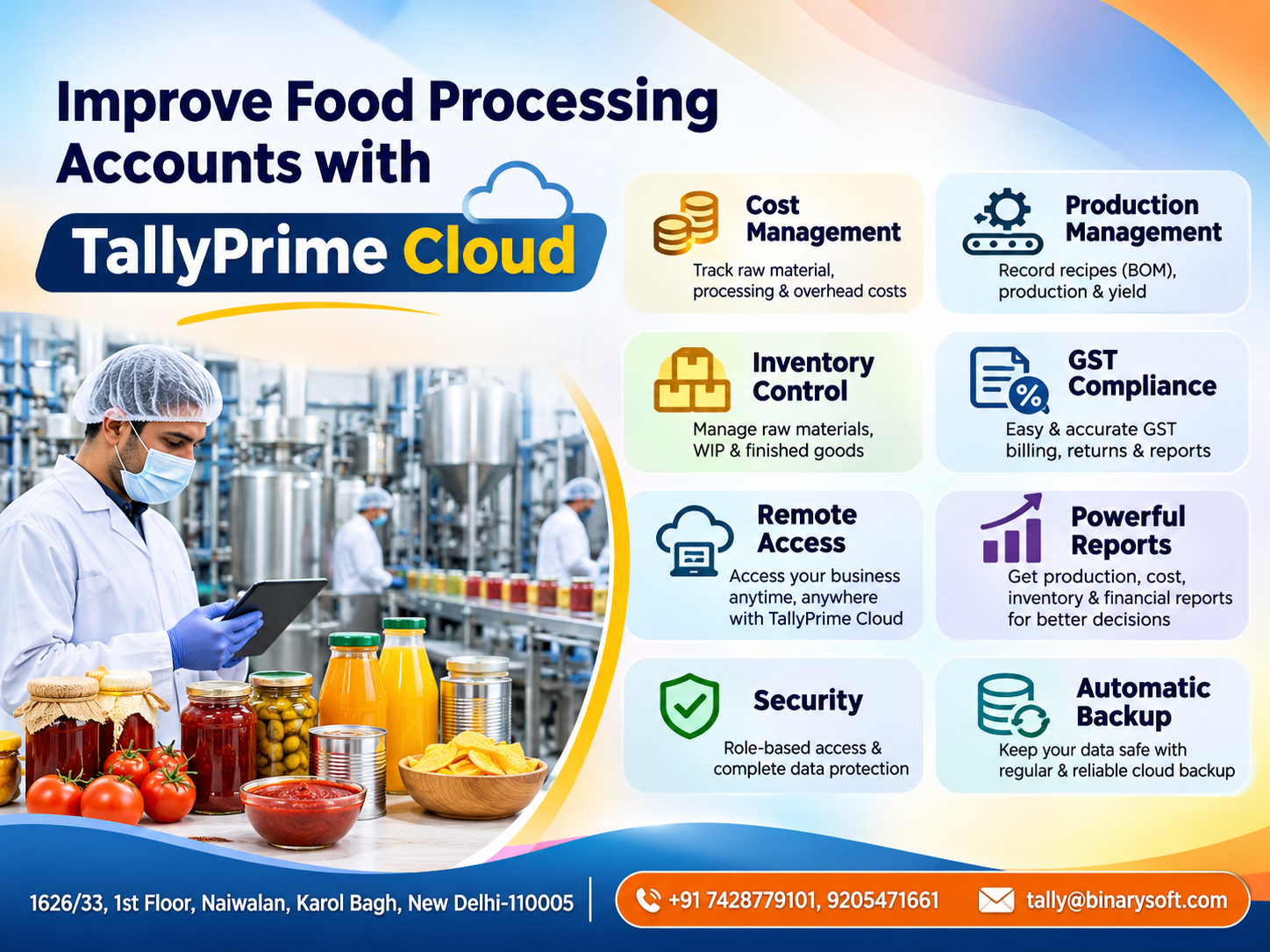
Before adopting Tally Prime Cloud hosting, businesses should understand the hosting arrangement.
Important considerations include service availability, backup frequency, data location, authorized access, security controls, support responsibilities and data retrieval procedures.
Backup and recovery arrangements
A hosting agreement should clearly explain whether backups are included, how frequently they are performed and what recovery options are available.
Businesses should also understand how they can obtain their data if they change providers.
Security responsibilities
Cloud access should use secure connections and appropriate authentication.
Employee permissions should be reviewed regularly.
Businesses should not assume that cloud hosting automatically eliminates cybersecurity risks.
Service continuity
Internet connectivity, hosting infrastructure and external service availability can affect remote operations.
Companies should maintain a practical continuity plan for important accounting activities.
8. GST Compliance and the Responsibility of the Business
Accounting software can assist with GST-related calculations, reporting and record management.
However, the business remains responsible for ensuring that its transactions are correctly recorded and applicable statutory requirements are satisfied.
Tally Prime supports GST-related accounting through configurable tax information, invoice details and reports.
How Tally Prime can help
Businesses can maintain GST registration information, relevant tax ledgers, HSN or SAC classifications and customer details.
Supported features can help calculate applicable tax amounts and organize transaction records.
Businesses can also review GST-related reports and use eligible connected functions where available.
Why verification remains essential
Incorrect master data or transaction classifications can affect accounting results even when software performs calculations correctly.
For example, an incorrect tax rate or customer registration detail may lead to an inaccurate invoice.
Accountants should review transactions, reconciliation differences and applicable reporting obligations.
Software helps manage compliance processes, but it does not replace professional judgment or statutory responsibility.
9. A Business Owner's Story: The Day Financial Records Became His Biggest Worry
The following is a fictional story illustrating the importance of responsible software management.
For eighteen years, Mohan operated a family-owned garment distribution business in Delhi.
His father had started the company with a modest investment and a small group of loyal customers.
Over time, Mohan expanded the business and employed several people.
The company's accounting software contained years of customer transactions, supplier balances and inventory records.
Mohan trusted the system completely.
But he had never paid much attention to software licensing, backup verification or user permissions.
His employees shared access credentials, and important accounting backups were stored on the same office computer.
One morning, the computer developed a serious hardware problem.
The accounting team could not access its records.
Customers were waiting for invoices, suppliers were asking about payments and employees were unsure how to continue.
Mohan immediately remembered that his daughter's college admission payment was due that week.
He had planned the payment using funds expected from several customers.
Without reliable access to outstanding balances, he struggled to confirm which collections were pending.
For the first time in years, he felt uncertain about the financial position of the business he had worked so hard to build.
With professional assistance, the company recovered usable accounting information from an available data copy, although the process required considerable verification.
The experience changed Mohan's approach.
He reviewed the company's licensing arrangements, introduced individual user access, established separate backups and documented recovery procedures.
He also trained employees to understand their responsibilities.
The business continued growing, but Mohan no longer treated accounting data protection as an optional expense.
Months later, when his daughter received her college admission confirmation, he celebrated with his family.
He understood that protecting business information was also a way of protecting the people who depended on the business.
The lesson was simple: responsible accounting is not only about recording money. It is about safeguarding years of effort, trust and opportunity.
10. Case Study One: A Wholesale Distributor Improves License and Access Management
Illustrative case study; not a verified customer testimonial.
Business background
A Delhi-based electrical goods distributor operates a warehouse and sales office.
Several employees handle invoicing, purchasing, stock records and financial reporting.
The company uses Tally Prime for its accounting operations.
Challenges
Employees previously shared login credentials, making it difficult to identify who had entered or modified transactions.
Management also lacked a documented process for reviewing software subscription requirements.
Solution
The company reviewed its licensing needs and established a clearer access-management procedure.
Individual user responsibilities were defined, relevant permissions were configured and administrative access was restricted.
Management introduced a subscription review calendar and a periodic accounting backup process.
Business outcome
The company improved accountability for accounting activities.
Employees understood their responsibilities more clearly, while management gained confidence in the internal controls surrounding financial records.
Key learning
Software licensing and access management should be treated as ongoing business responsibilities rather than one-time installation tasks.
11. Case Study Two: A Manufacturing Business Strengthens Cloud Data Protection
Illustrative case study; outcomes are hypothetical.
Business background
A small manufacturing company in Faridabad uses Tally Prime for purchase accounting, inventory management, sales and financial reporting.
Its management wanted authorized accountants to access the application from different locations.
Challenges
The company needed reliable remote access while maintaining appropriate security and backup procedures.
Management was also uncertain about the division of responsibilities between the hosting provider and its internal accounting team.
Solution
Before selecting a hosting arrangement, the company reviewed security controls, service availability, backup procedures and data retrieval options.
It established user-access policies and assigned responsibility for reviewing backups.
The company also documented procedures for handling access problems and recovering important accounting information.
Business outcome
The business gained a clearer understanding of its hosting responsibilities and established more structured operating procedures.
Management could evaluate remote access without overlooking important security and continuity considerations.
Key learning
A dependable cloud accounting arrangement requires both suitable infrastructure and clearly understood service conditions.
12. How to Use Tally Prime Responsibly: A Practical Guide
Businesses can establish reliable accounting operations by following a structured approach.
Step 1: Select an appropriate license
Evaluate user requirements, operating locations and expected transaction volumes.
Choose a license edition suitable for the intended deployment.
Step 2: Configure company information
Enter accurate business details, financial year information, accounting masters and applicable tax settings.
Review customer and supplier records carefully.
Step 3: Establish user permissions
Create suitable access controls and restrict sensitive functions to authorized employees.
Step 4: Configure accounting and inventory
Set up sales, purchases, receipts, payments, stock items and other required accounting functions.
Step 5: Implement a backup procedure
Maintain verified backups in secure locations separate from the primary accounting system.
Periodically test whether important data can be restored.
Step 6: Review GST and financial reports
Use Tally Prime reports to examine recorded transactions, tax information, outstanding balances and financial performance.
Step 7: Maintain software and security
Review applicable updates, subscription requirements, employee access and system security.
Step 8: Document operating responsibilities
Identify who manages software renewals, backups, user access, financial verification and technical support.
These practices can improve business continuity and reduce avoidable operational risks.
13. Important Terms to Review Before Purchasing Accounting Software
|
Area
|
Questions businesses should ask
|
|---|
|
Licensing
|
How many users and installations are permitted?
|
|
Subscription
|
Which benefits require an active subscription?
|
|
Updates
|
Which releases and updates are included?
|
|
Data protection
|
Who is responsible for backups and recovery?
|
|
User access
|
What security and permission controls are available?
|
|
Cloud hosting
|
What are the hosting provider's obligations?
|
|
Support
|
Which services are included and which cost extra?
|
|
Cancellation
|
What happens when a service is discontinued?
|
|
Data retrieval
|
How can business records be recovered or exported?
|
|
Liability
|
What limitations and remedies apply under the agreement?
|
These questions help businesses evaluate software and related services before making a financial commitment.
14. How Tally Prime Supports Better Business Governance
Good business governance involves maintaining reliable records, assigning responsibilities and protecting important information.
Tally Prime can support these objectives through accounting, reporting and configurable access features.
Financial transparency
Balance sheets, profit and loss statements, ledgers and transaction reports provide information for management review.
Inventory accountability
Stock records and inventory reports help businesses examine product movement and stock balances.
Customer and supplier management
Outstanding receivable and payable reports support collection planning and supplier payment decisions.
Transaction review
Proper voucher entry and record maintenance can help accountants identify discrepancies requiring investigation.
Business continuity
When combined with verified backups, access controls and suitable infrastructure, accounting software can form part of a broader continuity strategy.
The most effective results come from combining software capabilities with clear internal policies.
15. Why Choose Binarysoft Technologies for Tally Prime Assistance?
Understanding accounting software requirements can be challenging, particularly when businesses are comparing license editions, subscription options and cloud hosting arrangements.
Binarysoft Technologies, an Authorized Tally Partner, helps businesses evaluate Tally Prime solutions according to their accounting and operational needs.
Businesses can seek assistance with software licensing, installation, accounting configuration, inventory features, GST-related functionality and suitable cloud deployment options.
Guidance can also help organizations understand the practical differences between local installations and hosted accounting environments.
For companies planning to modernize their accounting systems, the objective should be to select an appropriate solution while maintaining reliable records and secure operating procedures.
16. Conclusion: Protect Your Business by Understanding Software Responsibilities
Accounting software plays a central role in modern business operations.
It helps organizations maintain financial records, manage inventory, prepare invoices and review business performance.
However, using accounting software responsibly requires more than understanding its features.
Businesses should also understand licensing requirements, subscription conditions, authorized access, data protection responsibilities and service limitations.
Tally Prime can provide a strong foundation for organized accounting when combined with appropriate licensing, accurate configuration, secure access and dependable backup procedures.
Businesses considering cloud hosting should also review the terms governing infrastructure, support, availability and data recovery.
By establishing clear responsibilities and maintaining reliable accounting practices, organizations can reduce operational uncertainty and improve long-term financial management.
For Indian businesses in 2026, understanding software terms is not merely an administrative task. It is an important part of protecting business continuity, customer trust and future growth.
Powered by Binarysoft Technologies
Authorized Tally Partner
Location: 1626/33, 1st Floor, Naiwalan, Karol Bagh, New Delhi – 110005, INDIA
Contact Us: +91 7428779101, 9205471661
Email: tally@binarysoft.com
Business Hours: 10:00 AM – 6:00 PM, Monday to Friday
Frequently Asked Questions
Can businesses change their cloud hosting provider?
This depends on the relevant hosting agreement and technical arrangements. Businesses should understand data retrieval and migration procedures before selecting a provider.
Why are regular accounting backups important?
Backups help businesses recover information following hardware failures, accidental changes, corruption or other operational incidents. Backup copies should be verified through periodic restoration testing.
Can employees have different access permissions in Tally Prime?
Yes. Supported security features allow businesses to configure user access according to operational responsibilities.
Is cloud hosting included with every Tally Prime license?
No. Cloud hosting is a separate deployment arrangement unless expressly included in a particular service package.
CA. Vihaan Taparia focuses on GST compliance, ledger reconciliation, and accounting process management. He helps trading and service businesses establish structured workflows for accurate reporting and efficient record maintenance.