Call CA Tally HelpDesk
+91 9205471661,
7428779101
What Changed in 2026: Manufacturing Profits Are Being Won or Lost in the Details
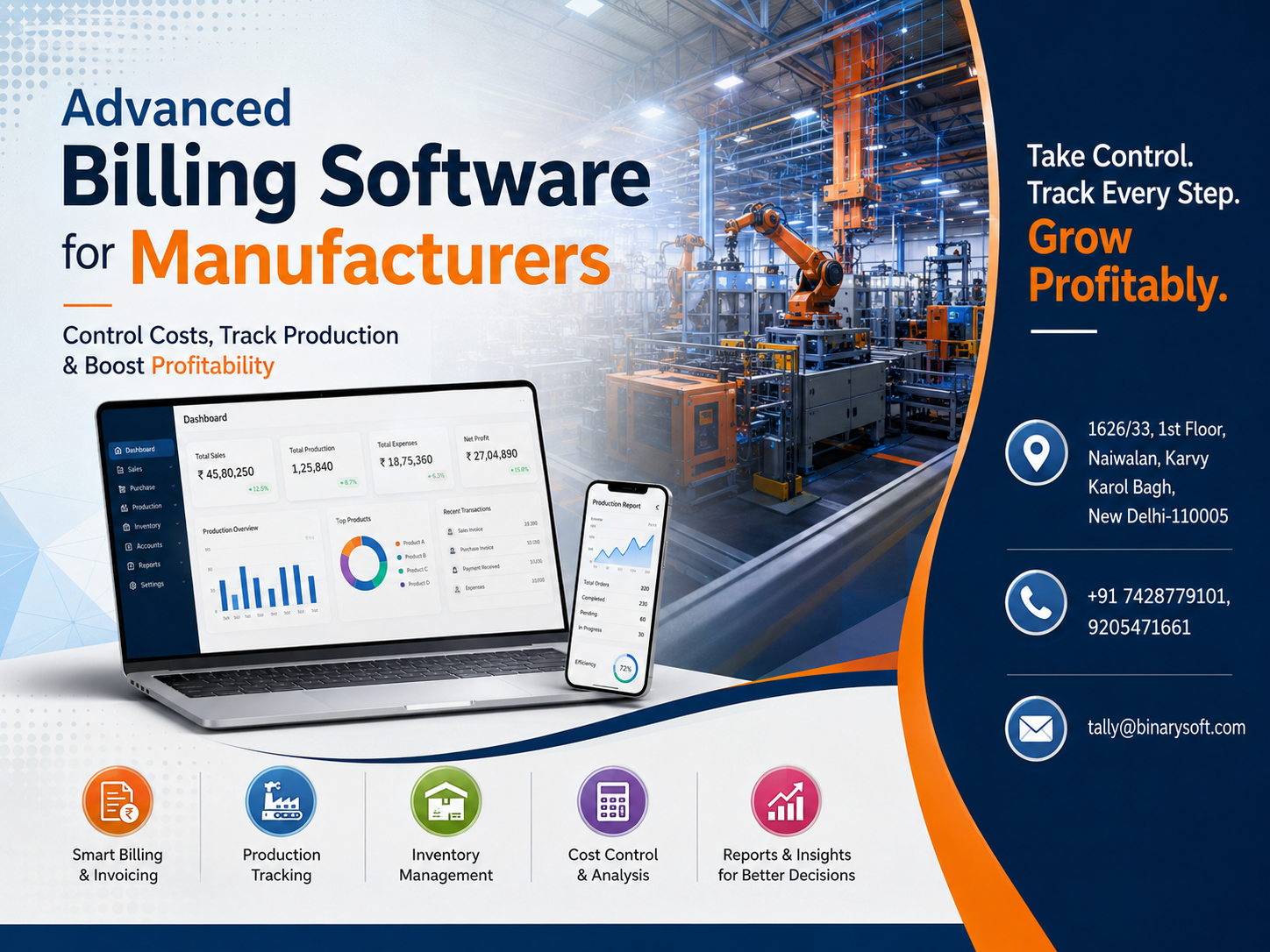
In 2026, manufacturers are under growing pressure to control production costs while managing volatile raw-material prices, tighter delivery schedules, GST compliance, inventory movement and increasingly demanding customers. In recent months, the biggest challenge has not simply been generating invoices faster—it has been knowing the true cost of every finished product before margins disappear. A manufacturer may record strong sales and still lose profitability because of excess material consumption, unplanned wastage, inaccurate stock, overlooked production expenses or delayed customer collections. Advanced billing and manufacturing accounting software can connect purchasing, inventory, production, invoicing and financial records so management can see what is happening across the business. With a properly configured TallyPrime environment, manufacturers can strengthen material tracking, structure bills of materials, record manufacturing activity, monitor costs and review profitability from connected business data—turning billing from an administrative task into a powerful management control system.
Introduction: Manufacturing Billing Is No Longer Just About Printing an Invoice
For a trading business, the basic commercial cycle can appear relatively straightforward:
Buy a product.
Store it.
Sell it.
Collect payment.
Manufacturing introduces another layer.
A manufacturer buys raw materials, consumes those materials, converts them into finished products, deals with wastage or by-products, incurs labour and overhead costs, stores finished goods and eventually sells them.
This means management needs answers to questions that ordinary invoice generation cannot provide.
How much raw material is available?
How much material is required for the next production run?
What quantity was actually consumed?
How much finished stock was produced?
Was there abnormal wastage?
What was the production cost?
What price should be charged?
Which products generate better margins?
Which customers have not paid?
What GST-related information needs attention?
How much working capital is locked in inventory?
Advanced manufacturing billing software should help connect these questions rather than treating billing, production and accounting as completely separate activities.
For many Indian manufacturers, TallyPrime can form an important part of this connected business-management environment when configured according to the actual production workflow.
A Manufacturer's Story: The Factory Was Busy, but the Profit Was Shrinking
Consider a fictional small manufacturing company producing electrical components.
Orders were growing.
Machines were running for longer hours.
Workers were busy.
Dispatches were increasing.
The owner felt confident that the company was moving in the right direction.
Then the accountant presented the periodic financial numbers.
Profit had fallen.
The owner was surprised.
"How can profit fall when we are manufacturing and selling more?"
The first suspicion was the selling price.
Then they looked deeper.
Raw-material prices had increased several times, but selling prices had not been reviewed systematically.
Certain components were being consumed in greater quantities than expected.
Production wastage was recorded inconsistently.
Some material issued to production was not reflected properly in stock records.
Freight and other indirect costs had increased.
Several customers were also taking longer to pay.
The factory was producing more, but management did not have enough visibility into what each unit was actually costing.
The company reorganized its inventory and accounting workflow.
Raw materials and finished goods were standardized.
Bills of materials were reviewed.
Production quantities were recorded more systematically.
Purchase costs were monitored.
Receivables were reviewed regularly.
Management began comparing estimated material requirements with actual consumption.
A few months later, the owner noticed something important.
One high-volume product that everyone considered successful was producing a much weaker margin than expected.
The company revised its pricing and purchasing strategy.
That single insight changed the owner's approach to accounting.
The question was no longer:
"How much did we sell?"
It became:
"How much did we earn after understanding what it really cost us to produce and sell?"
That is the difference advanced manufacturing information can make.
What Is Advanced Billing Software for Manufacturers?
Manufacturing billing software is a business system designed to handle invoicing together with the financial and operational information surrounding manufacturing.
Depending on the software and configuration, manufacturers may need capabilities relating to:
- Sales invoicing
- Purchase recording
- GST accounting
- Inventory management
- Raw-material tracking
- Finished-goods tracking
- Bills of materials
- Manufacturing entries
- Stock locations
- Customer receivables
- Supplier payables
- Expense accounting
- Cost analysis
- Financial reporting
- E-Invoice-related workflows where applicable
- E-Way Bill-related workflows where applicable
The objective is integration.
Instead of maintaining production in one spreadsheet, inventory in another file, billing in separate software and accounting somewhere else, an integrated workflow can reduce duplication and improve visibility.
Why Manufacturers Need More Than Basic Billing Software
Basic billing software may successfully create an invoice containing:
Customer name
Product
Quantity
Rate
Tax
Total amount
But manufacturing management requires much more.
Imagine a finished product selling for ₹5,000.
Management needs to understand the economic structure behind that ₹5,000.
Raw materials: ₹2,100
Packaging: ₹150
Direct labour allocation: ₹450
Production overhead: ₹350
Freight or handling: ₹100
Other relevant costs: ₹150
Total indicative cost: ₹3,300
Selling price: ₹5,000
The apparent difference is ₹1,700 before considering other applicable costs and accounting factors.
Now suppose raw-material prices rise by 12%.
If management continues using the old selling price without understanding the cost impact, profitability can deteriorate quietly.
That is why cost visibility matters.
TallyPrime for Manufacturing Businesses
TallyPrime provides accounting and inventory capabilities that can support many manufacturing workflows when properly configured.
Depending on business requirements, manufacturers can use relevant functionality for:
- Accounting
- Purchases
- Sales
- Inventory
- Stock items
- Stock groups
- Units
- Godowns or locations
- Bill of Materials
- Manufacturing-related stock entries
- Receivables
- Payables
- GST
- Financial reports
The exact configuration should reflect the manufacturer's production process rather than using a generic setup for every company.
Build the Correct Manufacturing Master Structure
Before recording production, businesses should build accurate masters.
Poor master creation is one of the most common causes of unreliable inventory reports.
Manufacturing masters may broadly involve:
Raw Materials
These are materials consumed during production.
Examples could include:
Steel Sheet
Aluminium Coil
Copper Wire
Plastic Granules
Chemical A
Packaging Material
Work-in-Process
Depending on the manufacturing and accounting process, some businesses may need to monitor materials or products at intermediate stages.
Finished Goods
These are completed products ready for sale.
Examples:
Finished Component A
Finished Assembly B
Packaged Product C
Consumables
Factories may use consumable items that support manufacturing but do not necessarily form the primary physical component of the finished product.
Scrap or By-Products
Where relevant, scrap and by-products should be considered in the inventory design.
The appropriate treatment depends on the production and accounting requirements of the company.
Stock Groups: Organize Manufacturing Inventory
Manufacturers can have hundreds or thousands of inventory items.
A logical Stock Group structure can make inventory easier to understand.
For example:
Raw Materials
Packaging Materials
Consumables
Semi-Finished Goods
Finished Goods
Scrap
Within Raw Materials, a manufacturer may create additional categories if required.
The structure should be meaningful without becoming unnecessarily complicated.
Stock Items: Standardization Is Critical
Duplicate stock items can create serious inventory confusion.
Suppose employees create:
SS Sheet 2MM
SS 2 MM Sheet
Stainless Steel Sheet 2mm
If these represent the same material, inventory can become divided among multiple records.
Management may think only 500 kg is available when another 700 kg is recorded under a different item name.
A standardized naming convention should therefore be established before large volumes of data are entered.
Units of Measure
Correct units are essential in manufacturing.
Common units may include:
Kg
Gram
Litre
Metre
Nos
Box
Pack
Dozen
Ton
The unit should reflect how the material is purchased, consumed, stored and sold.
Poor unit configuration can make production quantities difficult to interpret.
Godown and Location Management
A manufacturing company may hold inventory across several physical areas.
For example:
Raw Material Store
Production Floor
Finished Goods Warehouse
Packaging Store
Factory Warehouse
Secondary Warehouse
Location-wise inventory tracking can improve visibility into where material is held.
This can be especially useful for manufacturers operating multiple stores, factories or warehouses.
Bill of Materials: The Blueprint Behind Production
A Bill of Materials, commonly called BOM, defines the materials required to manufacture a product.
Suppose a company manufactures Product X.
Its indicative BOM might require:
Component A – 2 Nos
Component B – 1 No
Raw Material C – 3 Kg
Packaging Box – 1 No
Label – 1 No
The BOM provides a standard material requirement for producing the finished item.
This can help businesses structure manufacturing records and understand expected material consumption.
Why BOM Accuracy Matters
A BOM should reflect the actual production process as closely as practical.
If the BOM says 5 kg of material is required but the factory routinely consumes 5.8 kg, management needs to understand why.
Possible causes may include:
Production loss
Material quality
Machine efficiency
Incorrect standard quantity
Operator practices
Scrap
Measurement errors
Product-design changes
A BOM should therefore not be treated as something created once and forgotten forever.
Manufacturers should review it when production specifications or material requirements change.
Production Tracking
Manufacturers need visibility into the relationship between materials consumed and goods produced.
For example:
Raw material issued: 1,000 kg
Expected production: 950 units
Actual production: 910 units
Scrap: 35 kg
Unexplained difference: requires investigation
Without production records, such differences can disappear into inventory adjustments.
Regular recording makes production variance easier to identify.
Raw-Material Consumption Control
Raw material is often one of the largest cost components in manufacturing.
Even a small percentage of excess consumption can materially affect profit.
Consider a company consuming ₹50 lakh of material annually.
If preventable excess consumption represents only 2%, that is ₹1 lakh of additional cost.
At larger manufacturing volumes, the impact becomes much greater.
Management should therefore monitor material consumption rather than relying exclusively on purchase totals.
Wastage and Scrap Management
Not all input becomes finished output.
Manufacturing may naturally generate:
Scrap
Cutting loss
Evaporation
Breakage
Rejected material
Defective output
Production residue
Some wastage may be normal.
Some may indicate inefficiency.
The key is visibility.
If management does not record or review wastage, it cannot determine whether losses are acceptable or increasing.
Purchase Management for Manufacturers
Production depends heavily on timely purchasing.
A shortage of one inexpensive component can stop production of a high-value finished product.
Purchase records should therefore provide clarity on:
Supplier
Material
Quantity
Rate
Taxes
Payment terms
Outstanding liability
Manufacturers can use this information alongside stock information for better procurement planning.
Supplier Price Comparison
Material prices can change quickly.
Suppose the same raw material is purchased at:
Supplier A: ₹102/kg
Supplier B: ₹99/kg
Supplier C: ₹105/kg
The lowest price is not automatically the best option because quality, credit terms, freight and reliability also matter.
However, historical purchase information gives management a stronger basis for supplier negotiations.
Sales Billing for Finished Goods
Once production is complete, finished goods enter the sales cycle.
A sales invoice may need relevant information such as:
Customer details
Product description
Quantity
Rate
Discount
Tax details
Delivery information
Payment terms
Other applicable commercial information
Accurate invoicing improves accounting and customer communication while feeding sales information into the company's books.
GST Billing for Manufacturers
Manufacturers registered under GST need their transaction records to support applicable compliance requirements.
Depending on the transaction, GST-related information may involve:
GSTIN
Place of supply
HSN
Taxable value
Applicable GST rate
CGST
SGST
IGST
Credit/debit notes
Input tax-related records
Businesses should ensure GST configurations and transaction treatment are reviewed according to current law and their specific circumstances.
For tax interpretation, manufacturers should consult their Chartered Accountant or tax professional.
E-Invoicing
Where e-invoicing requirements apply to a business, the billing workflow needs to support the applicable statutory process.
Applicability can depend on prevailing government rules, turnover criteria and other conditions.
Because thresholds and requirements can change, manufacturers should verify current applicability instead of relying on outdated information.
E-Way Bill Requirements
Movement of goods may also require an E-Way Bill in applicable circumstances.
Manufacturers dispatching finished products across locations should maintain accurate invoice and transportation information.
Again, current statutory requirements should always be verified before implementation.
Customer Receivables: Sales Are Not Cash
A manufacturer can report excellent sales while facing severe cash-flow pressure.
The reason is simple.
Customers have not paid.
Consider:
Monthly sales: ₹50 lakh
Customer outstanding: ₹85 lakh
Supplier payments due: ₹35 lakh
Salary and factory expenses: ₹12 lakh
Loan repayment: ₹5 lakh
Strong sales figures do not automatically solve the cash problem.
Receivables need active management.
Bill-Wise Outstanding Tracking
Invoice-level outstanding information helps management identify exactly which customer invoices remain unpaid.
Instead of seeing:
ABC Industries – ₹12,50,000 outstanding
Management can review the individual invoices contributing to that amount.
This improves collection follow-up and credit decisions.
Receivable Ageing
Ageing analysis can help divide receivables according to how long they have remained unpaid.
For example:
0–30 days
31–60 days
61–90 days
Above 90 days
A ₹10 lakh outstanding amount due recently is very different from ₹10 lakh that has remained unpaid for six months.
Ageing gives context to the number.
Supplier Payables
Manufacturers must also manage outgoing payments carefully.
Payable information helps management understand:
Which suppliers need payment?
How much is due?
When is it due?
Which invoices remain unpaid?
Are there supplier advances?
Proper payable management supports both cash-flow planning and supplier relationships.
Cost Control Starts with Accurate Accounting
Manufacturing cost is not limited to raw material.
Other expenses can include:
Factory rent
Electricity
Fuel
Labour
Machine repairs
Maintenance
Packaging
Freight
Quality testing
Insurance
Depreciation
Administrative expenses
Finance costs
Professional fees
When these expenses are recorded systematically, management can better understand where money is being spent.
Direct and Indirect Costs
Manufacturers may need to distinguish between costs directly associated with production and general overhead expenses.
The exact classification should follow appropriate accounting practices and the company's reporting requirements.
The objective is to understand how costs influence profitability.
Product Costing
One of the most valuable manufacturing questions is:
"What does one unit actually cost us?"
The answer may require considering:
Material cost
Labour
Machine-related cost
Power
Packaging
Production overhead
Wastage
Other relevant allocations
The appropriate costing method depends on the manufacturing operation.
TallyPrime can provide accounting and inventory information that contributes to management's costing analysis, while specialized costing requirements may require additional processes or solutions.
Pricing Decisions
Selling price should not be based solely on competitor pricing.
Manufacturers need to understand their cost structure.
Suppose:
Estimated product cost = ₹720
Selling price = ₹800
Apparent margin = ₹80
Now material cost increases by ₹45.
Freight increases by ₹10.
Packaging increases by ₹5.
New cost = ₹780
The apparent margin falls to ₹20.
If management does not review costs, a product can remain popular while becoming increasingly unprofitable.
Profitability Analysis
Profitability should be reviewed at multiple levels where appropriate.
Management may want to analyze:
Overall company profitability
Product-category performance
Customer profitability
Location performance
Departmental costs
Production-related expenses
Period-to-period changes
Better accounting data provides a foundation for these decisions.
Cost Centres for Manufacturing Analysis
Cost Centres can be useful when businesses want to analyze income or expenses across specific operational areas.
Possible examples include:
Plant 1
Plant 2
Production Department
Packaging Department
Maintenance Department
Sales Division
Project A
Project B
The exact design depends on management's reporting needs.
Avoid creating unnecessary cost centres simply because the feature exists.
Financial Reports Manufacturers Should Monitor
Profit & Loss Account
Shows income and expenses over a period and helps management assess overall profitability.
Balance Sheet
Provides visibility into assets, liabilities and the financial position of the business.
Trial Balance
Helps accountants review ledger balances and identify unusual classifications or balances requiring investigation.
Stock Reports
Help management understand inventory quantities and values based on recorded information and configuration.
Receivables
Show customer amounts outstanding.
Payables
Show supplier obligations.
Cash and Bank Information
Helps management understand available liquidity and transaction movement.
Daily Manufacturing Accounting Workflow
A disciplined daily routine can include:
Morning
Review material availability for important production requirements.
Purchasing
Record relevant purchases promptly.
Material Movement
Record stock movements according to the company's process.
Production
Record applicable manufacturing activity and output.
Sales
Generate accurate invoices for dispatches.
Collections
Record customer receipts against appropriate accounts.
Payments
Record supplier and expense payments.
End of Day
Review significant transactions, cash, bank activity and pending entries.
This keeps reports closer to operational reality.
Weekly Management Review
Every week, management can review important indicators such as:
Sales
Production output
Material consumption
Stock availability
Customer outstanding
Supplier outstanding
Major expenses
Cash and bank position
Delayed collections
Slow-moving stock
Production issues
This provides a practical connection between accounting and factory operations.
Monthly Manufacturing Review
A stronger month-end process can include:
- Complete purchase entries.
- Complete sales entries.
- Review production records.
- Review raw-material consumption.
- Verify significant inventory balances.
- Review customer receivables.
- Review supplier payables.
- Reconcile bank accounts.
- Review expenses.
- Check unusual ledger balances.
- Review GST-related information.
- Review Trial Balance.
- Review Profit & Loss Account.
- Review Balance Sheet.
- Compare actual results with the previous month.
- Investigate significant cost changes.
- Review product pricing where required.
The goal is to identify issues while there is still time to act.
Inventory Control and Working Capital
Inventory represents money.
₹20 lakh of unnecessary stock is not merely a warehouse issue.
It is ₹20 lakh of working capital tied up in material.
Excess inventory can create:
Storage cost
Damage risk
Obsolescence
Cash-flow pressure
Insurance cost
Handling expenses
At the same time, insufficient inventory can stop production.
Manufacturers therefore need a balance between availability and working-capital efficiency.
Slow-Moving and Non-Moving Stock
Materials can remain unused because of:
Product changes
Over-purchasing
Demand reduction
Customer cancellation
Incorrect forecasting
Design modifications
Regular inventory review helps management identify such items before they become obsolete.
Minimum Stock Planning
Manufacturers should identify materials that are critical to production.
Running out of a ₹50 component could prevent the shipment of a ₹10,000 finished product.
Stock planning should therefore consider:
Consumption rate
Supplier lead time
Production schedule
Order pipeline
Safety requirements
Storage capacity
Working capital
Software data can support this process, while procurement decisions remain a management responsibility.
Multiple Warehouses and Factory Locations
Growing manufacturers may operate:
Factory
Raw Material Warehouse
Finished Goods Warehouse
Job Work Location
Regional Warehouse
Dispatch Centre
Proper location-wise inventory tracking can improve control across these operations.
Management should know not just total stock but where that stock is physically expected to be.
Preventing Negative Stock and Inventory Errors
Inventory errors commonly occur when:
Purchases are entered late.
Production entries are missing.
Wrong stock items are selected.
Units are inconsistent.
Sales are entered before corresponding stock activity is recorded.
Duplicate items exist.
Material transfers are not recorded.
Regular stock review and disciplined entry procedures can reduce these problems.
User Access and Internal Control
Not every employee needs unrestricted access to every part of the accounting system.
A manufacturing business may have:
Billing staff
Store personnel
Accounts team
Purchase team
Management
Administrator
Access should be designed according to responsibilities and operational requirements.
Internal control becomes increasingly important as the company grows.
Data Backup
Accounting and inventory data represents years of business activity.
Manufacturers should maintain appropriate backups and ensure those backups are stored securely.
Backup procedures should be tested periodically.
A backup that has never been tested may not provide the protection management expects.
Common Manufacturing Accounting Mistakes
Incorrect BOM
An outdated Bill of Materials can produce misleading consumption expectations.
Duplicate Stock Items
Duplicate masters divide inventory quantities and values.
Delayed Production Entries
Late entries make real-time stock information unreliable.
Ignoring Wastage
Unrecorded or unexplained wastage can hide production inefficiencies.
Poor Expense Classification
Incorrect classification makes cost analysis difficult.
No Receivable Follow-Up
Profit recorded in books does not provide cash until customers pay.
Failure to Reconcile Banks
Unreconciled bank records can hide missing or incorrectly recorded transactions.
Mixing Production and Inventory Processes
Material movement should follow a defined workflow so users know exactly how transactions must be recorded.
Signs Your Manufacturing Business Has Outgrown Basic Billing
A manufacturer should consider improving its business system when:
Sales and inventory figures frequently disagree.
Management cannot determine material availability quickly.
Production consumption is unclear.
The same stock item appears multiple times.
Invoices are generated separately from accounting.
Customer outstanding reports are unreliable.
Supplier balances require manual calculation.
Profitability is understood only at year-end.
Pricing decisions are based mainly on guesswork.
Production staff and accounts staff maintain different versions of the same information.
These are often process problems as much as software problems.
How to Implement TallyPrime for Manufacturing
A structured implementation can follow several stages.
Stage 1: Understand the Production Process
Document how materials enter, move through production and become finished goods.
Stage 2: Review Existing Data
Identify customers, suppliers, materials, products, units, warehouses and opening balances.
Stage 3: Design Masters
Create standardized Groups, Ledgers, Stock Groups and Stock Items.
Stage 4: Configure Inventory
Set appropriate units, locations and other inventory requirements.
Stage 5: Build BOMs
Create and verify material structures for applicable finished products.
Stage 6: Configure Accounting
Set up sales, purchases, expenses, banks, customers, suppliers and relevant tax information.
Stage 7: Define Production Entry Procedures
Staff should understand how manufacturing transactions will be recorded.
Stage 8: Train Users
Accounts, stores and billing staff should follow consistent processes.
Stage 9: Verify Reports
Review stock, outstanding amounts, Trial Balance and financial statements.
Stage 10: Introduce Management Reviews
Establish daily, weekly and monthly review routines.
Why Employee Training Is Essential
The quality of software reports depends on the quality of information entered.
A sophisticated system cannot compensate indefinitely for poor processes.
Employees should understand:
Which stock item to select
Which unit to use
How purchases are recorded
How production is recorded
How sales are entered
How receipts are adjusted
How corrections should be handled
Who can create new masters
When management approval is required
Training reduces errors and improves consistency.
How Advanced Billing Can Improve Profitability
Software does not create profit automatically.
It improves the information management uses to protect profit.
Better information can help businesses:
Reduce avoidable material loss.
Identify cost increases earlier.
Improve pricing decisions.
Control unnecessary expenses.
Improve customer collection follow-up.
Avoid excessive inventory.
Plan supplier payments.
Compare business performance.
Identify unusual stock movement.
Understand financial performance more frequently.
Each improvement may appear small individually.
Together, they can significantly strengthen business control.
From Invoice Software to Manufacturing Intelligence
The most important shift for manufacturers in 2026 is conceptual.
Do not ask only:
"Can the software generate GST invoices?"
Ask:
Can we understand material consumption?
Can we track finished stock?
Can we monitor customer outstanding?
Can we see supplier liabilities?
Can we review our expenses?
Can we identify cost pressure?
Can we understand profitability?
Can management access useful financial information without waiting until year-end?
That is the difference between basic billing and a more integrated manufacturing accounting system.
Why Choose TallyPrime for a Growing Manufacturing Business?
TallyPrime is widely used by Indian businesses for accounting and related business processes.
For manufacturers, its value can come from connecting important business records within a structured environment.
Depending on configuration and business needs, this may include:
Accounting
Inventory
Purchasing
Sales
Manufacturing-related stock records
BOM
Receivables
Payables
GST-related functionality
Financial reporting
The implementation should be designed according to the actual business rather than copied from another company.
How Binarysoft Technologies Can Help Manufacturers
Implementing manufacturing accounting requires more than installing software.
The first step should be understanding how the factory operates.
Binarysoft Technologies, an Authorized Tally Partner, can assist businesses with TallyPrime-related requirements including licensing, implementation, configuration, training and support.
A professional implementation may involve reviewing:
Existing accounting workflow
Product and material structure
Stock Groups
Stock Items
Units
Godowns
Bills of Materials
Purchase processes
Sales processes
Customer ledgers
Supplier ledgers
Expense structure
GST-related configuration
User workflow
Reporting requirements
The objective is to create a practical TallyPrime environment that employees can use consistently and management can rely upon.
Conclusion
Advanced billing software for manufacturers should do much more than print professional invoices.
Manufacturing profitability depends on understanding the complete journey of money and materials—from purchasing raw materials to production, inventory, finished-goods sales and final customer collection.
A factory can be busy and still lose money.
Sales can rise while margins decline.
Production can increase while cash flow becomes weaker.
Inventory can grow while working capital disappears.
That is why manufacturers need connected financial and operational information.
With a properly planned TallyPrime setup, businesses can strengthen accounting, organize inventory, structure Bills of Materials, record manufacturing activity, monitor receivables and payables, review expenses and obtain financial reports from a connected data environment.
The greatest benefit is visibility.
When manufacturers know what they are buying, consuming, producing, selling, spending, collecting and owing, management can make faster and better-informed decisions.
In 2026, controlling manufacturing costs is increasingly about identifying small inefficiencies before they become large losses. Better accounting and inventory information gives management the opportunity to do exactly that.
Frequently Asked Questions
What is advanced billing software for manufacturers?
It is a business solution that combines invoicing with relevant accounting, inventory, purchasing, production and financial-management processes rather than handling invoices alone.
Can TallyPrime be used by manufacturing companies?
Yes. TallyPrime provides accounting and inventory capabilities that can support various manufacturing workflows when appropriately configured.
CA. Rohin Mehtaal is a Chartered Accountant with experience in accounting systems, audit support, and GST compliance. He has assisted businesses in adopting structured financial processes and improving inventory accuracy. His writing emphasizes clarity, control, and data-driven decision making.