Call CA Tally HelpDesk
+91 9205471661,
7428779101
What Changed in 2026? Why Traders Should Prepare for GSTR-9 Before the Year Ends
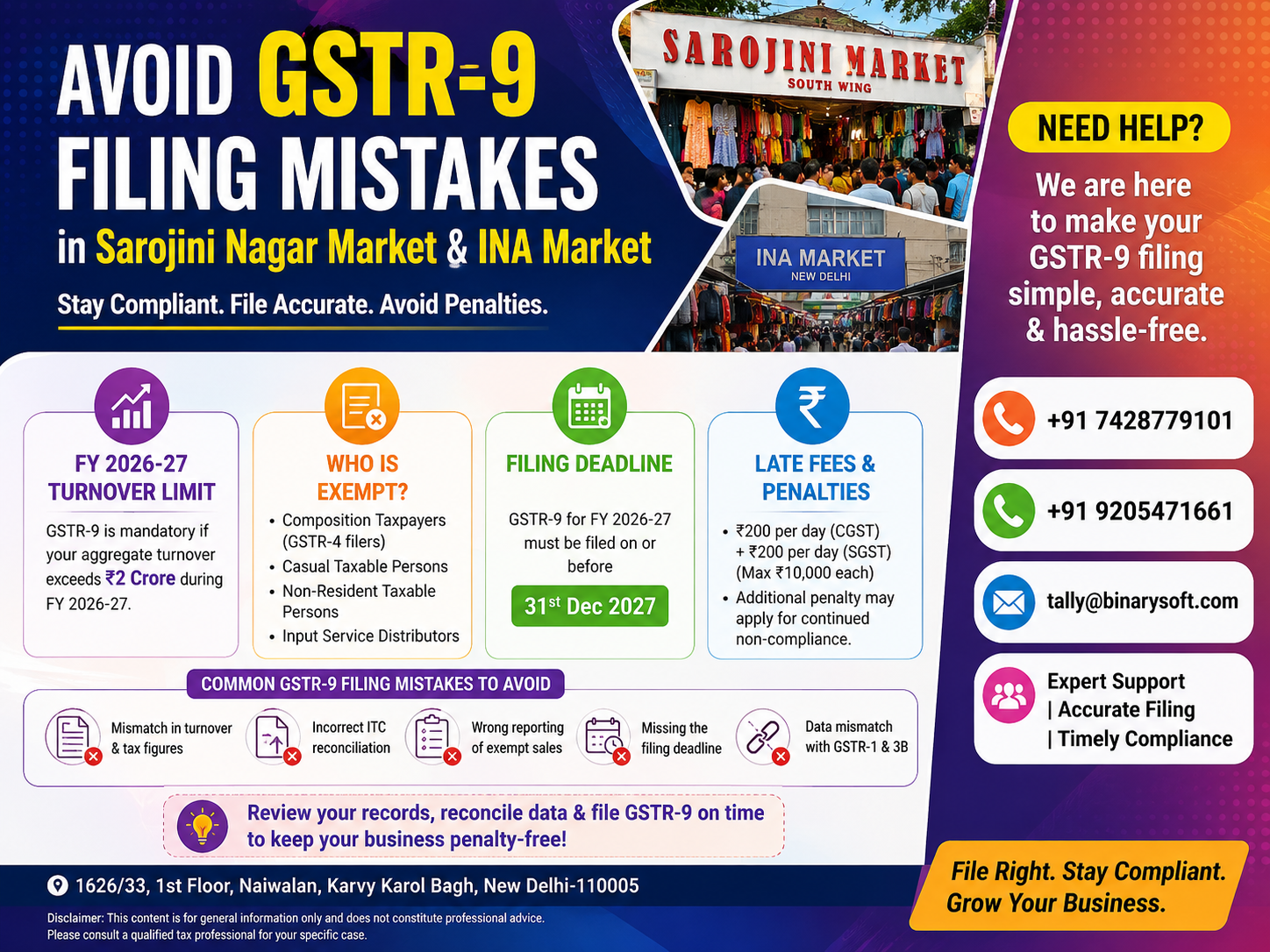
In 2026, GST compliance is increasingly about consistency between books, GSTR-1, GSTR-3B, Input Tax Credit records and annual-return figures—not simply filing another form at year-end. For busy traders in Sarojini Nagar Market and INA Market, where hundreds of purchases, sales, returns, discounts and credit notes can be recorded every month, even a small recurring mismatch can become a significant reconciliation problem by March 2027. The biggest mistake is assuming that last year's GSTR-9 exemption or turnover threshold will automatically apply to FY 2026-27. Businesses near important turnover limits should therefore maintain GSTR-9-ready records throughout the year and verify the notification applicable to FY 2026-27 before claiming an exemption. Early reconciliation can identify incorrect GST rates, missing invoices, ITC differences, turnover mismatches and HSN errors while there is still time to investigate them—reducing December pressure and helping businesses approach annual GST compliance with cleaner, better-organised data.
GSTR-9 Compliance Matters for Sarojini Nagar Market and INA Market Businesses
Sarojini Nagar Market and INA Market are two of South Delhi's busiest commercial destinations, but their business environments can create very different accounting challenges.
Sarojini Nagar Market is strongly associated with garments, fashion accessories, footwear, household products and high-volume retail transactions. INA Market, meanwhile, includes businesses dealing in food products, groceries, imported products, household items and numerous other categories.
For GST-registered traders operating in these markets, daily transactions may include:
- B2B and B2C sales
- Cash, UPI, card and other digital receipts
- Local and interstate purchases
- Interstate outward supplies
- Credit and debit notes
- Sales returns
- Purchase returns
- Discounts
- Multiple GST rates
- Input Tax Credit
- Exempt and taxable supplies
- E-commerce transactions
- HSN-wise product information
- Vendor advances
- Reverse-charge transactions, where applicable
A mistake repeated over twelve months can eventually affect annual reconciliation.
That is why businesses should not think about GSTR-9 only when the filing deadline approaches.
What Is GSTR-9?
GSTR-9 is the annual GST return prescribed for applicable registered taxpayers.
Section 44 of the CGST Act provides for furnishing the annual return by registered persons, subject to specified statutory exclusions and exemptions or relaxations provided under the law.
The annual return essentially brings together important GST information reported during the financial year.
It provides an opportunity to review the annual position relating to areas such as outward supplies, tax liability, Input Tax Credit and other applicable GST particulars.
GSTR-9 should therefore be viewed as an annual consolidation and reconciliation exercise rather than simply another GST form.
FY 2026-27 GSTR-9 Turnover Limit: An Important Warning
One of the most searched questions among traders is:
What is the GSTR-9 turnover limit for FY 2026-27?
This requires careful treatment.
Businesses should not automatically assume that a turnover-based exemption available for an earlier financial year has already become applicable to FY 2026-27.
Historically, exemptions from filing the annual return for taxpayers up to a specified turnover have been provided through notifications applicable to particular financial years.
Therefore, as of September 1, 2026, businesses should verify the notification specifically applicable to FY 2026-27 before treating a ₹2 crore or any other turnover-based exemption as final.
This matters because FY 2026-27 is still underway and will end only on 31 March 2027.
The practical strategy for Sarojini Nagar and INA Market traders is straightforward:
Maintain records as though annual reconciliation will be required, and determine the final filing requirement after checking the notification applicable to FY 2026-27.
Do Not Confuse GSTR-9 with GSTR-9C
This is another common GST compliance mistake.
GSTR-9 and GSTR-9C are connected, but they are not the same form.
GSTR-9 is the annual return.
GSTR-9C is the self-certified reconciliation statement applicable when the prescribed turnover threshold is crossed.
Under the current Rule 80 framework, a registered person whose aggregate turnover during a financial year exceeds ₹5 crore is required to furnish the self-certified reconciliation statement in Form GSTR-9C along with the annual return.
Businesses should continue checking for amendments applicable to FY 2026-27 before filing.
Understanding Aggregate Turnover Correctly
Turnover calculation itself can cause mistakes.
Under the GST framework, aggregate turnover is broadly calculated on an all-India PAN basis and includes taxable supplies, exempt supplies, exports and interstate supplies, while excluding GST/cess and specified inward supplies liable to reverse charge.
This is important for a business operating more than one GST registration.
Suppose a trader operates one establishment in Delhi and another GST-registered establishment elsewhere under the same PAN.
Looking only at the turnover of the Sarojini Nagar shop can potentially give the business an incorrect picture of aggregate turnover.
Always calculate aggregate turnover in accordance with the GST definition rather than relying only on one shop, branch or GSTIN's sales figure.
Who Is Generally Excluded from the GSTR-9 Requirement?
Section 44 contains specified categories that are outside the general annual-return requirement, including:
- Input Service Distributor
- Persons required to deduct tax under Section 51
- Persons required to collect tax under Section 52
- Casual taxable persons
- Non-resident taxable persons
In addition, exemptions can be provided for specified classes of registered persons.
Therefore, a trader should determine applicability using both the statutory provisions and the notification applicable to the particular financial year.
Do not decide applicability merely on the basis of something that applied last year.
GSTR-9 Due Date for FY 2026-27
Under the general statutory framework, the annual return is due on or before 31 December following the end of the relevant financial year.
FY 2026-27 ends on:
31 March 2027
Therefore, the general statutory due date would be:
31 December 2027
This should be treated as the normal deadline unless the government subsequently extends or otherwise modifies the applicable timeline.
Waiting until December 2027 to begin reconciliation would nevertheless be a poor strategy.
Businesses should begin preparing much earlier.
A Sarojini Nagar Trader's December Problem: A Story Many Businesses Will Recognise
Imagine a garment trader named Rajiv operating a busy shop in Sarojini Nagar Market.
Throughout the year, his staff handled hundreds of transactions every week.
During festival seasons, sales increased dramatically.
Invoices were generated quickly. Customers returned products. Suppliers issued credit notes. Some purchases were recorded late. A few GSTINs were entered incorrectly.
Rajiv believed everything could be corrected when his accountant prepared the annual return.
Then came year-end reconciliation.
The sales figure in his books did not align neatly with the outward supplies reported through GST returns.
Several credit notes required investigation.
Some purchase invoices appearing in the accounting records required ITC verification.
His accountant started asking for invoices from months earlier.
Rajiv opened old files, WhatsApp conversations and supplier emails searching for documents.
The business was running, customers were waiting, and suddenly accounting records from months earlier demanded immediate attention.
His biggest frustration was simple:
"Why didn't we check this every month?"
That question captures one of the biggest lessons of annual GST compliance.
The problem often isn't created in December.
It accumulates quietly throughout the financial year.
Had Rajiv performed monthly reconciliation, each discrepancy could have been investigated when the transaction was still fresh.
For another trader in INA Market, the same problem might involve grocery products, imported goods, different tax rates, purchase returns or large numbers of supplier invoices.
The products may change.
The lesson doesn't:
Clean annual GST compliance starts with disciplined daily accounting.
12 GSTR-9 Filing Mistakes Sarojini Nagar and INA Market Traders Should Avoid
1. Assuming the ₹2 Crore Exemption Automatically Applies
This could become one of the most important mistakes for FY 2026-27.
A threshold applicable to an earlier year should not automatically be treated as the final exemption for FY 2026-27.
Check the notification specifically applicable to the financial year.
2. Confusing GSTR-9 and GSTR-9C Thresholds
The two forms have different purposes.
Under the presently applicable framework, GSTR-9C is relevant when aggregate turnover exceeds ₹5 crore.
Do not use the GSTR-9C threshold to determine whether GSTR-9 itself applies.
3. Calculating Turnover GSTIN-Wise Instead of PAN-Wise
Aggregate turnover under GST has an all-India dimension.
Businesses with multiple registrations should be particularly careful.
Do not look at only one Delhi shop's turnover and conclude that you are below a threshold.
4. Ignoring Differences Between GSTR-1 and GSTR-3B
GSTR-1 reports outward supply details, while GSTR-3B contains the summary return and tax-payment information.
Differences can arise because of:
Late invoices
Incorrect tax rates
Missed credit notes
Amendments
Wrong reporting periods
Data-entry mistakes
These differences should be reconciled systematically.
5. Treating Books of Accounts and GST Returns as Separate Systems
Your accounting records and GST filings should tell a consistent financial story.
Large unexplained differences between turnover in books and GST returns can complicate annual reconciliation.
Monthly comparison can reduce this problem.
6. Ignoring Credit Notes and Debit Notes
Retail businesses frequently deal with product returns, price adjustments and supplier corrections.
Credit and debit notes should be properly accounted for and reviewed in the appropriate GST context.
7. Claiming ITC Without Proper Reconciliation
Input Tax Credit is one of the most sensitive areas of GST compliance.
Businesses should review purchase records and applicable GST data instead of assuming every GST amount recorded in the purchase ledger automatically qualifies as credit.
Check:
Supplier GSTIN
Invoice number
Invoice date
Taxable value
GST amount
Eligibility
Applicable restrictions
Relevant GST statement information
8. Incorrect HSN Classification
Markets such as Sarojini Nagar can contain a wide variety of merchandise.
INA Market traders may deal with an equally diverse mix of food and consumer products.
Incorrect HSN classification can lead to incorrect GST rates and reporting problems.
Product masters should therefore be reviewed periodically.
9. Ignoring Exempt or Nil-Rated Supplies
Businesses sometimes concentrate exclusively on taxable sales.
However, exempt supplies can also matter when determining aggregate turnover and annual reporting.
Correct classification is essential.
10. Forgetting Reverse-Charge Transactions
Where the Reverse Charge Mechanism applies, transactions should be identified and accounted for correctly.
Businesses should not wait until annual filing to discover that RCM transactions were missed throughout the year.
11. Filing GSTR-9 Without Checking Whether GSTR-9C Is Also Required
Businesses above the applicable GSTR-9C threshold should not stop after preparing GSTR-9.
CBIC has clarified that where GSTR-9C is required, the annual return is not considered complete merely because GSTR-9 has been furnished.
This makes GSTR-9C applicability an important year-end checkpoint.
12. Waiting Until the Last Week of December
This is perhaps the easiest mistake to prevent.
Year-end GST reconciliation can involve twelve months of:
Sales
Purchases
ITC
Credit notes
Debit notes
GST payments
HSN information
RCM
Returns and amendments
Starting early gives the business time to investigate discrepancies instead of simply accepting them.
GSTR-9 Late Fee and Penalty: What Businesses Should Know
Section 47(2) of the CGST Act provides for late fees when the annual return is not furnished by the due date.
Notification No. 07/2023-Central Tax rationalised late fees for annual returns from FY 2022-23 onwards for specified turnover classes.
For taxpayers with aggregate turnover up to ₹5 crore, the notified Central Tax component is ₹25 per day, subject to the prescribed maximum of 0.02% of turnover in the State or Union Territory.
For taxpayers with aggregate turnover above ₹5 crore and up to ₹20 crore, the notified Central Tax component is ₹50 per day, subject to the prescribed maximum of 0.02% of turnover in the State or Union Territory.
Corresponding State/UT GST implications must also be considered, so the combined amount can effectively be higher.
Businesses above ₹20 crore remain subject to the applicable statutory framework.
The exact position applicable when FY 2026-27 is eventually filed should always be rechecked against amendments and notifications then in force.
GSTR-9C Delay Can Also Matter
Businesses crossing the applicable GSTR-9C threshold should pay particular attention to this point.
CBIC Circular No. 246/03/2025-GST clarified that where GSTR-9C is required, filing GSTR-9 alone does not complete the annual-return requirement.
The late fee can continue until the complete annual return, including the required GSTR-9C, has been furnished.
This makes it dangerous for a business to think:
"We filed GSTR-9, so annual compliance is finished."
First determine whether GSTR-9C is applicable.
A Practical FY 2026-27 GSTR-9 Timeline
April 2026 to March 2027
Maintain accurate accounting and GST records.
Reconcile transactions periodically rather than postponing the entire exercise.
31 March 2027
FY 2026-27 closes.
Finalise annual sales, purchases, expenses, inventory and GST ledgers.
April to June 2027
Begin detailed reconciliation between books, GSTR-1, GSTR-3B and relevant ITC information.
Identify discrepancies early.
July to September 2027
Review turnover, GST liability, ITC, RCM, credit/debit notes and HSN information.
Determine GSTR-9 and GSTR-9C applicability based on the rules and notifications applicable to FY 2026-27.
October to November 2027
Complete annual-return working papers.
Investigate unresolved differences.
December 2027
Complete final review and filing sufficiently before the statutory deadline.
Under the general rule, 31 December 2027 is the annual-return deadline for FY 2026-27 unless subsequently extended or otherwise modified.
Monthly Reconciliation Can Prevent Annual Problems
Businesses do not need to wait for the annual return to begin preparing for it.
A monthly GST health check can include:
Sales as per books vs GSTR-1
Tax liability as per books vs GSTR-3B
GSTR-1 vs GSTR-3B
Purchase register vs available GST information
Credit notes
Debit notes
RCM transactions
E-commerce transactions
HSN classification
Tax rates
GSTIN validation
Exempt supplies
Inventory adjustments
The objective is not simply to create another monthly task.
It is to prevent twelve months of unresolved differences from landing on the accountant's desk at the same time.
How TallyPrime Can Help Businesses Prepare for GSTR-9
For businesses in Sarojini Nagar Market and INA Market, structured accounting can significantly improve GST reconciliation.
TallyPrime can help businesses maintain integrated records covering areas such as:
Accounting
Sales
Purchases
GST
Inventory
Receivables
Payables
Credit notes
Debit notes
Tax ledgers
HSN/SAC information
Financial statements
The effectiveness of the software, however, depends on correct configuration and accurate transaction entry.
Software cannot automatically make incorrect source data correct.
Businesses should therefore ensure that:
Party GSTINs are properly maintained.
GST rates are correctly configured.
HSN/SAC codes are assigned appropriately.
Sales and purchase vouchers are entered consistently.
Credit and debit notes are recorded correctly.
GST ledgers are configured properly.
Opening balances are verified.
Inventory masters are maintained systematically.
Users responsible for accounting understand the GST treatment of the transactions they enter.
Why Inventory Accuracy Matters for Sarojini Nagar Traders
Garment and fashion businesses frequently deal with multiple sizes, colours, designs, brands and product categories.
Stock can move rapidly during seasonal sales.
If sales returns, damaged inventory or purchase returns are not recorded correctly, accounting and inventory information can diverge.
A properly maintained inventory system can help the owner understand not only GST-related sales information but also:
Closing stock
Fast-moving items
Slow-moving inventory
Product-wise profitability
Purchase requirements
Outstanding supplier balances
Sales trends
For a high-volume retailer, better GST records and better inventory records often begin with the same thing: accurate transaction entry.
Why INA Market Businesses Need Strong Product Classification
INA Market businesses can handle numerous product categories, potentially involving different GST treatments.
Maintaining clean product masters becomes particularly important.
Each relevant product should be reviewed for:
Correct name
Unit of measurement
HSN code
Applicable GST rate
Taxability
Purchase treatment
Sales treatment
Proper classification makes routine invoicing easier and reduces reconciliation problems later.
GSTR-9 Pre-Filing Checklist for FY 2026-27
Before filing the annual return, businesses should review at least the following:
- Confirm whether GSTR-9 applies for FY 2026-27.
- Check the final FY 2026-27 exemption notification rather than relying on an earlier year's threshold.
- Calculate aggregate turnover correctly on the applicable all-India PAN basis.
- Determine whether GSTR-9C is required.
- Reconcile books with GSTR-1.
- Reconcile books with GSTR-3B.
- Reconcile GSTR-1 with GSTR-3B.
- Review Input Tax Credit.
- Review credit and debit notes.
- Check amendments made during the year.
- Verify exempt and nil-rated supplies.
- Review RCM transactions.
- Check HSN/SAC information.
- Verify GSTINs of customers and suppliers where relevant.
- Review tax liability and tax payments.
- Investigate major differences rather than simply adjusting figures.
- Maintain reconciliation working papers.
- Check the applicable deadline.
- Review any latest CBIC/GST Portal advisories.
- File sufficiently before the deadline.
What Businesses Near the Turnover Threshold Should Do
Suppose your FY 2026-27 turnover is approaching a level that could affect annual-return applicability.
Do not artificially delay accounting entries or wait until March to calculate turnover.
Track turnover throughout the financial year.
A useful monthly dashboard can show:
Current aggregate turnover
Projected year-end turnover
Taxable turnover
Exempt turnover
Interstate supplies
GST liability
ITC
Outstanding receivables
Outstanding payables
This provides management with a clearer view of upcoming compliance requirements.
Why GSTR-9 Preparation Should Begin Before March 2027
Many traders think annual-return preparation starts after the financial year ends.
A better approach is to start during the financial year.
By December 2026, businesses can already review nine months of data.
By January 2027, most of the financial year is complete.
If discrepancies are discovered then, staff members and suppliers are more likely to remember the underlying transactions than they will many months later.
This is particularly valuable in businesses processing large numbers of invoices.
GST Compliance Is Becoming a Data-Quality Exercise
The long-term direction of tax administration increasingly rewards clean, structured and reconcilable data.
For business owners, this changes the meaning of compliance.
The objective should not be:
"How quickly can we file GSTR-9?"
A better question is:
"Can every important annual figure be supported by our books and GST records?"
That mindset can improve not only GST compliance but also financial management.
Benefits of Keeping GSTR-9-Ready Accounts Throughout FY 2026-27
Businesses that continuously maintain reconciled records can benefit from:
Faster year-end closing
Better GST visibility
Reduced reconciliation workload
Earlier detection of incorrect entries
Cleaner ITC review
Better inventory information
Improved financial statements
Less pressure near deadlines
Better audit trail
Improved decision-making
More reliable management reporting
The biggest benefit is control.
Instead of discovering twelve months of problems at year-end, management can resolve issues progressively.
Important Note for FY 2026-27
Because FY 2026-27 will end only on 31 March 2027, businesses should continue monitoring CBIC and GST Portal updates.
Any final turnover-based exemption for GSTR-9 should be confirmed from the notification specifically applicable to FY 2026-27.
Similarly, businesses should recheck:
GSTR-9 applicability
GSTR-9C applicability
Turnover thresholds
Due date
Late fees
Portal changes
Annual-return instructions
Government notifications
Do not rely exclusively on rules that applied to a previous financial year.
Conclusion
For businesses in Sarojini Nagar Market and INA Market, avoiding GSTR-9 mistakes for FY 2026-27 begins long before the annual-return filing window opens.
The biggest risk is not simply missing the deadline. It is reaching year-end with unreconciled sales, incorrect GST rates, missing credit notes, ITC differences, HSN problems or unexplained gaps between accounting records and GST returns.
Businesses should also be careful when discussing the GSTR-9 turnover exemption for FY 2026-27. A turnover-based exemption applicable to an earlier financial year should not automatically be assumed to apply to FY 2026-27. Verify the notification specifically applicable to this financial year before deciding that GSTR-9 is not required.
Under the present Rule 80 framework, the separate GSTR-9C threshold is aggregate turnover exceeding ₹5 crore. The general statutory deadline for FY 2026-27 would be 31 December 2027, unless subsequently extended or modified.
The best strategy is therefore continuous reconciliation.
Maintain accurate books, reconcile GSTR-1 and GSTR-3B, review ITC, maintain correct HSN information, track aggregate turnover and resolve discrepancies throughout the year.
When December 2027 arrives, businesses that followed this approach should be reviewing their annual data—not beginning to search for it.
Frequently Asked Questions
What is GSTR-9?
GSTR-9 is the annual GST return applicable to specified registered taxpayers. It consolidates important GST information for the relevant financial year.
Is the GSTR-9 exemption limit ₹2 crore for FY 2026-27?
Businesses should not assume this automatically. Turnover-based exemptions have been provided through financial-year-specific notifications. The notification applicable specifically to FY 2026-27 should be verified before treating any exemption threshold as final.
CA. Harshit Gaurwaadi is a practicing Chartered Accountant with hands-on experience in accounting systems, GST compliance, and MSME advisory. He regularly works with small and mid-sized businesses to streamline inventory, billing, and statutory processes using modern accounting software. His articles focus on practical, ground-level challenges faced by Indian traders and professionals.