Call CA Tally HelpDesk
+91 9205471661,
7428779101
What Changed in Retail Inventory Management in 2026?
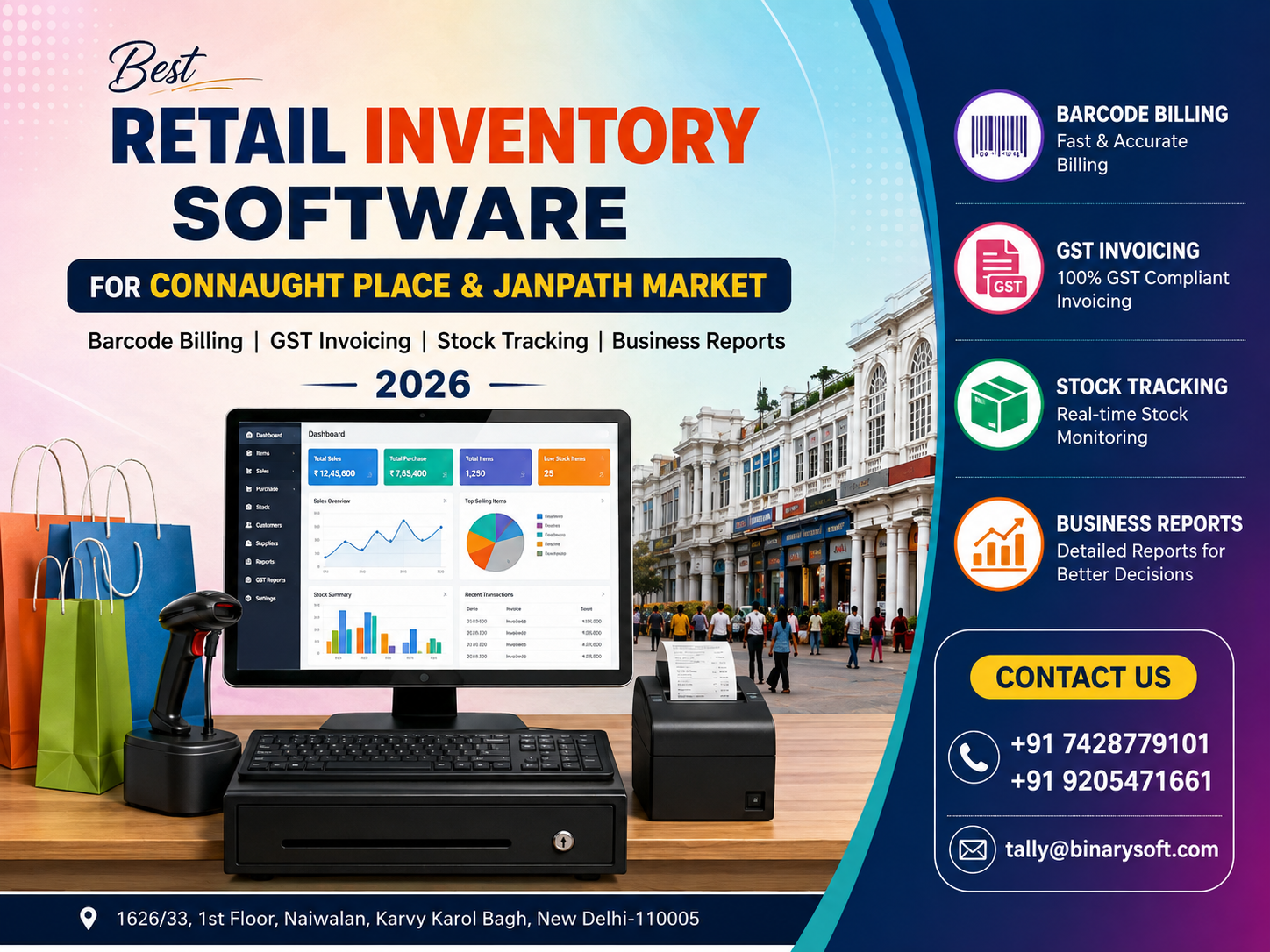
In 2026, running a retail shop in busy commercial destinations such as Connaught Place and Janpath Market is becoming increasingly data-driven. Customers expect faster checkout, accurate pricing and immediate product availability, while retailers must simultaneously manage GST invoicing, purchases, stock movement, supplier payments and profitability. The pressure becomes greater when hundreds or thousands of products are handled through manual registers, spreadsheets or disconnected billing applications. A single stock-entry mistake can lead to incorrect availability, unnecessary purchasing or a lost sale. The major shift in recent months is toward integrated retail inventory software where billing, inventory and accounting work from the same business data. With TallyPrime, retailers can connect sales and purchases with inventory records, organise stock systematically, support barcode-based billing and access detailed business reports. The benefit is straightforward: less repetitive work, better stock visibility, faster billing and stronger control over the money invested in inventory.
Retail Business in Connaught Place & Janpath Market Needs More Than Simple Billing
Connaught Place and Janpath are among New Delhi's best-known commercial and shopping areas. Retailers operating in and around these markets may deal in garments, fashion accessories, handicrafts, footwear, electronics, cosmetics, gifts, lifestyle products, jewellery, books and many other product categories.
In such an environment, generating a sales invoice is only one part of retail management.
The retailer also needs to know:
Which products are available right now?
Which products are selling fastest?
Which items have remained unsold for months?
How much stock should be reordered?
What was the purchase cost?
How much profit is being generated?
What amount is payable to suppliers?
Which customers have outstanding balances?
Is the GST information attached to products correct?
Does the physical stock match the quantity recorded in the system?
These questions become difficult to answer when billing, inventory and accounting are maintained separately.
Modern retail inventory software brings these activities together.
TallyPrime, for example, supports inventory management from purchases through sales, including stock movements between locations and inventory adjustments. Its inventory capabilities also include stock groups, categories, batches, godowns and multiple inventory reports.
A Retailer's Story: "The Product Was in the Shop, But the System Said Zero"
Imagine a retailer running a busy fashion and accessories store near Connaught Place.
It is Saturday evening. Customers are entering continuously, the billing counter is busy and staff members are searching shelves for different colours and sizes.
A customer finds a jacket she likes but wants another size.
The salesperson checks the old stock sheet.
"Not available."
The customer leaves.
Twenty minutes later, while searching for another product, an employee discovers three pieces of exactly that size in another storage section.
The owner feels frustrated.
The product was available.
The customer was ready to buy.
But inaccurate stock information turned available inventory into a lost sale.
Later that night, another problem appears. The owner discovers that several items ordered from a supplier were entered into the purchase records but not updated correctly in the separate inventory sheet.
Now the team must manually compare purchase invoices, sales bills and physical stock.
What should have been a normal business day turns into hours of reconciliation.
This fictional situation illustrates a very real retail problem: inventory is valuable only when the business knows what it has, where it is located and how quickly it is moving.
That is why integrated retail inventory management matters.
What Is Retail Inventory Software?
Retail inventory software helps businesses record, organise, track and analyse the products they purchase and sell.
Instead of maintaining separate registers for purchases, sales and inventory, a properly configured system can connect these transactions.
For example:
Purchase goods → inventory increases.
Sell goods → inventory decreases.
Customer returns goods → inventory can be updated.
Transfer products to another godown → location-wise quantities change.
Perform physical stock verification → differences can be identified and adjusted.
The objective is to create reliable visibility into inventory without repeatedly entering the same information.
Tally's current retail inventory offering highlights real-time stock tracking, barcode/RFID integration, reorder management and multi-location inventory capabilities.
Why Connaught Place Retailers Need Better Inventory Control in 2026
Retail space, staff time and working capital are valuable.
A retailer cannot afford to fill shelves and storage areas with products that do not sell while popular products repeatedly go out of stock.
Consider a store with 5,000 individual products or variants.
Trying to remember the availability of every:
size,
colour,
brand,
model,
design,
batch,
price range,
and storage location
is practically impossible.
Software turns this information into structured business data.
The retailer can therefore move from:
"I think we still have ten pieces."
to:
"Let's check the stock report."
That change can significantly improve purchasing discipline.
1. Barcode Billing for Faster Retail Checkout
Barcode-based billing is particularly valuable for retailers handling large numbers of products.
Instead of manually typing product names or codes at the billing counter, staff can scan the product.
A properly configured barcode workflow can help identify the correct stock item and speed up invoice preparation.
This becomes valuable during:
weekend rush,
festival shopping,
seasonal sales,
promotional events,
evening peak hours,
and high-volume billing periods.
TallyPrime supports integration with standard barcode scanners for faster billing and inventory-related operations.
Why Faster Billing Matters
Long queues affect customer experience.
Imagine two stores selling similar products.
At Store A, every item is manually searched and selected.
At Store B, products are scanned quickly and the invoice is generated without unnecessary delay.
Customers naturally appreciate the smoother experience.
Barcode billing can also reduce product-selection mistakes, especially when several items have similar names.
2. GST-Compliant Invoicing
GST invoicing is another major requirement for Indian retailers.
A retail inventory system should not treat taxation as an unrelated activity.
The product master should be configured carefully with relevant information such as:
product description,
unit,
HSN details where applicable,
GST applicability,
GST rate,
selling information,
and inventory details.
TallyPrime allows GST applicability and HSN/rate information to be configured for stock items or appropriate stock groups.
For businesses implementing TallyPrime in 2026, proper GST setup at the beginning is important. Tally's updated GST documentation recommends configuring company GST registration details and the required GST information in relevant masters before regular GST invoicing.
3. Billing and Stock Should Work Together
One of the biggest mistakes retailers make is using one application for billing and another file for stock management.
Suppose you sell five shirts.
The billing software records the sale.
But somebody must later reduce those five shirts from an Excel inventory sheet.
What happens when that second step is forgotten?
Your sales records say five products were sold.
Your inventory sheet still shows those five products as available.
Over time, the difference grows.
Integrated billing and inventory reduces this duplication. TallyPrime's invoice-and-inventory workflow is designed so sales and returns can update inventory records as transactions are recorded.
4. Real-Time Stock Tracking
Retailers need answers quickly.
When a customer asks:
"Do you have this product?"
the employee should not have to search multiple registers.
Inventory software provides a structured view of stock quantities and movement.
This is useful for understanding:
opening stock,
purchases,
sales,
returns,
stock transfers,
adjustments,
and closing quantities.
TallyPrime also supports inventory tracking across godowns or locations, which can be useful when stock is kept separately from the primary shop.
5. Stock Groups and Categories
A large retail inventory should not become one enormous unorganised list.
Products can be organised logically.
For example, a garment retailer could structure inventory like this:
Men's Wear
Shirts
T-Shirts
Jeans
Jackets
Women's Wear
Kurtis
Dresses
Tops
Jeans
Accessories
Belts
Wallets
Bags
Scarves
The exact structure depends on the business.
TallyPrime supports stock groups and categories that allow businesses to organise inventory according to product type, brand, colour, size or other practical classifications.
6. Multiple Godown and Location Management
Not every Connaught Place or Janpath retailer keeps all inventory inside the showroom.
Some businesses maintain:
a retail outlet,
nearby storage,
central warehouse,
secondary branch,
or another godown.
Without location-wise inventory, the owner may know that 50 pieces exist but not where those 50 pieces are physically stored.
Location-based inventory management helps solve this problem.
A business can record stock according to its relevant godown or location and record transfers when products move between them.
This becomes increasingly valuable as a retailer expands from one shop to multiple locations.
7. Better Reorder Planning
Running out of popular merchandise can mean lost sales.
Overordering is equally dangerous because money becomes trapped in stock.
The purpose of inventory management is therefore not simply to maintain the maximum quantity possible.
The objective is to maintain the right inventory.
Retail inventory software can help management identify products that require replenishment and support more structured reorder decisions.
Retailers can use stock information to determine:
what needs purchasing,
which items need urgent replenishment,
which products already have sufficient quantities,
and which products should not be reordered.
8. Identify Fast-Moving Products
Your bestselling product deserves attention.
If a particular handbag, shirt, cosmetic product or electronic accessory sells repeatedly, purchasing decisions should reflect that demand.
Inventory movement reports can help reveal these patterns.
Instead of purchasing based entirely on instinct, the retailer can combine experience with transaction data.
This is especially valuable before:
festivals,
wedding seasons,
tourist periods,
weekends,
promotional campaigns,
and seasonal demand changes.
9. Find Slow-Moving Inventory Before It Becomes Dead Stock
Slow-moving inventory silently consumes working capital.
A product may still physically exist in your store, but if it remains unsold for months, the money invested in it is unavailable for faster-moving merchandise.
Stock ageing and movement analysis can help retailers identify such items. Tally's inventory functionality highlights stock ageing and movement analysis as tools for understanding inventory performance.
Once slow-moving inventory is identified, management can consider business actions such as:
discounting,
bundling,
promotional displays,
repositioning,
supplier negotiations,
or avoiding further purchases.
10. Batch and Expiry Management
Some retail businesses need more detailed inventory controls.
Examples include businesses dealing with products having:
batch numbers,
manufacturing dates,
expiry dates,
or lot-based tracking requirements.
Batch-wise management helps distinguish inventory even when the basic product name is the same.
This can be particularly useful for food, healthcare-related products and other date-sensitive merchandise.
TallyPrime provides batch-oriented inventory functionality and can maintain manufacturing and expiry-related information where required.
11. Purchase Management
Retail inventory begins before the product reaches the shelf.
A strong inventory workflow also needs to track purchasing.
Retailers should be able to understand:
what was ordered,
what was received,
from which supplier,
at what cost,
in what quantity,
and what amount remains payable.
When purchases, inventory and accounting are connected, business owners receive a more complete picture of operations.
TallyPrime's integrated workflow connects purchase and sales transactions with inventory and accounting data rather than requiring independent stock and financial systems.
12. Sales Returns and Purchase Returns
Retail is rarely a one-directional process.
Customers return products.
Businesses return damaged or incorrect products to suppliers.
If returns are not recorded correctly, inventory quantities become unreliable.
A proper inventory workflow should therefore account for:
sales returns,
purchase returns,
damaged products,
shortages,
excess quantities,
and other inventory adjustments.
13. Physical Stock Verification
Software quantity and physical quantity should periodically be compared.
Suppose the system shows:
Product A – 100 units
but physical counting finds:
Product A – 96 units.
The four-unit difference needs investigation.
Possible causes might include:
incorrect billing,
unrecorded damage,
wrong purchase quantity,
incorrect return entry,
stock transferred without recording,
or counting mistakes.
Periodic physical verification helps retailers maintain confidence in inventory reports.
14. Inventory Valuation
Inventory is not merely a quantity.
It represents money invested in merchandise.
Retailers therefore need visibility into the value of their stock.
TallyPrime supports multiple inventory valuation approaches, including methods such as FIFO and average cost.
Correct inventory valuation supports better understanding of:
closing stock,
cost of goods,
gross profitability,
working capital,
and financial position.
15. Business Reports for Retail Owners
A retail owner should not have to wait until year-end to understand business performance.
Useful reports can provide ongoing visibility into operations.
Depending on configuration and business requirements, retailers can review information related to:
sales,
purchases,
stock quantities,
stock valuation,
item movement,
ageing,
receivables,
payables,
profitability,
Profit & Loss,
Balance Sheet,
and cash flow.
The value of reporting is not the number of reports available.
The real value is the decision the owner can make after reading them.
16. Item-Wise Profitability
Two products with similar selling prices may generate very different profits.
For example:
Product A sells frequently but has a low margin.
Product B sells less frequently but produces a significantly higher margin.
Product C sells slowly and generates almost no meaningful contribution after discounting.
Without proper data, all three may look like ordinary sales.
Integrated accounting and inventory reports help businesses examine sales and profitability more intelligently. Tally's stock inventory offering includes item/invoice profitability and integration between sales and financial information.
17. Receivables and Payables
Retail businesses may also have credit transactions.
Some customers owe money.
At the same time, the business owes suppliers.
Inventory decisions cannot be separated completely from cash flow.
An owner considering another large purchase should know:
cash available,
supplier liabilities,
customer outstanding amounts,
existing inventory value,
and current sales movement.
This provides a more complete foundation for purchasing decisions.
18. Multiple Price Levels
Retail businesses sometimes maintain different prices for different customer types.
For example:
standard retail price,
dealer price,
special customer price,
promotional price,
or another predefined price level.
TallyPrime supports multiple price lists/levels that can help businesses apply appropriate pricing in invoicing workflows.
19. Reduce Dependence on Excel-Based Inventory
Excel remains useful for many business tasks.
However, as the primary inventory system for a growing retail operation, spreadsheets can become difficult to control.
Common challenges include:
duplicate entries,
manual formulas,
incorrect quantities,
multiple versions of the same file,
delayed updates,
accidental deletion,
and separation between accounting and inventory.
The bigger problem is repetitive entry.
If a sale must be entered once for billing, again for inventory and later again for accounting, the business creates unnecessary opportunities for errors.
An integrated system reduces those repetitions.
20. GST and Inventory Working Together
In retail operations, stock transactions and taxation frequently intersect.
A purchase affects inventory.
A sale affects inventory and revenue.
Returns can affect inventory and tax records.
TallyPrime's integrated GST and inventory approach is designed to connect these activities through the transaction workflow.
For the retailer, this means fewer separate systems to reconcile.
21. Why Accurate Stock Improves Customer Experience
Inventory management may sound like a back-office activity.
But customers experience its effects directly.
Accurate inventory can mean:
fewer "out of stock" surprises,
faster product searches,
faster billing,
correct product selection,
better availability,
and smoother returns.
When a customer asks whether a particular item is available, the staff should have reliable information.
That creates confidence.
22. How Inventory Control Protects Working Capital
Consider a retailer with ₹25 lakh invested in merchandise.
If ₹5 lakh is tied up in products that barely sell, that money cannot easily be used for:
new merchandise,
supplier payments,
rent,
salaries,
marketing,
store expansion,
or other business requirements.
Better inventory reporting helps owners understand where capital is sitting.
This is why inventory control is fundamentally also financial control.
23. Retail Inventory Management During Festival Seasons
Festival and wedding periods can create sharp changes in retail demand.
The challenge is balancing two risks:
Too little inventory → missed sales.
Too much inventory → unsold merchandise after the season.
Historical sales and inventory movement information can help owners plan purchases with greater confidence.
Retailers can review previous product performance and combine that information with current trends and their own market knowledge.
24. Retail Inventory Software for Different Businesses
The same underlying inventory principles can apply to many businesses around Connaught Place and Janpath Market.
Garment Stores
Track products according to brand, style, size, colour and category.
Footwear Retailers
Manage model and size-based variants.
Electronics and Accessories
Track different product models and relevant product identifiers.
Gift Shops
Manage large numbers of relatively small SKUs efficiently.
Handicraft Retailers
Organise diverse merchandise into meaningful product groups.
Cosmetic Retailers
Manage product variants and, where relevant, batch or expiry-related information.
Lifestyle Stores
Combine billing, inventory, purchasing and accounting.
Book and Stationery Stores
Use product coding and barcode-based workflows for faster billing.
25. How to Choose the Best Retail Inventory Software in 2026
Before selecting software, a retailer should evaluate actual operational requirements.
Ask:
Can it handle GST billing?
Can sales automatically affect inventory?
Can purchases update inventory?
Does it support barcode-based workflows?
Can I maintain multiple godowns?
Can I organise thousands of products?
Can I track batches where required?
Can I view stock movement?
Can I analyse ageing?
Can I see receivables and payables?
Can I get accounting and financial reports?
Can it support my business as it expands?
Is reliable implementation and support available?
The best system is not necessarily the one with the longest feature list.
It is the system that fits your daily workflow and is configured correctly.
26. Why TallyPrime Can Be Considered for Retail Businesses
TallyPrime combines several business-management functions in one environment, including:
Accounting
Inventory management
GST invoicing and compliance
Sales management
Purchase management
Receivables
Payables
Business reporting
Godown management
Batch management
Barcode-supported billing workflows
Financial reporting
Tally's official retail inventory information describes capabilities including real-time stock updates, barcode/RFID tracking, multi-location inventory and integrated billing.
For retailers already using Tally for accounting, using its inventory functionality can also reduce the need to maintain disconnected stock systems.
27. Implementation Matters as Much as Software
Buying software alone does not automatically solve inventory problems.
Correct implementation is essential.
A retail implementation should consider:
product master structure,
stock groups,
categories,
units of measurement,
GST configuration,
HSN details,
opening stock,
godowns,
barcode structure,
price levels,
supplier ledgers,
customer ledgers,
user access,
invoice configuration,
and reporting requirements.
Poorly structured masters can produce poor reports even when the software itself is capable.
Planning the structure before entering thousands of products can save significant effort later.
28. Suggested Retail Inventory Workflow
A practical retail workflow may look like:
Purchase Order
↓
Goods Received
↓
Purchase Entry
↓
Inventory Updated
↓
Product Available for Sale
↓
Barcode Scan / Item Selection
↓
GST Sales Invoice
↓
Inventory Reduced
↓
Accounting Updated
↓
Payment / Receivable Recorded
↓
Business Reports Updated
The goal is simple:
Enter a genuine business transaction once and allow the relevant records to remain connected.
29. From Billing Counter to Business Intelligence
A modern billing counter is no longer simply a place where invoices are printed.
Every properly recorded sale produces useful business information.
After hundreds or thousands of transactions, the retailer can analyse:
which products sell,
when they sell,
how much they sell for,
what they cost,
which categories perform best,
how much stock remains,
and how the business is performing financially.
That is the transition from simple billing software to business management software.
30. Why 2026 Is a Good Time to Modernise Retail Operations
Retail customers are becoming accustomed to fast, organised shopping experiences.
At the same time, businesses are generating more transactional information than ever.
Retailers that continue relying entirely on handwritten stock registers or multiple disconnected spreadsheets may spend increasing amounts of time reconciling information.
An integrated retail inventory system can create a clearer operational cycle:
Buy.
Receive.
Track.
Sell.
Invoice.
Collect.
Analyse.
Reorder.
Instead of repeatedly fixing yesterday's records, the retailer can spend more time planning tomorrow's business.
Powered by Binarysoft Technologies
For businesses in Connaught Place, Janpath Market and other parts of Delhi looking to implement TallyPrime for retail billing, GST, inventory and accounting, Binarysoft Technologies can assist with solution configuration and implementation according to business requirements.
Binarysoft Technologies
Authorized Tally Partner
Location:
1626/33, 1st Floor, Naiwalan, Karol Bagh, New Delhi – 110005, INDIA
Contact us:
+91 7428779101, 9205471661
Email us:
tally@binarysoft.com
Business Hours:
10:00 AM – 6:00 PM, Mon–Fri
Conclusion
For retailers in Connaught Place and Janpath Market, inventory is one of the most important investments in the business. Every product sitting on a shelf represents money, and every unavailable bestselling item can represent a missed sales opportunity.
In 2026, effective retail management requires more than generating invoices. Businesses need barcode-supported billing, GST invoicing, accurate stock tracking, purchase management, multiple-location control and meaningful business reports working together.
TallyPrime provides an integrated environment for accounting, billing, GST and inventory management, with capabilities such as stock groups, godowns, batches, barcode-supported workflows, stock reporting and financial reporting.
The biggest advantage comes from visibility.
When retailers know what they have, what they are selling, what they need to purchase and where their money is invested, they can make faster and more informed decisions.
For a growing retail business, better inventory control is not simply about counting products.
It is about protecting working capital, improving customer service and building a more manageable and profitable operation.
CA. Mayankh Singhaal is a Chartered Accountant experienced in accounting systems, statutory audits, and compliance advisory. He has worked with businesses across different sectors to improve reporting accuracy and inventory tracking. His writing focuses on structured growth and compliance-ready operations.