Call CA Tally HelpDesk
+91 9205471661,
7428779101
What Changed in 2026: Financial Accounting Is Becoming Faster, More Connected and Compliance-Driven
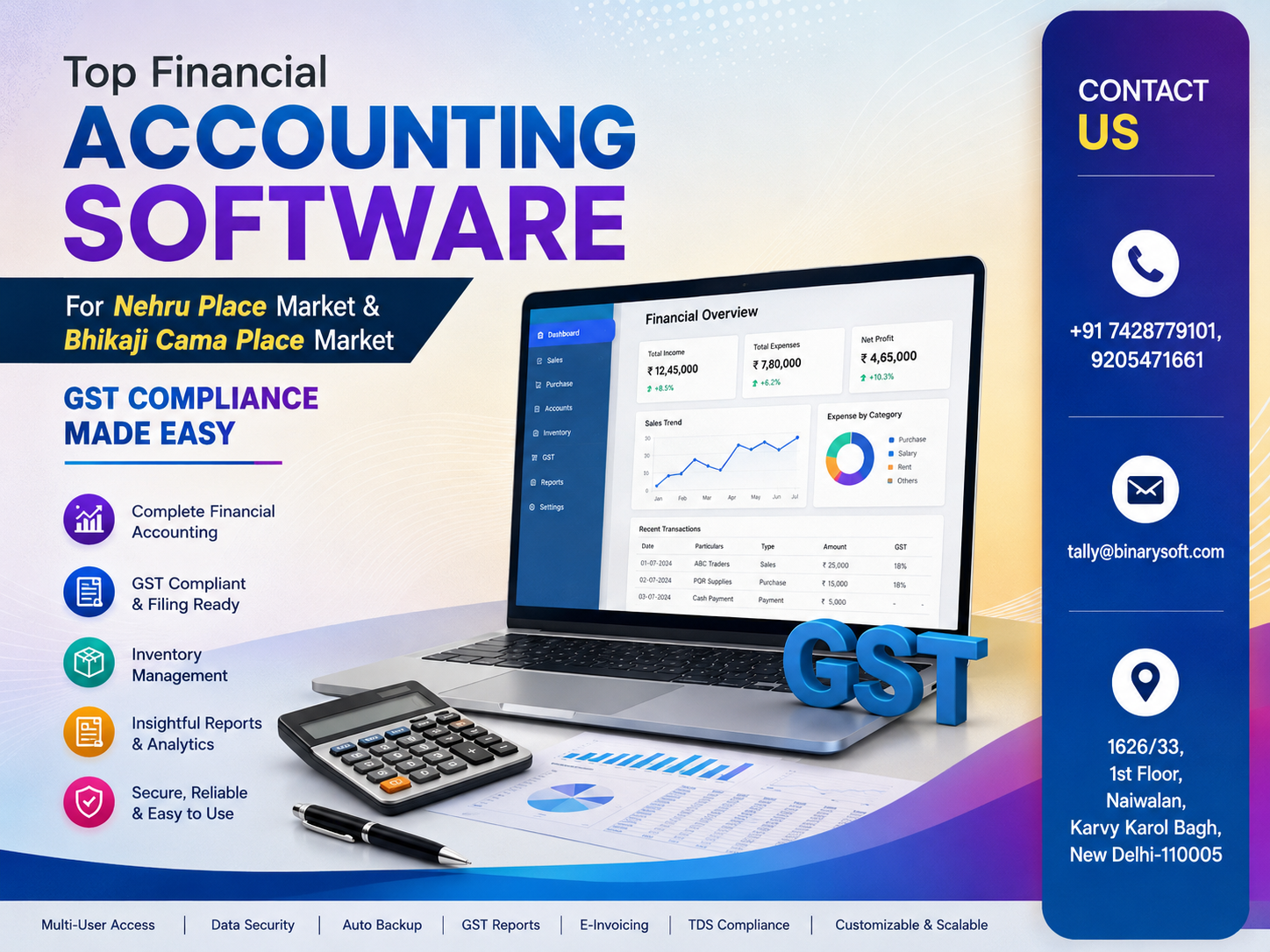
In 2026, businesses operating in busy commercial hubs such as Nehru Place Market and Bhikaji Cama Place Market in Delhi are facing a different accounting environment. Financial accounting is no longer limited to recording sales, purchases, receipts and payments at the end of the day. Businesses increasingly need faster GST reconciliation, accurate HSN/SAC information, e-Invoice and e-Way Bill workflows, better inventory visibility and reliable financial reports. Recent GST-related system changes have made accurate transaction data even more important, putting pressure on businesses that still depend heavily on spreadsheets, disconnected billing tools or repetitive manual entry. The benefit of moving to modern financial accounting software is significant: billing, accounting, GST compliance, inventory, receivables, banking and management reporting can work together in a more controlled system. For growing businesses, that means fewer repetitive tasks, better visibility and more time to focus on customers and business growth.
Why Nehru Place and Bhikaji Cama Place Businesses Need Modern Financial Accounting Software
Nehru Place is one of Delhi's best-known commercial and technology-oriented business districts, while Bhikaji Cama Place is home to offices, professional establishments, service businesses, traders and corporate operations.
Businesses working in these commercial areas may process dozens, hundreds or even thousands of transactions depending on their size and industry.
A computer hardware trader may need serial-wise or item-wise inventory visibility. A service company may need GST-compliant invoicing and outstanding management. A distributor may need stock, purchase, sales and e-Way Bill functionality. A professional organisation may require accounting, TDS, GST, receivables and detailed financial reporting.
This makes the selection of financial accounting software an important operational decision.
The right software should not simply replace handwritten books or Excel sheets. It should create a connected financial information system where business owners and accountants can quickly understand:
- Sales and purchase position
- Cash and bank balances
- Customer outstanding amounts
- Supplier payables
- GST liability
- Input Tax Credit information
- Stock position
- Profitability
- Expenses
- Receivables ageing
- Financial statements
- Business performance
For many SMEs, traders and service businesses, TallyPrime is one option designed to combine accounting, GST compliance, inventory and reporting within the same business system.
GST Compliance Has Become an Everyday Accounting Requirement
One of the biggest reasons businesses are upgrading financial accounting software is GST compliance.
A GST-registered business cannot treat accounting and tax compliance as completely separate activities. Information entered during normal billing and purchase accounting ultimately affects GST reports and return preparation.
Incorrect GSTINs, tax rates, HSN/SAC classifications, invoice details or transaction classifications can create additional reconciliation work later.
Modern accounting software can help businesses establish a structured process from the beginning:
Transaction Entry → GST Validation → Reconciliation → Review → Return Preparation/Filing
TallyPrime's connected GST capabilities include GSTR-1 and GSTR-3B functionality, GSTR-2A/2B download and reconciliation, e-Invoicing and e-Way Bill capabilities.
This can be particularly useful for businesses with significant monthly transaction volumes.
A Nehru Place Business Story: When Growth Created an Accounting Problem
Consider the example of a fictional electronics and IT accessories distributor operating from Nehru Place.
The business began with a small team and a manageable number of invoices. The owner personally knew most customers, stock could be checked manually, and an accountant maintained transaction details using spreadsheets and separate billing records.
Then the business grew.
More customers started placing orders. Additional products were introduced. Credit sales increased. Purchases came from multiple suppliers, and online and offline orders began moving simultaneously.
From outside, everything looked positive.
Sales were increasing.
But inside the office, the pressure was building.
One evening, the owner asked a simple question:
“How much money do our customers actually owe us today?”
Nobody could provide an immediate answer.
One spreadsheet showed one figure. The billing system showed another. Several payments had been received but had not yet been properly adjusted. A few invoices needed verification, and the accountant was still reconciling purchase information.
The owner realised that the business had grown faster than its accounting process.
The problem wasn't that employees weren't working hard. They were working extremely hard.
The problem was that too much of their time was being spent connecting information manually.
After moving towards a more integrated accounting workflow, sales, purchases, inventory, receipts, payments and outstanding balances became easier to review from a central accounting system.
For the owner, the most important improvement wasn't simply faster billing.
It was confidence.
When a customer called, the accounts team could check the ledger. When stock needed review, inventory reports were available. When management wanted to understand receivables or profitability, the information did not have to be reconstructed from several different spreadsheets.
For many growing businesses in Nehru Place and Bhikaji Cama Place, this is the real value of financial accounting software: turning scattered transactions into useful business information.
TallyPrime for Financial Accounting and GST Management
TallyPrime is designed for accounting and business management requirements covering areas such as accounting, inventory, GST compliance and reporting.
For businesses evaluating financial accounting software in Nehru Place Market or Bhikaji Cama Place Market, the advantage of an integrated system is that everyday transactions can become the foundation for management and compliance reports.
Instead of repeatedly entering similar information into separate systems, businesses can build a more streamlined workflow.
Sales Management
Sales invoices are one of the most important documents in a business.
A structured accounting system can help maintain customer information, sales ledgers, taxation details, inventory information and outstanding balances.
This is particularly important for Nehru Place businesses dealing in computers, networking equipment, accessories, software, electronics and other technology products.
Purchase Management
Purchases directly influence stock, supplier balances, GST input information and business profitability.
Accurate purchase accounting helps management understand:
Supplier-wise purchases
Outstanding supplier payments
Product costs
Input GST information
Purchase returns
Stock availability
This gives management a clearer view of procurement and financial commitments.
GST-Compliant Invoicing
Businesses should configure their accounting system with accurate GST registration details, GST rates and related master information before generating GST-compliant transactions.
Tally's documentation specifically recommends setting up GST registration information and GST rates/details in the company and masters for smoother GST invoicing.
Depending on the nature of the transaction, an invoice may need information such as:
GSTIN/UIN
Invoice number and date
Customer information
Place of supply
HSN/SAC
Taxable value
CGST
SGST
IGST
Item or service description
Quantity and rate
Maintaining these details systematically can reduce unnecessary corrections during GST preparation.
e-Invoice Integration
For businesses to which e-Invoicing provisions apply, software integration can significantly reduce repetitive work.
TallyPrime supports generation of an e-Invoice IRN and QR code from transactions. Where required, businesses can also provide e-Way Bill information during the process.
This creates a smoother workflow compared with repeatedly transferring invoice information between accounting records and external systems.
For high-volume businesses, even saving a small amount of time per invoice can produce substantial productivity gains over a month or financial year.
e-Way Bill Management
Businesses dealing with movement of goods may also require e-Way Bill functionality.
TallyPrime provides facilities for online and offline e-Way Bill processes, along with related reporting and management functionality.
This can be useful for wholesalers, distributors, computer dealers, hardware suppliers, electronics traders and other goods-based businesses operating from Nehru Place.
Recent 2026 changes also make software currency important. Tally's current documentation notes new Ship-To GSTIN requirements affecting relevant Bill-To/Ship-To transactions and provides support for those requirements in TallyPrime 7.1.
This illustrates why businesses should keep both their compliance processes and software versions current.
GST Reconciliation and Input Tax Credit
Purchase reconciliation is one of the most important areas of GST accounting.
Your accounting books may contain a purchase invoice, but GST-related data also needs to be reviewed against information available through the GST system.
A mismatch could result from differences in:
GSTIN
Invoice number
Invoice date
Taxable value
GST amount
Document status
Supplier reporting
Connected reconciliation tools can help the accounts team identify exceptions and investigate them before return filing.
TallyPrime currently includes GST reconciliation functionality and GSTR-2A/2B capabilities as part of its connected GST offering.
Inventory Management for Nehru Place Traders
Inventory is particularly important in Nehru Place.
Businesses dealing in computer components and technology products may handle a wide variety of items, including:
Laptops
Desktop systems
Processors
Motherboards
RAM
Storage devices
Monitors
Printers
Networking equipment
Cables
Computer accessories
CCTV equipment
UPS systems
Peripherals
When hundreds of products are involved, relying entirely on manual stock registers becomes increasingly difficult.
Integrated accounting and inventory software can help businesses understand stock movement alongside purchases and sales.
Management can use this information to answer questions such as:
Which items are selling quickly?
Which products are moving slowly?
What is the current stock position?
What needs to be reordered?
How much money is tied up in inventory?
Which product categories contribute strongly to revenue?
Better stock information can improve purchasing decisions and reduce unnecessary capital blockage.
Receivables and Outstanding Management
Sales do not automatically mean cash in the bank.
For businesses selling on credit, outstanding management can be just as important as revenue growth.
Suppose a company records ₹50 lakh in monthly sales but ₹20 lakh remains unpaid for an extended period. The profit-and-loss statement may appear healthy while actual cash flow remains under pressure.
Accounting software helps businesses monitor customer ledgers and outstanding receivables more systematically.
Management can identify overdue invoices and prioritise collection activities.
This can improve working-capital discipline.
Supplier and Payables Management
The same principle applies to suppliers.
Businesses need visibility into:
Amounts payable
Due dates
Purchase invoices
Debit and credit adjustments
Payments already made
Supplier balances
Better payable management can help businesses plan cash requirements and maintain healthier vendor relationships.
Cash and Bank Management
A business may receive and make payments through multiple channels:
Bank transfer
Cheque
UPI
Cash
NEFT
RTGS
IMPS
Payment gateway
Other digital modes
When transaction volume increases, reconciliation becomes an important part of accounting control.
Modern accounting software helps bring banking and accounting information closer together. TallyPrime's current release highlights smart bank reconciliation, connected banking and integrated payment-related capabilities among its business-management features.
Financial Reports for Better Decision-Making
Financial accounting software should not only store information.
It should help management understand it.
Important reports may include:
Balance Sheet
Profit & Loss Account
Trial Balance
Cash Flow
Fund Flow
Day Book
Sales Register
Purchase Register
Stock Summary
Receivables
Payables
Ledger Reports
GST Reports
TallyPrime also provides dashboards, configurable reports, analytical options and SmartFind for locating information entered in masters or vouchers.
For business owners, this can convert accounting data into actionable management information.
Financial Accounting Software for Bhikaji Cama Place Service Businesses
Not every business needs extensive inventory management.
Bhikaji Cama Place has many office-oriented and professional businesses where the primary requirements may include:
Service invoicing
Expense accounting
Bank reconciliation
GST accounting
TDS/TCS management
Customer outstanding management
Cost tracking
Profitability analysis
Financial statements
For these businesses, the focus should be on financial control rather than complex stock operations.
Accounting software can be configured according to the organisation's actual requirements rather than forcing every company into the same workflow.
Multi-Department Accounting
Larger organisations may have separate departments for:
Sales
Purchases
Accounts
Administration
Operations
Management
A centralised accounting system helps these departments work with more consistent financial information.
Instead of maintaining disconnected spreadsheets in different departments, transactions can be recorded using a structured process.
This improves accountability and reduces duplication.
Cost Centre and Profitability Analysis
Management frequently wants answers beyond total profit.
For example:
Which department generates the highest revenue?
Which project is profitable?
Which branch has higher expenses?
Which cost centre is exceeding its budget?
Which business segment is growing?
Cost-centre-based accounting can help organisations analyse expenses and income at a more detailed level.
This is especially useful for service companies, agencies, consulting organisations and businesses managing multiple projects.
Why Excel Alone Becomes Difficult as a Business Grows
Excel remains extremely useful for analysis, calculations and specialised reporting.
However, using spreadsheets as the primary accounting system can become challenging as transaction volumes grow.
Common issues include:
Multiple file versions
Accidental formula changes
Duplicate data entry
Manual reconciliation
Limited transaction control
Difficulty tracking changes
Scattered customer information
Delayed reporting
Dependence on individual employees
A dedicated accounting system provides a structured framework for transaction recording and financial reporting.
Excel can still complement the accounting system where required.
Data Accuracy Matters More Than Automation
Automation does not correct fundamentally incorrect data.
Businesses should therefore maintain proper masters for:
Customers
Suppliers
GSTINs
Stock items
HSN/SAC codes
Tax rates
Ledgers
Units
Addresses
Bank details
Well-maintained master data creates the foundation for accurate billing, GST reporting and management analysis.
Selecting Financial Accounting Software in Nehru Place and Bhikaji Cama Place
Before choosing software, businesses should evaluate their real requirements.
Important questions include:
How many users need access?
Is the business trading, manufacturing or service-based?
How many invoices are generated each month?
Is inventory management required?
Is GST applicable?
Does the organisation require e-Invoicing?
Are e-Way Bills frequently generated?
Does the company operate multiple branches or GST registrations?
Is remote access required?
Does management require customised reports?
Is integration with other applications required?
Does the business need implementation and ongoing support?
The cheapest software is not necessarily the most economical solution.
A system that reduces repetitive work, prevents avoidable errors and provides better management visibility can deliver considerably more value over time.
Benefits of Implementing TallyPrime Through an Authorized Tally Partner
Software implementation involves more than installation.
Businesses may require assistance with:
Requirement analysis
Software selection
Installation
Company creation
GST configuration
Ledger configuration
Inventory setup
Opening balances
User configuration
Data migration
Invoice format setup
e-Invoice configuration
e-Way Bill setup
Training
Troubleshooting
Upgrades
Ongoing support
Working with an experienced Tally partner can help businesses configure the software according to their operational requirements.
Why Local Support Matters
For businesses in Nehru Place Market and Bhikaji Cama Place Market, access to Delhi-based assistance can be useful when implementing or upgrading accounting systems.
Problems often occur at critical moments:
An invoice needs to be generated.
A GST report requires review.
A new system needs configuration.
Users need training.
An accounting process needs correction.
Having an experienced support team available can reduce downtime and help staff resolve operational issues faster.
Who Can Use Financial Accounting Software?
A modern financial accounting solution can support many types of organisations, including:
Computer dealers
IT hardware distributors
Electronics businesses
Wholesalers
Retailers
Service providers
Consulting firms
Professional organisations
Importers and exporters
Corporate offices
Startups
SMEs
Distributors
Trading businesses
Multi-location organisations
The configuration should depend on the nature and scale of the business.
Accounting Software as a Management Tool
One of the biggest mistakes a business can make is viewing accounting software only as a tool for the accountant.
Good accounting software should also help management.
A business owner should be able to understand questions such as:
How much did we sell?
How much did we collect?
How much do customers owe?
How much do we owe suppliers?
What is our stock value?
What are our major expenses?
Are we profitable?
What is our GST position?
Which products or departments are performing better?
When financial information becomes available faster, management can make decisions with greater confidence.
GST Compliance Made Easier Through Connected Accounting
The biggest advantage of integrated accounting is that compliance becomes part of normal business activity.
Instead of thinking:
Accounting first, GST later
businesses can move towards:
Record correctly once and use that structured information for accounting, reporting and compliance.
This reduces repetitive work and helps the accounts team focus on reviewing exceptions instead of repeatedly rebuilding information.
Current TallyPrime capabilities combine accounting and reporting with connected GST functionality including reconciliation, return-related processes, e-Invoicing and e-Way Bills.
Preparing Your Business for Future Growth
Software selection should not only solve today's problems.
A business should consider what happens when:
Invoice volume doubles.
New employees join.
A new branch opens.
Inventory expands.
GST compliance becomes more detailed.
Management demands faster reports.
Remote access becomes necessary.
More customers purchase on credit.
A scalable accounting foundation makes these transitions easier.
Businesses in Nehru Place and Bhikaji Cama Place should therefore view financial accounting software as infrastructure for growth rather than merely another office application.
Conclusion
For businesses operating in Nehru Place Market and Bhikaji Cama Place Market, financial accounting in 2026 requires much more than basic bookkeeping. GST compliance, e-Invoicing, e-Way Bills, reconciliation, inventory management, receivables, banking and management reporting increasingly need to operate as connected processes.
TallyPrime provides businesses with an integrated environment for accounting, inventory, GST compliance and financial reporting. Current capabilities include connected GST functionality, e-Invoice and e-Way Bill processes, reconciliation and business reporting features that can reduce repetitive administrative work when correctly configured.
Whether you operate an IT hardware business in Nehru Place, a professional service company in Bhikaji Cama Place, a wholesale operation, corporate office, distribution company or growing SME, selecting and properly implementing the right financial accounting software can help create better financial control.
The goal is not simply to make accounting digital.
The goal is to make financial information accurate, accessible and useful for everyday business decisions.
CA. Shivesh Khandelwaal is a practicing Chartered Accountant experienced in accounting automation, compliance management, and audit support. He has worked with trading and distribution businesses to improve inventory visibility and financial reporting. His articles focus on real-world applicability.