Call CA Tally HelpDesk
+91 9205471661,
7428779101
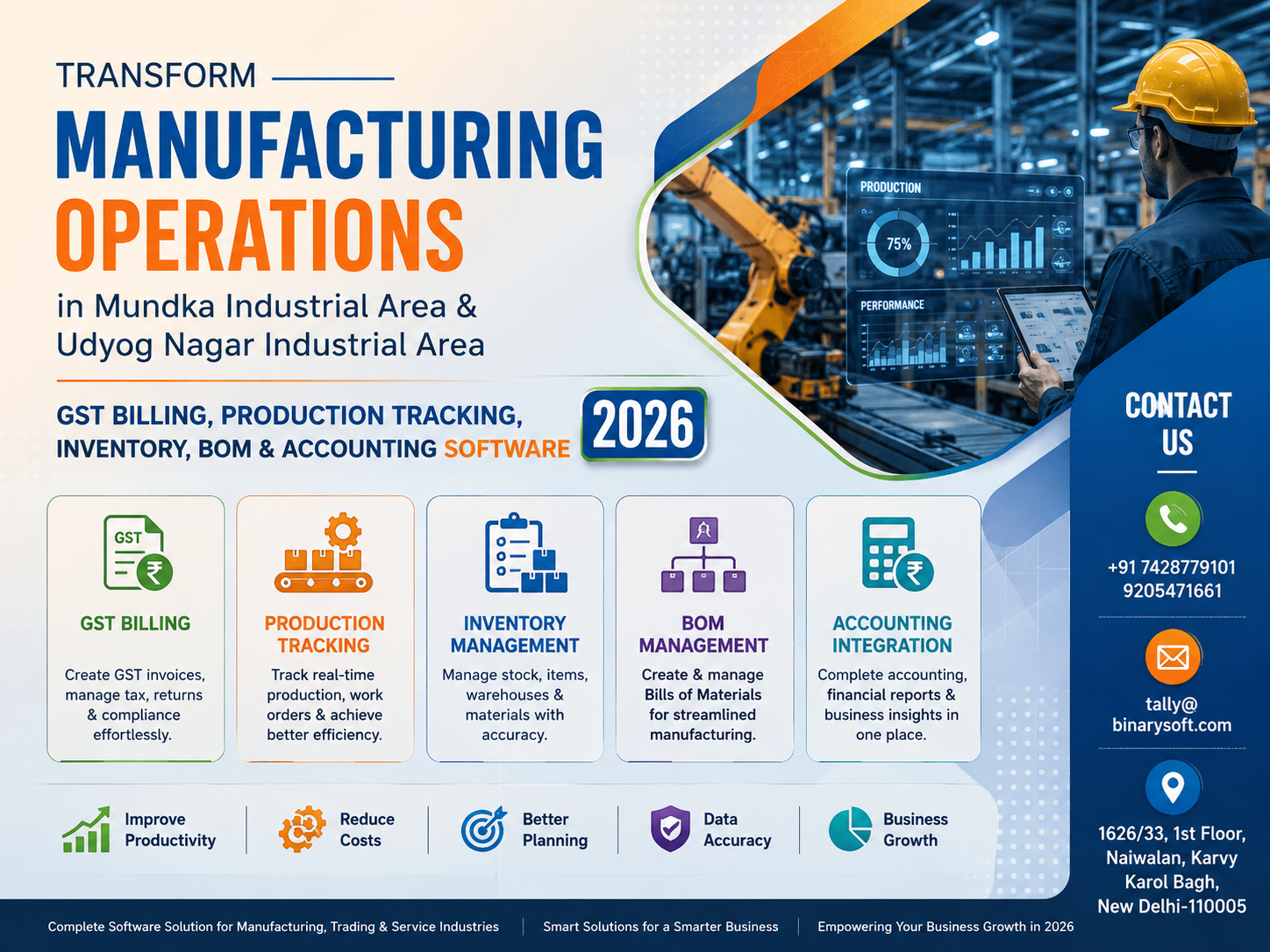
Manufacturing in 2026: Faster Production Needs Smarter Business Control
In 2026, manufacturing businesses are operating under greater pressure to deliver faster, control material costs, maintain accurate GST records, and know the real profitability of every product they manufacture. For units operating in Mundka Industrial Area and Udyog Nagar Industrial Area, Delhi, spreadsheets, handwritten production registers, disconnected billing systems, and delayed stock updates can quickly become operational bottlenecks. Even a small mismatch between raw-material consumption, finished-goods production, purchase costs, and actual inventory can affect margins and management decisions. What has changed in recent months is the growing need for connected business information: manufacturers want GST billing, inventory, Bill of Materials (BOM), production tracking, accounting, receivables, payables, and management reports to work together. With an integrated accounting and business management solution such as TallyPrime, manufacturers can reduce repetitive work, improve stock visibility, track production more systematically, and make faster decisions using reliable business data.
Why Manufacturing Businesses in Mundka and Udyog Nagar Need Digital Transformation
Delhi's manufacturing ecosystem includes businesses of dramatically different sizes and operating models. Manufacturers may deal with raw materials from multiple suppliers, semi-finished components, outsourced processes, packaging materials, finished goods, distributors, wholesalers, retailers, and institutional customers.
For businesses operating in industrial areas such as Mundka and Udyog Nagar, accounting is therefore only one part of the operational challenge.
The bigger challenge is connecting accounts with what is actually happening on the factory floor and inside the warehouse.
A manufacturer needs answers to questions such as:
How much raw material is currently available?
How much material was consumed during production?
How many finished units were produced?
What is the approximate cost of producing a particular item?
Which materials need to be reordered?
Which customers have outstanding payments?
How much money is payable to suppliers?
What GST transactions have been recorded?
Which products are contributing more to revenue?
Where is working capital getting blocked?
When these answers come from separate registers, spreadsheets, billing applications, and accounting records, management spends valuable time reconciling information.
A structured business management system can bring these activities together.
A Manufacturing Story: When Growth Started Creating More Problems Than Profit
Consider a fictional manufacturing business operating from Mundka Industrial Area.
The company started as a small family-run unit manufacturing products for local distributors. During the early years, production was manageable. Purchases were entered into accounting software, production quantities were written in registers, and inventory was checked manually.
Then the business started growing.
Orders increased.
More workers joined the production unit.
New raw materials were introduced.
The company began dealing with more suppliers and customers.
At first, everyone was excited about the growth.
But within months, the owner noticed something uncomfortable: sales were increasing, yet understanding actual margins was becoming harder.
One evening, an important customer requested urgent delivery of a large order. The sales team believed enough finished stock was available. The production supervisor believed additional production was required. The storekeeper's register showed raw material in stock, but the physical quantity was lower.
The owner stood inside the warehouse looking at shelves of material and unfinished orders.
The problem was not lack of business.
The problem was lack of connected information.
The company gradually moved toward structured inventory records, BOM-based material planning, production tracking, GST billing, and integrated accounting.
Instead of asking five people for five different reports, management could review business information from one connected system.
That change did not magically remove every manufacturing challenge. But it gave the owner something extremely valuable: visibility.
And in manufacturing, visibility often determines how quickly a problem can be identified and corrected.
What Is Manufacturing Accounting Software?
Manufacturing accounting software is designed to connect financial accounting with important manufacturing-related transactions such as purchases, inventory movement, material consumption, production, sales, receivables, payables, and taxation.
For many MSMEs, the objective is not to deploy an unnecessarily complicated enterprise system.
The objective is to create a reliable operational structure.
A suitable system should help businesses manage:
GST billing
Purchases
Sales
Raw materials
Finished goods
Semi-finished goods where applicable
Stock groups and stock categories
Units of measurement
Bill of Materials
Material consumption
Production entries
Godowns or storage locations
Receivables
Payables
Cash and bank transactions
Expenses
Accounting reports
GST-related information
Business profitability
Management reporting
TallyPrime can help businesses bring many of these activities into an integrated accounting and inventory environment.
1. GST Billing for Manufacturing Businesses in 2026
Billing is one of the most visible parts of any manufacturing operation.
But a sales invoice is not simply a document given to the customer. It can affect inventory, customer outstanding balances, revenue reporting, taxation, and accounting.
When transactions are structured correctly, integrated GST billing can reduce duplicate data entry.
GST Billing Can Help Manufacturers Manage
Customer details
GST-related information
Item-wise invoicing
Applicable tax treatment
Quantity and rates
Discounts where applicable
Sales ledgers
Customer outstanding balances
Inventory impact
Invoice records
Credit and debit adjustments where relevant
Instead of preparing an invoice in one application and later entering the same sale again into accounting records, businesses can work toward a more integrated process.
Why Accurate Billing Matters
Suppose a manufacturing business generates hundreds of invoices every month.
If invoice information is entered manually across multiple systems, even a small percentage of errors can create considerable reconciliation work.
Incorrect item selection, quantity, rate, customer ledger, tax treatment, or duplicate entries can affect downstream reporting.
A well-configured billing workflow helps reduce these risks.
2. Production Tracking: Know What Goes Into Manufacturing and What Comes Out
One of the biggest differences between trading and manufacturing is transformation.
A trader purchases a finished product and sells it.
A manufacturer may purchase several materials, consume them in a production process, and create a completely different finished product.
Therefore, simply knowing purchase and sales values is not enough.
Manufacturers need visibility into production.
Production Tracking Can Include
Raw material issued for production
Quantity consumed
Finished goods produced
Components used
Production date
Production location
Material movement
Scrap or by-products where relevant to the configured process
Finished inventory generated
Tracking these transactions creates a clearer connection between material availability and actual output.
Example
Imagine that a manufacturer produces 100 units of Product A.
Each unit may require:
2 units of Component X
1 unit of Component Y
0.5 kg of Material Z
Packaging material
Additional consumables
Without a structured material definition, the production team may estimate requirements manually every time.
With a properly configured BOM, standard material requirements can be defined more systematically.
3. Bill of Materials (BOM): Build a Stronger Production Structure
Bill of Materials is an important concept for manufacturing businesses.
A BOM describes the components or materials required to manufacture a finished item.
For example, a furniture manufacturer may need wood, hardware, fittings, adhesive, and other materials to produce a particular finished product.
An electrical-product manufacturer may require several components and packaging materials.
A fabrication unit may consume sheets, sections, fasteners, and other inputs.
Instead of relying entirely on memory, manufacturers can define a standard material structure.
Why BOM Is Valuable
A properly designed BOM can help businesses:
Standardize material requirements
Improve production planning
Understand expected consumption
Reduce dependence on individual employee memory
Improve inventory control
Identify material requirements before production
Support better costing analysis
Compare standard consumption with operational results
BOM and Growing Manufacturing Companies
The value of BOM becomes even greater as a company grows.
When the owner personally supervises every production activity, informal knowledge may appear sufficient.
But once multiple supervisors, workers, shifts, warehouses, or product variants become involved, undocumented knowledge creates operational risk.
A BOM helps convert manufacturing knowledge into a repeatable business process.
4. Raw Material Inventory Management
Raw material availability can directly affect production schedules.
Too little stock may delay production.
Too much stock can block working capital.
The objective is therefore not simply to maintain maximum inventory.
The objective is to maintain appropriate inventory visibility.
Manufacturers Should Track
Opening stock
Purchases
Material consumption
Stock transfers
Returns
Adjustments
Closing stock
Storage locations
Item quantities
Units of measurement
Reorder requirements where the business process supports them
Accurate inventory records help purchasing and production teams make better decisions.
5. Finished Goods Inventory Management
Production is only complete from an operational perspective when finished goods are properly recorded and made visible to the business.
Sales teams need to know whether products are ready for dispatch.
Management needs to know how much finished stock is lying unsold.
The accounts team needs transactions to be properly reflected.
Warehouse personnel need reliable quantity information.
An integrated inventory system creates a common information base.
Better Finished-Goods Visibility Can Help Answer
What is available for immediate dispatch?
Which products have low stock?
Which products have accumulated?
What quantity was produced during a period?
What quantity has been sold?
What is the closing quantity?
Which storage location holds the stock?
These answers can improve production and sales coordination.
6. Manage Multiple Godowns and Storage Locations
Manufacturers may store materials in multiple locations.
For example:
Main raw-material warehouse
Production-floor storage
Finished-goods warehouse
Packaging-material section
Secondary godown
Dispatch area
When everything is recorded under one general stock quantity, locating materials becomes difficult.
Godown or location-based inventory tracking can provide better visibility into where inventory is actually stored.
This is particularly useful for businesses whose manufacturing, storage, and dispatch activities are spread across different sections or locations.
7. Purchase Management for Better Material Planning
Manufacturing begins before the production line starts.
It begins with procurement.
The purchasing team needs to ensure that appropriate materials are available at suitable prices and at the right time.
Poor purchasing decisions can affect production schedules and margins.
An integrated accounting and inventory system helps connect supplier purchases with inventory and payable records.
Important Purchase Information Includes
Supplier name
Purchase invoice
Material purchased
Quantity
Rate
Purchase value
Taxes
Payment terms
Outstanding amount
Purchase returns
Supplier balances
When procurement information is properly recorded, management can evaluate supplier-related expenditure and outstanding liabilities more effectively.
8. Supplier Payables and Cash-Flow Control
Manufacturers often operate between two financial timelines.
Suppliers expect payment according to agreed terms.
Customers may pay later.
Meanwhile, salaries, electricity, transportation, rent, maintenance, packaging, and other operating expenses continue.
This creates working-capital pressure.
A business should therefore know not only its sales but also:
How much customers owe
How much is payable to suppliers
Which bills are approaching their due dates
How much cash is available
What bank balances are available
What major expenses are upcoming
Integrated accounting gives management a clearer picture of these obligations.
9. Receivables Management: Sales Are Not the Same as Cash
A growing sales figure can look impressive.
But sales do not automatically mean cash has been received.
Manufacturers supplying to dealers, distributors, wholesalers, institutions, or corporate buyers may offer credit.
As outstanding balances increase, working capital can become tight.
Receivables tracking helps management identify pending customer payments and follow up systematically.
Useful Receivable Information
Customer-wise outstanding
Invoice-wise outstanding
Age of pending balances
Overdue amounts
Total receivables
Credit exposure
Payment history based on recorded transactions
This information helps businesses prioritize collection efforts.
10. Manufacturing Cost Visibility
Manufacturing profitability cannot be understood from selling price alone.
Consider a product sold for ₹1,000.
That does not mean the business earns ₹1,000.
The manufacturer may have costs related to:
Raw materials
Components
Packaging
Labour
Power
Machine operation
Freight
Job work
Factory expenses
Administrative expenses
Sales expenses
Returns
Wastage
Other overheads
Therefore, businesses need systematic accounting and inventory records to analyze costs and margins more effectively.
The exact costing approach depends on the nature of the manufacturing process and how the accounting system is configured.
11. Accounting Software as the Financial Backbone of Manufacturing
Production and inventory information become far more valuable when connected with financial accounting.
A manufacturing business needs accurate books not only for compliance but also for management decisions.
Important accounting reports may include:
Profit & Loss Account
Balance Sheet
Trial Balance
Cash Book
Bank Book
Ledger reports
Purchase Register
Sales Register
Receivables
Payables
Stock reports
Expense analysis
These reports give management different views of the same business.
12. Why Real-Time or Timely Business Information Matters
Traditional reporting often tells management what happened last month.
Modern business owners increasingly want to know what is happening now.
Suppose material costs suddenly rise.
If management discovers the effect weeks later, quotations may already have been issued at old assumptions.
Suppose a customer has accumulated substantial outstanding invoices.
If nobody notices until cash flow becomes tight, collection becomes reactive.
Suppose finished stock is building up while sales are slowing.
Delayed visibility can lead to unnecessary production.
Timely reporting allows management to identify these situations earlier.
13. Reduce Dependence on Excel and Manual Registers
Excel remains extremely useful for calculations, analysis, and specialized reporting.
The problem arises when spreadsheets become the primary transaction system for every department.
One spreadsheet may contain purchases.
Another may contain production.
Another may contain customer outstanding amounts.
A physical register may track raw materials.
Accounting software may contain financial entries.
The owner then needs to reconcile everything.
This increases the possibility of:
Duplicate entries
Missing transactions
Formula errors
Old file versions
Unauthorized changes
Incorrect stock quantities
Delayed reporting
Data reconciliation problems
A structured system provides a more consistent source of operational information.
14. Improve Coordination Between Accounts, Stores, Production and Sales
Manufacturing efficiency is rarely the responsibility of one department.
Accounts needs financial accuracy.
Stores needs inventory accuracy.
Production needs material availability.
Sales needs finished-goods availability.
Management needs profitability and cash-flow visibility.
When every team works from disconnected information, coordination becomes difficult.
Integrated business software helps establish a common transactional foundation.
For example, a correctly recorded purchase can affect inventory and supplier balances.
Production transactions can affect raw-material and finished-goods quantities.
Sales invoices can affect finished inventory, revenue, customer balances, and taxation records.
This reduces repetitive work and improves consistency.
15. Inventory Control Can Protect Working Capital
Inventory is money stored in physical form.
Raw materials sitting unused represent invested capital.
Finished goods that are not selling also represent blocked funds.
Therefore, inventory management is closely connected with cash-flow management.
Manufacturers should regularly identify:
Fast-moving materials
Slow-moving items
High-value stock
Excess inventory
Frequently required components
Finished goods accumulating in storage
Materials approaching shortage levels
The purpose is not merely to reduce inventory.
It is to maintain the right inventory for business requirements.
16. Production Planning Becomes Easier with Better Data
Production decisions should ideally be based on information rather than assumptions.
Before accepting a large order, management may need to evaluate:
Finished stock available
Raw material available
Additional materials required
Pending purchase orders
Production capacity
Expected production time
Existing customer commitments
When inventory and production information is properly maintained, planning becomes more structured.
17. Track Business Performance by Product
Not every product contributes equally to business performance.
One item may generate high sales but have thin margins.
Another may sell in smaller quantities but contribute better profitability.
A third may consume substantial working capital while moving slowly.
Management should therefore avoid evaluating performance only by total turnover.
Depending on the business setup and available reports, manufacturers can analyze sales, inventory movement, costs, and profitability from multiple perspectives.
18. GST and Accounting Discipline for Manufacturers
Manufacturing businesses typically generate a large volume of purchase and sales transactions.
As transaction volume increases, data discipline becomes increasingly important.
The business should maintain consistent:
Customer masters
Supplier masters
Stock items
Ledger classification
Tax-related information
Invoice numbering
Transaction dates
Purchase records
Sales records
Credit/debit adjustments
Bank entries
Expense records
Good software cannot compensate for poor data-entry discipline.
Successful digital transformation therefore requires both technology and clearly defined processes.
19. Better Management Reports for Business Owners
Many manufacturing owners do not need hundreds of reports.
They need the right reports at the right time.
A practical management review may focus on:
Sales
Purchases
Gross business performance
Expenses
Cash position
Bank position
Receivables
Payables
Inventory
Production
High-value outstanding customers
Supplier liabilities
Slow-moving stock
Product movement
The objective is to turn transaction data into information that supports decisions.
20. How TallyPrime Can Support Manufacturing Operations
TallyPrime is widely used by businesses for accounting, inventory, taxation, invoicing, and business reporting.
For manufacturers, a properly configured implementation can help create a connected environment for financial and inventory transactions.
Depending on requirements and configuration, businesses can use capabilities related to:
Accounting
Inventory management
GST invoicing
Stock items
Stock groups
Units of measurement
Godowns
Bill of Materials
Manufacturing-related inventory entries
Purchases
Sales
Receivables
Payables
Banking-related accounting processes
Financial statements
Business reports
The key phrase here is properly configured.
Simply installing software does not transform manufacturing operations.
The system must reflect how the business actually purchases, stores, manufactures, sells, and accounts for goods.
21. Why Implementation Planning Matters
Two manufacturing companies operating next to each other may have completely different processes.
One may manufacture furniture.
Another may produce electrical components.
Another may manufacture garments.
Another may operate a packaging unit.
Their requirements for stock items, units, BOM structures, warehouses, production transactions, costing, and reports will differ.
Therefore, implementation should begin with process understanding.
A Practical Implementation Process Can Include
Understanding the existing workflow
Identifying raw materials
Identifying finished goods
Defining stock groups
Defining units of measurement
Reviewing warehouse structure
Creating appropriate ledgers
Setting up customer and supplier masters
Configuring GST-related information
Designing BOM structures where required
Defining production-entry processes
Testing purchase transactions
Testing production transactions
Testing sales transactions
Checking inventory impact
Reviewing financial reports
Training users
Creating backup procedures
Reviewing access controls
The objective is to build a system employees can actually use consistently.
22. User Access and Data Control
As a manufacturing business grows, more employees may require access to business information.
However, not everyone needs access to everything.
The production team may need operational information.
The accounts team may require financial transactions.
Senior management may need broader reports.
Businesses should establish appropriate user responsibilities and access controls based on their operational needs and the capabilities of their software environment.
This helps improve accountability and reduce unnecessary exposure of sensitive business information.
23. Data Backup Is Part of Business Continuity
Accounting and inventory databases contain years of valuable business information.
Losing this information can disrupt:
Billing
Customer follow-up
Supplier reconciliation
Inventory tracking
GST work
Financial reporting
Management analysis
Therefore, manufacturers should establish disciplined backup procedures.
A backup policy should consider frequency, storage location, responsible personnel, restoration testing, and protection against accidental loss.
Software implementation is incomplete without data-protection planning.
24. Common Problems Manufacturers Should Avoid in 2026
Digital transformation does not mean purchasing software and continuing every old manual practice.
Manufacturers should avoid creating unnecessary duplicate systems.
Common operational problems include maintaining stock manually despite recording inventory digitally, creating duplicate stock items, inconsistent naming conventions, incorrect units of measurement, incomplete BOMs, delayed production entries, mixing personal and business transactions, ignoring outstanding reports, failing to reconcile bank transactions, and not reviewing backup procedures.
Data quality determines report quality.
If employees enter transactions inconsistently, management reports will also become unreliable.
25. Mundka Industrial Area: Why Manufacturing Digitization Matters
Manufacturing businesses operating in Mundka may handle multiple suppliers, products, materials, customers, workers, transport arrangements, and production schedules.
As transaction volume increases, owners cannot personally verify every entry.
A structured accounting and inventory system helps move the organization from owner-dependent operations toward process-driven operations.
Instead of relying on questions such as:
"How much material should be there?"
management can review recorded stock information.
Instead of:
"Has this customer paid?"
the accounts team can review outstanding records.
Instead of:
"How much did we produce?"
production transactions can provide structured information.
That transition can make a significant difference as a business expands.
26. Udyog Nagar Industrial Area: Build Better Operational Visibility
Manufacturing businesses in Udyog Nagar may similarly face pressure from material prices, customer expectations, credit cycles, production deadlines, inventory requirements, and compliance responsibilities.
The solution is not simply faster billing.
Businesses need visibility across the complete cycle:
Purchase → Inventory → Production → Finished Goods → Sales → Receivables → Accounting → Reporting
When these stages are connected, management can make decisions using a more consistent information base.
27. From Factory Floor to Financial Statement
One of the most important benefits of integrated manufacturing accounting is the connection between physical operations and financial information.
Every manufacturing activity ultimately has a financial impact.
Raw material purchases require money.
Inventory blocks working capital.
Production consumes resources.
Finished goods carry value.
Sales create revenue.
Credit sales create receivables.
Supplier purchases create payables.
Operating activities generate expenses.
Integrated accounting helps management understand these connections.
28. Who Can Benefit from Manufacturing Accounting and Inventory Software?
A structured solution can be useful across many manufacturing segments, including:
Furniture manufacturers
Garment manufacturers
Packaging businesses
Engineering units
Fabrication businesses
Electrical-product manufacturers
Electronic-component businesses
Plastic-product manufacturers
Printing businesses
Food-processing units
Auto-component businesses
Machinery manufacturers
Metal-product businesses
Consumer-product manufacturers
Small assembly units
Job-oriented manufacturing businesses
The exact configuration should always depend on the actual manufacturing process.
29. Signs Your Manufacturing Business Needs a Better System
Your current process may need improvement if stock figures regularly differ from physical inventory, production is still maintained mainly in notebooks, management cannot quickly determine customer outstanding amounts, the same transactions are entered repeatedly into different systems, BOM information depends on employee memory, financial reports are significantly delayed, supplier liabilities are difficult to track, or the owner has to call several employees simply to understand today's business position.
These are not merely accounting problems.
They are information-flow problems.
30. A Practical Digital Transformation Roadmap for 2026
Manufacturers in Mundka Industrial Area and Udyog Nagar Industrial Area do not necessarily need to digitize everything simultaneously.
A phased approach can be more practical.
Phase 1: Accounting Foundation
Organize ledgers, opening balances, customers, suppliers, expenses, bank accounts, and accounting processes.
Phase 2: GST Billing
Standardize customer invoicing and tax-related transaction recording.
Phase 3: Inventory
Create stock groups, items, units, locations, and opening quantities.
Phase 4: BOM
Define material structures for appropriate manufactured products.
Phase 5: Production
Establish a consistent process for recording material consumption and production.
Phase 6: Receivables and Payables
Review customer and supplier outstanding balances regularly.
Phase 7: Management Reporting
Identify the reports that owners and managers should review daily, weekly, and monthly.
Phase 8: Controls and Backup
Implement user responsibilities, data backup, review procedures, and periodic reconciliation.
This phased approach can make adoption easier for employees while reducing operational disruption.
31. Technology Should Make Manufacturing Simpler, Not More Complicated
A manufacturing software implementation should not create unnecessary complexity.
Employees should understand what information they are responsible for entering.
Management should know which reports to review.
Processes should have clear ownership.
The best technology implementation is not necessarily the one with the largest number of features.
It is the one that helps a business record transactions accurately, retrieve information quickly, reduce repetitive work, and make better decisions.
32. Why 2026 Is the Right Time to Improve Manufacturing Systems
Manufacturing businesses are dealing with increasingly demanding customers, tighter delivery schedules, fluctuating input costs, growing transaction volumes, and greater expectations for timely financial information.
Continuing with fragmented processes can make growth harder to manage.
A business may increase turnover while simultaneously increasing:
Inventory mismatches
Outstanding receivables
Manual reconciliation
Employee dependency
Reporting delays
Data-entry errors
Working-capital pressure
Digital transformation should therefore be viewed as an operational investment rather than simply a software purchase.
Conclusion
Manufacturing businesses in Mundka Industrial Area and Udyog Nagar Industrial Area need more than basic invoicing software in 2026. Sustainable growth requires better coordination between GST billing, purchases, raw-material inventory, Bill of Materials, production, finished goods, customer receivables, supplier payables, accounting, and management reporting.
An integrated solution such as TallyPrime can help manufacturers establish a more structured information flow when it is configured according to the actual requirements of the business.
The real objective is not to digitize for the sake of technology. It is to give business owners better visibility and control.
When management can understand what was purchased, what was consumed, what was produced, what was sold, what remains in stock, who owes money, what must be paid, and how the business is performing financially, decisions can become faster and more informed.
For manufacturers preparing to grow in 2026 and beyond, creating that connected operational foundation can be an important step toward a more scalable business.
Powered by Binarysoft Technologies
Authorized Tally Partner
Binarysoft Technologies provides Tally-related solutions, implementation, configuration, support, and business process assistance for organizations looking to improve accounting and operational management.
Location:
1626/33, 1st Floor, Naiwalan, Karol Bagh, New Delhi – 110005, INDIA
Contact Us:
+91 7428779101, 9205471661
Email Us:
tally@binarysoft.com
Business Hours:
10:00 AM – 6:00 PM, Monday–Friday
Frequently Asked Questions
What is manufacturing accounting software?
Manufacturing accounting software helps businesses connect financial accounting with operational transactions such as purchases, inventory, material consumption, production, sales, receivables, payables, and taxation. The available functionality depends on the software and its configuration.
Can TallyPrime be used by manufacturing businesses?
Yes. TallyPrime provides accounting, inventory, invoicing, taxation, and reporting capabilities that can be configured for various manufacturing-related business processes.
CA. Lakshy Vermaa advises small and mid-sized businesses on accounting discipline, tax compliance, and process improvement. With exposure to retail and trading environments, he writes practical articles aimed at helping business owners gain better financial visibility and control.